REVIEW 4 major objections 4 minor 2 cited by
Combined analysis of the 12.8 and 15 $\mu m$ JWST/MIRI eclipse observations of TRAPPIST-1 b
T0 review · 4 major / 4 minor · reviewed 2026-08-11 · deepseek-v4-flash
Pith's one-line read Ten JWST eclipses of TRAPPIST-1 b yield two brightness temperatures that fit both a bare ultramafic rock and a hazy CO2 atmosphere, with a phase curve predicted to break the tie.
desk verdict A robust new eclipse-depth measurement for TRAPPIST-1 b, with an interpretation that is more fragile than the paper's two-scenario framing suggests. read the letter →
The pith
A machine-rendered reading of the paper's core claim, the machinery that carries it, and where it could break.
The reading
What carries the argument
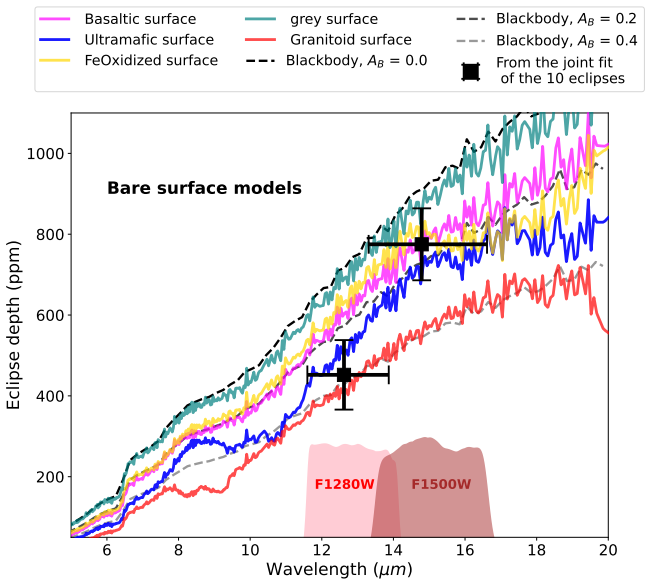
The argument runs on the spectral contrast between the two MIRI filters, F1280W (11.6–14.2 µm) and F1500W (13.5–16.6 µm), centered inside and outside the 15 µm CO2 band. On one side, a grid of radiative-convective surface models (basaltic, ultramafic, feldspathic, metal-rich, Fe-oxidized, granitoid) predicts band-integrated eclipse depths; the ultramafic composition (60% olivine, 40% enstatite) matches the observed ratio, while space-weathering expectations make a young surface plausible. On the other, a 1D radiative-transfer retrieval that mixes hydrocarbon haze particles (50 nm particles with optEC(s) optical properties) into a pure-CO2 atmosphere produces a temperature inversion that flips the CO2 feature from absorption to emission, and the same haze abundance also fits the NIRISS transmission spectrum. The proposed discriminator is heat redistribution: the airless model has essentially no nightside flux, whereas the hazy atmosphere redistributes a large fraction of absorbed stellar energy, so the predicted 15 µm phase curve differs sharply between the two cases.
What would settle it
A single 15 µm phase curve (the planned GO 3077 observations) would settle the matter: the airless ultramafic model predicts an almost vanishing nightside flux and a symmetric eclipse (night-to-day flux near zero), whereas the 10-bar hazy CO2 model predicts a night-to-day ratio of 0.85 and a phase-curve offset; if the measured nightside flux is near zero, the hazy-atmosphere scenario is ruled out.
Extended reading notes
Core claim
The central claim is that the 12.8 µm and 15 µm eclipse depths of TRAPPIST-1 b, analyzed together for the first time, are each individually consistent with more than one physical picture. The authors establish that the brightness temperature at 12.8 µm (424 ± 28 K) is 2.1σ lower than expected for a dark bare rock, implying a Bond albedo of 0.19 ± 0.08. They then show that a bare, geologically fresh ultramafic surface fits the two eclipse depths, and that a hazy CO2-dominated atmosphere with a thermal inversion also fits, producing CO2 in emission at 15 µm. The paper's conclusion is that this two-scenario degeneracy cannot be resolved with only two broadband points, and that the heat-redistribution signal expected from phase-curve observations will tell an airless world apart from a hazy, heat-redistributing atmosphere.
Load-bearing premise
The hazy CO2 scenario depends on photochemical hazes forming and surviving in a hot, CO2-dominated atmosphere via roughly 1% H2S from volcanism, and the paper admits it is unclear whether such H2S abundances can be maintained, so if hazes cannot form the two-scenario conclusion reduces to a bare-surface interpretation.
Editorial extensions
If this is right
- A single pair of broadband eclipse depths cannot by itself determine whether TRAPPIST-1 b is airless or has a thick atmosphere; the paper predicts that the upcoming 15 µm phase curve (program GO 3077) will separate the two.
- If the airless interpretation is correct, the surface must be relatively reflective (Bond albedo 0.19 ± 0.08) and geologically fresh ultramafic rock, implying recent volcanic or tectonic resurfacing on a tidally and induction-heated world.
- If the hazy atmosphere interpretation is correct, hazes produce a strong thermal inversion that makes the 15 µm CO2 band appear in emission, and the needed haze formation pathway depends on volcanic H2S at roughly the 1% level.
- The 12.8 µm brightness temperature is 2.1σ lower than the null-albedo bare-rock prediction, so neither a dark blackbody nor a simple greenhouse atmosphere matches; both scenarios require a departure from the simplest expectations.
- The joint fit of all ten eclipses confirms the earlier 15 µm detection at the 1σ level while tightening the eclipse depth, and statistical tests find no significant eclipse-depth variability at 12.8 µm.
Reading between the lines
- The authors stop short of saying so, but the same degeneracy should affect other emission-photometry surveys of rocky M-dwarf planets: any two broadband points can be matched by some surface composition or some haze-affected atmosphere, so phase curves or resolved spectra will be needed before claiming an airless or atmospheric detection.
- If the fresh ultramafic surface is the right answer, TRAPPIST-1 b would join Io as a volcanically resurfaced world; a testable corollary is that eclipse depth at 12.8 µm could vary on resurfacing timescales, which is exactly the currently insignificant variability hinted at in the five individual eclipses.
- The haze path could be checked before more telescope time is spent: laboratory or photochemical-model experiments scanning H2S abundance, CO2/O2 ratio, and TRAPPIST-1-like XUV flux would show whether the required 1% H2S and the resulting haze column are realistic, putting a prior on which of the two scenarios to prefer.
Editorial analysis
A structured set of objections, weighed in public.
Referee Report
Summary. The paper presents five new JWST/MIRI secondary-eclipse observations of TRAPPIST-1 b at 12.8 µm, combined with a re-analysis of five previously observed eclipses at 15 µm. A global fit of all ten eclipses yields eclipse depths of 452 ± 86 ppm at 12.8 µm and 775 ± 90 ppm at 15 µm, corresponding to brightness temperatures of 424 ± 28 K and 478 ± 27 K. The authors then explore two model interpretations: an airless ultramafic surface with a fitted Bond albedo of 0.19 ± 0.08, and a thick, pure-CO2 atmosphere with photochemical hazes producing a thermal inversion. They argue that both scenarios fit the data and that future phase-curve observations can distinguish them.
Significance. The central measurement is a genuine advance: four independent reductions and four distinct analysis methods give mutually consistent eclipse depths, and the data and source products are archived. The 12.8 µm measurement in particular provides a key constraint inside the CO2 band and reveals a possible tension with the previously favored null-albedo bare-rock interpretation. If the two-scenario conclusion holds, the paper will be an important benchmark for broadband emission studies of rocky exoplanets. However, the interpretation stage is less secure: both the Bond-albedo fit and the hazy-CO2 retrieval use the NIRISS/SOSS transmission spectrum as a joint constraint, even though the paper itself argues that this spectrum is strongly contaminated by the transit light source effect. The citation for the haze optical properties is also incorrect. The measurement should stand, but the interpretive claims need strengthening before publication.
major comments (4)
- [Methods, '1D atmosphere with full heat redistribution'; Section 1.1] The hazy-CO2 retrieval (fhaze = 4.5×10⁻⁴, Eg, Rp) uses the NIRISS/SOSS transmission spectrum of ref. 51 as a constraint, even though Section 1.1 argues that this spectrum is strongly contaminated by the transit light source effect. Because the transmission spectrum is used to fit the same model parameters that then produce the claimed good fit to the eclipse depths, the atmospheric scenario is not an independent MIRI-only result. Please re-run the retrieval using only the two MIRI eclipse depths (or a TLS-marginalized treatment of the NIRISS data) and report whether the hazy-CO2 solution survives; if it does not, the 'two main scenarios' conclusion must be revised to a single preferred scenario.
- [Methods, 'Bare surfaces'] The quoted Bond albedo Ab = 0.19 ± 0.08 is derived from a joint fit to both the MIRI eclipse depths and the NIRISS transmission spectrum. This is circular with respect to the claim that the airless model fits the MIRI data well: the albedo is adjusted to match the eclipse depths rather than predicted from them. The only MIRI-only model comparison in the paper is the reduced-χ² table for the fixed surface-composition models (Supplementary Table 1), which does not constrain Ab. Please separate the MIRI-only albedo constraint from the joint-fit value and quantify how the TLS-contaminated transmission spectrum affects Ab.
- [Methods, 'Atmospheric models'] Reference 53 is Jones et al. (2013), 'An advanced scattered moonlight model for Cerro Paranal,' which does not contain the optEC(s) hydrocarbon haze optical properties used for the haze opacity. The correct source for these optical constants must be identified and cited, or the constants provided as supplementary data; without this, the thermal inversion calculation is not reproducible.
- [Discussion, third paragraph] The statement that the hazy-CO2 model 'can fit the measurements very well' is not supported by a quantitative goodness-of-fit or model-comparison statistic for the atmospheric model. Please provide a chi-squared, Bayesian evidence, or equivalent for the atmospheric scenario against the MIRI data, alongside the existing bare-surface χ²_r values.
minor comments (4)
- [Methods, 'Bare surfaces', Eq. (1)] Equation (1) integrates cosθ cosφ dθ dφ with θ defined as longitude and φ as latitude; this appears to contain an extra geometric factor or a missing area element. Please check the projection and area element and correct the equation or the coordinate definitions, as it affects the computed blackbody flux.
- [Figure 2 caption] The caption says the measurements are 'compared to realistic emission models for bare surface models,' but the right-hand panel of the figure contains atmospheric models; please make the caption consistent with the two panels.
- [Methods, 'Data Reduction: POL'] The text contains broken variable names such as 'Nf rames' and 'aper-ima'; these should be formatted correctly for readability.
- [Methods, 'Data Reduction: ED'] There are several typographical errors, e.g., 'fist and last groups' and 'four the four others'; please proofread the Methods section.
Circularity Check
No significant circularity: the eclipse depths are independent measurements and the model agreements are presented as fits, not as predictions.
full rationale
The eclipse depths are derived from four independent reductions and multiple light-curve fitting methods (Eureka!, trafit, Eureka!/dynesty, POL), and the final values 452 ± 86 ppm and 775 ± 90 ppm are measurements, not outputs of the surface or atmospheric models. The Bond-albedo value AB = 0.19 ± 0.08 is obtained by an explicitly described Bayesian fit of the blackbody-sum model to the MIRI eclipse depths and the NIRISS/SOSS transmission spectrum, and the paper presents it as a best-fit parameter, not as a prediction from first principles. Likewise, the hazy-CO2 retrieval has three free parameters (Rp, fhaze, Eg) fitted to the MIRI eclipses plus the NIRISS spectrum; the sentence 'our model can fit the measurements very well' is a report of that fit, not an out-of-sample prediction, so no fitted parameter is renamed as a prediction. The only forward-looking statement is the phase-curve prediction for GO 3077, which is genuinely independent of the eclipse data used to condition the models. Self-citations (Greene et al. 2023, Eureka!, ARCiS, trafit, Ducrot et al. 2020) are code, method, or prior-measurement citations and are not used as load-bearing uniqueness arguments. Concerns about using the stellar-contaminated NIRISS/SOSS spectrum as a retrieval constraint, and the erroneous citation of ref. 53 for haze optical properties, are data-quality and correctness issues and do not make the derivation circular by construction. Hence no circular step meeting the required evidentiary bar is present.
Assumptions & free parameters
free parameters (4)
- Bond albedo AB (bare rock model) =
0.19 ± 0.08
- Haze mass fraction fhaze =
4.5e-4 (median)
- Hydrocarbon band gap Eg =
posterior median, not quoted in text
- Planet radius Rp =
1.12 Rearth (median from corner plot)
assumptions (4)
- domain assumption SPHINX stellar spectrum with a ~7% correction represents TRAPPIST-1's SED for flux calibration.
- domain assumption The NIRISS/SOSS transmission spectrum (ref 51) can be used as a retrieval constraint despite stellar contamination reported for the same dataset (ref 19).
- domain assumption Zero heat redistribution on the dayside for the bare rock model.
- domain assumption Haze particles are 50 nm spheres, uniformly mixed through the atmosphere, and follow the optEC(s) optical properties.
Cite this review
Pith. "Pith review of Combined analysis of the 12.8 and 15 $\mu m$ JWST/MIRI eclipse observations of TRAPPIST-1 b." pith.science (2026). https://pith.science/paper/3VY2YNKH
@misc{pith2026241211627,
  author       = {Pith},
  title        = {Pith review of: Combined analysis of the 12.8 and 15 $\mu m$ JWST/MIRI eclipse observations of TRAPPIST-1 b},
  year         = {2026},
  howpublished = {\url{https://pith.science/paper/3VY2YNKH}},
  note         = {Machine review of arXiv:2412.11627}
}
abstract
The first JWST/MIRI photometric observations of TRAPPIST-1 b allowed for the detection of the thermal emission of the planet at 15 $\mu m$, suggesting that the planet could be a bare rock with a zero albedo and no redistribution of heat. These observations at 15 $\mu m$ were acquired as part of GTO time that included a twin program at 12.8 $\mu m$ in order to have a measurement in and outside the CO$_2$ absorption band. Here we present five new occultations of TRAPPIST-1 b observed with MIRI in an additional photometric band at 12.8 $\mu m$. We perform a global fit of the 10 eclipses and derive a planet-to-star flux ratio and 1-$\sigma$ error of 452 $\pm$ 86 ppm and 775 $\pm$ 90 ppm at 12.8 $\mu m$ and 15 $\mu m$, respectively. We find that two main scenarios emerge. An airless planet model with an unweathered (fresh) ultramafic surface, that could be indicative of relatively recent geological processes fits well the data. Alternatively, a thick, pure-CO2 atmosphere with photochemical hazes that create a temperature inversion and result in the CO2 feature being seen in emission also works, although with some caveats. Our results highlight the challenges in accurately determining a planet's atmospheric or surface nature solely from broadband filter measurements of its emission, but also point towards two very interesting scenarios that will be further investigated with the forthcoming phase curve of TRAPPIST-1 b.
Figures


Forward citations
Cited by 2 Pith papers
-
Interior redox state effects on the stability of secondary atmospheres and observational manifestations: LP 791-18 d as a case study for outgassing rocky exoplanets
LP 791-18d's outgassed atmosphere is stable only for highly oxidized interiors (fO2-IW greater than about 2); reduced interiors lose their volatiles to hydrodynamic escape within the planet's lifetime.
-
Stellar Contamination Correction Using Back-to-Back Transits of TRAPPIST-1 b and c
Back-to-back transits of TRAPPIST-1 b and c allow an observed, model-free correction of stellar contamination in planet c's spectrum, reducing structured noise 2.5x below 2 micrometers.
Reference graph
Works this paper leans on
-
[1]
Kirkpatrick, J. D., Beichman, C. A. & Skrutskie, M. F. The Coolest Isolated M Dwarf and Other 2MASS Discoveries. Astrophys. J. 476, 311–318 (1997). URL http://adsabs. harvard.edu/abs/1997ApJ...476..311K
work page 1997
-
[2]
Anglada-Escud ´e, G. et al. A terrestrial planet candidate in a temperate orbit around Proxima Centauri. Nature 536, 437–440 (2016). URL https://www.nature.com/ articles/nature19106. Number: 7617 Publisher: Nature Publishing Group
work page 2016
-
[3]
Zechmeister, M. et al. The CARMENES search for exoplanets around M dwarfs: Two temperate Earth-mass planet candidates around Teegarden’s Star. ˚a 627, A49 (2019). URL https://www.aanda.org/10.1051/0004-6361/201935460
-
[4]
Gillon, M. et al. Seven temperate terrestrial planets around the nearby ultracool dwarf star TRAPPIST-1. Nature 542, 456–460 (2017). URL https://www.nature.com/ articles/nature21360. Number: 7642 Publisher: Nature Publishing Group
work page 2017
-
[5]
Ment, K. et al. A Second Terrestrial Planet Orbiting the Nearby M Dwarf LHS 1140. Astron. J. 157, 32 (2019). URL https://iopscience.iop.org/article/10. 3847/1538-3881/aaf1b1
work page 2019
-
[6]
Dreizler, S. et al. RedDots: a temperate 1.5 Earth-mass planet candidate in a compact multiterrestrial planet system around GJ 1061. Monthly Notices of the Royal Astronomi- cal Society 493, 536–550 (2020). URL https://ui.adsabs.harvard.edu/abs/ 2020MNRAS.493..536D. ADS Bibcode: 2020MNRAS.493..536D
work page 2020
-
[7]
Peterson, M. S. et al. A temperate Earth-sized planet with tidal heating transiting an M6 star. Nature 617, 701–705 (2023). URL https://www.nature.com/articles/ s41586-023-05934-8 . Number: 7962 Publisher: Nature Publishing Group
work page 2023
-
[8]
Vanderspek, R. et al. TESS Discovery of an Ultra-short-period Planet around the Nearby M Dwarf LHS 3844. Astrophys. J. 871, L24 (2019). URL https://ui.adsabs. harvard.edu/abs/2019ApJ...871L..24V. ADS Bibcode: 2019ApJ...871L..24V
work page 2019
Show all 70 references
-
[9]
Agol, E. et al. Refining the Transit-timing and Photometric Analysis of TRAPPIST- 1: Masses, Radii, Densities, Dynamics, and Ephemerides. The Planetary Science Jour- nal 2, 1 (2021). URL https://iopscience.iop.org/article/10.3847/PSJ/ abd022/meta. Publisher: IOP Publishing
2021 doi
-
[10]
Gillon, M. et al. The TRAPPIST-1 JWST Community Initiative. arXiv:2002.04798 [astro- ph] (2020). URL http://arxiv.org/abs/2002.04798. ArXiv: 2002.04798
2020 arXiv
-
[11]
V ., Kreidberg, L., Rustamkulov, Z., Robinson, T
Morley, C. V ., Kreidberg, L., Rustamkulov, Z., Robinson, T. & Fortney, J. J. Observing the Atmospheres of Known Temperate Earth-sized Planets with JWST. Astrophys. J. 850, 121 (2017). URL http://arxiv.org/abs/1708.04239. ArXiv: 1708.04239. 32
2017 arXiv
-
[12]
Greene, T. P. et al. Thermal emission from the Earth-sized exoplanet TRAPPIST-1 b us- ing JWST (2023). URL http://arxiv.org/abs/2303.14849. ArXiv:2303.14849 [astro-ph]
2023 arXiv
-
[13]
Zieba, S. et al. No thick carbon dioxide atmosphere on the rocky exoplanet TRAPPIST-1 c. Nature 1–4 (2023). URL https://www.nature.com/articles/ s41586-023-06232-z. Publisher: Nature Publishing Group
2023
-
[14]
Mansfield, M. et al. Identifying Atmospheres on Rocky Exoplanets Through Inferred High Albedo. Astrophys. J. 886, 141 (2019). URL http://arxiv.org/abs/1907.13150. ArXiv:1907.13150 [astro-ph]
2019 arXiv
-
[15]
Koll, D. D. B. et al. Identifying Candidate Atmospheres on Rocky M Dwarf Planets via Eclipse Photometry. Astrophys. J. 886, 140 (2019). URL https://ui.adsabs. harvard.edu/abs/2019ApJ...886..140K. ADS Bibcode: 2019ApJ...886..140K
2019
-
[16]
Crossfield, I. J. M. et al. GJ 1252b: A Hot Terrestrial Super-Earth with No Atmo- sphere. Astrophys. J., Letters937, L17 (2022). URLhttps://dx.doi.org/10.3847/ 2041-8213/ac886b. Publisher: The American Astronomical Society
2022
-
[17]
V ., Apai, D
Rackham, B. V ., Apai, D. & Giampapa, M. S. The Transit Light Source Effect: False Spectral Features and Incorrect Densities for M-dwarf Transiting Planets. Astrophys. J. 853, 122 (2018). URL http://arxiv.org/abs/1711.05691. ArXiv: 1711.05691
2018 arXiv
-
[18]
Howard, W. S. et al. Characterizing the Near-infrared Spectra of Flares from TRAPPIST- 1 During JWST Transit Spectroscopy Observations (2023). URL http://arxiv.org/ abs/2310.03792. ArXiv:2310.03792 [astro-ph]
2023 arXiv
-
[19]
Lim, O. et al. Atmospheric Reconnaissance of TRAPPIST-1 b with JWST/NIRISS: Evi- dence for Strong Stellar Contamination in the Transmission Spectra (2023). URL http: //arxiv.org/abs/2309.07047. ArXiv:2309.07047 [astro-ph]
2023 arXiv
-
[20]
& Agol, E
Luger, R., Lustig-Yaeger, J. & Agol, E. Planet-Planet Occultations in TRAPPIST-1 and Other Exoplanet Systems. Astrophys. J. 851, 94 (2017). URL http://arxiv.org/ abs/1711.05739. ArXiv: 1711.05739
2017 arXiv
-
[21]
Bell, T. J. et al. Eureka!: An End-to-End Pipeline for JWST Time-Series Observations (2022). URL http://arxiv.org/abs/2207.03585. ArXiv:2207.03585 [astro-ph]
2022 arXiv
-
[22]
Lyu, X. et al. Super-Earth LHS3844b is tidally locked (2023). URL https://ui. adsabs.harvard.edu/abs/2023arXiv231001725L. Publication Title: arXiv e- prints ADS Bibcode: 2023arXiv231001725L
2023
-
[23]
& Kaltenegger, L
Madden, J. & Kaltenegger, L. A Catalog of Spectra, Albedos, and Colors of Solar System Bodies for Exoplanet Comparison. Astrobiology 18, 1559–1573 (2018). URL https: //www.liebertpub.com/doi/10.1089/ast.2017.1763. Publisher: Mary Ann Liebert, Inc., publishers. 33
2018
-
[24]
& Takahashi, S
Takahashi, J., Itoh, Y . & Takahashi, S. Mid-Infrared Spectroscopy of 11 Main-Belt Asteroids. Publications of the Astronomical Society of Japan 63, 499 (2011). URL https://ui.adsabs.harvard.edu/abs/2011PASJ...63..499T. ADS Bib- code: 2011PASJ...63..499T
2011
-
[25]
M.-R., Whittaker, E
Ih, J., Kempton, E. M.-R., Whittaker, E. A. & Lessard, M. Constraining the Thick- ness of TRAPPIST-1 b’s Atmosphere from Its JWST Secondary Eclipse Observation at 15 µm. Astrophys. J., Letters 952, L4 (2023). URL https://dx.doi.org/10.3847/ 2041-8213/ace03b. Publisher: The Ame...
2023
-
[26]
Hu, R., Ehlmann, B. L. & Seager, S. THEORETICAL SPECTRA OF TERRESTRIAL EXOPLANET SURFACES. Astrophys. J. 752, 7 (2012). URL https://dx.doi.org/ 10.1088/0004-637X/752/1/7. Publisher: The American Astronomical Society
2012 doi
-
[27]
Turbet, M. et al. Modeling climate diversity, tidal dynamics and the fate of volatiles on TRAPPIST-1 planets. ˚a 612, A86 (2018). URL https://www.aanda.org/ articles/aa/abs/2018/04/aa31620-17/aa31620-17.html. Publisher: EDP Sciences
2018
-
[28]
Kislyakova, K. G. et al. Magma oceans and enhanced volcanism on TRAPPIST-1 plan- ets due to induction heating. Nature Astronomy 1, 878–885 (2017). URL https: //www.nature.com/articles/s41550-017-0284-0. Publisher: Nature Pub- lishing Group
2017
-
[29]
Robinson, T. D. & Catling, D. C. Common 0.1 bar tropopause in thick atmospheres set by pressure-dependent infrared transparency. Nature Geoscience 7, 12–15 (2014). URL https://www.nature.com/articles/ngeo2020
2014
-
[30]
Bourrier, V . et al. Temporal Evolution of the High-energy Irradiation and Water Content of TRAPPIST-1 Exoplanets. Astron. J. 154, 121 (2017). URL https://iopscience. iop.org/article/10.3847/1538-3881/aa859c
2017 doi
-
[31]
L., Hauschildt, P
Peacock, S., Barman, T., Shkolnik, E. L., Hauschildt, P. H. & Baron, E. Predicting the Extreme Ultraviolet Radiation Environment of Exoplanets Around Low-Mass Stars: the TRAPPIST-1 System. Astrophys. J. 871, 235 (2019). URL http://arxiv.org/abs/ 1812.06159. ArXiv: 1812.06159
2019 arXiv
-
[32]
Wilson, D. J. et al. The Mega-MUSCLES Spectral Energy Distribution Of TRAPPIST-1. arXiv:2102.11415 [astro-ph] (2021). URL http://arxiv.org/abs/2102.11415. ArXiv: 2102.11415
2021 arXiv
-
[33]
A., Krissansen-Totton, J., Wogan, N., Telus, M
Thompson, M. A., Krissansen-Totton, J., Wogan, N., Telus, M. & Fortney, J. J. The case and context for atmospheric methane as an exoplanet biosignature. Proceedings of the National Academy of Sciences 119, e2117933119 (2022). URL https://www.pnas.org/doi/ abs/10.1073/pnas.2117...
2022 doi
-
[34]
& Catling, D
Wogan, N., Krissansen-Totton, J. & Catling, D. C. Abundant Atmospheric Methane from V olcanism on Terrestrial Planets Is Unlikely and Strengthens the Case for Methane as a Biosignature. The Planetary Science Journal1, 58 (2020). URL https://iopscience. iop.org/article/10.3847/...
2020 doi
-
[35]
He, C. et al. Sulfur-driven haze formation in warm CO2-rich exoplanet atmospheres. Na- ture Astronomy 4, 986–993 (2020). URL https://www.nature.com/articles/ s41550-020-1072-9. Publisher: Nature Publishing Group
2020
-
[36]
Redfield, S. et al. Report of the Working Group on Strategic Exoplanet Initiatives with HST and JWST (2024). URL http://arxiv.org/abs/2404.02932. ArXiv:2404.02932 [astro-ph]
2024 arXiv
-
[37]
Stetson, P. B. DAOPHOT - A computer program for crowded-field stellar photometry. Publications of the Astronomical Society of the Pacific 99, 191 (1987). URL http: //iopscience.iop.org/article/10.1086/131977
1987 doi
-
[38]
Greene, T. P. et al. Thermal Emission from the Earth-sized Exoplanet TRAPPIST-1 b using JWST. Nature 1–2 (2023). URL https://www.nature.com/articles/ s41586-023-05951-7. Publisher: Nature Publishing Group
2023
-
[39]
Bushouse, H. et al. JWST Calibration Pipeline (2023). URL https://zenodo.org/ record/7577320
2023
-
[40]
CRDS: Calibration Reference Data System for HST and JWST (2022)
developers, C. CRDS: Calibration Reference Data System for HST and JWST (2022). URL https://github.com/spacetelescope/crds. Original-date: 2016-02- 18T23:15:38Z
2022
-
[41]
Gillon, M. et al. Improved precision on the radius of the nearby super-Earth 55 Cnc e.˚a 539, A28 (2012). URL http://arxiv.org/abs/1110.4783. ArXiv: 1110.4783
2012 arXiv
-
[42]
Gillon, M. et al. Search for a habitable terrestrial planet transiting the nearby red dwarf GJ
-
[43]
& Agol, E
Mandel, K. & Agol, E. Analytic Light Curves for Planetary Transit Searches. Astrophys. J. 580, L171–L175 (2002). URL https://iopscience.iop.org/article/10. 1086/345520
2002
-
[44]
Ducrot, E. et al. TRAPPIST-1: Global results of the Spitzer Exploration Science Program Red Worlds. ˚a 640, A112 (2020). URL https://www.aanda.org/articles/aa/ abs/2020/08/aa37392-19/aa37392-19.html. Publisher: EDP Sciences
2020
-
[45]
& Angus, R
Foreman-Mackey, D., Agol, E., Ambikasaran, S. & Angus, R. Fast and scalable Gaussian process modeling with applications to astronomical time series. Astron. J. 154, 220 (2017). URL http://arxiv.org/abs/1703.09710. ArXiv: 1703.09710. 35
2017 arXiv
-
[46]
Nested sampling for general Bayesian computation
Skilling, J. Nested sampling for general Bayesian computation. Bayesian Analysis 1, 833–859 (2006). URL https://projecteuclid.org/euclid.ba/1340370944. Publisher: International Society for Bayesian Analysis
2006
-
[47]
Speagle, J. S. DYNESTY: a dynamic nested sampling package for estimating Bayesian posteriors and evidences. Monthly Notices of the Royal Astronomical Society 493, 3132– 3158 (2020). URL https://ui.adsabs.harvard.edu/abs/2020MNRAS.493. 3132S. ADS Bibcode: 2020MNRAS.493.3132S
2020
-
[48]
R., Line, M
Iyer, A. R., Line, M. R., Muirhead, P. S., Fortney, J. J. & Gharib-Nezhad, E. The SPHINX M-dwarf Spectral Grid. I. Benchmarking New Model Atmospheres to Derive Fundamental M-Dwarf Properties. Astrophys. J. 944, 41 (2023). URL http://arxiv.org/abs/ 2206.12010. ArXiv:2206.12010 ...
2023 arXiv
-
[49]
Malik, M. et al. Analyzing Atmospheric Temperature Profiles and Spectra of M Dwarf Rocky Planets. Astrophys. J. 886, 142 (2019). URL https://ui.adsabs.harvard.edu/ abs/2019ApJ...886..142M. ADS Bibcode: 2019ApJ...886..142M
2019
-
[50]
Whittaker, E. A. et al. The Detectability of Rocky Planet Surface and Atmosphere Com- position with JWST: The Case of LHS 3844b. Astron. J. 164, 258 (2022). URL http: //arxiv.org/abs/2207.08889. ArXiv:2207.08889 [astro-ph]
2022 arXiv
-
[51]
Lim, O. et al. JWST Reconnaissance Transmission Spectroscopy of the Earth-sized Exo- planet TRAPPIST-1 b. Bulletin of the AAS 55 (2023). URL https://baas.aas.org/ pub/2023n2i125p06/release/1
2023
-
[52]
Domingue, D. L. et al. Mercury’s Weather-Beaten Surface: Understanding Mercury in the Context of Lunar and Asteroidal Space Weathering Studies. Space Science Reviews 181, 121–214 (2014). URL https://doi.org/10.1007/s11214-014-0039-5
2014 doi
-
[53]
& Kimeswenger, S
Jones, A., Noll, S., Kausch, W., Szyszka, C. & Kimeswenger, S. An advanced scattered moonlight model for Cerro Paranal. ˚a 560, A91 (2013). URL https://www.aanda. org/articles/aa/abs/2013/12/aa22433-13/aa22433-13.html. Pub- lisher: EDP Sciences
2013
-
[54]
He, C. et al. Laboratory Simulations of Haze Formation in the Atmospheres of Super-Earths and Mini-Neptunes: Particle Color and Size Distribution. Astrophys. J., Letters 856, L3 (2018). URL https://dx.doi.org/10.3847/2041-8213/aab42b. Publisher: The American Astronomical Society
2018 doi
-
[55]
W., Chubb, K., Helling, C
Min, M., Ormel, C. W., Chubb, K., Helling, C. & Kawashima, Y . The ARCiS framework for Exoplanet Atmospheres: Modelling Philosophy and Retrieval. ˚a 642, A28 (2020). URL http://arxiv.org/abs/2006.12821. ArXiv:2006.12821 [astro-ph]
2020 arXiv
-
[56]
Chubb, K. L. & Min, M. Exoplanet atmosphere retrievals in 3D using phase curve data with ARCiS: application to W ASP-43b. ˚a 665, A2 (2022). URL http://arxiv.org/abs/ 2206.09738. ArXiv:2206.09738 [astro-ph]. 36
2022 arXiv
-
[57]
Tremblin, P. et al. FINGERING CONVECTION AND CLOUDLESS MODELS FOR COOL BROWN DW ARF ATMOSPHERES.Astrophys. J. 804, L17 (2015). URL https: //iopscience.iop.org/article/10.1088/2041-8205/804/1/L17
2015 doi
-
[58]
Drummond, B. et al. The effects of consistent chemical kinetics calculations on the pressure-temperature profiles and emission spectra of hot Jupiters. ˚a 594, A69 (2016). URL https://www.aanda.org/articles/aa/abs/2016/10/aa28799-16/ aa28799-16.html. Publisher: EDP Sciences
2016
-
[59]
& Ikoma, M
Kawashima, Y . & Ikoma, M. Theoretical Transmission Spectra of Exoplanet Atmospheres with Hydrocarbon Haze: Effect of Creation, Growth, and Settling of Haze Particles. I. Model Description and First Results. Astrophys. J. 853, 7 (2018). URL https://ui.adsabs. harvard.edu/abs/2...
2018
-
[60]
& Barnes, R
Luger, R. & Barnes, R. Extreme Water Loss and Abiotic O$ 2$ Buildup On Planets Throughout the Habitable Zones of M Dwarfs. Astrobiology 15, 119–143 (2015). URL http://arxiv.org/abs/1411.7412. ArXiv: 1411.7412
2015 arXiv
-
[61]
& Wolf, E
Hu, R., Peterson, L. & Wolf, E. T. O2- and CO-rich Atmospheres for Potentially Hab- itable Environments on TRAPPIST-1 Planets. Astrophys. J. 888, 122 (2020). URL https://dx.doi.org/10.3847/1538-4357/ab5f07. Publisher: The American Astronomical Society
2020 doi
-
[62]
Arney, G. N. et al. Pale Orange Dots: The Impact of Organic Haze on the Habitability and Detectability of Earthlike Exoplanets. Astrophys. J.836, 49 (2017). URL http://arxiv. org/abs/1702.02994. ArXiv: 1702.02994
2017 arXiv
-
[63]
Luger, R. et al. starry: Analytic Occultation Light Curves. Astron. J. 157, 64 (2019). URL https://ui.adsabs.harvard.edu/abs/2019AJ....157...64L. ADS Bib- code: 2019AJ....157...64L
2019
-
[64]
Foreman-Mackey, D. et al. exoplanet: Gradient-based probabilistic inference for exoplanet data & other astronomical time series.Journal of Open Source Software6, 3285 (2021). URL http://arxiv.org/abs/2105.01994. Number: 62 arXiv:2105.01994 [astro-ph]
2021 arXiv
-
[65]
Salvatier, J., Wiecki, T. V . & Fonnesbeck, C. Probabilistic programming in Python us- ing PyMC3. PeerJ Computer Science 2, e55 (2016). URL https://peerj.com/ articles/cs-55. Publisher: PeerJ Inc
2016
-
[66]
W., Lang, D
Foreman-Mackey, D., Hogg, D. W., Lang, D. & Goodman, J. emcee: The MCMC Hammer. arXiv:1202.3665 [astro-ph, physics:physics, stat] (2013). URL http://arxiv.org/ abs/1202.3665. ArXiv: 1202.3665
2013 arXiv
-
[67]
Harris, C. R. et al. Array programming with NumPy. Nature 585, 357–362 (2020). URL https://www.nature.com/articles/s41586-020-2649-2. Number: 7825 Publisher: Nature Publishing Group. 37
2020
-
[68]
Robitaille, T. P. et al. Astropy: A community Python package for astronomy. ˚a 558, A33 (2013). URL https://www.aanda.org/articles/aa/abs/2013/10/ aa22068-13/aa22068-13.html. Publisher: EDP Sciences
2013
-
[69]
fiducial
Hunter, J. D. Matplotlib: A 2D Graphics Environment. Computing in Science & Engineering 9, 90–95 (2007). Conference Name: Computing in Science & Engineering. 38 Supplementary Figures GTO 1279 Visit 1 GTO 1279 Visit 2 Supplementary Fig. 1: STScI pipeline-corrected (Stage 2) ima...
2007
-
[1214]
URL http://www.aanda.org/10.1051/0004-6361/ 201322362
˚a 563, A21 (2014). URL http://www.aanda.org/10.1051/0004-6361/ 201322362
2014 doi
Reviewed August 11, 2026 · model on record in the stance chip above.
Discussion (0). Continue with ORCID to comment.