REVIEW 3 major objections 4 minor 2 cited by
Uplifts in the Penumbra: Features of the Moduli Potential away from Infinite-Distance Boundaries
T0 review · 3 major / 4 minor · reviewed 2026-08-11 · deepseek-v4-flash
Pith's one-line read The paper argues that the flux-induced scalar potential of the complex structure moduli in type IIB Calabi-Yau orientifolds features de Sitter uplifting minima in the 'penumbra,' the crossover region between the moduli-space interior and…
desk verdict Penumbra dS uplift examples that are new and honestly presented, but the missing error estimate on the sl(2) approximation at s≈7 makes the core claim plausible rather than established. read the letter →
The pith
A machine-rendered reading of the paper's core claim, the machinery that carries it, and where it could break.
The reading
What carries the argument
The central object is the sl(2)-approximated, nilpotent-orbit scalar potential (3.13), $V=\tfrac{1}{2}M_P^4e^{\hat K}f^T Z(s)\rho(a)$, with $Z(s)$ given by (3.20) for large-complex-structure boundaries and (3.27) for Tyurin boundaries. The log-monodromy matrix $N$ and the limiting vector $a_0$ encode the boundary data, while the flux vector $f$ is kept integral. What carries the argument is keeping the subleading terms in $Z(s)$ that would be dropped in the strict asymptotic monomial approximation: these competing powers of $s$ create the critical points and valleys that a single monomial tail cannot produce. The same Hodge-norm structure supplies the growth estimates that make the de Sitter coefficient computable along the resulting valleys.
What would settle it
Compute the exact periods for an explicit one-parameter Calabi-Yau whose monodromy data match (3.15) with $m=1$, $n=6$, $\beta=\chi=-100$ (or the Tyurin data with $m=n=1$, $c=-200$, $d=-1$), including the exponentially suppressed instanton terms, and check whether the positive critical point near $(0.35,7.18)$ (or $(100,100)$) persists and remains above zero; alternatively, verify whether integer fluxes satisfying tadpole cancellation can realize this parameter point at all.
Extended reading notes
Core claim
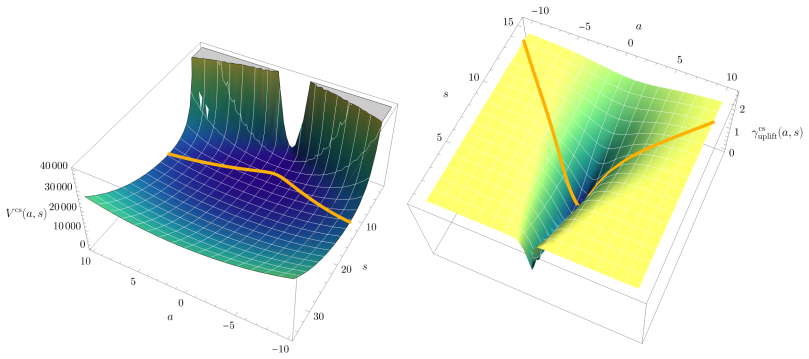
On its own terms, the paper's central claim is that the pure complex-structure sector of type IIB on a Calabi-Yau orientifold, without anti-branes, can supply the uplifting term in a de Sitter construction. Using the sl(2)-approximated scalar potential $V=\tfrac{1}{2}M_P^4e^{\hat K}f^T Z(s)f$ built from nilpotent-orbit periods, the paper finds metastable minima with $V>0$ at moderately large saxion vevs: for the large-complex-structure example with parameters (4.1) at $a_{\min}\simeq0.3517$, $s_{\min}\simeq7.183$ with $V\simeq724.1\,e^{\hat K}M_P^4$, and for the Tyurin example (4.2) at $a_{\min}\simeq s_{\min}\simeq100$ with $V\simeq200\,e^{\hat K}M_P^4$. These are interpreted as de Sitter uplifts because $e^{\hat K}\sim1/\mathcal{V}_{CY}^2$ makes the physical potential small once Kähler moduli are stabilized. The paper also claims that the same potentials contain axion valleys determined by $\partial V/\partial s|_{s_v(a)}=0$, along which saxion backreaction is milder than in the strict asymptotic region and the potential grows more slowly, as $a^2$, $a^{3/2}$, or nearly constant, than the asymptotic $a^3$ or $a$ behavior, although the late-time de Sitter coefficient along these valleys typically remains above the strong de Sitter bound.
Load-bearing premise
The load-bearing assumption is that the sl(2)-approximated potential (3.13) with matrices (3.20) and (3.27) faithfully represents the true flux potential for saxion values as low as $s\approx7$ and $s\approx100$; the paper gives no error estimate and does not demonstrate that its chosen parameters correspond to a real Calabi-Yau orientifold satisfying tadpole cancellation.
Editorial extensions
If this is right
- A working de Sitter uplift can come from the complex-structure sector alone, so anti-D3-brane uplifts need not be the default mechanism.
- The asymptotic de Sitter conjecture cannot be used to rule out these vacua, since the penumbral potential is not a single monomial and the uplift coefficient can fall below the strong de Sitter bound near the minima.
- Long-range axion valleys with axion monodromy exist in these models; their potentials flatten from saxion backreaction, though the late-time de Sitter coefficient remains above the strong bound in the explicit examples.
- Some toy models in the same spirit have valley de Sitter coefficient $\gamma_v\to0$ as $a\to\infty$ when $p+q>2$, leaving open the possibility of slow-roll monodromy inflation in a suitable realization.
- Machine-learning classification of parameter space can identify regions where valleys with small uplift coefficient occur, making systematic searches feasible.
Reading between the lines
- Editorially, the natural next test is to realize the chosen integers as an actual orientifold flux choice; the paper's parameter scan suggests such realizations may be abundant, but it does not exhibit one.
- Editorially, the toy-model valley result $\gamma_v\sim a^{4/(p+q)-2}$ implies that searches should prioritize flux configurations whose sl(2) weights give $p+q>2$, where valleys flatten fastest.
- Editorially, the k-nearest-neighbor scan is a proof of concept; a full scan over all fluxes and geometric parameters with tadpole constraints would decide how generic penumbral uplifts really are.
Editorial analysis
A structured set of objections, weighed in public.
Referee Report
Summary. The paper studies the three-form flux-induced scalar potential for the complex structure modulus of type IIB Calabi-Yau orientifold compactifications near large-complex-structure (LCS) and Tyurin boundaries. Working within the sl(2)-approximation of asymptotic Hodge theory, the authors construct the saxion-dependent potential matrices (3.20) and (3.27), scan over integer flux and geometric parameters, and report de Sitter critical points at moderately large saxion values, e.g. (a_min,s_min)=(0.3517,7.183) with V_cs ≃ 724.1 e^K M_P^4 in §4.1 and (a_min,s_min)≃(100,100) with V_cs ≃ 200 e^K M_P^4 in §4.2. They interpret these as uplifts for full dS constructions. The paper also identifies axion valleys defined by ∂V/∂s=0, shows that backreaction flattens the potential in the penumbral region, and uses a k-nearest-neighbors algorithm to locate parameter regions with small uplift de Sitter coefficient.
Significance. If the central claim holds, the paper provides explicit evidence against a naive 'no dS in asymptotic regimes' expectation and shows that the penumbra, the crossover region at moderately large saxion vevs, can host positive-energy critical points of the complex structure potential. This is a useful and non-obvious contribution to the dS uplifts discussion, complementing the known strict-asymptotic no-go results. The paper is also commendable for giving explicit integral flux assignments, showing parameter scans, and providing analytic toy-model valley equations (5.5) and de Sitter coefficient scalings. The machine-learning section, while preliminary, is clearly described and reproducible. However, the significance is contingent on the sl(2)-approximation being quantitatively reliable at the reported minima; the manuscript does not yet establish that.
major comments (3)
- [§4.1, §4.2, Eq. (3.13)] The central claim that the potential exhibits dS minima at s≈7 and s≈100 rests entirely on the sl(2)-approximated matrices (3.20) and (3.27). The text justifies this approximation only by the smallness of exponential corrections |e^{2πiz}|=e^{-2πs}, but the sl(2)-approximation differs from the nilpotent-orbit potential by subleading polynomial terms, and no estimate of those terms is provided. Since the minima in §4.1 and §4.2 rely on a delicate competition between terms amplified by large geometric parameters (β=χ=-100 and c=-200), an O(1) shift in the Z(s) entries from the first omitted polynomial correction could move or destroy the critical points. The statement in §7 that the minima 'are expected to survive' is an assertion, not a computation. Because the nilpotent-orbit periods are explicitly given in (3.18) and (3.24), the authors could compute the full nilpotent-orbit potential via (A.10) and compare it directly with the sl(2)-approximated result at the claimed minima; this comparison is necessary to substantiate the headline finding.
- [§4.1, §4.2, Eq. (3.15), (3.22)] The paper does not verify that the integer choices (m,n,β,χ,c,d,ξ) in (4.1), (4.2), (5.2), and (5.3) correspond to actual Calabi-Yau threefolds with the required monodromy data, nor does it check the D3-tadpole cancellation condition from the chosen fluxes. The boundary data in (3.15) and (3.22) are abstract inputs, and the claim to present 'type IIB string theory on Calabi-Yau orientifolds' is only as strong as the existence of geometries realizing these data. At minimum, the authors should either provide a known CY example with these parameters or state clearly that the results are for a toy boundary model in the classification of [65,66] and check the tadpole constraint for the unit flux choices used in the scans.
- [§7, last paragraph] The outlook states that 'it is tantalizing to examine whether the de Sitter uplifts studied in this work survive after assuming that the Kähler moduli sector is dynamical' and mentions tadpole cancellation as future work. This is a candid limitation, but it underscores that the claimed uplifts are not yet shown to be embeddable in a full compactification: the Kähler moduli and axio-dilaton are treated as frozen by an unspecified mechanism, and the e^K prefactor is set to a constant. The paper should make this caveat more prominent in the abstract or introduction, since the present formulation does not yet deliver a vacuum of the full 4d effective theory.
minor comments (4)
- [Throughout] There are several typos and small presentation issues, including 'paratemeter' in §6.1, 'aformentioned' in Appendix B.1, 'theorem' for 'theorem' in the description of Schmid's theorem, and the repeated 'FLR W' instead of 'FLRW' in §2.1. These should be corrected in a final version.
- [§3.1, Eq. (3.7)] The subtraction of V_cs_min to define the late-time de Sitter coefficient (3.7) is a modeling assumption equivalent to postulating ⟨V_K⟩ = -V_cs_min from Kähler moduli stabilization. The paper states this assumption explicitly, which is good, but it should be reiterated in §5 where the late de Sitter coefficient is used to assess inflationary viability, so that readers do not mistake it for a derived quantity.
- [§5.3, Eq. (5.4)] The toy-model family (5.4) is introduced with 'integral parameters e, m∈Z' and 'p,q∈Z_>0', but the formal resemblance to boundary potentials such as (2.22) would be clearer if the authors explicitly connected p,q to the weight data ℓ used in the asymptotic expansion. As written, the toy model is a useful illustration but its relation to the specific LCS/Tyurin examples of §§5.1–5.2 is only qualitative.
- [§6, Figs. 17–18] The machine-learning analysis uses the threshold c=1 for the uplift de Sitter coefficient, while the strong de Sitter bound quoted in (2.19) gives c_d=√2≈1.41 in d=4. The choice c=1 is more restrictive and is fine, but the text should state this explicitly to avoid the impression that the learned regions directly satisfy the strong dS conjecture bound.
Circularity Check
No significant circularity: the dS minima are computed from boundary data and integer fluxes, not fitted to a target outcome.
full rationale
The paper's central derivation is not circular. The scalar potential (3.13) is assembled from the log-monodromy data N and a0 quoted in (3.15)-(3.16) and (3.22)-(3.23), the sl(2)-approximated matrices Z_LCS and Z_Tyurin in (3.20) and (3.27), and explicit integer flux vectors; these inputs are stated independently of the target minima. The claimed critical points in Sections 4.1 and 4.2 are obtained by direct numerical extremization, yielding minima near (a,s) = (0.3517, 7.183) and (100, 100), not by adjusting parameters to force a pre-specified vacuum energy or location. The parameter scans in Figures 2 and 4 explore existence regions rather than fit a datum. The subtraction defining the late-dS coefficient in (3.7) is an explicit normalization convention, not a hidden insertion of the result. The self-citations to [58] and [65] provide standard asymptotic-Hodge-theory tools, nilpotent orbit theorems, and boundary prepotentials that are mathematically established results; despite author overlap, they do not smuggle in the dS-minimum claim. The main vulnerability is physical rather than logical: the sl(2)-approximation is asserted to remain controlled at s of order 7 to 100 without quantitative error estimates, and the chosen geometric parameters are not verified against a concrete Calabi-Yau orientifold with tadpole cancellation. That is a correctness and control risk, not circularity.
Assumptions & free parameters
free parameters (5)
- β, χ (LCS geometric parameters) =
-100, 10^3, 10^2 in examples; scanned over [1,2000]
- c, d (Tyurin geometric parameters) =
-200, -1 in the main example; scanned over [-250,-1] and [-20,-1]
- Flux quanta e0, e1, m0, m1 =
Typically 1, with m1=10 in one example
- m, n (monodromy parameters) =
m=1, n=6 (LCS); m=n=1 (Tyurin)
- V0 (toy model offset) =
0
assumptions (5)
- domain assumption The sl(2)-approximation of the Weil operator provides a valid approximation of the scalar potential for moderately large saxion vevs.
- domain assumption The nilpotent orbit data (N, a0) for LCS and Tyurin boundaries describe genuine Calabi-Yau degenerations.
- domain assumption All other moduli (Kähler moduli, axio-dilaton) are stabilized externally and contribute only a constant prefactor e^{K}.
- ad hoc to paper Subtracting V_cs_min from the potential mimics Kähler moduli stabilization and gives a reliable late-time dS coefficient.
- domain assumption The chosen flux vectors satisfy all consistency conditions of a string vacuum, including tadpole cancellation.
Cite this review
Pith. "Pith review of Uplifts in the Penumbra: Features of the Moduli Potential away from Infinite-Distance Boundaries." pith.science (2026). https://pith.science/paper/CJXD36HH
@misc{pith2026241212253,
  author       = {Pith},
  title        = {Pith review of: Uplifts in the Penumbra: Features of the Moduli Potential away from Infinite-Distance Boundaries},
  year         = {2026},
  howpublished = {\url{https://pith.science/paper/CJXD36HH}},
  note         = {Machine review of arXiv:2412.12253}
}
read the original abstract
The construction of meta-stable four-dimensional de Sitter vacua in type IIB string compactifications represents an important question and an ongoing area of work. There is considerable support both for stringy de Sitter vacua in the interior of moduli space and for their scarceness in the strict asymptotic regime towards infinite-distance boundaries of the compactification moduli space. Here, we present evidence for the existence of uplifting vacua in the three-form flux-induced scalar potential of the complex structure moduli of type IIB string theory on Calabi-Yau orientifolds in the cross-over region between the interior of the moduli space and its strictly asymptotic infinite-distance regions. Moreover, we also exhibit the existence of long-range axion valleys which, while not yet supporting slow-roll inflation, do show a flattened scalar potential from complex structure moduli backreaction and axion monodromy. We further illustrate how such regions hosting axion valleys may be obtained by using machine learning techniques.
Figures


Figures from the paper (15 more)



Forward citations
Cited by 2 Pith papers
-
The String Theory Photoverse
Massless string-theory hidden photons acquire dimension-six dipole couplings to SM fermions with suppression scale Λ = αM_s, converting dipole measurements into constraints on the string scale.
-
Penumbral Inflation from Calabi-Yau Boundaries
A string-theoretic construction maps Calabi-Yau boundary data into a logarithmic plateau inflation model, yielding the leading tensor-to-scalar prediction r = 4d/(q²N²) with Hodge degree d.
Reference graph
Works this paper leans on
-
[1]
E. Silverstein and A. Westphal, Monodromy in the CMB: Gravity Waves and String Inflation, Phys. Rev. D 78 (2008) 106003 [ 0803.3085]
arXiv 2008
-
[2]
L. McAllister, E. Silverstein and A. Westphal, Gravity Waves and Linear Inflation from Axion Monodromy, Phys. Rev. D 82 (2010) 046003 [ 0808.0706]
arXiv 2010
-
[3]
N. Kaloper and L. Sorbo, A Natural Framework for Chaotic Inflation , Phys. Rev. Lett. 102 (2009) 121301 [ 0811.1989]. – 41 –
arXiv 2009
-
[4]
N. Kaloper, A. Lawrence and L. Sorbo, An Ignoble Approach to Large Field Inflation , JCAP 03 (2011) 023 [ 1101.0026]
arXiv 2011
- [5]
-
[6]
R. Flauger, L. McAllister, E. Pajer, A. Westphal and G. Xu, Oscillations in the CMB from Axion Monodromy Inflation , JCAP 06 (2010) 009 [ 0907.2916]
arXiv 2010
-
[7]
X. Dong, B. Horn, E. Silverstein and A. Westphal, Simple exercises to flatten your potential, Phys. Rev. D 84 (2011) 026011 [ 1011.4521]
arXiv 2011
-
[8]
J. P. Conlon, Brane-Antibrane Backreaction in Axion Monodromy Inflation , JCAP 01 (2012) 033 [ 1110.6454]
work page Pith review arXiv 2012
Show all 73 references
-
[9]
Blumenhagen, D
R. Blumenhagen, D. Herschmann and E. Plauschinn, The Challenge of Realizing F-term Axion Monodromy Inflation in String Theory , JHEP 01 (2015) 007 [ 1409.7075]
2015 arXiv
-
[10]
McAllister, E
L. McAllister, E. Silverstein, A. Westphal and T. Wrase, The Powers of Monodromy , JHEP 09 (2014) 123 [ 1405.3652]
2014 arXiv
-
[11]
Hebecker, P
A. Hebecker, P. Mangat, F. Rompineve and L. T. Witkowski, Tuning and Backreaction in F-term Axion Monodromy Inflation , Nucl. Phys. B 894 (2015) 456 [ 1411.2032]
2015 arXiv
-
[12]
Baume and E
F. Baume and E. Palti, Backreacted Axion Field Ranges in String Theory , JHEP 08 (2016) 043 [1602.06517]
2016 arXiv
-
[13]
Landete, F
A. Landete, F. Marchesano and C. Wieck, Challenges for D-brane large-field inflation with stabilizer fields , JHEP 09 (2016) 119 [ 1607.01680]
2016 arXiv
-
[14]
Valenzuela, Backreaction Issues in Axion Monodromy and Minkowski 4-forms , JHEP 06 (2017) 098 [ 1611.00394]
I. Valenzuela, Backreaction Issues in Axion Monodromy and Minkowski 4-forms , JHEP 06 (2017) 098 [ 1611.00394]
2017 arXiv
-
[15]
Blumenhagen, I
R. Blumenhagen, I. Valenzuela and F. Wolf, The Swampland Conjecture and F-term Axion Monodromy Inflation, JHEP 07 (2017) 145 [ 1703.05776]
2017 arXiv
-
[16]
Landete, F
A. Landete, F. Marchesano, G. Shiu and G. Zoccarato, Flux Flattening in Axion Monodromy Inflation, JHEP 06 (2017) 071 [ 1703.09729]
2017 arXiv
-
[17]
Kim and L
M. Kim and L. McAllister, Monodromy Charge in D7-brane Inflation , JHEP 10 (2020) 060 [1812.03532]
2020 arXiv
-
[18]
Buratti, J
G. Buratti, J. Calder´ on and A. M. Uranga,Transplanckian axion monodromy!?, JHEP 05 (2019) 176 [ 1812.05016]
2019 arXiv
-
[19]
T. W. Grimm and C. Li, Universal axion backreaction in flux compactifications , JHEP 06 (2021) 067 [ 2012.08272]
2021 arXiv
-
[20]
Kaloper, M
N. Kaloper, M. Kleban, A. Lawrence and M. S. Sloth, Large Field Inflation and Gravitational Entropy, Phys. Rev. D 93 (2016) 043510 [ 1511.05119]
2016 arXiv
-
[21]
Kaloper and A
N. Kaloper and A. Lawrence, London equation for monodromy inflation , Phys. Rev. D 95 (2017) 063526 [ 1607.06105]. – 42 –
2017 arXiv
-
[22]
D’Amico, N
G. D’Amico, N. Kaloper and A. Lawrence, Monodromy Inflation in the Strong Coupling Regime of the Effective Field Theory , Phys. Rev. Lett. 121 (2018) 091301 [ 1709.07014]
2018 arXiv
-
[23]
Kachru, R
S. Kachru, R. Kallosh, A. D. Linde and S. P. Trivedi, De Sitter vacua in string theory , Phys.Rev. D68 (2003) 046005 [ hep-th/0301240]
2003 arXiv
-
[24]
Saltman and E
A. Saltman and E. Silverstein, A New handle on de Sitter compactifications , JHEP 01 (2006) 139 [ hep-th/0411271]
2006 arXiv
-
[25]
Balasubramanian, P
V. Balasubramanian, P. Berglund, J. P. Conlon and F. Quevedo, Systematics of moduli stabilisation in Calabi-Yau flux compactifications , JHEP 0503 (2005) 007 [hep-th/0502058]
2005 arXiv
-
[26]
Gallego, M
D. Gallego, M. C. D. Marsh, B. Vercnocke and T. Wrase, A New Class of de Sitter Vacua in Type IIB Large Volume Compactifications , JHEP 10 (2017) 193 [ 1707.01095]
2017 arXiv
-
[27]
Krippendorf and A
S. Krippendorf and A. Schachner, New non-supersymmetric flux vacua in string theory , JHEP 12 (2023) 145 [ 2308.15525]
2023 arXiv
-
[28]
Saltman and E
A. Saltman and E. Silverstein, The Scaling of the no scale potential and de Sitter model building, JHEP 11 (2004) 066 [ hep-th/0402135]
2004 arXiv
-
[29]
Hebecker and S
A. Hebecker and S. Leonhardt, Winding Uplifts and the Challenges of Weak and Strong SUSY Breaking in AdS , JHEP 03 (2021) 284 [ 2012.00010]
2021 arXiv
-
[30]
Carta, A
F. Carta, A. Mininno, N. Righi and A. Westphal, Gopakumar-Vafa hierarchies in winding inflation and uplifts , JHEP 05 (2021) 271 [ 2101.07272]
2021 arXiv
-
[31]
Ooguri and C
H. Ooguri and C. Vafa, On the Geometry of the String Landscape and the Swampland , Nucl. Phys. B766 (2007) 21 [ hep-th/0605264]
2007 arXiv
-
[32]
S. K. Garg and C. Krishnan, Bounds on Slow Roll and the de Sitter Swampland , JHEP 11 (2019) 075 [ 1807.05193]
2019 arXiv
-
[33]
Ooguri, E
H. Ooguri, E. Palti, G. Shiu and C. Vafa, Distance and de Sitter Conjectures on the Swampland, Phys. Lett. B 788 (2019) 180 [ 1810.05506]
2019 arXiv
-
[34]
Hebecker and T
A. Hebecker and T. Wrase, The Asymptotic dS Swampland Conjecture - a Simplified Derivation and a Potential Loophole , Fortsch. Phys. 67 (2019) 1800097 [ 1810.08182]
2019 arXiv
-
[35]
Obied, H
G. Obied, H. Ooguri, L. Spodyneiko and C. Vafa, De Sitter Space and the Swampland , 1806.08362
-
[36]
Denef, A
F. Denef, A. Hebecker and T. Wrase, de Sitter swampland conjecture and the Higgs potential, Phys. Rev. D 98 (2018) 086004 [ 1807.06581]
2018 arXiv
-
[37]
T. W. Grimm, E. Palti and I. Valenzuela, Infinite Distances in Field Space and Massless Towers of States , JHEP 08 (2018) 143 [ 1802.08264]
2018 arXiv
-
[38]
T. W. Grimm, C. Li and E. Palti, Infinite Distance Networks in Field Space and Charge Orbits, JHEP 03 (2019) 016 [ 1811.02571]
2019 arXiv
-
[39]
Corvilain, T
P. Corvilain, T. W. Grimm and I. Valenzuela, The Swampland Distance Conjecture for K¨ ahler moduli, JHEP 08 (2019) 075 [ 1812.07548]. – 43 –
2019 arXiv
-
[40]
Marchesano and M
F. Marchesano and M. Wiesner, Instantons and infinite distances , JHEP 08 (2019) 088 [1904.04848]
2019 arXiv
-
[41]
Joshi and A
A. Joshi and A. Klemm, Swampland Distance Conjecture for One-Parameter Calabi-Yau Threefolds, JHEP 08 (2019) 086 [ 1903.00596]
2019 arXiv
-
[42]
A. Font, A. Herr´ aez and L. E. Ib´ a˜ nez,The Swampland Distance Conjecture and Towers of Tensionless Branes, JHEP 08 (2019) 044 [ 1904.05379]
2019 arXiv
-
[43]
T. W. Grimm and D. Van De Heisteeg, Infinite Distances and the Axion Weak Gravity Conjecture, JHEP 03 (2020) 020 [ 1905.00901]
2020 arXiv
-
[44]
Gendler and I
N. Gendler and I. Valenzuela, Merging the weak gravity and distance conjectures using BPS extremal black holes , JHEP 01 (2021) 176 [ 2004.10768]
2021 arXiv
-
[45]
S.-J. Lee, W. Lerche and T. Weigand, Emergent strings, duality and weak coupling limits for two-form fields , JHEP 02 (2022) 096 [ 1904.06344]
2022 arXiv
-
[46]
S.-J. Lee, W. Lerche and T. Weigand, Emergent strings from infinite distance limits , JHEP 02 (2022) 190 [ 1910.01135]
2022 arXiv
-
[47]
T. W. Grimm, C. Li and I. Valenzuela, Asymptotic Flux Compactifications and the Swampland, JHEP 06 (2020) 009 [ 1910.09549]
2020 arXiv
-
[48]
Calder´ on-Infante, I
J. Calder´ on-Infante, I. Ruiz and I. Valenzuela,Asymptotic accelerated expansion in string theory and the Swampland , JHEP 06 (2023) 129 [ 2209.11821]
2023 arXiv
-
[49]
Bielleman, L
S. Bielleman, L. E. Ibanez, F. G. Pedro, I. Valenzuela and C. Wieck, Higgs-otic Inflation and Moduli Stabilization , JHEP 02 (2017) 073 [ 1611.07084]
2017 arXiv
-
[50]
M. Dias, J. Frazer, A. Retolaza and A. Westphal, Primordial Gravitational Waves and the Swampland, Fortsch. Phys. 67 (2019) 2 [ 1807.06579]
2019 arXiv
-
[51]
Etheredge, B
M. Etheredge, B. Heidenreich, S. Kaya, Y. Qiu and T. Rudelius, Sharpening the Distance Conjecture in diverse dimensions , JHEP 12 (2022) 114 [ 2206.04063]
2022 arXiv
-
[52]
Arkani-Hamed, L
N. Arkani-Hamed, L. Motl, A. Nicolis and C. Vafa, The String landscape, black holes and gravity as the weakest force , JHEP 06 (2007) 060 [ hep-th/0601001]
2007 arXiv
-
[53]
Rudelius, Dimensional reduction and (Anti) de Sitter bounds , JHEP 08 (2021) 041 [2101.11617]
T. Rudelius, Dimensional reduction and (Anti) de Sitter bounds , JHEP 08 (2021) 041 [2101.11617]
2021 arXiv
-
[54]
Rudelius, Asymptotic observables and the swampland , Phys
T. Rudelius, Asymptotic observables and the swampland , Phys. Rev. D 104 (2021) 126023 [2106.09026]
2021 arXiv
-
[55]
Aragam, R
V. Aragam, R. Chiovoloni, S. Paban, R. Rosati and I. Zavala, Rapid-turn inflation in supergravity is rare and tachyonic , JCAP 03 (2022) 002 [ 2110.05516]
2022 arXiv
-
[56]
Chakraborty, R
D. Chakraborty, R. Chiovoloni, O. Loaiza-Brito, G. Niz and I. Zavala, Fat inflatons, large turns and the η-problem, JCAP 01 (2020) 020 [ 1908.09797]
2020 arXiv
-
[57]
T. W. Grimm, Taming the landscape of effective theories , JHEP 11 (2022) 003 [2112.08383]. – 44 –
2022 arXiv
-
[58]
T. W. Grimm, S. Lanza and C. Li, Tameness, Strings, and the Distance Conjecture , JHEP 09 (2022) 149 [ 2206.00697]
2022 arXiv
-
[59]
Schmid, Variation of Hodge Structure: the Singularities of the Period Mapping , Invent
W. Schmid, Variation of Hodge Structure: the Singularities of the Period Mapping , Invent. Math. 22 (1973) 211
1973
-
[60]
Cattani, A
E. Cattani, A. Kaplan and W. Schmid, Degeneration of Hodge Structures , Ann. of Math. 123 (1986) 457
1986
-
[61]
T. W. Grimm, E. Plauschinn and D. van de Heisteeg, Moduli stabilization in asymptotic flux compactifications, JHEP 03 (2022) 117 [ 2110.05511]
2022 arXiv
-
[62]
Andrianopoli, M
L. Andrianopoli, M. Bertolini, A. Ceresole, R. D’Auria, S. Ferrara, P. Fre et al., N=2 supergravity and N=2 superYang-Mills theory on general scalar manifolds: Symplectic covariance, gaugings and the momentum map , J. Geom. Phys. 23 (1997) 111 [hep-th/9605032]
1997 arXiv
-
[63]
Craps, F
B. Craps, F. Roose, W. Troost and A. Van Proeyen, What is special Kahler geometry? , Nucl. Phys. B503 (1997) 565 [ hep-th/9703082]
1997 arXiv
-
[64]
Lanza, F
S. Lanza, F. Marchesano, L. Martucci and I. Valenzuela, Large Field Distances from EFT strings, in 21st Hellenic School and Workshops on Elementary Particle Physics and Gravity, 5, 2022, 2205.04532
2022 arXiv
-
[65]
T. W. Grimm, S. Lanza and T. van Vuren, Global symmetry-breaking and generalized theta-terms in Type IIB EFTs , JHEP 10 (2023) 154 [ 2211.11769]
2023 arXiv
-
[66]
Green, P
M. Green, P. Griffiths and M. Kerr, N´ eron models and boundary components for degenerations of hodge structure of mirror quintic type , 2008
2008
-
[67]
A. N. Tyurin, Fano versus Calabi - Yau , 2003
2003
-
[68]
Bastian, T
B. Bastian, T. W. Grimm and D. van de Heisteeg, Modeling General Asymptotic Calabi-Yau Periods, 2105.02232
-
[69]
Dine and N
M. Dine and N. Seiberg, Is the Superstring Weakly Coupled? , Phys. Lett. B 162 (1985) 299
1985
-
[70]
Ruehle, Data science applications to string theory , Phys
F. Ruehle, Data science applications to string theory , Phys. Rept. 839 (2020) 1
2020
-
[71]
T. W. Grimm and J. Louis, The Effective action of N = 1 Calabi-Yau orientifolds , Nucl.Phys. B699 (2004) 387 [ hep-th/0403067]
2004 arXiv
-
[72]
Cremmer, S
E. Cremmer, S. Ferrara, L. Girardello and A. Van Proeyen, Yang-Mills Theories with Local Supersymmetry: Lagrangian, Transformation Laws and SuperHiggs Effect , Nucl. Phys. B212 (1983) 413
1983
-
[73]
Gukov, C
S. Gukov, C. Vafa and E. Witten, CFT’s from Calabi-Yau four folds , Nucl.Phys. B584 (2000) 69 [ hep-th/9906070]. – 45 –
2000 arXiv
Reviewed August 11, 2026 · model on record in the stance chip above.
Discussion (0). Continue with ORCID to comment.