REVIEW 3 major objections 4 minor 29 references
Axion strings from string axions
T0 review · 3 major / 4 minor · reviewed 2026-08-11 · deepseek-v4-flash
Pith's one-line read A string-theory axion in a warped extra dimension can form cosmic strings with much lower tension than ordinary axion strings, arising from colliding bubbles in a first-order phase transition.
desk verdict Solid static string solution, soft formation claim; the tension calculation is worth publishing, but the abstract oversells the production mechanism. read the letter →
The pith
A machine-rendered reading of the paper's core claim, the machinery that carries it, and where it could break.
The reading
What carries the argument
The paper's central objects are the bulk U(1) gauge field, whose fifth component A5 has a zero mode that is the axion, and the radion, the dynamical field for the size of the extra dimension, which replaces the usual Peccei-Quinn scalar as the radial support of the string. The axion's decay constant is set by the Wilson loop of A5, $f_a=\sqrt{k}v/(g_5 F)$, and the small dimensionless parameter $b=f_a/v=[24(g_5^2 k)(M_5/k)^3]^{-1/2}$ controls the tension. The formation mechanism is the collision of three phase-transition bubbles with winding axion phases, in contrast to the Kibble mechanism's tile of horizon-sized regions; the paper estimates a naive winding probability of $2/9$ per triple junction.
What would settle it
A numerical simulation of three-bubble collisions in this first-order phase transition, tracking the axion phase and the radion field, would settle the central claim: if the winding configuration relaxes to a phase-equilibrated state or the zero-radion tube is unstable, no string network forms. The simulation should measure the string formation probability per triple junction and compare it with the paper's naive $2/9$ estimate.
Extended reading notes
Core claim
The central claim is that in a five-dimensional warped extra-dimension model with a bulk U(1) gauge field, the axion is the zero mode of the fifth component A5 and the radion—the light field controlling the size of the extra dimension—plays the role of the radial field supporting a cosmic string. During the strongly supercooled first-order phase transition that compactifies the extra dimension, each nucleated bubble carries a roughly uniform axion phase; when three bubbles with phases that wind around the circle collide, the interstitial region is topologically forced to keep the radion at zero, forming a string. The string tension is computed from the radion profile: the core contribution is $T_c=\pi b v^2/(1+b/2)^2$ with $b=f_a/v\ll 1$, and the exterior contribution grows only logarithmically. This is offered as a counterexample to the recent conclusion that string-theory axion cosmic strings have Planck-scale tensions and therefore do not form networks, and it makes the axion mass–relic density relation potentially accessible for such axions.
Load-bearing premise
The load-bearing premise is that three colliding bubbles with a winding axion phase lock the interstitial region into a stable string core with the radion at zero; this step is taken from an M.Sc. thesis and a private communication rather than from a derivation or simulation, and it also requires QCD and a bulk quark to live in the bulk for the axion to be a viable QCD axion.
Editorial extensions
If this is right
- A string-theory axion can evade the Planck-scale-tension obstruction and form a cosmic string network, reopening the standard axion mass–relic density link for this class of models.
- The string core tension is set by the warped low scale, $T_c\simeq \pi b v^2/(1+b/2)^2$, which for small $b=f_a/v$ is parametrically smaller than a field-theory PQ string's tension.
- The model is a viable QCD axion only if QCD and a bulk quark reside in the bulk, giving an axion–gluon coupling of order $1/f_a$.
- Numerical simulations are needed to determine whether the network reaches a scaling regime and whether the mass–relic density relation gains new dependence on $b$ and the degree of supercooling.
Reading between the lines
- If the three-bubble mechanism is confirmed, the axion relic density could depend on bubble-nucleation statistics and the amount of supercooling, not only on the axion mass, which would change how experimental axion searches interpret a string-network signal.
- The same warped-gauge construction could be extended to several bulk U(1) factors, producing multiple axions and potentially string networks with junctions of higher multiplicity, a generalization the paper does not explore.
- A direct lattice simulation of the phase transition, tracking the axion phase and radion field, could test whether the string core is stable and measure the formation probability per triple junction, which the paper estimates naively as 2/9.
- Low-tension strings of this kind, if they reach a scaling regime, may emit gravitational waves or axions with a spectrum distinct from field-theory string networks; the paper does not compute these signals.
Editorial analysis
A structured set of objections, weighed in public.
Referee Report
Summary. This paper studies axion strings in a warped extra-dimensional (Randall-Sundrum) setup in which the axion is the zero mode of the fifth component of a bulk U(1) gauge field. The authors derive the effective radion/axion Lagrangian, construct a static cosmic-string profile, and compute the string tension in a small-b = f_a/v expansion, obtaining a core tension T_c = π b v^2/(1+b/2)^2 plus a logarithmically divergent exterior contribution. They argue that during the strongly supercooled first-order RS compactification phase transition, axion strings form at junctions of three bubbles with winding phases, and that these strings have tensions parametrically smaller than conventional field-theory axion strings. The paper explicitly leaves numerical simulation of the formation process for future work.
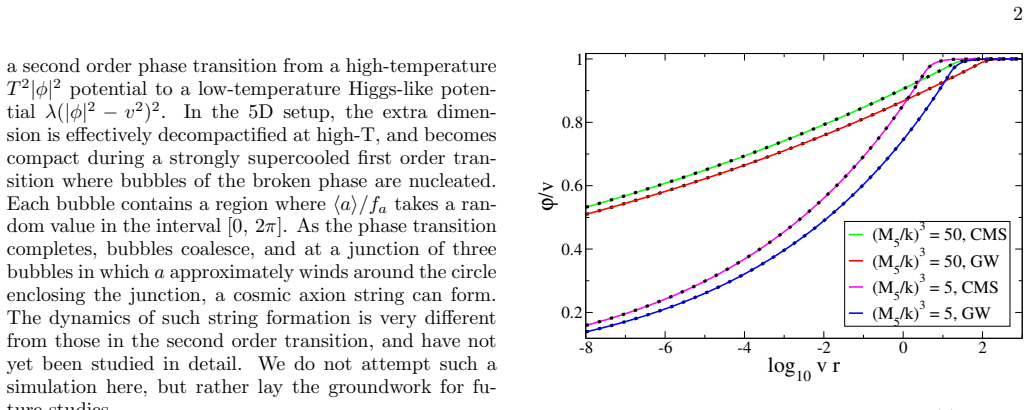
Significance. If the formation mechanism is borne out, the paper identifies a concrete string-theoretic axion model with low-tension cosmic strings that preserves a sharp axion mass–relic-density link while avoiding the usual quantum-gravity quality problem. The static string calculation is a genuine contribution: the small-b expansion is analytic, the numerical cross-checks in Fig. 1 make the tension formulas credible for the stated parameters, and the derivation of f_a from the Wilson-loop periodicity is clear. The paper is also honest in separating core and exterior contributions and in noting that simulations are needed. The main weakness is that the paper's headline physical claim—that strings actually form—is currently a conjecture rather than a derived or simulated result.
major comments (3)
- [Sec. 4 and Abstract] The abstract states as fact that "Axion strings arise following the first-order Randall-Sundrum compactification phase transition, forming at the junctions of three bubbles during percolation," but Sec. 4 does not demonstrate this. The key assertion that the interstitial region is "topologically restricted to maintain φ = 0" is not derived, and the only supporting evidence is an M.Sc. thesis [23] and a private communication [24]. The probability 3!/3^3 = 2/9 also assumes independent, uniformly distributed phases with no estimate of phase equilibration between two bubbles before a third arrives. Since the dark-matter relic-density link requires a string network, this unverified formation step is load-bearing. Please either provide a controlled calculation or simulation, or explicitly rephrase the abstract and Sec. 4 to present the formation mechanism as a conjecture.
- [Sec. 4] The picture of one uniform random phase per bubble is not quantitatively justified. A massless axion field has long-wavelength fluctuations, so the size of correlated patches inside a nucleated bubble must be compared with the bubble radius. The paper itself acknowledges that three-bubble collisions may be rare and that phases may equilibrate before a third bubble arrives; without an estimate of the suppression factor, the plausibility of a string network in this scenario remains open.
- [Sec. 2] The QCD-axion viability rests on the additional model-building assumption that QCD and a bulk quark reside in the bulk so that the axion-gluon coupling is O(1/f_a), based on Ref. [21]. This condition is plausible but is not demonstrated in the present model. Since the paper's motivation is the axion dark-matter and strong-CP connection, this should be stated explicitly as an inherited assumption and, ideally, supplemented with a concrete bulk-quark construction or a citation to one.
minor comments (4)
- [Sec. 3] The matching radius r_m is defined as sqrt(2b + b^2)/m_φ, but it would help to display the matching conditions explicitly, since the small- and large-r branches in Eq. (8) are joined in a way that is not immediately transparent.
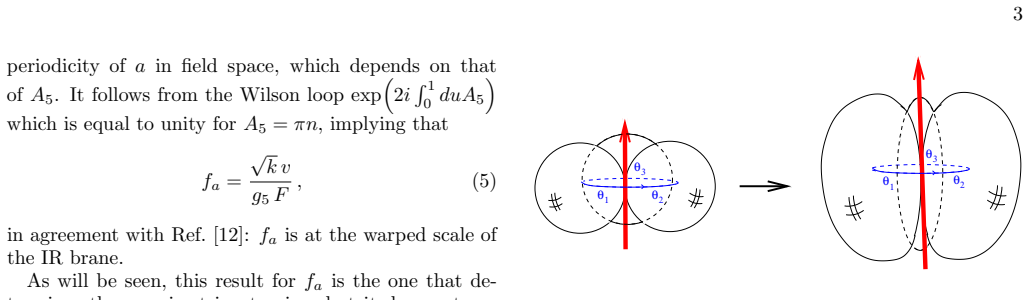
- [Sec. 4] Figure 2 is a useful schematic, but labeling the phases θ_1, θ_2, θ_3 on the figure would make the winding condition and the formation argument easier to follow.
- [References] The central formation mechanism relies on an M.Sc. thesis [23] and a private communication [24]. For verifiability, the authors should state the content of the in-progress work more explicitly or include a self-contained version of the argument in an appendix.
- [Sec. 3] The paragraph contrasting the warped-axion string with a generic PQ string would be clearer if it emphasized that the comparison is made with a PQ string of the same decay constant f_a, since b = f_a/v is the parameter that controls the suppression.
Circularity Check
No significant circularity: the string-tension derivation is self-contained, and the three-bubble formation mechanism is an acknowledged unverified assumption rather than a circular reduction.
full rationale
The quantitative derivation chain is not circular. Appendix A starts from the bulk U(1) action, integrates out the massive A_mu, and obtains the effective axion kinetic term (4); combined with the radion potential (2)-(3), this gives the string energy (6), the equations of motion (7), the profile (8), and the tensions (9)-(10). No input is defined in terms of the output: b, lambda, and epsilon are fixed for illustrative parameter regimes, not fitted to reproduce T_c, and the smallness of b is a parametric assumption, not a target-derived constraint. The decay constant fa in Eq. (5) is imported from Refs. [12,16,21] as external literature input, not from a self-citation, and it is used as an input rather than renamed as a prediction. Section 4's three-bubble production mechanism is the central physical assumption, but the paper explicitly flags its lack of verification: 'The dynamics of such string formation is very different from those in the second order transition, and have not yet been studied in detail. We do not attempt such a simulation here' and 'the production of global strings in a first order phase transition has only been studied in an M.Sc. thesis [23]'. That is an acknowledged limitation and a correctness risk, not a circularity: no equation or fitted parameter is equivalent by construction to the claimed string-formation outcome. There are no load-bearing self-citations, no imported uniqueness theorem, and no ansatz smuggled in via self-citation. Score 0.
Assumptions & free parameters
free parameters (4)
- b = f_a/v =
b^2 = 1/[24 (g5^2 k)(M5/k)^3], examples 1/120 and 1/1200
- lambda (radion potential quartic) =
(M5/k)^-6
- epsilon (GW/CMS potential exponent) =
0.1
- v (radion VEV) =
10^10 GeV illustrative
assumptions (6)
- domain assumption The axion is the zero mode of A5 in a 5D U(1) gauge field with Dirichlet boundary conditions on A_mu, with f_a given by the Wilson-loop periodicity.
- domain assumption QCD and a bulk quark with quantized g5 charge live in the bulk, so the axion-gluon coupling is order 1/f_a.
- domain assumption The Randall-Sundrum phase transition is first order and completes, with a strongly supercooled radion potential engineered via the Goldberger-Wise mechanism or similar.
- domain assumption Flat-space global string energy functional with canonical radion kinetic term and negligible O((phi/F)^2) corrections is valid.
- ad hoc to paper Three bubble collisions with winding phases trap a phi=0 core, forming strings.
- domain assumption Bubble phases are uncorrelated so the winding probability is 2/9.
Cite this review
Pith. "Pith review of Axion strings from string axions." pith.science (2026). https://pith.science/paper/ACYTZOUT
@misc{pith2026241212260,
  author       = {Pith},
  title        = {Pith review of: Axion strings from string axions},
  year         = {2026},
  howpublished = {\url{https://pith.science/paper/ACYTZOUT}},
  note         = {Machine review of arXiv:2412.12260}
}
read the original abstract
A favored scenario for axions to be dark matter is for them to form a cosmic string network that subsequently decays, allowing for a tight link between the axion mass and relic abundance. We discuss an example in which the axion is protected from quantum gravity effects that would spoil its ability to solve the strong CP problem: namely a string theoretic axion arising from gauge symmetry in warped extra dimensions. Axion strings arise following the first-order Randall-Sundrum compactification phase transition, forming at the junctions of three bubbles during percolation. Their tensions are at the low scale associated with the warp factor, and are parametrically smaller than the usual field-theory axion strings, relative to the scale of their decay constant. Simulations of string network formation by this mechanism must be carried out to see whether the axion mass-relic density relation depends on the new parameters in the theory.
Figures
Reference graph
Works this paper leans on
-
[23]
Modulus stabilization with bulk fields,
W. D. Goldberger and M. B. Wise, “Modulus stabilization with bulk fields,” Phys. Rev. Lett. 83 (1999) 4922–4925, arXiv:hep-ph/9907447
arXiv 1999
-
[24]
Dynamics of a Stabilized Radion and Duality
Z. Chacko, R. K. Mishra, and D. Stolarski, “Dynamics of a Stabilized Radion and Duality,” JHEP 09 (2013) 121, arXiv:1304.1795 [hep-ph]
work page Pith review arXiv 2013
-
[21]
Holography and the electroweak phase transition,
P. Creminelli, A. Nicolis, and R. Rattazzi, “Holography and the electroweak phase transition,” JHEP 03 (2002) 051, arXiv:hep-th/0107141
arXiv 2002
-
[1]
Introduction. The axion solution to the strong CP problem [1–5] provides a highly motivated dark mat- ter candidate [6, 7], potentially resolving two of the ma- jor mysteries of particle physics through one hypothe- sis. Conventional axion models involve a complex scalar field Φ = φ eia/fa , the Peccei-Quinn (PQ) field, whose angular component a is the ax...
arXiv 2024
-
[2]
F ramework. The geometry of the Randall- Sundrum model can be described by a warped 5D anti- deSitter metric ds2 = φ F 2u ηµνdxµdxν + ln2(φ/F ) k2 du2 , (1) having an ultraviolet (UV) brane atu = 0 and an infrared (IR) brane at u = 1. The field φ is the radion, which de- scribes dynamical fluctuations of the size of the extra dimension, and F = p 24M 3 5 ...
-
[3]
String Solutions. For configurations with axion winding by 2π, the energy density of the string is E = 1 2 φ′(r)2 + b2 φ2 r2 + V (φ) , (6) leading to the equation of motion φ′′ + φ′ r = b2 φ r2 + V ′(φ) , (7) where b2 = (fa/v)2 = [24 (g2 5k)(M5/k)3]−1, which is ex- pected to be small, b2 ≪ 1. The exact solution is very well approximated by joining its sma...
-
[4]
Inside each bubble, the axion field will have an approximately uniform phase θi = ai/fa
String production.Unlike the field theoretic PQ phase transition, the RS transition is first order, pro- ceeding by bubble nucleation. Inside each bubble, the axion field will have an approximately uniform phase θi = ai/fa. If three bubbles meet such that θ1 < θ2 < θ3, or vice versa, with the angles approximately covering the circle, then the axion is in ...
-
[5]
CP Conservation in the Presence of Instantons,
R. D. Peccei and H. R. Quinn, “CP Conservation in the Presence of Instantons,” Phys. Rev. Lett. 38 (1977) 1440–1443
1977
Show all 29 references
-
[6]
Axions and the Strong CP 5 Problem,
J. E. Kim and G. Carosi, “Axions and the Strong CP 5 Problem,” Rev. Mod. Phys. 82 (2010) 557–602, arXiv:0807.3125 [hep-ph]. [Erratum: Rev.Mod.Phys. 91, 049902 (2019)]
2010 arXiv
-
[7]
A New Light Boson?,
S. Weinberg, “A New Light Boson?,” Phys. Rev. Lett. 40 (1978) 223–226
1978
-
[8]
Problem of Strong P and T Invariance in the Presence of Instantons,
F. Wilczek, “Problem of Strong P and T Invariance in the Presence of Instantons,” Phys. Rev. Lett. 40 (1978) 279–282
1978
-
[9]
The Strong CP problem and axions,
R. D. Peccei, “The Strong CP problem and axions,” Lect. Notes Phys. 741 (2008) 3–17, arXiv:hep-ph/0607268
2008 arXiv
-
[10]
A Cosmological Bound on the Invisible Axion,
L. F. Abbott and P. Sikivie, “A Cosmological Bound on the Invisible Axion,” Phys. Lett. B 120 (1983) 133–136
1983
-
[11]
Cosmology of the Invisible Axion,
J. Preskill, M. B. Wise, and F. Wilczek, “Cosmology of the Invisible Axion,” Phys. Lett. B 120 (1983) 127–132
1983
-
[12]
Planck scale corrections to axion models,
S. M. Barr and D. Seckel, “Planck scale corrections to axion models,” Phys. Rev. D 46 (1992) 539–549
1992
-
[13]
Solutions to the strong CP problem in a world with gravity,
R. Holman, S. D. H. Hsu, T. W. Kephart, E. W. Kolb, R. Watkins, and L. M. Widrow, “Solutions to the strong CP problem in a world with gravity,” Phys. Lett. B 282 (1992) 132–136, arXiv:hep-ph/9203206
1992 arXiv
-
[14]
Planck scale physics and the Peccei-Quinn mechanism,
M. Kamionkowski and J. March-Russell, “Planck scale physics and the Peccei-Quinn mechanism,” Phys. Lett. B 282 (1992) 137–141, arXiv:hep-th/9202003
1992 arXiv
-
[15]
High-Quality Axions from Higher-Form Symmetries in Extra Dimensions,
N. Craig and M. Kongsore, “High-Quality Axions from Higher-Form Symmetries in Extra Dimensions,” arXiv:2408.10295 [hep-ph]
-
[16]
The Cosmological Dynamics of String Theory Axion Strings,
J. N. Benabou, Q. Bonnefoy, M. Buschmann, S. Kumar, and B. R. Safdi, “The Cosmological Dynamics of String Theory Axion Strings,” arXiv:2312.08425 [hep-ph]
-
[17]
Topology of Cosmic Domains and Strings,
T. W. B. Kibble, “Topology of Cosmic Domains and Strings,” J. Phys. A 9 (1976) 1387–1398
1976
-
[18]
Cosmological Experiments in Superfluid Helium?,
W. H. Zurek, “Cosmological Experiments in Superfluid Helium?,” Nature 317 (1985) 505–508
1985
-
[19]
A Large mass hierarchy from a small extra dimension,
L. Randall and R. Sundrum, “A Large mass hierarchy from a small extra dimension,” Phys. Rev. Lett. 83 (1999) 3370–3373, arXiv:hep-ph/9905221
1999 arXiv
-
[20]
A QCD axion from higher dimensional gauge field,
K.-w. Choi, “A QCD axion from higher dimensional gauge field,” Phys. Rev. Lett. 92 (2004) 101602, arXiv:hep-ph/0308024
2004 arXiv
-
[22]
Phase Transitions from the Fifth Dimension,
K. Agashe, P. Du, M. Ekhterachian, S. Kumar, and R. Sundrum, “Phase Transitions from the Fifth Dimension,” JHEP 02 (2021) 051, arXiv:2010.04083 [hep-th]
2021 arXiv
-
[25]
Warped axions,
T. Flacke, B. Gripaios, J. March-Russell, and D. Maybury, “Warped axions,” JHEP 01 (2007) 061, arXiv:hep-ph/0611278
2007 arXiv
-
[26]
It simplifies the calculation to choose an axial gauge A5 = constant, where the constant is quantized by the requirement of the Wilson loop being a multiple of 2 π
-
[27]
Global strings from bubble collisions in a first-order cosmological phase transition,
E. Vihonen, “Global strings from bubble collisions in a first-order cosmological phase transition,” M.Sc. thesis, University of Helsinki, 2023. https://helda.helsinki. fi/items/a21f09ff-1e6b-42b2-b352-ae183f3a5175
2023
-
[28]
Weir, private communication
D. Weir, private communication
-
[29]
Extra natural inflation,
N. Arkani-Hamed, H.-C. Cheng, P. Creminelli, and L. Randall, “Extra natural inflation,” Phys. Rev. Lett. 90 (2003) 221302, arXiv:hep-th/0301218
2003 arXiv
Reviewed August 11, 2026 · model on record in the stance chip above.
Discussion (0). Continue with ORCID to comment.