REVIEW 3 major objections 4 minor 1 cited by
Mixture equivalence principles and post-quantum theories of gravity
T0 review · 3 major / 4 minor · reviewed 2026-08-11 · deepseek-v4-flash
Pith's one-line read The paper argues that Møller-Rosenfeld semiclassical gravity is not the semiclassical limit of quantum gravity, because it treats proper and improper mixtures with the same density matrix as gravitationally distinct.
desk verdict A clean formal core on MEP violations, but the black-hole conclusion rests on an explicitly flagged and unproven assumption about gravitational-field measurements; the abstract overstates the result. read the letter →
The pith
A machine-rendered reading of the paper's core claim, the machinery that carries it, and where it could break.
The reading
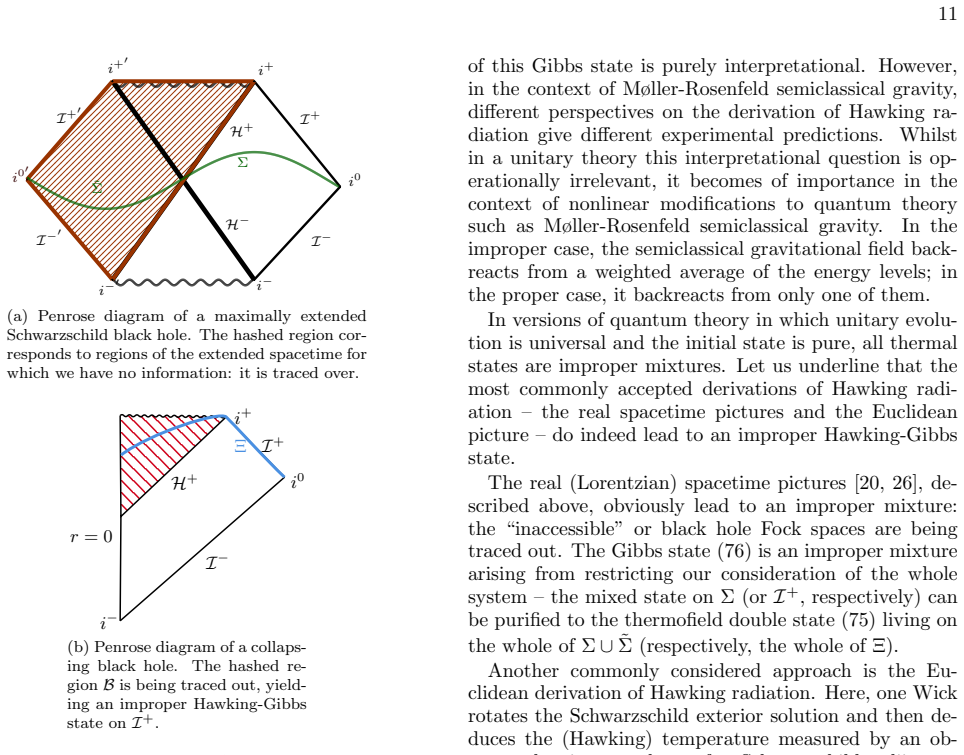
What carries the argument
The central object is the semiclassical Einstein equation $G_{\mu\nu}=\frac{8\pi G}{c^4}\langle \hat{T}_{\mu\nu}\rangle$, together with the distinction between proper and improper mixed states with equal density matrices. The argument is carried by Alice–Bob Cavendish thought experiments showing that these two mixture types produce different gravitational fields in Møller-Rosenfeld gravity, by a mass-interferometer calculation in which the nonlinear Schrödinger-Newton term $f(|\psi|^2;x,t)$ gives statistical violations of the gravitational mixture equivalence principle, and by the thermofield-double purification of the Hawking-Gibbs state, which establishes that the black-hole thermal state is improper.
What would settle it
Look for a single-measurement difference in the gravitational field produced by an improper mixture (an entangled superposition of a mass in two boxes) versus a proper mixture (a classical coin choosing one box) with the same density matrix: if a one-shot Cavendish experiment cannot distinguish them, Møller-Rosenfeld gravity and the unitary semiclassical limit coincide observably, and the paper's central claim fails.
Extended reading notes
Core claim
The central claim is that Møller-Rosenfeld semiclassical gravity—defined by taking the spacetime curvature to be driven by the expectation value of the quantum stress-energy tensor, $G_{\mu\nu}=\frac{8\pi G}{c^4}\langle \hat{T}_{\mu\nu}\rangle$—violates the gravitational mixture equivalence principle and therefore cannot be the semiclassical limit of a unitary quantum gravity theory. In a proper mixture, Alice's gravitational-field measurement reveals which branch Bob prepared, so backreaction follows one definite energy eigenstate; in an improper mixture (an entangled ancilla), semiclassical gravity instead backreacts from the averaged stress-energy. Because the two density matrices are identical, standard quantum theory says no experiment on the matter subsystem can tell them apart, yet semiclassical gravity makes them gravitationally distinguishable. Applied to Hawking radiation, the paper notes that the Hawking-Gibbs state is improper, arising from tracing out the black hole interior; in Møller-Rosenfeld gravity the backreaction averages over energy eigenstates, whereas in the semiclassical limit of unitary quantum gravity a measurement of the gravitational field would collapse to one component. Hence the two theories differ observably outside a black hole, regardless of $N$.
Load-bearing premise
The argument rests on the assumption that gravitational-field measurements in the semiclassical limit of quantum gravity collapse the matter state to a definite branch; if they instead behave like Møller-Rosenfeld averages, the claimed difference disappears.
Editorial extensions
If this is right
- Møller-Rosenfeld semiclassical gravity and the semiclassical limit of unitary quantum gravity make different single-measurement predictions for the gravitational field outside a black hole, and the difference does not disappear as the number of matter fields $N$ grows.
- A single Cavendish-style measurement of the gravitational field at future null infinity could distinguish the two theories, even though repeated averaged measurements of the gravitational field would not.
- In Møller-Rosenfeld gravity the Hawking-Gibbs state must be treated as an improper mixture; any statistical-ensemble reading that treats it as a proper mixture would be inconsistent with the standard derivations of Hawking radiation.
- Nonlinear time evolution generically violates the mixture equivalence principle statistically, and generic modified Born rules violate it independently of the dynamics.
- Semiclassical gravity violates the gravitational weak mixture equivalence principle one-shot through gravitational-field measurements and statistically through position measurements in a mass interferometer.
Reading between the lines
- Editorial inference: the paper's one-shot versus statistical distinction suggests a feasible tabletop test—a single measurement of the gravitational field of a prepared superposition could separate Møller-Rosenfeld gravity from the unitary semiclassical limit, whereas averaged runs could not.
- Editorial inference: the argument's stated 'strong and non-obvious' assumption about gravitational-field measurements is the pivot; if no consistent measurement theory exists in that limit, the identification of the semiclassical limit with proper-mixture backreaction is unsupported.
- Editorial inference: the same proper-versus-improper logic should apply to any post-quantum or classical-quantum theory with nonlinear state dependence, making gravitational mixture-equivalence violations a general signature of non-unitary gravitational dynamics.
Editorial analysis
A structured set of objections, weighed in public.
Referee Report
Summary. The paper introduces a family of principles—MEP, WMEP, GMEP, GWMEP—governing the distinguishability of proper and improper mixtures in theories that extend quantum mechanics, and applies them to Møller-Rosenfeld semiclassical gravity. It argues that semiclassical gravity violates the GMEP and GWMEP by making the gravitational field depend on whether a given density matrix arises as a classical ensemble or as a partial trace of an entangled state. It also proves that nonlinear dynamics and modified Born rules violate the MEP, and applies the proper/improper distinction to thermal states and Hawking radiation. The central conclusion is that Møller-Rosenfeld semiclassical gravity is not the semiclassical limit of quantum gravity in black hole spacetimes, even with N≫1 matter fields, because a measurement of the gravitational field in the unitary quantum-gravity limit would collapse the matter state, producing proper-mixture backreaction, whereas Møller-Rosenfeld gravity retains the improper-mixture average.
Significance. If the main conclusion holds, the paper resolves a genuine conceptual puzzle: why the semiclassical Einstein equations are often treated as both a fundamental theory and a limit of quantum gravity, despite known paradoxes in the former role. The formal parts—Lemma 2, Theorem 1, the GPT extension in Appendix A, and the Born-rule argument in Section II F—are correct, self-contained, and parameter-free. The paper is also careful in reviewing why standard derivations of Hawking radiation yield an improper mixture. The advertised distinction is in principle testable through Cavendish-type experiments, which is a notable strength. However, the central black-hole claim is explicitly conditional on a strong and non-obvious assumption about measurements of the gravitational field in the semiclassical limit, and the paper does not supply a model of such measurements. The proper/improper sourcing rule for gravitational backreaction also needs a more precise prescription.
major comments (3)
- [III B] The paper's central claim—that Møller-Rosenfeld gravity is not the semiclassical limit of quantum gravity—rests on the assumption, stated by the authors as 'strong and non-obvious', that a measurement of the gravitational field in the semiclassical limit collapses the matter state into a definite branch. The standard 1/N limit recalled in Appendix C treats the metric as a c-number determined by expectation values of matter stress-energy; in that limit a 'measurement' of the metric is a readout of a classical number, and standard von Neumann measurement theory does not automatically induce collapse of the matter state. If no collapse occurs, the Cavendish experiment at I+ gives the same improper-mixture backreaction in both theories and the distinction disappears. The paper provides no Kraus operators, POVM, or dynamical collapse model for gravitational-field measurements in this regime. To make the conclusion load-bearing, the authors need either to supply an explicit measurement model or to reformulate the conclusion as conditional on a clearly stated postulate.
- [II A, Eqs. (7)-(15)] The derivation of the one-shot GMEP violation assumes that for a proper mixture the gravitational source is a single branch |x_i>, as in Eq. (9), rather than the trace average Tr(\hat T ρproper) that would follow from applying Eq. (1) to the density operator ρproper defined in Eq. (7). This assumes that a proper mixture is an epistemic ensemble whose individual members have definite pure states, rather than a single-system state described by a density matrix. The paper should state this as an explicit prescription for how Møller-Rosenfeld gravity treats proper mixtures, since the formal definition of a proper mixed state as a density operator leaves room for the opposite reading, under which the GMEP violation would not follow.
- [II E, Eq. (61)] The claimed statistical GMEP violation in the mass-interferometer example rests on the assertion that ρimproper(x,y;t) differs from p1ψ1(x,t)ψ1*(y,t)+p2ψ2(x,t)ψ2*(y,t) for 'generic' initial states. No explicit family of initial states, numerical demonstration, or existence proof is given, and 'generic' is not quantified. The inequality is plausible, but since it is the basis of the advertised statistical GMEP violation, the authors should provide at least one concrete example or a rigorous argument that the set of initial states for which equality holds has measure zero.
minor comments (4)
- [II B] The phrase 'an entangled state between boxes 1−4 and 2−3' is ambiguous and should read 'between boxes 1 and 4, and between boxes 2 and 3'.
- [II D] The sentence 'which we look at below' is informal and should be replaced with 'which we consider below'.
- [II B, Eq. (24)] The notation ρprop|imp is not explicitly defined before use; a brief definition would improve readability.
- [II E] The sentence 'will typically couple the time evolution the two branches' is missing a word and should read 'will typically couple the time evolution of the two branches'.
Circularity Check
No significant circularity: the derivations are self-contained, and the central black-hole conclusion is explicitly conditional on an external measurement-collapse assumption rather than being read back from the formalism.
full rationale
The paper's GMEP/GWMEP arguments are computed from the stated defining equations: semiclassical gravity through G=8π⟨T⟩ (Eq. 1) and the Poisson/Newton-Schrödinger equations (Eqs. 10, 47); the proper/improper differences are obtained by applying these equations to the explicitly constructed states (Eqs. 7–15 and 52–63). No free parameter is fitted to a data subset and then presented as a prediction, and no equation is solved by assuming its own conclusion. The nonlinear-dynamics MEP violation (Lemma 2/Theorem 1) is a formal unpacking of the paper's own definition of nonlinear evolution (Eq. 36) together with the purification construction; it is trivial but not an instance of fitting an input and renaming it an output. The central claim of Section III B is hedged: the authors state that the distinction between Møller-Rosenfeld gravity and the semiclassical limit holds "if we make the (strong and non-obvious, though maybe common) assumption that there is a consistent treatment of measurements of the gravitational field within the latter." This is an explicitly external physical assumption, not an input disguised as a result; if one rejects it the distinction collapses, but that is a fragility or assumption concern, not circularity. Self-citations ([10], [14]) supply definitions and background, while the relevant thought experiments are re-derived in the paper, so the self-citations are not load-bearing. The paper even directs the reader to independent contemporaneous criticism [37]. No circular step is identifiable.
Assumptions & free parameters
assumptions (5)
- domain assumption Preparation statistics of any ensemble are independent of the outcome statistics of any later measurements.
- domain assumption All experimental measurements ultimately involve measurements of mass densities in localised regions.
- ad hoc to paper There is a consistent treatment of measurements of the gravitational field in the semiclassical limit of quantum gravity, such that a measurement collapses the matter state.
- domain assumption Standard derivations of Hawking radiation (Israel, Hawking-Wald, Euclidean) yield an improper Hawking-Gibbs state.
- domain assumption In a unitary quantum gravity theory, the initial state of the universe is pure and unitary evolution is universal.
Cite this review
Pith. "Pith review of Mixture equivalence principles and post-quantum theories of gravity." pith.science (2026). https://pith.science/paper/ROTXQHQE
@misc{pith2026241212288,
  author       = {Pith},
  title        = {Pith review of: Mixture equivalence principles and post-quantum theories of gravity},
  year         = {2026},
  howpublished = {\url{https://pith.science/paper/ROTXQHQE}},
  note         = {Machine review of arXiv:2412.12288}
}
abstract
We examine the mixture equivalence principle (MEP), which states that proper and improper mixed states with the same density matrix are always experimentally indistinguishable, and a weaker version, which states that this is sometimes true in gravity theories. We point out that Moller-Rosenfeld semiclassical gravity violates the weak MEP and that nonlinear extensions of quantum mechanics violate the MEP. We further demonstrate that modifications of the Born rule in quantum theory also typically violate the MEP. We analyse such violations in the context of thermal baths, where proper and improper thermal states induce different physical situations. This has significant implications in the context of black hole physics. We argue that Moller-Rosenfeld semiclassical gravity is not the semiclassical limit of quantum gravity in the context of black hole spacetimes, even in the presence of $N\gg1$ matter fields.
Figures


Figures from the paper (2 more)

Forward citations
Cited by 1 Pith paper
-
Structure and statistical properties of the semiclassical Einstein equations
Two standard derivations of semiclassical gravity are equivalent as partial classical limits, so the equation predicts only the expectation value of the Einstein tensor.
Reference graph
Works this paper leans on
-
[1]
Proper mixture of pure states In the version of the experiment depicted on the far right of Figure 2, Bob prepares a particle of massmwhose wavefunction is localised around points x1,x 2,x 3 andx 4 in one of four boxes 1,2,3 and
-
[2]
Alice and Bob agree on an inertial reference frame in which they will remain at agreed fixed separation during the experiment, and on the experiment’s protocol. There are now three versions
-
[3]
Mixtures of mixtures Another scenario is described in the centre of Figure 2. Bob first tosses a weighted classical coin (whose weights are also known by Alice), and prepares, with probability p1, the entangled state |ψ1⟩=a 1 |0⟩ |x1⟩+a 2 |1⟩ |x2⟩(22) and with probabilityp 2 = 1−p 1 the entangled state |ψ2⟩=a 3 |0⟩ |x3⟩+a 4 |1⟩ |x4⟩(23) where|0⟩,|1⟩are or...
-
[4]
Alice observes a test massMini- tially at spacetime point (y, t′)
Bob chooses the box randomly, with probabilities p1|a1|2, p1|a2|2, p2|a3|2, p2|a4|2 respectively (say, by toss- ing a weighted four-sided classical dice whose weights are also known by Alice). Alice observes a test massMini- tially at spacetime point (y, t′). She initially has no in- formation about which of the two boxes the particle is in so, for her, t...
-
[5]
This violates the GMEP, as seen previously
Single pure entangled state In the version on the far left of Figure 2, on the other hand, Bob keeps his random choice indeterminate at the quantum level by preparing a pure entangled state √p1(a1 |0⟩ |x1⟩+a2 |1⟩ |x2⟩)+√p2(a3 |2⟩ |x3⟩+a4 |3⟩ |x4⟩), (19) where|0⟩,|1⟩,|2⟩,|3⟩are orthogonal states of an ancilla qudit, the massmis initially in an improper mix...
-
[6]
⟨O⟩ρproper(t) = X i pi ⟨O⟩ψi(t) = X i pi Tr Oψi(t) .(41)
in the proper case, by lemma 1, we must have that the statistics of the outcomes of any experiment on any observableOwithρ proper(t) must follow that of the statistics of outcomes with the pure states |ψi(t)⟩weighted by thep i’s, i.e. ⟨O⟩ρproper(t) = X i pi ⟨O⟩ψi(t) = X i pi Tr Oψi(t) .(41)
-
[7]
in the improper case, ρimproper(t) =T ρ(t, t0) h X i piψi(t0) i ≡ρ(t).(42) If time-evolution is nonlinear, then there exists {pi},{ψ i}, t0, t > t0 such that this is not equal toP i piψi(t). Thus, since the statistics of the mea- surements of observables satisfy the Born rule, ⟨O⟩ρimproper(t) = Tr(Oρ(t))̸= X i pi Tr Oψi(t) .(43) From (37), (41), (43) we h...
-
[8]
That of Werner Israel [20], depicted in Figure 4a. One may formally analytically extend the space- time through the Kruskal extension and augment the physical Fock spaceFof a hypersurface Σ⊂ M toF ⊗ ˜F. Here, ˜Fcorresponds to the Fock space of a hypersurface in the hashed region in Figure 4a i.e. ˜Σ⊂ ¯Mwhere ¯Mis the dual region toM of the Kruskal extensi...
Show all 49 references
-
[9]
inaccessible
That of Hawking and Wald [21, 23], which is de- picted in Figure 4b. One here works with a col- lapsing black hole spacetime, in which case the thermofield double lies on a hypersurface Ξ with 11 i+′ i0′ I+′ i−′ I−′ i+ i0 I+ i− I− H+ H− Σ ˜Σ (a) Penrose diagram of a maximally ...
-
[10]
We stress there is no novelty in the discussions in this and the next section
` a la Unruh-T olman For completeness, we here summarize and paraphrase the derivation of Hawking radiation in Euclidean space presented in [29]. We stress there is no novelty in the discussions in this and the next section. We start with the usual (Minkowskian) Schwarzschild ...
-
[11]
Euclidean path integral derivation Again, for completeness, we summarize and para- phrase derivations of the Hartle-Hawking state using Eu- clidean path integrals provided in [29, 34]. We start with the analytically continued Euclidean spacetime ds2 = 1− RS r c2dt2 E + dr2 1− ...
-
[12]
Page and C
Don N. Page and C. D. Geilker. Indirect evidence for quantum gravity.Physical Review Letters, 47, 1981
1981
-
[13]
Tom W. B. Kibble. Is a semi-classical theory of gravity 17 viable? In C. J. Isham, R. Penrose, and D. W. Sciama, editors,Quantum Gravity 2. A Second Oxford Sympo- sium, pages 63–80, Oxford, 1980. Clarendon Press
1980
-
[14]
Michael J. Duff. Inconsistency of quantum field theory in curved spacetime. In C. J. Isham, R. Penrose, and D. W. Sciama, editors,Quantum Gravity 2. A Second Oxford Symposium, pages 81–105, Oxford, 1980. Claren- don Press
1980
-
[15]
Weinberg’s non-linear quantum mechanics and supraluminal communications.Physics Letters A, 143, 1990
Nicolas Gisin. Weinberg’s non-linear quantum mechanics and supraluminal communications.Physics Letters A, 143, 1990
1990
-
[16]
Sourcing semiclassical gravity from spontaneously localized quantum matter
Antoine Tilloy and Lajos Di´ osi. Sourcing semiclassical gravity from spontaneously localized quantum matter. Physical Review D, 93, 2016
2016
-
[17]
Binding Quantum Matter and Space- Time, Without Romanticism.Foundations of Physics, 48(12):1753–1769, December 2018
Antoine Tilloy. Binding Quantum Matter and Space- Time, Without Romanticism.Foundations of Physics, 48(12):1753–1769, December 2018
2018
-
[18]
Does gravity have to be quantized? lessons from non-relativistic toy models.Journal of Physics: Conference Series, 1275(1):012006, sep 2019
Antoine Tilloy. Does gravity have to be quantized? lessons from non-relativistic toy models.Journal of Physics: Conference Series, 1275(1):012006, sep 2019
2019
-
[19]
Three little paradoxes: Making sense of semiclassical gravity.A VS Quantum Science, 4, 2022
Andr´ e Großardt. Three little paradoxes: Making sense of semiclassical gravity.A VS Quantum Science, 4, 2022
2022
-
[20]
Nonlinearity without superluminality
Adrian Kent. Nonlinearity without superluminality. Physical Review A - Atomic, Molecular, and Optical Physics, 72, 2005
2005
-
[21]
The measurement postulates of quantum mechanics are not redundant.Quantum, 9:1749, May 2025
Adrian Kent. The measurement postulates of quantum mechanics are not redundant.Quantum, 9:1749, May 2025
2025
-
[22]
A postquantum theory of classical gravity?Phys
Jonathan Oppenheim. A postquantum theory of classical gravity?Phys. Rev. X, 13:041040, 2023
2023
-
[23]
Probabilistic theories with purification.Phys
Giulio Chiribella, Giacomo Mauro D’Ariano, and Paolo Perinotti. Probabilistic theories with purification.Phys. Rev. A, 81:062348, Jun 2010
2010
-
[24]
Galley and Lluis Masanes
Thomas D. Galley and Lluis Masanes. Any modifica- tion of the Born rule leads to a violation of the purifica- tion and local tomography principles.Quantum, 2:104, November 2018
2018
-
[25]
Quantum state readout, collapses, probes, and signals.Physical Review D, 103, 2021
Adrian Kent. Quantum state readout, collapses, probes, and signals.Physical Review D, 103, 2021
2021
-
[26]
Kingsley R. W. Jones. Newtonian quantum gravity.Aus- tralian Journal of Physics, 48(6):1055, 1995
1995
-
[27]
Is Quantum Mechanics An Island In Theoryspace? arxiv : quant-ph/0401062, 2004
Scott Aaronson. Is Quantum Mechanics An Island In Theoryspace? arxiv : quant-ph/0401062, 2004
2004 arXiv
-
[28]
PhD thesis, SISSA, Trieste, 1992
Antony Valentini.On the pilot-wave theory of classical, quantum and subquantum physics. PhD thesis, SISSA, Trieste, 1992
1992
-
[29]
Dynamical origin of quantum probabilities.Proceedings of the Royal Soci- ety A: Mathematical, Physical and Engineering Sciences, 461, 2005
Antony Valentini and Hans Westman. Dynamical origin of quantum probabilities.Proceedings of the Royal Soci- ety A: Mathematical, Physical and Engineering Sciences, 461, 2005
2005
-
[30]
Extensions of Born’s rule to non-linear quantum mechanics, some of which do not imply superluminal communication
Bassam Helou and Yanbei Chen. Extensions of Born’s rule to non-linear quantum mechanics, some of which do not imply superluminal communication. InJournal of Physics: Conference Series, volume 880, 2017
2017
-
[31]
Thermo-field dynamics of black holes
Werner Israel. Thermo-field dynamics of black holes. Physics Letters A, 57, 1976
1976
-
[32]
Stephen W. Hawking. Particle creation by black holes. Communications in Mathematical Physics, 43, 1975
1975
-
[33]
Probability distribution of particles cre- ated by a black hole.Physical Review D, 12, 1975
Leonard Parker. Probability distribution of particles cre- ated by a black hole.Physical Review D, 12, 1975
1975
-
[34]
Robert M. Wald. On particle creation by black holes. Communications in Mathematical Physics, 45, 1975
1975
-
[35]
J. B. Hartle and S. W. Hawking. Path-integral derivation of black-hole radiance.Phys. Rev. D, 13:2188–2203, Apr 1976
1976
-
[36]
W. G. Unruh. Notes on black-hole evaporation.Phys. Rev. D, 14:870–892, Aug 1976
1976
-
[37]
Wald.General Relativity, pages 399–416
Robert M. Wald.General Relativity, pages 399–416. Uni- versity of Chicago Press, UK edition, 1984
1984
-
[38]
Stephen W. Hawking. The unpredictability of quan- tum gravity.Communications in Mathematical Physics, 87(3):395–415, December 1982
1982
-
[39]
S. W. Hawking. The density matrix of the universe.Phys- ica Scripta, 1987, 1987
1987
-
[40]
The en- tropy of Hawking radiation.Reviews of Modern Physics, 93, 2021
Ahmed Almheiri, Thomas Hartman, Juan Maldacena, Edgar Shaghoulian, and Amirhossein Tajdini. The en- tropy of Hawking radiation.Reviews of Modern Physics, 93, 2021
2021
-
[41]
Richard C. Tolman. On the weight of heat and thermal equilibrium in general relativity.Phys. Rev., 35:904–924, Apr 1930
1930
-
[42]
J Bisognano and E
J. J Bisognano and E. H. Wichmann. On the Duality Condition for a Hermitian Scalar Field.J. Math. Phys., 16:985–1007, 1975
1975
-
[43]
J Bisognano and E
J. J Bisognano and E. H. Wichmann. On the Duality Condition for Quantum Fields.J. Math. Phys., 17:303– 321, 1976
1976
-
[44]
The Unruh effect for philosophers.Studies in History and Philosophy of Science Part B: Studies in History and Philosophy of Modern Physics, 42(2):81–97, 2011
John Earman. The Unruh effect for philosophers.Studies in History and Philosophy of Science Part B: Studies in History and Philosophy of Modern Physics, 42(2):81–97, 2011
2011
-
[45]
Cornell University, 2015
Thomas Hartman.Lectures on Quantum Gravity and Black Holes, chapter 5, pages 54–67. Cornell University, 2015
2015
-
[46]
Kuo and L
Chung I. Kuo and L. H. Ford. Semiclassical gravity the- ory and quantum fluctuations.Physical Review D, 47, 1993
1993
-
[47]
Semiclassical dy- namics of Hawking radiation.Classical and Quantum Gravity, 40(20):205006, September 2023
David A Lowe and L´ arus Thorlacius. Semiclassical dy- namics of Hawking radiation.Classical and Quantum Gravity, 40(20):205006, September 2023
2023
-
[48]
Daniel R. Terno. Structure and statistical properties of the semiclassical Einstein equations, 2024. arxiv : gr- qc/2412.18213
2024 arXiv
-
[49]
Generalized no-broadcasting theorem
Howard Barnum, Jonathan Barrett, Matthew Leifer, and Alexander Wilce. Generalized no-broadcasting theorem. Physical Review Letters, 99, 2007
2007
Reviewed August 11, 2026 · model on record in the stance chip above.
Discussion (0). Continue with ORCID to comment.