REVIEW 2 major objections 4 minor 1 cited by
Feasibility Study of Measuring $\Lambda^0\to n\pi^{0}$ Using a High-Granularity Zero-Degree Calorimeter at the Future Electron-Ion Collider
T0 review · 2 major / 4 minor · reviewed 2026-08-11 · deepseek-v4-flash
Pith's one-line read This paper argues that the neutral decay $\Lambda^0 \to n\pi^0$ can be reconstructed at the EIC using a high-granularity zero-degree calorimeter, meeting the Yellow Report requirements.
desk verdict A clearly argued clean-simulation feasibility study of a genuinely unstudied channel; worth refereeing, but the 'comfortable margin' over Yellow Report requirements is not yet established because noise and backgrounds are absent. read the letter →
The pith
A machine-rendered reading of the paper's core claim, the machinery that carries it, and where it could break.
The reading
What carries the argument
The load-bearing objects are IDOLA and a graph neural network. IDOLA (Iterative Decay Origin for Lambda Analysis) is a bisection-style algorithm: it starts with the decay vertex at the interaction point, computes the $\Lambda^0$ momentum from the three daughter clusters, then moves the assumed vertex along that momentum direction, halving the step at each iteration, until the opening angle of the two photons reproduces the known $\pi^0$ mass; this recovers the displaced vertex, which can lie tens of meters downstream, with about 0.6–0.9 m resolution. The GNN treats the calorimeter hits as a point cloud with energy and position features, regresses the $\Lambda^0$ energy and angles, and classifies $\Lambda^0$ events against neutron background without explicitly estimating the vertex. Supporting machinery includes the HEXPLIT subcell-splitting algorithm, which exploits staggered calorimeter layers to improve transverse granularity, and topological clustering to separate the neutron and two photon showers.
What would settle it
Simulate the same $\Lambda^0 \to n\pi^0$ events with realistic SiPM noise, beam-gas background, and underlying event added, then rerun IDOLA and the GNN: if the reconstructed $\Lambda^0$ mass peak broadens or shifts, the GNN classification efficiency drops below the neutron rejection needed, or the $38\%/\sqrt{E}$ resolution degrades materially, the feasibility claim as stated fails. A faster proxy is to inject random low-energy hits into the existing simulated events and measure how the two-photon invariant-mass constraint and cluster separation respond.
Extended reading notes
Core claim
On its own terms, the paper establishes that $\Lambda^0 \to n\pi^0$ is a viable measurement channel for the EIC's zero-degree calorimeter. The authors simulate 50–300 GeV $\Lambda^0$ decays, reconstruct the three daughter showers with HEXPLIT subcell splitting and topological clustering, and infer the displaced decay vertex either with IDOLA or implicitly with a graph neural network. They find that the $\Lambda^0$ energy resolution, about $38\%/\sqrt{E}$, and polar-angle resolution are essentially the same as for single neutrons and satisfy the EIC Yellow Report requirements for neutron measurements; the geometric acceptance rises from about 2% at 100 GeV to about 35% at 250 GeV, in contrast to the roughly 1% acceptance quoted for the charged decay channel at the $18\times 275$ GeV setting. The paper also estimates that the neutron direction in the $\Lambda^0$ rest frame, the observable that carries $\Lambda^0$ spin information, can be reconstructed with roughly 100–120 mrad polar and 50–60 mrad azimuthal resolution by the conventional method.
Load-bearing premise
The whole feasibility result rests on a simulation with no SiPM electronic noise, no beam-gas background, and no underlying-event activity, so the quoted efficiencies and resolutions are clean-simulation values.
Editorial extensions
If this is right
- At 50–300 GeV, the neutral channel's geometric acceptance grows with energy, so it reaches the higher-energy, lower-$x$ and higher-$Q^2$ region where the charged channel $\Lambda^0 \to p\pi^-$ is blocked by tracker and magnet acceptance.
- Combining the roughly 2–35% acceptance with the GNN's 43–70% identification efficiency, the authors estimate about 36k reconstructed $\Lambda^0 \to n\pi^0$ events at an integrated luminosity of $10\,\mathrm{fb}^{-1}$, enough to begin kaon-structure and spin analyses.
- The measured neutron direction in the $\Lambda^0$ rest frame can be used to extract $\Lambda^0$ polarization through the angular distribution $dP/d\Omega_n = 1 + \alpha \vec{P}_{\Lambda^0}\cdot\hat{p}_n$, with the conventional reconstruction giving 100–120 mrad polar resolution.
- Because the neutron carries 75–94% of the $\Lambda^0$ energy, the $\Lambda^0$ energy resolution is essentially the neutron energy resolution, so improvements in neutron calorimetry directly improve $\Lambda^0$ measurements.
- The methods also apply to $\Sigma^0 \to \Lambda^0\gamma \to n\pi^0\gamma \to n\gamma\gamma\gamma$, providing a cross-check for kaon form-factor extractions, albeit with only 2.1% of $\Sigma^0$ events passing the selected cuts.
Reading between the lines
- The IDOLA displaced-vertex technique is not limited to $\Lambda^0$; any long-lived neutral particle decaying to a photon pair plus a visible hadron at a forward calorimeter could use the same mass-constraint bisection, so the method could be adapted to other hyperon and meson decays at EIC-class facilities.
- The quoted noiseless simulation numbers are an upper bound on real performance: adding SiPM noise, beam-gas background, and underlying-event activity could merge the neutron and photon clusters that IDOLA and the GNN rely on to separate, which is the most direct stress test the paper leaves for future work.
- The GNN's edge over the conventional method in $\Lambda^0$ efficiency (43–70% versus 4–8%) suggests that, when noise eventually degrades topological clustering, a point-cloud model trained on noisy hits may retain more of the signal than an explicit vertex-finding chain; this is testable in the follow-up simulations the paper proposes.
- If the acceptance-versus-energy trend holds, the same ZDC design with a wider angular coverage could serve the lower-energy EicC program, since the displaced-vertex problem becomes less severe at lower boost.
Editorial analysis
A structured set of objections, weighed in public.
Referee Report
Summary. The paper reports a Geant4-based feasibility study of reconstructing Lambda0 -> n pi0 decays at the EIC using a high-granularity SiPM-on-tile zero-degree calorimeter. For Lambda0 energies between 50 and 300 GeV, the authors propose an iterative displaced-vertex reconstruction (IDOLA) that uses the pi0 mass constraint to locate the decay vertex, and a graph neural network that directly regresses the Lambda0 kinematics and classifies Lambda0 vs neutron events. They find that energy and polar-angle resolutions meet the EIC Yellow Report requirements, that the GNN improves reconstruction efficiency over the conventional topocluster method, and that the neutral channel extends the measurable energy range relative to the charged channel. The paper includes geometric acceptance studies, mass resolution, polarization sensitivity estimates, and a discussion of the impact of beam spread on pT resolution.
Significance. If the reported performance holds under realistic conditions, this work would establish a new path for forward-Lambda measurements at the EIC, enabling kaon structure and spin studies that were previously deemed impractical with the ZDC alone. The analysis has notable strengths: the Geant4 setup is validated against CALICE test-beam data, the GNN training/test split on continuous vs discrete energies avoids memorization, and the code and trained models are publicly released. The principal weakness is that the quoted efficiencies and resolutions are obtained from clean single-particle events; the paper's own limitations section acknowledges that noise and beam-gas backgrounds are not included. The feasibility margin claimed in the summary is therefore conditional on follow-up studies with more realistic event samples.
major comments (2)
- [Section 2.2 and Section 4.1] The simulation includes no electronic noise, beam-gas background, or underlying event; Section 2.2 states 'No noise was included in the simulation,' and Section 4.1 acknowledges that 'Background from beam-gas interactions, or SiPM noise, could affect these numbers as they are not included.' IDOLA requires exactly two clusters passing photon-shape cuts and at least one additional cluster, while the GNN was trained and tested only on single-Lambda and single-neutron events. Consequently, the 43-70% Lambda efficiencies and the '<1%' neutron misidentification are clean-simulation values, and the 'comfortable margin' claimed in Section 5 is not yet established for realistic running conditions. I recommend either adding a simplified noise/background overlay study (e.g., SiPM dark-count hits and beam-gas photons) or explicitly qualifying the summary as a clean-simulation feasibility result.
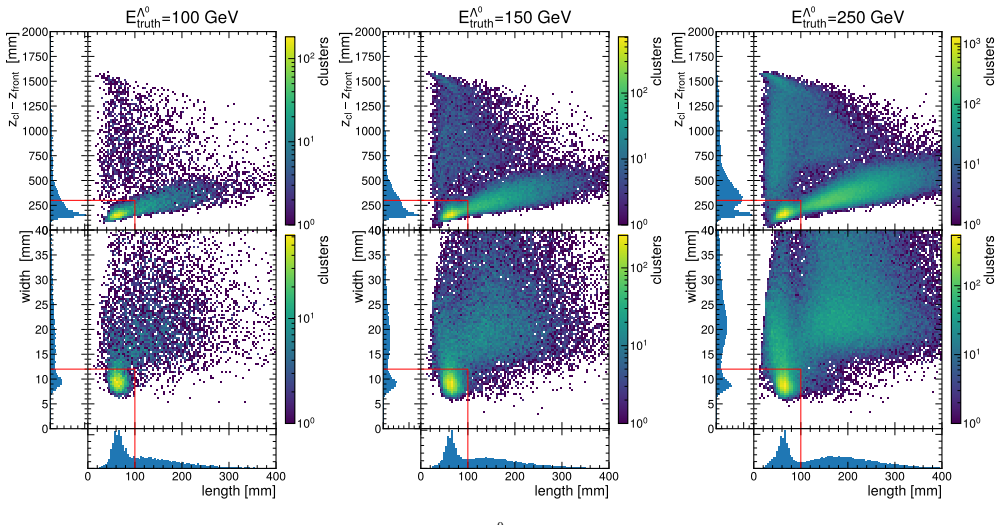
- [Section 3.2 and Section 4.1] The photon-identification cuts (length < 100 mm, width < 12 mm, z_cl - z_front < 300 mm) are defined in Section 3.2 using the same simulated sample on which the Section 4.1 efficiencies are reported, with no separate optimization sample or scan over cut values. If these cuts are tuned to the specific event topologies of the clean sample, the quoted 4-8% (IDOLA) and 43-70% (GNN) efficiencies could be optimistic. Please validate the stability of the efficiencies against reasonable variations of the cuts, or evaluate them on a dedicated tuning sample.
minor comments (4)
- [Section 5] There is a typo in the summary: 'distibution' should be 'distribution'.
- [Figure 6] In the middle panel of Figure 6, the fit label reads 'fit: = 0.03' with the fitted parameter omitted; it should be 'fit: mu = 0.03' (or similar). Also, the right-panel legend 'fit: 0.13/sqrt(E)' for photons omits the negative sign, which is inconsistent with Eq. (9) where B_gamma = -0.13.
- [Code Availability] In the Code Availability section, 'The code ... are found at' should be 'The code ... is found at' (singular subject).
- [Section 2.2] The sentence 'These cuts were inspired by those used in CALICE prototypes [17,18] and the anticipated capabilities of the EIC ASIC for SiPM readout' is slightly ambiguous about which cuts (ADC dynamic range, threshold, or time window) are being referred to; consider listing them explicitly.
Circularity Check
No significant circularity; resolutions are measured simulation outputs and self-citations have external validation.
full rationale
This paper is a Geant4 simulation feasibility study. The central resolutions, efficiencies, and acceptances are Monte Carlo outputs, not quantities derived from the paper's inputs by construction. The energy corrections in Eqs. (8) and (9) are calibrated to simulated truth for single neutrons and photons; this is standard detector calibration, and the quoted Lambda energy and angle resolutions are measured on independent simulated Lambda events rather than being equal to the calibration fits. The IDOLA vertex estimation uses the known pi0 mass as a constraint, but the reconstructed Lambda mass and vertex resolution are separate checks that could fail and are not forced by the pi0 constraint. The paper relies on prior work by the authors for the ZDC design [14] and HEXPLIT [23], but that prior work has external validation against CALICE test-beam data and GNN studies, so the self-citations are not an unverified load-bearing chain. The main limitations, including the absence of electronic noise, beam-gas background, and underlying event, are explicitly acknowledged in Sections 2.2 and 4.1 and in the summary; these are realism and correctness risks for the claimed 'comfortable margin,' not evidence of circularity. I find no step in which a 'prediction' reduces by definition to a fitted parameter or to a self-citation.
Assumptions & free parameters
free parameters (10)
- An (neutron energy correction offset) =
-0.11
- Bn (neutron energy correction sqrt coefficient) =
-1.5 GeV^(1/2)
- A_gamma (photon energy correction offset) =
0
- B_gamma (photon energy correction sqrt coefficient) =
-0.13 GeV^(1/2)
- Photon cluster ID cuts =
length < 100 mm, width < 12 mm, zcl - zfront < 300 mm
- Topocluster thresholds =
>=30 subcell hits, >=11 MeV total, seed >3 MeV, subcell >50 keV
- HEXPLIT tolerance delta =
0.01 MIPs
- GNN hyperparameters =
k=10, alpha=0.75, 4x64 nodes, 15 or 100 epochs, batch 256, lr 1e-3 to 1e-6
- w0 position-weight coefficients =
5.8, 0.65, 0.31
- Sampling fraction SF =
2.03%
assumptions (6)
- domain assumption Geant4 FTFP_BERT physics list reproduces hadronic and electromagnetic shower development for 50-300 GeV particles in the ZDC.
- domain assumption Omitting noise, beam-gas background, and underlying-event activity does not change the relative performance of the reconstruction methods.
- domain assumption The generated Lambda kinematics (energies 50-300 GeV, polar angles 0-3 mrad, no beam effects) cover the relevant EIC phase space.
- domain assumption IDOLA's 10-iteration bisection using the PDG pi0 mass converges to the true displaced vertex.
- domain assumption A GNN trained on clean Geant4 events generalizes to the real detector.
- domain assumption Prior validation of the ZDC simulation against CALICE test-beam data (Refs. [17,18]) transfers to the Lambda decay topology.
Cite this review
Pith. "Pith review of Feasibility Study of Measuring $\Lambda^0\to n\pi^{0}$ Using a High-Granularity Zero-Degree Calorimeter at the Future Electron-Ion Collider." pith.science (2026). https://pith.science/paper/O3UJFWAQ
@misc{pith2026241212346,
  author       = {Pith},
  title        = {Pith review of: Feasibility Study of Measuring $\Lambda^0\to n\pi^0$ Using a High-Granularity Zero-Degree Calorimeter at the Future Electron-Ion Collider},
  year         = {2026},
  howpublished = {\url{https://pith.science/paper/O3UJFWAQ}},
  note         = {Machine review of arXiv:2412.12346}
}
abstract
Key measurements at the future Electron-Ion Collider (EIC), including first-of-their-kind studies of kaon structure, require the detection of $\Lambda^0$ at forward angles. We present a feasibility study of $\Lambda^0 \to n\pi^0$ measurements using a high-granularity Zero Degree Calorimeter to be located about 35 m from the interaction point. We introduce a method to address the unprecedented challenge of identifying $\Lambda^0$s with energy $O(100)$ GeV that produce displaced vertices of $O(10)$ m. In addition, we present a reconstruction approach using graph neural networks. We find that the energy and angle resolution for $\Lambda^0$ is similar to that for neutrons, both of which meet the requirements outlined in the EIC Yellow Report.Furthermore, we estimate performance for measuring the neutron's direction in the $\Lambda^0$ rest frame, which reflects the $\Lambda^0$ spin polarization. We estimate that the neutral-decay channel $\Lambda^0 \to n\pi^0$ will greatly extend the measurable energy range for the charged-decay channel $\Lambda^0 \to p\pi^-$, which is limited by the location of small-angle trackers and the accelerator magnets. This work paves the way for EIC studies of kaon structure and spin phenomena.
Figures


Figures from the paper (9 more)



Forward citations
Cited by 1 Pith paper
-
First-Ever Deployment of a SiPM-on-Tile Calorimeter in a Collider: A Parasitic Test with 200 GeV $pp$ Collisions at RHIC
A SiPM-on-tile calorimeter prototype was deployed, calibrated, and operated for the first time in a collider environment, withstanding about 1e10 1-MeV neutron-equivalent fluence at room temperature.
Reference graph
Works this paper leans on
-
[1]
Electron Ion Collider: The Next QCD Frontier: Understanding the glue that binds us all,
A. Accardi et al., “Electron Ion Collider: The Next QCD Frontier: Understanding the glue that binds us all,” Eur. Phys. J. A52 no. 9, (2016) 268, arXiv:1212.1701 [nucl-ex]
arXiv 2016
-
[2]
Design of the ECCE Detector for the Electron Ion Collider,
J. K. Adkins et al., “Design of the ECCE Detector for the Electron Ion Collider,” arXiv:2209.02580 [physics.ins-det]
-
[3]
A THENACollaboration, J. Adam et al., “ATHENA detector proposal — a totally hermetic electron nucleus apparatus proposed for IP6 at the Electron-Ion Collider,” JINST 17 no. 10, (2022) P10019, arXiv:2210.09048 [physics.ins-det]
arXiv 2022
-
[4]
Science Requirements and Detector Concepts for the Electron-Ion Collider: EIC Yellow Report,
R. Abdul Khalek et al., “Science Requirements and Detector Concepts for the Electron-Ion Collider: EIC Yellow Report,”Nucl. Phys. A 1026 (2022) 122447, arXiv:2103.05419 [physics.ins-det]
arXiv 2022
-
[5]
The pion: an enigma within the Standard Model,
T. Horn and C. D. Roberts, “The pion: an enigma within the Standard Model,” J. Phys. G 43 no. 7, (2016) 073001, arXiv:1602.04016 [nucl-th]
arXiv 2016
-
[6]
Pion and Kaon Structure at the Electron-Ion Collider,
A. C. Aguilar et al., “Pion and Kaon Structure at the Electron-Ion Collider,” Eur. Phys. J. A 55 no. 10, (2019) 190, arXiv:1907.08218 [nucl-ex]
arXiv 2019
-
[7]
Revealing the structure of light pseudoscalar mesons at the electron–ion collider,
J. Arrington et al., “Revealing the structure of light pseudoscalar mesons at the electron–ion collider,” J. Phys. G 48 no. 7, (2021) 075106, arXiv:2102.11788 [nucl-ex]
arXiv 2021
-
[8]
A. Bylinkin et al., “Detector requirements and simulation results for the EIC exclusive, diffractive and tagging physics program using the ECCE detector concept,” Nucl. Instrum. Meth. A 1052 (2023) 168238, arXiv:2208.14575 [physics.ins-det]
Show all 42 references
-
[9]
Review of particle physics,
Particle Data Group Collaboration, S. Navas et al., “Review of particle physics,” Phys. Rev. D 110 no. 3, (2024) 030001
2024
-
[10]
Deep exclusive meson production as a probe to the puzzle of Λ hyperon polarization,
Z. Tu, “Deep exclusive meson production as a probe to the puzzle of Λ hyperon polarization,” Phys. Rev. C 109 no. 5, (2024) 055205, arXiv:2308.09127 [hep-ph]
2024 arXiv
-
[11]
Lambda polarization at the Electron-ion collider in China,
Z. Ji, X.-Y . Zhao, A.-Q. Guo, Q.-H. Xu, and J.-L. Zhang, “Lambda polarization at the Electron-ion collider in China,” Nucl. Sci. Tech. 34 no. 10, (2023) 155, arXiv:2308.15998 [nucl-ex]
2023 arXiv
-
[12]
Electron-ion collider in China,
D. P. Anderle et al., “Electron-ion collider in China,” Front. Phys. (Beijing) 16 no. 6, (2021) 64701, arXiv:2102.09222 [nucl-ex]
2021 arXiv
-
[13]
Tackling the kaon structure function at EicC *,
G. Xie, C. Han, R. Wang, and X. Chen, “Tackling the kaon structure function at EicC *,” Chin. Phys. C 46 no. 6, (2022) 064107, arXiv:2109.08483 [hep-ph]
2022 arXiv
-
[14]
Design of a SiPM-on-Tile ZDC for the future EIC and its Performance with Graph Neural Networks,
R. Milton, S. J. Paul, B. Schmookler, M. Arratia, P. Karande, A. Angerami, F. T. Acosta, and B. Nachman, “Design of a SiPM-on-Tile ZDC for the future EIC and its Performance with Graph Neural Networks,” arXiv:2406.12877 [physics.ins-det]
-
[15]
GEANT4–a simulation toolkit,
GEANT4 Collaboration, S. Agostinelli et al., “GEANT4–a simulation toolkit,” Nucl. Instrum. Meth. A 506 (2003) 250–303
2003
-
[16]
DD4hep: A Detector Description Toolkit for High Energy Physics Experiments,
M. Frank, F. Gaede, C. Grefe, and P. Mato, “DD4hep: A Detector Description Toolkit for High Energy Physics Experiments,”J. Phys. Conf. Ser. 513 (2014) 022010
2014
-
[17]
Hadronic energy resolution of a highly granular scintillator-steel hadron calorimeter using software compensation techniques,
CALICE Collaboration, C. Adloff et al., “Hadronic energy resolution of a highly granular scintillator-steel hadron calorimeter using software compensation techniques,” JINST 7 (2012) P09017, arXiv:1207.4210 [physics.ins-det]
2012 arXiv
-
[18]
Design, construction and commissioning of a technological prototype of a highly granular SiPM-on-tile scintillator-steel hadronic calorimeter,
CALICE Collaboration, A. White et al., “Design, construction and commissioning of a technological prototype of a highly granular SiPM-on-tile scintillator-steel hadronic calorimeter,” JINST 18 no. 11, (2023) P11018, arXiv:2209.15327 [physics.ins-det]
2023 arXiv
-
[19]
Software Compensation for Highly Granular Calorimeters using Machine Learning,
CALICE Collaboration, S. Lai et al., “Software Compensation for Highly Granular Calorimeters using Machine Learning,” JINST 19 (2024) P04037, arXiv:2403.04632 [physics.ins-det]
2024 arXiv
-
[20]
A high-granularity calorimeter insert based on SiPM-on-tile technology at the future Electron-Ion Collider,
M. Arratia et al., “A high-granularity calorimeter insert based on SiPM-on-tile technology at the future Electron-Ion Collider,” Nucl. Instrum. Meth. A 1047 (2023) 167866, arXiv:2208.05472 [physics.ins-det]
2023 arXiv
-
[21]
Beam Test of the First Prototype of SiPM-on-Tile Calorimeter Insert for the EIC Using 4 GeV Positrons at Jefferson Laboratory,
M. Arratia, B. Bagby, P. Carney, J. Huang, R. Milton, S. J. Paul, S. Preins, M. Rodriguez, and W. Zhang, “Beam Test of the First Prototype of SiPM-on-Tile Calorimeter Insert for the EIC Using 4 GeV Positrons at Jefferson Laboratory,” Instruments 7 no. 4, (2023) 43, arXiv:2309....
2023 arXiv
-
[22]
Studies of time resolution, light yield, and crosstalk using SiPM-on-tile calorimetry for the future Electron-Ion Collider,
M. Arratia, L. Garabito Ruiz, J. Huang, S. J. Paul, S. Preins, and M. Rodriguez, “Studies of time resolution, light yield, and crosstalk using SiPM-on-tile calorimetry for the future Electron-Ion Collider,” JINST 18 no. 05, (2023) P05045, arXiv:2302.03646 [physics.ins-det]
2023 arXiv
-
[23]
Leveraging staggered tessellation for enhanced spatial resolution in high-granularity calorimeters,
S. J. Paul and M. Arratia, “Leveraging staggered tessellation for enhanced spatial resolution in high-granularity calorimeters,” Nucl. Instrum. Meth. A 1060 (2024) 169044, arXiv:2308.06939 [physics.ins-det]
2024 arXiv
-
[24]
Topological cell clustering in the ATLAS calorimeters and its performance in LHC Run 1,
A TLASCollaboration, G. Aad et al., “Topological cell clustering in the ATLAS calorimeters and its performance in LHC Run 1,”Eur. Phys. J. C 77 (2017) 490, arXiv:1603.02934 [hep-ex]
2017 arXiv
-
[25]
Measurement of the transverse polarization of Λ and Λ hyperons produced in proton-proton collisions at√s=7 TeV using the ATLAS detector,
A TLASCollaboration, G. Aad et al., “Measurement of the transverse polarization of Λ and Λ hyperons produced in proton-proton collisions at√s=7 TeV using the ATLAS detector,”Phys. Rev. D 91 (Feb, 2015) 032004. https://link.aps.org/doi/10.1103/PhysRevD.91.032004
2015 doi
-
[26]
Polarization of Λ and ¯Λ in 920 GeV fixed-target proton–nucleus collisions,
I. Abt et al., “Polarization of Λ and ¯Λ in 920 GeV fixed-target proton–nucleus collisions,” Physics Letters B 638 no. 5, (2006) 415–421. 12 https://www.sciencedirect.com/science/article/pii/ S0370269306006216
2006
-
[27]
Polarization in inclusive Λ and Λ production at large pT ,
B. Lundberg, R. Handler, L. Pondrom, M. Shea ff, C. Wilkinson, J. Dworkin, O. E. Overseth, R. Rameika, K. Heller, C. James, A. Beretvas, P. Cushman, T. Devlin, K. B. Luk, G. B. Thomson, and R. Whitman, “Polarization in inclusive Λ and Λ production at large pT ,” Phys. Rev. D 4...
1989 doi
-
[28]
Transverse Lambda production at the future Electron-Ion Collider,
Z.-B. Kang, J. Terry, A. V ossen, Q. Xu, and J. Zhang, “Transverse Lambda production at the future Electron-Ion Collider,” Phys. Rev. D 105 no. 9, (2022) 094033, arXiv:2108.05383 [hep-ph]
2022 arXiv
-
[29]
Point Cloud Deep Learning Methods for Pion Reconstruction in the ATLAS Experiment,
A TLASCollaboration, “Point Cloud Deep Learning Methods for Pion Reconstruction in the ATLAS Experiment,” tech. rep., CERN, Geneva,
-
[30]
The optimal use of segmentation for sampling calorimeters,
F. Torales Accosta et al., “The optimal use of segmentation for sampling calorimeters,” JINST 19 no. 06, (2023) P06002, arXiv:2310.04442 [physics.ins-det]
2023 arXiv
-
[31]
Comparison of point cloud and image-based models for calorimeter fast simulation,
F. T. Acosta, V . Mikuni, B. Nachman, M. Arratia, B. Karki, R. Milton, P. Karande, and A. Angerami, “Comparison of point cloud and image-based models for calorimeter fast simulation,” JINST 19 no. 05, (2024) P05003, arXiv:2307.04780 [cs.LG]
2024 arXiv
-
[32]
Relational inductive biases, deep learning, and graph networks,
P. Battaglia et al., “Relational inductive biases, deep learning, and graph networks,” arXiv:1806.01261 [cs.LG]
-
[33]
TensorFlow: Large-scale machine learning on heterogeneous systems,
M. Abadi et al., “TensorFlow: Large-scale machine learning on heterogeneous systems,” 2015. http://tensorflow.org/
2015
-
[34]
Scikit-learn: Machine learning in Python,
F. Pedregosa, G. Varoquaux, A. Gramfort, V . Michel, B. Thirion, O. Grisel, M. Blondel, P. Prettenhofer, R. Weiss, V . Dubourg, J. Vanderplas, A. Passos, D. Cournapeau, M. Brucher, M. Perrot, and E. Duchesnay, “Scikit-learn: Machine learning in Python,” Journal of Machine Lear...
2011
-
[35]
Rectified linear units improve restricted boltzmann machines,
V . Nair and G. E. Hinton, “Rectified linear units improve restricted boltzmann machines,” in Proceedings of the 27th International Conference on International Conference on Machine Learning, ICML’10, p. 807–814. Omnipress, Madison, WI, USA, 2010
2010
-
[36]
Delving deep into rectifiers: Surpassing human-level performance on imagenet classification,
K. He, X. Zhang, S. Ren, and J. Sun, “Delving deep into rectifiers: Surpassing human-level performance on imagenet classification,” in 2015 IEEE International Conference on Computer Vision (ICCV), pp. 1026–1034. 2015
2015
-
[37]
Adam: A method for stochastic optimization,
D. P. Kingma and J. Ba, “Adam: A method for stochastic optimization,” arXiv:1412.6980 [cs.LG]
-
[38]
Leading Λ production in future electron-proton colliders,
F. Carvalho, K. P. Khemchandani, V . P. Gonc ¸alves, F. S. Navarra, D. S. Spiering, and A. Mart´ınez Torres, “Leading Λ production in future electron-proton colliders,” Phys. Rev. D 108 no. 9, (2023) 094034, arXiv:2306.09813 [hep-ph]
2023 arXiv
-
[39]
DEMPgen: Physics event generator for Deep Exclusive Meson Production at Jefferson Lab and the EIC,
Z. Ahmed, R. S. Evans, I. Goel, G. M. Huber, S. J. D. Kay, W. B. Li, L. Preet, and A. Usman, “DEMPgen: Physics event generator for Deep Exclusive Meson Production at Jefferson Lab and the EIC,” arXiv:2403.06000 [hep-ph]
-
[40]
Feasibility Study of Measuring Λ0→ nπ0 Using a High-Granularity Zero-Degree Calorimeter at the Future Electron-Ion Collider: GNN Models ,
R. Milton and S. Moran Vasquez, “Feasibility Study of Measuring Λ0→ nπ0 Using a High-Granularity Zero-Degree Calorimeter at the Future Electron-Ion Collider: GNN Models ,” Dec., 2024. https://doi.org/10.5281/zenodo.14518203
2024 doi
-
[41]
The idola (iterative decay origin in lambda analysis) algorithm
S. Paul, “The idola (iterative decay origin in lambda analysis) algorithm.” https://doi.org/10.5281/zenodo.14518550. 13
-
[2022]
All figures including auxiliary figures are available at https://atlas.web.cern.ch/Atlas/GROUPS/PHYSICS/PUBNOTES/ATL- PHYS-PUB-2022-040
http://cds.cern.ch/record/2825379. All figures including auxiliary figures are available at https://atlas.web.cern.ch/Atlas/GROUPS/PHYSICS/PUBNOTES/ATL- PHYS-PUB-2022-040
2022
Reviewed August 11, 2026 · model on record in the stance chip above.
Discussion (0). Continue with ORCID to comment.