REVIEW 4 major objections 6 minor 32 references
Error analysis of quantum operators written as a linear combination of permutations
T0 review · 4 major / 6 minor · reviewed 2026-08-11 · deepseek-v4-flash
Pith's one-line read For quantum operators written as positive linear combinations of permutation matrices, bit-flip errors leave the dominant eigenvalue exactly unchanged, and the paper bounds how phase-flips and mixed-sign coefficients perturb the spectrum.
desk verdict Correct spectral fact about bit-flip invariance of the dominant eigenvalue, but the application-resilience claim is not supported. read the letter →
The pith
A machine-rendered reading of the paper's core claim, the machinery that carries it, and where it could break.
The reading
What carries the argument
The load-bearing object is the decomposition $A=\sum_i \alpha_i \Pi_i$ into permutation matrices with scalar coefficients. The argument runs on two mechanisms. First, a bit-flip is a Pauli-$X$ gate (a NOT gate that flips a qubit), and composing it with a permutation gives another permutation, so a flipped term is still a permutation term; when the $\alpha_i$ are positive the whole matrix stays non-negative and keeps constant column sums, which pins the dominant eigenvalue at $\sum_i\alpha_i$ by the Perron-Frobenius theorem. Second, the Gershgorin circle theorem bounds how far any eigenvalue can move: each bit-flipped term changes a row's Gershgorin radius by at most $2p_i|\alpha_i|$, so the full perturbation obeys $\Delta R_j\le 2\sum_i p_i|\alpha_i|$, and a similar bound holds for phase-flips. A block-encoded implementation adds a control register whose bit-flips swap the coefficients attached to the permutation terms, which the paper argues preserves the eigenvalue spectrum for positive coefficients.
What would settle it
Prepare the dominant eigenvector of a positive-coefficient linear combination of permutations, apply the circuit with a known bit-flip on one term, and measure the fidelity of the output against the no-error output; if the fidelity drops while the dominant eigenvalue remains exactly $\sum_i\alpha_i$, the eigenvalue invariance is real but the claimed application-level resilience is not. A second check: compare the measured average output fidelity under random bit-flips with the fidelity predicted from the averaged operator $A(p,b)$; any systematic mismatch would falsify the error model itself.
Extended reading notes
Core claim
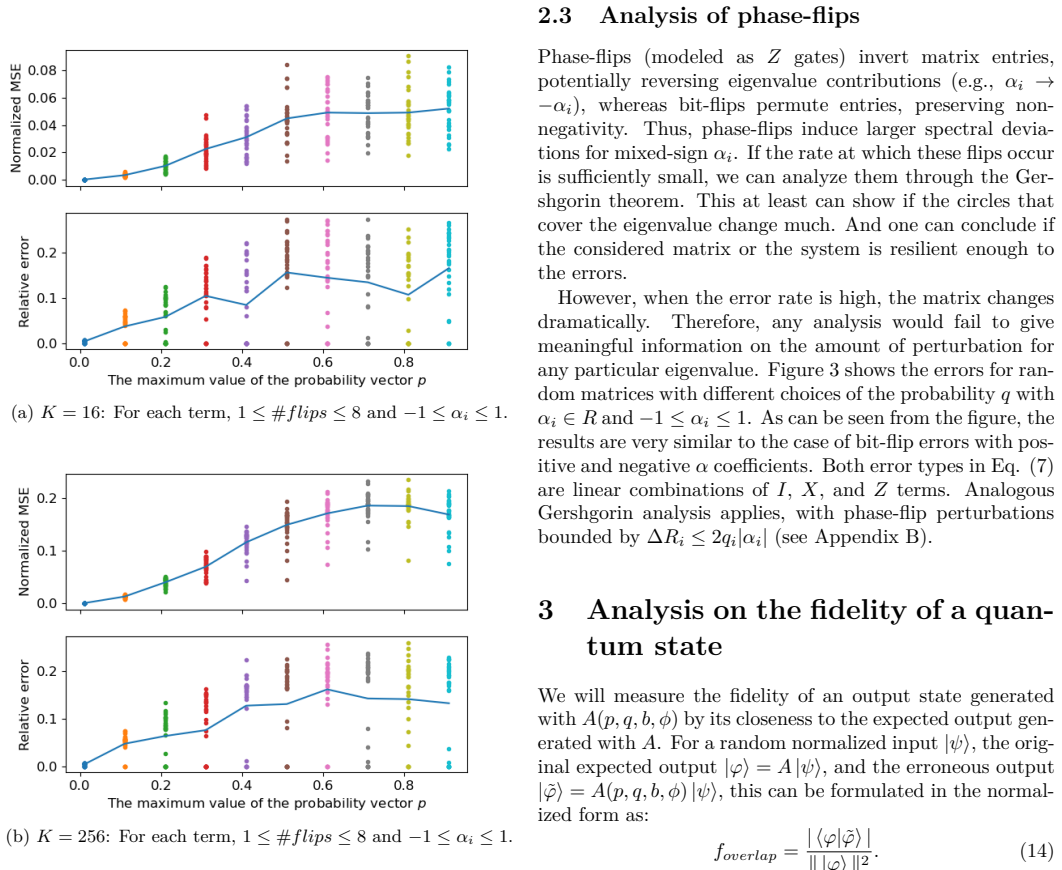
The paper's core discovery is an exact spectral invariance for positive linear combinations of permutations. For $A=\sum_i \alpha_i\Pi_i$ with $\alpha_i>0$, $A$ is a non-negative matrix whose columns all sum to $S=\sum_i \alpha_i$, so the Perron-Frobenius theorem makes $S$ the isolated dominant eigenvalue. Under the proposed bit-flip error model $A(p,b)=\sum_i \alpha_i\bigl((1-p_i)I+p_i X_{b_i}\bigr)\Pi_i$, each term $\alpha_i X_{b_i}\Pi_i$ is again a positive permutation term, so $A(p,b)$ has the same column sums and therefore the same dominant eigenvalue $S$; the paper concludes that the dominant eigenvalue is not affected by bit-flip errors and that applications built on such matrices are resilient to those errors. Non-dominant eigenvalues are not protected, because their eigenvectors have mixed signs and the Gershgorin radius changes by at most $2\sum_i p_i|\alpha_i|$. For mixed-sign $\alpha_i$ and for phase-flips, exact invariance is lost, yet the same Gershgorin machinery bounds the perturbation and the numerics show small spectral and fidelity changes at low error rates; the paper also shows that in a block-encoded implementation, bit-flips on the control register only permute coefficients and leave the spectrum unchanged.
Load-bearing premise
The model replaces each error-prone permutation term with a weighted average of the unflipped and flipped operator, so the claims describe the averaged operator $\bigl((1-p_i)I+p_i X_{b_i}\bigr)\Pi_i$ rather than the behavior of any single run of the circuit; the conclusion that applications are resilient may not transfer if single-run behavior is what matters.
Editorial extensions
If this is right
- For any positive-coefficient linear combination of permutations, the dominant eigenvalue is exactly $\sum_i\alpha_i$, and bit-flips on any qubits in any term do not change it.
- A positive-coefficient operator embedded by block encoding with a control register keeps the same eigenvalue spectrum under control-register bit-flips, since those only swap coefficients among terms.
- For mixed-sign coefficients, the Gershgorin bound $\Delta R_j\le 2\sum_i p_i|\alpha_i|$ shows that small bit-flip probabilities keep the spectral perturbation small, although eigenvalues with small magnitude can suffer large relative changes.
- Output-state fidelity is governed by the relative operator error: the bound $\sigma_{\max}(A-B)/\sigma_{\min}(A)$ shows that ill-conditioned operators amplify the effect of any bit-flip or phase-flip perturbation.
- Phase-flips act like sign reversals on the matrix entries and produce larger deviations than bit-flips for mixed-sign matrices, but at low flip rates both the eigenvalue error and the fidelity loss remain small in the simulations.
Reading between the lines
- One extension left implicit in the paper: encode the quantity an algorithm needs as the dominant eigenvalue of a positive linear combination of permutations, and system-register bit-flip noise becomes structurally irrelevant to that eigenvalue without any error correction.
- A strengthening not stated in the paper: every single error realization is still a positive linear combination of permutations with the same column sums, so the dominant-eigenvalue invariance holds realization by realization; the residual vulnerability sits in the eigenvectors and the non-dominant spectrum.
- A testable extension not explored in the paper: compare bit-flip errors on the control register versus the system register of the same block encoding; the model predicts control-register flips only permute coefficients and preserve the spectrum, so error budgets for the two registers could be set very differently.
- The framework also points toward permutation-based error mitigation: because averaging over bit-flips preserves the dominant eigenvalue, deliberately randomizing over permutations could recover the eigenvalue exactly; this mitigation idea is not developed in the paper.
Signed reviews
Editorial analysis
A structured set of objections, weighed in public.
Referee Report
Summary. The paper considers matrices expressed as linear combinations of permutation matrices, A = sum_i alpha_i Pi_i, and studies how bit-flip and phase-flip errors perturb the eigenvalues. The author introduces a probabilistic error model in which each permutation term is replaced by a mixture of the identity and an X or Z operation, defines the expected operator A(p,b), and proves that for positive coefficients the dominant eigenvalue of this expected operator is invariant under bit-flips because every error realization preserves column sums. The paper also gives Gershgorin-type bounds, reports numerical experiments on eigenvalue errors and output-state fidelities, and discusses implications for block-encoding implementations and for algorithms whose operators have this form.
Significance. The core spectral observation is correct and easy to verify: for positive coefficients, every bit-flipped permutation term is still a permutation, so the all-ones vector remains an eigenvector with eigenvalue sum_i alpha_i. The paper is also commendably concrete: the model is explicit, the numerical experiments are documented, and the code is made available. However, the paper's central applied claim, that such operators are resilient to quantum bit-flip errors, is not established by the given analysis. The problem is that the model in Eq. (5) is the expectation of the random error operators, whereas a single run applies one error realization; measurement probabilities are second moments, so the expected operator does not determine algorithm success. The same gap propagates into the fidelity analysis of Sec. 3. Because the main advertised contribution depends on this inference, the manuscript needs substantial revision before it can be considered sound.
major comments (4)
- [Sec. 2.2.1 and Abstract] The proof that the dominant eigenvalue of the averaged operator in Eq. (5) equals sum_i alpha_i under bit-flips is correct, but the subsequent claim that 'applications ... are resilient to quantum bit-flip errors' does not follow. In a single run of the circuit each term applies either Pi_i or X_{b_i}Pi_i; Eq. (5) is only the first moment of the error distribution, whereas success probabilities are second moments. Concretely, for n=1, K=2, alpha_1=alpha_2=1, Pi_1=I, Pi_2=X, and independent bit-flip probability p on each term, A(p,b)=I+X for every p, so Eqs. (12)-(14) and Fig. 1 report zero error. In an actual run, with probability 2p(1-p) the applied operator is 2I or 2X, and on input |0> with measurement in the |+>/|-> basis the average success probability is 1-p+p^2, which is less than 1 for p>0.
- [Sec. 2.2.2] The statement that a bit flip on the control register swaps the coefficients of the permutations while leaving the eigenvalue spectrum unchanged is false in general. For example, with Pi_1=I, Pi_2=X, alpha_1=1, alpha_2=2, swapping the coefficients changes A=I+2X into A'=2I+X; the eigenvalue sets are {3,-1} and {3,1}, respectively. The claim should be deleted or restricted to special cases where the operator is actually invariant, such as when the swapped coefficients are equal.
- [Sec. 3, Eqs. (14)-(15)] The fidelity quantities f_overlap and f_re are computed against the output of the expected operator A(p,q,b,phi), not against the distribution of actual error operators applied in individual runs. Consequently, the numerical fidelity curves in Figs. 4-7 inherit the same gap identified in Sec. 2.2.1: they can remain at 1 for erroneous realizations such as 2I and 2X in the counterexample above, while the probability of obtaining the correct measurement outcome decreases. The paper should replace or supplement these quantities with the average fidelity over the random per-term bit-flip and phase-flip distribution, e.g., E_B[|<psi|A^dagger B|psi>|^2 / (||B|psi>||^2 ||A|psi>||^2)] for B drawn from the error model.
- [Sec. 2.2.1] The claim that the Perron-Frobenius dominant eigenvalue is 'isolated' with a gap to the second largest eigenvalue is not guaranteed for general nonnegative matrices; a reducible nonnegative matrix can have multiple eigenvalues on the spectral circle. The correct and sufficient statement for the paper's purpose is that the spectral radius is sum_i alpha_i because the all-ones vector is a right eigenvector with that eigenvalue and the column sums are constant. The simplicity claim should be removed or proved under an extra primitivity assumption.
minor comments (6)
- [Sec. 2.3] The description of phase-flips as 'potentially reversing eigenvalue contributions (e.g., alpha_i -> -alpha_i)' does not match Eq. (6), where a Z gate flips signs of selected basis amplitudes inside each permutation term rather than changing the coefficients alpha_i globally; the wording should be aligned with the model.
- [Sec. 1.1 and Sec. 4] The statement that any square matrix can be expressed as a linear combination of permutations multiplied by two diagonal scaling matrices 'via Sinkhorn's theorem' overstates the classical result: Sinkhorn's theorem concerns positive matrices, and arbitrary complex or indefinite matrices require additional conditions or an extended decomposition. The sentence should be qualified.
- [Appendix A, Eq. (32)] The Gershgorin derivation in Eq. (32) assumes that the two changed positions are off-diagonal; if a flipped permutation places a 1 on the diagonal, the change to the Gershgorin radius differs because diagonal entries are excluded from the radius. The bound should be derived with explicit bookkeeping of diagonal versus off-diagonal positions.
- [Sec. 2.2.1 and Sec. 2.2.3] The text says 'K = 256 (i.e. K = 2n)' for n=8; this should be K = 2^n, while K=16 corresponds to 2n. The same typo appears in Sec. 2.2.3.
- [Sec. 3.2] The sentence 'we see the same error resilient observed in Fig. 1' should read 'the same error resilience observed in Fig. 1'.
- [References and data availability] Reference [24] contains the typo 'Quantum omputation and quantum information', and the data-availability URL in Sec. 5 is broken across a line as 'sum-of-p ermutations.git'; the URL should be typeset as a single token.
Circularity Check
No circular derivation: the bit-flip eigenvalue invariance is proved from the model; the application-resilience inference is unsupported but not circular.
full rationale
The paper's central claim, that the dominant eigenvalue of a positive linear combination of permutation matrices is invariant under bit-flip errors as modeled, is derived directly from the model rather than assumed. Equation (5) defines the perturbed operator as A(p,b) = sum_i alpha_i ((1-p_i)I + p_i X_{b_i}) Pi_i. Since X_{b_i} and Pi_i are both permutations, each term remains a permutation scaled by alpha_i, so every column sum of A(p,b) is sum_i alpha_i. The proof in Sec. 2.2.1 then uses Perron-Frobenius and the all-ones left eigenvector to conclude lambda_max = sum_i alpha_i; this is a mathematical consequence of the model, not a circular restatement of the conclusion. The Gershgorin bounds in Appendices A and B are likewise derived from the model. No parameter fitting to data is used, and the author's self-citations, refs. [19] and [21], are cited only for the linear-combination-of-permutations representation and circuit decomposition, not for the error-perturbation theorem, so they are not load-bearing. The weaker point is the inference in Sec. 2.2.1 that 'the applications ... are resilient to quantum bit-flip errors' because the dominant eigenvalue is unaffected. This goes beyond what the eigenvalue calculation shows: Eq. (5) is an expectation operator, while measurement outcomes in actual runs depend on the individual permutation error realizations, which are second-moment quantities. That is an unsupported logical leap, not a circular reduction of the conclusion to the premise, so it does not raise the circularity score. Overall, the derivation chain is self-contained and non-circular, with only a minor overreach in interpreting the spectral result as application-level resilience.
Assumptions & free parameters
assumptions (5)
- standard math Perron-Frobenius theorem
- standard math Gershgorin circle theorem
- standard math Sinkhorn's theorem and Birkhoff-von Neumann decomposition
- domain assumption Independent bit-flip and phase-flip errors on each permutation term, modeled by the expected operator
- domain assumption Block encoding represents A as a controlled linear combination of permutations
Cite this review
Pith. "Pith review of Error analysis of quantum operators written as a linear combination of permutations." pith.science (2026). https://pith.science/paper/ZEANTET3
@misc{pith2026241212762,
  author       = {Pith},
  title        = {Pith review of: Error analysis of quantum operators written as a linear combination of permutations},
  year         = {2026},
  howpublished = {\url{https://pith.science/paper/ZEANTET3}},
  note         = {Machine review of arXiv:2412.12762}
}
read the original abstract
In this paper, we consider matrices given as a linear combination of permutations and analyze the impact of bit and phase-flips on the perturbation of the eigenvalues. When the coefficients in the linear combination are positive, we observe that the eigenvalues of the resulting matrices exhibit resilience to quantum bit-flip errors. In addition, we analyze the bit-flips in combination with positive and negative coefficients and the phase-flips. Although matrices with mixed-sign coefficients show less resilience to the bit-flip and phase-flip errors, the numerical evidence shows that the perturbation of the eigenspectrum is very small when the rate of these errors is small. We also discuss the situation when this matrix is implemented through block encoding and there is a control register. Since any square matrix can be expressed as a linear combination of permutations multiplied by two scaling matrices from the left and right (via Sinkhorn's theorem), this paper gives a framework to study matrix computations in quantum algorithms related to numerical linear algebra. In addition, it can give ideas to design more error-resilient algorithms that may involve quantum registers with different error characteristics.
Figures


Figures from the paper (3 more)


Reference graph
Works this paper leans on
-
[1]
Perturbation theory for linear operators , volume 132
Tosio Kato. Perturbation theory for linear operators , volume 132. Springer Science & Business Media, 2013
2013
-
[2]
First-orderperturbationtheoryforeigenvaluesand eigenvectors
Anne Greenbaum, Ren-cang Li, and Michael L Over- ton. First-orderperturbationtheoryforeigenvaluesand eigenvectors. SIAM Review, 62(2):463–482, 2020
work page 2020
-
[3]
Gene H Golub and Henk A Van der Vorst. Eigenvalue computation in the 20th century.Journal of Computa- tional and Applied Mathematics , 123(1-2):35–65, 2000
work page 2000
-
[4]
Perturbation bounds for matrix eigen- values
RajendraBhatia. Perturbation bounds for matrix eigen- values. SIAM, 2007
work page 2007
-
[5]
Gene H Golub and Charles F Van Loan.Matrix com- putations. JHU press, 2013
work page 2013
-
[6]
Error analysis of floating-point computation
James H Wilkinson. Error analysis of floating-point computation. Numerische Mathematik , 2:319–340, 1960
work page 1960
-
[7]
Floating-point perturbations of hermitian matrices
Krešimar Veselić and Ivan Slapničar. Floating-point perturbations of hermitian matrices. Linear Algebra and its Applications, 195:81–116, 1993
work page 1993
-
[8]
Error-resilience phase transitions in encoding-decoding quantum cir- cuits
Xhek Turkeshi and Piotr Sierant. Error-resilience phase transitions in encoding-decoding quantum cir- cuits. Physical Review Letters, 132(14):140401, 2024
work page 2024
Show all 32 references
-
[9]
Error-resilient monte carlo quantum simulation of imaginary time
Mingxia Huo and Ying Li. Error-resilient monte carlo quantum simulation of imaginary time. Quantum, 7: 916, 2023
2023
-
[10]
Error resilient quantum amplitude estimation from parallel quantum phase estimation.arXiv preprint arXiv:2204.01337, 2022
MC Braun, T Decker, N Hegemann, and SF Ker- stan. Error resilient quantum amplitude estimation from parallel quantum phase estimation.arXiv preprint arXiv:2204.01337, 2022
2022 arXiv
-
[11]
Quan- tum error mitigation relying on permutation filtering
Yifeng Xiong, Soon Xin Ng, and Lajos Hanzo. Quan- tum error mitigation relying on permutation filtering. IEEE Transactions on Communications , 70(3):1927– 1942, 2021
1927
-
[12]
Unified approach to data-driven quantum error mitiga- tion
Angus Lowe, Max Hunter Gordon, Piotr Czarnik, An- drew Arrasmith, Patrick J Coles, and Lukasz Cincio. Unified approach to data-driven quantum error mitiga- tion. Physical Review Research, 3(3):033098, 2021
2021
-
[13]
Quantum error mitiga- tion
Zhenyu Cai, Ryan Babbush, Simon C Benjamin, Sug- uru Endo, William J Huggins, Ying Li, Jarrod R Mc- Clean, and Thomas E O’Brien. Quantum error mitiga- tion. Reviews of Modern Physics , 95(4):045005, 2023. 10
2023
-
[14]
Fundamental limits of quantum error mitiga- tion
Ryuji Takagi, Suguru Endo, Shintaro Minagawa, and Mile Gu. Fundamental limits of quantum error mitiga- tion. npj Quantum Information , 8(1):114, 2022
2022
-
[15]
Quantum singular value transformation and beyond: exponential improvements for quantum matrix arithmetics
András Gilyén, Yuan Su, Guang Hao Low, and Nathan Wiebe. Quantum singular value transformation and beyond: exponential improvements for quantum matrix arithmetics. In Proceedings of the 51st Annual ACM SIGACT Symposium on Theory of Computing , pages 193–204, 2019
2019
-
[16]
Tres observaciones sobre el algebra lineal
Garrett Birkhoff. Tres observaciones sobre el algebra lineal. Univ. Nac. Tucuman, Ser. A , 5:147–154, 1946
1946
-
[17]
A relationship between arbitrary positive matrices and doubly stochastic matrices.The Annals of Mathematical Statistics, 35(2):876–879, 1964
Richard Sinkhorn. A relationship between arbitrary positive matrices and doubly stochastic matrices.The Annals of Mathematical Statistics, 35(2):876–879, 1964
1964
-
[18]
Minimum birkhoff-von neumann decomposition
Janardhan Kulkarni, Euiwoong Lee, and Mohit Singh. Minimum birkhoff-von neumann decomposition. InIn- ternational Conference on Integer Programming and Combinatorial Optimization, pages 343–354. Springer, 2017
2017
-
[19]
A quantum compiler design method by using linear combinations of permutations
Ammar Daskin. A quantum compiler design method by using linear combinations of permutations. arXiv preprint arXiv:2404.18226, 2024
2024 arXiv
-
[20]
Sinkhorn normal form for unitary matrices
Martin Idel and Michael M Wolf. Sinkhorn normal form for unitary matrices. Linear Algebra and its Applica- tions, 471:76–84, 2015
2015
-
[21]
A generalized circuit for the hamiltonian dynamics through the truncated series
Ammar Daskin and Sabre Kais. A generalized circuit for the hamiltonian dynamics through the truncated series. Quantum Information Processing, 17:1–19, 2018
2018
-
[22]
Quantum computations: algorithms and error correction
A Yu Kitaev. Quantum computations: algorithms and error correction. Russian Mathematical Surveys, 52(6): 1191, 1997
1997
-
[23]
Quantum error correction for beginners
Simon J Devitt, William J Munro, and Kae Nemoto. Quantum error correction for beginners. Reports on Progress in Physics, 76(7):076001, 2013
2013
-
[24]
Cambridge Univer- sity Press, 2010
Michael A Nielsen and Isaac L Chuang.Quantum om- putation and quantum information . Cambridge Univer- sity Press, 2010
2010
-
[25]
Some applications of doubly stochastic matrices
Richard A Brualdi. Some applications of doubly stochastic matrices. Linear Algebra and its Applica- tions, 107:77–100, 1988
1988
-
[26]
Cambridge University Press, 2012
Roger A Horn and Charles R Johnson.Matrix analysis. Cambridge University Press, 2012
2012
-
[27]
Prac- tical quantum error mitigation for near-future applica- tions
Suguru Endo, Simon C Benjamin, and Ying Li. Prac- tical quantum error mitigation for near-future applica- tions. Physical Review X, 8(3):031027, 2018
2018
-
[28]
Matrix nearness problems and ap- plications
Nicholas J Higham. Matrix nearness problems and ap- plications. University of Manchester. Department of Mathematics, 1988
1988
-
[29]
Matrix nearness problems with bregman divergences
Inderjit S Dhillon and Joel A Tropp. Matrix nearness problems with bregman divergences. SIAM Journal on Matrix Analysis and Applications , 29(4):1120–1146, 2008
2008
-
[30]
Quantumcomputerscansearcharbitrar- ily large databases by a single query.Physical Review Letters, 79(23):4709, 1997
LovKGrover. Quantumcomputerscansearcharbitrar- ily large databases by a single query.Physical Review Letters, 79(23):4709, 1997
1997
-
[31]
Algorithms for quantum computation: discrete logarithms and factoring
Peter W Shor. Algorithms for quantum computation: discrete logarithms and factoring. InProceedings 35th Annual Symposium on Foundations of Computer Sci- ence, pages 124–134. Ieee, 1994
1994
-
[32]
Optimal hamilto- nian simulation by quantum signal processing.Physical Review Letters, 118(1):010501, 2017
Guang Hao Low and Isaac L Chuang. Optimal hamilto- nian simulation by quantum signal processing.Physical Review Letters, 118(1):010501, 2017. 11
2017
Reviewed August 11, 2026 · model on record in the stance chip above.
Discussion (0). Continue with ORCID to comment.