REVIEW 4 major objections 4 minor 69 references
Higher rank elliptic partition functions and multisymmetric elliptic functions
T0 review · 4 major / 4 minor · reviewed 2026-08-11 · deepseek-v4-flash
Pith's one-line read Exact closed forms for higher-rank elliptic partition functions
desk verdict A genuine rational-case result, but the elliptic theorem is not yet proved: the quasi-periodicity of the explicit W is never checked. read the letter →
The pith
A machine-rendered reading of the paper's core claim, the machinery that carries it, and where it could break.
The reading
What carries the argument
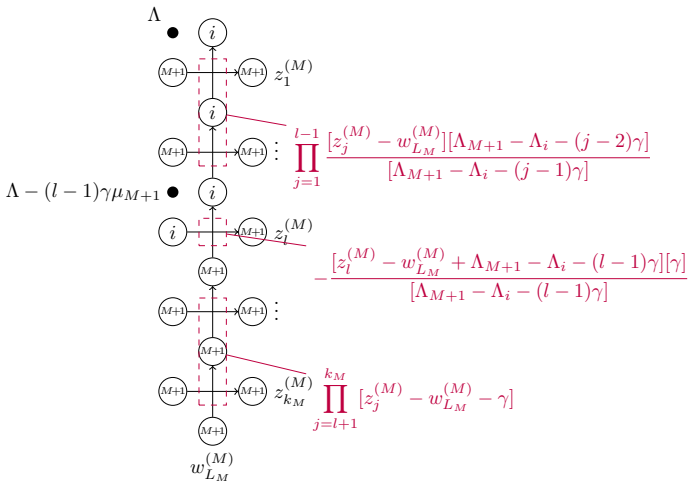
The load-bearing object is the nested Izergin–Korepin analysis—a recursion scheme that determines a partition function from structural properties—together with the extended weight functions $W$. The partition function $\psi$ is shown to satisfy a Korepin lemma: a top-layer degree bound (or, in the elliptic case, elliptic-polynomial quasi-periods), symmetry in the auxiliary variables, two recursion relations depending on whether the top right boundary colour is $M+1$, and an initial condition that reduces the top layer to a known $\mathfrak{gl}_M$ partition function. The extended weight functions $W$—nested multisymmetric sums over permutations $\sigma_1,\ldots,\sigma_M$ with rational, trigonometric, or $\theta$-function factors—are then checked against exactly these same properties, so uniqueness of the characterization yields $\psi = W$. In the elliptic case the uniqueness step rests on an elliptic interpolation theorem (Proposition 3.1), which identifies an elliptic polynomial of degree $k_M$ from its values at $k_M$ points.
What would settle it
Evaluate both sides of (38) for the smallest case with left and right boundary sites, say $M=2$, $L^I_1 = L^{II}_1 = 1$, $k_2=1$, at a generic point not among the interpolation values; any mismatch in the values, or any failure of the weight function $W$ to satisfy the quasi-periodicity (31) under $w^{(M)}_{L_M} \to w^{(M)}_{L_M} + \tau$, would disprove the elliptic theorem.
Extended reading notes
Core claim
On the paper's own terms, the central discovery is that the partition function $\psi$ defined graphically from the R-matrix is not merely characterized recursively but is identically equal to the extended weight function $W$: $\psi = W$ for every configuration allowed by the labelling of the paper, including configurations with nonempty left and right boundary sites $y^{(j)}_I, y^{(j)}_{II}$ at each intermediate level. Here $W$ is an explicit multisymmetric function given as a nested sum over permutations of the auxiliary spectral variables, with factors built from the rational, trigonometric, or elliptic R-matrix weights. In the elliptic case the identity is proved with the help of an elliptic Lagrange interpolation uniqueness statement, and in the boundary-free special case the elliptic $W$ reduces to the previously known elliptic weight functions. The paper thus presents a unified treatment of all three R-matrix types.
Load-bearing premise
The proof's load-bearing premise is uniqueness: the stated degree bound (or elliptic quasi-periods), symmetry, recursion relations and initial condition must single out exactly one function, and in the elliptic case the quasi-periods (30)–(31) must be exactly right for the interpolation theorem to apply.
Editorial extensions
If this is right
- With $\psi = W$ established, every partition function in this family has a closed multisymmetric expression, so off-shell nested Bethe wavefunctions can be studied by manipulating $W$ directly.
- Setting all left and right boundary sets empty recovers the original partition functions of the prior work as a special case, so the new formulas strictly generalize that construction.
- For the elliptic case with no intermediate boundary sites, $W$ reduces to the previously known elliptic weight functions, giving a lattice-model derivation of those special functions.
- The same nested Korepin-lemma scheme works uniformly for the rational, trigonometric and elliptic R-matrices, so one proof template covers all three regimes.
Reading between the lines
- One testable consequence left implicit: because $W$ is explicitly multisymmetric, one could attempt to derive determinant or contour-integral representations for these partition functions, in analogy with scalar-product formulas; the paper does not carry that out.
- The elliptic quasi-periods (30)–(31) are proved for $\psi$ but not independently checked for $W$; a symbolic verification of those exact quasi-periods for $W$ would close the last gap in the elliptic uniqueness argument.
- The conclusion's suggestion of supersymmetric analogues gives a direct route: re-running the nested Korepin lemma with supersymmetric R-matrices should produce $\mathfrak{gl}_{M+1|N}$ weight functions, though that is not done here.
- The possible link to stable bases and quiver varieties, mentioned as future work, would let these partition functions serve as explicit formulas for stable-envelope classes beyond the boundary-free cases.
Signed reviews
Editorial analysis
A structured set of objections, weighed in public.
Referee Report
Summary. The paper introduces a family of gl_{M+1} lattice partition functions that extend the Foda-Manabe construction by adding left and right boundary quantum spaces at every level. For the rational, trigonometric, and elliptic R-matrices, the authors state a nested Korepin lemma and use it to characterize the partition function, then propose explicit extended multisymmetric weight functions W and claim ψ = W (Theorems 2.3, 2.9, and 3.4). The rational case is supported by detailed computations in Propositions 2.4–2.6; the trigonometric case is stated to follow by the same strategy; the elliptic case is summarized with a brief proof sketch. Section 4 specializes the elliptic formulas and compares them with elliptic weight functions of Konno and Rimányi–Tarasov–Varchenko.
Significance. If the main identities hold, the paper gives explicit multisymmetric formulas for a substantially enlarged class of gl_{M+1} partition functions and unifies the rational, trigonometric, and elliptic weight-function families. The rational proof is concrete and the special-case comparison in Section 4 is a useful contribution. The elliptic claim is, however, not currently established: the essential quasi-periodicity check for the candidate function W is missing, and the manuscript also contains a discrepancy in the displayed elliptic recursion. These are localized and fixable issues, but they are load-bearing for the central theorem, so I cannot recommend acceptance in the present form.
major comments (4)
- [§3, Theorem 3.4] The elliptic uniqueness argument is incomplete. Proposition 3.1 can be applied only if both the partition function and the explicit candidate function W lie in Θ_{k_M}(χ) with the same quasi-periods. Proposition 3.2 establishes the quasi-periods (30)–(31) for ψ, but the proof of Theorem 3.4 says only that the proof is 'the same as the rational/trigonometric case' and then lists relations among the C^{(p)} symbols for Properties 3–5. No verification is given that the function defined by (37), as a function of w^{(M)}_{L_M}, satisfies (30)–(31). This is not a cosmetic omission: the interpolation step uses exactly k_M point evaluations, and a different γ-shift in the character would make Proposition 3.1 inapplicable. Please add the explicit computation of W(w^{(M)}_{L_M}+1) and W(w^{(M)}_{L_M}+τ) from (37), or give a self-contained induction proving the quasi-periodicity.
- [§3, Proposition 3.2, Eq. (32)] The displayed recursion coefficient in (32) does not match the derivation in the proof. The proof ends with the factor -[Λ_{M+1}-Λ_i+γ][γ] / [Λ_{M+1}-Λ_i-(k_M-L_M)γ], which is equal to [γ][λ_{M+1}-λ_i+γ(k_M-L_M+C^{(M)}(L_I,i))] / [λ_i-λ_{M+1}+γ(1-C^{(M)}(L_I,i))]. Equation (32) instead writes [γ] divided by the product of these two theta brackets. As written, the printed recursion differs from the derived one by a factor of [λ_{M+1}-λ_i+γ(k_M-L_M+C^{(M)}(L_I,i))]^2. Since this recursion is part of the data used in the uniqueness argument, the formula must be corrected or an explanation must be given for the missing cancellation.
- [§3, Definition 3.3 and Theorem 3.4] The notation in the elliptic case is inconsistent. Definition 3.3 presents formula (37) with the symbol ψ on the left-hand side and calls it the extended elliptic weight function, while Theorem 3.4 states ψ = W. As printed, W is never defined for the elliptic case, so the theorem is ill-posed or tautological. Presumably (37) is intended to define W; please fix the notation consistently throughout Section 3 and in the statement of Theorem 3.4.
- [§2.5, Theorem 2.9] The trigonometric theorem is not actually proved in the text. The statement that the strategy is identical to the rational case is not a proof, because the q-dependent R-matrix (14) changes the weights and the specialization point v^{(M)}_{L_M}=q^{-1}u^{(M)}_{k_M} in Property 3 of Proposition 2.7. The analogues of Propositions 2.4–2.6 for the function (19) are not stated. I recommend either providing the trigonometric recursion proofs or giving a precise reduction showing that the rational computations apply verbatim to (14)–(19).
minor comments (4)
- [§3, Proposition 3.1] The interpolation condition after the points y_j is misprinted: 'P k y_k − α' should presumably be '∑_k y_k − α ∉ Γ'.
- [§3, proof of Proposition 3.2] In the proof of Property 4 or 5 there is a typo 'L_I^{M1}' in the sentence about I^{(M)}_{k_M}; it should be 'L_I^{M-1}' or similar.
- [§2, proof of Proposition 2.4] The displayed equations in Step 1 contain strikethrough/cancelled factors; the camera-ready version should remove these editorial marks.
- [§4] The equivalence of (40) with the Konno and Rimányi–Tarasov–Varchenko formulas is shown by a dictionary between symbols and a statement that the expressions are equivalent; please add at least a short explanation of why the unordered multisets of summands and the theta arguments coincide after the stated relabellings.
Circularity Check
No substantive circularity: the identity ψ = W is proved through independent Korepin properties; only a notation collision and an omitted elliptic quasi-period check are flagged as non-circular caveats.
full rationale
The paper's central identity ψ = W is not circular. The partition function ψ is defined from the lattice R-matrix diagram, and the candidate W is defined independently as a multisymmetric sum over permutations (Definition 2.2). Theorem 2.3 is proved by checking that W satisfies exactly the nested Korepin characterization of ψ from Proposition 2.1: the degree bound and x^{(M)}-symmetry are immediate, and Propositions 2.4–2.6 verify the two recursion relations and the initial condition; these properties determine the partition function by the nested induction described in §2.3. Thus the equality does not assume its conclusion. The trigonometric case is the same argument in u/v variables, and the elliptic case is intended to repeat it. No parameter is fitted to data, and no prediction is a fitted input renamed. The only self-citations ([30], [33], [69]) concern earlier special cases or the authors' prior Bethe-ansatz work; the elliptic interpolation uniqueness theorem (Proposition 3.1) is an external Felder–Schorr result, not an imported self-theorem, so the elliptic uniqueness step does not reduce to a self-citation. Two caveats are worth flagging, though neither is circularity: (i) Theorem 3.4 is proved only by the sentence 'The proof is the same as the rational/trigonometric case', and the manuscript does not explicitly verify that the explicit elliptic function (37) lies in Θ_{k_M}(χ) with the quasi-periods (30)–(31) required by Proposition 3.1; this is an omitted check, not a definitional identification. (ii) In Definition 3.3 the explicit function is printed with the symbol ψ, while Theorem 3.4 prints ψ = W, so taken literally the elliptic statement is self-referential; the surrounding text and Section 4 make the intended reading unambiguous. These are correctness/completeness or typographical issues, not evidence that the derivation reduces to its inputs.
Assumptions & free parameters
assumptions (4)
- domain assumption The rational, trigonometric, and elliptic R-matrices satisfy the Yang-Baxter equation (2), (15), and the dynamical Yang-Baxter equation (25).
- standard math Elliptic Lagrange interpolation theorem (Proposition 3.1, cited from [59]).
- domain assumption Ice rule (color conservation) at each vertex of the lattice model.
- domain assumption The partition function is well-defined for arbitrary orderings of auxiliary spectral variables due to Yang-Baxter.
Cite this review
Pith. "Pith review of Higher rank elliptic partition functions and multisymmetric elliptic functions." pith.science (2026). https://pith.science/paper/QE4A33GO
@misc{pith2026241213561,
  author       = {Pith},
  title        = {Pith review of: Higher rank elliptic partition functions and multisymmetric elliptic functions},
  year         = {2026},
  howpublished = {\url{https://pith.science/paper/QE4A33GO}},
  note         = {Machine review of arXiv:2412.13561}
}
abstract
We introduce and investigate a class of $\mathfrak{gl}_{M+1}$ partition functions which is an extension of the one introduced by Foda-Manabe. We characterize the partition functions by a nested version of Izergin-Korepin analysis, and determine the explicit forms, for each of the rational, trigonometric and elliptic versions. The resulting multisymmetric functions can be regarded as extensions of the rational, trigonometric and elliptic weight functions.
Figures


Figures from the paper (14 more)



Reference graph
Works this paper leans on
-
[1]
Bethe, Z
H. Bethe, Z. Phys. 71, 205 (1931)
1931
-
[2]
Baxter, Exactly Solved Models in Statistical Mechanics (Academic Press, London, 1982)
R.J. Baxter, Exactly Solved Models in Statistical Mechanics (Academic Press, London, 1982)
work page 1982
-
[3]
V.E. Korepin, N.M. Bogoliubov and A.G. Izergin Quantum Inverse Scattering Method and Correlation functions (Cambridge University Press, Cambridge, 1993)
work page 1993
- [4]
- [5]
- [6]
- [7]
- [8]
Show all 69 references
-
[9]
Brubaker, D
B. Brubaker, D. Bump and S. Friedberg, Commun. Math. Phys. 308, 281 (2011)
2011
-
[10]
Tarasov and A
V. Tarasov and A. Varchenko, SIGMA 9, 048 (2013)
2013
-
[11]
Betea, M
D. Betea, M. Wheeler and P. Zinn-Justin, J. Alg. Comb. 42, 555 (2015)
2015
-
[12]
Borodin and L
A. Borodin and L. Petrov, Sel. Math. New Ser. 24 751 (2016)
2016
-
[13]
van Diejen and E
J.F. van Diejen and E. Emsiz, Commun. Math. Phys. 350, 1017 (2017)
2017
-
[14]
Borodin, Adv
A. Borodin, Adv. in Math. 306, 973 (2017)
2017
-
[15]
Takeyama, Funkcialaj Ekvacioj, 61, 349 (2018)
Y. Takeyama, Funkcialaj Ekvacioj, 61, 349 (2018)
2018
-
[16]
Brubaker, V
B. Brubaker, V. Buciumas, D. Bump and N. Gray, Comm. Numb. Theor. Phys. 13, 101 (2019)
2019
-
[17]
Foda and M
O. Foda and M. Manabe, J. High Energ. Phys. 2019, 36 (2019)
2019
-
[18]
Borodin and M
A. Borodin and M. Wheeler, Ast´ erisque, 437 (2022)
2022
-
[19]
Brubaker, C
B. Brubaker, C. Frechette, A. Hardt, E. Tibor and K. Weber, Alg. Comb. 6, 789 (2023)
2023
-
[20]
Felder and A
G. Felder and A. Varchenko, Nucl. Phys. B, 480, 485 (1996)
1996
-
[21]
Tarasov and A
V. Tarasov and A. Varchenko, Ast´ erisque,246 (1997)
1997
-
[22]
Pakuliak, V
S. Pakuliak, V. Rubtsov and A. Silantyev, J. Phys. A:Math. Theor. 41, 295204 (2008)
2008
-
[23]
Rosengren, Adv
H. Rosengren, Adv. Appl. Math. 43, 137 (2009)
2009
-
[24]
Filali and N
F. Filali and N. Kitanine, J. Stat. Mech. L06001 (2010)
2010
-
[25]
W-L. Yang, X. Chen, J. Feng, K. Hao, K-J. Shi, C-Y. Sun, Z-Y. Yang and Y-Z. Zhang, Nucl. Phys. B 847, 367 (2011)
2011
-
[26]
W-L. Yang, X. Chen, J. Feng, K. Hao, K. Wu, Z-Y. Yang and Y-Z. Zhang, Nucl. Phys. B 848, 523 (2011)
2011
-
[27]
W.Galleas, Nucl. Phys. B 858, 117 (2012)
2012
-
[28]
Galleas, J
W. Galleas, J. Lamers, Nucl. Phys. B 886, 1003 (2014)
2014
-
[29]
Lamers, Nucl
J. Lamers, Nucl. Phys. B 901, 556 (2015)
2015
-
[30]
Motegi, J
K. Motegi, J. Math. Phys. 59, 053505 (2018)
2018
-
[31]
Aggarwal, Sel
A. Aggarwal, Sel. Math. New Ser. 24, 2659 (2018)
2018
-
[32]
Borodin, J
A. Borodin, J. Eur. Math. Soc. 22, 1353 (2020)
2020
-
[33]
Motegi, J
K. Motegi, J. Math. Phys. 61, 053507 (2020)
2020
-
[34]
Matsuo, Comm
A. Matsuo, Comm. Math. Phys. 157, 479 (1993)
1993
-
[35]
Tarasov and A
V. Tarasov and A. Varchenko, Leningrad Math. J. 6, 275 (1994)
1994
-
[36]
Mimachi, Duke Math.J
K. Mimachi, Duke Math.J. 85, 635 (1996). 29
1996
-
[37]
Rim´ anyi, V
R. Rim´ anyi, V. Tarasov and A. Varchenko, J. Geom. Phys.94, 81 (2015)
2015
-
[38]
Shenfeld, Abelianization of Stable Envelopes in Symplectic Resolutions, PhD thesis, Princeton, 2013
D. Shenfeld, Abelianization of Stable Envelopes in Symplectic Resolutions, PhD thesis, Princeton, 2013
2013
- [39]
- [40]
-
[41]
N. Yu. Reshetikhin, J. Sov. Math. 46, 1694 (1989)
1989
-
[42]
Smirnov, Sel
A. Smirnov, Sel. Math. New Ser. 26, 1 (2020)
2020
-
[43]
Konno, J
H. Konno, J. Int. Syst. 2, xyx011 (2017)
2017
-
[44]
Konno, J
H. Konno, J. Int. Syst. 3, xyy012 (2018)
2018
-
[45]
Felder, R
G. Felder, R. Rim´ anyi and A. Varchenko, SIGMA14, 41 (2018)
2018
-
[46]
Rim´ anyi, V
R. Rim´ anyi, V. Tarasov and A. Varchenko, Sel. Math.25, 16 (2019)
2019
-
[47]
Aganagic and A
M. Aganagic and A. Okounkov, J. Amer. Math. Soc. 34, 79 (2021)
2021
-
[48]
Maulik and A
D. Maulik and A. Okounkov, Quantum groups and quantum cohomology, Ast´ erisque, 408 (2019)
2019
-
[49]
Nekrasov and S
N. Nekrasov and S. Shatashvili, Nucl. Phys. Proc. Supp. 192-193, 91 (2009)
2009
-
[50]
Nekrasov and S
N. Nekrasov and S. Shatashvili, Prog. Theor. Phys. Supp. 177, 105 (2009)
2009
-
[51]
Wheeler, Nucl
M. Wheeler, Nucl. Phys. B 852, 468 (2011)
2011
-
[52]
Slavnov, Theor
N.A. Slavnov, Theor. Math. Phys. 79, 502 (1989)
1989
-
[53]
V. G. Drinfeld, Soviet Math. Dokl. 36, 212 (1988)
1988
-
[54]
M. Jimbo. Lett. Math. Phys. 10, 63 (1985)
1985
-
[55]
Reshetikhin, L.A
N.Y. Reshetikhin, L.A. Takhtadzhyan and L.D. Faddeev. Algebra i Analiz 1, 178 (1989)
1989
-
[56]
Felder, Elliptic quantum groups
G. Felder, Elliptic quantum groups. In: Iagolnitzer, D. (ed.) Proceedings of the ICMP, Paris 1994, pp. 211-218. Intern. Press, Cambridge, MA (1995)
1995
-
[57]
Felder and A
G. Felder and A. Varchenko, Comm. Math. Phys. 181, 741 (1996)
1996
-
[58]
Cavalli, On representations of the Elliptic Quantum Group Eγ,τ (glN ), PhD thesis, 2001, ETH Z¨ urich
A. Cavalli, On representations of the Elliptic Quantum Group Eγ,τ (glN ), PhD thesis, 2001, ETH Z¨ urich
2001
-
[59]
Felder and A
G. Felder and A. Schorr, J. Phys. A: Math.Gen. 32, 8001 (1999)
1999
-
[60]
Andrews, R.J
G.E. Andrews, R.J. Baxter and P.J. Forrester, J. Stat. Phys. 35, 193 (1984)
1984
-
[61]
Baxter, Ann
R.J. Baxter, Ann. Phys. 70, 193 (1972)
1972
-
[62]
O. Foda, K. Iohara, M. Jimbo, R. Kedem, T. Miwa and H. Yan, Lett. Math. Phys. 32, 259 (1994)
1994
-
[63]
Fronsdal, Lett
C. Fronsdal, Lett. Math. Phys. 40, 117 (1997)
1997
-
[64]
Konno, Comm
H. Konno, Comm. Math. Phys. 195, 373 (1998)
1998
-
[65]
Jimbo, H
M. Jimbo, H. Konno, S. Odake and J. Shiraishi, Trans. Groups. 4, 303 (1999)
1999
-
[66]
E. Date, M. Jimbo, A. Kuniba, T. Miwa and M. Okado, Nucl. Phys.B 290, 231 (1987)
1987
-
[67]
Jimbo, A
M. Jimbo, A. Kuniba, T. Miwa and M. Okado, Comm. Math. Phys. 119, 543 (1988)
1988
-
[68]
Liashyk and S
A. Liashyk and S. Z. Pakuliak. ‘Algebraic Bethe Ansatz for o2n+1-Invariant Integrable Models’. Theor. and Math. Phys. 206, no. 1 (2021): 19–39
2021
-
[69]
Gerrard and V
A. Gerrard and V. Regelskis. ‘Nested Algebraic Bethe Ansatz for Deformed Orthogonal and Symplectic Spin Chains’. Nucl. Phys. B 956C. (2020) 30
2020
Reviewed August 11, 2026 · model on record in the stance chip above.
Discussion (0). Continue with ORCID to comment.