REVIEW 3 major objections 5 minor 23 references
Progress in lattice simulations for two Higgs doublet models
T0 review · 3 major / 5 minor · reviewed 2026-08-11 · deepseek-v4-flash
Pith's one-line read On a line of constant Standard-Model physics, the custodial two-Higgs-doublet model with weak quartic couplings allows an extra neutral scalar H with mass about 0.2 times the W boson mass, and this ratio does not change as the lattice…
desk verdict First lattice line-of-constant-physics study of the inert/custodial 2HDM, with a striking low-mass claim that needs a finite-volume check before I'd trust it. read the letter →
The pith
A machine-rendered reading of the paper's core claim, the machinery that carries it, and where it could break.
The reading
What carries the argument
The argument is carried by a line of partially constant physics (LPCP) in the bare parameter space of the lattice action. The SM sector is tuned at each bare gauge coupling $\beta$ by adjusting $\kappa_2,\eta_2$ so that $R\equiv m_h/m_W\approx1.5$ and the gradient-flow renormalized gauge coupling satisfies $g^2_{GF}(\mu=m_W)=0.5$ (equivalently $\sqrt{8t_0}\,m_W=1.0$); all BSM couplings $\kappa_1,\eta_1,\eta_3,\eta_4,\eta_5$ are held fixed at small values. The spectrum is read from two-point functions of composite operators that separate the SM Higgs and W boson from the BSM states $H,A,H^\pm$. The BSM scan then varies $\kappa_1$ within the $\mathbf{H}_2$ phase while monitoring $R$ and $S$ to check that SM physics is unchanged.
What would settle it
On the same five lattice spacings, re-tune $\kappa_2$ and $\eta_2$ for each $\kappa_1$ value so that $R$ and $S$ match the target values to much higher precision, then check whether $m_H/m_W$ still approaches $0.2$ and remains cutoff independent. If the plateau shifts or disappears, the reported lower bound is an artifact of the LPCP tuning rather than a property of the model with constant SM physics.
Extended reading notes
Core claim
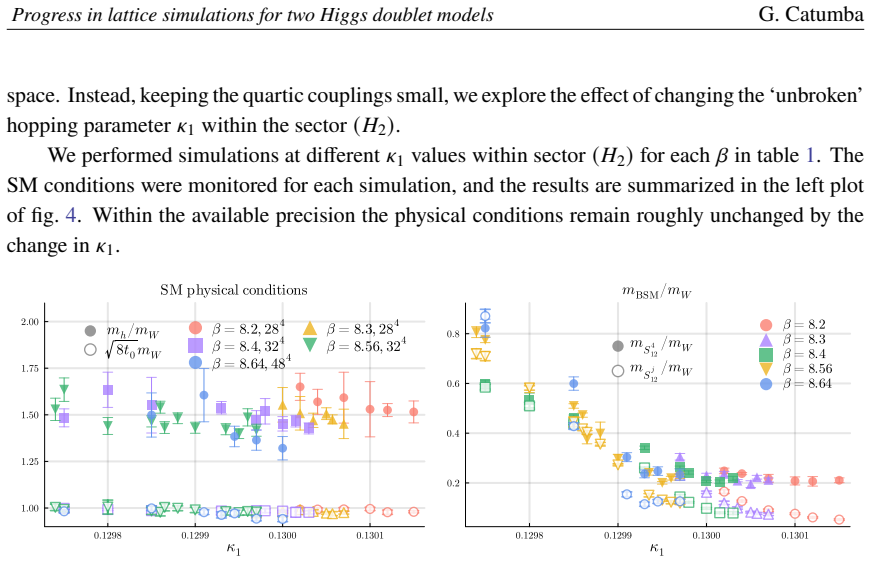
The central discovery is that the custodial inert two-Higgs-doublet model on the lattice admits a BSM neutral scalar whose mass ratio $m_H/m_W$ saturates at roughly $0.2$ before the transition into the phase where both doublets condense, and this saturation is independent of the lattice cutoff over $300$--$630$ GeV. Along the same line of constant SM physics the heavier states $A$ and $H^\pm$ behave differently: $m_A/m_W = m_{H^\pm}/m_W$ keeps decreasing as the hopping parameter $\kappa_1$ is raised, so the mass gap between $H$ and $A/H^\pm$ widens. Because the SM conditions $R=m_h/m_W\approx1.5$ and $g^2_{GF}(m_W)=0.5$ are fixed at each cutoff, the light $H$ is a property of a theory that still looks like the SM in the Higgs-gauge sector.
Load-bearing premise
The whole construction rests on the assumption that the BSM sector is 'mostly insensitive' to the SM sector, so that scanning $\kappa_1$ while keeping all other BSM couplings fixed leaves the line of constant SM physics intact; the paper verifies only that $R$ and $S$ stay roughly constant, not that small mistunings would leave the BSM mass ratios unchanged.
Editorial extensions
If this is right
- A neutral inert-doublet scalar $H$ with $m_H\simeq 0.2\,m_W$ can coexist with SM-like Higgs and W masses in a weakly coupled custodial 2HDM.
- The cutoff independence of the ratio justifies calling $\sim0.2\,m_W$ a non-perturbative lower bound of the H mass for the chosen couplings.
- $m_A/m_W=m_{H^\pm}/m_W$ keeps falling toward the W as $\kappa_1$ approaches the $\mathbf{H}_{12}$ transition, so the H--A mass splitting grows along the LPCP.
- The gradient-flow running gauge coupling collapses onto one curve over a wide energy range, matching one-loop massless running at high energy and a screened Yukawa form at low energy.
- At small quartic couplings the electroweak transition is a crossover, with no volume dependence in the susceptibility peak; the transition sits near $m_W/T_c\sim0.5$.
- If the $\sim0.2\,m_W$ plateau survives a fully retuned LPCP, the model predicts a $\sim16$ GeV neutral scalar that lies within reach of low-energy collider and Higgs-decay searches, a target the paper does not discuss.
- A natural next step is to repeat the $\kappa_1$ scan with larger $\eta_3$ or $\eta_4$, since the paper notes these couplings must be $O(1)$ for a strong first-order transition; the light-H plateau may move or disappear in that regime, which would change the phenomenology.
- The partially constant physics line fixes only SM quantities; an extension that also matches a BSM renormalized quantity would test whether the H-mass bound is an accident of the tuning strategy.
Editorial analysis
A structured set of objections, weighed in public.
Referee Report
Summary. The manuscript reports exploratory lattice simulations of the custodial/inert two-Higgs-doublet model with SU(2) gauge fields. It defines a line of partially constant physics (LPCP) by fixing R = m_h/m_W ≈ 1.5 and g_GF^2(m_W) = 0.5, with cutoffs Λ ranging from about 300 to 630 GeV. Along this line the authors compute the SM spectrum, the gradient-flow running gauge coupling, the BSM mass ratios m_H/m_W and m_A/m_W as functions of the unbroken hopping parameter κ1, and the finite-temperature susceptibility of the Higgs angular variable. The central claim, stated in the abstract and Section 5, is that for small BSM quartic couplings the lighter BSM scalar has m_H ~ 0.2 m_W and that this value is independent of the cutoff.
Significance. If established, the main result would be a non-perturbative counterpoint to typical tree-level expectations: a weakly coupled 2HDM could contain a BSM scalar considerably lighter than the W boson, which is relevant for model building and for future searches. The paper also provides useful first lattice data on the running coupling and on the screening mass in this model. Strengths include the use of two independent SM quantities to define the LPCP, the gradient-flow definition of the coupling, and the clear description of the parameter space sectors. The principal limitations are the absence of a quoted uncertainty for the central m_H ~ 0.2 m_W value and the lack of any finite-volume test for the BSM spectrum; as a result the claim is plausible but not yet demonstrated to the standard needed for a quantitative mass bound.
major comments (3)
- [Abstract; Section 4, Fig. 4 (right); Section 5] The central claim m_H ~ 0.2 m_W is quoted without any uncertainty in the abstract and conclusion, and Fig. 4 (right) is not accompanied by a table of the plateau values or fit errors. Since the LPCP tuning quantities R and S in Table 1 carry relative errors of several percent, and the mass ratios are derived from correlator fits on finite statistics, the statement that the value is 'independent of the cutoff' needs numerical values with errors, e.g. m_H/m_W = 0.21(3) for each β. Without an explicit error budget and a χ²/dof for the plateau, the abstract overstates the precision of the result.
- [Section 4, Table 1 and Eq. (3)] No finite-volume study of the BSM two-point functions is reported. For the claimed m_H/m_W ~ 0.2, the five LPCP points have m_H L ~ 1.7, 1.5, 1.3, 0.94 and 1.2 (using m_W L from Table 1). These values are in a regime where finite-volume corrections to a ground-state mass extracted from a zero-momentum correlator can be substantial, and the volumes change together with β (L = 28, 28, 32, 32, 48). A volume dependence test at one or two β values, or at least an estimate of the expected finite-volume shift, is a prerequisite for the claim that the plateau in Fig. 4 (right) is a cutoff-independent physical mass rather than a finite-volume artifact.
- [Section 3 and Section 4, Fig. 4 (left)] The LPCP fixes only R and g_GF, while the BSM bare couplings are held fixed, and the paper assumes that the BSM sector is 'mostly insensitive' to SM physics. The evidence shown is a coarse monitoring of R and S under the κ1 scan. Table 1 shows that R varies from 1.462(53) to 1.527(80), so the line is not tuned exactly to R = 1.5. If m_H/m_W depends on the residual deviations from the LPCP or on R itself, the plateau could be an artifact of an incompletely tuned constant-physics line. The authors should quantify the insensitivity, for example by varying η3 or R at one β and demonstrating that m_H/m_W shifts by less than the quoted statistical error.
minor comments (5)
- [Abstract; Fig. 1; Conclusion] Several typographical errors should be corrected: 'bellow' in the abstract should be 'below', 'cutodial' in the Fig. 1 caption should be 'custodial', 'scaning' in the conclusion should be 'scanning', and 'LCPC' in the discussion of Fig. 4 should be 'LPCP'.
- [References] Reference [12] has a formatting error: '1604 [1410.2740]' should be '1604 (2016) [arXiv:1410.2740]' or similar.
- [Fig. 4 caption] The left panel caption should explicitly define which quantities are plotted (R and S) and explain the marker types and the meaning of the shaded bands, so that the figure is self-contained.
- [Section 4, screening mass discussion] The sentence reporting m_screen ≈ 50 GeV should carry a caveat in the main text (not only in footnote 3) that the screening mass depends on the assumed Yukawa form and on the scheme, since the text later uses this value without further qualification.
- [Section 2, Eq. (2)] The notation 2μ^2 Tr(Φ1†Φ2) for the bare mass-mixing term is easily confused with the renormalization scale μ used later; renaming this bare parameter, e.g. as μ12^2, and stating its relation to the parameters in Eq. (1) would improve clarity.
Circularity Check
No significant circularity: the BSM mass ratios are measured outputs of a scan after fixing the LPCP, and no fitted parameter is renamed as a prediction.
full rationale
The paper's central claim, m_H ~ 0.2 m_W independent of the cutoff, is a measured output rather than an input. The line of partially constant physics is defined by fixing R = m_h/m_W and g_GF^2(m_W) = 0.5 (Eq. 5), while the BSM bare couplings kappa1, eta1, eta3, eta4, eta5 are held fixed. The BSM spectrum is then extracted from two-point functions (Eq. 3) at different kappa1 values, and the resulting m_H/m_W and m_A/m_W ratios are reported as data in Fig. 4. Nothing in the defining equations forces m_H/m_W to equal 0.2; the plateau is an empirical feature of the data. The only calibrated step in the paper is matching the perturbative running coupling to the Lambda = 628 GeV curve at mu ~ 3.5 m_W, which is explicitly disclosed and is not used to set or infer m_H/m_W. The screening-mass fit from the Yukawa potential is also scheme-dependent and disclosed as such. The self-citations present in the paper (e.g., refs. [13] and [23]) are used for physics motivation or as methodological background, not as load-bearing support for the central spectrum result. Possible concerns about finite-volume floors or incomplete tuning of the line of constant physics are correctness or systematic-error issues, not circularity. The derivation chain is therefore self-contained in the relevant sense.
Assumptions & free parameters
free parameters (4)
- kappa1 (unbroken hopping parameter) =
0.1245 (fixed), scanned up to kappa_c1
- BSM quartic couplings eta1, eta3, eta4, eta5 =
0.003, 0.002, 0.0001, 0.0001
- kappa2 and eta2 per beta (LPCP tuning) =
Table 1: 0.13175-0.129985 and 0.00338-0.002737
- m_screen (Yukawa screening mass) =
0.6243(28) m_W
assumptions (5)
- domain assumption The inert/custodial limit defined by mu12 = lambda6 = lambda7 = 0 and lambda4 = lambda5 has the same global symmetry structure as the SM.
- domain assumption The H12 phase, where both Higgs fields acquire vevs, is excluded from phenomenological consideration because it spontaneously breaks custodial symmetry and contains massless Goldstone bosons.
- domain assumption The interpolators S22, W22, S12, W12 in Eq. (3) excite the states identified as h, W, H, A/H+/- with the corresponding perturbative quantum numbers.
- standard math The gradient-flow coupling defined in Eq. (5) with the perturbative prefactor 128 pi^2/9 provides a valid renormalized running coupling.
- domain assumption The confinement and Higgs phases of the single-doublet Higgs-gauge system are analytically connected.
Cite this review
Pith. "Pith review of Progress in lattice simulations for two Higgs doublet models." pith.science (2026). https://pith.science/paper/DS3D5PAO
@misc{pith2026241213896,
  author       = {Pith},
  title        = {Pith review of: Progress in lattice simulations for two Higgs doublet models},
  year         = {2026},
  howpublished = {\url{https://pith.science/paper/DS3D5PAO}},
  note         = {Machine review of arXiv:2412.13896}
}
abstract
The custodial Two-Higgs-Doublet-Model with SU(2) gauge fields is studied on the lattice. This model has the same global symmetry structure as the Standard Model but the additional Higgs field enlarges the scalar spectrum and opens the possibility for the occurrence of spontaneous symmetry breaking of the global symmetries. Both the spectrum and the running of the gauge coupling of the custodial 2HDM are studied on a line of constant Standard Model physics with cutoff ranging from 300 to 600 GeV. The lower bounds of the realizable masses for the additional BSM scalar states are found to be well bellow the W boson mass. In fact, for the choice of quartic couplings in this work the estimated lower mass for one of the BSM states is found to be about $\sim 0.2m_{W}$ and independent of the cutoff.
Figures


Figures from the paper (2 more)

Reference graph
Works this paper leans on
- [1]
-
[2]
M. D’Onofrio and K. Rummukainen,Standard model cross-over on the lattice, Physical Review D93(2016)
work page 2016
-
[3]
Ma,Verifiable radiative seesaw mechanism of neutrino mass and dark matter, Phys
E. Ma,Verifiable radiative seesaw mechanism of neutrino mass and dark matter, Phys. Rev. D 73(2006) 077301 [hep-ph/0601225]
arXiv 2006
-
[4]
R. Barbieri, L.J. Hall and V.S. Rychkov,Improved naturalness with a heavy higgs boson: An alternative road to cern lhc physics,Physical Review D74(2006)
work page 2006
-
[5]
L.L. Honorez, E. Nezri, J.F. Oliver and M.H.G. Tytgat,The Inert Doublet Model: an Archetype for Dark Matter,J. Cosmol. Astropart. Phys.2007(2007) 028
work page 2007
-
[6]
H.E. Haber and G.L. Kane,The Search for Supersymmetry: Probing Physics Beyond the Standard Model,Phys. Rept.117 (1985) 75
work page 1985
-
[7]
H.E. Haber and R. Hempfling,Renormalization-group-improved Higgs sector of the minimal supersymmetric model, Phys. Rev. D48(1993) 4280
work page 1993
-
[8]
H.E. Haber and D. O’Neil,Basis-independent methods for the two-higgs-doublet model. iii. the cp-conserving limit, custodial symmetry, and the oblique parameters s , t , u, Physical Review D83(2011)
work page 2011
Show all 23 references
-
[9]
O’Neil,Phenomenology of the Basis-Independent CP-Violating Two-Higgs Doublet Model [Dissertation], Ph.D
D. O’Neil,Phenomenology of the Basis-Independent CP-Violating Two-Higgs Doublet Model [Dissertation], Ph.D. thesis, UC, Santa Cruz, Phys. Dept., 6, 2009.0908.1363
2009
-
[10]
Branco, P
G. Branco, P. Ferreira, L. Lavoura, M. Rebelo, M. Sher and J.P. Silva,Theory and phenomenology of two-Higgs-doublet models, Physics Reports516(2012) 1
2012
-
[11]
Lewis and R.M
R. Lewis and R.M. Woloshyn,Spontaneous symmetry breaking in a two-doublet lattice Higgs model, Phys. Rev. D82(2010) 034513
2010
-
[12]
Maas,Observables in Higgsed Theories, Nucl
A. Maas,Observables in Higgsed Theories, Nucl. Part. Phys. Proc.273-275(2016) 1604 [1410.2740]. 9 Progress in lattice simulations for two Higgs doublet models G. Catumba
2016 arXiv
-
[13]
Hou,Tree level𝑡→𝑐ℎ 0 orℎ0→𝑡𝑐 decays, Physics Letters B296 (1992) 179
W.-S. Hou,Tree level𝑡→𝑐ℎ 0 orℎ0→𝑡𝑐 decays, Physics Letters B296 (1992) 179
1992
-
[14]
Hou and M
W.-S. Hou and M. Kikuchi,Approximate alignment in two-higgs-doublet model with extra yukawa couplings, Europhysics Letters123 (2018) 11001
2018
-
[15]
L.Fromme, S.J.HuberandM.Seniuch, Baryogenesisinthetwo-Higgsdoubletmodel ,JHEP 11 (2006) 038 [hep-ph/0605242]
2006 arXiv
-
[16]
Dorsch, S.J
G.C. Dorsch, S.J. Huber and J.M. No,A strong electroweak phase transition in the 2HDM after LHC8,J. High Energ. Phys.2013(2013) 29
2013
-
[17]
Basler, M
P. Basler, M. Krause, M. Muhlleitner, J. Wittbrodt and A. Wlotzka,Strong First Order Electroweak Phase Transition in the CP-Conserving 2HDM Revisited, J. High Energ. Phys. 2017 (2017) 121
2017
-
[18]
Bernon, L
J. Bernon, L. Bian and Y. Jiang,A new insight into the phase transition in the early Universe with two Higgs doublets, J. High Energ. Phys.2018 (2018) 151
2018
-
[19]
Lüscher,Properties and uses of the wilson flow in lattice qcd,Journal of High Energy Physics 2010 (2010)
M. Lüscher,Properties and uses of the wilson flow in lattice qcd,Journal of High Energy Physics 2010 (2010)
2010
-
[20]
Lüscher and P
M. Lüscher and P. Weisz,Perturbative analysis of the gradient flow in non-abelian gauge theories, J. High Energ. Phys.2011(2011) 51
2011
-
[21]
Particle Data Groupcollaboration, Review of Particle Physics,PTEP 2022 (2022) 083C01
2022
-
[22]
Langguth, I
W. Langguth, I. Montvay and P. Weisz,Monte Carlo study of the standard SU(2) Higgs model,Nuclear Physics B277 (1986) 11
1986
-
[23]
Fodor, J
Z. Fodor, J. Hein, K. Jansen, A. Jaster and I. Montvay,Simulating the Electroweak Phase Transition in the SU(2) Higgs Model, Sept., 1994. 10.1016/0550-3213(95)00038-T. 10
1994 doi
Reviewed August 11, 2026 · model on record in the stance chip above.
Discussion (0). Continue with ORCID to comment.