REVIEW 3 major objections 4 minor 90 references
Correlations, Spectra and Entanglement Transitions in Ensembles of Matrix Product States
T0 review · 3 major / 4 minor · reviewed 2026-08-11 · deepseek-v4-flash
Pith's one-line read This paper claims that fixed-bond-dimension matrix product states produced by random circuits retain a spectral memory of the dynamics, with correlations spreading as $\xi_{\mathrm{eff}} \sim \log \chi^\alpha$ and a measurement-induced…
desk verdict A useful and partly original RMPS result, but the headline MIPT claim rests on an unvalidated proxy and needs stronger numerical support. read the letter →
The pith
A machine-rendered reading of the paper's core claim, the machinery that carries it, and where it could break.
The reading
What carries the argument
The load-bearing object is the MPS transfer matrix $T_i = \sum_{\sigma} (A^\sigma_i)^* \otimes A^\sigma_i$, whose eigenvalues encode how correlations decay in space. The argument is carried by the $k$-replicated transfer matrices $T^{(k)}_{\alpha}$, which enter the R\'enyi-$k$ mutual information formula and whose full eigenvalue sum, not just the leading term, sets the effective correlation length. For random MPSs, Haar averaging with Weingarten calculus reduces these replicated matrices to small $k!\times k!$ matrices, giving the analytic result $\xi_{\mathrm{eff}} \sim \log(\chi^2)$. The null-space order parameter is the probability $P(|\lambda| < \rho)$ of transfer-matrix eigenvalues near zero; in the area-law phase this probability remains non-zero as $\rho \to 0$ because the MPS description becomes exact and many eigenvalues vanish.
What would settle it
Compute the variance of $\log \mathrm{Tr}(\rho_X^2)$ across Haar realizations for random MPSs at $\chi = 16, 32, 64, 128$; if the variance does not decay relative to the mean, the ensemble-average approximation that yields $\alpha = 2$ fails. A second check is to extrapolate, in a brickwork monitored circuit, the location where $\lim_{\rho \to 0^+} P(|\lambda| < \rho)$ turns on, and see whether $p_c(\chi)$ converges to $0.16$ as $\chi$ grows.
Extended reading notes
Core claim
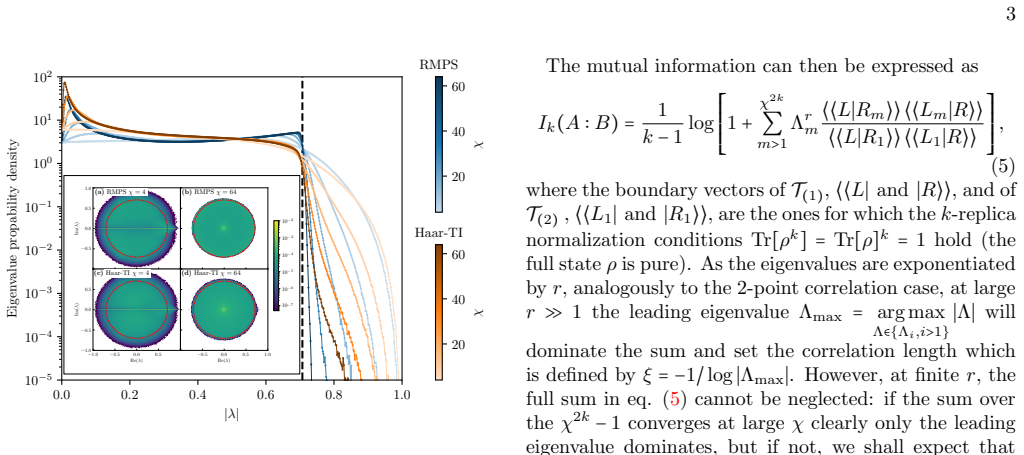
The central discovery is that truncating quantum dynamics to a finite bond dimension does not erase its physical content. For all ensembles considered, the full spectral density of the MPS transfer matrix, not just the leading eigenvalue, controls spatial correlations. In the volume-law regime, correlations spread over an effective distance $\xi_{\mathrm{eff}} \sim \log \chi^\alpha$, with $\alpha = 2$ for random MPSs, $\alpha \simeq 1.8$ for translation-invariant Haar circuits, and $\alpha$ decreasing as the measurement rate approaches the transition. In the monitored case, the relevant spectral feature is the density of near-zero eigenvalues: for $p$ above a $\chi$-dependent critical rate, the probability $P(|\lambda| < \rho)$ remains finite as $\rho \to 0$, indicating a finite null space, and this quantity serves as the effective order parameter of the measurement-induced entanglement transition. The paper therefore claims that the MIPT can be detected in circuits whose states are constrained to have fixed bond dimension, at any finite $\chi$, with $p_c(\chi)$ approaching $0.16$.
Load-bearing premise
The calculation assumes that one typical random state behaves like the average: the log of the average purity moment can stand in for the average of the log, and after averaging the replicated transfer matrices look translation invariant, so the formula derived for translation-invariant MPSs applies to non-translation-invariant random MPSs.
Editorial extensions
If this is right
- Correlation lengths read from the largest transfer-matrix eigenvalue alone will under-predict how far mutual information reaches in these states; the full spectral sum sets an effective length $\xi_{\mathrm{eff}} \sim \log \chi^\alpha$.
- Different random circuit architectures can be distinguished by transfer-matrix spectral density even when their spectral gaps and spectral supports are identical, meaning the exponent $\alpha$ encodes microscopic dynamical information.
- The measurement-induced entanglement transition is visible in fixed-$\chi$ MPS ensembles for any finite bond dimension, with the extrapolated critical rate $p_c(\chi) \to 0.16$ as $\chi \to \infty$, so tensor-network simulations can detect the transition.
- In the area-law phase, correlations stop spreading with $\chi$, giving $\xi_{\mathrm{eff}} \sim \log \chi^0$, consistent with an exact MPS description for $\chi > \bar{\chi}(p)$.
- The spectral densities of these truncated chaotic states are radially uniform rather than peaked around quasiparticle frequencies, so they require a different interpretive paradigm from MPSs near critical ground states.
Reading between the lines
- The paper leaves implicit that if $\xi_{\mathrm{eff}} \sim \log \chi^\alpha$ is generic, then classical tensor-network simulations that truncate bond dimension capture the long-time entanglement structure meaningfully: the mutual information of the simulated state can be compared with exact evolution over a window growing like $\log \chi$.
- The null-space density $\lim_{\rho \to 0^+} P(|\lambda| < \rho)$ may serve as a practical finite-$\chi$ diagnostic of the measurement-induced transition that is computed locally from the transfer matrix and could be less sensitive to boundary effects than direct entanglement-entropy estimates.
- The same transfer-matrix logic could extend to two-dimensional tensor networks, where a finite null-space dimension might count constraints or topological content rather than a phase transition; the paper gestures at PEPS but does not develop this.
- The side remark about random quantum channels suggests an analogous effective thermalization time growing like $\log d \, N$ in open systems, which would be a testable extension of the correlation-spreading result beyond pure state dynamics.
Editorial analysis
A structured set of objections, weighed in public.
Referee Report
Summary. The paper studies ensembles of matrix product states (MPSs) of fixed bond dimension χ generated by random sequential circuits, random brickwork circuits, and hybrid circuits with projective measurements. The authors analyze the eigenvalues of the MPS transfer matrix and use the Rényi-2 mutual information to define an effective correlation length ξeff. They claim that ξeff grows as log χ^α with α depending on the microscopic dynamics: α = 2 for random MPSs, α ≈ 1.8 for translation-invariant Haar circuits, and a measurement-rate-dependent α(p) that decreases to zero across the measurement-induced entanglement transition (MIPT). For monitored circuits they propose that the averaged dimension of the transfer-matrix null space, probed through the eigenvalue counting function P(|λ| < ρ), acts as an order parameter for the MIPT at finite χ, with a critical rate pc(χ) approaching the known value pc ≃ 0.16 as χ grows.
Significance. If the central claims hold, the paper would establish a useful phenomenology: the full transfer-matrix spectral density, not just the leading eigenvalue, controls spatial correlations in compressed MPS descriptions of chaotic dynamics, and a finite-χ MPS truncation can still detect the MIPT. The analytic Weingarten computation in End Matter A leading to Eq. (6), the comparison of RMPS and Haar-TI spectra, and the explicit prediction ξeff ∼ log χ^2 for RMPSs are concrete and testable strengths. The numerical observation that the inferred pc(χ) approaches the established MIPT value is suggestive. However, the validity of the analytic derivation and of the proposed order parameter is not yet established to the standard required for the paper's main conclusions.
major comments (3)
- [Effective correlation length in translational invariant MPSs and in RMPSs; End Matter A] The derivation of Eq. (6) relies on the replacement E log[Tr(ρ_X^k)] ≈ log[E Tr(ρ_X^k)], stated in the text as an assumption that statistical fluctuations are small. This assumption is load-bearing for the analytic value α = 2 and for the claim that Eq. (5), derived for translation-invariant MPSs, can be applied to non-translation-invariant RMPSs after averaging. The manuscript does not provide any numerical check of the variance of Tr(ρ_X^k) over the Haar ensemble, nor a comparison of the averaged mutual information with the mutual information of typical samples. I ask the authors to validate this concentration assumption numerically for the values of χ used in Fig. 3 and, if it fails for some k or χ, to state the resulting limitations on the analytic formula.
- [Monitored dynamics; Figure 4] The central MIPT claim uses P(|λ| < ρ) at ρ = 10^-6 as a proxy for the dimension of the transfer-matrix null space, but the paper never computes the actual nullity. For non-normal transfer matrices, eigenvalues with modulus below a fixed threshold need not correspond to an exact null space, and truncation can produce spurious near-zero eigenvalues. Figure 4(b) itself shows nonzero P(|λ| < 10^-6) in the volume-law phase at small χ (for example p = 0.1, χ = 20 and p = 0.15, χ = 20, 30, 40), so the proxy does not cleanly separate the phases at finite χ. The claimed extrapolation ρ → 0+ is not described: no fit form, threshold-independence analysis, or stability check is given. To support the conclusion that a finite null space appears for any χ at p > pc(χ), the authors should either compute the rank deficiency of the transfer matrix directly or provide a controlled extrapolation in ρ together with a scaling analysis in the system size N.
- [Figures 3 and B.1] The exponents α reported for the Haar-TI circuit (α ≈ 1.8) and for monitored circuits (α(p) in Fig. B.1) are extracted from linear fits of Rényi-2 mutual information versus log χ, but no error bars, fit ranges, or sensitivity to the choice of r = 1 are reported. Since the separation between α = 2 and α ≈ 1.8 is quantitative and underlies the claim that the spectral density encodes model-dependent information, the fits need to be documented sufficiently for the reader to assess whether the difference is significant. Similarly, the convergence of α(p) to 0 for p > pc is inferred from the χmin dependence without an extrapolation; please provide a concrete fitting procedure and associated uncertainties.
minor comments (4)
- [Monitored dynamics; Figure 4] The notation P(|λ| < 0+) is not defined; the text should state explicitly that it means lim_{ρ→0+} P(|λ| < ρ) and describe how this limit is estimated from the data.
- [Spectra of TI-Haar circuits] The 'Haar-TI' ensemble is not fully specified: it should be stated whether translation invariance is imposed over sites only, over gates within a layer, and whether the same random gate is repeated at each time step or only within a layer.
- [Unitary and Monitored Dynamics] The statement that contributions from states with small gaps 'effectively cancel out in the sum (5) as dephasing angles' is asserted without demonstration; Eq. (5) contains complex overlaps involving left and right eigenvectors, so the cancellation is not obvious and should either be proved or presented as a conjecture.
- [References] There are duplicated references: [23] and [61] are both Skinner, Ruhman, and Nahum, Phys. Rev. X 9, 031009 (2019), and [22] and [60] are both Chan, Nandkishore, Pretko, and Smith, Phys. Rev. B 99, 224307 (2018).
Circularity Check
No significant circularity: the RMPS result is derived via Weingarten averaging, and the MIPT order parameter is benchmarked against the external pc≈0.16; self-citations are background only.
full rationale
The paper's main analytic prediction is the RMPS mutual-information formula in End Matter A: after Haar averaging with Weingarten calculus, E[I2(A:B)] ≈ log[1 + e^{-r log d}(χ d/(d+1))^2], giving ξeff ∼ log χ^2. This is a genuine calculation from the stated sequential-circuit ensemble; it does not assume the result. The only non-trivial premise is stated openly: 'we make the assumption E log[Tr(ρ^k_X)]≈log[E Tr(ρ^k_X)]' (Effective correlation length paragraph). That premise is an explicit validity assumption, not a hidden use of the conclusion or a fitted parameter renamed as a prediction. The MIPT claim is benchmarked externally: P(|λ|<ρ) is compared with the independently established pc≈0.16, and the paper openly shows finite-χ caveats (nonzero P in the volume-law phase for small χ). Self-citations [15,45,46] appear only in background reference lists for projected MPS dynamics and RMPS ensembles; no load-bearing conclusion rests on them, and no uniqueness theorem from the authors' prior work is invoked. The ρ→0+ extrapolation is underdescribed and the identification of P(|λ|<ρ) with the null-space dimension is a correctness risk, but neither is a circular reduction. Overall: no significant circularity.
Assumptions & free parameters
free parameters (3)
- alpha_Haar_TI =
approximately 1.8
- alpha_monitored(p) =
1.2 (p=0.1), 0.9 (p=0.15), 0 (p=0.3)
- rho_threshold =
10^-6
assumptions (6)
- standard math Standard MPS transfer-matrix formalism: connected correlations and Rényi mutual information are governed by eigenvalues of the transfer matrix (Eqs. (3)-(5)).
- standard math Random quantum channel spectrum is confined in a disk of radius 1/sqrt(d).
- domain assumption E log[Tr(rho^k_X)] is approximately log[E Tr(rho^k_X)] (self-averaging).
- domain assumption After Haar averaging, the replicated transfer matrices of the RMPS become translation invariant, so Eq. (5) applies.
- domain assumption The MIPT critical rate for hybrid Haar circuits is pc approximately 0.16.
- ad hoc to paper Dephasing phases of near-unit eigenvalues cancel in sum (5), so only magnitudes matter in circular spectral tails.
Cite this review
Pith. "Pith review of Correlations, Spectra and Entanglement Transitions in Ensembles of Matrix Product States." pith.science (2026). https://pith.science/paper/C4V35JGQ
@misc{pith2026241214261,
  author       = {Pith},
  title        = {Pith review of: Correlations, Spectra and Entanglement Transitions in Ensembles of Matrix Product States},
  year         = {2026},
  howpublished = {\url{https://pith.science/paper/C4V35JGQ}},
  note         = {Machine review of arXiv:2412.14261}
}
abstract
We investigate ensembles of Matrix Product States (MPSs) generated by quantum circuit evolution followed by projection onto MPSs with a fixed bond dimension $\chi$. Specifically, we consider ensembles produced by: (i) random sequential unitary circuits, (ii) random brickwork unitary circuits, and (iii) circuits involving both unitaries and projective measurements. In all cases, we analyze the spectra of the MPS transfer matrices and relate them to the spreading of mutual information in the MPS state. We demonstrate how different features of the spectral density correspond to distinct types of circuits, revealing that these MPS ensembles retain crucial physical information about the underlying microscopic dynamics. Notably, in the presence of quantum monitoring, we show the existence of a measurement-induced entanglement transition (MIPT) in MPS ensembles, with the averaged dimension of the transfer matrix's null space serving as the effective order parameter.
Figures


Figures from the paper (1 more)

Reference graph
Works this paper leans on
-
[1]
Perez-Garcia, F
D. Perez-Garcia, F. Verstraete, M. M. Wolf, and J. I. Cirac, Quantum Info. Comput. 7, 401–430 (2007)
2007
-
[2]
(b) Plot of the probability P (∣λ∣ < ρ) of finding an eigenvalue with norm up to ρ as a function of ρ for different p and χ
(i.1) The eigenvalue density in the complex plane for χ = 50 and p = 0.05. (b) Plot of the probability P (∣λ∣ < ρ) of finding an eigenvalue with norm up to ρ as a function of ρ for different p and χ. For p ⩾ 0.16 the curves have been artificially shifted by ×5 for visualization purposes. The plot indicates that the limit lim ρ→0+ P (∣λ∣ < ρ) is: for p = 0...
-
[3]
Verstraete and J
F. Verstraete and J. I. Cirac, Phys. Rev. B 73, 094423 (2006)
2006
-
[4]
Verstraete, V
F. Verstraete, V. Murg, and J. Cirac, Advances in Physics 57, 143–224 (2008)
2008
-
[5]
Piroli, G
L. Piroli, G. Styliaris, and J. I. Cirac, Phys. Rev. Lett. 127, 220503 (2021)
2021
-
[6]
Schollw¨ ock, Annals of Physics326, 96–192 (2011)
U. Schollw¨ ock, Annals of Physics326, 96–192 (2011)
2011
-
[7]
K. C. Smith, A. Khan, B. K. Clark, S. Girvin, and T.-C. Wei, PRX Quantum 5, 030344 (2024)
2024
-
[8]
D. Malz, G. Styliaris, Z.-Y. Wei, and J. I. Cirac, Phys. Rev. Lett. 132, 040404 (2024)
2024
Show all 90 references
-
[9]
Zhang, S
Y. Zhang, S. Gopalakrishnan, and G. Styliaris, PRX Quantum 5, 10.1103/prxquantum.5.040304 (2024)
2024 doi
-
[10]
D. T. Stephen and O. Hart, (2024), arXiv:2404.16360 [quant-ph]
2024
-
[11]
A. Rath, V. Vitale, S. Murciano, M. Votto, J. Dubail, R. Kueng, C. Branciard, P. Calabrese, and B. Vermersch, PRX Quantum 4, 010318 (2023)
2023
-
[12]
Nahum, J
A. Nahum, J. Ruhman, S. Vijay, and J. Haah, Phys. Rev. X 7, 031016 (2017)
2017
-
[13]
Fagotti and P
M. Fagotti and P. Calabrese, Phys. Rev. A 78, 010306 (2008)
2008
-
[14]
Calabrese and J
P. Calabrese and J. Cardy, Journal of Statistical Mechan- ics: Theory and Experiment 2016, 064003 (2016)
2016
-
[15]
Cecile, H
G. Cecile, H. L´ oio, and J. De Nardis, Phys. Rev. Res. 6, 033220 (2024)
2024
-
[16]
Leviatan, F
E. Leviatan, F. Pollmann, J. H. Bardarson, D. A. 6 Huse, and E. Altman, (2017), arXiv:1702.08894 [cond- mat.stat-mech]
2017 arXiv
-
[17]
Kloss, Y
B. Kloss, Y. B. Lev, and D. Reichman, Phys. Rev. B 97, 024307 (2018)
2018
-
[18]
Beguˇ si´ c, J
T. Beguˇ si´ c, J. Gray, and G. K.-L. Chan, Science Ad- vances 10, 10.1126/sciadv.adk4321 (2024)
2024 doi
-
[19]
M. P. Fisher, V. Khemani, A. Nahum, and S. Vijay, An- nual Review of Condensed Matter Physics14, 335 (2023)
2023
-
[20]
Ayral, T
T. Ayral, T. Louvet, Y. Zhou, C. Lambert, E. M. Stoudenmire, and X. Waintal, PRX Quantum 4, 020304 (2023)
2023
-
[21]
Y. Li, X. Chen, and M. P. A. Fisher, Phys. Rev. B 100, 134306 (2019)
2019
-
[22]
J. C. e. a. Hoke, Nature 622, 481–486 (2023)
2023
-
[24]
A. Chan, R. M. Nandkishore, M. Pretko, and G. Smith, Phys. Rev. B 99, 224307 (2018)
2018
-
[25]
N. Katz, M. Ansmann, R. C. Bialczak, E. Lucero, R. Mc- Dermott, M. Neeley, M. Steffen, E. M. Weig, A. N. Cle- land, J. M. Martinis, and A. N. Korotkov, Science 312, 1498 (2006)
2006
-
[26]
Vijay, C
R. Vijay, C. Macklin, D. H. Slichter, S. J. Weber, K. W. Murch, R. Naik, A. N. Korotkov, and I. Siddiqi, Nature 490, 77 (2012)
2012
-
[27]
Bauer, D
M. Bauer, D. Bernard, and A. Tilloy, J. Phys. A: Math. Theor. 48, 25FT02 (2015)
2015
-
[28]
Campagne-Ibarcq, P
P. Campagne-Ibarcq, P. Six, L. Bretheau, A. Sarlette, M. Mirrahimi, P. Rouchon, and B. Huard, Phys. Rev. X 6, 011002 (2016)
2016
-
[29]
M. M. Rams, P. Czarnik, and L. Cincio, Phys. Rev. X 8, 041033 (2018)
2018
-
[30]
Carollo and V
F. Carollo and V. Alba, Phys. Rev. B 106, L220304 (2022)
2022
-
[31]
M. M. Rams, V. Zauner, M. Bal, J. Haegeman, and F. Verstraete, Phys. Rev. B 92, 235150 (2015)
2015
-
[32]
D. Haag, F. Baccari, and G. Styliaris, PRX Quantum 4, 030330 (2023)
2023
-
[33]
Huang, L
R.-Z. Huang, L. Zhang, A. M. L¨ auchli, J. Haegeman, F. Verstraete, and L. Vanderstraeten, Phys. Rev. Lett. 132, 086503 (2024)
2024
-
[34]
Zauner, D
V. Zauner, D. Draxler, L. Vanderstraeten, M. Degroote, J. Haegeman, M. M. Rams, V. Stojevic, N. Schuch, and F. Verstraete, New Journal of Physics 17, 053002 (2015)
2015
-
[35]
Schollw¨ ock, Annals of Physics326, 96 (2011), january 2011 Special Issue
U. Schollw¨ ock, Annals of Physics326, 96 (2011), january 2011 Special Issue
2011
-
[36]
Vanhecke, J
B. Vanhecke, J. Haegeman, K. Van Acoleyen, L. Vander- straeten, and F. Verstraete, Phys. Rev. Lett.123, 250604 (2019)
2019
-
[37]
Tagliacozzo, T
L. Tagliacozzo, T. R. de Oliveira, S. Iblisdir, and J. I. Latorre, Phys. Rev. B 78, 024410 (2008)
2008
-
[38]
Pollmann, S
F. Pollmann, S. Mukerjee, A. M. Turner, and J. E. Moore, Phys. Rev. Lett. 102, 255701 (2009)
2009
-
[39]
J. T. Schneider, A. Ueda, Y. Liu, A. M. L¨ auchli, M. Os- hikawa, and L. Tagliacozzo, (2024), arXiv:2411.03954 [cond-mat.stat-mech]
2024 arXiv
-
[40]
Vanhecke, J
B. Vanhecke, J. Hasik, F. Verstraete, and L. Vander- straeten, Phys. Rev. Lett. 129, 200601 (2022)
2022
-
[41]
Garnerone, T
S. Garnerone, T. R. de Oliveira, S. Haas, and P. Zanardi, Phys. Rev. A 82, 052312 (2010)
2010
-
[42]
Garnerone, T
S. Garnerone, T. R. de Oliveira, and P. Zanardi, Phys. Rev. A 81, 032336 (2010)
2010
-
[43]
Haferkamp, C
J. Haferkamp, C. Bertoni, I. Roth, and J. Eisert, PRX Quantum 2, 040308 (2021)
2021
-
[44]
Lancien and D
C. Lancien and D. P´ erez-Garc ´ ıa, Annales Henri Poincar´ e 23, 141 (2022)
2022
-
[45]
G. Lami, T. Haug, and J. D. Nardis, (2024), arXiv:2404.18751 [quant-ph]
2024 arXiv
-
[46]
Iwaki, A
A. Iwaki, A. Shimizu, and C. Hotta, Phys. Rev. Res. 3, L022015 (2021)
2021
-
[47]
M. M. Wolf, J. Eisert, T. S. Cubitt, and J. I. Cirac, Phys. Rev. Lett. 101, 150402 (2008)
2008
-
[48]
G. Lami, J. D. Nardis, and X. Turkeshi, (2024), arXiv:2409.13023 [quant-ph]
2024 arXiv
-
[49]
C. E. Gonz´ alez-Guill´ en, M. Junge, and I. Nechita, arXiv preprint arXiv:1811.08847 (2018)
2018 arXiv
-
[50]
Kukulski, I
R. Kukulski, I. Nechita, L. Pawela, Z. Pucha la, and K. ˙Zyczkowski, Journal of Mathematical Physics 62 (2021)
2021
-
[51]
A. S. Matsoukas-Roubeas, T. Prosen, and A. d. Campo, Quantum 8, 1446 (2024)
2024
-
[52]
Denisov, T
S. Denisov, T. Laptyeva, W. Tarnowski, D. Chru´ sci´ nski, and K. ˙Zyczkowski, Phys. Rev. Lett. 123, 140403 (2019)
2019
-
[53]
At large χ, the mutual information simplifies to E[I2(A∶ B)]≈ log[1+ e−r log d( χd d+ 1) 2 ]
and its calculation is reported in the End Matter A. At large χ, the mutual information simplifies to E[I2(A∶ B)]≈ log[1+ e−r log d( χd d+ 1) 2 ] . (6) This expression is clearly finite on a length scale r ∼ log(χ2) and it decays to zero for larger values ofr. We are then in p...
-
[54]
L. S´ a, P. Ribeiro, T. Can, and T. c. v. Prosen, Phys. Rev. B 102, 134310 (2020)
2020
-
[55]
Collins and P
B. Collins and P. ´Sniady, Communications in Mathemat- ical Physics 264, 773 (2006)
2006
-
[56]
J. c. v. Bensa and M. ˇZnidariˇ c, Phys. Rev. X11, 031019 (2021)
2021
-
[57]
Zabalo, M
A. Zabalo, M. J. Gullans, J. H. Wilson, S. Gopalakrish- nan, D. A. Huse, and J. H. Pixley, Phys. Rev. B 101, 060301 (2020)
2020
-
[58]
Nahum, S
A. Nahum, S. Roy, B. Skinner, and J. Ruhman, PRX Quantum 2, 010352 (2021)
2021
-
[59]
Jian, Y.-Z
C.-M. Jian, Y.-Z. You, R. Vasseur, and A. W. W. Ludwig, Phys. Rev. B 101, 104302 (2020)
2020
-
[60]
X. Cao, A. Tilloy, and A. D. Luca, SciPost Phys. 7, 024 (2019)
2019
-
[61]
A. C. Potter and R. Vasseur, Entanglement dynamics in hybrid quantum circuits, in Entanglement in Spin Chains: From Theory to Quantum Technology Applica- tions, edited by A. Bayat, S. Bose, and H. Johannesson (Springer, Cham, 2022) pp. 211–249
2022
-
[62]
A. Chan, R. M. Nandkishore, M. Pretko, and G. Smith, Phys. Rev. B 99, 224307 (2019)
2019
-
[63]
Skinner, J
B. Skinner, J. Ruhman, and A. Nahum, Phys. Rev. X 9, 031009 (2019)
2019
-
[64]
Czischek, G
S. Czischek, G. Torlai, S. Ray, R. Islam, and R. G. Melko, Phys. Rev. A 104, 062405 (2021)
2021
-
[65]
Han and X
Y. Han and X. Chen, Phys. Rev. B 107, 014306 (2023)
2023
-
[66]
Minoguchi, P
Y. Minoguchi, P. Rabl, and M. Buchhold, SciPost Phys. 12, 009 (2022)
2022
-
[67]
Altland, M
A. Altland, M. Buchhold, S. Diehl, and T. Micklitz, Phys. Rev. Res. 4, L022066 (2022)
2022
-
[68]
Fuji and Y
Y. Fuji and Y. Ashida, Phys. Rev. B 102, 054302 (2020)
2020
-
[69]
Jian, Z.-C
S.-K. Jian, Z.-C. Yang, Z. Bi, and X. Chen, Phys. Rev. B 104, L161107 (2021)
2021
-
[70]
G. S. Bentsen, S. Sahu, and B. Swingle, Phys. Rev. B 104, 094304 (2021)
2021
-
[71]
Z.-C. Yang, Y. Li, M. P. A. Fisher, and X. Chen, Phys. Rev. B 105, 104306 (2022)
2022
-
[72]
Medina, R
R. Medina, R. Vasseur, and M. Serbyn, Phys. Rev. B 104, 104205 (2021)
2021
-
[73]
Lunt and A
O. Lunt and A. Pal, Phys. Rev. Res. 2, 043072 (2020)
2020
-
[74]
Szyniszewski, A
M. Szyniszewski, A. Romito, and H. Schomerus, Phys. 7 Rev. B 100, 064204 (2019)
2019
-
[75]
Tang and W
Q. Tang and W. Zhu, Phys. Rev. Res. 2, 013022 (2020)
2020
-
[76]
Iadecola, S
T. Iadecola, S. Ganeshan, J. H. Pixley, and J. H. Wilson, (2022), arXiv:2207.12415 [cond-mat.dis-nn]
2022 arXiv
-
[77]
O’Dea, A
N. O’Dea, A. Morningstar, S. Gopalakrishnan, and V. Khemani, Phys. Rev. B 109, L020304 (2024)
2024
-
[78]
Ravindranath, Y
V. Ravindranath, Y. Han, Z.-C. Yang, and X. Chen, Phys. Rev. B 108, L041103 (2023)
2023
-
[79]
Sierant and X
P. Sierant and X. Turkeshi, Phys. Rev. Lett. 130, 120402 (2023)
2023
-
[80]
Sierant and X
P. Sierant and X. Turkeshi, Acta Physica Polonica A ISSN 1898-794X 144, 474 (2023)
2023
-
[81]
Buchhold, T
M. Buchhold, T. M¨ uller, and S. Diehl, (2022), arXiv:2208.10506 [cond-mat.dis-nn]
2022 arXiv
- [82]
-
[83]
R. Fan, S. Vijay, A. Vishwanath, and Y.-Z. You, Phys. Rev. B 103, 174309 (2021)
2021
-
[84]
Y. Li, X. Chen, A. W. W. Ludwig, and M. P. A. Fisher, Phys. Rev. B 104, 104305 (2021)
2021
-
[85]
Ippoliti, M
M. Ippoliti, M. J. Gullans, S. Gopalakrishnan, D. A. Huse, and V. Khemani, Phys. Rev. X 11, 011030 (2021)
2021
-
[86]
Turkeshi, R
X. Turkeshi, R. Fazio, and M. Dalmonte, Phys. Rev. B 102, 014315 (2020)
2020
-
[87]
Turkeshi, Phys
X. Turkeshi, Phys. Rev. B 106, 144313 (2022)
2022
-
[88]
Sierant, M
P. Sierant, M. Schir` o, M. Lewenstein, and X. Turkeshi, Phys. Rev. B 106, 214316 (2022)
2022
-
[89]
Zabalo, J
A. Zabalo, J. H. Wilson, M. J. Gullans, R. Vasseur, S. Gopalakrishnan, D. A. Huse, and J. H. Pixley, Phys. Rev. B 107, L220204 (2023)
2023
-
[90]
S. J. Garratt and E. Altman, PRX Quantum 5, 030311 (2024)
2024
-
[91]
Fishman, S
M. Fishman, S. R. White, and E. M. Stoudenmire, Sci- Post Phys. Codebases , 4 (2022). 8 End Matter A. Calculation of the mutual information in RMPS RMPSs can be written as MPSs where each site is asso- ciated with a Haar-random unitary matrix of size dχ×dχ (in the case where a...
2022
Reviewed August 11, 2026 · model on record in the stance chip above.
Discussion (0). Continue with ORCID to comment.