REVIEW 3 major objections 5 minor 82 references
Gaussian boson sampling for binary optimization
T0 review · 3 major / 5 minor · reviewed 2026-08-11 · deepseek-v4-flash
Pith's one-line read A trained photon sampler beats random guessing on 3-SAT and graph partitioning.
desk verdict A clean proof-of-concept for variational GBS on binary optimization, with a sound analytical VQE core; the practical CVaR claim is conditional on unverified finite-sample behavior. read the letter →
The pith
A machine-rendered reading of the paper's core claim, the machinery that carries it, and where it could break.
The reading
What carries the argument
The load-bearing object is the threshold-detector click probability $P(x;\hat\rho_\theta)=\operatorname{Tor}(O(J_x))/\sqrt{\det(\Sigma_\theta)}$, expressed through the Torontonian, a sum of $2^k$ determinants that gives the probability of a click pattern from threshold detectors. The prepared Gaussian state is encoded by its Husimi covariance matrix $\Sigma_\theta$, and in the Bargmann parametrization the state is represented by a complex symmetric matrix $A_\theta=U\operatorname{diag}(\tanh r)U^T$ with $\|A_\theta\|<1$, so interferometer angles and squeezing strengths become trainable parameters. The promotion rule $x_J\mapsto \bigotimes_{j\in J}\hat\Pi_j^{(1)}$ converts the polynomial into a diagonal Hamiltonian, and in the VQE case the expectation value collapses to $\langle \hat x_J\rangle_\theta=\sum_{J'\subseteq J}(-1)^{|J'|}\det(\Sigma_\theta^{J'})^{-1/2}$, which is what makes classical training with gradients possible.
What would settle it
Take a trained instance with $\ell=12$, compute the exact solution probability $p_{\theta^*}$, then draw roughly $10^4$ samples from a threshold-detector GBS realization or a shot-noise-accurate simulation and count solution clicks; if the observed fraction is not within statistical error of $p_{\theta^*}$, the central performance claim fails. Equivalently, replace the exact CVaR cost during training by a finite-sample estimator and check whether the optimized distributions still beat random guessing.
Extended reading notes
Core claim
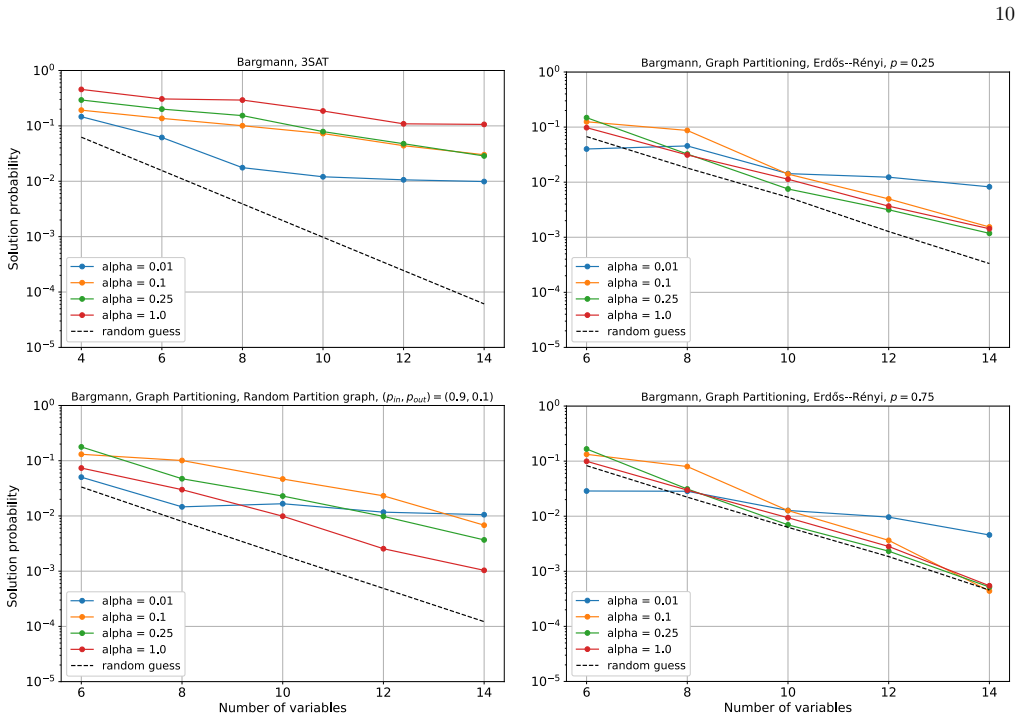
The central discovery is that the probability distribution of threshold-detector click patterns in a Gaussian boson sampler can be shaped by optimization to concentrate mass on the minimizers of a binary optimization problem. Concretely, the paper proves a promotion rule that turns each monomial $x_J$ of the PUBO polynomial into a tensor product of click projectors, so the quantum expectation of the promoted Hamiltonian equals the classical expectation of the polynomial under the GBS output distribution. For $\alpha=1$ the cost reduces to the standard VQE expectation and is given analytically by sums of inverse square roots of determinants of Husimi covariance submatrices, computable with automatic differentiation for low-degree polynomials. For $\alpha<1$ the paper uses the derivative-free COBYLA optimizer on exactly evaluated CVaR costs, and reports that the trained distribution samples a solution with probability one to two orders of magnitude above random guessing across most tested instances, with $\alpha=0.01$ often scaling favorably with problem size.
Load-bearing premise
The load-bearing premise is that the solution probabilities computed with exact, noiseless probability evaluations will still be achieved with a finite number of samples from a real threshold-detector device, and that derivative-free optimization will still find good parameters when the cost is estimated from noisy samples.
Editorial extensions
If this is right
- For QUBO and low-degree PUBO instances, the $\alpha=1$ case can be trained entirely on a classical computer; the quantum device is only needed to sample from the optimized distribution.
- Using a small CVaR tail such as $\alpha=0.01$ often gives the best scaling, but for the 3-SAT encoding plain VQE with analytic gradients beats CVaR, showing the trade-off depends on the problem.
- The Wigner parametrization with two interferometer layers generally outperforms the Bargmann parametrization on graph partitioning, while Bargmann wins on 3-SAT under standard VQE.
- If the maximum squeezing is below about $0.8814$, the probability of sampling a unique solution with many 1s decays exponentially in the number of 1s, and the paper conjectures this limitation persists for any squeezing bound.
- The authors state that incorporating shot noise and photon loss into the simulations is future work, so the current performance numbers are for exact, noiseless probabilities.
Reading between the lines
- Because the VQE cost and gradient are classically computable, that training phase cannot by itself provide a quantum speedup; any advantage must come from the distribution sampled by the physical device, so the honest benchmark is end-to-end time-to-solution on real hardware with finite samples.
- The analytic determinant formula grows exponentially in the monomial degree $k$, so the classical VQE shortcut is limited to low-degree polynomials; for high-degree PUBO the CVaR route with sampling is the only option.
- A direct testable extension is to repeat the experiments with simulated shot noise: if COBYLA trained on stochastically estimated CVaR values no longer beats random guessing, then the proof of concept does not yet transfer to practice.
- The threshold-detector click strings are already binary, so the method may extend naturally to higher-order pseudo-Boolean terms without ancillary variables, at the price of evaluating determinants over larger subsets.
Editorial analysis
A structured set of objections, weighed in public.
Referee Report
Summary. This paper proposes a variational Gaussian boson sampling (GBS) approach with threshold detectors for QUBO/PUBO optimization. The authors map each monomial x_J to a product of click projectors, so that the quantum expectation equals the classical expectation under the GBS click distribution. They combine this with CVaR-VQE cost functions. For alpha=1 (standard VQE) they derive an analytical expression for the cost and its gradient via determinants of Husimi covariance submatrices, enabling classical training for low-degree polynomials. For alpha<1 they use COBYLA on the exact CVaR cost. Numerical experiments on 3-SAT and graph partitioning instances (ell=6-14) report solution-sampling probabilities one to two orders of magnitude above random guessing. Appendix B analyzes how finite squeezing limits the probability of sampling patterns with many ones.
Significance. If the results hold, the paper offers a new variational photonic framework for combinatorial optimization and, notably, an analytically computable VQE cost for low-degree PUBO/QUBO with threshold detectors, extending the WAW-parametrization work of Banchi et al. and the CVaR-VQE work of Barkoutsos et al. The derivation of Eq. (10) and the determinant regrouping in Appendix A are clear and consistent with standard Torontonian formulas. The paper also provides two explicit parameterizations and an expressivity bound for finite squeezing. However, the numerical proof of concept is currently limited to exact, noiseless probability evaluation, and the practical usefulness of the CVaR variant depends on finite-shot and loss behavior that is not demonstrated. The expressivity analysis also suggests a fundamental limitation for dense solutions.
major comments (3)
- [Section VI D and VII] The central numerical claim is established under idealized conditions that are not stated in the abstract. The text in Section VI D says the cost function C_alpha(theta) is evaluated exactly, 'taking no account of shot noise,' and Section VII explicitly defers shot-noise and photon-loss modeling. For alpha<1, a real implementation would estimate the CVaR from K samples (the average of the lowest ceil(alpha*K) energies), which is a high-variance statistic for small alpha, and COBYLA would optimize a stochastic, nonsmooth objective. The paper provides no evidence about the number of shots needed per iteration, the variance of the estimator, or the robustness of the optimizer to this noise. The reported p_theta* values are therefore properties of the exact output distribution, not of the actual sampling algorithm. I request either finite-shot simulations (with and without photon loss) or a revised framing that explicitly restricts the 'significant gains' claim to exact probabilities.
- [Section VI D] The Bargmann parametrization requires the matrix A to satisfy ||A||<1 (or ||A||<=tanh(r_bar) in the restricted space), but the manuscript does not state how this constraint is enforced during optimization. The text says the parameters are trained directly as 'a random perturbation of J' and does not mention any projection, penalty, or re-parametrization. Without such a mechanism, the optimized A can leave the physical domain, in which case Eq. (4) and the reported probabilities are invalid. Please specify the constraint-handling procedure and confirm that all reported results lie in P_{B,r_bar}.
- [Appendix B] The expressivity bound is proven only for r_bar<=0.8814, while the simulations use r_bar=1, and the extension to larger r_bar is explicitly conjectural. If the conjecture is correct, the probability of sampling a solution with k ones decays exponentially with k for any finite r_bar, which is a serious scalability limitation for problems whose solutions are dense (for balanced graph partitioning, k=ell/2). This limitation is currently confined to an appendix with a conjecture; it should be stated prominently in the abstract or conclusion as a known limitation of the approach.
minor comments (5)
- [Section VI E] The paragraph beginning 'The results are presented in Fig. 6 and Fig. 7' is repeated verbatim; the duplicate should be removed.
- [Section V B] The phrase 'whether the case alpha = 0 could bring any quantum advantage' is presumably a typo for alpha = 1, since the preceding discussion concerns standard VQE.
- [Section VI B/VI E] The averaged success probabilities in Figs. 6 and 7 are reported without error bars or confidence intervals; adding standard deviations or percentiles would make the 'significant gains' claim more robust.
- [Section VI D] The counting leading to 3(ell-1) trainable parameters for the two-layer Wigner interferometer is unclear; please spell out the number of Mach-Zehnder elements and which phases are fixed.
- [Section IV] The statement that as alpha->0 the CVaR cost 'corresponds to the minimum possible outcome' should be qualified: it is the infimum of the energies with positive probability under rho_theta, which can be larger than the ground-state energy.
Circularity Check
No significant circularity: the optimized distribution is scored by an independently evaluated solution probability, and the analytic VQE cost is derived from standard Gaussian-state identities rather than assumed.
full rationale
The derivation chain is self-contained. The PUBO-to-Hamiltonian promotion (Sec. V A) constructs \hat{x}_J as a product of threshold projectors so that the quantum expectation equals the classical PUBO expectation by definition; this is a reformulation, not an input that contains the reported performance. The VQE cost (Eqs. (8), (10) and Appendix A) is obtained by inclusion-exclusion and the Gaussian determinant formula for vacuum probabilities, with the underlying identities cited to independent prior literature (Refs. [66,67]); the same formulas are not used as a premise about solution quality. The numerical claim is literally about p_{\theta*}, the probability, evaluated independently from the optimized state via Eq. (11), that a sample is an exact minimizer; this metric is not a fitted parameter renamed as a prediction. Hyperparameters such as the number of MZI layers or the number of trained off-diagonal entries were selected numerically, but the reported gains are not conditional on a held-out split and the paper does not frame them as out-of-sample predictions, so any overfitting concern is a robustness issue, not a circularity. Self-citations [26,27] document prior CVaR applications and an extended conference version; they are not load-bearing for the mapping, the analytic cost, or the benchmark metric. The stated limitations (Sec. VI D: exact noiseless evaluation; Sec. VII: shot noise and photon loss deferred) concern whether the exact optimized distribution can be realized by finite sampling on real hardware, which is a correctness/realizability gap rather than a circular reduction. No equation or claim in the paper reduces to its own inputs.
Assumptions & free parameters
free parameters (4)
- Squeezing upper bound r_bar =
1 (about 8.7 dB)
- CVaR parameter alpha =
swept over {0.01, 0.1, 0.25, 1}
- Graph partitioning penalty ratio c1/c2 =
unspecified
- Training hyperparameters =
learning rates 0.01 to 1.0, 2500 to 4000 ADAM steps, 70*ell COBYLA steps
assumptions (5)
- domain assumption Torontonian formula Eq. (4) gives threshold-detector click probabilities.
- standard math The reduced-state click probability identity Eq. (A1): expectation of a product of click projectors equals a signed sum of determinants of reduced Husimi covariance matrices.
- domain assumption Random 3-SAT instances with clause ratio M/ell = 4.3 are hard.
- domain assumption CVaR-VQE is an appropriate cost function for binary optimization.
- standard math Sub-Gaussian concentration bound on the Beta distribution.
Cite this review
Pith. "Pith review of Gaussian boson sampling for binary optimization." pith.science (2026). https://pith.science/paper/OWPAO7HR
@misc{pith2026241214783,
  author       = {Pith},
  title        = {Pith review of: Gaussian boson sampling for binary optimization},
  year         = {2026},
  howpublished = {\url{https://pith.science/paper/OWPAO7HR}},
  note         = {Machine review of arXiv:2412.14783}
}
read the original abstract
Binary optimization is a fundamental area in computational science, with wide-ranging applications from logistics to cryptography, where the tasks are often formulated as Quadratic or Polynomial Unconstrained Binary Optimization problems (QUBO/PUBO). In this work, we propose to use a parametrized Gaussian Boson Sampler (GBS) with threshold detectors to address such problems. We map general PUBO instance onto a quantum Hamiltonian and optimize the Conditional Value-at-Risk of its energy with respect to the GBS ansatz. In particular, we observe that, when the algorithm reduces to standard Variational Quantum Eigensolver, the cost function is analytical. Therefore, it can be computed efficiently, along with its gradient, for low-degree polynomials using only classical computing resources. Numerical experiments on 3-SAT and Graph Partitioning problems show significant performance gains over random guessing, providing a first proof of concept for our proposed approach.
Figures


Figures from the paper (4 more)


Reference graph
Works this paper leans on
-
[1]
Y. Kim, A. Eddins, S. Anand, K. X. Wei, E. van den Berg, S. Rosenblatt, H. Nayfeh, Y. Wu, M. Zaletel, K. Temme, and A. Kandala, Nature 618, 500 (2023), number: 7965 Publisher: Nature Publishing Group
2023
-
[2]
A. M. Dalzell, S. McArdle, M. Berta, P. Bienias, C.-F. Chen, A. Gily´ en, C. T. Hann, M. J. Kastoryano, E. T. Khabiboulline, A. Kubica, G. Salton, S. Wang, and F. G. S. L. Brand˜ ao, Quantum algorithms: A survey of appli- cations and end-to-end complexities (2023), 2310.03011 [quant-ph]
arXiv 2023
-
[3]
A. Abbas, A. Ambainis, B. Augustino, A. B¨ artschi, H. Buhrman, C. Coffrin, G. Cortiana, V. Dunjko, D. J. Egger, B. G. Elmegreen, N. Franco, F. Fratini, B. Fuller, J. Gacon, C. Gonciulea, S. Gribling, S. Gupta, S. Had- field, R. Heese, G. Kircher, T. Kleinert, T. Koch, G. Ko- rpas, S. Lenk, J. Marecek, V. Markov, G. Mazzola, S. Mensa, N. Mohseni, G. Nanni...
arXiv 2023
-
[4]
Bauer, S
B. Bauer, S. Bravyi, M. Motta, and G. K.-L. Chan, Chemical Reviews 120, 12685 (2020), pMID: 33090772
2020
-
[5]
M. Schuld and F. Petruccione, Machine Learning with Quantum Computers , Quantum Science and Technology (Springer International Publishing, Cham, 2021)
work page 2021
-
[6]
Gujju, A
Y. Gujju, A. Matsuo, and R. Raymond, Phys. Rev. Appl. 21, 067001 (2024)
2024
-
[7]
S. Pirandola, U. L. Andersen, L. Banchi, M. Berta, D. Bunandar, R. Colbeck, D. Englund, T. Gehring, C. Lupo, C. Ottaviani, J. L. Pereira, M. Razavi, J. S. Shaari, M. Tomamichel, V. C. Usenko, G. Vallone, P. Vil- loresi, and P. Wallden, Adv. Opt. Photon. 12, 1012 (2020)
work page 2020
- [8]
Show all 82 references
-
[9]
Bharti, A
K. Bharti, A. Cervera-Lierta, T. H. Kyaw, T. Haug, S. Alperin-Lea, A. Anand, M. Degroote, H. Heimonen, J. S. Kottmann, T. Menke, W.-K. Mok, S. Sim, L.- C. Kwek, and A. Aspuru-Guzik, Rev. Mod. Phys. 94, 015004 (2022), publisher: American Physical Society
2022
-
[10]
J. R. McClean, S. Boixo, V. N. Smelyanskiy, R. Babbush, and H. Neven, Nature Communications 9, 4812 (2018), number: 1 Publisher: Nature Publishing Group
2018
-
[11]
Arrasmith, Z
A. Arrasmith, Z. Holmes, M. Cerezo, and P. J. Coles, Quantum Science and Technology 7, 045015 (2022), pub- lisher: IOP Publishing
2022
-
[12]
Larocca, S
M. Larocca, S. Thanasilp, S. Wang, K. Sharma, J. Bia- monte, P. J. Coles, L. Cincio, J. R. McClean, Z. Holmes, and M. Cerezo, arXiv:2405.00781 (2024)
2024 arXiv
-
[13]
Cerezo, A
M. Cerezo, A. Sone, T. Volkoff, L. Cincio, and P. J. Coles, Nature Communications 12, 1791 (2021)
2021
-
[14]
S. Wang, E. Fontana, M. Cerezo, K. Sharma, A. Sone, L. Cincio, and P. J. Coles, Nature Communications 12, 6961 (2021)
2021
-
[15]
Ortiz Marrero, M
C. Ortiz Marrero, M. Kieferov´ a, and N. Wiebe, PRX Quantum 2, 040316 (2021)
2021
-
[16]
P. K. Barkoutsos, G. Nannicini, A. Robert, I. Taver- nelli, and S. Woerner, Quantum 4, 256 (2020), publisher: Verein zur F¨ orderung des Open Access Publizierens in den Quantenwissenschaften
2020
-
[17]
C. S. Hamilton, R. Kruse, L. Sansoni, S. Barkhofen, C. Silberhorn, and I. Jex, Phys. Rev. Lett. 119, 170501 (2017), publisher: American Physical Society
2017
-
[18]
Kruse, C
R. Kruse, C. S. Hamilton, L. Sansoni, S. Barkhofen, C. Silberhorn, and I. Jex, Phys. Rev. A 100, 032326 (2019), publisher: American Physical Society
2019
-
[19]
Hangleiter and J
D. Hangleiter and J. Eisert, Rev. Mod. Phys. 95, 035001 (2023)
2023
-
[20]
Zhong, L.-C
H.-S. Zhong, L.-C. Peng, Y. Li, Y. Hu, W. Li, J. Qin, D. Wu, W. Zhang, H. Li, L. Zhang, Z. Wang, L. You, X. Jiang, L. Li, N.-L. Liu, J. P. Dowling, C.-Y. Lu, and J.-W. Pan, Science Bulletin 64, 511 (2019)
2019
-
[21]
Zhong, H
H.-S. Zhong, H. Wang, Y.-H. Deng, M.-C. Chen, L.-C. Peng, Y.-H. Luo, J. Qin, D. Wu, X. Ding, Y. Hu, P. Hu, X.-Y. Yang, W.-J. Zhang, H. Li, Y. Li, X. Jiang, L. Gan, G. Yang, L. You, Z. Wang, L. Li, N.-L. Liu, C.-Y. Lu, and J.-W. Pan, Science 370, 1460 (2020), publisher: Ameri- ...
2020
-
[22]
Zhong, Y.-H
H.-S. Zhong, Y.-H. Deng, J. Qin, H. Wang, M.-C. Chen, L.-C. Peng, Y.-H. Luo, D. Wu, S.-Q. Gong, H. Su, Y. Hu, P. Hu, X.-Y. Yang, W.-J. Zhang, H. Li, Y. Li, X. Jiang, L. Gan, G. Yang, L. You, Z. Wang, L. Li, N.-L. Liu, J. J. Renema, C.-Y. Lu, and J.-W. Pan, Phys. Rev. Lett. 127...
2021
-
[23]
L. S. Madsen, F. Laudenbach, M. F. Askarani, F. Rortais, T. Vincent, J. F. F. Bulmer, F. M. Miatto, L. Neuhaus, L. G. Helt, M. J. Collins, A. E. Lita, T. Gerrits, S. W. Nam, V. D. Vaidya, M. Menotti, I. Dhand, Z. Vernon, N. Quesada, and J. Lavoie, Nature 606, 75 (2022), num- b...
2022
-
[24]
Deng, Y.-C
Y.-H. Deng, Y.-C. Gu, H.-L. Liu, S.-Q. Gong, H. Su, Z.- J. Zhang, H.-Y. Tang, M.-H. Jia, J.-M. Xu, M.-C. Chen, J. Qin, L.-C. Peng, J. Yan, Y. Hu, J. Huang, H. Li, Y. Li, Y. Chen, X. Jiang, L. Gan, G. Yang, L. You, L. Li, H.-S. Zhong, H. Wang, N.-L. Liu, J. J. Renema, C.-Y. Lu,...
2023
-
[25]
C. Oh, M. Liu, Y. Alexeev, B. Fefferman, and L. Jiang, Nat. Phys. 20, 1461 (2024)
2024
-
[26]
Y. Chai, L. Funcke, T. Hartung, K. Jansen, S. K¨ uhn, P. Stornati, and T. Stollenwerk, Phys. Rev. Appl. 20, 064025 (2023)
2023
-
[27]
Cazalis, Y
J. Cazalis, Y. Chai, K. Jansen, S. K¨ uhn, and T. Shah, in 2023 IEEE International Conference on Quantum Com- 16 puting and Engineering (QCE) , Vol. 02 (2023) pp. 332– 333
2023
-
[28]
Banchi, N
L. Banchi, N. Quesada, and J. M. Arrazola, Phys. Rev. A 102, 012417 (2020), publisher: American Physical So- ciety
2020
-
[29]
Quesada, J
N. Quesada, J. M. Arrazola, and N. Killoran, Phys. Rev. A 98, 062322 (2018), publisher: American Physical So- ciety
2018
-
[30]
J. F. F. Bulmer, S. Paesani, R. S. Chadwick, and N. Que- sada, Phys. Rev. A 106, 043712 (2022), publisher: Amer- ican Physical Society
2022
-
[31]
W. R. Clements, P. C. Humphreys, B. J. Metcalf, W. S. Kolthammer, and I. A. Walmsley, Optica 3, 1460 (2016)
2016
-
[32]
Thekkadath, S
G. Thekkadath, S. Sempere-Llagostera, B. Bell, R. Pa- tel, M. Kim, and I. Walmsley, PRX Quantum 3, 020336 (2022), publisher: American Physical Society
2022
-
[33]
Google Sycamore’s repetition rate can reach a maximum of 15 kHz, which provides an order of magnitude for the upper limit of sampling rates for non-photonic quantum computers, since superconducting qubits have the short- est gate time in this category
-
[34]
B. A. Bell, G. S. Thekkadath, R. Ge, X. Cai, and I. A. Walmsley, Optics Express 27, 35646 (2019), publisher: Optica Publishing Group
2019
-
[35]
Paesani, Y
S. Paesani, Y. Ding, R. Santagati, L. Chakhmakhchyan, C. Vigliar, K. Rottwitt, L. K. Oxenløwe, J. Wang, M. G. Thompson, and A. Laing, Nat. Phys. 15, 925 (2019), number: 9 Publisher: Nature Publishing Group
2019
-
[36]
J. M. Arrazola, V. Bergholm, K. Br´ adler, T. R. Brom- ley, M. J. Collins, I. Dhand, A. Fumagalli, T. Gerrits, A. Goussev, L. G. Helt, J. Hundal, T. Isacsson, R. B. Israel, J. Izaac, S. Jahangiri, R. Janik, N. Killoran, S. P. Kumar, J. Lavoie, A. E. Lita, D. H. Mahler, M. Meno...
2021
-
[37]
Weedbrook, S
C. Weedbrook, S. Pirandola, R. Garc ´ ıa-Patr´ on, N. J. Cerf, T. C. Ralph, J. H. Shapiro, and S. Lloyd, Rev. Mod. Phys. 84, 621 (2012), publisher: American Physi- cal Society
2012
-
[38]
Serafini, Quantum Continuous Variables: A Primer of Theoretical Methods, 2nd ed
A. Serafini, Quantum Continuous Variables: A Primer of Theoretical Methods, 2nd ed. (CRC Press, Boca Raton, 2023)
2023
-
[39]
Y. Yao, F. Miatto, and N. Quesada, SciPost Phys. 17, 082 (2024)
2024
-
[40]
C. N. Gagatsos and S. Guha, Phys. Rev. A 99, 053816 (2019), publisher: American Physical Society
2019
-
[41]
T. R. Bromley, J. M. Arrazola, S. Jahangiri, J. Izaac, N. Quesada, A. D. Gran, M. Schuld, J. Swinarton, Z. Za- baneh, and N. Killoran, Quantum Science and Technol- ogy 5, 034010 (2020), publisher: IOP Publishing
2020
-
[42]
Houde, W
M. Houde, W. McCutcheon, and N. Quesada, Matrix decompositions in Quantum Optics: Takagi/Autonne, Bloch-Messiah/Euler, Iwasawa, and Williamson (2024), arxiv:2403.04596 [physics, physics:quant-ph]
2024 arXiv
-
[43]
J. F. F. Bulmer, B. A. Bell, R. S. Chadwick, A. E. Jones, D. Moise, A. Rigazzi, J. Thorbecke, U.-U. Haus, T. Van Vaerenbergh, R. B. Patel, I. A. Walmsley, and A. Laing, Science Advances8, eabl9236 (2022), publisher: American Association for the Advancement of Science
2022
-
[44]
Kaposi, Z
A. Kaposi, Z. Kolarovszki, T. Kozsik, Z. Zimbor´ as, and P. Rakyta, Polynomial speedup in Torontonian calcula- tion by a scalable recursive algorithm (2022)
2022
-
[45]
Deshpande, A
A. Deshpande, A. Mehta, T. Vincent, N. Quesada, M. Hinsche, M. Ioannou, L. Madsen, J. Lavoie, H. Qi, J. Eisert, D. Hangleiter, B. Fefferman, and I. Dhand, Sci- ence Advances 8, eabi7894 (2022), publisher: American Association for the Advancement of Science
2022
-
[46]
C. H. Papadimitriou and K. Steiglitz, Combinatorial op- timization: algorithms and complexity (Prentice Hall, Englewood Cliffs, N.J, 1982)
1982
-
[47]
G. L. Nemhauser and L. A. Wolsey, Integer and combina- torial optimization , Wiley-Interscience series in discrete mathematics and optimization (Wiley, New York, 1988)
1988
-
[48]
Korte and J
B. Korte and J. Vygen, Combinatorial Optimization: Theory and Algorithms , Algorithms and Combinatorics, Vol. 21 (Springer, Berlin, Heidelberg, 2018)
2018
-
[49]
Kochenberger, J.-K
G. Kochenberger, J.-K. Hao, F. Glover, M. Lewis, Z. L¨ u, H. Wang, and Y. Wang, Journal of Combinatorial Opti- mization 28, 58 (2014)
2014
-
[50]
Glover, G
F. Glover, G. Kochenberger, R. Hennig, and Y. Du, An- nals of Operations Research 314, 141 (2022)
2022
-
[51]
Lucas, Frontiers in Physics 2 (2014)
A. Lucas, Frontiers in Physics 2 (2014)
2014
-
[52]
Babbush, B
R. Babbush, B. O’Gorman, and A. Aspuru-Guzik, An- nalen der Physik 525, 877 (2013)
2013
-
[53]
Stein, F
J. Stein, F. Chamanian, M. Zorn, J. N¨ ußlein, S. Zielin- ski, M. K¨ olle, and C. Linnhoff-Popien, inProceedings of the Companion Conference on Genetic and Evolutionary Computation (2023) pp. 2254–2262, arXiv:2305.03390 [quant-ph]
2023 arXiv
-
[54]
Salehi, A
O. Salehi, A. Glos, and J. A. Miszczak, Quantum Infor- mation Processing 21, 67 (2022)
2022
-
[55]
Z. Tabi, K. H. El-Safty, Z. Kallus, P. H´ aga, T. Kozsik, A. Glos, and Z. Zimbor´ as, in 2020 IEEE International Conference on Quantum Computing and Engineering (QCE) (2020) pp. 56–62
2020
-
[56]
Y. Chai, E. Epifanovsky, K. Jansen, A. Kaushik, and S. K¨ uhn, Simulating the flight gate assignment problem on a trapped ion quantum computer (2023), arXiv:2309.09686 [quant-ph]
2023 arXiv
-
[57]
Bulu¸ c, H
A. Bulu¸ c, H. Meyerhenke, I. Safro, P. Sanders, and C. Schulz, inAlgorithm Engineering: Selected Results and Surveys, Lecture Notes in Computer Science, edited by L. Kliemann and P. Sanders (Springer International Pub- lishing, Cham, 2016) pp. 117–158
2016
-
[58]
Howson, Logic with Trees: An Introduction to Sym- bolic Logic (Routledge, London, 1997)
C. Howson, Logic with Trees: An Introduction to Sym- bolic Logic (Routledge, London, 1997)
1997
-
[59]
R. M. Karp, in 50 Years of Integer Programming 1958- 2008: From the Early Years to the State-of-the-Art , edited by M. J¨ unger, T. M. Liebling, D. Naddef, G. L. Nemhauser, W. R. Pulleyblank, G. Reinelt, G. Rinaldi, and L. A. Wolsey (Springer, Berlin, Heidelberg, 2010) pp. 219–241
1958
-
[60]
Tilly, H
J. Tilly, H. Chen, S. Cao, D. Picozzi, K. Setia, Y. Li, E. Grant, L. Wossnig, I. Rungger, G. H. Booth, and J. Tennyson, Physics Reports The Variational Quantum Eigensolver: a review of methods and best practices, 986, 1 (2022)
2022
-
[61]
Mitarai, M
K. Mitarai, M. Negoro, M. Kitagawa, and K. Fujii, Phys. Rev. A 98, 032309 (2018), publisher: American Physical Society
2018
-
[62]
Schuld, V
M. Schuld, V. Bergholm, C. Gogolin, J. Izaac, and N. Kil- loran, Phys. Rev. A 99, 032331 (2019), publisher: Amer- ican Physical Society
2019
-
[63]
Y. Cao, J. Romero, J. P. Olson, M. Degroote, P. D. John- 17 son, M. Kieferov´ a, I. D. Kivlichan, T. Menke, B. Per- opadre, N. P. D. Sawaya, S. Sim, L. Veis, and A. Aspuru- Guzik, Chemical Reviews 119, 10856 (2019)
2019
-
[64]
Nannicini, Phys
G. Nannicini, Phys. Rev. E 99, 013304 (2019), publisher: American Physical Society
2019
-
[65]
D ´ ıez-Valle, D
P. D ´ ıez-Valle, D. Porras, and J. J. Garc ´ ıa-Ripoll, Phys. Rev. A 104, 062426 (2021), publisher: American Physi- cal Society
2021
-
[66]
Conti, Quantum Machine Intelligence 3, 26 (2021)
C. Conti, Quantum Machine Intelligence 3, 26 (2021)
2021
-
[67]
Conti, Phys
C. Conti, Phys. Rev. A 106, 013518 (2022), publisher: American Physical Society
2022
-
[68]
Abadi, A
M. Abadi, A. Agarwal, P. Barham, E. Brevdo, Z. Chen, C. Citro, G. S. Corrado, A. Davis, J. Dean, M. Devin, S. Ghemawat, I. Goodfellow, A. Harp, G. Irving, M. Is- ard, Y. Jia, R. Jozefowicz, L. Kaiser, M. Kudlur, J. Lev- enberg, D. Man´ e, R. Monga, S. Moore, D. Murray, C. Olah...
2015
-
[69]
D. P. Kingma and J. Ba, Adam: A Method for Stochastic Optimization (2017), arXiv:1412.6980 [cs]
2017 arXiv
-
[70]
Bradler and H
K. Bradler and H. Wallner, Certain proper- ties and applications of shallow bosonic circuits (2021), arXiv:2112.09766 [math-ph, physics:physics, physics:quant-ph]
2021 arXiv
-
[71]
D. J. Brod, E. F. Galv˜ ao, A. Crespi, R. Osellame, N. Spagnolo, and F. Sciarrino, Advanced Photonics 1, 034001 (2019), publisher: SPIE
2019
-
[72]
A. Mari, T. R. Bromley, and N. Killoran, Phys. Rev. A 103, 012405 (2021), publisher: American Physical Soci- ety
2021
-
[73]
Mitarai, M
K. Mitarai, M. Negoro, M. Kitagawa, and K. Fujii, Phys. Rev. A 98, 032309 (2018)
2018
-
[74]
Schuld, V
M. Schuld, V. Bergholm, C. Gogolin, J. Izaac, and N. Kil- loran, Phys. Rev. A 99, 032331 (2019)
2019
-
[75]
M. J. D. Powell, in Advances in Optimization and Numer- ical Analysis , Mathematics and Its Applications, edited by S. Gomez and J.-P. Hennart (Springer Netherlands, Dordrecht, 1994) pp. 51–67
1994
-
[76]
Selman, D
B. Selman, D. G. Mitchell, and H. J. Levesque, Artificial Intelligence Frontiers in Problem Solving: Phase Transi- tions and Complexity, 81, 17 (1996)
1996
-
[77]
Hagberg, P
A. Hagberg, P. J. Swart, and D. A. Schult, Explor- ing Network Structure, Dynamics, and Function Using NetworkX, Tech. Rep. LA-UR-08-05495; LA-UR-08-5495 (Los Alamos National Laboratory (LANL), Los Alamos, NM (United States), 2008)
2008
-
[78]
H. Qi, D. Cifuentes, K. Br´ adler, R. Israel, T. Kala- jdzievski, and N. Quesada, Phys. Rev. A 105, 052412 (2022)
2022
-
[79]
B. Go, C. Oh, L. Jiang, and H. Jeong, Phys. Rev. A 109, 052613 (2024)
2024
-
[80]
A. I. Lvovsky, in Photonics (John Wiley & Sons, Ltd,
-
[81]
Skorski, Modern Stochastics: Theory and Applica- tions 10, 211 (2023)
M. Skorski, Modern Stochastics: Theory and Applica- tions 10, 211 (2023)
2023
-
[82]
S. L. Braunstein and P. van Loock, Rev. Mod. Phys. 77, 513 (2005)
2005
Reviewed August 11, 2026 · model on record in the stance chip above.
Discussion (0). Continue with ORCID to comment.