REVIEW 3 major objections 3 minor 60 references
Tail effects of self-interacting scalar fields
T0 review · 3 major / 3 minor · reviewed 2026-08-11 · deepseek-v4-flash
Pith's one-line read Quartic self-interactions of a conformally coupled scalar generate a logarithmically running conservative force and radiative tail couplings between binary multipoles, producing a small periastron advance but no secular orbital decay.
desk verdict A careful but incomplete EFT calculation of quartic-scalar tails; the qualitative memory effect is convincing, but the periastron coefficient is not yet established because only one of several tail diagrams is computed and the log normalization is scheme-dependent. read the letter →
The pith
A machine-rendered reading of the paper's core claim, the machinery that carries it, and where it could break.
The reading
What carries the argument
Tail effects here are corrections to radiation reaction that remember the binary's past trajectory. The engine of the calculation is the Schwinger-Keldysh (in-in) effective action, which doubles every field into a physical and a shadow copy so that conservative forces and radiation reaction come from one Lagrangian. Within that framework, the selected tail term is $-6\lambda\int d^4x\,(\Phi_1^2-\Phi_2^2)\phi_+^2$: two radiative fields $\phi_+$ interact with the squared conservative field, acting as a mass insertion $12\lambda\bar{\Phi}^2$ in the wave equation. The Fourier integrals are evaluated with a generating function whose logarithmic pieces come from the zeroth-order Hankel function; the inverse Fourier transform of $\ln|\omega|$ is precisely the memory kernel $\theta(t)/t$. The tail force is then inserted as a radial perturbation of a Newtonian orbit, and the textbook periastron formula $dw/d\theta$ is integrated over one period to get the advance, with the arbitrary renormalisation scale chosen as $\mu=1/T$.
What would settle it
Compute all the neglected terms in the radiative action at the same order in $\lambda$ and check whether the $\theta(t)/t$ coefficient of the monopole-monopole tail survives; if it cancels or changes sign, the predicted periastron advance is wrong. A purely observational version would be a binary whose periastron advance is measured to be inconsistent with the formula $\Delta w \propto \lambda\beta^4 (G_N M/a)^2 G_N\mu^2$ while all conservative parameters are independently fixed.
Extended reading notes
Core claim
The central claim is that a quartic self-interaction of a conformally coupled, nearly massless scalar produces two classes of effects on a binary system. In the conservative sector, the static scalar field sourced by the two bodies gives a repulsive correction to Newton's law whose logarithmic running is absorbed by renormalising the effective matter coupling $\beta$, leaving a bound $\lambda\beta^2 G_N M_\odot^2 \lesssim 1$ from the perihelion of Mercury and the Cassini time delay. In the radiative sector, the self-interaction couples the radiative field to the conservative field through a term of the form $-6\lambda\int d^4x\,(\Phi_1^2-\Phi_2^2)\phi_+^2$, which generates tail interactions between all multipoles of the binary with the same $\theta(t)/t$ memory kernel as in general relativity. The paper's explicit conclusion is that these tails cause no secular drift of the orbital size, while inducing a small advance of the periastron whose relative size is set by $\lambda\beta^4 (G_N M/a)^2 G_N\mu^2$.
Load-bearing premise
The prediction of the periastron advance assumes that the one tail term selected in the paper, the $(\Phi_1^2-\Phi_2^2)\phi_+^2$ coupling, dominates the radiative action and that the logarithmic terms extracted from the Hankel expansion, with renormalisation scale $\mu=1/T$, give the complete physical tail effect; the paper explicitly says it does not compute all terms in the radiative action.
Editorial extensions
If this is right
- The self-coupling must satisfy $\lambda\beta^2 G_N M_\odot^2 \lesssim 1$; with the Cassini bound $\beta^2\lesssim 2\times10^{-5}$, this becomes $\lambda\lesssim 10^{-72}$.
- The scalar self-interaction changes the effective force between planets with a logarithmic distance dependence, so the coupling measured at one scale cannot be directly used at another without renormalisation-group running.
- Scalar tail effects couple every pair of multipoles of the binary, not just one, and the leading term is the monopole-monopole interaction involving first time derivatives of the scalar monopole.
- The averaged tail power vanishes, so the semi-major axis and eccentricity of the binary do not drift secularly; only the periastron advances, at relative order $\lambda\beta^4(G_N M/a)^2G_N\mu^2$.
- For Mercury the resulting bound is $\lambda\beta^4\lesssim 10^{-50}$, still far weaker than the conservative-sector bound, and for the S2 star around Sagittarius A* the effect remains much smaller than the general-relativistic advance unless $\beta$ is enhanced away from solar-system values.
Reading between the lines
- The paper computes one class of tail terms and leaves the rest of the radiative action uncalculated; if the omitted terms shift the coefficient of the $\theta(t)/t$ kernel, the numerical size of the periastron advance would change while the no-drift structure would likely survive.
- Because the effect scales as $(G_N M/a)^2$, inspiralling compact binaries near merger are the natural place for this tail to grow: it could accumulate as a phase correction in gravitational-wave templates without altering the orbital decay rate.
- The logarithmic running of $\beta$ is a classical analogue of asymptotic freedom: self-interacting scalar forces get weaker at large distances, so a strong coupling in a local binary could coexist with a tiny coupling measured in the solar system, testing screening and scalarisation scenarios.
- A clean observational test would be a binary with a measured periastron excess that shows no accompanying change in orbital decay; the tail mechanism predicts exactly that split signature.
Editorial analysis
A structured set of objections, weighed in public.
Referee Report
Summary. This paper studies the dynamics of a binary system sourced by a (nearly) massless scalar field with a quartic self-interaction and a conformal coupling to matter. In the conservative sector it derives a logarithmic correction to the Newtonian potential from the self-interaction, renormalises it by a non-minimal coupling, and translates solar-system tests (perihelion of Mercury and Cassini Shapiro delay) into bounds on the coupling, summarised as λβ^2 ≲ (G_N M_sun^2)^{-1}. In the radiative sector the paper uses the Schwinger-Keldysh formalism to reproduce the known scalar emitted power and then isolates one class of tail interactions, obtaining a θ(t)/t memory kernel between multipoles, an absence of secular orbital-size change, and a periastron advance given in Eq. (189).
Significance. If fully established, the result would add a concrete scalar-tail effect to the EFT description of binary systems and would sharpen constraints on self-interacting scalar dark-matter/dark-energy models. The conservative calculation is a clean, parameter-free derivation in the sense that no quantity is fitted to the target observable, and the recovery of the standard scalar power formula from the Schwinger-Keldysh action is a useful consistency check. The radiative sector, however, is explicitly presented as an incomplete calculation: the paper states in Section V that it computes only one term of the radiative action. Because the advertised new quantitative prediction is the periastron advance, the current manuscript is best read as a partial estimate rather than a complete prediction.
major comments (3)
- [Section V (opening paragraph) and Eq. (189)] The periastron advance in Eq. (189) is obtained from a single selected term, -6λ∫(Φ1²−Φ2²)ϕ+², while the radiative action in Eq. (100) contains further terms, including -4λϕ+³(Φ1−Φ2), +3λϕ−²ϕ+(Φ1−Φ2), and λϕ−³(Φ1−Φ2)/2, that can contribute at the same order in λ to radiation reaction and to conservative shifts of the orbit. The text says explicitly, 'We will not compute all the terms in the action here and focus on one effect.' Without a computation, or at least an order-of-magnitude estimate, of the omitted terms, Eq. (189) is a diagram-level coefficient and not the theory's prediction; the abstract's statement that the tail effects 'induce a small advance of the periastron' is stronger than the calculation supports.
- [Appendix D and Eq. (190)] The memory kernel is defined only up to an additive constant: footnote 8 states that the Fourier transform of θ(t)/t is defined up to a renormalisation scale μ and that the paper chooses μ = 1/T. This choice enters the final result through the logarithms ln(2π|n′|) in Eq. (180) and in the coefficient C(e) of Eq. (190). Different choices of μ change C(e) by a constant shift, and no counterterm calculation is provided that would fix this finite part. Consequently the numerical coefficient in Eq. (189) is scheme-dependent unless the full radiative computation fixes the constant.
- [Section V B, Eqs. (151) and (164)] The x-integral leading to B(−1/2,−1/2) is not finite as written. The corresponding integral over the Feynman parameter is ∫_0^1 dx [x(1−x)]^{-3/2}, which diverges at both endpoints; the Euler Beta function at B(−1/2,−1/2) has x+y = −1, a negative integer, so the 'analytic extension except for negative integers' invoked in the text does not define it. A regulator and a renormalisation prescription for this divergence are required before Eq. (189) has a definite coefficient. The analogous issue affects the higher-order coefficients B(n−m+1/2, n′−m+1/2) in Eq. (169) when the arguments sum to a non-positive integer. This is an additional source of scheme dependence beyond the μ-ambiguity noted in Appendix D.
minor comments (3)
- [Section III E and Eq. (91)] The numerical bounds quoted in the text are not mutually consistent: after applying the Cassini bound β² ≲ 2×10^{-5}, Eq. (91) gives λ ≲ (β² G_N M_sun²)^{-1} ∼ 1.5×10^{-70}, while the text states λ ≲ 10^{-72} from the Mercury perihelion. These differ by about two orders of magnitude, so the summary bound should be derived with a single consistent set of numbers.
- [Equation (151)] The displayed integrand in Eq. (151) appears to reduce to 1/[x(1−x)] if read literally, which is not the same as the B(−1/2,−1/2) integral; the prefactor and the αβ factors from the Hankel expansion should be written out explicitly to avoid ambiguity.
- [Section V E] The statement that the absence of a secular drift 'can be extended to all multipole-multipole interactions' relies on the parity argument applied to the terms that have been computed; in view of the incomplete radiative action, this sentence should be qualified to the class of terms considered here.
Circularity Check
No significant circularity: the central conservative and tail predictions are derived from the scalar action and compared to independent data, not fitted or defined into existence.
full rationale
After walking the derivation chain, I find no circular step. The conservative sector starts from the φ⁴ action, solves the Klein-Gordon equation to first order in λ, computes the four-source integral of Eq. (52), removes the UV cutoff with the counterterm of Eqs. (58)-(67), and then derives the perihelion and Shapiro corrections, Eqs. (81) and (89), which are compared with measured GR residuals. The resulting bound λβ² ≲ (G_N M_⊙²)^(-1) is an upper limit on an input coupling obtained by requiring the derived correction not to exceed observed deviations; it is not a fitted parameter renamed as a prediction. The radiative sector derives the dissipative action and emitted power from the Schwinger-Keldysh action without assuming the answer, and the tail calculation starts from the specific vertex -6λ∫(Φ1²−Φ2²)ϕ+², performs the momentum integrals of Appendix C, extracts the ln|ω| memory terms from the Hankel expansion, and obtains the θ(t)/t kernel and the periastron formula of Eq. (189). No equation in the chain is identical by construction to the output; the output is a function of λ, β, G_N, M, μ, e and the multipoles. The self-citations, such as [22] for the matter multipoles and [29] for dark-matter cross-section bounds, supply standard ingredients, but none is a uniqueness theorem and none encodes the tail periastron result; the central claim rests on the explicit SK computation, not on those citations. The explicitly incomplete summation of tail terms and the scheme choice μ = 1/T noted in Section V and Appendix D are genuine limitations affecting the numerical coefficient and robustness of Eq. (189), but incompleteness and scheme dependence are not circularity: the paper does not define the prediction as the selected term, nor does it fit the coefficient to the target result. Accordingly, the appropriate finding is no significant circularity.
Assumptions & free parameters
free parameters (4)
- quartic self-coupling lambda =
bounded, lambda beta^2 G_N M_sun^2 ≲ 1; text also quotes lambda ≲ 10^-72 with beta^2 ≲ 2 x 10^-5
- conformal coupling beta =
beta^2 ≲ 2 x 10^-5 from Cassini; beta ≲ 10^-1 from Mercury
- matching scale Lambda_M =
not specified, expected to be 1/R_bodies
- IR regulator mass m =
m -> 0 limit
assumptions (6)
- domain assumption Point-particle limit with UV cutoff Lambda = 1/R, using sources J proportional to delta functions at the body positions.
- domain assumption Non-relativistic binary motion with |v_a,b| much less than 1, expanding propagators in p_0/|p|.
- domain assumption Leading order in lambda and classical tree-level integration of the scalar field.
- domain assumption Conformal universal coupling of the scalar to matter through the Jordan metric, with no disformal terms.
- ad hoc to paper The UV logarithmic divergence can be absorbed by a single non-minimal counterterm delta S = 2c(Lambda) integral sqrt(-g) R/(16 pi G_N) phi/m_Pl.
- ad hoc to paper Only ln|omega| terms in the Hankel expansion produce memory effects, while other frequency-dependent terms are local and discarded, with renormalisation scale mu = 1/T.
Cite this review
Pith. "Pith review of Tail effects of self-interacting scalar fields." pith.science (2026). https://pith.science/paper/N6XO2PNV
@misc{pith2026241215092,
  author       = {Pith},
  title        = {Pith review of: Tail effects of self-interacting scalar fields},
  year         = {2026},
  howpublished = {\url{https://pith.science/paper/N6XO2PNV}},
  note         = {Machine review of arXiv:2412.15092}
}
abstract
We consider the effects of quartic self-interactions on the dynamics of a binary system due to a (nearly) massless scalar field conformally coupled to matter. We investigate the deviations from General Relativity at the conservative level and put a bound on the self-coupling $ \lambda \lesssim (\beta^2 G_N M_\odot^2)^{-1}$ where $\beta$ is the conformal coupling of the scalar to matter. We also consider the radiative sector where we use the Schwinger-Keldysh formalism to find the tail interactions which couple the multipoles of the binary system and induce a small advance of the periastron.
Figures


Figures from the paper (1 more)

Reference graph
Works this paper leans on
-
[1]
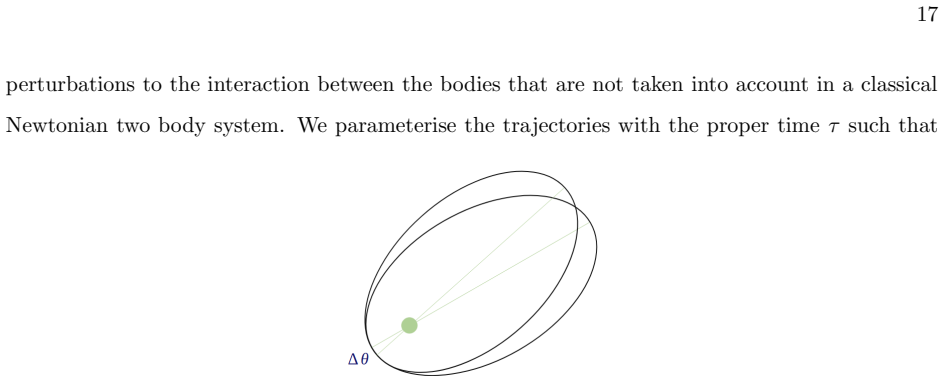
The perihelion advance The perihelion advance of a small object such as Mercury orbiting around a larger one such as the Sun is a classic test of GR. It corresponds to the angular shift of the perihelion position due to 17 perturbations to the interaction between the bodies that are not taken into account in a classical Newtonian two body system. We param...
-
[2]
The supplementary time delay caused by the coupling of matter to a scalar field is due to FIG
Shapiro time delay The Shapiro effect is a gravitational time delay for electromagnetic signals passing near a massive object. The supplementary time delay caused by the coupling of matter to a scalar field is due to FIG. 3: Representation of Shapiro time delay for photon skirting a large objects with an impact parameter b the shift in the satellite’s tra...
-
[3]
− 3λ 2 ϕ2 −(Φ2 1 − Φ2 2) . (97) The two Klein-Gordon equations obtained from the radiative action are □ϕ+ = − X n (−1)n n! ∂i1 · · ·∂in I i1···in + δ(3)(x) + m2ϕ+ + 4λϕ3 + + 3λϕ+ϕ2 − + 3λϕ−(Φ2 1 − Φ2 2) + 6λϕ+(Φ2 1 + Φ2
-
[4]
+ 6λϕ2 +(Φ1 + Φ2) + 6λϕ−ϕ+(Φ1 − Φ2) + 3 2 ϕ2 −(Φ1 − Φ2) (98) and □ϕ− = − X n (−1)n n! ∂i1 · · ·∂in I i1···in − δ(3)(x) + m2ϕ− + λϕ3 − + 12λϕ+ϕ2 − + 4λϕ−(Φ2 1 + Φ2 2) + 12λϕ+(Φ2 1 − Φ2
-
[5]
+ 12λϕ2 +(Φ1 − Φ2) + 12λϕ−ϕ+(Φ1 + Φ2) + 3ϕ2 −(Φ1 − Φ2). (99) Replacing the solutions to the Klein-Gordon equation in the action, we obtain the effective action for the binary system in the radiative sector Srad eff [xa,b ± ] = Z d4x δ(3)(x) X n 1 n! I i1···in − ∂i1 · · ·∂in ¯ϕ+ + 2λ ¯ϕ3 − ¯ϕ+ − 4λ ¯ϕ3 +( ¯Φ1 − ¯Φ2) + 3λ ¯ϕ2 − ¯ϕ+( ¯Φ1 − ¯Φ2) +λ ¯ϕ3 −( ¯Φ1...
-
[6]
(100) This action contains the dissipative and tail effects as we will see below
+ 3λ 2 ¯ϕ2 −( ¯Φ2 1 − ¯Φ2 2) . (100) This action contains the dissipative and tail effects as we will see below. 23 B. Dissipation Let us focus on the term coupling the sources to the radiative field R d4xδ(3)(x)I i1···in − ∂i1 · · ·∂in ¯ϕ+. Taking ¯ϕ+ at the lowest order and using the matrix of propagators in the ( ϕ+, ϕ−) basis [18, 19, 27] 4 Gab = ...
-
[7]
We must also perform the integration over x and y
The monopole-monopole For the particular case of monopole-monopole we evaluate the previous expression forλ = λ′ = 0 and use X ≡ X0 = r|y − ma M |. We must also perform the integration over x and y. This gives Z [0,1]2 dxdy − 4 π ln(|ω|T ) X m≥1 (−1)m ω2m (m!)222m m−1X p′=0 (−1)p′ C2p′+1 2m X 2m−2p′−2r2p′+1(x(1−x))−m− 1 2 (y(1−y))p′ (163) Putting it all t...
-
[8]
eiω(t−t′) i(t − t′) ln(ω) #+∞ ϵ +
The higher multipole interactions For the higher order terms, we must act with derivatives with respect to λ or λ′. We remark that for p′ = n − 1 we have a term in X 0 so no derivatives can act on it. This implies that we must consider derivatives ∂n λ ∂n′ λ′ − 4 π ln(|ω|T ) X n≥2 ω2m (n!)222m (x(1 − x))−m(−1)m m−2X p′=0 (−1)p′ C2p′+1 2m X 2m−2p′−2r2p′...
Show all 60 references
-
[9]
Arcadi, D
G. Arcadi, D. Cabo-Almeida, M. Dutra, P. Ghosh, M. Lindner, Y. Mambrini, J. P. Neto, M. Pierre, S. Profumo, and F. S. Queiroz (2024), 2403.15860
2024 arXiv
-
[10]
Weinberg, Rev
S. Weinberg, Rev. Mod. Phys. 61, 1 (1989)
1989
-
[11]
E. J. Copeland, M. Sami, and S. Tsujikawa, Int. J. Mod. Phys. D 15, 1753 (2006), hep-th/0603057
2006 arXiv
- [12]
-
[13]
A. G. Adame et al. (DESI) (2024), 2404.03002
2024 arXiv
-
[14]
Desjacques, A
V. Desjacques, A. Kehagias, and A. Riotto, Phys. Rev. D 97, 023529 (2018), 1709.07946
2018 arXiv
-
[15]
Bertotti, L
B. Bertotti, L. Iess, and P. Tortora, Nature 425, 374 (2003)
2003
-
[16]
Damour and G
T. Damour and G. Esposito-Farese, Class. Quant. Grav. 9, 2093 (1992). 48
1992
-
[17]
R. N. Lang, Phys. Rev. D 89, 084014 (2014), 1310.3320
2014 arXiv
-
[18]
R. N. Lang, Phys. Rev. D 91, 084027 (2015), 1411.3073
2015 arXiv
- [19]
- [20]
-
[21]
Bernard, L
L. Bernard, L. Bernard, and L. Bernard, Phys. Rev. D 101, 021501 (2020), 1906.10735
2020 arXiv
-
[22]
Bernard, E
L. Bernard, E. Dones, and S. Mougiakakos, Phys. Rev. D 109, 044006 (2024), 2310.19679
2024 arXiv
- [23]
-
[24]
Huang, M
J. Huang, M. C. Johnson, L. Sagunski, M. Sakellariadou, and J. Zhang, Phys. Rev. D 99, 063013 (2019), 1807.02133
2019 arXiv
-
[25]
R. F. Diedrichs, D. Schmitt, and L. Sagunski, Phys. Rev. D 110, 104073 (2024), 2311.04274
2024 arXiv
-
[26]
R. A. Porto, Phys. Rept. 633, 1 (2016), 1601.04914
2016 arXiv
-
[27]
W. D. Goldberger and I. Z. Rothstein, Phys. Rev. D 73, 104029 (2006), hep-th/0409156
2006 arXiv
-
[28]
C. R. Galley and M. Tiglio, Phys. Rev. D 79, 124027 (2009), 0903.1122
2009 arXiv
- [29]
-
[30]
Brax, A.-C
P. Brax, A.-C. Davis, and A. Kuntz, Phys. Rev. D 99, 124034 (2019), 1903.03842
2019 arXiv
-
[31]
W. D. Goldberger (2022), 2212.06677
2022 arXiv
-
[32]
C. R. Galley, Phys. Rev. Lett. 110, 174301 (2013), 1210.2745
2013 arXiv
-
[33]
C. R. Galley and A. K. Leibovich, Phys. Rev. D 86, 044029 (2012), 1205.3842
2012 arXiv
-
[34]
C. R. Galley, A. K. Leibovich, R. A. Porto, and A. Ross, Phys. Rev. D 93, 124010 (2016), 1511.07379
2016 arXiv
-
[35]
G. U. Jakobsen, G. Mogull, J. Plefka, and B. Sauer, JHEP 10, 128 (2022), 2207.00569
2022 arXiv
-
[36]
P. Brax, S. Casas, H. Desmond, and B. Elder, Universe 8, 11 (2021), 2201.10817
2021 arXiv
-
[37]
P. Brax, J. A. R. Cembranos, and P. Valageas, Phys. Rev. D 100, 023526 (2019), 1906.00730
2019 arXiv
-
[38]
C. M. Will, Living Rev. Rel. 17, 4 (2014), 1403.7377
2014 arXiv
-
[39]
J. S. Schwinger, J. Math. Phys. 2, 407 (1961)
1961
-
[40]
L. V. Keldysh, Zh. Eksp. Teor. Fiz. 47, 1515 (1964)
1964
-
[41]
X. Chen, Y. Wang, and Z.-Z. Xianyu, JCAP 12, 006 (2017), 1703.10166
2017 arXiv
-
[42]
R. A. Porto, M. M. Riva, and Z. Yang (2024), 2409.05860
2024 arXiv
-
[43]
Blanchet and T
L. Blanchet and T. Damour, Phys. Rev. D 37, 1410 (1988)
1988
-
[44]
Blanchet and G
L. Blanchet and G. Schaefer, Class. Quant. Grav. 10, 2699 (1993)
1993
-
[45]
Blanchet and B
L. Blanchet and B. S. Sathyaprakash, Phys. Rev. Lett. 74, 1067 (1995)
1995
- [46]
-
[47]
Bernard, L
L. Bernard, L. Blanchet, A. Boh´ e, G. Faye, and S. Marsat, Phys. Rev. D95, 044026 (2017), 1610.07934
2017 arXiv
-
[48]
Foffa and R
S. Foffa and R. Sturani, Phys. Rev. D 101, 064033 (2020), [Erratum: Phys.Rev.D 103, 089901 (2021)], 1907.02869
2020 arXiv
-
[49]
G. L. Almeida, S. Foffa, and R. Sturani, Phys. Rev. D 104, 124075 (2021), 2110.14146
2021 arXiv
- [50]
-
[51]
F. M. Ramazano˘ glu and F. Pretorius, Phys. Rev. D 93, 064005 (2016), 1601.07475. 49
2016 arXiv
- [52]
- [53]
-
[54]
Mougiakakos and P
S. Mougiakakos and P. Vanhove, Phys. Rev. D 103, 026001 (2021), 2010.08882
2021 arXiv
- [55]
- [56]
- [57]
-
[58]
Benisty, P
D. Benisty, P. Brax, and A.-C. Davis, Phys. Rev. D 107, 064049 (2023), 2212.03098
2023 arXiv
-
[59]
Poisson and C
E. Poisson and C. M. Will, Gravity: Newtonian, Post-Newtonian, Relativistic (Cambridge University Press, 2014)
2014
-
[60]
Tedesco, A
A. Tedesco, A. Capolupo, and G. Lambiase, Eur. Phys. J. C 84, 811 (2024), 2311.15944
2024 arXiv
Reviewed August 11, 2026 · model on record in the stance chip above.
Discussion (0). Continue with ORCID to comment.