REVIEW 3 major objections 4 minor 79 references
Scattering-Based Structural Inversion of Soft Materials via Kolmogorov-Arnold Networks
T0 review · 3 major / 4 minor · reviewed 2026-08-11 · deepseek-v4-flash
Pith's one-line read A Kolmogorov-Arnold network trained on computed scattering curves can invert measured small-angle scattering data into real-space structural parameters without closed-form analytical models.
desk verdict A useful KAN surrogate for SAS fitting, with a strong colloid demo and a weaker lamellar half; the 'model-independent' claim overreaches. read the letter →
The pith
A machine-rendered reading of the paper's core claim, the machinery that carries it, and where it could break.
The reading
What carries the argument
The load-bearing object is the KAN itself, built on the Kolmogorov-Arnold representation theorem, which writes a multivariate function as sums of univariate spline functions. Two stacked KAN blocks separate physical parameters from $Q$: the first maps parameters to latent variables, the second combines those latent variables with $Q$ to emit a continuous $I(Q)$, so no fixed $Q$ grid is needed. A second device is reference-system standardization: the lamellar network learns the ratio $I(Q)/I_{\mathrm{ref}}(Q)$ against a linear baseline, and the colloidal network learns deviations from the analytic hard-sphere structure factor, which concentrates the network's capacity on small corrections and improves numerical stability.
What would settle it
Take a lamellar sample whose real-space defect structure has been determined independently by electron microscopy, compute the KAN-inferred $(\sigma_k, \Gamma, \alpha)$ from its SANS curve, and check whether the reconstructed three-dimensional structure reproduces the observed layer connectivity and defect distribution; if it does not, the three-parameter representation is insufficient for structural inversion.
Extended reading notes
Core claim
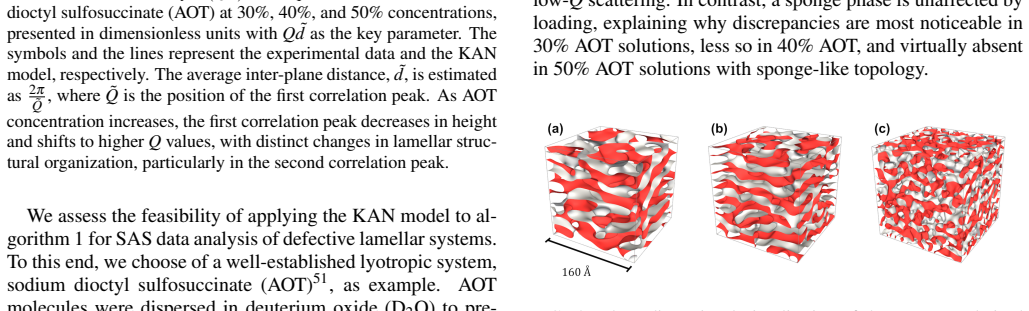
The authors' central claim is that a two-stage KAN can learn the mapping from structural parameters and wave vector $Q$ to scattering intensity $I(Q)$ well enough that the trained network, inserted into a least-squares fitting loop, returns physically meaningful parameters from experimental data. For defective lamellar phases, the network takes $(\sigma_k, \Gamma, \alpha)$—the wave-vector spread, symmetry ordering, and amphiphile-to-water volume ratio—and outputs $\ln I(Q\tilde d)$; the fitted values reproduce the measured SANS curves and, when fed back into the wave-field representation, show a concentration-driven evolution from isolated anisotropic plates to connected, more isotropic structures. For charged colloids, the network takes $(\varphi, 1/(\kappa D), \ln A, QD)$ and outputs corrections to a hard-sphere reference structure factor; the resulting $S(Q)$ matches molecular-dynamics test sets, and fitting experimental data from silica dispersions yields effective interaction potentials whose repulsive strength grows with concentration.
Load-bearing premise
The lamellar half of the paper stands on the assumption, taken from earlier work, that every defective lamellar structure encountered in the experiments is uniquely captured by the three parameters $(\sigma_k, \Gamma, \alpha)$ used to build the training library; if that wave-field representation is wrong or incomplete, the fitted numbers will have no direct real-space meaning.
Editorial extensions
If this is right
- A trained KAN can fit SANS data recorded at arbitrary, unevenly spaced $Q$ values without rebinning or interpolation, so one network can analyze data from different instruments and configurations.
- Because the KAN is differentiable in its input parameters, standard gradient-based least-squares minimizers can be used for fitting, which is not practical for activation-heavy convolutional networks.
- For defective lamellar phases, the extracted $(\sigma_k, \Gamma, \alpha)$ parameters yield three-dimensional structures, so scattering alone can visualize the transition from ordered lamellae toward sponge-like, interconnected phases.
- For charged colloids, the KAN replaces approximate closure relations used in integral-equation inversion, extending feasible analysis to concentrated or strongly coupled regimes where those closures fail to converge.
- The same surrogate-plus-least-squares recipe should apply to other scattering problems, as long as a reference system and a sufficiently representative training library can be constructed.
Reading between the lines
- The method's independence from closed-form scattering expressions does not make it independent of the physical assumptions built into the training library; the inversion inherits those assumptions through the simulated or modeled training data.
- The fitted parameters carry no built-in uncertainty estimate, so a natural extension is to attach one, for example by training an ensemble of KANs or adding synthetic noise.
- The continuous-$Q$ property suggests the framework can be applied to time-resolved or scanning scattering experiments where the $Q$ grid changes between frames, without the data preprocessing that grid-based networks require.
- One could test the scheme's limits by generating scattering curves from structures outside the training library and checking whether fitting recovers a plausible parameter set or silently returns an in-distribution compromise.
Signed reviews
Editorial analysis
A structured set of objections, weighed in public.
Referee Report
Summary. This paper proposes a Kolmogorov-Arnold Network (KAN) framework for small-angle scattering inversion: a continuous, differentiable surrogate I(Q;\lambda) that can be used in least-squares fitting of experimental SANS data at arbitrary Q points. Two applications are presented: defective lamellar phases, where the KAN maps (\sigma_k, \Gamma, \alpha) to the scattering intensity, and charged colloidal suspensions, where the KAN maps (\phi, 1/\kappa D, \ln A, QD) to the direct correlation function relative to a hard-sphere reference. The authors fit experimental AOT SANS data and silica colloidal SANS data, and benchmark the colloidal S(Q) against an MD test set.
Significance. If validated, the KAN approach would be a useful addition to the SAS analysis toolbox because it provides continuous, differentiable scattering functions that avoid fixed-Q grids and can support gradient-based minimization. The colloid case is the stronger part: the KAN reproduces an independent MD test set across \phi from 0.045 to 0.405, and the hard-sphere-referenced formulation is a sensible way to reduce the learning target. The lamellar case is weaker: the experimental fits show acknowledged low-Q discrepancies and no reported parameter values or uncertainties. The main gap is that the central claim of a 'model-independent, data-driven approach' is not supported, because the training data are generated from the authors' own forward models and no test on independently generated scattering data is reported. The paper also does not report quantitative goodness-of-fit statistics for the experimental inversions, which limits the ability to judge the accuracy of the extracted structural parameters.
major comments (3)
- [Abstract; Section III.A; Section III.B] The central claim of a 'model-independent, data-driven approach' is not supported by the presented evidence. The KAN is trained exclusively on simulation libraries produced by the authors' own wave-field model (Ref. 10) for lamellae and by the authors' MD pipeline (Ref. 3) for colloids. Consequently, the experimental inversion returns parameters of those same forward models, and the fitted parameters have real-space meaning only to the extent that those models are correct. Held-out tests within the same pipeline validate the KAN as a surrogate for the forward model, but they do not establish model independence. The authors should either temper the 'model-independent' claim in the abstract and conclusions or demonstrate parameter recovery on scattering data generated by an independent model outside the training family (e.g., a different simulation approach or a different closure relation).
- [Section III.A; Fig. 4] The lamellar experimental fits are not quantitatively documented. The text acknowledges significant discrepancies for Q\tilde{d} < 1, yet the paper reports no goodness-of-fit statistics, no fitted values of (\sigma_k, \Gamma, \alpha) for the 30%, 40%, and 50% AOT samples, and no uncertainty estimates from Algorithm 1. Without these numbers, the three-dimensional structural renderings in Fig. 5 and the claim that the KAN 'enabled the resolution of structural distortions' cannot be assessed. Please report the fitted parameters, their uncertainties, and residual statistics separately for Q\tilde{d} < 1 and Q\tilde{d} > 1.
- [Section III.B; Fig. 8] The experimental colloid inversion is not sufficiently validated or documented. The particle diameter D=115 nm and 6% polydispersity are obtained from a fit to the 1 wt% data, but no confidence intervals for D are given. The fitted potential parameters (A, \kappa, \phi) for each weight fraction are also not reported. The VR(r/D) curves in Fig. 8(b) are shown without error bars, and no comparison with an independent inversion method (e.g., HNC, RMSA, or an alternate closure) is provided. As a result, the conclusion that the KAN achieves 'excellent agreement with both molecular dynamics simulations and experimental data' is only demonstrated for S(Q) on the MD test set, not for the experimental potential inversion. Please provide the fitted values, uncertainties, and an independent cross-check of the inverted potential.
minor comments (4)
- [Section III.B] The sentence 'This report contends that achieving a perfect closure for solving the inverse scattering problem is unattainable' uses 'report' in an unusual way; 'we contend' or 'the present work contends' would be clearer.
- [Section III.A; Section IV] The notation 'D 2O' should be rendered as 'D2O' with proper subscript formatting, and the tilde placement in 'Q \tilde{d}' should be defined explicitly to avoid ambiguity in plain text.
- [Section III.A; Section III.B] The training set details are not reported: no number of training samples, no parameter ranges for (\sigma_k, \Gamma, \alpha) or (\phi, 1/\kappa D, \ln A), and no network hyperparameters (depth, width, spline knots, learning rate). Providing these details would aid reproducibility.
- [Algorithm 1] The convergence threshold L_c and the specific minimization algorithm used in each case study are not stated; please specify these choices so that the fitting procedure is reproducible.
Circularity Check
The experimental inversions are not model-independent: the KAN is trained on the authors' own wave-field and Yukawa/MD libraries, and the reported real-space structures are re-renderings of those same forward models at fitted parameters.
-
uniqueness imported from authors
[Section III.A, defective lamellar phases, paragraph introducing the wave-field descriptor]
"We propose a conformational descriptor for defective lamellar phases based on a wave field representation 10. In this framework, we have demonstrated that the structure of defective lamellar phases can be uniquely characterized by three parameters: σk, which represents the standard deviation of the wave vector in the wave field that models the density fluctuation of lamellar phases; Γ, which quantifies the degree of symmetry in the ordering of lamellar phases; and α, which measures the volume ratio of amphiphilic molecules to water."
The three-parameter completeness claim is taken from the authors' own Ref. 10, which is also the source of the training set used to train the KAN ('training set 10'). The KAN's input space and the final real-space renderings are therefore both defined by that self-cited representation. If the representation is incomplete, the fitted parameters have no independent real-space meaning; the paper does not test the uniqueness claim against any data outside Ref. 10. The central premise is thus imported from the authors' prior work rather than established in this paper.
-
fitted input called prediction
[Section III.A, KAN training for lamellar phases and Fig. 5 (real-space visualization)]
"The KAN model is then trained to capture the relations between Itrain and {σk, Γ, α} in the training set10. ... From the values of σk, Γ, and α, a three-dimensional wave field representation of lamellar structure (Fig. 5) is constructed. ... Real-space renderings of these distorted lamellar phases, including inter-layer distances and in-plane correlation lengths, are presented in Fig. 5, with further details in Ref.10."
The scattering curves used to train the KAN are generated from the same wave-field representation that later produces the 'extracted' real-space structures. Fitting experimental AOT data with Algorithm 1 therefore returns the parameters of that self-generated forward model, and the reported structural visualization is simply the forward model evaluated at those fitted parameters. The real-space prediction cannot contain information beyond the training library; it is the inverse of the authors' own generator by construction. This is a fitted parameter renamed as a direct structural extraction.
1 more flagged steps
-
fitted input called prediction
[Section III.B, charged colloidal suspensions, KAN architecture and Fig. 8]
"By systematically training the KAN using the training set 3 containing structure factor S(Q) and corresponding potential parameters, this architecture effectively maps the input physical parameters to the correction terms of inter-particle correlation... The optimized I(QD) obtained from algorithm 1 align well with the SANS data... Fig. 8(b) presents the inverted VR(r/D) curves, which show little variation across dispersions, with fluctuations within reasonable uncertainties."
The colloidal training set is the authors' own MD/Yukawa library (Ref. 3): the inputs (φ, 1/κD, ln A, QD) are the parameters of the Yukawa potential in Eq. (7), and the structure factors are MD-generated from that same potential. Fitting experimental silica SANS data with the KAN-generated S(Q) therefore recovers parameters of the training model, and the reported VR(r/D) in Fig. 8(b) is Eq. (7) evaluated with those parameters. As in the lamellar case, the 'inverted potential' is a re-rendering of the fitted training model, not an independent extraction; only the held-out MD test is independent, and it stays inside the same Yukawa/MD pipeline.
full rationale
Most of the KAN mechanics is mathematically self-contained: Eq. (1) is the Kolmogorov-Arnold theorem, Eqs. (2)-(6) define a linear standardization, and the held-out MD test in Fig. 6(b) is a genuine in-pipeline prediction. There is no equation in this paper that is formally identical to another by substitution. The circularity is at the level of the experimental-inversion claims: both case studies train the KAN on libraries generated by the authors' own forward models (Ref. 10 wave-field representation and Ref. 3 MD/Yukawa potentials), then fit experimental scattering with that KAN and present the corresponding forward-model parameters as 'directly extracted real-space structural information' and 'model-independent.' The abstract's 'model-independent' claim is, on the paper's own construction, not supportable: the KAN can only return the parameters of the training family. The paper's admission of systematic low-Q misfit for AOT (Q ˜d < 1) confirms that the surrogate is tied to the training model and cannot adapt to experimental features outside it. Since the central 'transformative' claim depends on the unvalidated, self-cited uniqueness/completeness of those forward models, the circularity score is a partial 6 rather than 0-2.
Assumptions & free parameters
free parameters (6)
- Reference intensity coefficients A and B (lamellar) =
not reported
- Quadratic Q coefficients C (lamellar) =
not reported
- Particle diameter D and polydispersity (colloids) =
D=115 nm, 6% polydispersity
- Fitted structural parameters from Algorithm 1 =
not tabulated
- KAN spline coefficients and network weights =
not reported
- Correction functions f1, f2, f3 (colloid) =
learned by KAN
assumptions (6)
- standard math Kolmogorov-Arnold representation theorem: any multivariate continuous function is a finite sum of univariate continuous functions.
- ad hoc to paper Defective lamellar phases are uniquely characterized by (σk, Γ, α) in the wave field representation.
- domain assumption MD simulations of the Yukawa model accurately represent real charged colloidal suspensions.
- ad hoc to paper The discrepancy in the direct correlation function has the form ΔG(K) = f1(K) sin(f2(K))/K.
- domain assumption The decoupling approximation I(Q) = ⟨P(Q)⟩⟨S(Q)⟩ holds for 6% polydispersity.
- domain assumption Instrument resolution is not the source of the low-Q lamellar discrepancy.
Cite this review
Pith. "Pith review of Scattering-Based Structural Inversion of Soft Materials via Kolmogorov-Arnold Networks." pith.science (2026). https://pith.science/paper/RD5ZGFRS
@misc{pith2026241215474,
  author       = {Pith},
  title        = {Pith review of: Scattering-Based Structural Inversion of Soft Materials via Kolmogorov-Arnold Networks},
  year         = {2026},
  howpublished = {\url{https://pith.science/paper/RD5ZGFRS}},
  note         = {Machine review of arXiv:2412.15474}
}
read the original abstract
Small-angle scattering (SAS) techniques are indispensable tools for probing the structure of soft materials. However, traditional analytical models often face limitations in structural inversion for complex systems, primarily due to the absence of closed-form expressions of scattering functions. To address these challenges, we present a machine learning framework based on the Kolmogorov-Arnold Network (KAN) for directly extracting real-space structural information from scattering spectra in reciprocal space. This model-independent, data-driven approach provides a versatile solution for analyzing intricate configurations in soft matter. By applying the KAN to lyotropic lamellar phases and colloidal suspensions -- two representative soft matter systems -- we demonstrate its ability to accurately and efficiently resolve structural collectivity and complexity. Our findings highlight the transformative potential of machine learning in enhancing the quantitative analysis of soft materials, paving the way for robust structural inversion across diverse systems.
Figures


Figures from the paper (5 more)



Reference graph
Works this paper leans on
-
[1]
merlin.mbs apsrev4-1.bst 2010-07-25 4.21a (PWD, AO, DPC) hacked
FUNCTION id.bst "merlin.mbs apsrev4-1.bst 2010-07-25 4.21a (PWD, AO, DPC) hacked" ENTRY address archive archivePrefix author bookaddress booktitle chapter collaboration doi edition editor eid eprint howpublished institution isbn issn journal key language month note number organization pages primaryClass publisher school SLACcitation series title translati...
2010
-
[2]
author author P. Lindner \ and\ author T. Zemb ,\ @noop title Neutron, X-rays and Light. Scattering Methods Applied to Soft Condensed Matter \ ( publisher North-Holland ,\ address Amsterdam ,\ year 2002 ) NoStop
work page 2002
-
[3]
author author J. Pedersen ,\ in\ @noop booktitle Neutron, X -Ray and Light: Scattering Methods Applied to Soft Condensed Matter \ ( publisher edited by Th. Zemb and P. Lindner, North-Holland, Amsterdam ,\ year 2002 )\ pp.\ pages 391--420 NoStop
work page 2002
-
[4]
author author M.-C. \ Chang , author C.-H. \ Tung , author S.-Y. \ Chang , author J.-M. \ Carrillo , author Y. Wang , author B. G. \ Sumpter , author G.-R. \ Huang , author C. Do , \ and\ author W.-R. \ Chen ,\ @noop journal journal Commun. Phys. \ volume 5 ,\ pages 1–8 ( year 2022 ) NoStop
work page 2022
-
[5]
author author C.-H. \ Tung , author S.-Y. \ Chang , author H.-L. \ Chen , author Y. Wang , author K. Hong , author J.-M. \ Carrillo , author B. G. \ Sumpter , author Y. Shinohara , author C. Do , \ and\ author W.-R. \ Chen ,\ @noop journal journal J. Chem. Phys. \ volume 156 ,\ pages 131101 ( year 2022 ) NoStop
work page 2022
-
[6]
author author L. Ding , author C.-H. \ Tung , author B. G. \ Sumpter , author W.-R. \ Chen , \ and\ author C. Do ,\ @noop journal journal arXiv preprint arXiv:2410.05574 \ ( year 2024 a ) NoStop
arXiv 2024
-
[7]
Machine Learning-Assisted Profiling of Ladder Polymer Structure using Scattering
author author L. Ding , author C.-H. \ Tung , author Z. Cao , author Z. Ye , author X. Gu , author Y. Xia , author W.-R. \ Chen , \ and\ author C. Do ,\ @noop journal journal arXiv preprint arXiv:2411.00134 \ ( year 2024 b ) NoStop
work page Pith review arXiv 2024
-
[8]
Machine Learning-Informed Scattering Correlation Analysis of Sheared Colloids
author author L. Ding , author Y. Chen , \ and\ author C. Do ,\ @noop journal journal arXiv preprint arXiv:2412.07926 \ ( year 2024 c ) NoStop
work page Pith review arXiv 2024
Show all 79 references
-
[9]
\ Tung , author S.-Y
author author C.-H. \ Tung , author S.-Y. \ Chang , author M.-C. \ Chang , author J.-M. \ Carrillo , author B. G. \ Sumpter , author C. Do , \ and\ author W.-R. \ Chen ,\ @noop journal journal Carbon Trends \ volume 10 ,\ pages 100252 ( year 2023 ) NoStop
2023
-
[10]
\ Tung , author M.-Z
author author C.-H. \ Tung , author M.-Z. \ Chen , author H.-L. \ Chen , author G.-R. \ Huang , author L. Porcar , author M.-C. \ Chang , author J.-M. \ Carrillo , author Y. Wang , author B. G. \ Sumpter , author Y. Shinohara , author C. Do , \ and\ author W.-R. \ Chen ,\ @noo...
2024
-
[11]
\ Tung , author Y.-J
author author C.-H. \ Tung , author Y.-J. \ Hsiao , author H.-L. \ Chen , author G.-R. \ Huang , author L. Porcar , author M.-C. \ Chang , author J.-M. \ Carrillo , author Y. Wang , author B. G. \ Sumpter , author Y. Shinohara , author J. Taylor , author C. Do , \ and\ author ...
2024
-
[12]
Liu , author Y
author author Z. Liu , author Y. Wang , author S. Vaidya , author F. Ruehle , author J. Halverson , author M. Soljačić , author T. Y. \ Hou , \ and\ author M. Tegmark ,\ @noop journal journal arXiv:2404.19756 \ ( year 2024 ) NoStop
2024 arXiv
-
[13]
author author V. I. \ Arnol'd ,\ @noop journal journal Dokl. Akad. Nauk SSSR \ volume 108 ,\ pages 179 ( year 1956 ) NoStop
1956
-
[14]
author author A. N. \ Kolmogorov ,\ @noop journal journal Dokl. Akad. Nauk SSSR \ volume 114 ,\ pages 679 ( year 1957 ) NoStop
1957
-
[15]
author author R. H. \ Bartels , author J. C. \ Beatty , \ and\ author B. A. \ Barsky ,\ @noop title An Introduction to Splines for Use in Computer Graphics and Geometric Modeling \ ( publisher Morgan Kaufmann Publishers ,\ year 1987 ) NoStop
1987
-
[16]
Odena , author V
author author A. Odena , author V. Dumoulin , \ and\ author C. Olah ,\ @noop journal journal Distill \ volume 1 ,\ pages e3 ( year 2016 ) NoStop
2016
-
[17]
Nallet , author R
author author F. Nallet , author R. Laversanne , \ and\ author D. Roux ,\ @noop journal journal J. Phys. II France \ volume 3 ,\ pages 487–502 ( year 1993 ) NoStop
1993
-
[18]
Zhang , author R
author author R. Zhang , author R. M. \ Suter , \ and\ author J. F. \ Nagle ,\ @noop journal journal Phys. Rev. E \ volume 50 ,\ pages 5047–5060 ( year 1994 ) NoStop
1994
-
[19]
Lemmich , author K
author author J. Lemmich , author K. Mortensen , author J. H. \ Ipsen , author T. H nger , author R. Bauer , \ and\ author O. G. \ Mouritsen ,\ @noop journal journal Phys. Rev. E \ volume 53 ,\ pages 5169–5180 ( year 1996 ) NoStop
1996
-
[20]
Pabst , author M
author author G. Pabst , author M. Rappolt , author H. Amenitsch , \ and\ author P. Laggner ,\ @noop journal journal Phys. Rev. E \ volume 62 ,\ pages 4000–4009 ( year 2000 ) NoStop
2000
-
[21]
Bouglet \ and\ author C
author author G. Bouglet \ and\ author C. Ligoure ,\ @noop journal journal Eur. Phys. J. B \ volume 9 ,\ pages 137–147 ( year 1999 ) NoStop
1999
-
[22]
Mihailescu , author M
author author M. Mihailescu , author M. Monkenbusch , author J. Allgaier , author H. Frielinghaus , author D. Richter , author B. Jakobs , \ and\ author T. Sottmann ,\ @noop journal journal Phys. Rev. E \ volume 66 ,\ pages 041504 ( year 2002 ) NoStop
2002
-
[23]
Castro-Roman , author L
author author F. Castro-Roman , author L. Porcar , author G. Porte , \ and\ author C. Ligoure ,\ @noop journal journal Eur. Phys. J. E \ volume 18 ,\ pages 259–272 ( year 2005 ) NoStop
2005
-
[24]
Pabst , author R
author author G. Pabst , author R. Koschuch , author B. Pozo-Navas , author M. Rappolt , author K. Lohner , \ and\ author P. Laggner ,\ @noop journal journal J. Appl. Crystallogr. \ volume 36 ,\ pages 1378–1388 ( year 2004 ) NoStop
2004
-
[25]
author author P. T. \ Callaghan \ and\ author O. Soderman ,\ @noop journal journal J. Phys. Chem. \ volume 77 ,\ pages 1737–1744 ( year 1983 ) NoStop
1983
-
[26]
author author J. H. \ Davis ,\ @noop journal journal Biochim. Biophys. Acta \ volume 737 ,\ pages 117–171 ( year 1983 ) NoStop
1983
-
[27]
Chidichimo , author C
author author G. Chidichimo , author C. La Mesa , author G. A. \ Ranieri , \ and\ author M. Terenzi ,\ @noop journal journal Mol. Cryst. Liq. Cryst. \ volume 150b ,\ pages 221–236 ( year 1987 ) NoStop
1987
-
[28]
Chidichimo , author L
author author G. Chidichimo , author L. Coppola , author C. La Mesa , author G. A. \ Ranieri , \ and\ author A. Saupe ,\ @noop journal journal Chem. Phys. Lett. \ volume 145 ,\ pages 85–89 ( year 1988 ) NoStop
1988
-
[29]
Ukleja , author G
author author P. Ukleja , author G. Chidichimo , \ and\ author P. Photinos ,\ @noop journal journal Liq. Cryst. \ volume 9 ,\ pages 359 ( year 1991 ) NoStop
1991
-
[30]
Coppola , author R
author author L. Coppola , author R. Muzzalupo , author G. A. \ Ranieri , \ and\ author M. Terenzi ,\ @noop journal journal Langmuir \ volume 11 ,\ pages 1116–1121 ( year 1995 ) NoStop
1995
-
[31]
Jóhannesson , author I
author author H. Jóhannesson , author I. Furó , \ and\ author B. Halle ,\ @noop journal journal Phys. Rev. E \ volume 53 ,\ pages 4904 ( year 1996 ) NoStop
1996
-
[32]
Coppola , author R
author author L. Coppola , author R. Gianferri , author I. Nicotera , \ and\ author C. Oliviero ,\ @noop journal journal Mol. Cryst. Liq. Cryst. \ volume 398 ,\ pages 157–167 ( year 2003 ) NoStop
2003
-
[33]
author author P. L. \ Hubbard , author K. M. \ McGrath , \ and\ author P. T. \ Callaghan ,\ @noop journal journal Langmuir \ volume 21 ,\ pages 4340–4346 ( year 2005 ) NoStop
2005
-
[34]
Eriksson , author S
author author S. Eriksson , author S. Lasič , author M. Nilsson , author C.-F. \ Westin , \ and\ author D. Topgaard ,\ @noop journal journal J. Chem. Phys. \ volume 142 ,\ pages 104201 ( year 2015 ) NoStop
2015
-
[35]
Kléman , author C
author author M. Kléman , author C. E. \ Williams , author M. J. \ Costello , \ and\ author T. Gulik-krzywicki ,\ @noop journal journal Philos. Mag. \ volume 35 ,\ pages 33 ( year 1977 ) NoStop
1977
-
[36]
author author R. B. \ Meyer , author B. Stebler , \ and\ author S. T. \ Lagerwall ,\ @noop journal journal Phys. Rev. Lett. \ volume 41 ,\ pages 1393 ( year 1978 ) NoStop
1978
-
[37]
Bourdon , author J
author author L. Bourdon , author J. Sommeria , \ and\ author M. Kléman ,\ @noop journal journal J. Physique \ volume 43 ,\ pages 77 ( year 1982 ) NoStop
1982
-
[38]
author author M. J. \ Costello , author S. Meiboom , \ and\ author M. Sammon ,\ @noop journal journal Phys. Rev. A \ volume 29 ,\ pages 2957 ( year 1984 ) NoStop
1984
-
[39]
Allain \ and\ author M
author author M. Allain \ and\ author M. Kléman ,\ @noop journal journal J. Physique \ volume 45 ,\ pages 225 ( year 1985 ) NoStop
1985
-
[40]
Allain ,\ @noop journal journal Europhys
author author M. Allain ,\ @noop journal journal Europhys. Lett. \ volume 2 ,\ pages 597 ( year 1986 ) NoStop
1986
-
[41]
Allain \ and\ author M
author author M. Allain \ and\ author M. Kléman ,\ @noop journal journal J. Physique \ volume 48 ,\ pages 1799 ( year 1987 ) NoStop
1987
-
[42]
Kléman ,\ @noop journal journal Rep
author author M. Kléman ,\ @noop journal journal Rep. Prog. Phys. \ volume 52 ,\ pages 555 ( year 1989 ) NoStop
1989
-
[43]
Strey , author W
author author R. Strey , author W. Jahn , author G. Porte , \ and\ author P. Bassereau ,\ @noop journal journal Langmuir \ volume 6 ,\ pages 1635 ( year 1990 ) NoStop
1990
-
[44]
Blanc , author C
author author C. Blanc , author C. Meyer , author S. S. Asnacios , author M. Kléman , author I. Lelidis , \ and\ author J.-L. \ Martin ,\ @noop journal journal Philos. Mag. Lett. \ volume 85 ,\ pages 641 ( year 2005 ) NoStop
2005
-
[45]
Moreau , author L
author author P. Moreau , author L. Navailles , author J. Giermanska-Kahn , author O. Mondain-Monval , author F. Nallet , \ and\ author D. Roux ,\ @noop journal journal Europhys. Lett. \ volume 73 ,\ pages 49 ( year 2006 ) NoStop
2006
-
[46]
Zhang , author M
author author C. Zhang , author M. Gao , author N. Diorio , author W. Weissflog , author U. Baumeister , author S. Sprunt , author J. T. \ Gleeson , \ and\ author A. Jákli ,\ @noop journal journal Phys. Rev. Lett. \ volume 109 ,\ pages 107802 ( year 2012 ) NoStop
2012
-
[47]
author author P. J. \ Photinos , author L. J. \ Yu , \ and\ author A. Saupe ,\ @noop journal journal Mol. Cryst. Liq. Cryst. \ volume 67 ,\ pages 277 ( year 1981 ) NoStop
1981
-
[48]
Boden , author S
author author N. Boden , author S. A. \ Corne , \ and\ author K. W. \ Jolley ,\ @noop journal journal Mol. Cryst. Liq. Cryst. \ volume 67 ,\ pages 277 ( year 1981 ) NoStop
1981
-
[49]
author author P. J. \ Photinos \ and\ author A. Saupe ,\ @noop journal journal J. Chem. Phys. \ volume 84 ,\ pages 517 ( year 1986 ) NoStop
1986
-
[50]
Photinos \ and\ author A
author author P. Photinos \ and\ author A. Saupe ,\ @noop journal journal Phys. Rev. A \ volume 43 ,\ pages 2890 ( year 1991 ) NoStop
1991
-
[51]
Boden \ and\ author K
author author N. Boden \ and\ author K. W. \ Jolley ,\ @noop journal journal Phys. Rev. A \ volume 45 ,\ pages 8751 ( year 1992 ) NoStop
1992
-
[52]
Rogers \ and\ author P
author author J. Rogers \ and\ author P. A. \ Winsor ,\ @noop journal journal J. Colloid Interface Sci. \ volume 30 ,\ pages 247–257 ( year 1969 ) NoStop
1969
-
[53]
\ Huang , author C.-H
author author G.-R. \ Huang , author C.-H. \ Tung , author M.-Z. \ Chen , author L. Porcar , author Y. Shinohara , author C. U. \ Wildbruber , author C. Do , \ and\ author W.-R. \ Chen ,\ @noop journal journal J. Appl. Cryst. \ volume 56 ,\ pages 1537 ( year 2023 ) NoStop
2023
-
[54]
\ Chen \ and\ author S.-M
author author S.-H. \ Chen \ and\ author S.-M. \ Choi ,\ @noop journal journal J. Appl. Cryst. \ volume 30 ,\ pages 755 ( year 1997 ) NoStop
1997
-
[55]
author author N. F. \ Berk ,\ @noop journal journal Phys. Rev. A \ volume 44 ,\ pages 5069 ( year 1991 ) NoStop
1991
-
[56]
author author G. B. \ Arfken , author H. J. \ Weber , \ and\ author F. E. \ Harris ,\ @noop title Mathematical Methods for Physicists: A Comprehensive Guide \ ( publisher Academic Press ,\ address Cambridge ,\ year 2012 ) NoStop
2012
-
[57]
author author C. M. \ Bishop ,\ @noop title Pattern Recognition and Machine Learning \ ( publisher Springer ,\ year 2006 ) NoStop
2006
-
[58]
Kékicheff , author B
author author P. Kékicheff , author B. Cabane , \ and\ author M. Rawiso ,\ @noop journal journal J. Physique Lett. \ volume 45 ,\ pages 813–821 ( year 1984 ) NoStop
1984
-
[59]
author author E. J. W. \ Verway \ and\ author J. T. G. \ Overbeek ,\ @noop title Theory of The Stability of Lyophobic Colloids \ ( publisher Elsevier Publ. Co. Inc. ,\ address New York ,\ year 1948 ) NoStop
1948
-
[60]
author author J. N. \ Israelachvili ,\ @noop title Intermolecular and Surface Forces \ ( publisher Academic Press, Elsevier ,\ year 2011 )\ pp.\ pages 139--140 NoStop
2011
-
[61]
author author R. L. \ Henderson ,\ @noop journal journal Phys. Lett. \ volume 49A ,\ pages 197 ( year 1974 ) NoStop
1974
-
[62]
author author C. G. \ Gray \ and\ author K. E. \ Gubbins ,\ @noop title Theory of Molecular Fluids: Fundamentals Volume I \ ( publisher Clarendon Press ,\ address Oxford ,\ year 1984 ) NoStop
1984
-
[63]
author author P. A. \ Egelstaff ,\ @noop title An Introduction to the Liquid State, 2nd Ed. \ ( publisher Clarendon Press ,\ address Oxford ,\ year 1992 ) NoStop
1992
-
[64]
author author L. S. \ Ornstein \ and\ author F. Zernike ,\ @noop journal journal Proc. Akad. Sci. \ volume 17 ,\ pages 793 ( year 1914 ) NoStop
1914
-
[65]
\ Hansen \ and\ author I
author author J.-P. \ Hansen \ and\ author I. R. \ McDonald ,\ @noop title Theory of Simple Liquids with Applications to Soft Matter, 4th Ed. \ ( publisher Academic Press ,\ address Amsterdam ,\ year 2013 ) NoStop
2013
-
[66]
author author J. B. \ Hayter \ and\ author J. Penfold ,\ @noop journal journal Mol. Phys. \ volume 42 ,\ pages 109 ( year 1981 ) NoStop
1981
-
[67]
\ Hansen \ and\ author J
author author J.-P. \ Hansen \ and\ author J. B. \ Hayter ,\ @noop journal journal Mol. Phys. \ volume 46 ,\ pages 651 ( year 1982 ) NoStop
1982
-
[68]
author author I. K. \ Snook \ and\ author J. B. \ Hayter ,\ @noop journal journal Langmuir \ volume 8 ,\ pages 2880 ( year 1992 ) NoStop
1992
-
[69]
Beresford-Smith , author D
author author B. Beresford-Smith , author D. Y. C. \ Chan , \ and\ author D. J. \ Mitchell ,\ @noop journal journal J. Colloid Interface Sci. \ volume 105 ,\ pages 216 ( year 1985 ) NoStop
1985
-
[70]
Klein \ and\ author B
author author R. Klein \ and\ author B. D’Aguanno ,\ @noop title Light Scattering: Principles and Development \ ( publisher edited by W. Brown, Clarendon Press, Oxford ,\ year 1996 )\ pp.\ pages 30--102 NoStop
1996
-
[71]
Heinen , author P
author author M. Heinen , author P. Holmqvist , author A. J. \ Banchio , \ and\ author G. Nägele ,\ @noop journal journal J. Chem. Phys. \ volume 134 ,\ pages 044532 ( year 2011 ) NoStop
2011
-
[72]
author author K. S. \ Schmitz ,\ @noop title Macroions in Solution and Colloidal Suspension \ ( publisher Wiley-VCH, New York ,\ year 1992 ) NoStop
1992
-
[73]
Belloni ,\ @noop title Neutron, X -Ray and Light Scattering: Introduction to an Investigative Tool for Colloidal and Polymetric Systems \ ( publisher edited by Th
author author L. Belloni ,\ @noop title Neutron, X -Ray and Light Scattering: Introduction to an Investigative Tool for Colloidal and Polymetric Systems \ ( publisher edited by Th. Zemb and P. Lindner, North-Holland, Amsterdam ,\ year 1991 )\ pp.\ pages 135--155 NoStop
1991
-
[74]
author author F. J. \ Rogers \ and\ author D. A. \ Young ,\ @noop journal journal Phys. Rev. A \ volume 30 ,\ pages 999 ( year 1984 ) NoStop
1984
-
[75]
Huš , author M
author author M. Huš , author M. Zalar , \ and\ author T. Urbic ,\ @noop journal journal J. Chem. Phys. \ volume 138 ,\ pages 224508 ( year 2013 ) NoStop
2013
-
[76]
author author J. A. \ Anta \ and\ author S. Lago ,\ @noop journal journal J. Chem. Phys. \ volume 116 ,\ pages 10514 ( year 2002 ) NoStop
2002
-
[77]
author author L. L. \ Lee ,\ @noop journal journal J. Chem. Phys. \ volume 107 ,\ pages 7360 ( year 1997 ) NoStop
1997
-
[78]
author author M. S. \ Wertheim ,\ 10.1103/PhysRevLett.10.321 journal journal Phys. Rev. Lett. \ volume 10 ,\ pages 321 ( year 1963 ) NoStop
1963 doi
-
[79]
Gillan ,\ @noop journal journal J
author author M. Gillan ,\ @noop journal journal J. Phys. C: Solid State Phys. \ volume 7 ,\ pages L1 ( year 1974 ) NoStop
1974
Reviewed August 11, 2026 · model on record in the stance chip above.
Discussion (0). Continue with ORCID to comment.