REVIEW 5 minor 1 cited by
In Pursuit of New Paradigms: TASI 2024
T0 review · 0 major / 5 minor · reviewed 2026-08-11 · deepseek-v4-flash
Pith's one-line read The Higgs hierarchy problem is a sharp, concrete puzzle, and every solution class surveyed here leaves a testable imprint, most universally in modified Higgs couplings.
desk verdict Reliable, well-crafted TASI survey of hierarchy-problem paradigms—no new results, but a clean and honest map. read the letter →
The pith
A machine-rendered reading of the paper's core claim, the machinery that carries it, and where it could break.
The reading
What carries the argument
The argument runs on effective field theory with spurions, and it repeatedly uses the Goldstone mechanism as the device that keeps a scalar light. For a pseudo-Nambu-Goldstone Higgs the key identity is the universal suppression $\cos(v/f)$ of the Higgs couplings to gauge bosons, which ties the coupling modification directly to the fine-tuning measure $\Delta \gtrsim f^2/v^2$. The Twin Higgs variant uses an exchange symmetry to make quadratic divergences SO(8)-symmetric, protecting the pseudo-Goldstone mass while keeping the top partners uncoloured. The Gegenbauer construction shows that non-minimal sources of explicit symmetry breaking can relax the $v/f$ tuning. The relaxion instead uses a rolling scalar whose stopping point is set by the QCD barrier, and NNaturalness uses many SM copies with a reheaton that preferentially reheats the lightest sector. Supersymmetry enters through the non-renormalization of the superpotential, which removes quadratic divergences until SUSY breaks at the soft mass scale.
What would settle it
Measure the Higgs couplings with per-coupling precision near 1% at the HL-LHC and search for TeV-scale resonances and exotic Higgs decays: if every coupling is SM-like and no new states or exotic decays appear, minimal pion-like and Twin Higgs scenarios are driven to sub-percent fine-tuning, directly contradicting the paper's expectation that modified couplings must show up at some level.
Extended reading notes
Core claim
On the paper's own terms, the discovery claim is stated in Section 3.5: in all Pion-like Higgs scenarios we expect modified Higgs couplings to show up at some level. More broadly, the lectures maintain that the hierarchy problem is crisp: just as the charged-pion mass splitting demands a cutoff near 750 MeV unless it is fine-tuned, the measured Higgs mass demands new physics near the TeV scale unless the Standard Model is fine-tuned. Because no symmetry is restored when the Higgs mass goes to zero, the smallness must be explained either by a protecting symmetry, by dynamics that selects a critical point, or by accepting the mass as an input parameter. The paper's contribution is to lay out the theoretical menu and to show how each option connects to specific observables—modified couplings, vector and coloured resonances, exotic Higgs decays, and cosmological signatures.
Load-bearing premise
The load-bearing premise is that a light Higgs mass without new physics would be an unnatural fine-tuning; the paper itself notes that taking the Higgs mass as a free input is a logical possibility, calling it 'admitting defeat.' If naturalness is not a reliable guide to what nature must do, the entire framing of the hierarchy problem, and of the survey, weakens.
Editorial extensions
If this is right
- Precision Higgs coupling measurements are the universal probe: in minimal pNGB models, current ~6–8% constraints already imply tuning at roughly the 10% level, and HL-LHC-level precision near 1.5% would either reveal new physics or push tuning to a few percent.
- Vector-resonance searches in dilepton and diboson channels should extend from about 5 TeV to above 6.5 TeV at the HL-LHC, giving pion-like scenarios a concrete discovery channel.
- Coloured top-partner reach improves only modestly, from ~1.5 TeV to ~1.8 TeV, because the production cross section falls steeply with mass; the present null search already puts vanilla pNGB models under tuning pressure.
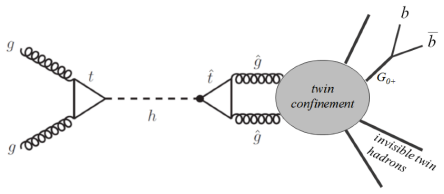
- Exotic Higgs decays into Twin glueballs improve much faster than $\sqrt{L}$, roughly like $L$, making displaced-vertex searches a leading route to neutral-naturalness models.
- In supersymmetric models, stop and gluino mass limits around 1.2–2.2 TeV imply roughly 1% tuning, and HL-LHC exclusions near 1.8 and 3.2 TeV would make minimal MSSM naturalness severely strained without non-minimal structure.
Reading between the lines
- If modified Higgs couplings are the universal diagnostic, then a future electron-positron Higgs factory, with sub-percent coupling precision, would be the most direct way to confirm or exclude the pion-like Higgs family, a step the paper does not itself take.
- The paper's menu suggests a strategic reframing: searching for new physics only in traditional channels (colored partners, resonances) under-weights the cosmological and neutral-naturalness options, whose discovery signatures are low-background exotic decays.
- The relaxion's tiny shift-symmetry-breaking parameter $g$ and its super-Planckian field excursion raise the same quality questions familiar from axions; the paper notes these as open, and a quantitative connection to axion-quality bounds would be a natural extension.
- One can turn the paper's logic around: if the HL-LHC sees exactly SM-like Higgs couplings and no exotic decays, the surviving explanations would be non-symmetry ones such as NNaturalness or a cosmological multiverse selection, which are far harder to falsify—a consequence the author leaves implicit.
Editorial analysis
A structured set of objections, weighed in public.
Referee Report
Summary. This manuscript, based on the author's TASI 2024 lectures, offers a pedagogical survey of theoretical paradigms that address the origin of the Higgs sector and the lightness of the Higgs boson. It covers EFT foundations, pion-like (pNGB, composite, little, twin, Gegenbauer) Higgs models, extra-dimensional and deconstructed theories, less conventional alternatives (UV/IR mixing, swampland constraints, scale invariance), cosmological mechanisms (relaxion, self-organized criticality, NNaturalness), and supersymmetry. The overarching message is that the Standard Model is an EFT, the Higgs mass hierarchy is a well-posed puzzle if one adopts the naturalness criterion, and the HL-LHC provides concrete targets such as modified Higgs couplings, vector and colored resonances, and exotic Higgs decays. The lectures are explicitly a review, with the author flagging speculative sections and the conditional status of naturalness.
Significance. If the naturalness criterion is taken as a working hypothesis, the manuscript is a valuable and accurate review. The derivations of the Goldstone/CCWZ formalism, the Twin Higgs mechanism, Randall-Sundrum warping, relaxion dynamics, and the SUSY non-renormalization theorem are technically correct and pedagogically clear. A particular strength is the paper's honesty: Section 4.1 acknowledges the 'just input parameters' alternative, Section 5.2 includes a prominent caveat about the speculative dS calculations, and Section 5.4 states that none of the cosmological mechanisms is complete. The inclusion of the author's Gegenbauer Higgs work is accompanied by an explicit conflict-of-interest statement and a frank discussion of the open question whether non-minimal spurions can dominate. The paper also makes explicit the conditional nature of the naturalness argument, which is essential in a fair review. For these reasons, the manuscript is likely to be a useful reference for students and researchers.
minor comments (5)
- [3.5] The take-home message 'In all Pion-like Higgs scenarios we expect modified Higgs couplings to show up at some level' is potentially misleading in light of Section 3.3, where the Gegenbauer Higgs can make the v/f-suppressed couplings arbitrarily small while remaining natural; the text should add a qualifier that the expected magnitude is model-dependent and may be far below HL-LHC sensitivity.
- [3.3] Equation (3.51) introduces the spurion K_{2n} and identifies its potential contribution with a Gegenbauer polynomial G_3/2^n(cos 2h/f), but the normalization of K_{2n} and the definition of the polynomial are not given; a brief definition or a pointer to [11] would improve accessibility.
- [4.2] In the paragraph comparing QED and quark-mass sources of pion symmetry breaking, the labels 'the former' and 'the latter' appear to be misplaced: the QED interaction is the IR source and the quark masses are the UV source, contrary to the sentence as written.
- [3.1] The 'Collider Reach tool' is mentioned without a citation or URL; a reference to the tool's documentation would be useful for readers who wish to reproduce the reach estimates.
- [3.4] There is a typo, 'wheer' should be 'where', in the Linear Dilaton theory subsection.
Circularity Check
No significant circularity: the review's conclusions rest on standard EFT and naturalness reasoning, with a declared, non-load-bearing self-citation.
full rationale
This is a pedagogical review (TASI lecture notes), not a paper that fits parameters or derives new predictions from inputs. The central message—that in pion-like Higgs scenarios modified Higgs couplings should appear at some level—is derived from the Goldstone/CCWZ structure and from the standard cos(v/f) coupling suppression in the reviewed model classes, not from an equation that defines the output in terms of the input. Section 3.3 discusses the author's own Gegenbauer Higgs proposal and explicitly declares a conflict of interest ('I should declare a conflict of interest here...'), citing [10, 11] as existing literature rather than as a theorem that forces the paper's conclusions. This self-citation is not load-bearing: Section 3.5's summary holds for the broad class of pion-like models and is independently supported by the QCD-pion analogy, composite Higgs, Twin Higgs, and extra-dimensional examples surveyed in Sections 3.1 through 3.4. The paper's naturalness premise is also transparent: Section 4.1 explicitly calls 'just input parameters' a logical possibility, so the motivation is not smuggled in as a derived result. Cosmological mechanisms in Section 5 are presented with their known limitations, including the strong-CP problem in the relaxion and the statement that self-organised localisation 'doesn't actually work' in its simplest form. No equation in the paper reduces to its own input by construction, no fitted parameter is renamed as a prediction, and no uniqueness theorem from the authors is invoked to forbid alternatives. The only self-reference is the declared Gegenbauer citation, which is not circular.
Assumptions & free parameters
assumptions (4)
- domain assumption The Standard Model is an effective field theory with a UV cutoff well above the weak scale, and the hierarchy problem is defined by the sensitivity of the Higgs mass-squared to that cutoff.
- standard math Goldstone's theorem: spontaneous breaking of a global symmetry yields massless bosons, which can become massive pseudo-Goldstone bosons when the symmetry is explicitly broken.
- domain assumption The naturalness criterion: dimensionless parameters are expected to be of order one unless protected by a symmetry, and fine-tuning measures such as Delta quantify the plausibility of a theory.
- standard math Supersymmetry non-renormalization theorems guarantee the absence of quadratic divergences in SUSY theories.
Cite this review
Pith. "Pith review of In Pursuit of New Paradigms: TASI 2024." pith.science (2026). https://pith.science/paper/CFIWDAX6
@misc{pith2026241215744,
  author       = {Pith},
  title        = {Pith review of: In Pursuit of New Paradigms: TASI 2024},
  year         = {2026},
  howpublished = {\url{https://pith.science/paper/CFIWDAX6}},
  note         = {Machine review of arXiv:2412.15744}
}
read the original abstract
These lectures discuss diverse theoretical approaches, old and new, towards understanding the origin of the Higgs sector of the Standard Model and the lightness of the Higgs boson.
Figures


Figures from the paper (17 more)




Forward citations
Cited by 1 Pith paper
-
Light scalars in light of UV/IR mixing: classicalization via synergy between Vainshtein and chameleon screenings
Classicalizing k-essence scalars need m << Λ* and, when potentials or fermion couplings are present, a chameleon-like screening layer to keep Vainshtein screening and classicalon stability intact.
Reference graph
Works this paper leans on
-
[1]
T. Das, G. S. Guralnik, V. S. Mathur, F. E. Low, and J. E. Young, Electromagnetic mass difference of pions , Phys. Rev. Lett. 18 (1967) 759–761
1967
-
[2]
Nambu, Quasiparticles and Gauge Invariance in the Theory of Superconductivity , Phys
Y. Nambu, Quasiparticles and Gauge Invariance in the Theory of Superconductivity , Phys. Rev. 117 (1960) 648–663
1960
-
[3]
Goldstone, Field Theories with Superconductor Solutions , Nuovo Cim
J. Goldstone, Field Theories with Superconductor Solutions , Nuovo Cim. 19 (1961) 154–164
1961
-
[4]
R. Contino, The Higgs as a Composite Nambu-Goldstone Boson , in Theoretical Advanced Study Institute in Elementary Particle Physics: Physics of the Large and the Small , pp. 235–306, 2011. arXiv:1005.4269
arXiv 2011
-
[5]
M. Schmaltz and D. Tucker-Smith, Little Higgs review , Ann. Rev. Nucl. Part. Sci. 55 (2005) 229–270, [ hep-ph/0502182]
arXiv 2005
-
[6]
S. R. Coleman, J. Wess, and B. Zumino, Structure of phenomenological Lagrangians. 1., Phys. Rev. 177 (1969) 2239–2247. 75
1969
-
[7]
C. G. Callan, Jr., S. R. Coleman, J. Wess, and B. Zumino, Structure of phenomenological Lagrangians. 2., Phys. Rev. 177 (1969) 2247–2250
1969
-
[8]
A. De Simone, O. Matsedonskyi, R. Rattazzi, and A. Wulzer, A First Top Partner Hunter’s Guide , JHEP 04 (2013) 004, [ arXiv:1211.5663]
arXiv 2013
Show all 173 references
-
[9]
Panico and A
G. Panico and A. Wulzer, The Composite Nambu-Goldstone Higgs , vol. 913. Springer, 2016
2016
-
[10]
Durieux, M
G. Durieux, M. McCullough, and E. Salvioni, Gegenbauer Goldstones, JHEP 01 (2022) 076, [ arXiv:2110.06941]
2022 arXiv
-
[11]
Durieux, M
G. Durieux, M. McCullough, and E. Salvioni, Gegenbauer’s Twin, JHEP 05 (2022) 140, [arXiv:2202.01228]
2022 arXiv
-
[12]
ATLAS Collaboration, G. Aad et. al., A detailed map of Higgs boson interactions by the ATLAS experiment ten years after the discovery , Nature 607 (2022), no. 7917 52–59, [arXiv:2207.00092]. [Erratum: Nature 612, E24 (2022)]
2022 arXiv
-
[13]
Tumasyan et
CMS Collaboration, A. Tumasyan et. al. , A portrait of the Higgs boson by the CMS experiment ten years after the discovery. , Nature 607 (2022), no. 7917 60–68, [arXiv:2207.00043]. [Erratum: Nature 623, (2023)]
2022 arXiv
-
[14]
de Blas et
J. de Blas et. al., Higgs Boson Studies at Future Particle Colliders , JHEP 01 (2020) 139, [arXiv:1905.03764]
2020
-
[15]
Tumasyan et
CMS Collaboration, A. Tumasyan et. al. , Search for new physics in the lepton plus missing transverse momentum final state in proton-proton collisions at √s = 13 TeV, JHEP 07 (2022) 067, [ arXiv:2202.06075]
2022 arXiv
-
[16]
Thamm, R
A. Thamm, R. Torre, and A. Wulzer, Future tests of Higgs compositeness: direct vs indirect, JHEP 07 (2015) 100, [ arXiv:1502.01701]
2015 arXiv
-
[17]
Tumasyan et
CMS Collaboration, A. Tumasyan et. al. , Search for pair production of vector-like quarks in leptonic final states in proton-proton collisions at √s = 13 TeV , JHEP 07 (2023) 020, [ arXiv:2209.07327]
2023 arXiv
-
[18]
CMS Collaboration, Search for a vector-like quark T decaying to bW, tZ, tH in the single lepton final state at the HL-LHC ,
-
[19]
Cid Vidal et
X. Cid Vidal et. al., Report from Working Group 3: Beyond the Standard Model physics at the HL-LHC and HE-LHC , CERN Yellow Rep. Monogr. 7 (2019) 585–865, [arXiv:1812.07831]
2019 arXiv
-
[20]
Chacko, H.-S
Z. Chacko, H.-S. Goh, and R. Harnik, The Twin Higgs: Natural electroweak breaking from mirror symmetry , Phys. Rev. Lett. 96 (2006) 231802, [ hep-ph/0506256]
2006 arXiv
-
[21]
Craig, A
N. Craig, A. Katz, M. Strassler, and R. Sundrum, Naturalness in the Dark at the LHC, JHEP 07 (2015) 105, [ arXiv:1501.05310]. 76
2015 arXiv
-
[22]
M. J. Strassler and K. M. Zurek, Echoes of a hidden valley at hadron colliders , Phys. Lett. B 651 (2007) 374–379, [ hep-ph/0604261]
2007 arXiv
-
[23]
M. J. Strassler and K. M. Zurek, Discovering the Higgs through highly-displaced vertices, Phys. Lett. B 661 (2008) 263–267, [ hep-ph/0605193]
2008 arXiv
-
[24]
T. Han, Z. Si, K. M. Zurek, and M. J. Strassler, Phenomenology of hidden valleys at hadron colliders, JHEP 07 (2008) 008, [ arXiv:0712.2041]
2008 arXiv
-
[25]
Curtin and C
D. Curtin and C. B. Verhaaren, Discovering Uncolored Naturalness in Exotic Higgs Decays, JHEP 12 (2015) 072, [ arXiv:1506.06141]
2015 arXiv
-
[26]
J. M. Maldacena, The Large N limit of superconformal field theories and supergravity , Adv. Theor. Math. Phys. 2 (1998) 231–252, [ hep-th/9711200]
1998 arXiv
-
[27]
Arkani-Hamed, S
N. Arkani-Hamed, S. Dimopoulos, and G. R. Dvali, The Hierarchy problem and new dimensions at a millimeter , Phys. Lett. B 429 (1998) 263–272, [ hep-ph/9803315]
1998 arXiv
-
[28]
Antoniadis, N
I. Antoniadis, N. Arkani-Hamed, S. Dimopoulos, and G. R. Dvali, New dimensions at a millimeter to a Fermi and superstrings at a TeV , Phys. Lett. B 436 (1998) 257–263, [hep-ph/9804398]
1998 arXiv
-
[29]
Rattazzi, Cargese lectures on extra-dimensions , in Cargese School of Particle Physics and Cosmology: the Interface , pp
R. Rattazzi, Cargese lectures on extra-dimensions , in Cargese School of Particle Physics and Cosmology: the Interface , pp. 461–517, 8, 2003. hep-ph/0607055
2003 arXiv
-
[30]
C. Csaki, TASI lectures on extra dimensions and branes , in Theoretical Advanced Study Institute in Elementary Particle Physics (TASI 2002): Particle Physics and Cosmology: The Quest for Physics Beyond the Standard Model(s) , pp. 605–698, 4,
2002
-
[31]
Arkani-Hamed, S
N. Arkani-Hamed, S. Dimopoulos, and J. March-Russell, Stabilization of submillimeter dimensions: The New guise of the hierarchy problem , Phys. Rev. D 63 (2001) 064020, [ hep-th/9809124]
2001 arXiv
-
[32]
Randall and R
L. Randall and R. Sundrum, A Large mass hierarchy from a small extra dimension , Phys. Rev. Lett. 83 (1999) 3370–3373, [ hep-ph/9905221]
1999 arXiv
-
[33]
Arkani-Hamed, A
N. Arkani-Hamed, A. G. Cohen, and H. Georgi, (De)constructing dimensions, Phys. Rev. Lett. 86 (2001) 4757–4761, [ hep-th/0104005]
2001 arXiv
-
[34]
K. G. Wilson and J. B. Kogut, The Renormalization group and the epsilon expansion , Phys. Rept. 12 (1974) 75–199
1974
-
[35]
Jackiw, Ken Wilson – The Early Years , Int
R. Jackiw, Ken Wilson – The Early Years , Int. J. Mod. Phys. A 29 (2014) 1430008, [arXiv:1312.6634]
2014 arXiv
-
[36]
Adams, N
A. Adams, N. Arkani-Hamed, S. Dubovsky, A. Nicolis, and R. Rattazzi, Causality, analyticity and an IR obstruction to UV completion , JHEP 10 (2006) 014, [hep-th/0602178]. 77
2006 arXiv
-
[37]
D. E. Kaplan, S. Rajendran, and F. Serra, Wrong Signs are Alright , arXiv:2406.06681
-
[38]
Grinstein, D
B. Grinstein, D. O’Connell, and M. B. Wise, The Lee-Wick standard model , Phys. Rev. D 77 (2008) 025012, [ arXiv:0704.1845]
2008 arXiv
-
[39]
Craig and S
N. Craig and S. Koren, IR Dynamics from UV Divergences: UV/IR Mixing, NCFT, and the Hierarchy Problem , JHEP 03 (2020) 037, [ arXiv:1909.01365]
2020 arXiv
-
[40]
Banks and N
T. Banks and N. Seiberg, Symmetries and Strings in Field Theory and Gravity , Phys. Rev. D 83 (2011) 084019, [ arXiv:1011.5120]
2011 arXiv
-
[41]
Vafa, The String landscape and the swampland , hep-th/0509212
C. Vafa, The String landscape and the swampland , hep-th/0509212
-
[42]
Arkani-Hamed, L
N. Arkani-Hamed, L. Motl, A. Nicolis, and C. Vafa, The String landscape, black holes and gravity as the weakest force , JHEP 06 (2007) 060, [ hep-th/0601001]
2007 arXiv
-
[43]
Ooguri and C
H. Ooguri and C. Vafa, On the Geometry of the String Landscape and the Swampland, Nucl. Phys. B 766 (2007) 21–33, [ hep-th/0605264]
2007 arXiv
-
[44]
Ooguri and C
H. Ooguri and C. Vafa, Non-supersymmetric AdS and the Swampland , Adv. Theor. Math. Phys. 21 (2017) 1787–1801, [ arXiv:1610.01533]
2017 arXiv
-
[45]
L. E. Ibanez, V. Martin-Lozano, and I. Valenzuela, Constraining Neutrino Masses, the Cosmological Constant and BSM Physics from the Weak Gravity Conjecture , JHEP 11 (2017) 066, [ arXiv:1706.05392]
2017 arXiv
-
[46]
L. E. Ibanez, V. Martin-Lozano, and I. Valenzuela, Constraining the EW Hierarchy from the Weak Gravity Conjecture , arXiv:1707.05811
-
[47]
Hamada and G
Y. Hamada and G. Shiu, Weak Gravity Conjecture, Multiple Point Principle and the Standard Model Landscape, JHEP 11 (2017) 043, [ arXiv:1707.06326]
2017 arXiv
-
[48]
Lust and E
D. Lust and E. Palti, Scalar Fields, Hierarchical UV/IR Mixing and The Weak Gravity Conjecture, JHEP 02 (2018) 040, [ arXiv:1709.01790]
2018 arXiv
-
[49]
Gonzalo, A
E. Gonzalo, A. Herr´ aez, and L. E. Ib´ a˜ nez,AdS-phobia, the WGC, the Standard Model and Supersymmetry, JHEP 06 (2018) 051, [ arXiv:1803.08455]
2018 arXiv
-
[50]
Gonzalo and L
E. Gonzalo and L. E. Ib´ a˜ nez,The Fundamental Need for a SM Higgs and the Weak Gravity Conjecture, Phys. Lett. B 786 (2018) 272–277, [ arXiv:1806.09647]
2018 arXiv
-
[51]
Craig, I
N. Craig, I. Garcia Garcia, and S. Koren, Discrete Gauge Symmetries and the Weak Gravity Conjecture, JHEP 05 (2019) 140, [ arXiv:1812.08181]
2019 arXiv
-
[52]
Craig, I
N. Craig, I. Garcia Garcia, and S. Koren, The Weak Scale from Weak Gravity , JHEP 09 (2019) 081, [ arXiv:1904.08426]
2019 arXiv
-
[53]
Cheung and G
C. Cheung and G. N. Remmen, Naturalness and the Weak Gravity Conjecture , Phys. Rev. Lett. 113 (2014) 051601, [ arXiv:1402.2287]. 78
2014 arXiv
-
[54]
Gaiotto, A
D. Gaiotto, A. Kapustin, N. Seiberg, and B. Willett, Generalized Global Symmetries, JHEP 02 (2015) 172, [ arXiv:1412.5148]
2015 arXiv
-
[55]
T. D. Brennan and S. Hong, Introduction to Generalized Global Symmetries in QFT and Particle Physics , arXiv:2306.00912
-
[56]
Bhardwaj, L
L. Bhardwaj, L. E. Bottini, L. Fraser-Taliente, L. Gladden, D. S. W. Gould, A. Platschorre, and H. Tillim, Lectures on generalized symmetries, Phys. Rept. 1051 (2024) 1–87, [ arXiv:2307.07547]
2024 arXiv
-
[57]
P. R. S. Gomes, An introduction to higher-form symmetries , SciPost Phys. Lect. Notes 74 (2023) 1, [ arXiv:2303.01817]
2023 arXiv
-
[58]
Luo, Q.-R
R. Luo, Q.-R. Wang, and Y.-N. Wang, Lecture notes on generalized symmetries and applications, Phys. Rept. 1065 (2024) 1–43, [ arXiv:2307.09215]
2024 arXiv
-
[59]
Schafer-Nameki, ICTP lectures on (non-)invertible generalized symmetries , Phys
S. Schafer-Nameki, ICTP lectures on (non-)invertible generalized symmetries , Phys. Rept. 1063 (2024) 1–55, [ arXiv:2305.18296]
2024 arXiv
-
[60]
Shao, What’s Done Cannot Be Undone: TASI Lectures on Non-Invertible Symmetries, arXiv:2308.00747
S.-H. Shao, What’s Done Cannot Be Undone: TASI Lectures on Non-Invertible Symmetries, arXiv:2308.00747
-
[61]
C´ ordova, T
C. C´ ordova, T. T. Dumitrescu, and K. Intriligator,Exploring 2-Group Global Symmetries, JHEP 02 (2019) 184, [ arXiv:1802.04790]
2019 arXiv
-
[62]
Wan and J
Z. Wan and J. Wang, Beyond Standard Models and Grand Unifications: Anomalies, Topological Terms, and Dynamical Constraints via Cobordisms , JHEP 07 (2020) 062, [arXiv:1910.14668]
2020 arXiv
-
[63]
Davighi, B
J. Davighi, B. Gripaios, and N. Lohitsiri, Global anomalies in the Standard Model(s) and Beyond , JHEP 07 (2020) 232, [ arXiv:1910.11277]
2020 arXiv
-
[64]
Wang, Anomaly and Cobordism Constraints Beyond the Standard Model: Topological Force, arXiv:2006.16996
J. Wang, Anomaly and Cobordism Constraints Beyond the Standard Model: Topological Force, arXiv:2006.16996
2006 arXiv
-
[65]
T. D. Brennan and C. Cordova, Axions, higher-groups, and emergent symmetry , JHEP 02 (2022) 145, [ arXiv:2011.09600]
2022 arXiv
-
[66]
Hidaka, M
Y. Hidaka, M. Nitta, and R. Yokokura, Global 3-group symmetry and ’t Hooft anomalies in axion electrodynamics , JHEP 01 (2021) 173, [ arXiv:2009.14368]
2021 arXiv
-
[67]
J. Fan, K. Fraser, M. Reece, and J. Stout, Axion Mass from Magnetic Monopole Loops, Phys. Rev. Lett. 127 (2021), no. 13 131602, [ arXiv:2105.09950]
2021 arXiv
-
[68]
M. M. Anber and E. Poppitz, Nonperturbative effects in the Standard Model with gauged 1-form symmetry , JHEP 12 (2021) 055, [ arXiv:2110.02981]
2021 arXiv
-
[69]
J. Wang, Z. Wan, and Y.-Z. You, Cobordism and deformation class of the standard model, Phys. Rev. D 106 (2022), no. 4 L041701, [ arXiv:2112.14765]. 79
2022 arXiv
-
[70]
Wang and Y.-Z
J. Wang and Y.-Z. You, Gauge Enhanced Quantum Criticality Between Grand Unifications: Categorical Higher Symmetry Retraction , arXiv:2111.10369
-
[71]
Wang and Y.-Z
J. Wang and Y.-Z. You, Gauge enhanced quantum criticality beyond the standard model, Phys. Rev. D 106 (2022), no. 2 025013, [ arXiv:2106.16248]
2022 arXiv
- [72]
-
[73]
Cordova, S
C. Cordova, S. Hong, S. Koren, and K. Ohmori, Neutrino Masses from Generalized Symmetry Breaking, arXiv:2211.07639
-
[74]
Cordova and S
C. Cordova and S. Koren, Higher Flavor Symmetries in the Standard Model , Annalen Phys. 535 (2023), no. 8 2300031, [ arXiv:2212.13193]
2023 arXiv
-
[75]
Y. Choi, H. T. Lam, and S.-H. Shao, Noninvertible Time-Reversal Symmetry , Phys. Rev. Lett. 130 (2023), no. 13 131602, [ arXiv:2208.04331]
2023 arXiv
-
[76]
J. Wang, Z. Wan, and Y.-Z. You, Proton stability: From the standard model to beyond grand unification, Phys. Rev. D 106 (2022), no. 2 025016, [ arXiv:2204.08393]
2022 arXiv
-
[77]
Yokokura, Non-invertible symmetries in axion electrodynamics , arXiv:2212.05001
R. Yokokura, Non-invertible symmetries in axion electrodynamics , arXiv:2212.05001
-
[78]
T. D. Brennan, S. Hong, and L.-T. Wang, Coupling a Cosmic String to a TQFT , JHEP 03 (2024) 145, [ arXiv:2302.00777]
2024 arXiv
-
[79]
Cordova, S
C. Cordova, S. Hong, and L.-T. Wang, Axion domain walls, small instantons, and non-invertible symmetry breaking , JHEP 05 (2024) 325, [ arXiv:2309.05636]
2024 arXiv
-
[80]
Y. Choi, M. Forslund, H. T. Lam, and S.-H. Shao, Quantization of Axion-Gauge Couplings and Noninvertible Higher Symmetries , Phys. Rev. Lett. 132 (2024), no. 12 121601, [arXiv:2309.03937]
2024 arXiv
-
[81]
van Beest, P
M. van Beest, P. Boyle Smith, D. Delmastro, Z. Komargodski, and D. Tong, Monopoles, Scattering, and Generalized Symmetries , arXiv:2306.07318
-
[82]
T. D. Brennan, A New Solution to the Callan Rubakov Effect , arXiv:2309.00680
-
[83]
Y. Choi, H. T. Lam, and S.-H. Shao, Non-invertible Gauss law and axions , JHEP 09 (2023) 067, [ arXiv:2212.04499]
2023 arXiv
-
[84]
Cordova and K
C. Cordova and K. Ohmori, Quantum duality in electromagnetism and the fine structure constant, Phys. Rev. D 109 (2024), no. 10 105019, [ arXiv:2307.12927]
2024 arXiv
-
[85]
Reece, Axion-gauge coupling quantization with a twist , JHEP 10 (2023) 116, [arXiv:2309.03939]
M. Reece, Axion-gauge coupling quantization with a twist , JHEP 10 (2023) 116, [arXiv:2309.03939]
2023 arXiv
-
[86]
Putrov and J
P. Putrov and J. Wang, Categorical Symmetry of the Standard Model from Gravitational Anomaly, arXiv:2302.14862. 80
-
[87]
van Beest, P
M. van Beest, P. Boyle Smith, D. Delmastro, R. Mouland, and D. Tong, Fermion-Monopole Scattering in the Standard Model , arXiv:2312.17746
-
[88]
Aloni, E
D. Aloni, E. Garc ´ ıa-Valdecasas, M. Reece, and M. Suzuki,Spontaneously Broken (−1)-Form U(1) Symmetries , arXiv:2402.00117
- [89]
-
[90]
P. W. Graham, D. E. Kaplan, and S. Rajendran, Cosmological Relaxation of the Electroweak Scale, Phys. Rev. Lett. 115 (2015), no. 22 221801, [ arXiv:1504.07551]
2015 arXiv
-
[91]
L. F. Abbott, A Mechanism for Reducing the Value of the Cosmological Constant , Phys. Lett. B 150 (1985) 427–430
1985
-
[92]
Dvali and A
G. Dvali and A. Vilenkin, Cosmic attractors and gauge hierarchy , Phys. Rev. D 70 (2004) 063501, [ hep-th/0304043]
2004 arXiv
-
[93]
Dvali, Large hierarchies from attractor vacua , Phys
G. Dvali, Large hierarchies from attractor vacua , Phys. Rev. D 74 (2006) 025018, [hep-th/0410286]
2006 arXiv
-
[94]
Grilli di Cortona, E
G. Grilli di Cortona, E. Hardy, J. Pardo Vega, and G. Villadoro, The QCD axion, precisely, JHEP 01 (2016) 034, [ arXiv:1511.02867]
2016 arXiv
-
[95]
L. E. Ibanez, M. Montero, A. Uranga, and I. Valenzuela, Relaxion Monodromy and the Weak Gravity Conjecture , JHEP 04 (2016) 020, [ arXiv:1512.00025]
2016 arXiv
-
[96]
D. E. Kaplan and R. Rattazzi, Large field excursions and approximate discrete symmetries from a clockwork axion , Phys. Rev. D 93 (2016), no. 8 085007, [arXiv:1511.01827]
2016 arXiv
-
[97]
G. F. Giudice, M. McCullough, and T. You, Self-organised localisation, JHEP 10 (2021) 093, [ arXiv:2105.08617]
2021 arXiv
-
[98]
Cabibbo, L
N. Cabibbo, L. Maiani, G. Parisi, and R. Petronzio, Bounds on the Fermions and Higgs Boson Masses in Grand Unified Theories , Nucl. Phys. B 158 (1979) 295–305
1979
-
[99]
P. Q. Hung, Vacuum Instability and New Constraints on Fermion Masses , Phys. Rev. Lett. 42 (1979) 873
1979
-
[100]
Lindner, Implications of Triviality for the Standard Model , Z
M. Lindner, Implications of Triviality for the Standard Model , Z. Phys. C 31 (1986) 295
1986
-
[101]
Sher, Electroweak Higgs Potentials and Vacuum Stability , Phys
M. Sher, Electroweak Higgs Potentials and Vacuum Stability , Phys. Rept. 179 (1989) 273–418
1989
-
[102]
Schrempp and M
B. Schrempp and M. Wimmer, Top quark and Higgs boson masses: Interplay between infrared and ultraviolet physics , Prog. Part. Nucl. Phys. 37 (1996) 1–90, [hep-ph/9606386]
1996 arXiv
-
[103]
Altarelli and G
G. Altarelli and G. Isidori, Lower limit on the Higgs mass in the standard model: An Update, Phys. Lett. B 337 (1994) 141–144. 81
1994
-
[104]
Degrassi, S
G. Degrassi, S. Di Vita, J. Elias-Miro, J. R. Espinosa, G. F. Giudice, G. Isidori, and A. Strumia, Higgs mass and vacuum stability in the Standard Model at NNLO , JHEP 08 (2012) 098, [ arXiv:1205.6497]
2012 arXiv
-
[105]
Buttazzo, G
D. Buttazzo, G. Degrassi, P. P. Giardino, G. F. Giudice, F. Sala, A. Salvio, and A. Strumia, Investigating the near-criticality of the Higgs boson , JHEP 12 (2013) 089, [arXiv:1307.3536]
2013 arXiv
-
[106]
A. V. Bednyakov, B. A. Kniehl, A. F. Pikelner, and O. L. Veretin, Stability of the Electroweak Vacuum: Gauge Independence and Advanced Precision , Phys. Rev. Lett. 115 (2015), no. 20 201802, [ arXiv:1507.08833]
2015 arXiv
-
[107]
Andreassen, W
A. Andreassen, W. Frost, and M. D. Schwartz, Scale Invariant Instantons and the Complete Lifetime of the Standard Model , Phys. Rev. D 97 (2018), no. 5 056006, [arXiv:1707.08124]
2018 arXiv
-
[108]
Weinberg, A Model of Leptons , Phys
S. Weinberg, A Model of Leptons , Phys. Rev. Lett. 19 (1967) 1264–1266
1967
-
[109]
S. W. Hawking, Particle Creation by Black Holes , Commun. Math. Phys. 43 (1975) 199–220. [Erratum: Commun.Math.Phys. 46, 206 (1976)]
1975
-
[110]
G. W. Gibbons and S. W. Hawking, Action Integrals and Partition Functions in Quantum Gravity, Phys. Rev. D 15 (1977) 2752–2756
1977
-
[111]
A. A. Starobinsky, Multicomponent de Sitter (Inflationary) Stages and the Generation of Perturbations , JETP Lett. 42 (1985) 152–155
1985
-
[112]
A. A. Starobinsky, STOCHASTIC DE SITTER (INFLATIONARY) STAGE IN THE EARLY UNIVERSE , Lect. Notes Phys. 246 (1986) 107–126
1986
-
[113]
Rudelius, Conditions for (No) Eternal Inflation , JCAP 08 (2019) 009, [arXiv:1905.05198]
T. Rudelius, Conditions for (No) Eternal Inflation , JCAP 08 (2019) 009, [arXiv:1905.05198]
2019 arXiv
-
[114]
Arkani-Hamed, T
N. Arkani-Hamed, T. Cohen, R. T. D’Agnolo, A. Hook, H. D. Kim, and D. Pinner, Solving the Hierarchy Problem at Reheating with a Large Number of Degrees of Freedom, Phys. Rev. Lett. 117 (2016), no. 25 251801, [ arXiv:1607.06821]
2016 arXiv
-
[115]
Dvali, Black Holes and Large N Species Solution to the Hierarchy Problem , Fortsch
G. Dvali, Black Holes and Large N Species Solution to the Hierarchy Problem , Fortsch. Phys. 58 (2010) 528–536, [ arXiv:0706.2050]
2010 arXiv
-
[116]
Dvali and M
G. Dvali and M. Redi, Black Hole Bound on the Number of Species and Quantum Gravity at LHC , Phys. Rev. D 77 (2008) 045027, [ arXiv:0710.4344]
2008 arXiv
-
[117]
Geller, Y
M. Geller, Y. Hochberg, and E. Kuflik, Inflating to the Weak Scale , Phys. Rev. Lett. 122 (2019), no. 19 191802, [ arXiv:1809.07338]
2019 arXiv
-
[118]
G. F. Giudice, A. Kehagias, and A. Riotto, The Selfish Higgs , JHEP 10 (2019) 199, [arXiv:1907.05370]. 82
2019 arXiv
-
[119]
Strumia and D
A. Strumia and D. Teresi, Relaxing the Higgs mass and its vacuum energy by living at the top of the potential , Phys. Rev. D 101 (2020), no. 11 115002, [arXiv:2002.02463]
2020 arXiv
-
[120]
Cs´ aki, R
C. Cs´ aki, R. T. D’Agnolo, M. Geller, and A. Ismail, Crunching Dilaton, Hidden Naturalness, Phys. Rev. Lett. 126 (2021) 091801, [ arXiv:2007.14396]
2021 arXiv
-
[121]
Tito D’Agnolo and D
R. Tito D’Agnolo and D. Teresi, Sliding Naturalness: New Solution to the Strong- CP and Electroweak-Hierarchy Problems, Phys. Rev. Lett. 128 (2022), no. 2 021803, [arXiv:2106.04591]
2022 arXiv
-
[122]
Khoury and T
J. Khoury and T. Steingasser, Gauge hierarchy from electroweak vacuum metastability, Phys. Rev. D 105 (2022), no. 5 055031, [ arXiv:2108.09315]
2022 arXiv
-
[123]
Tito D’Agnolo and D
R. Tito D’Agnolo and D. Teresi, Sliding naturalness: cosmological selection of the weak scale, JHEP 02 (2022) 023, [ arXiv:2109.13249]
2022 arXiv
-
[124]
S. P. Martin, A Supersymmetry primer , Adv. Ser. Direct. High Energy Phys. 18 (1998) 1–98, [ hep-ph/9709356]
1998 arXiv
-
[125]
Baer and X
H. Baer and X. Tata, Weak scale supersymmetry: From superfields to scattering events. Cambridge University Press, 5, 2006
2006
-
[126]
Weinberg, The quantum theory of fields
S. Weinberg, The quantum theory of fields. Vol. 3: Supersymmetry . Cambridge University Press, 6, 2013
2013
-
[127]
Amati, K
D. Amati, K. Konishi, Y. Meurice, G. C. Rossi, and G. Veneziano, Nonperturbative Aspects in Supersymmetric Gauge Theories , Phys. Rept. 162 (1988) 169–248
1988
-
[128]
M. A. Shifman and A. I. Vainshtein, Solution of the Anomaly Puzzle in SUSY Gauge Theories and the Wilson Operator Expansion , Nucl. Phys. B 277 (1986) 456
1986
-
[129]
M. A. Shifman and A. I. Vainshtein, On holomorphic dependence and infrared effects in supersymmetric gauge theories , Nucl. Phys. B 359 (1991) 571–580
1991
-
[130]
M. T. Grisaru, W. Siegel, and M. Rocek, Improved Methods for Supergraphs, Nucl. Phys. B 159 (1979) 429
1979
-
[131]
Seiberg, Naturalness versus supersymmetric nonrenormalization theorems , Phys
N. Seiberg, Naturalness versus supersymmetric nonrenormalization theorems , Phys. Lett. B 318 (1993) 469–475, [ hep-ph/9309335]
1993 arXiv
-
[132]
Seiberg, The Power of holomorphy: Exact results in 4-D SUSY field theories , in Particles, Strings, and Cosmology (PASCOS 94) , pp
N. Seiberg, The Power of holomorphy: Exact results in 4-D SUSY field theories , in Particles, Strings, and Cosmology (PASCOS 94) , pp. 0357–369, 5, 1994. hep-th/9408013
1994 arXiv
-
[133]
D. Z. Freedman and A. Van Proeyen, Supergravity. Cambridge Univ. Press, Cambridge, UK, 5, 2012
2012
-
[134]
Dimopoulos, S
S. Dimopoulos, S. Raby, and F. Wilczek, Supersymmetry and the Scale of Unification, Phys. Rev. D 24 (1981) 1681–1683. 83
1981
-
[135]
Dimopoulos and H
S. Dimopoulos and H. Georgi, Softly Broken Supersymmetry and SU(5) , Nucl. Phys. B 193 (1981) 150–162
1981
-
[136]
Georgi and S
H. Georgi and S. L. Glashow, Unity of All Elementary Particle Forces , Phys. Rev. Lett. 32 (1974) 438–441
1974
-
[137]
Arvanitaki, N
A. Arvanitaki, N. Craig, S. Dimopoulos, and G. Villadoro, Mini-Split, JHEP 02 (2013) 126, [ arXiv:1210.0555]
2013 arXiv
-
[138]
J. D. Wells, PeV-scale supersymmetry, Phys. Rev. D 71 (2005) 015013, [hep-ph/0411041]
2005 arXiv
-
[139]
Arkani-Hamed and S
N. Arkani-Hamed and S. Dimopoulos, Supersymmetric unification without low energy supersymmetry and signatures for fine-tuning at the LHC , JHEP 06 (2005) 073, [hep-th/0405159]
2005 arXiv
-
[140]
G. F. Giudice and A. Romanino, Split supersymmetry, Nucl. Phys. B 699 (2004) 65–89, [hep-ph/0406088]. [Erratum: Nucl.Phys.B 706, 487–487 (2005)]
2004 arXiv
-
[141]
M. S. Chanowitz, J. R. Ellis, and M. K. Gaillard, The Price of Natural Flavor Conservation in Neutral Weak Interactions , Nucl. Phys. B 128 (1977) 506–536
1977
-
[142]
D. V. Nanopoulos and D. A. Ross, Limits on the Number of Flavors in Grand Unified Theories from Higher Order Corrections to Fermion Masses , Nucl. Phys. B 157 (1979) 273–284
1979
-
[143]
Georgi and C
H. Georgi and C. Jarlskog, A New Lepton - Quark Mass Relation in a Unified Theory, Phys. Lett. B 86 (1979) 297–300
1979
-
[144]
Antusch and M
S. Antusch and M. Spinrath, New GUT predictions for quark and lepton mass ratios confronted with phenomenology, Phys. Rev. D 79 (2009) 095004, [ arXiv:0902.4644]
2009 arXiv
-
[145]
Antusch, S
S. Antusch, S. F. King, and M. Spinrath, GUT predictions for quark-lepton Yukawa coupling ratios with messenger masses from non-singlets , Phys. Rev. D 89 (2014), no. 5 055027, [ arXiv:1311.0877]
2014 arXiv
-
[146]
Hempfling, Yukawa coupling unification with supersymmetric threshold corrections , Phys
R. Hempfling, Yukawa coupling unification with supersymmetric threshold corrections , Phys. Rev. D 49 (1994) 6168–6172
1994
-
[147]
L. J. Hall, R. Rattazzi, and U. Sarid, The Top quark mass in supersymmetric SO(10) unification, Phys. Rev. D 50 (1994) 7048–7065, [ hep-ph/9306309]
1994 arXiv
-
[148]
Carena, M
M. Carena, M. Olechowski, S. Pokorski, and C. E. M. Wagner, Electroweak symmetry breaking and bottom - top Yukawa unification , Nucl. Phys. B 426 (1994) 269–300, [hep-ph/9402253]
1994 arXiv
-
[149]
Blazek, S
T. Blazek, S. Raby, and S. Pokorski, Finite supersymmetric threshold corrections to CKM matrix elements in the large tan Beta regime , Phys. Rev. D 52 (1995) 4151–4158, [hep-ph/9504364]. 84
1995 arXiv
-
[150]
Antusch and M
S. Antusch and M. Spinrath, Quark and lepton masses at the GUT scale including SUSY threshold corrections, Phys. Rev. D 78 (2008) 075020, [ arXiv:0804.0717]
2008 arXiv
-
[151]
Antusch and C
S. Antusch and C. Sluka, Predicting the Sparticle Spectrum from GUTs via SUSY Threshold Corrections with SusyTC , JHEP 07 (2016) 108, [ arXiv:1512.06727]
2016 arXiv
-
[152]
Antusch and C
S. Antusch and C. Sluka, Testable SUSY Spectra from GUTs at a 100 TeV pp Collider, Int. J. Mod. Phys. A 31 (2016), no. 33 1644011, [ arXiv:1604.00212]
2016 arXiv
-
[153]
J. R. Ellis, G. Ridolfi, and F. Zwirner, Radiative corrections to the masses of supersymmetric Higgs bosons , Phys. Lett. B 257 (1991) 83–91
1991
-
[154]
J. R. Ellis, G. Ridolfi, and F. Zwirner, On radiative corrections to supersymmetric Higgs boson masses and their implications for LEP searches , Phys. Lett. B 262 (1991) 477–484
1991
-
[155]
Bagnaschi, G
E. Bagnaschi, G. F. Giudice, P. Slavich, and A. Strumia, Higgs Mass and Unnatural Supersymmetry, JHEP 09 (2014) 092, [ arXiv:1407.4081]
2014 arXiv
-
[156]
L. J. Hall, D. Pinner, and J. T. Ruderman, A Natural SUSY Higgs Near 126 GeV , JHEP 04 (2012) 131, [ arXiv:1112.2703]
2012 arXiv
-
[157]
Arkani-Hamed, A
N. Arkani-Hamed, A. Gupta, D. E. Kaplan, N. Weiner, and T. Zorawski, Simply Unnatural Supersymmetry, arXiv:1212.6971
-
[158]
J. R. Ellis, K. Enqvist, D. V. Nanopoulos, and F. Zwirner, Observables in Low-Energy Superstring Models, Mod. Phys. Lett. A 1 (1986) 57
1986
-
[159]
Barbieri and G
R. Barbieri and G. F. Giudice, Upper Bounds on Supersymmetric Particle Masses , Nucl. Phys. B 306 (1988) 63–76
1988
-
[160]
Craig, The State of Supersymmetry after Run I of the LHC , in Beyond the Standard Model after the first run of the LHC , 9, 2013
N. Craig, The State of Supersymmetry after Run I of the LHC , in Beyond the Standard Model after the first run of the LHC , 9, 2013. arXiv:1309.0528
2013 arXiv
-
[161]
Batell, G
B. Batell, G. F. Giudice, and M. McCullough, Natural Heavy Supersymmetry, JHEP 12 (2015) 162, [ arXiv:1509.00834]
2015 arXiv
-
[162]
J. L. Feng, K. T. Matchev, and T. Moroi, Focus points and naturalness in supersymmetry, Phys. Rev. D 61 (2000) 075005, [ hep-ph/9909334]
2000 arXiv
-
[163]
H. Baer, V. Barger, P. Huang, A. Mustafayev, and X. Tata, Radiative natural SUSY with a 125 GeV Higgs boson , Phys. Rev. Lett. 109 (2012) 161802, [arXiv:1207.3343]
2012 arXiv
-
[164]
T. J. LeCompte and S. P. Martin, Large Hadron Collider reach for supersymmetric models with compressed mass spectra, Phys. Rev. D 84 (2011) 015004, [arXiv:1105.4304]
2011 arXiv
-
[165]
J. Fan, M. Reece, and J. T. Ruderman, Stealth Supersymmetry, JHEP 11 (2011) 012, [arXiv:1105.5135]. 85
2011 arXiv
-
[166]
J. Fan, M. Reece, and J. T. Ruderman, A Stealth Supersymmetry Sampler , JHEP 07 (2012) 196, [ arXiv:1201.4875]
2012 arXiv
-
[167]
Barbier et
R. Barbier et. al. , R-parity violating supersymmetry , Phys. Rept. 420 (2005) 1–202, [hep-ph/0406039]
2005 arXiv
-
[168]
Csaki, Y
C. Csaki, Y. Grossman, and B. Heidenreich, MFV SUSY: A Natural Theory for R-Parity Violation , Phys. Rev. D 85 (2012) 095009, [ arXiv:1111.1239]
2012 arXiv
-
[169]
Papucci, J
M. Papucci, J. T. Ruderman, and A. Weiler, Natural SUSY Endures , JHEP 09 (2012) 035, [ arXiv:1110.6926]
2012 arXiv
-
[170]
Dimopoulos and G
S. Dimopoulos and G. F. Giudice, Naturalness constraints in supersymmetric theories with nonuniversal soft terms , Phys. Lett. B 357 (1995) 573–578, [ hep-ph/9507282]
1995 arXiv
-
[171]
A. G. Cohen, D. B. Kaplan, and A. E. Nelson, The More minimal supersymmetric standard model, Phys. Lett. B 388 (1996) 588–598, [ hep-ph/9607394]
1996 arXiv
-
[172]
P. J. Fox, A. E. Nelson, and N. Weiner, Dirac gaugino masses and supersoft supersymmetry breaking, JHEP 08 (2002) 035, [ hep-ph/0206096]
2002 arXiv
-
[173]
G. D. Kribs and A. Martin, Supersoft Supersymmetry is Super-Safe , Phys. Rev. D 85 (2012) 115014, [ arXiv:1203.4821]. 86
2012 arXiv
Reviewed August 11, 2026 · model on record in the stance chip above.
Discussion (0). Continue with ORCID to comment.