REVIEW 6 minor 28 references
Stochastic Resetting and Large Deviations
T0 review · 0 major / 6 minor · reviewed 2026-08-11 · deepseek-v4-flash
Pith's one-line read Resetting turns infinite search times into finite, optimizable ones
desk verdict Self-contained lecture notes that correctly re-derive the standard resetting results; zero new science by design, minor typos only, and genuinely useful for students. read the letter →
The pith
A machine-rendered reading of the paper's core claim, the machinery that carries it, and where it could break.
The reading
What carries the argument
The machinery is the pair of renewal equations — one integrating over the time of the last reset and one over the first reset — together with Laplace transforms in time. In the Laplace domain, the no-resetting propagator $\tilde P_0(x,s)=(4sD)^{-1/2}e^{-\sqrt{s/D}|x-x_0|}$ and the no-resetting survival probability $\tilde q_0(s|x_0)=(1-e^{-x_0\sqrt{s/D}})/s$ are the basic building blocks; every resetting quantity is expressed as a rational combination of these ingredients, with a pole that dominates long-time behaviour. The same structure produces the generating function $\tilde G_r(k,s)=\tilde G_0(k,s+r)/(1-r\tilde G_0(k,s+r))$, whose pole $s_0(k,r)$ is converted into the large-deviation rate function $I(a)=-\sup_k(ka+s_0(k,r))$ by a saddle-point/Legendre-Fenchel step. This pipeline — renewal equation, Laplace transform, locate the pole, invert by saddle point — is what carries every calculation in the notes.
What would settle it
Take a waiting-time distribution with infinite mean, such as $\psi(t)\sim t^{-(1+\alpha)}$ with $0<\alpha<1$, run the resetting diffusion to long times, and measure the position distribution: a localized stationary distribution would contradict the paper's claim that a finite mean reset time is required for a non-equilibrium stationary state.
Extended reading notes
Core claim
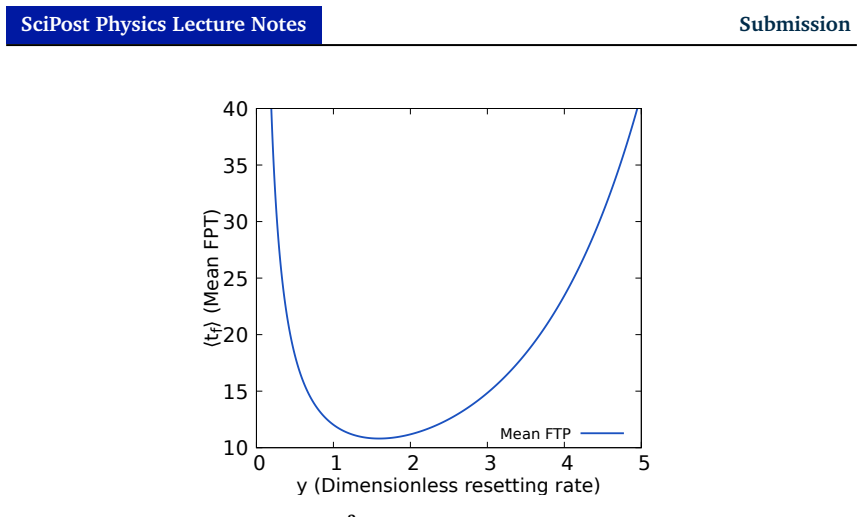
The paper's central claim is that the entire phenomenology of diffusion with stochastic resetting — the stationary state, the finite optimal mean first-passage time, the exponential long-time survival probability, and the large deviations of additive functionals — follows from one renewal-equation formalism plus Laplace transforms. For Poissonian resetting at rate $r$, the propagator obeys a last-renewal equation whose long-time limit is the Laplace distribution $P^*_r(x)=\frac{\alpha_0}{2}e^{-\alpha_0|x-x_r|}$, $\alpha_0=\sqrt{r/D}$, and the mean first-passage time to an absorbing target at known distance $x_0$ becomes $\langle T_r\rangle=(e^{y}-1)/r$ with $y=x_0\sqrt{r/D}$, minimized at $y=1.5936\ldots$. The survival probability decays exponentially rather than as a power law, with a Gumbel-like form in the large-$y$ regime. The notes then derive an exact Laplace-domain expression for the generating function of any additive functional, whose pole $s_0(k,r)$ generates the large-deviation rate function by Legendre-Fenchel transform, and they apply it to the cost of resetting. Finally, for non-Poissonian resetting, the same renewal equations show that a stationary non-equilibrium state exists if and only if the mean time between resets is finite.
Load-bearing premise
The load-bearing premise is that for non-Poissonian resetting the mean time between resets is finite; if a waiting-time distribution with an infinite mean is used, the stationary state disappears and the renewal-equation analysis no longer applies.
Editorial extensions
If this is right
- A reader can reproduce the stationary state of Poissonian resetting as a Laplace distribution with decay length $\sqrt{D/r}$, and see the probability current that makes it a non-equilibrium steady state.
- The mean first-passage time to a target at known distance is finite for every finite resetting rate $r$, diverges as $r\to0$ and $r\to\infty$, and has a unique optimum at dimensionless rate $y=1.5936\ldots$.
- Long-time survival under resetting becomes exponential, $q_r(t|x_0)\sim e^{-r t e^{-y}}$ in the large-$y$ regime, replacing the diffusive power-law tail with a Gumbel-type decay.
- For any additive functional with $f\ge0$, the rate function is obtained from the pole of $\tilde G_0(k,s+r)$ by a Legendre-Fenchel transform; the notes work out the linear-cost case explicitly.
- For non-Poissonian resetting, a stationary state exists only when the mean waiting time is finite, and when the target distance is known the optimal waiting-time distribution is deterministic resetting.
Reading between the lines
- The notes leave implicit that the same pole-and-saddle-point scheme should yield large-deviation rate functions for other additive functionals of the resetting process, such as the area swept or the local time at the resetting site, without new ideas.
- A natural extension the notes do not develop is optimizing the total cost of a search: the linear-cost rate function could be used to minimize the cost required to reach a target, rather than minimizing the mean first-passage time alone.
- The finite-mean condition in Section 8 implies that waiting-time distributions with infinite mean would produce an ageing regime with no stationary state; the notes state the condition but do not explore that regime.
- Because the large-deviation calculation in Section 7.3 keeps only the saddle-point exponential, the sub-exponential prefactors for $P_r(C,t)$ remain uncomputed; a reader could extract them from the full Bromwich integral.
Signed reviews
Editorial analysis
A structured set of objections, weighed in public.
Referee Report
Summary. These lecture notes provide a self-contained introduction to diffusion with stochastic resetting, developed from elementary Laplace-transform and renewal-equation techniques. The paper derives the free diffusion propagator and the survival probability in an absorbing half-line, introduces Poissonian resetting through master and renewal equations, obtains the Laplace stationary state and its relaxation front, computes the mean first-passage time and its optimal resetting rate, extends the renewal construction to additive functionals and to the cost of resetting (including an explicit large-deviation function for linear cost), and finally treats general non-Poissonian resetting subject to a finite mean inter-reset time. The presentation is aimed at readers who wish to reproduce every calculation.
Significance. The paper's claim is pedagogical rather than a claim of new scientific results. Its strength is that the derivations are standard, internally consistent, and complete enough for a student to follow: the renewal equations, the Laplace transforms, and the saddle-point inversions are all shown, with appendices supplying the contour and asymptotic tools. There are no fitted parameters or hidden numerical inputs, and the main restriction, namely the finite mean waiting time needed for a non-equilibrium stationary state in Eq. (117), is stated explicitly and is satisfied by all worked examples. The explicit large-deviation function for linear resetting cost in Eqs. (111)-(112) provides a concrete checkable result. I found no circularity: the notes re-derive known results from first principles. Once the equation typos listed below are fixed, these notes would be a valuable entry point to the field.
minor comments (6)
- [Section 2.1, Eq. (12)] With the scaling variable defined in Eq. (10) as z=(x-x0)/(Dt)^{1/2}, the normalized solution of Eq. (12) is f(z)=(4π)^{-1/2} e^{-z^2/4}, not (4π)^{-1/2} e^{-z^2/2}; the latter has norm 1/√2 and does not reproduce the propagator in Eq. (9).
- [Section 5.2, Eqs. (70) and (72)] The pole condition contains a spurious 'vt' and should read s0 + r exp(-x0 sqrt((r+s0)/D))=0; in the residue formula (72), x_r should be replaced by x0 under the assumption x_r=x0 stated just before Eq. (63).
- [Section 6.1, Eq. (89)] The displayed large-deviation form has the wrong sign; it should be P_r(A_t,t) ~ e^{-t I(a)} to agree with Eq. (79) and with the definition of I(a) in Eq. (90).
- [Section 6.1, Eqs. (80)-(84)] These renewal equations implicitly assume that the initial position equals the resetting position, x0=x_r; please state this at the beginning of Section 6.1, as is done for the cost model in Section 7.
- [Section 8.1, Eq. (119)] The denominator is written with e^{-s t} inside an integral over τ; it should be e^{-s τ} ψ(τ) q0(τ|x0), consistently with the numerator and with Eq. (120).
- [Throughout] Please proofread for small typos: 'Theses notes' in Section 1 should be 'These notes', and the caption of Fig. 4 abbreviates 'Mean FTP' where 'MFPT' is meant.
Circularity Check
No significant circularity: the lecture notes re-derive the core results from renewal equations and Laplace transforms, and the self-citations are not load-bearing.
full rationale
No circular step is identifiable in the derivation chain. The paper is a pedagogical exposition: the reset propagator (Eq. 46) follows from the definition of the reset process (Eq. 37) plus the no-reset Gaussian propagator (Eq. 9), and the stationary state (Eq. 41) is obtained by Laplace transform rather than assumed. The survival probability and mean first-passage time (Eqs. 60-68) are derived from the diffusive survival probability (Eq. 25) via a renewal equation, not from the final result. The large-deviation generating function (Eq. 85) and the cost generating function (Eq. 97) are likewise obtained by solving first-renewal equations and inverting by saddle point; no fitted parameter is renamed as a prediction. The non-Poissonian section derives the finite-mean waiting-time condition (Eq. 117) explicitly from the requirement that the stationary-state limit (Eq. 116) not vanish. The heavy self-citation reflects the authors' prior contributions to the field, but the load-bearing arguments are re-derived in these notes; cited results such as the optimal waiting-time distribution in Section 8.2 are presented as external literature and are not part of the self-contained derivation chain. Minor typographical errors (e.g., the spurious term in Eq. 70 and the Laplace variable in Eq. 119) do not constitute circularity.
Assumptions & free parameters
assumptions (4)
- domain assumption The renewal equation approach (Eq. 46) correctly represents the propagator for diffusion with resetting.
- domain assumption The large deviation principle (Eq. 79) holds for additive functionals of the resetting process.
- standard math The saddle-point method correctly gives the leading exponential behavior of the inverse transforms in Sections 4.3 and 7.3.
- domain assumption For non-Poissonian resetting, the existence of a stationary state requires a finite mean waiting time E(τ) (Eq. 117).
Cite this review
Pith. "Pith review of Stochastic Resetting and Large Deviations." pith.science (2026). https://pith.science/paper/EZ25D3C5
@misc{pith2026241216374,
  author       = {Pith},
  title        = {Pith review of: Stochastic Resetting and Large Deviations},
  year         = {2026},
  howpublished = {\url{https://pith.science/paper/EZ25D3C5}},
  note         = {Machine review of arXiv:2412.16374}
}
read the original abstract
Stochastic resetting has been a subject of considerable interest within statistical physics, both as means of improving completion times of complex processes such as searches and as a paradigm for generating nonequilibrium stationary states. In these lecture notes we give a self-contained introduction to the toy model of diffusion with stochastic resetting. We also discuss large deviation properties of additive functionals of the process such as the cost of resetting. Finally, we consider the generalisation from Poissonian resetting, where the resetting process occurs with a constant rate, to non-Poissonian resetting.
Figures


Figures from the paper (3 more)


Reference graph
Works this paper leans on
-
[1]
M. R. Evans and S. N. Majumdar,Diffusion with stochastic resetting, Phys. Rev. Lett.106, 160601 (2011), doi:10.1103/PhysRevLett.106.160601
-
[2]
M. R. Evans, S. N. Majumdar and G. Schehr,Stochastic resetting and applications, J. Phys. A: Math.Theor. 53 , 193001 (2020), doi:10.1088/1751-8121/ab7cfe
-
[3]
M. Montero, A. Masó-Puigdellosas, J, Villarroel, Continuous-time random walks with re- set events: historical background and new perspectives , Eur. Phys. J. B 90, 176 (2017), doi:10.1140/epjb/e2017-80348-4
-
[4]
S. Gupta and A. M. Jayannavar, Stochastic resetting: A (very) brief review , Frontiers in Physics 10, 789097 (2022), doi:10.3389/fphy .2022.789097
arXiv 2022
-
[5]
O. Bénichou, C. Loverdo, M. Moreau and R. Voituriez, Intermittent search strategies, Re- views of Modern Physics, 83, 81 (2011) doi:10.1103/RevModPhys.83.81
-
[6]
Reuveni, Optimal Stochastic Restart Renders Fluctuations in First Passage Times Univer- sal, Phys
S. Reuveni, Optimal Stochastic Restart Renders Fluctuations in First Passage Times Univer- sal, Phys. Rev. Lett.116, 170601 (2016), doi:10.1103/PhysRevLett.116.170601
-
[7]
I. S. Gradshteyn and I. M. Ryzhik, Table of Integrals, Series and Products , New York:Academic (1980), doi:10.1016/C2010-0-64839-5
-
[8]
S. Redner, A guide to First-Passage Processes Cambridge University Press, Cambridge (2001), doi:10.1017/CBO9780511606014
Show all 28 references
-
[9]
S. N. Majumdar, S. Sabhapandit and G. Schehr, Dynamical transition in the tempo- ral relaxation of stochastic processes under resetting , Phys. Rev. E 91, 052131 (2015), doi:10.1103/PhysRevE.91.052131
2015 doi
-
[10]
M. R. Evans and S. N. Majumdar, Run and tumble particle under resetting: a renewal approach, J. Phys. A: Math. Theor.51, 475003 (2018), doi:10.1088/1751-8121/aae74e
2018 doi
-
[11]
M. R. Evans and S. N. Majumdar, Diffusion with resetting in arbitrary spatial dimension , J. Phys. A: Math. Theor. 47, 285001 (2014), doi:10.1088/1751-8113/47/28/285001. 28 SciPost Physics Lecture Notes Submission
2014 doi
-
[12]
Singh and A
P . Singh and A. Pal,First-passage Brownian functionals with stochastic resetting , J. Phys. A: Math. Theor. 55, 234001 (2022), doi:10.1088/1751-8121/ac677c
2022 doi
-
[13]
M. R. Evans, S.N. Majumdar, G. Schehr, An exactly solvable predator prey model with resetting, J. Phys. A: Math. Theor. 55, 274005 (2022) doi:10.1088/1751-8121/ac7269
2022 doi
-
[14]
J. M. Meylahn, S. Sabhapandit, and H. Touchette, Large deviations for Markov processes with resetting, Phys. Rev. E92, 062148 (2015), doi:PhysRevE.92.062148
2015
-
[15]
Den Hollander, S
F . Den Hollander, S. N. Majumdar, J. M. Meylahn, H. Touchette,Properties of additive func- tionals of Brownian motion with resetting , J. Phys. A: Math. Theor. 52, 175001 (2019), doi:10.1088/1751-8121/ab0efd
2019 doi
-
[16]
Monthus,Large deviations for Markov processes with stochastic resetting: analysis via the empirical density and flows or via excursions between resets, J
C. Monthus,Large deviations for Markov processes with stochastic resetting: analysis via the empirical density and flows or via excursions between resets, J. Stat. Mech. 2021, 033201 (2021), doi:10.1088/1742-5468/abdeaf
2021 doi
-
[17]
J. C. Sunil, R. A. Blythe, M. R. Evans and S. N. Majumdar,The cost of stochastic resetting, J. Phys. A: Math. Theor. 56, 395001 (2023), doi:10.1088/1751-8121/acf3bb
2023 doi
-
[18]
J. C. Sunil, R. A. Blythe, M. R. Evans and S. N. Majumdar, Minimizing the Profligacy of Searches with Reset , Phys. Rev. E. 110, 054122 (2024), doi:10.1103/PhysRevE.110.054122
2024 doi
-
[19]
M. R. Evans and S. N. Majumdar, Effects of refractory period on stochastic resetting , J. Phys. A: Math. Theor. 52, 01LT01 (2019), doi:10.1088/1751-8121/aaf080
2019 doi
-
[20]
A. Pal, L. Ku´smierz, S. Reuveni, Search with home returns provides advantage under high uncertainty, Phys. Rev. Res.2, 043174 (2020), doi:10.1103/PhysRevResearch.2.043174
2020 doi
-
[21]
F . Mori, K. S. Olsen, S. Krishnamurthy , Entropy production of resetting processes , Phys. Rev. Res.5, 023103 (2023), doi:10.1103/PhysRevResearch.5.023103
2023 doi
-
[22]
Eule and J
S. Eule and J. J. Metzger, Non-equilibrium steady states of stochastic processes with intermittent resetting , New J. Phys. 18, 033006 (2016), doi:10.1088 /1367- 2630/18/3/033006
2016
-
[23]
A. Pal, A. Kundu and M. R. Evans, Diffusion under time-dependent resetting , J. Phys. A: Math. Theor. 49, 225001 (2016), doi:10.1088/1751-8113/49/22/225001
2016 doi
-
[24]
Pal and S
A. Pal and S. Reuveni, First Passage under Restart, Phys. Rev. Lett. 118, 030603 (2017), doi:10.1103/PhysRevLett.118.030603
2017 doi
-
[25]
Masó-Puigdellosas, D
A. Masó-Puigdellosas, D. Campos and V . Méndez, Transport properties and first-arrival statistics of random motion with stochastic reset times , Phys. Rev. E, 99, 012141 (2019) doi:10.1103/PhysRevE.99.012141
2019 doi
-
[26]
Chechkin and I
A. Chechkin and I. M. Sokolov, Random Search with Resetting: A Unified Renewal Ap- proach, Phys. Rev. Lett.121, 050601 (2018), doi:10.1103/PhysRevLett.121.050601
2018 doi
-
[27]
M. R. Evans and S. N. Majumdar,Diffusion with optimal resetting, J. Phys. A: Math. Theor. 44, 435001 (2011), doi:10.1088/1751-8113/44/43/435001
2011 doi
- [28]
Reviewed August 11, 2026 · model on record in the stance chip above.
Discussion (0). Continue with ORCID to comment.