REVIEW 4 major objections 7 minor 2 cited by
An automated framework for exploring and learning potential-energy surfaces
T0 review · 4 major / 7 minor · reviewed 2026-08-11 · deepseek-v4-flash
Pith's one-line read An open-source workflow turns random structure searches into ready-to-use machine-learned interatomic potentials.
desk verdict Useful, honest automation paper; the transferability claim needs held-out force metrics. read the letter →
The pith
A machine-rendered reading of the paper's core claim, the machinery that carries it, and where it could break.
The reading
What carries the argument
The load-bearing machinery is the iterative GAP-RSS loop: the buildcell code generates random structures under user-chosen constraints, the current MLIP relaxes them, a subset is labelled with single-point DFT, the new data are added to the training set, a new potential is fitted, and the cycle repeats. A Hookean repulsion term keeps atoms from approaching unphysically close during relaxation. The automation layer wraps this loop in workflow-management infrastructure, so thousands of tasks can be submitted and monitored on high-performance computing systems without manual intervention. This loop is what transfers the burden from hand-curated datasets to the random-search parameters.
What would settle it
Train an autoplex GAP-RSS model on a new small-cell random structure set for water and run molecular dynamics at 300 K; if the predicted O–O radial distribution function first peak deviates by more than roughly 0.05 Å from the experimental value, or the hydrogen-bond count falls outside the 3.48–3.84 range, the claim that RSS alone provides transferable robustness would fail.
Extended reading notes
Core claim
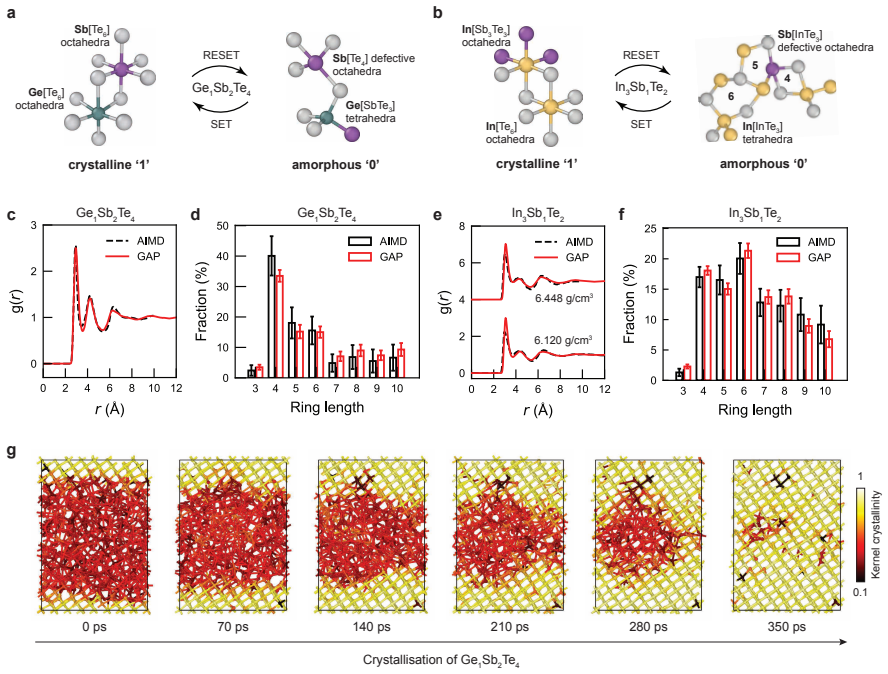
The central claim is that a GAP-RSS-style workflow—randomly generating small-cell structures, relaxing them with a progressively improved Gaussian approximation potential, labelling only with single-point DFT, and refitting—can be implemented as a modular, automated workflow system and still yield potentials that describe not just the training region but also bulk liquids, amorphous phases, and crystallisation dynamics. The demonstrations show energy errors near 0.01 eV per atom for held-out polymorphs, correct polymorph stability ordering at the SCAN level for SiO2, qualitatively correct liquid-water structure and hydrogen-bond counts, and a 350 ps crystallisation simulation of Ge1Sb2Te4. The paper presents this as evidence that automated random searching can serve as a general starting point for MLIP construction, including for materials with little existing domain knowledge.
Load-bearing premise
The load-bearing premise is that small-cell random structure searches, with user-chosen buildcell constraints and a Hookean repulsion term, generate a training distribution diverse enough for the resulting potential to transfer to large bulk liquid and amorphous systems.
Editorial extensions
If this is right
- MLIP models for a new material system can be created from scratch in an automated run, with the user's main choice being the random-search constraints and the DFT functional.
- Automated RSS datasets serve as training data not only for GAP but also for other architectures: the paper shows a NequIP model fitted to the same dataset improves extrapolation to ice polymorphs.
- Because only single-point DFT is needed, higher-rung functionals such as SCAN become affordable for building potentials, enabling qualitatively correct stability ordering where PBE fails.
- Materials with little domain knowledge, such as In3Sb1Te2, can get a first usable potential without months of hand curation.
- The workflow integrates with existing high-throughput infrastructure, making iterative MLIP fitting accessible on large HPC systems.
Reading between the lines
- The same automation could be extended to multi-element and disordered systems beyond the demonstrated binaries and ternaries, potentially enabling high-throughput screening of MLIPs across many chemistries.
- Small-cell random searches may under-sample long-ranged or slowly relaxing degrees of freedom, so adding uncertainty-based active learning to the loop could further improve transfer to large amorphous systems.
- Autoplex-generated RSS datasets could serve as a cheap pre-training or synthetic-data source for foundational MLIP fine-tuning, extending the paper's observation that a NequIP model benefits from the same dataset.
- The paper's cost estimates for SiO2 suggest that automated MLIP construction could become a routine pre-screening tool in computational materials discovery, not just a specialist technique.
Signed reviews
Editorial analysis
A structured set of objections, weighed in public.
Referee Report
Summary. The paper introduces autoplex, an automated workflow framework that combines random structure searching (RSS) with iterative fitting of machine-learned interatomic potentials, primarily GAP but with interfaces to other architectures such as NequIP, MACE, and ACE. The workflow is demonstrated on elemental silicon, TiO2 and the full Ti-O binary system, SiO2 at PBE and SCAN levels, liquid water and ice using GAP and NequIP, and the phase-change materials Ge1Sb2Te4 and In3Sb1Te2. The central claim is that MLIP fitting can be carried out in a largely automated, high-throughput manner and that the resulting potentials are robust and useful, especially given the ease of creating them from scratch.
Significance. If the claims are substantiated, this is a valuable contribution: it packages iterative RSS-plus-MLIP fitting in an open-source, workflow-based tool that integrates with atomate2 and jobflow, potentially lowering the barrier to building potentials from scratch. The demonstrations span several chemistries and multiple MLIP architectures, and the SiO2/SCAN example shows that the automated pipeline can access higher-rung functionals at moderate cost. Named strengths include the open code with a Zenodo-deposited version, the interoperability with existing workflow ecosystems, and the demonstration that an RSS-generated dataset can be reused with a different architecture (NequIP). The main gap is validation: the robustness claim currently rests on energy errors that are partly in-sample and on qualitative MD comparisons without force-error metrics or explicit held-out tests on the application systems.
major comments (4)
- [Results; Fig. 2 and Table 1] The error metrics are reported without an explicit statement of train/test separation. Fig. 2 shows the evolution of energy errors for selected crystalline phases, but it is not stated whether those phases, or rattled versions of them, are included in the training set at each iteration. Table 1 evaluates errors on 10 rattled structures per polymorph; because these are generated from the ground-state structures that the RSS pipeline is designed to find, they are likely inside or very close to the training distribution. As a result, the reported RMSEs do not by themselves establish that the potentials are robust for unseen configurations. Please report held-out errors and state explicitly which structures enter the training set at each stage.
- [Describing water; Application to chalcogenide memory materials; Figs. 4 and 5] The MD demonstrations are the strongest evidence for transferability, but no force-error metric is reported anywhere in the manuscript. The liquid-water RDFs and hydrogen-bond analysis (Fig. 4a-c) and the Ge1Sb2Te4 crystallisation simulation (Fig. 5g) are driven by forces, yet the paper only reports energy RMSEs. Please add force RMSEs on held-out configurations representative of the application systems, for example SCAN DFT-MD snapshots of liquid water and AIMD snapshots of amorphous GST/IST. Without such metrics, the conclusion that small-cell RSS data transfer to bulk liquid and amorphous systems in force space is unsubstantiated.
- [Describing water; Fig. 4d] Fig. 4d shows that the GAP-RSS model's energies for ice polymorphs are 'highly scattered', and the authors attribute this to low-density phases outside the training distribution. This is a direct counterexample to the general claim that RSS-derived potentials are robust across phases. Please either soften the robustness claim in the abstract and introduction or provide an analysis of when the workflow produces a transferable GAP, for example by detecting extrapolation through uncertainty estimates or active learning. The current text acknowledges the limitation in one sentence but does not reconcile it with the central claim.
- [Data availability] The Data Availability statement says that raw data and notebooks 'will be made available via GitHub upon journal publication', so the numerical results in Figs. 2-5 and Tables 1-2 are not currently available to reviewers or readers. Since the contribution is an automated framework that others should be able to reproduce, please deposit the datasets, trained potentials, and plotting notebooks, or at least the train/test splits and error tables, in a public repository with the submitted version.
minor comments (7)
- [Describing water] The statement that RSS searches 'typically use small unit cells' should be quantified: please give the cell sizes and number of molecules used in the water RSS runs so the reader can judge how far the liquid-water simulation extrapolates from the training data.
- [Describing water; Application to chalcogenide memory materials] The simulation protocols for Figs. 4a-c and 5c-g (ensemble, thermostat, system size, simulation length, and initial configurations) are not given in the Methods; please add these details for reproducibility.
- [The autoplex framework] The license is described only as 'permissive'; please specify the exact open-source license in the text or in the repository.
- [Table 1] For the entries marked '— a', the footnote states that errors exceed 1 eV/atom and are therefore not meaningful to report; giving approximate numerical values would be more informative for assessing the failure mode.
- [Fig. 2 caption] Please clarify whether the 0.001 eV/atom floor is a plotting cutoff or a stopping criterion used during the iterative fitting.
- [Methods; ML potentials] Equation (1) defines the total-energy decomposition but the force expression is not given; please state that forces are obtained as derivatives of the total energy and give the relevant implementation detail or reference.
- [Results; Ti-O system] The phrase 'standard DFT and GAP fitting settings' should be replaced by the actual settings or a pointer to repository defaults, since these settings are not standard across the community.
Circularity Check
No significant circularity: the automation claim is evaluated with external benchmarks and the RSS-derived potentials are tested against held-out ice, liquid, and literature data.
full rationale
The paper's central claim is that autoplex automates iterative RSS plus MLIP fitting, which is an engineering contribution rather than a derived quantitative prediction. The training data are generated by the same RSS pipeline, but the most informative evaluations are external to that pipeline: liquid-water RDFs compared to experiment (Fig. 4a to 4c), 52 ice polymorphs from Ref. 80 re-evaluated with SCAN DFT (Fig. 4d), and phase-change RDFs and ring statistics compared to literature AIMD (Fig. 5c to 5f). The SiO2 stability ordering is checked directly against DFT@SCAN energies, and the energy differences in Table 2 are compared with the corresponding DFT functional, so the GAP predictions are not equated with their training labels by construction. Self-citations to earlier GAP-RSS work (Refs. 44 and 48) supply the underlying method, but the present automation and its external tests are independent; no load-bearing reduction to self-citation occurs. The absence of a force-error metric and the extrapolation from small-cell RSS to bulk liquid and amorphous systems are genuine validation gaps and correctness risks, but they are not instances of circular reasoning under the definitions used here.
Assumptions & free parameters
free parameters (3)
- buildcell RSS parameter sets
- Hookean repulsion parameters
- GAP hyperparameters
assumptions (4)
- domain assumption Random structure searching with buildcell generates configurations representative of the relevant potential-energy surface.
- domain assumption DFT single-point energies computed with VASP (PBE, PBEsol, or SCAN) are accurate reference labels for the target potential-energy surface.
- domain assumption Total energy can be decomposed into local atomic-environment contributions (Eq. 1) as required by GAP.
- domain assumption Iterative retraining of GAP models on gradually growing RSS datasets converges to a useful potential without manual intervention.
Cite this review
Pith. "Pith review of An automated framework for exploring and learning potential-energy surfaces." pith.science (2026). https://pith.science/paper/UHHK2FVQ
@misc{pith2026241216736,
  author       = {Pith},
  title        = {Pith review of: An automated framework for exploring and learning potential-energy surfaces},
  year         = {2026},
  howpublished = {\url{https://pith.science/paper/UHHK2FVQ}},
  note         = {Machine review of arXiv:2412.16736}
}
read the original abstract
Machine learning has become ubiquitous in materials modelling and now routinely enables large-scale atomistic simulations with quantum-mechanical accuracy. However, developing machine-learned interatomic potentials requires high-quality training data, and the manual generation and curation of such data can be a major bottleneck. Here, we introduce an automated framework for the exploration and fitting of potential-energy surfaces, implemented in an openly available software package that we call autoplex (`automatic potential-landscape explorer'). We discuss design choices, particularly the interoperability with existing software architectures, and the ability for the end user to easily use the computational workflows provided. We show wide-ranging capability demonstrations: for the titanium-oxygen system, SiO2, crystalline and liquid water, as well as phase-change memory materials. More generally, our study illustrates how automation can speed up atomistic machine learning -- with a long-term vision of making it a genuine mainstream tool in physics, chemistry, and materials science.
Figures


Figures from the paper (2 more)

Forward citations
Cited by 2 Pith papers
-
NepTrain and NepTrainKit: Automated Active Learning and Visualization Toolkit for Neuroevolution Potentials
A new open-source toolkit automates active learning and dataset management for neuroevolution potentials, with a CsPbI3 case study showing comparable accuracy to hand-curated NEP models.
-
Full-cycle device-scale simulations of memory materials with a tailored atomic-cluster-expansion potential
A new ACE machine-learned potential enables full-cycle (RESET-SET-RESET) atomistic simulations of Ge-Sb-Te phase-change memory cells at device scale on CPU-only high-performance computers.
Reference graph
Works this paper leans on
-
[1]
First principles neural network potentials for reactive simulations of large molecular and condensed systems
Behler, J. First principles neural network potentials for reactive simulations of large molecular and condensed systems. Angew. Chem. Int. Ed. 56, 12828–12840 (2017)
2017
-
[2]
L., Caro, M
Deringer, V . L., Caro, M. A. & Cs ´anyi, G. Machine learning interatomic potentials as emerging tools for materials science. Adv. Mater .31, 1902765 (2019)
2019
-
[3]
& Clementi, C
No ´e, F., Tkatchenko, A., M¨uller, K.-R. & Clementi, C. Machine learning for molecular simulation. Annu. Rev. Phys. Chem. 71, 361–390 (2020)
2020
-
[4]
Unke, O. T. et al. Machine learning force fields. Chem. Rev. 121, 10142–10186 (2021)
2021
-
[5]
& Aspuru-Guzik, A
Friederich, P., H ¨ase, F., Proppe, J. & Aspuru-Guzik, A. Machine-learned potentials for next-generation matter simulations. Nat. Mater .20, 750–761 (2021)
2021
-
[6]
Cheng, B., Mazzola, G., Pickard, C. J. & Ceriotti, M. Evidence for supercritical be- haviour of high-pressure liquid hydrogen. Nature 585, 217–220 (2020). 19
2020
-
[7]
Deringer, V . L. et al. Origins of structural and electronic transitions in disordered sili- con. Nature 589, 59–64 (2021)
2021
-
[8]
Zong, H. et al. Free electron to electride transition in dense liquid potassium.Nat. Phys. 17, 955–960 (2021)
2021
Show all 110 references
-
[9]
Westermayr, J. et al. Deep learning study of tyrosine reveals that roaming can lead to photodamage. Nat. Chem. 14, 914–919 (2022)
2022
-
[10]
Zhang, S. et al. Exploring the frontiers of condensed-phase chemistry with a general reactive machine learning potential. Nat. Chem. 16, 727–734 (2024)
2024
-
[11]
Wang, T. et al. Ab initio characterization of protein molecular dynamics with AI2BMD. Nature 635, 1019–1027 (2024)
2024
-
[12]
P., Swiler, L
Thompson, A. P., Swiler, L. P., Trott, C. R., Foiles, S. M. & Tucker, G. J. Spectral neighbor analysis method for automated generation of quantum-accurate interatomic potentials. J. Comput. Phys. 285, 316–330 (2015)
2015
-
[13]
Moment tensor potentials: A class of systematically improvable inter- atomic potentials
Shapeev, A. Moment tensor potentials: A class of systematically improvable inter- atomic potentials. Multiscale Model. Simul. 14, 1153–1173 (2016)
2016
-
[14]
Atomic cluster expansion for accurate and transferable interatomic poten- tials
Drautz, R. Atomic cluster expansion for accurate and transferable interatomic poten- tials. Phys. Rev. B 99, 014104 (2019)
2019
-
[15]
P., Payne, M
Bart ´ok, A. P., Payne, M. C., Kondor, R. & Cs ´anyi, G. Gaussian approximation poten- tials: The accuracy of quantum mechanics, without the electrons. Phys. Rev. Lett. 104, 136403 (2010)
2010
-
[16]
& Parrinello, M
Behler, J. & Parrinello, M. Generalized neural-network representation of high- dimensional potential-energy surfaces. Phys. Rev. Lett. 98, 146401 (2007)
2007
-
[17]
Zhang, L., Han, J., Wang, H., Car, R. & E, W. Deep potential molecular dynamics: A scalable model with the accuracy of quantum mechanics. Phys. Rev. Lett. 120, 143001 (2018)
2018
-
[18]
Unke, O. T. & Meuwly, M. Physnet: A neural network for predicting energies, forces, dipole moments, and partial charges. J. Chem. Theory Comput. 15, 3678–3693 (2019)
2019
-
[19]
Batzner, S. et al. E(3)-equivariant graph neural networks for data-efficient and accurate interatomic potentials. Nat. Commun. 13, 2453 (2022)
2022
-
[20]
P., Simm, G., Ortner, C
Batatia, I., Kovacs, D. P., Simm, G., Ortner, C. & Csanyi, G. MACE: Higher or- der equivariant message passing neural networks for fast and accurate force fields. In Koyejo, S. et al. (eds.) Advances in Neural Information Processing Systems , vol. 35, 11423–11436 (Curran Assoc...
2022
-
[21]
& Ong, S
Chen, C. & Ong, S. P. A universal graph deep learning interatomic potential for the periodic table. Nat. Comput. Sci. 2, 718–728 (2022)
2022
-
[22]
Deng, B. et al. CHGNet as a pretrained universal neural network potential for charge- informed atomistic modelling. Nat. Mach. Intell. 5, 1031–1041 (2023)
2023
-
[23]
C., Miceli, G., Caravati, S., Behler, J
Sosso, G. C., Miceli, G., Caravati, S., Behler, J. & Bernasconi, M. Neural network interatomic potential for the phase change material GeTe. Phys. Rev. B 85, 174103 (2012)
2012
-
[24]
P., Kermode, J., Bernstein, N
Bart ´ok, A. P., Kermode, J., Bernstein, N. & Cs ´anyi, G. Machine learning a general- purpose interatomic potential for silicon. Phys. Rev. X 8, 041048 (2018)
2018
-
[25]
C., Rohrer, J., Albe, K
Erhard, L. C., Rohrer, J., Albe, K. & Deringer, V . L. A machine-learned interatomic potential for silica and its relation to empirical models.npj Comput. Mater .8, 90 (2022)
2022
-
[26]
& Deringer, V
Zhou, Y ., Zhang, W., Ma, E. & Deringer, V . L. Device-scale atomistic modelling of phase-change memory materials. Nat. Electron. 6, 746–754 (2023)
2023
-
[27]
Zhang, D. et al. DPA-2: a large atomic model as a multi-task learner. Preprint at https://arxiv.org/abs/2312.15492
-
[28]
Batatia, I. et al. A foundation model for atomistic materials chemistry. Preprint at https://arxiv.org/abs/2401.00096
-
[29]
Kaur, H. et al. Data-efficient fine-tuning of foundational models for first- principles quality sublimation enthalpies. Faraday Discuss. Advance Article, DOI: 10.1039/D4FD00107A (2024)
2024 doi
-
[30]
Ben Mahmoud, C., Gardner, J. L. A. & Deringer, V . L. Data as the next challenge in atomistic machine learning. Nat. Comput. Sci. 4, 384–387 (2024)
2024
-
[31]
Kulichenko, M. et al. Data generation for machine learning interatomic potentials and beyond. Chem. Rev. DOI: 10.1021/acs.chemrev.4c00572 (2024)
2024 doi
-
[32]
S., Nebgen, B., Lubbers, N., Isayev, O
Smith, J. S., Nebgen, B., Lubbers, N., Isayev, O. & Roitberg, A. E. Less is more: Sampling chemical space with active learning. J. Chem. Phys. 148 (2018)
2018
-
[33]
P., Ortner, C
van der Oord, C., Sachs, M., Kov ´acs, D. P., Ortner, C. & Cs ´anyi, G. Hyperactive learning for data-driven interatomic potentials. npj Comput. Mater .9, 168 (2023)
2023
-
[34]
Kulichenko, M. et al. Uncertainty-driven dynamics for active learning of interatomic potentials. Nat. Comput. Sci. 3, 230–239 (2023)
2023
-
[35]
Vandermause, J. et al. On-the-fly active learning of interpretable Bayesian force fields for atomistic rare events. npj Comput. Mater .6, 20 (2020). 21
2020
-
[36]
& Van Spey- broeck, V
Vandenhaute, S., Cools-Ceuppens, M., DeKeyser, S., Verstraelen, T. & Van Spey- broeck, V . Machine learning potentials for metal-organic frameworks using an incre- mental learning approach. npj Comput. Mater .9, 19 (2023)
2023
-
[37]
Uncertainty-aware molecular dynamics from Bayesian active learning for phase transformations and thermal transport in SiC
Xie, Y .et al. Uncertainty-aware molecular dynamics from Bayesian active learning for phase transformations and thermal transport in SiC. npj Comput. Mater .9, 36 (2023)
2023
-
[38]
A., Johnston-Wood, T., Deringer, V
Young, T. A., Johnston-Wood, T., Deringer, V . L. & Duarte, F. A transferable active- learning strategy for reactive molecular force fields. Chem. Sci. 12, 10944–10955 (2021)
2021
-
[39]
P., Ko, T., Yang, C
Guan, X., Heindel, J. P., Ko, T., Yang, C. & Head-Gordon, T. Using machine learning to go beyond potential energy surface benchmarking for chemical reactivity.Nat. Comput. Sci. 3, 965–974 (2023)
2023
-
[40]
L., Fako, E., De, S., Sch ¨afer, A
Schaaf, L. L., Fako, E., De, S., Sch ¨afer, A. & Cs´anyi, G. Accurate energy barriers for catalytic reaction pathways: an automatic training protocol for machine learning force fields. npj Comput. Mater .9, 180 (2023)
2023
-
[41]
Pickard, C. J. & Needs, R. J. High-pressure phases of silane.Phys. Rev. Lett.97, 045504 (2006)
2006
-
[42]
Pickard, C. J. & Needs, R. J. Ab initio random structure searching. J. Phys.: Condens. Matter 23, 053201 (2011)
2011
-
[43]
Jain, A. et al. Commentary: The Materials Project: A materials genome approach to accelerating materials innovation. APL Mater .1, 011002 (2013)
2013
-
[44]
L., Pickard, C
Deringer, V . L., Pickard, C. J. & Cs ´anyi, G. Data-driven learning of total and local energies in elemental boron. Phys. Rev. Lett. 120, 156001 (2018)
2018
-
[45]
Tong, Q., Xue, L., Lv, J., Wang, Y . & Ma, Y . Accelerating CALYPSO structure predic- tion by data-driven learning of a potential energy surface.Faraday Discuss. 211, 31–43 (2018)
2018
-
[46]
L., Proserpio, D
Deringer, V . L., Proserpio, D. M., Cs´anyi, G. & Pickard, C. J. Data-driven learning and prediction of inorganic crystal structures. Faraday Discuss. 211, 45–59 (2018)
2018
-
[47]
V ., Tikhonov, E
Podryabinkin, E. V ., Tikhonov, E. V ., Shapeev, A. V . & Oganov, A. R. Accelerat- ing crystal structure prediction by machine-learning interatomic potentials with active learning. Phys. Rev. B 99, 064114 (2019)
2019
-
[48]
& Deringer, V
Bernstein, N., Cs ´anyi, G. & Deringer, V . L. De novo exploration and self-guided learn- ing of potential-energy surfaces. npj Comput. Mater .5, 99 (2019). 22
2019
-
[49]
Pickard, C. J. Ephemeral data derived potentials for random structure search. Phys. Rev. B 106, 014102 (2022)
2022
-
[50]
Pickard, C. J. Beyond theory driven discovery: introducing hot random search and da- tum derived structures. Faraday Discuss.Advance Article, DOI: 10.1039/D4FD00134F (2024)
2024 doi
-
[51]
Merchant, A. et al. Scaling deep learning for materials discovery. Nature 624, 80–85 (2023)
2023
-
[52]
Yang, H. et al. MatterSim: A deep learning atomistic model across elements, tempera- tures and pressures (2024). Preprint at https://arxiv.org/abs/2405.04967
2024 arXiv
-
[53]
Automation in DFT-based computational materials science
George, J. Automation in DFT-based computational materials science. Trends Chem. 3, 697–699 (2021)
2021
-
[54]
Curtarolo, S. et al. Aflow: An automatic framework for high-throughput materials discovery. Comput. Mater . Sci.58, 218–226 (2012)
2012
-
[55]
Kirklin, S. et al. The Open Quantum Materials Database (OQMD): assessing the accu- racy of DFT formation energies. npj Comput. Mater .1, 15010 (2015)
2015
-
[56]
& Kozinsky, B
Pizzi, G., Cepellotti, A., Sabatini, R., Marzari, N. & Kozinsky, B. AiiDA: automated interactive infrastructure and database for computational science. Comput. Mater . Sci. 111, 218–230 (2016)
2016
-
[57]
Mathew, K. et al. Atomate: A high-level interface to generate, execute, and analyze computational materials science workflows. Comput. Mater . Sci.139, 140–152 (2017)
2017
-
[58]
Choudhary, K. et al. The joint automated repository for various integrated simulations (JARVIS) for data-driven materials design. npj Comput. Mater .6, 173 (2020)
2020
-
[59]
O., Suh, C., G ´omez-Bombarelli, R., Aguilera-Iparraguirre, J
Pyzer-Knapp, E. O., Suh, C., G ´omez-Bombarelli, R., Aguilera-Iparraguirre, J. & Aspuru-Guzik, A. What is high-throughput virtual screening? A perspective from organic materials discovery. Annu. Rev. Mater . Res.45, 195–216 (2015)
2015
-
[60]
& Toberer, E
Gorai, P., Stevanovi ´c, V . & Toberer, E. S. Computationally guided discovery of ther- moelectric materials. Nat. Rev. Mater .2, 17053 (2017)
2017
-
[61]
Finding the needle in the haystack: Materials discovery and design through computational ab initio high-throughput screening
Hautier, G. Finding the needle in the haystack: Materials discovery and design through computational ab initio high-throughput screening. Comput. Mater . Sci.163, 108–116 (2019)
2019
-
[62]
Janssen, J. et al. pyiron: An integrated development environment for computational materials science. Comput. Mater . Sci.163, 24–36 (2019). 23
2019
-
[63]
DP-GEN: A concurrent learning platform for the generation of reliable deep learning based potential energy models
Zhang, Y .et al. DP-GEN: A concurrent learning platform for the generation of reliable deep learning based potential energy models. Comput. Phys. Commun. 253, 107206 (2020)
2020
-
[64]
Gel ˇzinyt˙e, E. et al. wfl Python toolkit for creating machine learning interatomic poten- tials and related atomistic simulation workflows. J. Chem. Phys. 159, 124801 (2023)
2023
-
[65]
& Cheng, J
Guo, Y .-X., Zhuang, Y .-B., Shi, J. & Cheng, J. ChecMatE: A workflow package to auto- matically generate machine learning potentials and phase diagrams for semiconductor alloys. J. Chem. Phys. 159, 094801 (2023)
2023
-
[66]
Menon, S. et al. From electrons to phase diagrams with classical and machine learning potentials: automated workflows for materials science with pyiron. npj Comput. Mater . 10, 261 (2024)
2024
-
[67]
& Neugebauer, J
Poul, M., Huber, L. & Neugebauer, J. Automated generation of struc- ture datasets for machine learning potentials and alloys (2024). Preprint at https://www.researchsquare.com/article/rs-4732459/v1
2024
-
[68]
Ganose, A. et al. atomate2 (2024). URL https://github.com/materialsproject/ atomate2
2024
-
[69]
Y ., Stefanoski, S., Kurakevych, O
Kim, D. Y ., Stefanoski, S., Kurakevych, O. O. & Strobel, T. A. Synthesis of an open- framework allotrope of silicon. Nat. Mater .14, 169–173 (2015)
2015
-
[70]
R., Armstrong, G., Canales, J., Garc ´ıa, R
Armstrong, A. R., Armstrong, G., Canales, J., Garc ´ıa, R. & Bruce, P. G. Lithium-ion intercalation into TiO2-B nanowires. Adv. Mater .17, 862–865 (2005)
2005
-
[71]
Liang, S. et al. Bronze-phase TiO2 as anode materials in lithium and sodium-ion bat- teries. Adv. Funct. Mater .32, 2201675 (2022)
2022
-
[72]
P., Burke, K
Perdew, J. P., Burke, K. & Ernzerhof, M. Generalized gradient approximation made simple. Phys. Rev. Lett. 77, 3865–3868 (1996)
1996
-
[73]
& Perdew, J
Sun, J., Ruzsinszky, A. & Perdew, J. P. Strongly constrained and appropriately normed semilocal density functional. Phys. Rev. Lett. 115, 036402 (2015)
2015
-
[74]
&´Angy´an, J
Demuth, T., Jeanvoine, Y ., Hafner, J. &´Angy´an, J. G. Polymorphism in silica studied in the local density and generalized-gradient approximations. J. Phys.: Condens. Matter 11, 3833–3874 (1999)
1999
-
[75]
C., Rohrer, J., Albe, K
Erhard, L. C., Rohrer, J., Albe, K. & Deringer, V . L. Modelling atomic and nanoscale structure in the silicon–oxygen system through active machine learning. Nat. Commun. 15, 1927 (2024). 24
2024
-
[76]
Markland, T. E. & Ceriotti, M. Nuclear quantum effects enter the mainstream. Nat. Rev. Chem. 2, 0109 (2018)
2018
-
[77]
The radial distribution functions of water and ice from 220 to 673 K and at pressures up to 400 MPa
Soper, A. The radial distribution functions of water and ice from 220 to 673 K and at pressures up to 400 MPa. Chem. Phys. 258, 121–137 (2000)
2000
-
[78]
B., Benmore, C
Skinner, L. B., Benmore, C. J., Neuefeind, J. C. & Parise, J. B. The structure of water around the compressibility minimum. J. Chem. Phys. 141, 214507 (2014)
2014
-
[79]
P., Hutter, J., Kuo, I.-F
Todorova, T., Seitsonen, A. P., Hutter, J., Kuo, I.-F. W. & Mundy, C. J. Molecular dynamics simulation of liquid water: Hybrid density functionals. J. Phys. Chem. B 110, 3685–3691 (2006)
2006
-
[80]
G., Engel, E
Monserrat, B., Brandenburg, J. G., Engel, E. A. & Cheng, B. Liquid water contains the building blocks of diverse ice phases. Nat. Commun. 11, 5757 (2020)
2020
-
[81]
Thompson, A. P. et al. LAMMPS - a flexible simulation tool for particle-based materials modeling at the atomic, meso, and continuum scales. Comp. Phys. Comm. 271, 108171 (2022)
2022
-
[82]
Gardner, J. L. A. graph-pes: train and use graph-based Machine-Learned models of Potential Energy Surfaces. https://github.com/jla-gardner/graph-pes (2024). Version 0.0.10
2024
-
[83]
H., Sciortino, F., Grande, T., Stanley, H
Poole, P. H., Sciortino, F., Grande, T., Stanley, H. E. & Angell, C. A. Effect of hydrogen bonds on the thermodynamic behavior of liquid water.Phys. Rev. Lett. 73, 1632 (1994)
1994
-
[84]
& Skinner, J
Kumar, R., Schmidt, J. & Skinner, J. Hydrogen bonding definitions and dynamics in liquid water. J. Chem. Phys. 126, 204107 (2007)
2007
-
[85]
Salzbrenner, P. T. et al. Developments and further applications of ephemeral data de- rived potentials. J. Chem. Phys. 159, 144801 (2023)
2023
-
[86]
Gardner, J. L. A., Baker, K. T. & Deringer, V . L. Synthetic pre-training for neural- network interatomic potentials. Mach. Learn.: Sci. Technol. 5, 015003 (2024)
2024
-
[87]
& Yamada, N
Wuttig, M. & Yamada, N. Phase-change materials for rewriteable data storage. Nat. Mater .6, 824–832 (2007)
2007
-
[88]
Selmo, S. et al. Low power phase change memory switching of ultra-thin In 3Sb1Te2 nanowires. Appl. Phys. Lett. 109, 213103 (2016)
2016
-
[89]
Zhang, W., Mazzarello, R., Wuttig, M. & Ma, E. Designing crystallization in phase- change materials for universal memory and neuro-inspired computing. Nat. Rev. Mater . 4, 150–168 (2019). 25
2019
-
[90]
Y .et al
Raty, J. Y .et al. Aging mechanisms in amorphous phase-change materials. Nat. Com- mun. 6, 7467 (2015)
2015
-
[91]
H., K ¨uhne, T
Los, J. H., K ¨uhne, T. D., Gabardi, S. & Bernasconi, M. First-principles study of the amorphous In3SbTe2 phase change compound. Phys. Rev. B 88, 174203 (2013)
2013
-
[92]
P., Kondor, R
Bart ´ok, A. P., Kondor, R. & Cs´anyi, G. On representing chemical environments. Phys. Rev. B 87, 184115 (2013)
2013
-
[93]
Xu, Y . et al. Unraveling crystallization mechanisms and electronic structure of phase- change materials by large-scale ab initio simulations. Adv. Mater .34, 2109139 (2022)
2022
-
[94]
L., Dronskowski, R
Deringer, V . L., Dronskowski, R. & Wuttig, M. Microscopic complexity in phase- change materials and its role for applications.Adv. Funct. Mater .25, 6343–6359 (2015)
2015
-
[95]
Schr ¨oder, T. et al. Disorder and transport properties of In 3SbTe2 – an X-ray, neutron and electron diffraction study. Z. Anorg. Allg. Chem. 639, 2536–2541 (2013)
2013
-
[96]
L., Caro, M
Deringer, V . L., Caro, M. A. & Cs ´anyi, G. A general-purpose machine-learning force field for bulk and nanostructured phosphorus. Nat. Commun. 11, 5461 (2020)
2020
-
[97]
D., Gardner, J
Morrow, J. D., Gardner, J. L. A. & Deringer, V . L. How to validate machine-learned interatomic potentials. J. Chem. Phys. 158, 121501 (2023)
2023
-
[98]
F., Zhou, Y
Thomas du Toit, D. F., Zhou, Y . & Deringer, V . L. Hyperparameter optimization for atomic cluster expansion potentials.J. Chem. Theory Comput. 20, 10103–10113 (2024)
2024
-
[99]
Witt, W. C. et al. ACEpotentials.jl: A Julia implementation of the atomic cluster ex- pansion. J. Chem. Phys. 159, 164101 (2023)
2023
-
[100]
Rosen, A. S. et al. Jobflow: Computational Workflows Made Simple. J. Open Source Softw. 9, 5995 (2024)
2024
-
[101]
Jain, A. et al. FireWorks: a dynamic workflow system designed for high-throughput applications. Concurr . Comput.27, 5037 (2015)
2015
-
[102]
Ong, S. P. et al. Python Materials Genomics (pymatgen): A robust, open-source python library for materials analysis. Comput. Mater . Sci.68, 314–319 (2013)
2013
-
[103]
Hjorth Larsen, A. et al. The Atomic Simulation Environment—a Python library for working with atoms. J. Phys.: Condens. Matter 29, 273002 (2017)
2017
-
[104]
Bl ¨ochl, P. E. Projector augmented-wave method.Phys. Rev. B 50, 17953–17979 (1994)
1994
-
[105]
& Joubert, D
Kresse, G. & Joubert, D. From ultrasoft pseudopotentials to the projector augmented- wave method. Phys. Rev. B 59, 1758–1775 (1999). 26
1999
-
[106]
& Furthm ¨uller, J
Kresse, G. & Furthm ¨uller, J. Efficient iterative schemes for ab initio total-energy cal- culations using a plane-wave basis set. Phys. Rev. B 54, 11169–11186 (1996)
1996
-
[107]
Perdew, J. P. et al. Restoring the Density-Gradient Expansion for Exchange in Solids and Surfaces. Phys. Rev. Lett. 100, 136406 (2008)
2008
-
[108]
J., Pickard, C
Lyle, M. J., Pickard, C. J. & Needs, R. J. Prediction of 10-fold coordinated TiO 2 and SiO2 structures at multimegabar pressures. Proc. Natl. Acad. Sci. USA 112, 6898–6901 (2015)
2015
-
[109]
Zhang, L., Wang, H., Car, R. & E, W. Phase diagram of a deep potential water model. Phys. Rev. Lett. 126, 236001 (2021)
2021
-
[110]
Visualization and analysis of atomistic simulation data with OVITO–the Open Visualization Tool
Stukowski, A. Visualization and analysis of atomistic simulation data with OVITO–the Open Visualization Tool. Model. Simul. Mater . Sci. Eng.18, 015012 (2009). 27
2009
Reviewed August 11, 2026 · model on record in the stance chip above.
Discussion (0). Continue with ORCID to comment.