REVIEW 4 major objections 6 minor 58 references
Calculations of some doping nanostructurations and patterns improving the functionality of high-temperature superconductors for bolometer device applications
T0 review · 4 major / 6 minor · reviewed 2026-08-11 · deepseek-v4-flash
Pith's one-line read A four-step oxygen doping pattern turns YBCO films into bolometer sensors with a 12.7 K working range and more than ten times the saturation power of uniform films.
desk verdict A concrete, plausible doping pattern for HTS bolometers whose headline gains sit in the least-validated tail of the model. read the letter →
The pith
A machine-rendered reading of the paper's core claim, the machinery that carries it, and where it could break.
The reading
What carries the argument
The load-bearing object is the four-step exponential-like doping pattern $p(x)$: four longitudinal zones with nominal dopings $p_i = \{0.136, 0.141, 0.145, 0.160\}$ and zone lengths $L_i = B\exp((p_0 - p_i)/\delta p)$, a discretized version of the continuous exponential profile that maximizes the linear range. Each zone carries the intrinsic Gaussian spread of local doping (full width at half maximum $\Delta p \approx 0.006$ on a $(30\ \mathrm{nm})^2$ scale), so the film is modelled as a $200 \times 200$ network of monodomains, each with its own critical temperature and resistivity taken from the literature phase diagram and fluctuation-conductivity formulae. The pattern works by stringing together transitions at different temperatures and choosing the zone lengths so that the superposition of shifted S-shaped $R(T)$ curves is straight: one long linear segment. An effective-medium series formula is used as an independent check.
What would settle it
Fabricate a YBCO film with the four-zone pattern (nominal dopings $0.136$, $0.141$, $0.145$, and $0.160$, with the exponential zone lengths) and measure $R(T)$ from 70 K to 100 K: the claim fails if the linear resistive segment is narrower than about 12.7 K, if it does not start at or below about 77 K, or if the TCR is below about $5\ \mathrm{K}^{-1}$. A quicker check is to measure only the low-temperature foot between 76 K and 80 K, where the paper's own effective-medium approximation is expected to be least reliable.
Extended reading notes
Core claim
The central claim is that spatial patterning of the carrier doping in YBCO can convert the intrinsically narrow superconducting transition into a deliberately broad, linear thermometer. For a film with just four zones whose nominal doping levels are $p_i = \{0.136, 0.141, 0.145, 0.160\}$ and whose lengths follow an exponential weighting, the finite-element calculation gives an operational interval $\Delta T = 12.7$ K starting at $T_- = 76.6$ K, so a liquid-nitrogen bath at 77 K sits inside the window. In that window the resistance is linear in temperature with a TCR of $5.13\ \mathrm{K}^{-1}$, compared with $\Delta T = 0.9$ K and TCR $= 3.05\ \mathrm{K}^{-1}$ for nonstructured YBa$_2$Cu$_3$O$_{6.93}$; the saturation power increases from $0.5$ to $7.2\ \mu$W on an STO microsensor, from $0.037$ to $0.55\ \mu$W on a CMOS microsensor, and from $13$ to $230\ \mu$W on a meander millimeter-wave sensor. The accompanying random nanoscale doping disorder, far from being a nuisance, is part of the mechanism, and the effective-medium approximation reproduces the finite-element curves except in the low-temperature tail.
Load-bearing premise
The prediction stands or falls on whether a real patterned film's local doping disorder and current flow, especially near $T_- = 76.6$ K where the transition's low-temperature foot begins, match the model's assumption that each $(30\ \mathrm{nm})^2$ domain behaves as bulk YBCO with independent Gaussian disorder; the paper provides no measured patterned-film data in that regime.
Editorial extensions
If this is right
- A liquid-nitrogen bath at 77 K would sit just 0.4 K above the computed base temperature $T_- = 76.6$ K, so the sensor can run on simple nitrogen cryogenics rather than stabilized helium.
- The $\Delta T = 12.7$ K window relaxes cryostat stability requirements by more than an order of magnitude compared with the 0.9 K window of nonstructured YBCO.
- The more-than-tenfold increase in saturation power means the same pixel can detect much brighter radiation without losing signal to saturation.
- A TCR of about $5.1\ \mathrm{K}^{-1}$ improves the sensor's response to incident radiation by roughly 66% relative to uniform YBa$_2$Cu$_3$O$_{6.93}$ films.
- Because the pattern is only four discrete zones, it can be made by successive masked deoxygenation steps, which is more practical than a continuous doping gradient.
Reading between the lines
- Beyond the paper: the same design rule—exponentially weighted zone lengths chosen to linearize the ensemble transition—should transfer to other superconducting films with a known $T_c$-versus-doping curve, because it relies only on the shape of the phase diagram.
- Beyond the paper: the headline operating window begins at the low-temperature foot of the transition, where the paper itself notes the effective-medium check is least reliable; a real device may need the pattern re-tuned or a small temperature margin, so the $T_- = 76.6$ K value is the least secure of the headline numbers.
- Beyond the paper: combining the four-zone pattern with a meander geometry could tune the electrothermal loop gain to its usual optimal value $L_0 = 0.3$ while keeping $R(T)$ linear, potentially improving the static voltage responsivity beyond the $230\ \mu$W saturation power quoted for the meander design.
- Beyond the paper: a direct experimental test is to fabricate the four-zone pattern and compare the measured $R(T)$ and TCR with the finite-element curves; agreement would also support the assumption that $(30\ \mathrm{nm})^2$ domains behave as bulk YBCO.
Editorial analysis
A structured set of objections, weighed in public.
Referee Report
Summary. The paper models the resistive transition of YBCO films for use as high-temperature superconducting transition-edge bolometers (HTS TES). It considers two levels of structure: random nanoscale doping disorder present in off-optimal doping, and regular spatial patterns of nominal doping. The authors use finite-element simulations on a 200x200 grid of (30 nm)^2 monodomains, cross-checked with effective-medium (EM) approximations, and validate the uniform-doping case against experimental data from Ref. [48]. The central design claim is that a four-step exponential-like doping pattern with p_i = {0.136, 0.141, 0.145, 0.160} yields a linear resistive transition from T- = 76.6 K to T+ about 89.3 K, with Delta T = 12.7 K, TCR = 5.13 K^-1, and Pmax more than an order of magnitude larger than for nonstructured YBa2Cu3O6.93.
Significance. If the central claim holds, the paper provides a concrete, relatively simple fabrication-oriented design for HTS bolometers with a much wider operating window and dynamic range than present uniform films, and with an operating point near liquid-nitrogen temperature. The paper's strengths are its internal consistency: the finite-element and effective-medium results agree away from the transition tails, and the uniform-film curves are checked against independent measurements, giving the model external grounding outside the patterned cases. The headline patterned-film results are, however, model predictions without direct experimental validation, and they depend on the least-secure part of the modeling, namely the low-resistance foot of the transition. The paper would be significantly strengthened by a sensitivity analysis in that regime and by explicit framing of the patterned-film results as predictions rather than demonstrated device performance.
major comments (4)
- [§7.1, Eq. (2)] There is an internal inconsistency between the stated base operating temperature and the claimed liquid-nitrogen compatibility. Equation (2) defines T- as the base operation temperature in the absence of radiation, and Section 7.1 states that the linear region starts at T- = 76.6 K so that the device can be operated with a liquid-nitrogen bath at 77 K. A film in thermal contact with a 77 K bath will sit at 77 K or above, not at 76.6 K, unless actively cooled below the bath temperature. The quoted TCR = 5.13 K^-1 uses R(T-) at 76.6 K; if the zero-signal point is instead 77 K, the denominator in Eq. (2) is larger and the numerator is smaller, so the operative TCR is lower. The authors should either evaluate Eq. (2) at T- = 77 K and report the resulting TCR and usable Delta T, or explain how a 76.6 K base temperature is achieved with a simple 77 K bath.
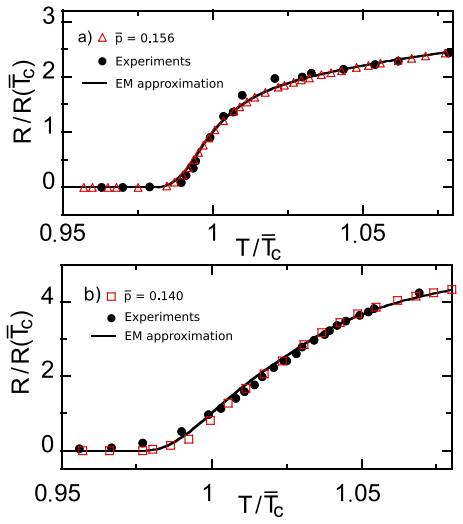
- [§7.2 and §4.2, Eq. (2)] The headline improvement rests on the low-resistance foot of the transition, exactly where the paper says its own cross-check is least reliable. For Delta T = 12.7 K and TCR = 5.13 K^-1, Eq. (2) implies R(T-)/R(T+) is about 0.015, so the linear operating interval is anchored at roughly 1.5% of the normal-state resistance. Section 7.2 states that the EM estimate is expected to be less reliable in the lower part of the transition, and Section 4.2 notes moderate relative deviations between finite-element and EM results in the R goes to 0+ tails due to percolation. Because TCR in Eq. (2) is inversely proportional to R(T-), a small absolute error in the modeled tail produces a large relative error in the claimed TCR and in the lower edge of Delta T; Pmax inherits this through Eq. (4). The authors should quantify the sensitivity of TCR and Delta T to the modeling uncertainty in the tail, for example by reporting the spread over disorder realizations and the FE/EM relative difference at T-.
- [§7.2 and Fig. 2] No patterned-film experimental data are presented, so the FE/EM agreement for the four-step pattern is only an internal consistency check, not an external validation. Both calculations share the same assumptions: each (30 nm)^2 monodomain behaves as bulk YBCO with the literature Tc(p), rho_b, fluctuation parameters, and Gaussian doping disorder. The only external anchor, Fig. 2, is for uniform films at p approximately 0.140 and 0.156, and it does not cover patterned films or the R/R_N about 0.01 to 0.02 range. The abstract's and Section 7.1's strong 'order-of-magnitude improvement' claims should be tempered to model predictions, or supported by direct measurements of a patterned film.
- [§7 and Eq. (24)] The four-step pattern parameters are selected by an optimization search, but no robustness analysis is given. Section 7 reports that 'we tested the bolometric performance for various doping levels pi' and found the best set p_i = {0.136, 0.141, 0.145, 0.160}, and Section 6 reports that delta_p = 0.007 was chosen as best. The paper does not show how Delta T, TCR, or Pmax respond to small variations in p_i, delta_p, or zone lengths, which are inevitable in a multistep deoxygenation process. Without this, the 'relatively simple-to-fabricate' claim is not fully supported; the authors should report the sensitivity of the headline figures to realistic fabrication tolerances.
minor comments (6)
- [Abstract and §7.1] The abstract says the design 'almost doubles the response of the sensor to radiation', while Section 7.1 reports a 66% improvement in TCR; these statements should be reconciled, and 'response' should be defined (e.g., TCR or voltage responsivity).
- [§2.1.2] In the millimeter-wave sensor design, 'I = 6 µm' should read 'I = 6 µA'; also the current density is written as '10 3 A/cm2' and should be '10^3 A/cm2'.
- [Eq. (15)] Equation (15) appears to contain a typo: after the change of variables from x to p, the integrand should be lambda(p) dp, not lambda(p) dx; as written the dimensions are inconsistent.
- [Eq. (10)] The notation in Eq. (10) uses p for both the local doping and the nominal doping, which is confusing; using an overbar or subscript for the nominal value would improve clarity.
- [§4 opening] The first paragraph of Section 4 says 'In the reminder of this article'; this should be 'In the remainder of this article'.
- [Fig. 2] Figure 2 should include a legend that distinguishes the finite-element results, the EM approximation, and the experimental data points of Ref. [48], since the open and solid symbols may be hard to tell apart in print.
Circularity Check
No significant circularity: the model is externally grounded, and the optimized four-step pattern is a transparent design search rather than a prediction forced by its own inputs.
full rationale
The derivation is self-contained in the relevant sense. The material inputs (Tc(p), rho_b, fluctuation parameters, doping disorder width, and monodomain size) are taken from prior literature, including external experimental data (references [38], [48], [55]); the uniform-film case is checked against measured R(T) curves of reference [48] in Figure 2, so the finite-element and effective-medium machinery is externally grounded. The central four-step design is presented transparently as the result of a search: in Section 7 the authors state, "We tested the bolometric performance for various doping levels pi of the four zones. We obtained the best results with the set pi = {0.136, 0.141, 0.145, 0.160}", and in Section 6 they state that "the delta_p value that best optimizes the bolometric characteristics (most notably Delta T) is delta_p = 0.007". This is an ordinary computational-design optimization, not a fit of parameters to the predicted quantity: no equation reduces to itself, and the improvement over the nonstructured baseline is not guaranteed by the search. The self-citations (e.g., references [30], [32], [47], [54]) supply model ingredients and prior methodology, but those ingredients are supported by independent experimental comparisons and are not invoked as an authority to forbid alternatives. The acknowledged limitation in Section 7.2 that the EM estimate "is expected to be less reliable in the lower part of the transition" affects confidence in the claimed operating edge at T- = 76.6 K, but that is a model-validity and correctness risk, not circularity. Overall, the paper's central claim is a computed consequence of stated physical inputs and design choices, not an input disguised as an output.
Assumptions & free parameters
free parameters (3)
- Pattern length-weight scale delta_p for exponential-like p(x) =
0.007
- Four-step zone doping levels p_i =
{0.136, 0.141, 0.145, 0.160}
- Pattern endpoints p0 and pL =
p0 = 0.135, pL = 0.161
assumptions (6)
- domain assumption YBCO material functions Tc(p), T*(p), and rho_b(T,p) from Ref. [38] are quantitatively accurate for every local monodomain in both uniform and patterned films.
- domain assumption Local oxygen doping disorder is Gaussian with FWHM delta_p = 0.0032 + 0.0189p and a monodomain size of (30 nm)^2, with independent draws per domain.
- domain assumption Critical fluctuation paraconductivity (Lawrence-Doniach Eq. 8 and BKT Eq. 9) with the quoted YBCO parameters applies within each monodomain.
- domain assumption A 200x200 resistor network with zero-resistance contacts and current bias correctly gives the effective R(T) of the film, including near the foot of the transition.
- standard math The Bruggeman effective-medium equation accurately approximates the 2D random composite conductivity except near percolation.
- domain assumption Bolometer performance is adequately captured by the endpoint-based Delta T, TCR, and Pmax definitions; noise, spectral absorbance, and dynamic response are neglected.
Cite this review
Pith. "Pith review of Calculations of some doping nanostructurations and patterns improving the functionality of high-temperature superconductors for bolometer device applications." pith.science (2026). https://pith.science/paper/DFTSZSBO
@misc{pith2026241218240,
  author       = {Pith},
  title        = {Pith review of: Calculations of some doping nanostructurations and patterns improving the functionality of high-temperature superconductors for bolometer device applications},
  year         = {2026},
  howpublished = {\url{https://pith.science/paper/DFTSZSBO}},
  note         = {Machine review of arXiv:2412.18240}
}
abstract
We calculate the effects of doping nanostructuration and the patterning of thin films of high-temperature superconductors (HTS) with the aim of optimizing their functionality as sensing materials for resistive transition-edge bolometer devices (TES). We focus, in particular, on spatial variations of the carrier doping into the CuO$_2$ layers due to oxygen off-stoichiometry, (that induce, in turn, critical temperature variations) and explore following two major cases of such structurations: First, the random nanoscale disorder intrinsically associated to doping levels that do not maximize the superconducting critical temperature; our studies suggest that this first simple structuration already improves some of the bolometric operational parameters with respect to the conventional, nonstructured HTS materials used until now. Secondly, we consider the imposition of regular arrangements of zones with different nominal doping levels (patterning); we find that such regular patterns may improve the bolometer performance even further. We find one design that improves, with respect to nonstructured HTS materials, both the saturation power and the operating temperature width by more than one order of magnitude. It also almost doubles the response of the sensor to radiation.
Figures


Figures from the paper (2 more)


Reference graph
Works this paper leans on
-
[48]
Fluctuation conductivity and pseudogap in YBCO high-temperature superconductors (Review)
Solov’ev, A.L.; Dmitriev, V.M. Fluctuation conductivity and pseudogap in YBCO high-temperature superconductors (Review). J. Low Temp. Phys. 2009, 35, 169–197
work page 2009
-
[1]
Mohajeri, R.; Opata, Y.A.; Wulff, A.C.; Grivel, J.C.; Fardmanesh, M. All Metal Organic Deposited High-Tc Superconducting Transition Edge Bolometer on Yttria-Stabilized Zirconia Substrate. J. Supercond. Nov. Magn. 2017, 30, 1981–1986
work page 2017
-
[2]
Detectivity Analysis and Optimization of Large-Area Freestanding-Type HTS Bolometers
Moftakharzadeh, A.; Kokabi, A.; Banzet, M.; Schubert, J.; Fardmanesh, M. Detectivity Analysis and Optimization of Large-Area Freestanding-Type HTS Bolometers. IEEE Tran. Appl. Supercond. 2012, 22, 2100107
work page 2012
-
[3]
Hosseini, M.; Moftakharzadeh, A.; Kokabi, A.; Vesaghi, M.A.; Kinder, H.; Fardmanesh, M. Characterization of a Transition-Edge Bolometer Made of YBCO Thin Films Prepared by nonfluorine Metal-Organic Deposition. IEEE Tran. Appl. Supercond. 2011, 21, 3587–3591
work page 2011
-
[4]
Moftakharzadeh, A.; Kokabi, A.; Ghodselahi, T.; Vesaghi, A.; Khorasani, S.; Banzet, M.; Schubert, J.; Fardmanesh, M. Investigation of Bias Current and Modulation Frequency Dependences of Detectivity of YBCO TES and the Effects of Coating of Cu-C Composite Absorver Layer. IEEE Tran. Appl. Supercond. 2009, 19, 3688–3693
work page 2009
-
[5]
Hosseini, M.; Moftakharzadeh, A.; Kokabi, A.; Vesaghi, M.A.; Kinder, M.; Fardmanesh, M. 2D Analysis of the Effects of Geometry on the Response of High-Tc Superconductive Bolometric Detectors. IEEE Tran. Appl. Supercond. 2009, 19, 484–488
work page 2009
-
[6]
Oktem, B.; Bozbey, A.; Avci, I.; Tepe, M.; Abukay, D.; Fardmanesh, M. The superconducting transition width and illumination wavelength dependence of the response of MgO substrate YBCO transition edge bolometers.Phys. C 2007, 458, 6–11
work page 2007
-
[7]
Lakew, B.; Brasunas, J.C.; Aslam, S.; Pugel, D.E. High-Tc transition edge superconducting (TES) bolometer on a monolithic saphire membrane– construction and performance. Sensors Actuators A. 2004, 114, 36–40. 25
work page 2004
Show all 58 references
-
[8]
YBCO Mid-Infrared Bolometer Arrays
Delerue, J.; Gaugue, A.; Test´ e, P.; Caristan, E.; Klisnick, G.; Redon, M.; Kreisler, A. YBCO Mid-Infrared Bolometer Arrays. IEEE Tran. Appl. Supercond. 2003, 13, 176–179
2003
-
[9]
High-Temperature superconductor bolometers for the IR region
Khrebtov, I.A.; Tkachenko, A.D. High-Temperature superconductor bolometers for the IR region. J. Opt. Technol. 1999, 66, 735–741
1999
-
[10]
Signal-to-noise ratio improvement of HTSC bolometers for cryocooler operation using a thermal compensation principle
Kaiser, G.; Thurk, M.; Seidel, P. Signal-to-noise ratio improvement of HTSC bolometers for cryocooler operation using a thermal compensation principle. Cryogenics 1995, 35, 463–465
1995
-
[11]
Thin Film YBCO Pixels for MMW Detector
Zakar, E.; Wikner, D.; Dubey, M.; Amirtharaj, P. Thin Film YBCO Pixels for MMW Detector. Adv. Sci. Technol. Res. J. 2008, 54, 434–438
2008
-
[12]
Investigation of CeO2 Buffer Layer Effects on the Voltage Response of YBCO Transition Edge Bolometers
Mohajeri, R.; Nazifi, R.; Wulff, A.C.; Vesaghi, M.A.; Grivel, J.C.; Fardmanesh, M. Investigation of CeO2 Buffer Layer Effects on the Voltage Response of YBCO Transition Edge Bolometers. IEEE Tran. Appl. Supercond. 2016, 26, 1–4
2016
-
[13]
Low noise high-Tc superconducting bolometers on silicon nitride membranes for far-infrared detection
de Nivelle, M.J.M.E.; Bruijn, M.P.; de Vries, R.; Wijnbergen, J.J.; de Korte, P.A.J.; S´ anchez, S.; Elwenspoek, M.; Heidenblut, T.; Schwierzi, B.; Michalke, W.; et al. Low noise high-Tc superconducting bolometers on silicon nitride membranes for far-infrared detection. J. App...
1997
-
[14]
Thermal and Nonequilibrium Responses of Superconductors for Radiation Detectors
Zhang, Z.M.; Frenkel, A. Thermal and Nonequilibrium Responses of Superconductors for Radiation Detectors. J. Supercond. 1994, 7, 871–884
1994
-
[15]
Noise Properties of High Temperature Superconducting Bolometers
Khrebtov, I.A. Noise Properties of High Temperature Superconducting Bolometers. Fluct. Noise Lett. 2002, 2, 51–69
2002
-
[16]
Characterization of the composite bolometer with a high-Tc superconductor thermometer for an absolute radiometer of synchrotron radiation
Ivanov, K.V.; Khokhlov, D.A.; Khrebtov, I.A.; Kulikov, Y.V.; Malyarov, V.G.; Nikolenko, A.D.; Pindyurin, V.F.; Zerov, V.Y. Characterization of the composite bolometer with a high-Tc superconductor thermometer for an absolute radiometer of synchrotron radiation. Nucl. Instrum. ...
2007
-
[17]
Observing Photons in Space, chapter 29
Eaton, H.A.C. Observing Photons in Space, chapter 29. In Infrared Imaging Bolometers; Huber, M.C.E., Pauluhn, A., Culhane, J.L., Timothy, J.G., Wilhelm, K., Zehnder, A., Eds.; AG of the Series ISSI Scientific Report Series; Springer: Basel, Switzerland, 2013; pp. 515–524, Volume 9. 26
2013
-
[18]
An application of electrothermal feedback for high resolution cryogenic particle detection
Irwin, K.D. An application of electrothermal feedback for high resolution cryogenic particle detection. Appl. Phys. Lett. 1995, 66, 1998–2000
1995
-
[19]
Transition-Edge Sensors in Cryogenic Particle Detection, edited by C
Irwin, K.D.; Hilton, G.C. Transition-Edge Sensors in Cryogenic Particle Detection, edited by C. Enss, Springer-Verlag, Berlin Heidelberg. Top. Appl. Phys. 2005, 99, 63–149
2005
-
[20]
Temperature coefficient of resistance and thermal conductivity of Vanadium oxide ’Big Mac’ sandwich structure.Infrared Phys
Abdel-Rahman, M.; Ilahi, S.; Zia, M.F.; Alduraibi, M.; Debbar, N.; Yacoubi, N.; Ilahi, B. Temperature coefficient of resistance and thermal conductivity of Vanadium oxide ’Big Mac’ sandwich structure.Infrared Phys. Technol. 2015, 71, 127–130
2015
-
[21]
Nanoscale electrostatic manipulation of magnetic flux quanta in ferroelec- tric/superconductor BiFeO 3/YBa2Cu3O7−δ heterostructures
Crassous, A.; Bernard, R.; Fusil, S.; Bouzehouane, K.; Bourdais, D.L.; Enouz-Vedrenne, S.; Briatico, J.; Bibes, M.; Barth´ el´ emy, A.; Villegas, J.E. Nanoscale electrostatic manipulation of magnetic flux quanta in ferroelec- tric/superconductor BiFeO 3/YBa2Cu3O7−δ heterostruc...
2011
-
[22]
Gold nanocrystals in high-temperature superconducting films: Creation of pinning patterns of choice
Katzer, C.; Stahl, C.; Michalowski, P.; Treiber, S.; Schmidl, F.; Seidel, P.; Albrecht, J.; Sch¨ utz, G. Gold nanocrystals in high-temperature superconducting films: Creation of pinning patterns of choice. New J. Phys. 2013, 15, 113029
2013
-
[23]
Mechanism for flux guidance by micrometric antidot arrays in superconducting films
Vestg ˚ arden, J.I.; Yurchenko, V.V.; W¨ ordenweber, R.; Johansen, T.H. Mechanism for flux guidance by micrometric antidot arrays in superconducting films. Phys. Rev. B 2012, 85, 014516
2012
-
[24]
Nanostructured superconductors: quantum matter at low temperatures
Moschalkov, V.V. Nanostructured superconductors: quantum matter at low temperatures. In Proceedings of the Workshop on vortex behavior in unconventional superconductors, Braga, Portugal, 7–12 October 2018
2018
-
[25]
High-Tc superconducting devices
Feuiller-Palma, C. High-Tc superconducting devices. In Proceedings of the Coherent Superconducting Hybrids and Related Materials, Les Arcs 1800, France, 26–29 March 2018
2018
-
[26]
Superconducting nanostructures grown by focused ion beam induced deposition
Garc ´ ıa-Serrano, I.; C´ ordoba, R.; Ses´ e, J.; Ibarra, M.R.; Guillam´ on, I.; Suderow, H.; Vieira, S.; De Teresa, J.M. Superconducting nanostructures grown by focused ion beam induced deposition. In Proceedings of the International conference on 27 nano confined superconduc...
2016
-
[27]
Influence of disorder and reduced dimensionality on the critical phenomena around the superconducting transition in cuprates
Ramallo, M.V.; Carballeira, C.; Cot´ on, N.; Mosqueira, J.; Ramos- ´Alvarez, A.; Vidal, F. Influence of disorder and reduced dimensionality on the critical phenomena around the superconducting transition in cuprates. In Proceedings of the International workshop on advances in ...
2014
-
[28]
Available online: http://www.cost.eu/actions/MP1201 (accessed on 1 January 2020)
European network NanoSC. Available online: http://www.cost.eu/actions/MP1201 (accessed on 1 January 2020)
2020
-
[29]
Available online: http://www.cost.eu/actions/CA16218 (accessed on 1 January 2020)
European network NanoCoHybri. Available online: http://www.cost.eu/actions/CA16218 (accessed on 1 January 2020)
2020
-
[30]
Resistive Transition of High- Tc Superconducting Films With Regular Arrays of Tc-Domains Induced by Micro- or Nanofunctionalization
Verde, J.C.; Doval, J.M.; Ramos- ´Alvarez, A.; S´ o˜ nora, D.; Ramallo, M.V. Resistive Transition of High- Tc Superconducting Films With Regular Arrays of Tc-Domains Induced by Micro- or Nanofunctionalization. IEEE Tran. Appl. Supercond. 2016, 26, 8800204
2016
-
[31]
Critical-temperature inhomogeneities and resistivity rounding in copper oxide superconductors
Maza, J.; Vidal, F. Critical-temperature inhomogeneities and resistivity rounding in copper oxide superconductors. Phys. Rev. B. 1991, 43, 10560
1991
-
[32]
Synthesis from separate oxide targets of high quality La2−xSrxCuO 4 thin films and dependence with doping of their superconducting transition width
Cot´ on, N; Mercey, B.; Mosqueira, J.; Ramallo, M.V.; Vidal, F. Synthesis from separate oxide targets of high quality La2−xSrxCuO 4 thin films and dependence with doping of their superconducting transition width. Supercond. Sci. Technol. 2013, 26, 075011
2013
-
[33]
Critical temperatures for supercon- ducting phase-coherence and condensation in La2−xSrxCuO 4
Cot´ on, N.; Ramallo, M.V.; Vidal, F. Critical temperatures for supercon- ducting phase-coherence and condensation in La2−xSrxCuO 4. arXiv 2013, arXiv:1309.5910v3
2013 arXiv
-
[34]
Doping dependence of the vortex-core energy in bilayer films of cuprates
Benfatto, L.; Castellani, C.; Giamarchi, T. Doping dependence of the vortex-core energy in bilayer films of cuprates. Phys. Rev. B 2008, 77, 100506
2008
-
[35]
Effective medium theory for superconducting layers: A systematic analysis including space correlation effects
Caprara, S.; Grilli, M.; Benfatto, L.; Castellani, C. Effective medium theory for superconducting layers: A systematic analysis including space correlation effects. Phys. Rev. B 2011, 84, 014514. 28
2011
-
[36]
Thermal conductivity reduction in oxygen-deficient strontium titanates
Yu, C.; Scullin, M.L.; Ramamoorthy, M.H.; Majumdar, A. Thermal conductivity reduction in oxygen-deficient strontium titanates. Appl. Phys. Lett. 2008, 92, 191911
2008
-
[37]
All Non-ohmic electrical transport properties above the critical temperature in optimally and underdoped superconductingY Ba2Cu 3O6+x
Lang, W.; Puica, I.; Zechner, G.; Kitzler, T.; Bodea, M.A.; Siraj, K.; Pedaring, J.D. All Non-ohmic electrical transport properties above the critical temperature in optimally and underdoped superconductingY Ba2Cu 3O6+x. J. Supercond. Nov. Magn. 2012, 25, 1361–1364
2012
-
[38]
Universal sheet resistance and revised phase diagram of the cuprate high-temperature superconductors
Bariˇ si´ c, M.; Chan, M.K.; Li, Y.; Yu, G.; Zhao, X.; Dressel, M.; Smontara, A.; Greven, M. Universal sheet resistance and revised phase diagram of the cuprate high-temperature superconductors. Proc. Natl. Acad. Sci. USA 2013, 110, 12235–12240
2013
-
[39]
Universal quantum oscillations in the underdoped cuprate superconductors
Bariˇ si´ c, N.; Badoux, S.; Chan, M.K.; Dorow, C.; Tabis, W.; Vignolle, B.; Yu, G.; B´ eard, J.; Zhao, X.; Proust, C.; et al. Universal quantum oscillations in the underdoped cuprate superconductors. Nat. Phys. 2013, 9, 761–764
2013
-
[40]
Nernst effect in the electron-doped cuprate superconductor P r2−xCe xCuO 4: Superconducting fluctuations, upper critical field Hc2, and the origin of the Tc dome
Tafti, F.F.; Lalibert´ e, F.; Dion, M.; Gaudet, J.; Fournier, P.; Taifeller, L. Nernst effect in the electron-doped cuprate superconductor P r2−xCe xCuO 4: Superconducting fluctuations, upper critical field Hc2, and the origin of the Tc dome. Phys. Rev. B 2014, 90, 024519
2014
-
[41]
Measurements of the fluctuation- induced magnetoconductivity in the a-direction of an untwinned Y 1Ba2Cu3O7−δ single-crystal in the weak magnetic field limit
Pomar, A.; Ramallo, M.V.; Maza, J.; Vidal F. Measurements of the fluctuation- induced magnetoconductivity in the a-direction of an untwinned Y 1Ba2Cu3O7−δ single-crystal in the weak magnetic field limit. Phys. C 1994, 225, 287–293
1994
-
[42]
On the width of the full-critical region for thermal fluctuations around the superconducting transition in layered superconductors
Ramallo, M.V.; Vidal, F. On the width of the full-critical region for thermal fluctuations around the superconducting transition in layered superconductors. Europhys. Lett. 1997, 39, 177–182
1997
-
[43]
Universal behavior of the in-plane paraconductivity of cuprate superconductors in the short-wavelength fluctuation regime
Vi˜ na, J.; Camp´ a, J.A.; Carballeira, C.; Curr´ as, S.R.; Maignan, A.; Ramallo, M.V.; Rasines, I.; Veira, J.A.; Wagner, P.; Vidal, F. Universal behavior of the in-plane paraconductivity of cuprate superconductors in the short-wavelength fluctuation regime. Phys. Rev. B 2002,...
2002
-
[44]
Paraconductivity at high reduced temperatures in Y Ba2Cu 3O7−δ superconductors
Carballeira, C.; Curr´ as, S.R.; Vi˜ na, J.; Veira, J.A.; Ramallo, M.V.; Vidal, F. Paraconductivity at high reduced temperatures in Y Ba2Cu 3O7−δ superconductors. Phys. Rev. B 2001, 63, 144515
2001
-
[45]
In-plane paraconductivity and fluctuation- induced magnetoconductivity in biperiodic layered superconductors: Application to Y Ba2Cu 3O7−δ
Ramallo, M.V.; Pomar, A.; Vidal, F. In-plane paraconductivity and fluctuation- induced magnetoconductivity in biperiodic layered superconductors: Application to Y Ba2Cu 3O7−δ. Phys. Rev. B. 1996, 54, 4341–4356
1996
-
[46]
Crossing point of the magnetization versus temperature curves and the Meissner fraction in granular La1.9Sr0.1CuO 4 superconductors: Random orientation and inhomogeneity effects
Mosqueira, J.; Recolevschi, A.; Torr´ on, C.; Ramallo, M.V.; Vidal, F. Crossing point of the magnetization versus temperature curves and the Meissner fraction in granular La1.9Sr0.1CuO 4 superconductors: Random orientation and inhomogeneity effects. Phys. Rev. B 1999, 59, 4394–4403
1999
-
[47]
Effects of critical temperature inhomogeneities on the voltage-current characteristics of a planar superconductor near the Berezinskii-Kosterlitz-Thouless transition
Cot´ on, N.; Ramallo, M.V.; Vidal, F. Effects of critical temperature inhomogeneities on the voltage-current characteristics of a planar superconductor near the Berezinskii-Kosterlitz-Thouless transition. Supercond. Sci. Technol. 2011, 24, 085013
2011
-
[49]
Theory of layer structure superconductors
Lawrence, W.E.; Doniach, S. Theory of layer structure superconductors. In Proceedings of the Twelfth International Conference on Low-Temperature Physics, Kyoto, Japan, 4–10 September 1970; Kanda, E., Ed.; Keigatu: Tokyo, Japan, 1971; p. 361
1970
-
[50]
Fluctuation- induced diamagnetism in bulk isotropic superconductors at high reduced temperatures
Carballeira, C.; Mosqueira, J.; Ramallo, M.V.; Veira, J.A.; Vidal, F. Fluctuation- induced diamagnetism in bulk isotropic superconductors at high reduced temperatures. J. Phys. Condens. Matter 2001, 13, 9271–9279
2001
-
[51]
Fluctuation- induced diamagnetism above the superconducting transition in MgB2
Mosqueira, J.; Ramallo, M.V.; Curr´ as, S.R.; Torr´ on, C.; Vidal, F. Fluctuation- induced diamagnetism above the superconducting transition in MgB2. Phys. Rev. B 2002, 65, 174522-1–174522-7
2002
-
[52]
Kosterlitz-Thouless transition and conductivity fluctuations in Y-Ba-Cu-O thin films
Ying, Q.Y.; Kwook, H.S. Kosterlitz-Thouless transition and conductivity fluctuations in Y-Ba-Cu-O thin films. Phys. Rev. B 1990, 42, 2242–2247. 30
1990
-
[53]
Resistive Transition in Superconducting Films
Halperin, B.I.; Nelson, D.R. Resistive Transition in Superconducting Films. J. Low Temp. Phys. 1979, 36, 599–616
1979
-
[54]
Structural and Tc inhomogeneities inherent to doping in La2−xSrxCuO 4 superconductors and their effects on the precursor diamagnetism
Mosqueira, J.; Cabo, L.; Vidal, F. Structural and Tc inhomogeneities inherent to doping in La2−xSrxCuO 4 superconductors and their effects on the precursor diamagnetism. Phys. Rev. B 2009, 80, 214527
2009
-
[55]
Mihailovic, D.; Optical experimental evidence for a universal length scale for the dynamic charge inhomogeneityy of cuprate superconductors. Phys. Rev. Lett. 2005, 94, 201001
2005
-
[56]
Herramientas Computacionales en el laboratorio LBTS
Verde, J.C.; Ramallo, M.V. Herramientas Computacionales en el laboratorio LBTS. In Pel ´ ıculas Micro- y Nanoestructuradas de Superconductores de alta Temperatura: Computaci´ on de su Transici´ on Resistiva; GIDFI: Santiago de Compostela, Spain, 2016; pp. 39–47, ISBN 978-1-68073-062-3
2016
-
[57]
(Eds.) Electrical Transport and Optical Properties of Inhomogeneous Media ; AIP: New York, NY, USA, 1978; p
Garland, J.C.; Tanner, B.D. (Eds.) Electrical Transport and Optical Properties of Inhomogeneous Media ; AIP: New York, NY, USA, 1978; p. 2
1978
-
[58]
Generic superconducting phase behavior in high-Tc cuprates: Tc variation with hole concentration in Y BaCu3O7−δ
Tallon, J.L.; Bernhard, C.; Shaked, H. Generic superconducting phase behavior in high-Tc cuprates: Tc variation with hole concentration in Y BaCu3O7−δ. Phys. Rev. B. 1995, 51, 12911–12914. 31 uniform p(x) local p(x,y) 0.14 0.16p= EM approximation (p=0.140 pictured) y x ✁ (10-7...
1995
Reviewed August 11, 2026 · model on record in the stance chip above.
Discussion (0). Continue with ORCID to comment.