REVIEW 2 major objections 4 minor 55 references
Effects of noise-induced coherence on the performance of a four-level laser heat engine
T0 review · 2 major / 4 minor · reviewed 2026-08-11 · deepseek-v4-flash
Pith's one-line read Noise-induced coherence breaks the left-right flux symmetry of a four-level laser heat engine, removing the universal η_C²/8 term from its efficiency at maximum power except in the high- and low-temperature limits.
desk verdict Useful new analytic results for a degenerate four-level engine, but the low-temperature EMP claim rests on an unexamined truncation. read the letter →
The pith
A machine-rendered reading of the paper's core claim, the machinery that carries it, and where it could break.
The reading
What carries the argument
The load-bearing object is the photon flux $I(x,y)$ extracted from the steady-state power formula (Eq. (A13) becomes Eq. (13)), with $x = \hbar\omega_c/k_B T_c$ and $y = \hbar\omega_h/k_B T_h$ the scaled cold and hot frequencies. The argument runs through the universal-efficiency formalism of Ref. [43]: for a tight-coupling engine whose energy flux is carried by photons, the efficiency at maximum power expands as $\eta = \eta_C/2 + (1 + M\,\partial_x L)\,\eta_C^2/4 + O(\eta_C^3)$, and the left-right symmetry condition $I(x,y) = -I(y,x)$ (flux reversal under exchange of $x$ and $y$) forces $2M = -\partial_x L$, reducing the quadratic term to $\eta_C^2/8$. The paper computes $L$ and $M$ from its flux and checks this condition, finding it broken in general and restored only in the high-temperature limit (with $\Gamma_c = \Gamma_h$, $p=0$) and the low-temperature limit. The coherence parameter $p$, which enters through the cross-terms coupling the two degenerate transitions $|1\rangle\leftrightarrow|g\rangle$ and $|2\rangle\leftrightarrow|g\rangle$ in the hot-bath dissipator, controls the deviation from symmetry. A second mechanism is the optimization of power with respect to $p$ itself, whose optimum $p^*$ (Eq. (28)) is governed by the ratio $\lambda/\Gamma_h$ of matter-field coupling to hot-bath coupling, deciding whether power rises or falls with coherence strength.
What would settle it
Numerically maximize the full steady-state power (Eq. (A13)) with respect to both $\omega_c$ and $\omega_h$ at small Carnot efficiency (say $\eta_C = 0.01$–$0.1$) for $\Gamma_c = \Gamma_h$ and $p = 0$ in the high-temperature regime, and fit the resulting efficiency series; if the quadratic coefficient is not $\eta_C^2/8$, the symmetry-breaking claim is wrong. Run the same check in the low-temperature regime to see whether Eq. (20) is the exact optimum of the full model or only of its leading-exponential approximation.
Extended reading notes
Core claim
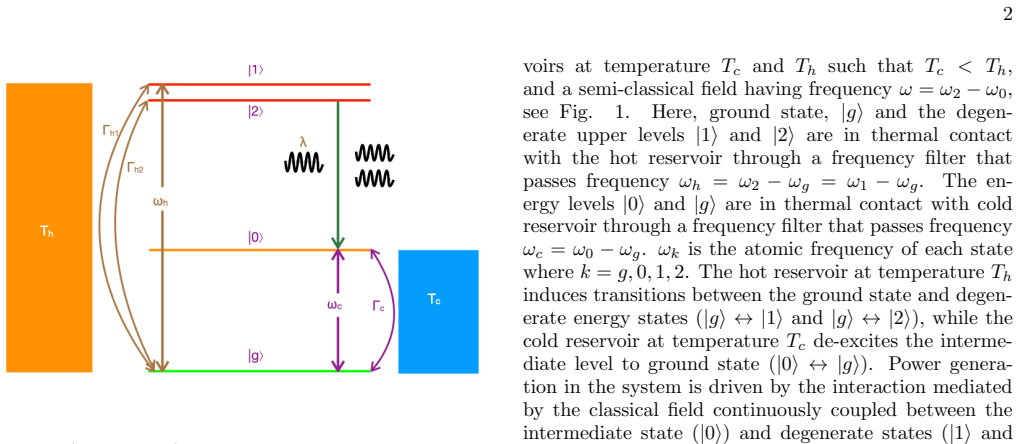
The paper's central claim is that noise-induced coherence, parametrized by $p$ in the hot-bath Lindblad dissipator, breaks the left-right symmetry of the photon flux — $I(x,y) \neq -I(y,x)$ — for the degenerate four-level heat engine, and that this removes the universal quadratic term $\eta_C^2/8$ from the efficiency at maximum power in a near-equilibrium two-parameter optimization (Eq. (14)). The symmetry is restored only in special regimes: at high temperature with $\Gamma_c = \Gamma_h$ and $p = 0$, where the efficiency at maximum power becomes $\eta_C/2 + \eta_C^2(1+p)/[4(2+p)] + O(\eta_C^3)$, so that $\eta_C^2/8$ returns at $p=0$; and at low temperature, where the leading-order flux $e^{-y} - e^{-x}$ is exactly antisymmetric and, being independent of $p$ at that order, yields the full universal series $\eta_C/2 + \eta_C^2/8 + 7\eta_C^3/96 + \cdots$ (Eq. (20)). The paper notes that even at $p=0$ the flux fails the reversal condition, so the broken symmetry is not caused by the coherence cross-terms alone. In the one-parameter scheme (strong coupling, high temperature), the linear term $\eta_C/2$ is robust, but the quadratic coefficient is constraint-dependent: it is $\eta_C^2(1+p)\Gamma_h/[8(\Gamma_c+\Gamma_h(1+p))]$ when $\omega_h$ is fixed (Eq. (24)), reduces to $3\eta_C^2/16$ when $\omega_c$ is fixed with $\Gamma_c=\Gamma_h$ and $p=0$ (Eq. (25)), and equals $\eta_C^2/8$ only under a symmetric constraint such as $\omega_c+\omega_h=k$ or $\omega_c\omega_h=k$ with $\Gamma_c=\Gamma_h$ and $p=0$ (Eq. (26)). The paper further claims that the optimal coherence parameter is set by the ratio $\lambda/\Gamma_h$: strong matter-field coupling favors $p \to 1$, weak coupling favors $p \to -1$ (Eqs. (28)–(29)).
Load-bearing premise
The low-temperature result (Eq. (20)) rests on optimizing $P_{LT} = F T_h [y - x(1-\eta_C)](e^{-y} - e^{-x})$, which keeps only the leading exponential terms of the full power formula (Eq. (A13)); if the discarded terms shift the optimum, Eq. (20) is not the efficiency at maximum power of the full model.
Editorial extensions
If this is right
- A two-parameter near-equilibrium optimization of the degenerate four-level engine yields the efficiency-at-maximum-power series $\eta_C/2 + c\,\eta_C^2/8 + O(\eta_C^3)$ with $c \neq 1$ in general (Eq. (14)), so the universal quadratic term is not a generic feature of this engine.
- In the high-temperature regime with $\Gamma_c = \Gamma_h$, the universal term $\eta_C^2/8$ is recovered exactly at $p = 0$, while for $p \neq 0$ the quadratic coefficient $(1+p)/(4(2+p))$ grows with $p$ (Eq. (16)).
- In the low-temperature regime the flux $e^{-y} - e^{-x}$ satisfies the reversal condition exactly and carries no $p$ dependence at leading order, giving the full universal series $\eta_C/2 + \eta_C^2/8 + 7\eta_C^3/96 + \cdots$ regardless of coherence strength (Eqs. (17)–(20)).
- In one-parameter optimization the linear universal term $\eta_C/2$ survives under every condition (tight coupling), but the quadratic coefficient is constraint-dependent: fixing $\omega_h$ gives $(1+p)\Gamma_h/[8(\Gamma_c + \Gamma_h(1+p))]$, fixing $\omega_c$ gives a different value, and only a symmetric constraint such as $\omega_c + \omega_h = k$ or $\omega_c\omega_h = k$ with $\Gamma_c = \Gamma
- The optimal coherence parameter is $p^* = \sqrt{2(1+3n_c+2n_h+4n_c n_h)/(1+3n_h+2n_c+4n_c n_h)}\,\lambda/[\Gamma_h(1+n_h)] - 1$, so under strong matter-field coupling ($\lambda \gg \Gamma_h$) power and efficiency increase with $p$ and the engine should run near $p = 1$, while under weak coupling it should run near $p = -1$ (Eqs. (28)–(29)).
Reading between the lines
- A corollary the paper leaves implicit: statements that an engine shows the universal $\eta_C/2 + \eta_C^2/8$ behaviour are only meaningful together with the exact optimization protocol, since the same engine produces $1/16$, $3/16$, or $1/8$ as its quadratic coefficient under different schemes (Eqs. (24)–(26)).
- Because the flux asymmetry already appears at $p = 0$, the degeneracy of the upper levels — not the coherence cross-terms alone — is the structural cause of the broken symmetry in the general regime; deleting the cross-terms while keeping the degeneracy should still fail to show $\eta_C^2/8$, which is a direct test of this attribution.
- If the coherence parameter is governed by the dipole alignment between the two degenerate transitions (the cross-terms in the hot-bath dissipator carry the dipole-angle factor), the paper's regime analysis becomes a design rule: strong matter-field coupling calls for aligned dipoles, while weak coupling calls for suppressed coherence.
Editorial analysis
A structured set of objections, weighed in public.
Referee Report
Summary. The paper analyzes a degenerate four-level laser heat engine with noise-induced coherence, focusing on the universality of the efficiency at maximum power (EMP). For two-parameter optimization near equilibrium, it derives an analytic EMP expression (Eq. 14) and argues that noise-induced coherence breaks the left-right symmetry required for the universal η_C^2/8 term, except in the high-temperature (Eq. 16) and low-temperature (Eq. 20) regimes under specific conditions. For one-parameter optimization, it shows that the quadratic coefficient depends on the imposed constraint (Eqs. 24–26). It also studies power optimization with respect to the noise-induced coherence parameter p and discusses the role of matter-field coupling strength.
Significance. If the results hold, the paper provides a concrete four-level model demonstrating how noise-induced coherence can modify the universal efficiency at maximum power, with analytic control over several regimes. Its strengths include explicit master-equation derivations, closed-form flux expressions, and a clear demonstration that one-parameter optimization constraints alter the quadratic universal term. The identification of operational regimes for maximizing power via coherence (strong vs. weak coupling) is also potentially useful. However, two load-bearing points are not currently established: the low-temperature EMP derivation uses an uncontrolled approximation, and the weak-coupling monotonicity claim contains an algebraic error. These issues need to be resolved before the paper's central claims can be accepted.
major comments (2)
- [Section III B, Eqs. (17)–(20)] The low-temperature derivation is not self-consistent. Equation (17) is obtained from Eq. (A13) by dropping terms of relative order e^{-x} and e^{-y} in the denominator, as shown in Eqs. (A11)–(A12). However, optimizing Eq. (17) yields x,y ≈ 2 for η_C → 0 (Eq. 19), where e^{-x} ≈ 0.135 is not exponentially small. Thus the truncation is uncontrolled at the optimum, and maximizing Eq. (17) does not generally maximize the full power in Eq. (A13). The claim that Eq. (20) is the exact EMP of the full low-temperature model is therefore not established. The author should either solve the full optimization problem in the low-temperature regime or prove that the omitted corrections do not alter the η_C^2 coefficient.
- [Section IV, Eq. (29) and following paragraph] The statement that p*_HT(LT) < -1 in the weak-coupling regime is algebraically impossible: p*_LT = √2 λ/Γ_h − 1 > −1 for any λ > 0, and similarly for p*_HT. Consequently, the conclusion that the power is a monotonically decreasing function of p over the physical range −1 ≤ p ≤ 1 is not supported; the optimum p* lies inside the interval for weak coupling, so the power increases for p up to p* and then decreases. This affects the recommended operating regime for weak matter-field coupling. Please correct the inequality and re-examine the monotonicity claim, for instance by evaluating ∂P/∂p at the boundaries p = ±1.
minor comments (4)
- [Eq. (14)] The analytic near-equilibrium EMP is presented without intermediate algebra, and α is defined only through a transcendental equation. Please provide the derivation or a supplementary file, as the expression is currently difficult to verify.
- [Section III C] The text states 'even imposing the condition Γ_c = Γ_c along with p = 0'; this appears to be a typo and should read 'Γ_c = Γ_h'.
- [Introduction and references] Reference [37] appears as an empty placeholder, and reference [40] is incomplete. Please complete these citations.
- [Section II] There is a typo in the sentence introducing the Tannor–Boukobza formalism: 'develepoded' should be 'developed'.
Circularity Check
No significant circularity: the EMP results are analytic consequences of the stated Lindblad model and an external universality theorem, with no fitted parameters or load-bearing self-citations.
full rationale
The derivation chain is self-contained. The paper starts from a specified Lindblad master equation (Eqs. (1)-(3)) and solves the steady-state coherences in Appendix A, obtaining the exact power expression Eq. (A13). The matter flux I is identified from Eq. (A13) by comparison with Eq. (10); no parameter is fitted to the quantity being predicted. The universal-efficiency analysis invokes the external theorem of Esposito et al. (Ref. [43], Eq. (11)), which gives eta_C/2 generally and eta_C^2/8 under flux reversal I(x,y) = -I(y,x). The paper checks flux reversal directly from the model-derived flux in the high-temperature limit (Eq. (15)) and the low-temperature limit (Eq. (18)), and the EMP formulas (Eqs. (14), (16), (23)-(26)) are obtained by explicit maximization of model power, not by imposing the desired coefficients. The only self-citation ([21]) is a general reference to prior three-level engine studies and is not load-bearing. The low-temperature section's Eq. (17) is a leading-exponential reduction of Eq. (A13); whether the neglected O(e^{-x}) terms shift the optimum is a technical correctness/approximation issue, not a circularity, because the truncated flux is not equivalent by construction to the predicted EMP. No step reduces by definition or by self-citation to its own input.
Assumptions & free parameters
assumptions (5)
- domain assumption The open-system dynamics is governed by the Born-Markov-secular Lindblad master equation in Eqs. (1)-(3), with degenerate levels and cross-dissipator terms proportional to cos(theta).
- standard math The Esposito-Lindenberg-Van den Broeck relation (Eq. 11) for the efficiency at maximum power applies to this engine, with energy flux proportional to matter flux (Eq. 10).
- domain assumption In the high-temperature limit, e^x is approximately 1+x and e^y is approximately 1+y at the optimum.
- domain assumption In the low-temperature limit, the power is dominated by the leading exponential term P_LT proportional to (e^{-y}-e^{-x})(y - x(1-eta_C)), with F independent of x and y.
- domain assumption For one-parameter optimization, the strong-coupling (lambda >> Gamma_c, Gamma_h) and high-temperature limits reduce the power to Eq. (21).
Cite this review
Pith. "Pith review of Effects of noise-induced coherence on the performance of a four-level laser heat engine." pith.science (2026). https://pith.science/paper/2ZOLKQMP
@misc{pith2026241218476,
  author       = {Pith},
  title        = {Pith review of: Effects of noise-induced coherence on the performance of a four-level laser heat engine},
  year         = {2026},
  howpublished = {\url{https://pith.science/paper/2ZOLKQMP}},
  note         = {Machine review of arXiv:2412.18476}
}
abstract
In this work, we study the effect of noise-induced coherence on the performance analysis of a degenerate four-level quantum heat engine with particular focus on the universal nature of efficiency, which refers to the appearance of the first two universal terms $\eta_C/2$ and $\eta_C^2/8$ in series expansion of the efficiency at maximum power under a left-right symmetry in the system. Firstly, for a two-parameter optimization scheme, we derive an analytic expression for the efficiency at maximum power for the near-equilibrium condition and show that presence of noise-induced coherence breaks the left-right symmetry of the system. However, when the operation of the engine is restricted to either high-temperature or low-temperature regime, we discuss the conditions under which the left-right symmetry can be retained in each case, giving rise to the universal characteristic of efficiency. In case of one-parameter optimization, we show that while the universality of the first linear term $\eta_c/2$ is robust and holds consistently across all conditions, the universality of the quadratic term $\eta_C^2/8$ depends on the constraints imposed on the control parameters. Finally, we examine the behavior of power as a function of noise-induced coherence parameter highlighting the role of matter-field coupling in determining the suitable operation regime for the heat engine to reap the benefits of noise-induced coherence.
Figures


Reference graph
Works this paper leans on
-
[1]
H. E. D. Scovil and E. O. Schulz-DuBois, Phys. Rev. Lett. 2, 262 (1959)
1959
- [2]
- [3]
-
[4]
Deffner, Entropy 20, 875 (2018)
S. Deffner, Entropy 20, 875 (2018)
2018
-
[6]
J. Guo, J. Wang, Y. Wang, and J. Chen, J. Appl. Phys. 113, 143510 (2013)
work page 2013
- [7]
-
[8]
R. Wang, J. Wang, J. He, and Y. Ma, Phys. Rev. E 87, 042119 (2013)
work page 2013
- [9]
Show all 55 references
-
[10]
Josefsson, A
M. Josefsson, A. Svilans, A. M. Burke, E. A. Hoffmann, S. Fahlvik, C. Thelander, M. Leijnse, and H. Linke, Nature Nanotechnology 10.1038/s41565-018-0200-5 (2018)
2018 doi
-
[11]
Yan-Chao and H
Z. Yan-Chao and H. Ji-Zhou, Chinese Physics Letters 30, 010501 (2013)
2013
-
[13]
Borga, M
F. Borga, M. Bekele, Y. B. Tatek, and M. Tsige, Phys. Rev. E 86, 032106 (2012)
2012
-
[14]
Thomas, N
G. Thomas, N. Siddharth, S. Banerjee, and S. Ghosh, Phys. Rev. E 97, 062108 (2018)
2018
-
[15]
Altintas, A
F. Altintas, A. U. C. Hardal, and O. E. M¨ ustecaplıo˘ glu, Phys. Rev. A91, 023816 (2015)
2015
-
[16]
A. U. C. Hardal and O. E. M¨ ustecaplıo˘ glu, Sci. Rep.5, 12953 (2015)
2015
-
[17]
Altintas, A
F. Altintas, A. U. C. Hardal, and O. E. M¨ ustecaplıo˘ glu, Phys. Rev. E90, 032102 (2014)
2014
-
[18]
Geva and R
E. Geva and R. Kosloff, Phys. Rev. E 49, 3903 (1994)
1994
-
[19]
Geva and R
E. Geva and R. Kosloff, J. Chem. Phys. 104, 7681 (1996)
1996
-
[20]
Singh, Phys
V. Singh, Phys. Rev. Res. 2, 043187 (2020)
2020
-
[21]
K. Kaur, V. Singh, J. Ghai, S. Jena, and ¨O. E. M¨ ustecaplıo˘ glu, Physica A: Statistical Mechanics and its Applications576, 125892 (2021)
2021
-
[22]
Jaseem, M
N. Jaseem, M. Hajduˇ sek, V. Vedral, R. Fazio, L.-C. Kwek, and S. Vinjanampathy, Phys. Rev. E 101, 020201 (2020). 9
2020
-
[23]
A. C. Barato and U. Seifert, Phys. Rev. Lett. 114, 158101 (2015)
2015
-
[24]
J. M. Horowitz and T. R. Gingrich, Nature Physics 16, 15 (2020)
2020
-
[25]
T. R. Gingrich, J. M. Horowitz, N. Perunov, and J. L. England, Phys. Rev. Lett. 116, 120601 (2016)
2016
-
[26]
Singh, V
V. Singh, V. Shaghaghi, O. E. M¨ ustecaplıo˘ glu, and D. Rosa, Phys. Rev. A108, 032203 (2023)
2023
-
[27]
A. A. S. Kalaee, A. Wacker, and P. P. Potts, Phys. Rev. E 104, L012103 (2021)
2021
-
[28]
Van Vu and K
T. Van Vu and K. Saito, Phys. Rev. Lett. 128, 140602 (2022)
2022
- [29]
-
[30]
T¨ urkpen¸ ce and O
D. T¨ urkpen¸ ce and O. E. M¨ ustecaplıo˘ glu, Phys. Rev. E93, 012145 (2016)
2016
-
[31]
Rahav, U
S. Rahav, U. Harbola, and S. Mukamel, Phys. Rev. A 86, 043843 (2012)
2012
-
[32]
C. L. Latune, I. Sinayskiy, and F. Petruccione, Quantum Science and Technology 4, 025005 (2019)
2019
-
[33]
Altintas, A
F. Altintas, A. U. C. Hardal, and O. E. M¨ ustecaplıog˘ glu, Phys. Rev. E90, 032102 (2014)
2014
-
[34]
Kilgour and D
M. Kilgour and D. Segal, Phys. Rev. E 98, 012117 (2018)
2018
-
[35]
M. O. Scully, K. R. Chapin, K. E. Dorfman, M. B. Kim, and A. Svidzinsky, Proc. Natl. Acad. Sci. USA 108, 15097 (2011)
2011
-
[36]
M. O. Scully, M. S. Zubairy, G. S. Agarwal, and H. Walther, 299, 862 (2003)
2003
-
[38]
K. E. Dorfman, D. V. Voronine, S. Mukamel, and M. O. Scully, Proceedings of the National Academy of Sciences 110, 2746 (2013), https://www.pnas.org/doi/pdf/10.1073/pnas.1212666110
2013 doi
-
[39]
M. O. Scully, Phys. Rev. Lett. 104, 207701 (2010)
2010
-
[41]
E. R. Bittner and C. Silva, Nature Communications 5, 10.1038/ncomms4119 (2014)
2014 doi
-
[42]
Klatzow, J
J. Klatzow, J. N. Becker, P. M. Ledingham, C. Weinzetl, K. T. Kaczmarek, D. J. Saunders, J. Nunn, I. A. Walmsley, R. Uzdin, and E. Poem, Phys. Rev. Lett. 122, 110601 (2019)
2019
-
[43]
Esposito, K
M. Esposito, K. Lindenberg, and C. Van den Broeck, Phys. Rev. Lett. 102, 130602 (2009)
2009
-
[44]
F. L. Curzon and B. Ahlborn, American Journal of Physics 43, 22 (1975)
1975
-
[45]
Esposito, R
M. Esposito, R. Kawai, K. Lindenberg, and C. Van den Broeck, Phys. Rev. E 81, 041106 (2010)
2010
-
[46]
Esposito, R
M. Esposito, R. Kawai, K. Lindenberg, and C. Van den Broeck, Phys. Rev. Lett. 105, 150603 (2010)
2010
-
[47]
Singh and R
V. Singh and R. S. Johal, J. Stat. Mech. 2018, 073205 (2018)
2018
-
[48]
Z. C. Tu, J. Phys. A: Math. and Theor. 41, 312003 (2008)
2008
-
[49]
Schmiedl and U
T. Schmiedl and U. Seifert, Europhys. Lett. 81, 20003 (2008)
2008
-
[51]
A. C. Hern´ andez, A. Medina, J. M. M. Roco, J. A. White, and S. Velasco, Phys. Rev. E 63, 037102 (2001)
2001
-
[52]
Van den Broeck, Phys
C. Van den Broeck, Phys. Rev. Lett. 95, 190602 (2005)
2005
-
[53]
Lindblad, Communications in Mathematical Physics 48, 119 (1976)
G. Lindblad, Communications in Mathematical Physics 48, 119 (1976)
1976
-
[54]
Gorini, A
V. Gorini, A. Kossakowski, and E. C. G. Sudarshan, Journal of Mathematical Physics 17, 821 (1976)
1976
-
[55]
Boukobza and D
E. Boukobza and D. J. Tannor, Phys. Rev. A 74, 063823 (2006)
2006
-
[56]
Boukobza and D
E. Boukobza and D. J. Tannor, Phys. Rev. A 74, 063822 (2006)
2006
-
[57]
Boukobza and D
E. Boukobza and D. J. Tannor, Phys. Rev. Lett. 98, 240601 (2007)
2007
-
[58]
Uzdin and R
R. Uzdin and R. Kosloff, EPL (Europhysics Letters) 108, 40001 (2014)
2014
-
[59]
S. H. Lee, J. Um, and H. Park, Phys. Rev. E 98, 052137 (2018)
2018
-
[60]
K. E. Dorfman, D. Xu, and J. Cao, Phys. Rev. E 97, 042120 (2018)
2018
Reviewed August 11, 2026 · model on record in the stance chip above.
Discussion (0). Continue with ORCID to comment.