REVIEW 3 major objections 6 minor 62 references
Reconstruction of non-trivial magnetization textures from magnetic field images using neural networks
T0 review · 3 major / 6 minor · reviewed 2026-08-11 · deepseek-v4-flash
Pith's one-line read A neural network that fits a single magnetic field image can reconstruct spatially varying magnetization, including the type and handedness of skyrmions.
desk verdict Useful multi-component PINN extension for magnetization reconstruction, but the skyrmion-helicity discrimination is confounded by the 80% initial guess and needs a zero-network baseline before the headline claim is credible. read the letter →
The pith
A machine-rendered reading of the paper's core claim, the machinery that carries it, and where it could break.
The reading
What carries the argument
The load-bearing object is the forward map $B = A M$, the Fourier-space expression of Maxwell's equations for a quasi-2D magnetization layer, which is non-invertible and therefore needs an approximate inverse. The paper's network is an untrained U-net that outputs magnetization components $M_x$, $M_y$, and for 3D textures $M_z$; those are forward-propagated to a field, and an error function compares the result to the measured image. Three additions carry the argument: a spatial mask $\zeta_S$ applied to the output (Eq. 2), a loss mask $\zeta_L$ weighting where the error is computed (Eq. 3), and an initial-guess modification $M'_{NN} = M_{NN} + \alpha M_{init} + \sigma$ (Eq. 6) that pins the optimization near a candidate spin texture. The multi-component input exploits the fact that a single measured field component can be Fourier-decomposed into all three vector components, which restricts the solution space and suppresses the cross-talk between $M_x$ and $M_y$.
What would settle it
Take an experimental stray-field image of a skyrmion whose Bloch/Néel type and handedness are already known from an independent technique, run the reconstruction with all four initial guesses, and check whether the correct guess forms a cluster separated by more than $3\sigma$ in field error and SSIM; the central claim fails if the correct guess does not win. A cheaper check is the paper's own simulated test at SNR below 10 or with a standoff error, where the four-type clusters may overlap.
Extended reading notes
Core claim
This paper's central claim is that neural network reconstruction can recover the magnetization of a sample whose magnetization direction varies from pixel to pixel within a single image, a task the paper says was not possible with previous Fourier-based or NN methods. The network is never trained on examples; it learns by fitting one image, using the forward relation between magnetization and stray field as the physical constraint. With weighted source masks, multi-component ($B_x$, $B_y$, $B_z$) field input, and a noisy, scaled copy of the expected spin texture as an initial guess, the reconstruction reaches fidelity $F = 0.91$ on overlapping in-plane structures and can differentiate Bloch from Néel skyrmions, including left- versus right-handed Bloch textures.
Load-bearing premise
The skyrmion-identification claim rests on the assumption that starting from a slightly smeared, noisy copy of the true spin texture reliably guides the network to the true magnetization, and that wrong starting guesses lead to measurably worse fits even in real experimental noise.
Editorial extensions
If this is right
- A single magnetic field image can yield quantitative, spatially resolved magnetization maps for samples with in-plane, out-of-plane, or mixed magnetization directions, without any training data.
- Bloch and Néel skyrmions can be distinguished, and left- versus right-handed Bloch skyrmions identified, by running the reconstruction with each candidate texture as an initial guess and comparing field error and SSIM.
- Source masks suppress the background-magnetization artifacts that plague Fourier inversion, especially for partially imaged flakes.
- Using all three decomposed magnetic field components increases reconstruction fidelity from 0.57 for a single component to 0.91 for multi-component input in the overlapping-sample test.
- The method transfers across sensor types, since a single-sensor image is decomposed to vector components before fitting.
Reading between the lines
- The initial-guess procedure is effectively a model-selection scheme: each candidate spin texture defines a preferred solution neighborhood, and the network is asked which neighborhood fits the data best; the same logic could be applied to chiral domain walls or vortex core polarities.
- Because the paper finds that Néel handedness cannot be separated while Bloch handedness can, the stray-field signature of Néel chirality at the tested standoff and SNR is likely too weak for this inverse method; a lower standoff or higher SNR might recover it, but the paper does not demonstrate that.
- The method's reliance on a good initial guess means that for a completely unknown texture, a multi-start search over many candidate guesses would be needed; the paper uses four candidates.
- Since the same forward map governs current-density imaging, the mask and multi-component improvements should transfer to reconstructing current distributions from magnetic images.
Editorial analysis
A structured set of objections, weighed in public.
Referee Report
Summary. The manuscript presents an untrained, physics-informed neural network method for reconstructing magnetization distributions from magnetic stray-field images, extending prior work to spatially varying magnetization directions. The method uses a convolutional network whose output is forward-propagated to compute a magnetic field that is compared with the measured field; it incorporates weighted masks, multi-component field inputs, and initial magnetization guesses. The authors demonstrate the approach on simulated examples including an 'Echidna' with orthogonal in-plane magnetization, a canted platypus crossing the image boundary, overlapping hallbars, a rotating torus, skyrmions, and merons. They further propose using initial guesses to identify skyrmion type and Bloch helicity from the reconstruction error and SSIM relative to the guess.
Significance. If valid, the method addresses a real limitation of Fourier-based reconstruction, which is ill-posed for in-plane magnetization and struggles with spatially varying textures. The multi-component and mask extensions are natural and well motivated, and the all-simulation setting permits quantitative comparison with ground truth. The paper's strengths are the clear forward model, the concrete demonstration on several non-trivial textures, and the explicit caveats in Appendices F-H that reconstructions of merons and Néel-handedness are imperfect. The skyrmion-type classification claim, however, rests on a diagnostic whose control baseline is missing; that claim needs additional evidence before the headline 'can even identify the helicity of Bloch Skyrmions' is established.
major comments (3)
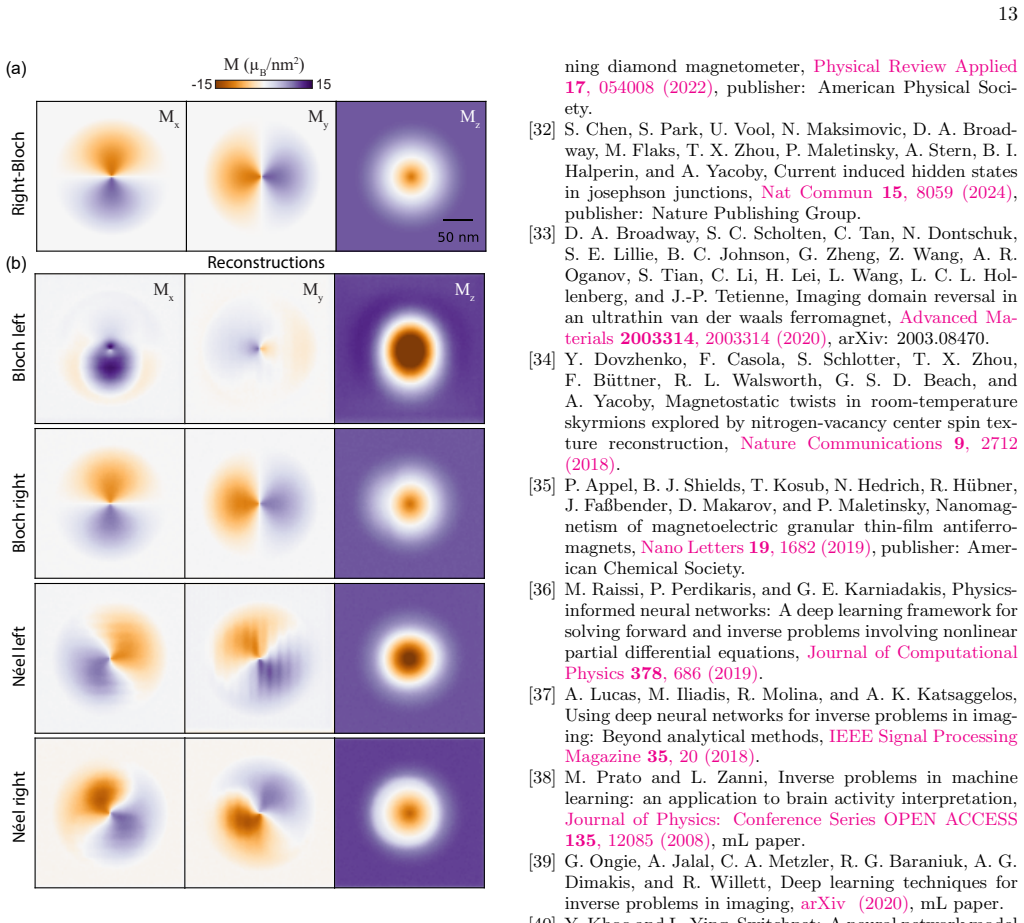
- [Sec. V, Eq. (6)] The initial-guess procedure of Eq. (6) adds αM_init with α=0.8 to the network output, so 80% of the final magnetization is fixed by the candidate before optimization. The clusters in Fig. 4(c,f) combine the field error and SSIM after training, but no baseline is reported with the network output frozen at zero (M_NN=0). Without that zero-NN baseline, the reported separation between Bloch-left and Bloch-right guesses may reflect the forward fields of the candidate textures themselves rather than any capability of the NN reconstruction. Please add this baseline for all four candidate classes and both Bloch handednesses; if the baseline already separates the classes, the experiment demonstrates template matching with a forward model, not NN-based reconstruction.
- [Sec. V, Figs. 4 and 8] The classification experiment is restricted to perfectly registered candidate textures with the same diameter, position, amplitude, and standoff as the ground truth, at SNR=10, with 20 runs and 100 epochs. Appendix H shows the same procedure cannot separate Néel handedness, so the helicity claim is narrow. To support the claim that the method can identify skyrmion type and Bloch helicity in experimental images, the separation must be shown to survive realistic candidate mismatch (e.g., ±20% diameter, pixel shift, unknown α, unknown standoff, and unknown background). Without such a robustness study, the method is not demonstrated for the stated application.
- [Sec. IV and Sec. V] Reported fidelity and SSIM values (e.g., F=0.91 in §IV, SSIM values in Appendix E) are single numbers without error bars, and the 'greater than 3σ separation' in §V is not defined. Please report the mean and standard deviation over the 20 runs for each metric, and state how the σ in the 3σ claim is computed. This is needed to judge whether the classification clusters are statistically significant, especially because Fig. 8 shows overlap for the Néel case.
minor comments (6)
- [Abstract] The abstract twice uses 'ill-poised'; the standard term is 'ill-posed'.
- [Appendix E] The text states 'SSIM(Mx) = 0.986 and SSIM(Mx) = 0.969'; the second instance should refer to SSIM(My).
- [Eq. (6) and Appendix A] The symbol σ is used for the random noise in Eq. (6), for standard deviation in Appendix A, and for the spatial filter width in Appendix A; please use distinct symbols for these quantities.
- [Table I and Section II] The architecture table omits activation functions, padding, and upsampling layers, and the optimizer and learning rate are not stated; please complete the training details so the results are reproducible.
- [Fig. 3 caption] The notation 'Bxyz' is undefined; please write explicitly that it denotes the decomposed Bx, By, and Bz field components.
- [Sec. V and Fig. 4] The quantities η_B and η_M are used in the text and figures, but only η_M is defined in Eq. (4); please define η_B as well.
Circularity Check
No significant circularity: the forward model and loss are physically independent of the network output; the Sec. V initial-guess design raises a missing-baseline concern but does not make the prediction equivalent to its input by construction.
full rationale
The paper's reconstruction chain is not self-referential. The forward model B = AM (Eq. 1) is fixed by magnetostatics for a quasi-2D source, and the loss in Eq. 3 compares the forward-propagated network output to the measured field image; the target magnetization is therefore defined by the data and the physics, not by the network parameters. The masks (Eq. 2) and multi-component input are explicit additional constraints that are not derived from the quantity being predicted. The skyrmion-type test in Sec. V is the only place where the input is close to the target: Eq. 6 sets M'_NN = M_NN + alpha M_init + sigma with alpha = 0.8 and the correct M_init is a scaled, noisy copy of the true texture. This means the reported >3 sigma cluster separation could in principle be dominated by the initial guess rather than by the NN refinement, and a zero-NN baseline (freezing M_NN at zero) would be needed to demonstrate the NN's added value. However, the paper's classification criterion is a field-error comparison that is physically independent of the initial guess, and the initial guess is not fitted to the data nor used to define the loss; the demonstration is a model-selection benchmark, not an equation-level equivalence between input and output. The self-citations [42,43] are to prior published work by the same group, but the multi-component, masked reconstruction and the skyrmion discrimination are implemented and benchmarked in this paper against simulated ground truth, so the citations are not load-bearing in a way that forces the conclusions. Furthermore, Appendix H reports that the same procedure cannot separate Neel handedness, which is inconsistent with a purely construction-driven circular result: if the discrimination were forced by the initial guess alone, it would succeed for all classes. No equation in the paper reduces to its own input by construction.
Assumptions & free parameters
free parameters (3)
- Initial guess scaling alpha =
0.8
- Initial guess noise sigma =
20%
- Standard-deviation loss weight alpha (Appendix A) =
not specified
assumptions (4)
- domain assumption Static quasi-2D forward model: B = A M in Fourier space, with magnetization confined to a thin layer.
- domain assumption Single-component field can be Fourier-decomposed into Bx, By, Bz without artifacts.
- domain assumption Untrained CNN architecture provides sufficient regularization to select physical solutions of the ill-posed inverse problem.
- ad hoc to paper For skyrmion type identification, the correct type yields a local minimum with lower combined field error and SSIM distance from the guess.
Cite this review
Pith. "Pith review of Reconstruction of non-trivial magnetization textures from magnetic field images using neural networks." pith.science (2026). https://pith.science/paper/LBK2R5SK
@misc{pith2026241219381,
  author       = {Pith},
  title        = {Pith review of: Reconstruction of non-trivial magnetization textures from magnetic field images using neural networks},
  year         = {2026},
  howpublished = {\url{https://pith.science/paper/LBK2R5SK}},
  note         = {Machine review of arXiv:2412.19381}
}
read the original abstract
Spatial imaging of magnetic stray fields from magnetic materials is a useful tool for identifying the underlying magnetic configurations of the material. However, transforming the magnetic image into a magnetization image is an ill-poised problem, which can result in artefacts that limit the inferences that can be made on the material under investigation. In this work, we develop a neural network fitting approach that approximates this transformation, reducing these artefacts. Additionally, we demonstrate that this approach allows the inclusion of additional models and bounds that are not possible with traditional reconstruction methods. These advantages allow for the reconstruction of non-trivial magnetization textures with varying magnetization directions in thin-film magnets, which was not possible previously. We demonstrate this new capability by performing magnetization reconstructions on a variety of topological spin textures.
Figures


Figures from the paper (6 more)


Reference graph
Works this paper leans on
-
[1]
Uniform magnetization within the sample
-
[2]
Uniform background magnetization of a magneti- zation direction opposite to the previous case
-
[3]
Varying magnetization confined to the edges of the sample. The first two scenarios are just the inverted allocation of the magnetization which produces identical stray edge fields at the barrier between magnetic material and the background. The last scenario can also replicate this edge field distribution by varying the magnetization at the edges to repli...
-
[4]
Bayesian regularisation method An alternative approach to the Fourier-based recon- struction method without neural networks is Bayesian estimation. In these approaches, the ill-poised transfor- mation is approximated using a regularization parameter that eliminates the 1 /0-terms due to its non-zero addi- tion to the matrix before inversion and can be use...
-
[5]
H. Yuan, Y. Cao, A. Kamra, R. A. Duine, and P. Yan, Quantum magnonics: When magnon spintronics meets quantum information science, Physics Reports 965, 1 (2022), publisher: North-Holland
work page 2022
-
[6]
Y. Ahn, X. Guo, S. Son, Z. Sun, and L. Zhao, Progress and prospects in two-dimensional magnetism of van der Waals materials, Progress in Quantum Electronics , 100498 (2024)
work page 2024
-
[7]
Q. H. Wang, A. Bedoya-Pinto, M. Blei, A. H. Dismukes, A. Hamo, S. Jenkins, M. Koperski, Y. Liu, Q.-C. Sun, E. J. Telford, H. H. Kim, M. Augustin, U. Vool, J.- X. Yin, L. H. Li, A. Falin, C. R. Dean, F. Casanova, R. F. L. Evans, M. Chshiev, A. Mishchenko, C. Petrovic, R. He, L. Zhao, A. W. Tsen, B. D. Gerardot, M. Brotons- Gisbert, Z. Guguchia, X. Roy, S. ...
work page 2022
-
[8]
D. V. Christensen, U. Staub, T. R. Devidas, B. Kalisky, K. C. Nowack, J. L. Webb, U. L. Andersen, A. Huck, D. A. Broadway, K. Wagner, P. Maletinsky, T. v. d. Sar, C. R. Du, A. Yacoby, D. Collomb, S. Bending, A. Oral, H. J. Hug, A.-O. Mandru, V. Neu, H. W. Schumacher, S. Sievers, H. Saito, A. A. Khajetoorians, N. Haupt- mann, S. Baumann, A. Eichler, C. L. ...
work page 2024
Show all 62 references
-
[9]
Thiel, Z
L. Thiel, Z. Wang, M. A. Tschudin, D. Rohner, I. Guti´ errez-Lezama, N. Ubrig, M. Gibertini, E. Gian- nini, A. F. Morpurgo, and P. Maletinsky, Probing mag- netism in 2d materials at the nanoscale with single-spin microscopy, Science 364, 973 (2019), publisher: Ameri- can Assoc...
2019
-
[10]
Song, Q.-C
T. Song, Q.-C. Sun, E. Anderson, C. Wang, J. Qian, T. Taniguchi, K. Watanabe, M. A. McGuire, R. St¨ ohr, 11 M (µB/nm2) -15 15 Meron SimulationRecon.Difference 15nm Mx My Mz Mx’ My’ Mz’ ΔMx ’ ΔMy ’ ΔMz ’ (a) (b) (c) (d) FIG. 7. Reconstruction of a topological spin texture – Mer...
2021
-
[11]
Huang, Z
M. Huang, Z. Sun, G. Yan, H. Xie, N. Agarwal, G. Ye, S. H. Sung, H. Lu, J. Zhou, S. Yan, S. Tian, H. Lei, R. Hovden, R. He, H. Wang, L. Zhao, and C. R. Du, Re- vealing intrinsic domains and fluctuations of moir´ e mag- netism by a wide-field quantum microscope, Nature Com- mun...
2023
-
[12]
S. Li, Z. Sun, N. J. McLaughlin, A. Sharmin, N. Agarwal, M. Huang, S. H. Sung, H. Lu, S. Yan, H. Lei, R. Hovden, H. Wang, H. Chen, L. Zhao, and C. R. Du, Observation of stacking engineered magnetic phase transitions within moir´ e supercells of twisted van der waals magnets (2...
2024 arXiv
-
[13]
Q.-C. Sun, T. Song, E. Anderson, A. Brunner, J. F¨ orster, T. Shalomayeva, T. Taniguchi, K. Watanabe, J. Gr¨ afe, R. St¨ ohr, X. Xu, and J. Wrachtrup, Magnetic domains and domain wall pinning in atomically thin crbr3 re- vealed by nanoscale imaging, Nature Communications 12, 1...
2021 arXiv
-
[14]
T. S. Ghiasi, M. Borst, S. Kurdi, B. G. Simon, I. Bertelli, C. Boix-Constant, S. Ma˜ nas-Valero, H. S. J. van der Zant, and T. van der Sar, Nitrogen-vacancy magnetome- try of crsbr by diamond membrane transfer, npj 2D Ma- terials and Applications 7, 1 (2023), publisher: Nature...
2023
-
[15]
D. J. Rizzo, A. S. McLeod, C. Carnahan, E. J. Telford, A. H. Dismukes, R. A. Wiscons, Y. Dong, C. Nuckolls, C. R. Dean, A. N. Pasupathy, X. Roy, D. Xiao, and D. N. Basov, Visualizing atomically layered magnetism in crsbr, Advanced Materials 34, 2201000 (2022)
2022
-
[16]
Y. Zur, A. Noah, C. Boix-Constant, S. Ma˜ nas-Valero, N. Fridman, R. Rama-Eiroa, M. E. Huber, E. J. G. San- tos, E. Coronado, and Y. Anahory, Magnetic imaging and domain nucleation in crsbr down to the 2d limit, Ad- vanced Materials 35, 2307195 (2023), arXiv:2309.11550 [cond-mat]
2023 arXiv
-
[17]
M. A. Tschudin, D. A. Broadway, P. Siegwolf, C. Schrader, E. J. Telford, B. Gross, J. Cox, A. E. E. Dubois, D. G. Chica, R. Rama-Eiroa, E. J. G. San- tos, M. Poggio, M. E. Ziebel, C. R. Dean, X. Roy, and P. Maletinsky, Imaging nanomagnetism and magnetic phase transitions in at...
2024
-
[18]
I. O. Robertson, C. Tan, S. C. Scholten, A. J. Healey, G. J. Abrahams, G. Zheng, A. Manchon, L. Wang, and J.-P. Tetienne, Imaging current control of magnetization in fe3gete2 with a widefield nitrogen-vacancy microscope, 2D Materials 10, 015023 (2022), publisher: IOP Publish- ing
2022
-
[19]
Huang, J
M. Huang, J. C. Green, J. Zhou, V. Williams, S. Li, H. Lu, D. Djugba, H. Wang, B. Flebus, N. Ni, and C. R. Du, Layer-dependent magnetism and spin fluctuations in atomically thin van der waals magnet crps4, Nano Letters 23, 8099 (2023), publisher: American Chemical Society
2023
-
[20]
S. C. Scholten, P. Singh, A. J. Healey, I. O. Robertson, G. Haim, C. Tan, D. A. Broadway, L. Wang, H. Abe, T. Ohshima, M. Kianinia, P. Reineck, I. Aharonovich, and J.-P. Tetienne, Multi-species optically addressable spin defects in a van der waals material, Nat Commun 15, 6727...
2024
-
[21]
Li, Proximity-induced chiral quantum light gener- ation in strain-engineered wse2/nips3 heterostructures, Nature Materials https://doi-org/10.1038/s41563-023- 01645-7 (2023)
X. Li, Proximity-induced chiral quantum light gener- ation in strain-engineered wse2/nips3 heterostructures, Nature Materials https://doi-org/10.1038/s41563-023- 01645-7 (2023)
2023 doi
-
[22]
Grover, M
S. Grover, M. Bocarsly, A. Uri, P. Stepanov, G. Di Bat- tista, I. Roy, J. Xiao, A. Y. Meltzer, Y. Myasoedov, K. Pareek, K. Watanabe, T. Taniguchi, B. Yan, A. Stern, E. Berg, D. K. Efetov, and E. Zeldov, Chern mosaic and berry-curvature magnetism in magic-angle graphene, Na- tu...
2022 doi
-
[23]
Thomas, and J
Shaofen Tan, Yu Pei Ma, I. Thomas, and J. Wikswo, Re- construction of two-dimensional magnetization and sus- ceptibility distributions from the magnetic field of soft magnetic materials, IEEE Transactions on Magnetics32, 230 (1996)
1996
-
[24]
E. A. Lima and B. P. Weiss, Obtaining vector magnetic field maps from single-component measurements of ge- ological samples, Journal of Geophysical Research 114, B06102 (2009)
2009
-
[25]
Casola, T
F. Casola, T. van der Sar, and A. Yacoby, Probing condensed matter physics with magnetometry based on nitrogen-vacancy centres in diamond, Nature Reviews 12 M (µB/nm2) -15 15 B error, ηB (mT/nm2) M error, ηM (μB/nm2)SSIM (guess-recon.) Mx My Mz Bloch right Bloch left Néel left...
2018
-
[26]
B. J. Roth, N. G. Sepulveda, and J. P. Wikswo, Using a magnetometer to image a two-dimensional current dis- tribution, Journal of Applied Physics 65, 361 (1989)
1989
-
[27]
L. A. Knauss, A. B. Cawthorne, N. Lettsome, S. Kelly, S. Chatraphorn, E. F. Fleet, F. C. Wellstood, and W. E. Vanderlinde, Scanning squid microscopy for current imaging, Microelectronics Reliability 41, 1211 (2001)
2001
-
[28]
Tetienne, N
J.-P. Tetienne, N. Dontschuk, D. A. Broadway, S. E. Lil- lie, T. Teraji, D. A. Simpson, A. Stacey, and L. C. L. Hollenberg, Apparent delocalization of the current den- sity in metallic wires observed with diamond nitrogen- vacancy magnetometry, Physical Review B 99, 014436 (20...
2019
-
[29]
Broadway, S
D. Broadway, S. Lillie, S. Scholten, D. Rohner, N. Dontschuk, P. Maletinsky, J.-P. Tetienne, and L. Hol- lenberg, Improved current density and magnetization reconstruction through vector magnetic field measure- ments, Physical Review Applied 14, 024076 (2020)
2020
-
[30]
M. J. H. Ku, T. X. Zhou, Q. Li, Y. J. Shin, J. K. Shi, C. Burch, L. E. Anderson, A. T. Pierce, Y. Xie, A. Hamo, U. Vool, H. Zhang, F. Casola, T. Taniguchi, K. Watanabe, M. M. Fogler, P. Kim, A. Yacoby, and R. L. Walsworth, Imaging viscous flow of the dirac fluid in graphene, N...
2020
-
[31]
Jenkins, S
A. Jenkins, S. Baumann, H. Zhou, S. A. Meynell, Y. Daipeng, K. Watanabe, T. Taniguchi, A. Lucas, A. F. Young, and A. C. Bleszynski Jayich, Imaging the break- down of ohmic transport in graphene, Physical Review Letters 129, 087701 (2022), publisher: American Physi- cal Society
2022
-
[32]
Aharon-Steinberg, T
A. Aharon-Steinberg, T. V¨ olkl, A. Kaplan, A. K. Pariari, I. Roy, T. Holder, Y. Wolf, A. Y. Meltzer, Y. Myasoe- 13 M (µB/nm2) -15 15 Reconstructions Bloch leftBloch rightNéel leftNéel right Right-Bloch (a) (b) Mx My Mz Mx My Mz FIG. 9. Example reconstructions with different i...
2022
-
[33]
Chang, A
K. Chang, A. Eichler, J. Rhensius, L. Lorenzelli, and C. L. Degen, Nanoscale imaging of current density with a single-spin magnetometer, Nano Letters 17, 2367 (2017)
2017
-
[34]
M. L. Palm, C. Ding, W. S. Huxter, T. Taniguchi, K. Watanabe, and C. L. Degen, Observation of current whirlpools in graphene at room temperature, Science 384, 465 (2024), publisher: American Association for the Advancement of Science
2024
-
[35]
M. Palm, W. Huxter, P. Welter, S. Ernst, P. Scheideg- ger, S. Diesch, K. Chang, P. Rickhaus, T. Taniguchi, K. Watanabe, K. Ensslin, and C. Degen, Imaging of sub- microampere currents in bilayer graphene using a scan- ning diamond magnetometer, Physical Review Applied 17, 05400...
2022
-
[36]
S. Chen, S. Park, U. Vool, N. Maksimovic, D. A. Broad- way, M. Flaks, T. X. Zhou, P. Maletinsky, A. Stern, B. I. Halperin, and A. Yacoby, Current induced hidden states in josephson junctions, Nat Commun 15, 8059 (2024), publisher: Nature Publishing Group
2024
-
[37]
D. A. Broadway, S. C. Scholten, C. Tan, N. Dontschuk, S. E. Lillie, B. C. Johnson, G. Zheng, Z. Wang, A. R. Oganov, S. Tian, C. Li, H. Lei, L. Wang, L. C. L. Hol- lenberg, and J.-P. Tetienne, Imaging domain reversal in an ultrathin van der waals ferromagnet, Advanced Ma- teria...
2020 arXiv
-
[38]
Dovzhenko, F
Y. Dovzhenko, F. Casola, S. Schlotter, T. X. Zhou, F. B¨ uttner, R. L. Walsworth, G. S. D. Beach, and A. Yacoby, Magnetostatic twists in room-temperature skyrmions explored by nitrogen-vacancy center spin tex- ture reconstruction, Nature Communications 9, 2712 (2018)
2018
-
[39]
Appel, B
P. Appel, B. J. Shields, T. Kosub, N. Hedrich, R. H¨ ubner, J. Faßbender, D. Makarov, and P. Maletinsky, Nanomag- netism of magnetoelectric granular thin-film antiferro- magnets, Nano Letters 19, 1682 (2019), publisher: Amer- ican Chemical Society
2019
-
[40]
Raissi, P
M. Raissi, P. Perdikaris, and G. E. Karniadakis, Physics- informed neural networks: A deep learning framework for solving forward and inverse problems involving nonlinear partial differential equations, Journal of Computational Physics 378, 686 (2019)
2019
-
[41]
Lucas, M
A. Lucas, M. Iliadis, R. Molina, and A. K. Katsaggelos, Using deep neural networks for inverse problems in imag- ing: Beyond analytical methods, IEEE Signal Processing Magazine 35, 20 (2018)
2018
-
[42]
Prato and L
M. Prato and L. Zanni, Inverse problems in machine learning: an application to brain activity interpretation, Journal of Physics: Conference Series OPEN ACCESS 135, 12085 (2008), mL paper
2008
-
[43]
Ongie, A
G. Ongie, A. Jalal, C. A. Metzler, R. G. Baraniuk, A. G. Dimakis, and R. Willett, Deep learning techniques for inverse problems in imaging, arXiv (2020), mL paper
2020
-
[44]
Khoo and L
Y. Khoo and L. Ying, Switchnet: A neural network model for forward and inverse scattering problems, SIAM Jour- nal on Scientific Computing 41, A3182 (2019)
2019
-
[45]
Arridge, P
S. Arridge, P. Maass, O. ¨Oktem, and C.-B. Sch¨ onlieb, Solving inverse problems using data-driven models, Acta Numerica 28, 1 (2019)
2019
-
[46]
Dubois, D
A. Dubois, D. Broadway, A. Stark, M. Tschudin, A. Healey, S. Huber, J.-P. Tetienne, E. Greplova, and P. Maletinsky, Untrained physically informed neural net- work for image reconstruction of magnetic field sources, Physical Review Applied 18, 064076 (2022), publisher: American...
2022
-
[47]
R. Li, L. J. Riddiford, Y. Chai, M. Dai, H. Zhong, B. Li, P. Li, D. Yi, Y. Zhang, D. A. Broadway, A. E. E. Dubois, P. Maletinsky, J. Hu, Y. Suzuki, D. C. Ralph, and T. Nan, A puzzling insensitivity of magnon spin dif- fusion to the presence of 180-degree domain walls, Nature C...
2023
-
[48]
N. R. Reed, D. Bhutto, M. J. Turner, D. M. Daly, S. M. Oliver, J. Tang, K. S. Olsson, N. Langellier, M. J. H. Ku, M. S. Rosen, and R. L. Walsworth, Machine learning for improved current density reconstruction from 2d vector 14 magnetic images (2024), arXiv:2407.14553 [physics]
2024 arXiv
-
[49]
C. B. Clement, J. P. Sethna, and K. C. Nowack, Recon- struction of current densities from magnetic images by bayesian inference, arXiv (2019), arXiv: 1910.12929
2019 arXiv
-
[50]
Midha, M
S. Midha, M. Parashar, A. Bathla, D. A. Broadway, J.- P. Tetienne, and K. Saha, Optimized current-density re- construction from wide-field quantum diamond magnetic field maps, Physical Review Applied 22, 014015 (2024), publisher: American Physical Society
2024
-
[51]
C. Yao, Y. Shi, J.-I. Jung, Z. Vaci, Y. Wang, Z. Liu, Y. Yu, C. Zhang, S. Tikoo-Schantz, and C. Zu, Universal reconstruction of complex magnetic profiles with mini- mum prior assumptions (2024), arXiv:2411.18882
2024
-
[52]
A. Y. Meltzer, E. Levin, and E. Zeldov, Direct recon- struction of two-dimensional currents in thin films from magnetic-field measurements, Physical Review Applied 8, 064030 (2017)
2017
-
[53]
Rondin, J.-P
L. Rondin, J.-P. Tetienne, P. Spinicelli, C. Dal Savio, K. Karrai, G. Dantelle, A. Thiaville, S. Rohart, J.-F. Roch, and V. Jacques, Nanoscale magnetic field mapping with a single spin scanning probe magnetometer, Applied Physics Letters 100, 153118 (2012), publisher: American...
2012
-
[54]
S. C. Scholten, A. J. Healey, I. O. Robertson, G. J. Abra- hams, D. A. Broadway, and J.-P. Tetienne, Widefield quantum microscopy with nitrogen-vacancy centers in di- amond: Strengths, limitations, and prospects, Journal of Applied Physics 130, 150902 (2021)
2021
-
[55]
A. J. Healey, S. Rahman, S. C. Scholten, I. O. Robertson, G. J. Abrahams, N. Dontschuk, B. Liu, L. C. L. Hollen- berg, Y. Lu, and J.-P. Tetienne, Varied magnetic phases in a van der waals easy-plane antiferromagnet revealed by nitrogen-vacancy center microscopy, ACS Nano 16, 1...
2022
-
[56]
Tetienne, T
J.-P. Tetienne, T. Hingant, L. Mart ´ ınez, S. Rohart, A. Thiaville, L. H. Diez, K. Garcia, J.-P. Adam, J.- V. Kim, J.-F. Roch, I. Miron, G. Gaudin, L. Vila, B. Ocker, D. Ravelosona, and V. Jacques, The nature of domain walls in ultrathin ferromagnets revealed by scanning nano...
2015
-
[57]
Thiel, D
L. Thiel, D. Rohner, M. Ganzhorn, P. Appel, E. Neu, B. M¨ uller, R. Kleiner, D. Koelle, and P. Maletinsky, Quantitative nanoscale vortex imaging using a cryogenic quantum magnetometer, Nature Nanotechnology 11, 677 (2016), publisher: Nature Publishing Group
2016
-
[58]
Z. Wang, A. Bovik, H. Sheikh, and E. Simoncelli, Im- age quality assessment: from error visibility to structural similarity, IEEE Transactions on Image Processing 13, 600 (2004)
2004
-
[59]
S. C. Scholten, I. O. Robertson, G. J. Abrahams, P. Singh, A. J. Healey, and J.-P. Tetienne, Aberration control in quantitative widefield quantum microscopy, A VS Quantum Science4, 034404 (2022)
2022
-
[60]
Nishimura, M
S. Nishimura, M. Tsukamoto, K. Sasaki, and K. Kobayashi, Investigations of optical aberration on quantum diamond microscopy toward high spatial resolution and sensitivity (2024)
2024
-
[61]
D. J. McCloskey, N. Dontschuk, D. A. Broadway, A. Nadarajah, A. Stacey, J. P. Tetienne, L. C. Hollen- berg, S. Prawer, and D. A. Simpson, Enhanced widefield quantum sensing with nitrogen-vacancy ensembles using diamond nanopillar arrays, ACS Applied Materials and Interfaces 12...
2020
-
[62]
Zhang, Y
X. Zhang, Y. Zhou, K. M. Song, T.-E. Park, J. Xia, M. Ezawa, X. Liu, W. Zhao, G. Zhao, and S. Woo, Skyrmion-electronics: writing, deleting, reading and pro- cessing magnetic skyrmions toward spintronic applica- tions, Journal of Physics: Condensed Matter 32, 143001 (2020), pub...
2020
Reviewed August 11, 2026 · model on record in the stance chip above.
Discussion (0). Continue with ORCID to comment.