REVIEW 1 major objections 4 minor 68 references
Measurement of the branching fraction, polarization, and time-dependent $CP$ asymmetry in $B^0 \to \rho^+\rho^-$ decays and constraint on the CKM angle $\phi_2$
T0 review · 1 major / 4 minor · reviewed 2026-08-11 · deepseek-v4-flash
Pith's one-line read This paper reports a measurement of the branching fraction, longitudinal polarization fraction, and time-dependent CP-violation parameters of $B^0\to\rho^+\rho^-$ decays, and uses an isospin analysis to extract the CKM angle $\phi_2 =…
desk verdict Solid first Belle II measurement of B0 -> rho+rho- observables that will feed the world averages, with a soft spot in the phi2 extraction where isospin-breaking is assumed rather than quantified. read the letter →
The pith
A machine-rendered reading of the paper's core claim, the machinery that carries it, and where it could break.
The reading
What carries the argument
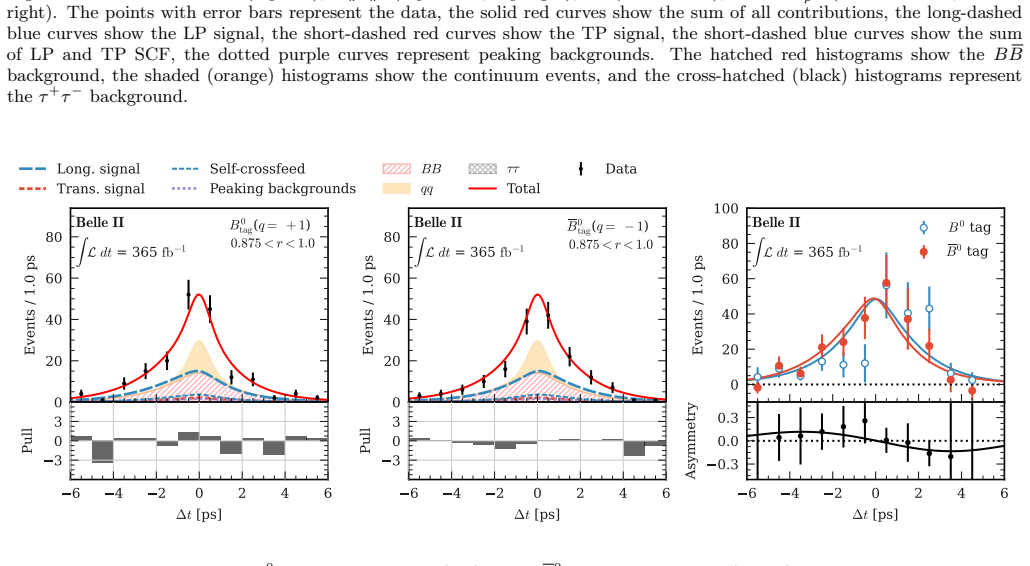
The argument's engine is the Gronau-London isospin relations, $(1/\sqrt{2})A^{+-}+A^{00}=A^{+0}$ and its charge-conjugate partner, which connect the three $\rho\rho$ decay amplitudes so that the tree-level phase $\phi_2$ can be separated from the loop-induced penguin shift $\Delta\phi_2$. Experimentally, the measurement rests on two unbinned maximum-likelihood fits: the first uses the observables $\Delta E$, $m_{\pi^\pm\pi^0}$, $\cos\theta_{\rho^\pm}$, and a transformed continuum-suppression output $T_C$ to extract $\mathcal{B}$ and $f_L$; the second fits the proper-time difference $\Delta t$ in seven flavor-tag quality bins to extract $S$ and $C$. The signal is split into longitudinal and transverse polarization components and into correctly reconstructed versus self-crossfeed candidates (candidates in which some final-state particles actually come from the other $B$ meson), with a relativistic Breit-Wigner line shape, helicity-angle templates, and control channels calibrating the probability-density functions.
What would settle it
A precise measurement of the direct CP asymmetry in $B^0\to\rho^0\rho^0$ that, through the isospin relations, forces a fitted penguin shift $\Delta\phi_2$ incompatible with $(2.4^{+3.8}_{-3.7})^\circ$, or an independent $\phi_2$ determination from $B\to\pi\pi$ that excludes $92.6^\circ$ at the $95\%$ confidence level, would falsify the isospin-based extraction.
Extended reading notes
Core claim
The central claim is that $B^0\to\rho^+\rho^-$ decays are governed by a nearly pure longitudinal, $CP$-even configuration with $\mathcal{B} = (2.89^{+0.23}_{-0.22}{}^{+0.29}_{-0.27})\times10^{-5}$, $f_L = 0.921^{+0.024}_{-0.025}{}^{+0.017}_{-0.015}$, $S = -0.26\pm0.19\pm0.08$, and $C = -0.02\pm0.12^{+0.06}_{-0.05}$. Feeding these numbers, together with the world-average branching fractions and $CP$ asymmetries for $B^0\to\rho^0\rho^0$ and $B^+\to\rho^+\rho^0$, into the Gronau-London isospin construction yields two solutions for the CKM angle $\phi_2$; the solution consistent with other unitarity-triangle constraints is $\phi_2 = (92.6^{+4.5}_{-4.7})^\circ$, with a second solution at $177.4^\circ$ excluded by measurements of the angles $\phi_1$ and $\phi_3$ and by unitarity. The uncertainty on $\phi_2$ is dominated by the statistical precision of the mixing-induced $CP$ parameter $S$ in $B^0\to\rho^+\rho^-$ and $B^0\to\rho^0\rho^0$.
Load-bearing premise
The isospin analysis assumes that the strong force treats up and down quarks identically in these decays, so that only the CKM phase distinguishes the amplitudes; if isospin-breaking effects are even a few degrees, the extracted angle would move outside its quoted uncertainty.
Editorial extensions
If this is right
- The measurement establishes $B^0\to\rho^+\rho^-$ as a nearly pure longitudinal, $CP$-even channel, so the extracted $S$ is an essentially direct probe of $\sin(2\phi_2^{\rm eff})$ with only a small penguin shift $\Delta\phi_2 = (2.4^{+3.8}_{-3.7})^\circ$.
- Combined with world averages, the isospin analysis yields $\phi_2 = (92.6^{+4.5}_{-4.7})^\circ$, the most stringent constraint on this angle from the $\rho\rho$ family and consistent with the Standard Model.
- The central value of $f_L$ is lower than the previous world average by about $2\sigma$, implying a slightly larger transverse polarization component than earlier experiments found.
- The uncertainty on $\phi_2$ is dominated by the $S$ parameters for $B^0\to\rho^+\rho^-$ and $B^0\to\rho^0\rho^0$; therefore further data in these two channels will directly reduce the error on $\phi_2$.
- The result, together with other unitarity-triangle constraints, can be used to bound possible beyond-Standard-Model contributions to $B^0$-$\bar B^0$ mixing.
Reading between the lines
- If $f_L$ moves lower with more data, the transverse polarization component becomes large enough that its assumed-zero $CP$-violation parameters will need to be measured rather than fixed; otherwise the $S$ extraction could shift by more than the current systematic uncertainty.
- The same isospin construction applied simultaneously to $B\to\rho\rho$, $B\to\pi\pi$, and $B\to\rho\pi$ would cross-check the size of isospin-breaking corrections, because the three channels share the same SU(2) structure but have independent experimental inputs.
- A future measurement of the direct $CP$ asymmetry in $B^0\to\rho^0\rho^0$ at the few-percent level would directly probe the penguin shift $\Delta\phi_2$ and test the fitted value of $(2.4^{+3.8}_{-3.7})^\circ$.
- This analysis uses part of the recorded dataset; if yields scale with luminosity, the $\phi_2$ uncertainty from $\rho\rho$ alone could roughly halve once the full data sample of the experiment is analyzed, making it a leading tree-level determination of the angle.
Editorial analysis
A structured set of objections, weighed in public.
Referee Report
Summary. This paper presents a Belle II measurement of B^0→ρ^+ρ^- using 365.4 fb^-1 of Υ(4S) data. Two unbinned maximum-likelihood fits are performed: a six-observable extended fit to extract the branching fraction and longitudinal polarization fraction, and a time-dependent CP fit to extract S and C. The results are B(B^0→ρ^+ρ^-) = (2.89+0.23−0.22+0.29−0.27)×10^-5, f_L = 0.921+0.024−0.025+0.017−0.015, S = −0.26 ± 0.19 ± 0.08, and C = −0.02 ± 0.12+0.06−0.05. The Δt PDF is validated with a B^0→D^{*-}π^+ control sample, giving τ_B0 = 1.523 ± 0.033 ps and Δm_d = 0.507 ± 0.017 ps^-1 consistent with world averages. Combining the measured B→ρρ observables with Belle, BaBar, and LHCb results in a Gronau-London isospin analysis yields φ_2 = (92.6+4.5−4.7)°.
Significance. If correct, this is the first Belle II measurement of B^0→ρ^+ρ^- and provides a competitive constraint on the CKM angle φ_2. The experimental analysis is thorough: the signal-extraction and CP fits are cross-checked with control channels, the resolution function is validated on data, null tests with random flavor tags give S and C consistent with zero, and the systematic tables cover efficiency, background, interference, tagging, and resolution effects. The main reservation concerns the isospin-breaking assumption in the φ_2 extraction, which is presented as a quantitative result without an explicit theory-uncertainty term.
major comments (1)
- [Sec. VII, Eqs. (16)–(17)] The φ_2 = (92.6+4.5−4.7)° result is derived from the Gronau-London isospin relations under the assumption of strong isospin symmetry, but the paper does not assign a theory uncertainty for isospin breaking (e.g., ρ mass and width differences, π^0–η mixing) or for electroweak-penguin contributions. The quoted uncertainty is dominated by experimental S parameters, yet published estimates of isospin-breaking shifts in B→ρρ are of order a few degrees, comparable to the quoted ±4.5/−4.7°. Because the abstract and title present φ_2 as a headline result, the absence of such a term, or of a demonstration that these shifts are below the quoted uncertainty, makes the precision claim incomplete. Please add a quantitative theory-uncertainty assessment (for example, varying the isospin-breaking inputs within published ranges and quoting the resulting shift in φ_2), or present the φ_2 result as an illustration rather than a precision constraint.
minor comments (4)
- [Sec. IV B 3 and Table II] The text says the continuum Δt PDF is a sum of two Gaussians with means set to zero, but the Table II entry 'DG' does not specify whether the two Gaussians share a common mean or whether a resolution function is applied; please clarify.
- [Table V] The floated yields for B^0→π^+π^-π^0π^0 and for rare peaking backgrounds are negative (−98.0 ± 62.2 and −31.9 ± 45.3); please comment on whether these values are consistent with zero and whether the fit imposes any positivity constraint on physical yields.
- [Sec. VII] The sentence 'The updated values of f_{+-} and f_{00} shift φ_2 by −0.4°' is difficult to reconcile with the two quoted central values 91.5° and 92.6°; please clarify which input is being updated and in which direction.
- [Table I] The row labeled 'PDG [12]' is a world average rather than an independent measurement; consider renaming it to avoid implying a separate experimental result.
Circularity Check
No significant circularity: the measured observables come from unbinned likelihood fits to data, and the phi2 constraint is a standard isospin application using external world averages.
full rationale
The paper's central results (B, fL, S, C) are extracted directly from data via unbinned maximum-likelihood fits (Eqs. 4-7 and 11) with signal yields, helicity-angle templates, and time-dependent CP-asymmetry parameters floated in the fits. No fitted output is renamed as a prediction, and no input is constructed from the target observable. The signal-extraction fit determines B and fL from Eqs. 5-6; the time-dependent fit determines S and C from the Delta-t distributions. Systematic uncertainties are estimated from control samples and ensemble tests, not by imposing the final results. The phi2 extraction in Sec. VII uses the Gronau-London isospin relations (Eqs. 16-17), which are external standard theory cited to Ref. [16], with inputs from PDG world averages and the present measurement. The method is attributed to Belle Ref. [19], but the analysis is not circular: the isospin relations are independent of this paper's measured values, and the phi2 result is consistent with external unitarity-triangle constraints rather than being fed back into the inputs. The absence of a separate isospin-breaking uncertainty is a legitimate physics-assumption concern, but it is a correctness and precision issue, not a circularity in the derivation chain. No step reduces, by construction or self-citation, to its own inputs.
Assumptions & free parameters
free parameters (7)
- LP signal yield N_LP =
436.3^{+34.2}_{-33.5}
- TP signal yield N_TP =
65.4^{+24.3}_{-22.6}
- Continuum (qq) yield =
1410.2^{+76.5}_{-75.7}
- Combinatorial BB yield =
849.2^{+73.3}_{-72.3}
- SCF yield ratios k_LP_SCFa, k_LP_SCFb, k_TP_SCF =
0.19, 0.16, 0.08
- Signal efficiencies epsilon_LP and epsilon_TP =
4.1% and 7.8%
- Peaking background yields (B0 -> rho±pi∓pi0, B0 -> pi+pi-pi0pi0, B0 -> pi+pi-pi0, B0 -> a1(1260)0 pi0, rare peaking) =
44.9, -98.0, -1.2, 32.0, -31.9 (Table V)
assumptions (6)
- domain assumption Gronau-London isospin relations (Eqs. 16-17) hold with negligible electroweak penguin and isospin-breaking contributions.
- domain assumption No CP violation in B0-B0 mixing.
- ad hoc to paper The transverse polarization (TP) signal has S = C = 0 in the baseline CP fit.
- domain assumption External inputs f00 = 0.4861 from HFLAV [51] and N(Upsilon(4S)) = (387 +/- 6) x 10^6 are correct.
- domain assumption The PDG values of tau_B0 and Delta m_d are used in the time-dependent PDF.
- domain assumption The MC simulation correctly models signal and background distributions after the applied data-MC corrections.
Cite this review
Pith. "Pith review of Measurement of the branching fraction, polarization, and time-dependent $CP$ asymmetry in $B^0 \to \rho^+\rho^-$ decays and constraint on the CKM angle $\phi_2$." pith.science (2026). https://pith.science/paper/7ODJGLA7
@misc{pith2026241219624,
  author       = {Pith},
  title        = {Pith review of: Measurement of the branching fraction, polarization, and time-dependent $CP$ asymmetry in $B^0 \to \rho^+\rho^-$ decays and constraint on the CKM angle $\phi_2$},
  year         = {2026},
  howpublished = {\url{https://pith.science/paper/7ODJGLA7}},
  note         = {Machine review of arXiv:2412.19624}
}
abstract
We present a measurement of the branching fraction and fraction of longitudinal polarization of $B^0 \to \rho^+ \rho^-$ decays, which have two $\pi^0$'s in the final state. We also measure time-dependent {\it CP} violation parameters for decays into longitudinally polarized $\rho^+ \rho^-$ pairs. This analysis is based on a data sample containing $(387\pm6) \times 10^6$ $\Upsilon(4S)$ mesons collected with the Belle~II detector at the SuperKEKB asymmetric-energy $e^+e^-$ collider in 2019-2022. We obtain $\mathcal{B}(B^0\to\rho^+\rho^-) = (2.89 ^{+0.23}_{-0.22} {}^{+0.29}_{-0.27}) \times 10^{-5}, f_{L} = 0.921 ^{+0.024}_{-0.025} {}^{+0.017}_{-0.015}$, \mbox{$S = -0.26\pm0.19\pm0.08$}, and $C = -0.02\pm0.12^{+0.06}_{-0.05}$, where the first uncertainties are statistical and the second are systematic. We use these results to perform an isospin analysis to constrain the CKM angle $\phi_2$ and obtain two solutions; the result consistent with other Standard Model constraints is $\phi_2 = (92.6^{+4.5}_{-4.7})^\circ$.
Figures


Figures from the paper (1 more)

Reference graph
Works this paper leans on
-
[19]
Low Energy Probes of PeV Scale Sfermions
W. Altmannshofer, R. Harnik, and J. Zupan, JHEP 11, 202 (2013), arXiv:1308.3653 [hep-ph]
work page Pith review arXiv 2013
-
[1]
Correctly reconstructed Signal The ∆ E distribution is described by two bifurcated Gaussian functions with a common mean. The ρ± line- shape is modeled by a relativistic Breit-Wigner (BW) function given by A(m) = pπ m2 − m2 0 + im0Γ(m) F (pρ) F (p′ρ) F (pπ) F (p′π) , (9) Γ(m) = pπ p′π 3 m0 m Γ0 F (pπ) F (p′π) 2 , (10) where m0 and Γ 0 are the peak positio...
-
[2]
The lineshape of mπ±π0 is described by the sum of a linear function and a relativistic BW function
Signal Self-crossfeed For self-cross-feed signal, the ∆E distributions are de- scribed by a bifurcated Gaussian function. The lineshape of mπ±π0 is described by the sum of a linear function and a relativistic BW function. The TC distribution is mod- eled by a linear function. A two-dimensional histogram template is used for cos θρ+ and cos θρ− , as these ...
-
[3]
Continuum For continuum events, the ∆E distribution is described by a quadratic function. Since continuum events also include ρ resonances, the mπ±π0 distributions are mod- eled by a sum of a relativistic BW function and a linear function. As there are correlations in the ∆ E-TC and mπ±π0 -cos θρ± distributions, one-dimensional histogram templates dependi...
-
[4]
The ∆ E-TC and mπ±π0 -cos θρ± distributions are modeled in the same way as continuum background
Combinatorial BB backgrounds The ∆ E and mπ±π0 distributions are both described by quadratic functions. The ∆ E-TC and mπ±π0 -cos θρ± distributions are modeled in the same way as continuum background. These parameters are obtained from MC simulated samples except for the ∆ E shape. The ∆ E shape parameters and the yield for combinatorial BB background are...
-
[5]
Peaking BB backgrounds The decay of B mesons to all-pion final states or to final states with pions and a kaon could peak in the fit observables. The peaking backgrounds are modeled indi- vidually, as summarized in Table II. The branching frac- tions used are measured values when possible and are listed in Table III. Most peaking backgrounds that are not ...
-
[6]
τ +τ − background The τ +τ − background is suppressed by the selec- tion with the TabNet classifier. The remaining events arise mostly from combinations of three decays: τ − → π−π+π−π0ντ , τ − → π−π0ντ , and τ − → π−π0π0ντ , which account for more than 90% of the τ +τ − back- ground. The ∆ E distribution for τ +τ − background is modeled by a quadratic fun...
-
[7]
Correctly reconstructed Signal Similar PDFs are used for the LP and TP signal events. Since the TP signal decay includes contributions from both CP-even and CP-odd states, our baseline fit as- sumes that CP-violating effects cancel out in the TP components; thus, in the PDF function for ∆ t, both S and C are set to zero. Possible nonzero values for the TP...
Show all 68 references
-
[8]
Thus, the ∆ t PDF for correctly reconstructed signal is used for the LP SCF a events with shared CP violation parameters
Signal Self-crossfeed The correct CP violation parameters can be extracted from LP SCF a events, as the B decay position (deter- mined from the trajectories of the two charged pions) is correctly reconstructed. Thus, the ∆ t PDF for correctly reconstructed signal is used for t...
-
[9]
The standard deviations and relative frac- tions of the Gaussians are determined from off-resonance data
Continuum The ∆t PDF for continuum background is modeled by the sum of two Gaussian functions with mean parameters set to zero. The standard deviations and relative frac- tions of the Gaussians are determined from off-resonance data. 8 Table II. Summary of fit models for each ...
-
[10]
The effec- tive lifetime is determined to be 1 .39 ± 0.02 ps from the simulation
Combinatrial BB backgrounds The ∆ t PDF for combinatorial BB backgrounds is modeled by an exponential function with an effective life- time convolved with the resolution function. The effec- tive lifetime is determined to be 1 .39 ± 0.02 ps from the simulation. The effective l...
-
[11]
The CP violation parameters are fixed to world average values if measurements are avail- able; or fixed to zero otherwise
Peaking BB backgrounds The ∆ t PDFs for each peaking background and rare peaking background are modeled with the same func- tional form as the combinatorial BB backgrounds but with a mode-specific effective lifetime as determined from MC-simulated samples. The CP violation par...
-
[12]
The means, standard deviations, and relative fractions are fixed to values from MC simulation
τ +τ − background The ∆ t PDF is modeled by a sum of two Gaussian functions. The means, standard deviations, and relative fractions are fixed to values from MC simulation
-
[13]
In- terLeptons
Validation of ∆t PDF To validate the ∆t resolution function, we use a B0 → D∗−π+ control sample to fit for parameters τB0 and ∆md. We set S = 0, C = −1, and q = qtag · qsig, where qtag and qsig represent the flavors of the tag-side and signal side. The results are τB0 = 1.523 ...
2024
-
[14]
Cabibbo, Phys
N. Cabibbo, Phys. Rev. Lett. 10, 531 (1963)
1963
-
[15]
Kobayashi and T
M. Kobayashi and T. Maskawa, Prog. Theor. Phys. 49, 652 (1973)
1973
-
[16]
http://www.utfit.org/UTfit/WebHome
-
[17]
Charles, A
J. Charles, A. H¨ ocker, H. Lacker, S. Laplace, F. R. Le Diberder, J. Malcl´ es, J. Ocariz, M. Pivk, and L. Roos, The European Physical Journal C 41, 1–131 (2005), up- dated results and plots available at: http://ckmfitter. in2p3.fr
2005
-
[18]
Bona et al
M. Bona et al. (UTfit Collaboration), JHEP 03, 049 (2008), arXiv:0707.0636 [hep-ph]
2008 arXiv
-
[20]
A. J. Buras and J. Girrbach, Rept. Prog. Phys. 77, 086201 (2014), arXiv:1306.3775 [hep-ph]
2014 arXiv
-
[21]
Tanimoto and K
M. Tanimoto and K. Yamamoto, Phys. Lett. B 735, 426 (2014), arXiv:1404.0520 [hep-ph]
2014 arXiv
-
[22]
Charles et al
J. Charles et al. , Phys. Rev. D 91, 073007 (2015), arXiv:1501.05013 [hep-ph]
2015 arXiv
-
[23]
Charles, S
J. Charles, S. Descotes-Genon, Z. Ligeti, S. Monteil, M. Papucci, K. Trabelsi, and L. Vale Silva, Phys. Rev. D 102, 056023 (2020)
2020
-
[24]
The angle ϕ2 is also known as α
-
[25]
Navas et al.(Particle Data Group), Phys
S. Navas et al.(Particle Data Group), Phys. Rev. D110, 030001 (2024)
2024
-
[26]
We use a system of units in which c = ℏ = 1
-
[27]
The CP violation parameter C is also defined as A = −C
-
[28]
We assume no CP violation in B0-B0 mixing, which is an excellent approximation
-
[29]
Gronau and D
M. Gronau and D. London, Phys. Rev. Lett. 65, 3381 (1990)
1990
-
[30]
Throughout this paper, the inclusion of the charge con- 15 jugate decay mode is implied unless otherwise specified
-
[31]
Aubert et al
B. Aubert et al. (BaBar Collaboration), Phys. Rev. D 76, 052007 (2007), arXiv:0705.2157 [hep-ex]
2007 arXiv
-
[32]
Vanhoefer et al
P. Vanhoefer et al. (Belle Collaboration), Phys. Rev. D 93, 032010 (2016), [Addendum: Phys.Rev.D 94, 099903 (2016)], arXiv:1510.01245 [hep-ex]
2016 arXiv
-
[33]
Zhang et al
J. Zhang et al. (Belle Collaboration), Phys. Rev. Lett. 91, 221801 (2003), arXiv:hep-ex/0306007
2003 arXiv
-
[34]
Aubert et al.(BaBar Collaboration), Phys
B. Aubert et al.(BaBar Collaboration), Phys. Rev. Lett. 97, 261801 (2006), arXiv:hep-ex/0607092
2006 arXiv
-
[35]
Aubert et al
B. Aubert et al. (BaBar Collaboration), Phys. Rev. D 78, 071104 (2008), arXiv:0807.4977 [hep-ex]
2008 arXiv
-
[36]
Adachi et al
I. Adachi et al. (Belle Collaboration), Phys. Rev. D 89, 072008 (2014), [Addendum: Phys.Rev.D 89, 119903 (2014)], arXiv:1212.4015 [hep-ex]
2014 arXiv
-
[37]
Aaij et al
R. Aaij et al. (LHCb Collaboration), Phys. Lett. B 747, 468 (2015), arXiv:1503.07770 [hep-ex]
2015 arXiv
-
[38]
Charles, O
J. Charles, O. Deschamps, S. Descotes-Genon, and V. Niess, Eur. Phys. J. C 77, 574 (2017), arXiv:1705.02981 [hep-ph]
2017 arXiv
-
[39]
Adachi et al
I. Adachi et al. (Belle II Collaboration), (2024), arXiv:2407.00965 [hep-ex]
2024 arXiv
-
[40]
A small number of non-resonant e+e− → B ¯B events are also included in the number ofY (4S) decays; these events are indistinguishable from e+e− → Υ(4S) → B ¯B
-
[41]
Abe (Belle II Collaboration), (2010), arXiv:1011.0352 [physics.ins-det]
T. Abe (Belle II Collaboration), (2010), arXiv:1011.0352 [physics.ins-det]
2010 arXiv
-
[42]
K. Akai, K. Furukawa, and H. Koiso, Nucl. Instrum. Meth. A907, 188 (2018), arXiv:1809.01958 [physics.acc- ph]
2018 arXiv
-
[43]
Adamczyk et al
K. Adamczyk et al. (Belle II SVD Group), JINST 17, P11042 (2022), arXiv:2201.09824 [physics.ins-det]
2022 arXiv
-
[44]
Kotchetkov et al., Nucl
D. Kotchetkov et al., Nucl. Instrum. Meth. A941, 162342 (2019), arXiv:1804.10782 [physics.ins-det]
2019 arXiv
-
[45]
D. J. Lange, Proceedings, 7th International Conference on B physics at hadron machines (BEAUTY 2000): Maagan, Israel, September 13-18, 2000, Nucl. Instrum. Meth. A462, 152 (2001)
2001
-
[46]
Jadach, B
S. Jadach, B. F. L. Ward, and Z. W¸ as, Comput. Phys. Commun. 130, 260 (2000), arXiv:hep-ph/9912214 [hep- ph]
2000 arXiv
-
[47]
Sj¨ ostrand, S
T. Sj¨ ostrand, S. Ask, J. R. Christiansen, R. Corke, N. De- sai, P. Ilten, S. Mrenna, S. Prestel, C. O. Rasmussen, and P. Z. Skands, Comput. Phys. Commun. 191, 159 (2015), arXiv:1410.3012 [hep-ph]
2015 arXiv
-
[48]
Skwarnicki, A study of the radiative CASCADE tran- sitions between the Upsilon-Prime and Upsilon reso- nances, Ph.D
T. Skwarnicki, A study of the radiative CASCADE tran- sitions between the Upsilon-Prime and Upsilon reso- nances, Ph.D. thesis, Cracow, INP (1986)
1986
-
[49]
Barberio and Z
E. Barberio and Z. W¸ as, Comput. Phys. Commun. 79, 291 (1994)
1994
-
[50]
Agostinelli et al
S. Agostinelli et al. (GEANT4 Collaboration), Nucl.Instrum.Meth. A506, 250 (2003)
2003
-
[51]
P. M. Lewis et al., Nucl. Instrum. Meth. A 914, 69 (2019), arXiv:1802.01366 [physics.ins-det]
2019 arXiv
-
[52]
Z. J. Liptak et al., Nucl. Instrum. Meth. A 1040, 167168 (2022), arXiv:2112.14537 [physics.ins-det]
2022 arXiv
-
[53]
T. Kuhr, C. Pulvermacher, M. Ritter, T. Hauth, and N. Braun (Belle II Framework Software Group), Com- put. Softw. Big Sci. 3, 1 (2019), arXiv:1809.04299 [physics.comp-ph]
2019 arXiv
-
[54]
Belle II Analysis Soft- ware Framework (basf2),
Belle II Collaboration, “Belle II Analysis Soft- ware Framework (basf2),” https://doi.org/10.5281/ zenodo.5574115
-
[55]
Keck, Computing and Software for Big Science 1, 2 (2017)
T. Keck, Computing and Software for Big Science 1, 2 (2017)
2017
-
[56]
Krohn et al
J.-F. Krohn et al. (Belle II Analysis Software Group), Nucl. Instrum. Meth. A976, 164269 (2020), arXiv:1901.11198 [hep-ex]
2020 arXiv
-
[57]
Abudin´ enet al
F. Abudin´ enet al. (Belle II Collaboration), Phys. Rev. D 107, L091102 (2023), arXiv:2302.12791 [hep-ex]
2023
-
[58]
Adachi et al
I. Adachi et al. (Belle II Collaboration), Phys. Rev. D 110, 012001 (2024), arXiv:2402.17260 [hep-ex]
2024 arXiv
-
[59]
Tabnet: Attentive inter- pretable tabular learning,
S. O. Arik and T. Pfister, “Tabnet: Attentive inter- pretable tabular learning,” (2020), arXiv:1908.07442 [cs.LG]
2020 arXiv
-
[60]
Brandt, C
S. Brandt, C. Peyrou, R. Sosnowski, and A. Wroblewski, Phys. Lett. 12, 57 (1964)
1964
-
[61]
G. C. Fox and S. Wolfram, Phys. Rev. Lett. 41, 1581 (1978)
1978
-
[62]
S. H. Lee et al. (Belle Collaboration), Phys. Rev. Lett. 91, 261801 (2003), arXiv:hep-ex/0308040
2003 arXiv
-
[63]
Storn and K
R. Storn and K. Price, Journal of Global Optimization 11, 341 (1997)
1997
-
[64]
Averages of b-hadron, c-hadron, and τ -lepton properties as of 2023,
S. Banerjee et al., “Averages of b-hadron, c-hadron, and τ -lepton properties as of 2023,” (2024), arXiv:2411.18639 [hep-ex]
2024 arXiv
-
[65]
J. M. Blatt and V. F. Weisskopf, Theoretical nuclear physics (Springer, New York, 1952)
1952
-
[66]
Pivk and F
M. Pivk and F. R. Le Diberder, Nucl. Instrum. Meth. A555, 356 (2005), arXiv:physics/0402083 [physics.data- an]
2005 arXiv
-
[67]
O. Long, M. Baak, R. N. Cahn, and D. Kirkby, Physical Review D 68 (2003), 10.1103/physrevd.68.034010
2003 doi
-
[68]
Bilka et al., EPJ Web Conf
T. Bilka et al., EPJ Web Conf. 245, 02023 (2020)
2020
Reviewed August 11, 2026 · model on record in the stance chip above.
Discussion (0). Continue with ORCID to comment.