REVIEW 3 major objections 4 minor 58 references
Relative Binding Free Energy Estimation of Congeneric Ligands and Macromolecular Mutants with the Alchemical Transfer with Coordinate Swapping Method
T0 review · 3 major / 4 minor · reviewed 2026-08-10 · deepseek-v4-flash
Pith's one-line read ATS computes exact relative binding free energies by transferring only the changed R-group and swapping common-region coordinates, so the cost scales with the mutation, not the ligand.
desk verdict The coordinate-swapping extension of ATM is a real and useful idea, but the claim of mathematical exactness goes beyond what the Appendix proof supports, and the authors should be pushed to either fix that gap or soften the claim. read the letter →
The pith
A machine-rendered reading of the paper's core claim, the machinery that carries it, and where it could break.
The reading
What carries the argument
The load-bearing object is a coordinate transformation applied to the $RA+B$ configuration: coordinates of the mapped atoms in the common regions are exchanged, $r_{A'} \leftrightarrow r_{B'}$, while the variable-region atoms are translated by the anchor displacement, $r_{A''} \to r_{A''} + d_{BA}$ and $r_{B''} \to r_{B''} - d_{BA}$. The perturbation energy is $u = U_{RB+A} - U_{RA+B}$, and the relative binding free energy is obtained from $\Delta\Delta G^\circ_b = -(1/\beta)\ln\langle e^{-\beta u}\rangle_{RA+B}$. The transformation's Jacobian determinant is 1, so no weight correction is needed, and its forces are assembled from gradients of the transformed potential. A soft-core alchemical interpolation $W_\lambda[u]$ and a multi-state free energy estimator are used to converge the exponential average.
What would settle it
Recompute a single ATS RBFE with progressively wider flat-bottom restraints on the anchor atoms; if the predicted value drifts by more than the statistical uncertainty, the indicator-mapping assumption is failing rather than being a benign approximation.
Extended reading notes
Core claim
The central claim is that the ratio of binding constants, $K_b(B)/K_b(A)$, equals the ensemble average $\langle e^{-\beta u}\rangle_{RA+B}$ evaluated with ligand A bound and ligand B in bulk, where $u$ is the potential energy change caused by (i) translating the variable R-group of A by the anchor displacement $d_{BA}$ and that of B by $-d_{BA}$, and (ii) swapping the coordinates of the mapped atoms of the common region. Because the swapped atoms occupy each other's positions, the covalent structure of the common region is preserved and contributes almost nothing to the perturbation. The proof in the appendix shows the coordinate transformation has unit Jacobian, so no Jacobian factor enters the ensemble average, and relies on the binding-site and bulk indicator functions mapping onto each other under the displacement. On the TYK2 benchmark, ATS agrees with the standard whole-ligand ATM protocol within statistical error (RMSD 0.37 kcal/mol, correlation 0.91), and on the PDZ-peptide benchmark it yields converged RBFEs for single-point mutants that track the experimental ranking.
Load-bearing premise
The proof requires that after the displacement and swap each ligand lands exactly in the indicator region occupied by the other, which in practice is only approximated by finite restraints on the anchor atoms.
Editorial extensions
If this is right
- ATS makes RBFE calculations practical for congeneric ligands and macromolecular single-point mutants because enlarging the common region does not enlarge the alchemical perturbation.
- For R-group transformations, ATS should converge as quickly as single-topology methods while keeping dual-topology simplicity: unmodified force fields and standard chemical topologies.
- Because only the variable region is transferred, ATS extends alchemical RBFE to protein, peptide, and potentially nucleic acid mutations that whole-ligand transfer cannot handle.
- The TYK2 benchmark shows ATS and standard ATM agree within statistical error (RMSD 0.37 kcal/mol, correlation 0.91), supporting the correctness of the new pathway.
- ATS is compatible with any energy function, including neural-network, polarizable, and quantum-mechanical potentials, so its efficiency gain carries over to advanced models.
Reading between the lines
- The exactness proof assumes the displaced coordinates land exactly inside the appropriate indicator region; because simulations use finite restraints, I would expect a small, unquantified bias that grows with anchor flexibility.
- A direct way to test this is to recompute one mutation under several restraint tolerances: an exact estimator should be insensitive to the tolerance, so any systematic drift would expose the approximation.
- The same swap-and-shift trick could be applied to other alchemical problems, such as hydration free energies or host-guest binding where only a small substituent changes on a large scaffold.
- If the size-independence claim holds, ATS may open protein-protein and RNA-mutant RBFE calculations, where current whole-complex alchemy is dominated by the cost of the unchanged bulk of the molecule.
Editorial analysis
A structured set of objections, weighed in public.
Referee Report
Summary. The paper introduces ATS-RBFE, an alchemical transfer variant for relative binding free energies in which only the variable R-groups of congeneric ligands (or mutated peptide side chains) are translated, while the coordinates of the common regions are swapped between the two ligands. The method is presented as a dual-topology scheme that retains ATM's compatibility with standard force fields while achieving the size-scaling advantages of single-topology approaches. The central theoretical claim is that the method is mathematically exact, with a proof in the Appendix. The paper reports benchmarks on the TYK2 inhibitor set, comparing ATS with standard ATM and with experiment, and on PDZ-domain/peptide mutants, comparing with literature single-topology calculations and experiment.
Significance. If the exactness claim were fully supported, ATS would be a valuable contribution: it extends the alchemical transfer framework to macromolecular R-group transformations, preserves standard chemical topologies, and avoids fitting any parameter to the benchmark results. The software is openly available, the benchmark systems are appropriate, and the comparison with ATM on TYK2 is a useful self-consistency check. However, the proof has an approximation at a load-bearing step, and several benchmark discrepancies are larger than the reported statistical uncertainties. The central claim that the method is 'mathematically exact' is therefore not established as written, and the validation evidence is more mixed than the text suggests.
major comments (3)
- [Appendix, Eqs. (19)–(21)] The exactness proof requires that the change of variables maps the indicator product I*(cA)I(cB) exactly to I(cA)I*(cB). The text states, however, that 'approximately I*(cA) → I*(cA + d) = I(cA)', relying on the indicator regions being 'large enough'. This is an approximation, not an exact equality: dBA = rb − ra is an instantaneous, fluctuating quantity under the flat-bottom restraints used in the simulations, and the transformed centroid is a mass-weighted combination of swapped common coordinates and displaced variable coordinates, so the effective displacement is not exactly the fixed bulk displacement d. The resulting bias in Eq. (21) is not quantified. Please either prove an exact indicator mapping (for example by defining the bulk indicator relative to the instantaneous anchor displacement, or by constraining dBA to equal d) or explicitly restate the method's claim as approximate and provide a quantitative bound or estimate of the error.
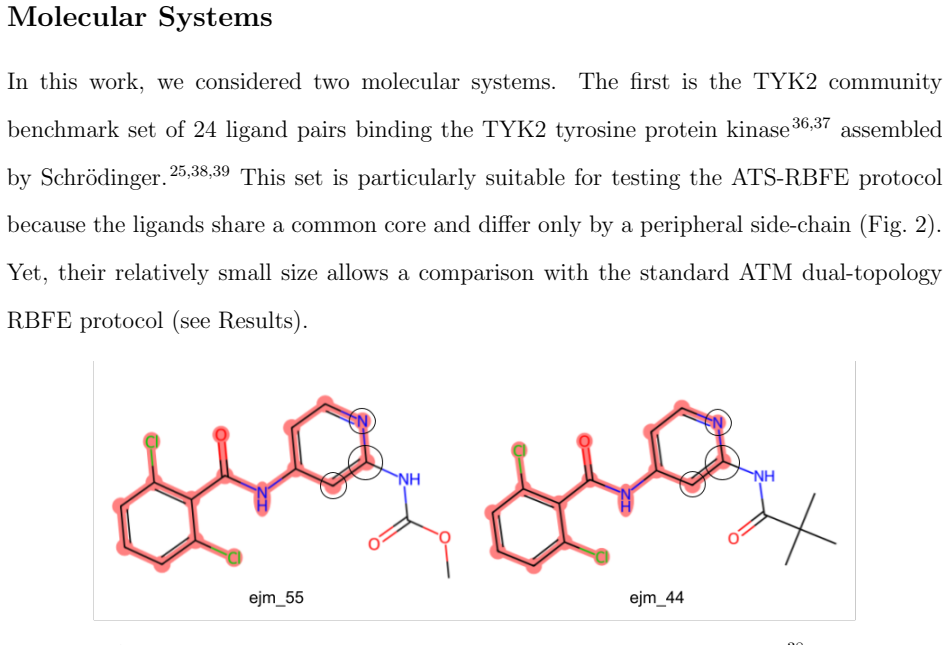
- [Table 1] The claim that the ATM and ATS estimates agree 'within statistical uncertainty' is not supported by the per-pair data. For ejm42–ejm48 the two estimates differ by 0.81 kcal/mol (0.82 ± 0.27 vs 0.01 ± 0.22), for ejm42–ejm55 by 0.67 kcal/mol, and for ejm31–ejm43 by 0.53 kcal/mol; in each case the difference exceeds the combined one-sigma uncertainty. Please report per-pair significance tests or otherwise reconcile these outliers with the statement that the 0.37 kcal/mol RMSD is within statistical uncertainty.
- [Table 2 and Figure 5] The PDZ/peptide benchmark is described as confirming the correctness of ATS, but the quantitative agreement is limited. For WT–A0F the ATS value (2.17 ± 0.28 kcal/mol) differs from the Panel et al. value (0.50 ± 1.00) and from experiment (0.43) by well over 1 kcal/mol, and the A0M/A0F ranking is reversed relative to experiment, as the text acknowledges. These results do not demonstrate quantitative accuracy; the conclusions should be tempered accordingly, or additional analysis should be provided to separate model error from statistical error in these comparisons.
minor comments (4)
- [Abstract and Introduction] The phrase 'the the bound and unbound ligands' appears twice; please correct the duplication.
- [Appendix, final paragraph] The sentence 'Finally, Eq. (21) is recovered by multiplying and dividing the integrand in the numerator by the Boltzmann factor in the denominator, .' is incomplete and appears to be missing the Boltzmann factor expression; please complete it.
- [References] Reference 49 is incomplete; it lists only 'Tan, Z.; Gallicchio, E.' with no title, journal, year, or DOI. Please supply the full citation.
- [Theory and Methods] The notation would be clearer if the text distinguished the fixed bulk displacement d from the instantaneous anchor displacement dBA throughout; the current usage of '≃' in the Appendix obscures this distinction, which is central to the exactness issue.
Circularity Check
No significant circularity: the ATS RBFE estimator is a derived ensemble average with no fitted parameters; the Appendix's approximate indicator matching is a rigor gap, not a circular reduction.
full rationale
The central ATS free energy expression, Eq. (8), is obtained by a change of variables in the ratio of binding-constant partition functions (Eqs. 12-21). The perturbation energy u in Eq. (9) is defined as the potential difference after coordinate swapping and displacement, and the final ensemble average follows algebraically from multiplying and dividing by the denominator Boltzmann factor. No parameter is fitted to the benchmark results; soft-core and restraint parameters are taken from prior work and the AToM-OpenMM defaults, not tuned to the TYK2 or PDZ data. The comparison to ATM-RBFE is a consistency check between two methods by the same author, but the central validation also includes experimental comparisons and external single-topology values from Panel et al. Self-citations (Refs. 15, 28, 30-35) support implementation choices and prior ATM machinery rather than supplying the ATS exactness claim. The one substantive concern is not circularity: the Appendix's exactness proof contains the statement 'approximately I*(cA) -> I*(cA+d)=I(cA)' and relies on indicator regions being large enough, so the claimed mathematical exactness is not rigorously established and the bias from fluctuating anchor displacement is unquantified. This is an accuracy/rigor limitation to be weighed separately, not a case where the prediction reduces to its inputs by construction.
Assumptions & free parameters
free parameters (3)
- Soft-core perturbation parameters (umax, uc, a) =
200 kcal/mol, 100 kcal/mol, 1/16
- Flat-bottom restraint tolerance and force constant =
3-5 A tolerance, 25 kcal/mol/A^2
- Ligand displacement distance d =
45 A (TYK2), 40 A (peptide)
assumptions (5)
- standard math Statistical mechanics partition functions and Boltzmann ensemble averages
- standard math Change of variables and Jacobian determinant in configuration integrals
- domain assumption Common regions of the two ligands have a bijective atom mapping with identical chemical types
- domain assumption The coordinate transformation maps the binding-site indicator function to the bulk indicator function exactly (or the regions are large enough that the approximation is negligible)
- ad hoc to paper The anchor displacement vector dBA equals the fixed bulk displacement d
Cite this review
Pith. "Pith review of Relative Binding Free Energy Estimation of Congeneric Ligands and Macromolecular Mutants with the Alchemical Transfer with Coordinate Swapping Method." pith.science (2026). https://pith.science/paper/WKMQF5D2
@misc{pith2026241219971,
  author       = {Pith},
  title        = {Pith review of: Relative Binding Free Energy Estimation of Congeneric Ligands and Macromolecular Mutants with the Alchemical Transfer with Coordinate Swapping Method},
  year         = {2026},
  howpublished = {\url{https://pith.science/paper/WKMQF5D2}},
  note         = {Machine review of arXiv:2412.19971}
}
read the original abstract
We present the Alchemical Transfer with Coordinate Swapping (ATS) method to enable the calculation of the relative binding free energies between large congeneric ligands and single-point mutant peptides to protein receptors with the Alchemical Transfer Method (ATM) framework. Similarly to ATM, the new method implements the alchemical transformation as a coordinate transformation, and works with any unmodified force fields and standard chemical topologies. Unlike ATM, which transfers the whole ligands in and out of the receptor binding site, ATS limits the magnitude of the alchemical perturbation by transferring only the portion of the molecules that differ between the the bound and unbound ligands. The common region of the two ligands, which can be arbitrarily large, is unchanged and does not contribute to the magnitude and statistical fluctuations of the perturbation energy. Internally, the coordinates of the atoms of the common regions are swapped to maintain the integrity of the covalent bonding data structures of the molecular dynamics engine. The work successfully validates the method on protein-ligand and protein-peptide RBFE benchmarks. This advance paves the road for the application of the relative binding free energy Alchemical Transfer Method protocol to study the effect of protein and nucleic acid mutations on the binding affinity and specificity of macromolecular complexes.
Figures


Figures from the paper (2 more)


Reference graph
Works this paper leans on
-
[1]
Gallicchio, E.; Deng, N.; He, P.; Perryman, A. L.; Santiago, D. N.; Forli, S.; Olson, A. J.; Levy, R. M. Virtual Screening of Integrase Inhibitors by Large Scale Binding Free Energy Calculations: the SAMPL4 Challenge. J. Comput.-Aided Mol. Des. 2014, 28, 475--490
work page 2014
-
[2]
Wang, L.; Wu, Y.; Deng, Y.; Kim, B.; Pierce, L.; Krilov, G.; Lupyan, D.; Robinson, S.; Dahlgren, M. K.; Greenwood, J.; Romero, D. L.; Mass, C.; Knight, L. J.; Steinbrecher, T.; Beuming, T.; Damm, W.; Harder, E.; Sherman, W.; Brewer, M.; Wester, R.; Murcho, M.; Frye, L.; Farid, R.; Lin, T.; Mobley, D. L.; Jorgensen, W. L.; Berne, B. J.; Friesner, R. A.; Ab...
work page 2015
-
[3]
Blinded prediction of protein--ligand binding affinity using Amber thermodynamic integration for the 2018 D3R grand challenge 4
Zou, J.; Tian, C.; Simmerling, C. Blinded prediction of protein--ligand binding affinity using Amber thermodynamic integration for the 2018 D3R grand challenge 4. J. Comput.-Aided Mol. Des. 2019, 33, 1021--1029
2018
-
[4]
Schindler, C. E.; Baumann, H.; Blum, A.; B\" o se, D.; Buchstaller, H.-P.; Burgdorf, L.; Cappel, D.; Chekler, E.; Czodrowski, P.; Dorsch, D.; I, E. M. K.; Follows, B.; Fuchs, T.; Grädler, U.; Gunera, J.; Johnson, T.; Lebrun, C. J.; Karra, S.; Klein, M.; Knehans, T.; Koetzner, L.; Krier, M.; Leiendecker, M.; Leuthner, B.; Li, L.; Mochalkin, I.; Musil, D.; ...
work page 2020
-
[5]
Lee, T.-S.; Allen, B. K.; Giese, T. J.; Guo, Z.; Li, P.; Lin, C.; McGee Jr, T. D.; Pearlman, D. A.; Radak, B. K.; Tao, Y.; Tsai, H.-C.; Xu, H.; Sherman, W.; York, D. M. Alchemical Binding Free Energy Calculations in AMBER20 : Advances and Best Practices for Drug Discovery. J. Chem. Inf. Model. 2020, 60, 5595--5623
work page 2020
-
[6]
Kuhn, M.; Firth-Clark, S.; Tosco, P.; Mey, A. S.; Mackey, M.; Michel, J. Assessment of binding affinity via alchemical free-energy calculations. J. Chem. Inf. Model. 2020, 60, 3120--3130
work page 2020
-
[7]
Gapsys, V.; P \'e rez-Benito, L.; Aldeghi, M.; Seeliger, D.; Van Vlijmen, H.; Tresadern, G.; De Groot, B. L. Large scale relative protein ligand binding affinities using non-equilibrium alchemy. Chemical Science 2020, 11, 1140--1152
work page 2020
-
[8]
Bieniek, M. K.; Bhati, A. P.; Wan, S.; Coveney, P. V. TIES 20: Relative binding free energy with a flexible superimposition algorithm and partial ring morphing. J. Chem. Theory Comput. 2021, 17, 1250--1265
work page 2021
Show all 58 references
-
[9]
L.; Bruce Macdonald, H.; Chodera, J.; Gapsys, V.; Mey, A.; Mobley, D.; Perez Benito, L.; Schindler, C.; Tresadern, G.; Warren, G
Hahn, D.; Bayly, C.; Boby, M. L.; Bruce Macdonald, H.; Chodera, J.; Gapsys, V.; Mey, A.; Mobley, D.; Perez Benito, L.; Schindler, C.; Tresadern, G.; Warren, G. Best Practices for Constructing, Preparing, and Evaluating Protein-Ligand Binding Affinity Benchmarks [Article v1.0]....
2022
-
[10]
F.; Tresadern, G.; Mobley, D
Gapsys, V.; Hahn, D. F.; Tresadern, G.; Mobley, D. L.; Rampp, M.; de Groot, B. L. Pre-exascale computing of protein--ligand binding free energies with open source software for drug design. J. Chem. Inf. Model. 2022, 62, 1172--1177
2022
-
[11]
Validation of the Alchemical Transfer Method for the Estimation of Relative Binding Affinities of Molecular Series
Saban \'e s Zariquiey, F.; P \'e rez, A.; Majewski, M.; Gallicchio, E.; De Fabritiis, G. Validation of the Alchemical Transfer Method for the Estimation of Relative Binding Affinities of Molecular Series. J. Chem. Inf. Model. 2023, 63, 2438--2444
2023
-
[12]
Relative binding free energy calculations in drug discovery: recent advances and practical considerations
Cournia, Z.; Allen, B.; Sherman, W. Relative binding free energy calculations in drug discovery: recent advances and practical considerations. J. Chem. Inf. Model. 2017, 57, 2911--2937
2017
-
[13]
Jorgensen, W. L. The many roles of computation in drug discovery. Science 2004, 303, 1813--1818
2004
-
[14]
Mey, A. S. J. S.; Allen, B. K.; Macdonald, H. E. B.; Chodera, J. D.; Hahn, D. F.; Kuhn, M.; Michel, J.; Mobley, D. L.; Naden, L. N.; Prasad, S.; Rizzi, A.; Scheen, J.; Shirts, M. R.; Tresadern, G.; Xu, H. Best Practices for Alchemical Free Energy Calculations [Article v1.0]. L...
2020
-
[15]
Z.; Pal, R
Azimi, S.; Khuttan, S.; Wu, J. Z.; Pal, R. K.; Gallicchio, E. Relative binding free energy calculations for ligands with diverse scaffolds with the alchemical transfer method. J. Chem. Inf. Model. 2022, 62, 309--323
2022
-
[16]
K.; Given, J
Gilson, M. K.; Given, J. A.; Bush, B. L.; McCammon, J. A. The Statistical-Thermodynamic Basis for Computation of Binding Affinities: A Critical Review. Biophys. J. 1997, 72, 1047--1069
1997
-
[17]
L.; Essex, J
Michel, J.; Verdonk, M. L.; Essex, J. W. Protein-Ligand Complexes: Computation of the Relative Free Energy of Different Scaffolds and Binding Modes. Journal of Chemical Theory and Computation 2007, 3, 1645--1655
2007
-
[18]
D.; Hansen, N.; Mark, A
Riniker, S.; Christ, C. D.; Hansen, N.; Mark, A. E.; Nair, P. C.; van Gunsteren, W. F. Comparison of enveloping distribution sampling and thermodynamic integration to calculate binding free energies of phenylethanolamine N-methyltransferase inhibitors. J. Chem. Phys. 2011, 135, 07B604
2011
-
[19]
Pearlman, D. A. A comparison of alternative approaches to free energy calculations. J. Phys. Chem. 1994, 98, 1487--1493
1994
-
[20]
Dummy atoms in alchemical free energy calculations
Fleck, M.; Wieder, M.; Boresch, S. Dummy atoms in alchemical free energy calculations. J. Chem. Theory Comput. 2021, 17, 4403--4419
2021
-
[21]
R.; Mobley, D
Shirts, M. R.; Mobley, D. L. An introduction to best practices in free energy calculations. Biomolecular Simulations: Methods and Protocols 2013, 271--311
2013
-
[22]
J.; Mobley, D
Rocklin, G. J.; Mobley, D. L.; Dill, K. A. Separated topologies—A method for relative binding free energy calculations using orientational restraints. J. Chem. Phys. 2013, 138, 02B614
2013
-
[23]
D.; Markland, T
Saban\'es Zariquiey, F.; Galvelis, R.; Gallicchio, E.; Chodera, J. D.; Markland, T. E.; De Fabritiis, G. Enhancing Protein--Ligand Binding Affinity Predictions Using Neural Network Potentials. J. Chem. Inf. Model. 2024,
2024
-
[24]
Lead Optimization Mapper: Automating free energy calculations for lead optimization
Shuai, L.; Yujie, W.; Teng, L.; Robert, A.; Jonathan, R.; Christopher, S.; Vivian, J.; Nathan, L.; David, M. Lead Optimization Mapper: Automating free energy calculations for lead optimization. J Comput Aided Mol Des. 2013, 27
2013
-
[25]
N.; Wandschneider, D.; Beachy, M.; Friesner, R
Wang, L.; Deng, Y.; Wu, Y.; Kim, B.; LeBard, D. N.; Wandschneider, D.; Beachy, M.; Friesner, R. A.; Abel, R. Accurate modeling of scaffold hopping transformations in drug discovery. J. Chem. Theory Comput. 2017, 13, 42--54
2017
-
[26]
Z.; Sohail, N.; Hayes, R
Vilseck, J. Z.; Sohail, N.; Hayes, R. L.; Brooks III, C. L. Overcoming challenging substituent perturbations with multisite -dynamics: a case study targeting -secretase 1. J. Phys. Chem. Lett. 2019, 10, 4875--4880
2019
-
[27]
P.; Yang, M.; Simmerling, C
Zou, J.; Li, Z.; Liu, S.; Peng, C.; Fang, D.; Wan, X.; Lin, Z.; Lee, T.-S.; Raleigh, D. P.; Yang, M.; Simmerling, C. Scaffold Hopping Transformations Using Auxiliary Restraints for Calculating Accurate Relative Binding Free Energies. J. Chem. Theory Comput. 2021,
2021
-
[28]
Performance and Analysis of the Alchemical Transfer Method for Binding-Free-Energy Predictions of Diverse Ligands
Chen, L.; Wu, Y.; Wu, C.; Silveira, A.; Sherman, W.; Xu, H.; Gallicchio, E. Performance and Analysis of the Alchemical Transfer Method for Binding-Free-Energy Predictions of Diverse Ligands. J. Chem. Inf. Model. 2024, 64, 250 -- 264
2024
-
[29]
P.; Abreu, C
Eastman, P.; Galvelis, R.; Pel \'a ez, R. P.; Abreu, C. R.; Farr, S. E.; Gallicchio, E.; Gorenko, A.; Henry, M. M.; Hu, F.; Huang, J.; Kr\" a mer, A.; Michel, J.; Mitchell, J. A.; Pande, V. S.; Rodrigues, J. a. P.; Rodriguez-Guerra, J.; Simmonett, A. C.; Swails, J.; Zhang, I.;...
2023
-
[30]
https://github.com/Gallicchio-Lab/AToM-OpenMM, 2024
AToM-OpenMM . https://github.com/Gallicchio-Lab/AToM-OpenMM, 2024
2024
-
[31]
What to Make of Zero: Resolving the Statistical Noise from Conformational Reorganization in Alchemical Binding Free Energy Estimates with Metadynamics Sampling
Khuttan, S.; Gallicchio, E. What to Make of Zero: Resolving the Statistical Noise from Conformational Reorganization in Alchemical Binding Free Energy Estimates with Metadynamics Sampling. J. Chem. Theory Comput. 2024, 20, 1489--1501
2024
-
[32]
Z.; Dick, S.; Wu, C.; Xu, H.; Gallicchio, E
Khuttan, S.; Azimi, S.; Wu, J. Z.; Dick, S.; Wu, C.; Xu, H.; Gallicchio, E. Taming multiple binding poses in alchemical binding free energy prediction: the -cyclodextrin host–guest SAMPL9 blinded challenge. Phys. Chem. Chem. Phys. 2023, 25, 24364--24376
2023
-
[33]
Binding Selectivity Analysis from Alchemical Receptor Hopping and Swapping Free Energy Calculations
Azimi, S.; Gallicchio, E. Binding Selectivity Analysis from Alchemical Receptor Hopping and Swapping Free Energy Calculations. J. Phys. Chem. B 2024, 128, 10841--10852
2024
-
[34]
K.; Gallicchio, E
Pal, R. K.; Gallicchio, E. Perturbation potentials to overcome order/disorder transitions in alchemical binding free energy calculations. J. Chem. Phys. 2019, 151, 124116
2019
-
[35]
Z.; Gallicchio, E
Khuttan, S.; Azimi, S.; Wu, J. Z.; Gallicchio, E. Alchemical transformations for concerted hydration free energy estimation with explicit solvation. J. Chem. Phys. 2021, 154, 054103
2021
-
[36]
S.; Chang, C.; Driscoll, J.; others Lead identification of novel and selective TYK2 inhibitors
Liang, J.; Tsui, V.; Van Abbema, A.; Bao, L.; Barrett, K.; Beresini, M.; Berezhkovskiy, L.; Blair, W. S.; Chang, C.; Driscoll, J.; others Lead identification of novel and selective TYK2 inhibitors. Eur. J. Med. Chem. 2013, 67, 175--187
2013
-
[37]
Liang, J.; van Abbema, A.; Balazs, M.; Barrett, K.; Berezhkovsky, L.; Blair, W.; Chang, C.; Delarosa, D.; DeVoss, J.; Driscoll, J.; others Lead optimization of a 4-aminopyridine benzamide scaffold to identify potent, selective, and orally bioavailable TYK2 inhibitors. J. Med. ...
2013
-
[38]
A.; Lu, C.; Scarabelli, G.; Albanese, S
Ross, G. A.; Lu, C.; Scarabelli, G.; Albanese, S. K.; Houang, E.; Abel, R.; Harder, E. D.; Wang, L. The maximal and current accuracy of rigorous protein-ligand binding free energy calculations. Communications Chemistry 2023, 6, 222
2023
-
[39]
Ross, G. A. Public Binding Free Energy Benchmark, Version 2.0. https://github.com/schrodinger/public_binding_free_energy_benchmark, 2023
2023
-
[40]
R.; Hard, R
Shepherd, T. R.; Hard, R. L.; Murray, A. M.; Pei, D.; Fuentes, E. J. Distinct ligand specificity of the Tiam1 and Tiam2 PDZ domains. Biochemistry 2011, 50, 1296--1308
2011
-
[41]
R.; Murray, A
Liu, X.; Shepherd, T. R.; Murray, A. M.; Xu, Z.; Fuentes, E. J. The structure of the Tiam1 PDZ domain/phospho-syndecan1 complex reveals a ligand conformation that modulates protein dynamics. Structure 2013, 21, 342--354
2013
-
[42]
J.; Simonson, T
Panel, N.; Villa, F.; Fuentes, E. J.; Simonson, T. Accurate PDZ/peptide binding specificity with additive and polarizable free energy simulations. Biophys. J. 2018, 114, 1091--1102
2018
-
[43]
Gallicchio, E. In Methods in Molecular Biology, Computational Peptide Science: Methods and Protocols; Simonson, T., Ed.; Springer Nature, 2021; Chapter Free Energy-Based Computational Methods for the Study of Protein-Peptide Binding Equilibria, pp 303--334
2021
-
[44]
A.; Martinez, C.; Kasavajhala, K.; Wickstrom, L.; Hauser, K
Maier, J. A.; Martinez, C.; Kasavajhala, K.; Wickstrom, L.; Hauser, K. E.; Simmerling, C. ff14SB : improving the accuracy of protein side chain and backbone parameters from ff99SB . J. Chem. Theory Comput. 2015, 11, 3696--3713
2015
-
[45]
K.; Madin, O
Boothroyd, S.; Behara, P. K.; Madin, O. C.; Hahn, D. F.; Jang, H.; Gapsys, V.; Wagner, J. R.; Horton, J. T.; Dotson, D. L.; Thompson, M. W.; Maat, J.; Gokey, T.; Wang, L.-P.; Cole, D. J.; Gilson, M. K.; Chodera, J. D.; Bayly, C. I.; Shirts, M. R.; Mobley, D. L. Development and...
2023
-
[46]
Gallicchio, E.; Levy, R. M. Recent Theoretical and Computational Advances for Modeling Protein-Ligand Binding Affinities. Adv. Prot. Chem. Struct. Biol. 2011, 85, 27--80
2011
-
[47]
F.; Zhang, B.; Samlalsingh, S.; Mentes, A.; Levy, R
Gallicchio, E.; Xia, J.; Flynn, W. F.; Zhang, B.; Samlalsingh, S.; Mentes, A.; Levy, R. M. Asynchronous replica exchange software for grid and heterogeneous computing. Comput. Phys. Commun. 2015, 196, 236--246
2015
-
[48]
Tan, Z.; Gallicchio, E.; Lapelosa, M.; Levy, R. M. Theory of binless multi-state free energy estimation with applications to protein-ligand binding. J. Chem. Phys. 2012, 136, 144102
2012
-
[49]
Tan, Z.; Gallicchio, E
-
[50]
J.; Fuentes, E
Panel, N.; Sun, Y. J.; Fuentes, E. J.; Simonson, T. A simple PB/LIE free energy function accurately predicts the peptide binding specificity of the Tiam1 PDZ domain. Frontiers Mol. Biosc. 2017, 4, 65
2017
-
[51]
Solvation free energies via alchemical simulations: let's get honest about sampling, once more
Procacci, P. Solvation free energies via alchemical simulations: let's get honest about sampling, once more. Phys. Chem. Chem. Phys. 2019, 21, 13826--13834
2019
-
[52]
In Computational Peptide Science: Methods and Protocols; Simonson, T., Ed.; Methods in Molecular Biology; Springer Nature, 2022; pp 303--334
Gallicchio, E. In Computational Peptide Science: Methods and Protocols; Simonson, T., Ed.; Methods in Molecular Biology; Springer Nature, 2022; pp 303--334
2022
-
[53]
Wang, Y.; Murlidaran, S.; Pearlman, D. A. Quantum simulations of SARS-CoV-2 main protease Mpro enable high-quality scoring of diverse ligands. J. Comp. Aided Mol. Des. 2021, 35, 963--971
2021
-
[54]
A.; De Vivo, M.; Mancia, M
Silvestri, I.; Manigrasso, J.; Andreani, A.; Brindani, N.; Mas, C.; Reiser, J.-B.; Vidossich, P.; Martino, G.; McCarthy, A. A.; De Vivo, M.; Mancia, M. Targeting the conserved active site of splicing machines with specific and selective small molecule modulators. Nat. Comm. 20...
2024
-
[55]
Targeting RNA with Small Molecules using State-of-the-Art Methods Provides Highly Predictive Affinities of Riboswitch Inhibitors
Ansari, N.; Liu, C.; Hedin, F.; H \'e nin, J.; Ponder, J.; Ren, P.; Piquemal, J.-P.; Lagard \`e re, L.; El Hage, K. Targeting RNA with Small Molecules using State-of-the-Art Methods Provides Highly Predictive Affinities of Riboswitch Inhibitors. ChemRxiv 2024, 10.26434/chemrxi...
2024 doi
-
[56]
Implicit Solvent Models
Roux, B.; Simonson, T. Implicit Solvent Models. Biophys. Chem. 1999, 78, 1--20
1999
-
[57]
Absolute binding free energies: A quantitative approach for their calculation
Boresch, S.; Tettinger, F.; Leitgeb, M.; Karplus, M. Absolute binding free energies: A quantitative approach for their calculation. J. Phys. Chem. B 2003 , 107 , 9535--9551
2003
-
[58]
Taboga, M. Lectures on Matrix Algebra; Statlect: https://www.statlect.com/matrix-algebra/block-matrix , 2021; Chapter Determinant of a Block Matrix mcitethebibliography main.tex0000664000000000000000000016652314733654670011260 0ustar rootroot [12pt,manuscript=article] achemso ...
2021
Reviewed August 10, 2026 · model on record in the stance chip above.
Discussion (0). Continue with ORCID to comment.