REVIEW 3 major objections 7 minor 1 cited by
Quark Transverse Spin-Momentum Correlation of the Pion from Lattice QCD: The Boer-Mulders Function
T0 review · 3 major / 7 minor · reviewed 2026-08-10 · deepseek-v4-flash
Pith's one-line read The paper reports the first lattice QCD computation of the pion's Boer-Mulders function, the T-odd transverse spin-momentum correlation of a quark inside the pion, and finds that it decreases with transverse separation and is compatible…
desk verdict First lattice x-space result for a T-odd TMDPDF; solid and honest, but the cross-ensemble soft-function transfer needs a systematic estimate. read the letter →
The pith
A machine-rendered reading of the paper's core claim, the machinery that carries it, and where it could break.
The reading
What carries the argument
The load-bearing object is the subtracted quasi-light-front Boer-Mulders correlator: a pion matrix element of a bilocal quark field with staple-shaped Wilson lines, divided by the square root of a rectangular Euclidean Wilson loop to remove the Wilson-line divergences, and then renormalized in the short-distance ratio scheme through the factor $Z_O$. A Fourier transform in the quasi-light-front distance $\lambda = zP^z$ converts this coordinate-space matrix element into a momentum-space distribution, and the LaMET factorization formula relates it to the physical TMDPDF using the intrinsic soft function $S_I(b_\perp)$ and the Collins-Soper kernel $K(b_\perp)$, with the hard matching kernel evaluated at NNLO and resummed. The final numerical result is obtained by fitting the $b_\perp$ dependence with a Gaussian form and extrapolating the lattice-spacing and momentum dependence with two combined ansatze.
What would settle it
Compute the soft function and the Collins-Soper kernel directly on the other two ensembles: if either deviates from the interpolated values by more than the quoted uncertainties over $b_\perp\approx 0.1$–$0.6$ fm, the continuum-extrapolated decay to zero would not be established.
Extended reading notes
Core claim
On its own terms, the discovery is that the T-odd Boer-Mulders quark TMDPDF of the pion is now accessible from first principles through the LaMET method, and its computed shape is a decreasing function of transverse separation. After renormalization in a short-distance scheme, NNLO matching with renormalization-group resummation, and a combined continuum and infinite-momentum extrapolation, the pion Boer-Mulders function at moderate longitudinal momentum fraction $x$ is compatible with zero for $b_\perp \approx 0.5$–$0.6$ fm. The paper also establishes the full pipeline for a T-odd TMDPDF: a staple-shaped Wilson-line quasi-operator, cancellation of divergences through a Wilson-loop ratio and a short-distance renormalization factor, and the use of the intrinsic soft function and Collins-Soper kernel in the matching.
Load-bearing premise
The load-bearing premise is that the intrinsic soft function and the Collins-Soper kernel, which were computed only on one lattice ensemble, can be carried over to the other two ensembles by a straight-line interpolation in $b_\perp$; the paper itself calls this a makeshift.
Editorial extensions
If this is right
- Phenomenological fits of the Boer-Mulders function can use this lattice result as a first-principles input rather than relying on model assumptions.
- Predictions for the Boer-Mulders single-spin asymmetry in semi-inclusive deep inelastic scattering and Drell-Yan processes at JLab and the EIC can be updated with this computed $b_\perp$ dependence.
- The contrast with the unpolarized pion TMDPDF, which did not show the same clear decay trend, supports the expectation that higher-twist contamination is milder for the Boer-Mulders function.
- The NNLO plus resummation treatment confines reliable results to moderate $x$; the endpoint regions $x\in[0,0.15]$ and $x\in[0.85,1]$ are not resolved by this calculation.
- Providing the first numerical shape of a T-odd TMDPDF from lattice QCD makes the class of T-odd functions amenable to the same first-principles treatment previously applied to unpolarized distributions.
Reading between the lines
- If the $b_\perp$ decay is confirmed at the physical pion mass, it would suggest that quark spin-momentum correlation in the pion is a short-distance effect, plausibly tied to the pion's small size rather than to a universal long-range scale.
- A natural extension would be to apply the same pipeline to the nucleon Sivers and Boer-Mulders functions; the pion provides a cleaner baseline because there are only two leading-twist quark TMDPDFs for a spin-0 hadron.
- Future EIC data on the pion Boer-Mulders asymmetry could test whether the zero near 0.5–0.6 fm in $b_\perp$ space translates into a sign change in transverse-momentum space after the Fourier transform.
- The heavy reliance on one lattice ensemble for the soft function and Collins-Soper kernel suggests that recomputing these on at least one additional ensemble should be a priority; the current interpolation is a stopgap, not a substitute.
Editorial analysis
A structured set of objections, weighed in public.
Referee Report
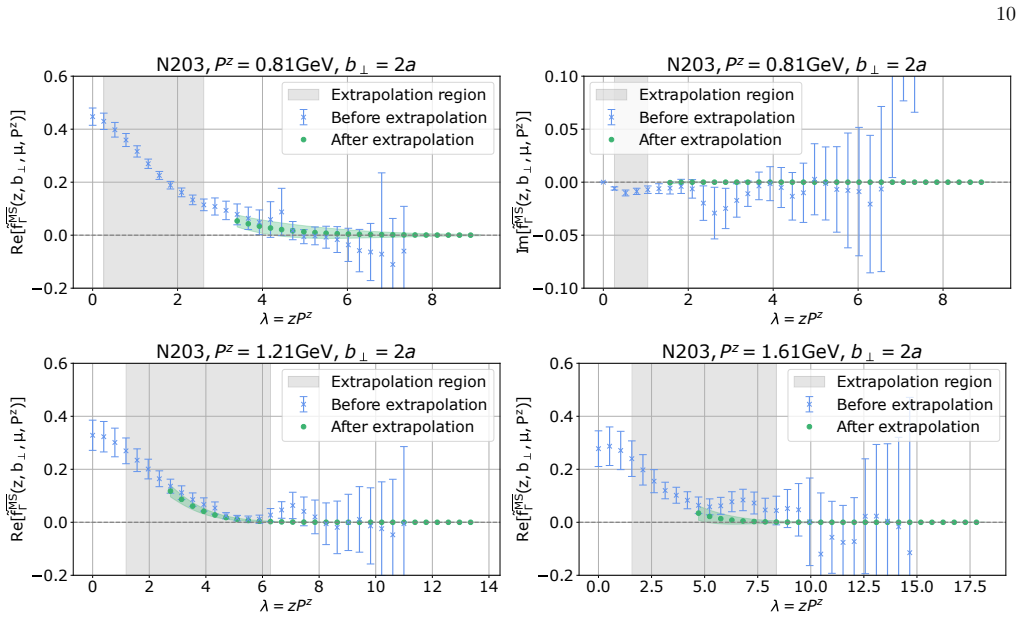
Summary. The manuscript presents a lattice QCD determination of the Boer-Mulders quark TMDPDF of the pion using LaMET. On three CLS ensembles with lattice spacings a = 0.098, 0.085, and 0.064 fm and pion masses near 350 MeV, the authors compute the staple-shaped quark quasi-TMDPDF matrix element, renormalize it in a short-distance scheme with RG resummation, convert it to the MS scheme, Fourier-transform in lambda = z Pz using the large-distance extrapolation of Eq. (21), and apply NNLO+RGR matching together with the Collins-Soper kernel and intrinsic soft function taken from Ref. [51]. The b_perp dependence is fitted with a Gaussian and a combined continuum/infinite-momentum extrapolation yields the final x- and b_perp-dependent result h_{1,0}(x,b_perp). The central finding is that the pion Boer-Mulders function decreases with b_perp and is compatible with zero for b_perp near 0.5-0.6 fm, with the reliably determined x range estimated as roughly 0.15-0.85.
Significance. If the systematic concerns are resolved, this would be the first full x- and b_perp-dependent lattice determination of a T-odd quark TMDPDF of the pion, and it is a technically demanding project: three lattice spacings, pion momenta up to 1.8 GeV, NNLO matching with RGR, and a detailed separation of statistical and systematic errors. The paper is also transparent about the cross-ensemble interpolation of the soft function and Collins-Soper kernel, the regions where resummation breaks down, and the model-dependent extrapolations. These strengths make the result a potentially valuable benchmark for EIC and JLab phenomenology. However, the quantitative central claim currently rests on several steps whose systematic uncertainty is not fully quantified: the transfer of K and S_I from one ensemble to the other two, the Gaussian ansatz for the b_perp dependence, and the stability of the combined continuum/infinite-momentum extrapolation.
major comments (3)
- [Sec. III G and Eq. (12)] The Collins-Soper kernel K(b_perp,mu) and intrinsic soft function S_I(b_perp,mu) that enter the factorization in Eq. (12) are available only on X650 (a = 0.098 fm, m_pi = 338 MeV) from Ref. [51]; they are linearly interpolated in b_perp and then applied unchanged to H102 and N203. Because K and S_I appear inside the matching and rapidity-evolution factors before the continuum and infinite-momentum extrapolation of Eq. (23), any lattice-spacing or pion-mass dependence in these non-perturbative inputs will bias the extracted h_{1,0}(x,b_perp) and its b_perp slope. The paper calls this procedure 'a makeshift' and propagates only the statistical errors of the X650 results, with no systematic uncertainty assigned to the cross-ensemble transfer. I request either dedicated calculations of K and S_I on H102 and N203, or a quantitative sensitivity estimate, for example by repeating the full analysis after shifting K and S_I by a term of order a^2 or by an estimate based on the pion-mass difference, and quoting the resulting changes in Fig. 15.
- [Sec. IV C, Eq. (22), and Fig. 14] The b_perp dependence is modeled with the Gaussian form c1(x,Pz,a) exp[-c2(x,Pz,a) b_perp^2] for each ensemble, and this fit is used to interpolate h to the common b_perp values entering Eq. (23). A Gaussian is monotonically decreasing and tends to zero at large b_perp, so the central qualitative conclusion that the Boer-Mulders function 'decays with increasing b_perp and is compatible with zero for b_perp ~ 0.5-0.6 fm' is partly built into the model. For N203 the point b_perp = 0.6 fm is actually an extrapolation of the fit, since the largest simulated b_perp is 9a ~ 0.58 fm. I ask for a stability test with a different functional form, for example an exponential or dipole in b_perp, and for a display of the fits against the raw b_perp data for all three ensembles, rather than only X650 at x = 0.5.
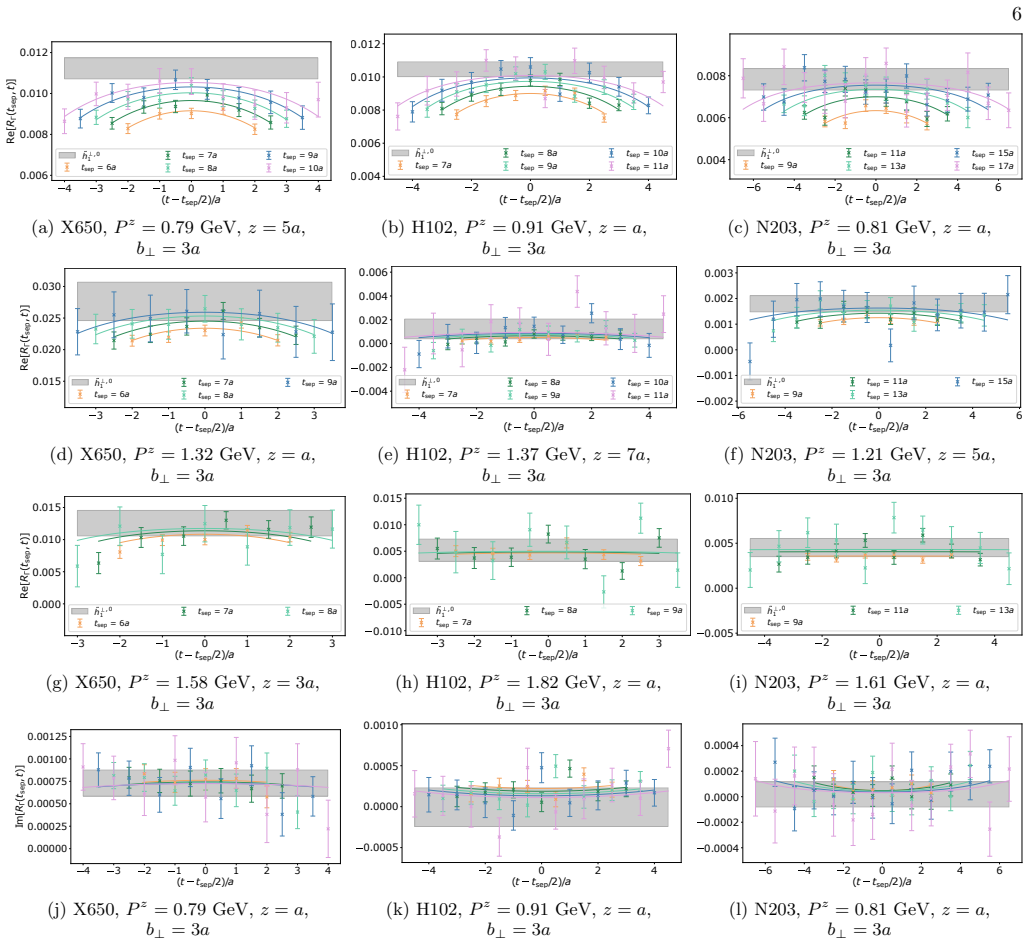
- [Sec. IV D, Eq. (23), and Fig. 15] The combined continuum and infinite-momentum extrapolation uses the form h = h0 + a^2 f(x,b_perp) + a^2 (P^z)^2 h(x,b_perp) + g(x,b_perp,a)/(P^z)^2. The paper does not report the number and quality of the fits, the correlations among the fit parameters, or the stability of h0 under dropping individual terms or under changing the minimum P^z included; given the limited number of momenta per ensemble, these checks are necessary for the central values in Fig. 15. The quoted extrapolation systematic, defined as the difference between the extrapolated result and N203 at P^z = 1.61 GeV, is a single proxy and does not cover the model dependence of Eq. (23). I request an explicit robustness study of this step, since it is the step that produces the final b_perp decay curve.
minor comments (7)
- [Sec. V] In the first paragraph of the summary, the pion mass is given as '~350 GeV'; this should read MeV, as in the abstract and Table II.
- [Fig. 9 and Sec. III G] The figure labels the intrinsic soft function as S_r(b,mu), while the text and Eq. (12) use S_I(b_perp,mu); please unify the notation.
- [Eqs. (17), (21), and (22)] The symbols c1 and c2 are reused for three different sets of fit parameters (dispersion relation, large-lambda extrapolation, and Gaussian b_perp fit); renaming at least one set would remove ambiguity.
- [Fig. 15 and Sec. IV D] The final results should state the values of the renormalization scale mu and rapidity scale zeta at which h1(x,b_perp,mu,zeta) is quoted, since the TMDPDF depends on both scales.
- [Eq. (21) and Sec. III F] The large-lambda extrapolation form should specify how the exponents a and b are determined and over which lambda window the fit is performed; describing the grey region only as chosen by minimizing chi2/d.o.f. is not sufficiently reproducible.
- [Fig. 12 and Sec. IV B] The legend entry 'syst.: reduced soft function' should use the same name as Eq. (12) ('intrinsic soft function'), and the two RGR scale-variation sources (ZO and matching kernel) should be defined explicitly as separate items in the text.
- [Sec. III A, Table II] All three ensembles have pion masses between 338 and 354 MeV, so the result is at an unphysical pion mass; the abstract and conclusion should state this qualification explicitly if no chiral extrapolation is provided.
Circularity Check
No significant circularity: the pion Boer-Mulders matrix elements are an independent first-principles calculation, and the soft function and Collins-Soper kernel are external inputs from a separate lattice calculation, not fitted to the target quantity.
full rationale
The derivation chain for the Boer-Mulders function is self-contained with respect to the target quantity: the quasi-TMDPDF matrix elements in Eq. (1) are computed directly on three CLS ensembles using a two-state fit (Sec. III C), renormalized via Eq. (5), Fourier-transformed, and matched through Eq. (12). The non-perturbative intrinsic soft function S_I(b_perp) and Collins-Soper kernel K(b_perp) entering Eq. (12) are taken from a separate lattice calculation [51]; they are parameter-free inputs with stated assumptions that do not include the Boer-Mulders function, and no parameter of the BM extraction is fitted to reproduce them. The overlap in authorship with Ref. [51] is therefore a dependency, not a logical loop. The b_perp interpolation of K and S_I from X650 to H102/N203 (Sec. III G), although explicitly called 'a makeshift,' is a systematic-error concern rather than a circular reduction: those inputs are not defined in terms of the BM matrix elements. Similarly, the Gaussian b_perp fit in Eq. (22) and the extrapolation in Eq. (23) are standard parametrizations applied to the data, not inputs that predetermine the observed decrease with b_perp; the plotted lattice data themselves exhibit the decreasing trend. No equation in the paper reduces a claimed prediction to a fitted input, a self-citation chain, or a definitional identity.
Assumptions & free parameters
free parameters (5)
- r (RGR scale variation parameter) =
0.8 to 1.2
- lambda_0 (correlation length in large-lambda extrapolation) =
Fitted per b_perp and Pz; no single value reported
- c1, c2 (large-lambda extrapolation coefficients) =
Fitted per b_perp and Pz
- c1(x), c2(x) (b_perp Gaussian fit parameters) =
Example: c1 = 1.04(10), c2 = 8.1(1.6) for X650, x = 0.5, Pz = 0.79 GeV
- f(x,b_perp), h(x,b_perp), g(x,b_perp,a) (continuum and infinite-momentum extrapolation parameters) =
Fitted in a combined fit across three ensembles and multiple momenta
assumptions (8)
- domain assumption LaMET factorization formula Eq. (12) holds for the quasi-Boer-Mulders function.
- domain assumption The perturbative matching kernel is universal for all leading-twist TMDPDFs, including T-odd ones.
- domain assumption The short-distance renormalization factor ZO is the same for the unpolarized and Boer-Mulders quasi-TMDPDFs at one loop.
- ad hoc to paper The Collins-Soper kernel and intrinsic soft function computed on X650 can be linearly interpolated in b_perp and applied unchanged to H102 and N203.
- ad hoc to paper The large-lambda extrapolation form of Eq. (21) correctly describes the coordinate-space quasi-TMDPDF at large lambda.
- ad hoc to paper The b_perp dependence of the Boer-Mulders function follows a Gaussian form, Eq. (22).
- ad hoc to paper The continuum and infinite-momentum extrapolation form of Eq. (23) captures the dominant corrections.
- standard math The two-state ansatz for two- and three-point correlators, Eqs. (17)-(20), adequately controls excited-state contamination.
Cite this review
Pith. "Pith review of Quark Transverse Spin-Momentum Correlation of the Pion from Lattice QCD: The Boer-Mulders Function." pith.science (2026). https://pith.science/paper/ODWFFQMU
@misc{pith2026241219988,
  author       = {Pith},
  title        = {Pith review of: Quark Transverse Spin-Momentum Correlation of the Pion from Lattice QCD: The Boer-Mulders Function},
  year         = {2026},
  howpublished = {\url{https://pith.science/paper/ODWFFQMU}},
  note         = {Machine review of arXiv:2412.19988}
}
abstract
We present the first lattice QCD calculation of the quark transverse spin-momentum correlation, i.e., the T-odd Boer-Mulders function, of the pion, using large-momentum effective theory (LaMET). The calculation is done at three lattice spacings $a=(0.098, 0.085, 0.064)$ fm and pion masses $\sim350$ MeV, with pion momenta up to $1.8$ GeV. The matrix elements are renormalized in a state-of-the-art scheme and extrapolated to the continuum and infinite momentum limit. We have implemented the perturbative matching up to the next-to-next-to-leading order and carried out a renormalization-group resummation. Our results provide valuable input for phenomenological analyses of the Boer-Mulders single-spin asymmetry.
Figures


Figures from the paper (11 more)




Forward citations
Cited by 1 Pith paper
-
Multivariable Painleve'-II equation: connection formulas for asymptotic solutions
Asymptotically exact WKB connection formulas for a multivariable Painlevé-II system are obtained via the Demkov–Osherov model and used to scale excitations in vacuum decay.
Reference graph
Works this paper leans on
- [51]
-
[1]
R. Abdul Khalek et al., Nucl. Phys. A 1026, 122447 (2022), 2103.05419
arXiv 2022
-
[2]
D. P. Anderle et al., Front. Phys. (Beijing) 16, 64701 (2021), 2102.09222
arXiv 2021
-
[3]
A. Bacchetta, F. Delcarro, C. Pisano, M. Radici, and A. Signori, JHEP 06, 081 (2017), [Erratum: JHEP 06, 051 (2019)], 1703.10157
arXiv 2017
- [4]
- [5]
- [6]
-
[7]
A. Bacchetta, V. Bertone, C. Bissolotti, G. Bozzi, F. Del- carro, F. Piacenza, and M. Radici, JHEP 07, 117 (2020), 1912.07550
arXiv 2020
Show all 74 references
-
[8]
Bacchetta, F
A. Bacchetta, F. Delcarro, C. Pisano, and M. Radici, Phys. Lett. B 827, 136961 (2022), 2004.14278
2022 arXiv
-
[9]
M. Bury, A. Prokudin, and A. Vladimirov, JHEP 05, 151 (2021), 2103.03270
2021 arXiv
-
[10]
M. G. Echevarria, Z.-B. Kang, and J. Terry, JHEP 01, 126 (2021), 2009.10710
2021 arXiv
-
[11]
H¨ agler, B
P. H¨ agler, B. U. Musch, J. W. Negele, and A. Sch¨ afer, EPL 88, 61001 (2009), 0908.1283
2009 arXiv
-
[12]
B. U. Musch, P. H¨ agler, J. W. Negele, and A. Sch¨ afer, Phys. Rev. D 83, 094507 (2011), 1011.1213
2011 arXiv
-
[13]
B. U. Musch, P. H¨ agler, M. Engelhardt, J. W. Negele, and A. Sch¨ afer, Phys. Rev. D 85, 094510 (2012), 1111.4249
2012 arXiv
-
[14]
Engelhardt, P
M. Engelhardt, P. H¨ agler, B. Musch, J. Negele, and A. Sch¨ afer, Phys. Rev. D93, 054501 (2016), 1506.07826
2016 arXiv
-
[15]
B. Yoon, M. Engelhardt, R. Gupta, T. Bhattacharya, J. R. Green, B. U. Musch, J. W. Negele, A. V. Pochinsky, A. Sch¨ afer, and S. N. Syritsyn, Phys. Rev. D96, 094508 (2017), 1706.03406
2017 arXiv
- [16]
-
[17]
X. Ji, Sci. China Phys. Mech. Astron. 57, 1407 (2014), 1404.6680
2014 arXiv
-
[18]
Ji, Y.-S
X. Ji, Y.-S. Liu, Y. Liu, J.-H. Zhang, and Y. Zhao, Rev. Mod. Phys. 93, 035005 (2021), 2004.03543
2021 arXiv
-
[19]
X. Ji, P. Sun, X. Xiong, and F. Yuan, Phys. Rev. D91, 074009 (2015), 1405.7640
2015 arXiv
-
[20]
Ji, L.-C
X. Ji, L.-C. Jin, F. Yuan, J.-H. Zhang, and Y. Zhao, Phys. Rev. D 99, 114006 (2019), 1801.05930
2019 arXiv
-
[21]
X. Ji, Y. Liu, and Y.-S. Liu, Nucl. Phys. B 955, 115054 (2020), 1910.11415
2020 arXiv
-
[22]
X. Ji, Y. Liu, and Y.-S. Liu, Phys. Lett. B 811, 135946 (2020), 1911.03840
2020 arXiv
-
[23]
X. Ji, Y. Liu, A. Sch¨ afer, and F. Yuan, Phys. Rev. D 103, 074005 (2021), 2011.13397
2021 arXiv
-
[25]
M. A. Ebert, I. W. Stewart, and Y. Zhao, Phys. Rev. D 99, 034505 (2019), 1811.00026
2019 arXiv
-
[26]
M. A. Ebert, I. W. Stewart, and Y. Zhao, JHEP 09, 037 (2019), 1901.03685
2019 arXiv
-
[27]
M. A. Ebert, I. W. Stewart, and Y. Zhao, JHEP 03, 099 (2020), 1910.08569
2020 arXiv
-
[28]
Shanahan, M
P. Shanahan, M. L. Wagman, and Y. Zhao, Phys. Rev. D 101, 074505 (2020), 1911.00800
2020 arXiv
-
[29]
M. A. Ebert, S. T. Schindler, I. W. Stewart, and Y. Zhao, JHEP 09, 099 (2020), 2004.14831
2020 arXiv
-
[30]
A. A. Vladimirov and A. Sch¨ afer, Phys. Rev. D 101, 074517 (2020), 2002.07527
2020 arXiv
-
[31]
Ji, J.-H
Y. Ji, J.-H. Zhang, S. Zhao, and R. Zhu, Phys. Rev. D 104, 094510 (2021), 2104.13345
2021 arXiv
-
[32]
M. A. Ebert, S. T. Schindler, I. W. Stewart, and Y. Zhao, JHEP 04, 178 (2022), 2201.08401
2022 arXiv
-
[33]
S. T. Schindler, I. W. Stewart, and Y. Zhao, JHEP 08, 084 (2022), 2205.12369
2022 arXiv
-
[34]
R. Zhu, Y. Ji, J.-H. Zhang, and S. Zhao, JHEP 02, 114 (2023), 2209.05443
2023 arXiv
- [35]
-
[36]
X.-Y. Han, J. Hua, X. Ji, C.-D. L¨ u, W. Wang, J. Xu, Q.-A. Zhang, and S. Zhao (2024), 2403.17492
2024 arXiv
-
[37]
Shanahan, M
P. Shanahan, M. Wagman, and Y. Zhao, Phys. Rev. D 102, 014511 (2020), 2003.06063
2020 arXiv
-
[38]
Zhang et al
Q.-A. Zhang et al. (Lattice Parton), Phys. Rev. Lett. 125, 192001 (2020), 2005.14572
2020 arXiv
-
[39]
Schlemmer, A
M. Schlemmer, A. Vladimirov, C. Zimmermann, M. En- gelhardt, and A. Sch¨ afer, JHEP 08, 004 (2021), 2103.16991
2021 arXiv
-
[40]
Shanahan, M
P. Shanahan, M. Wagman, and Y. Zhao, Phys. Rev. D 104, 114502 (2021), 2107.11930
2021 arXiv
-
[41]
Chu et al
M.-H. Chu et al. (Lattice Parton (LPC)), Phys. Rev. D 106, 034509 (2022), 2204.00200
2022 arXiv
-
[42]
He, M.-H
J.-C. He, M.-H. Chu, J. Hua, X. Ji, A. Sch¨ afer, Y. Su, W. Wang, Y.-B. Yang, J.-H. Zhang, and Q.-A. Zhang (Lattice Parton Collaboration (LPC)), Phys. Rev. D 109, 114513 (2024), 2211.02340
2024 arXiv
-
[43]
Chu et al
M.-H. Chu et al. (Lattice Parton), Phys. Rev. D 109, L091503 (2024), 2302.09961
2024 arXiv
-
[44]
Avkhadiev, P
A. Avkhadiev, P. E. Shanahan, M. L. Wagman, and Y. Zhao, Phys. Rev. D 108, 114505 (2023), 2307.12359
2023 arXiv
-
[45]
Avkhadiev, P
A. Avkhadiev, P. E. Shanahan, M. L. Wagman, and Y. Zhao, Phys. Rev. Lett. 132, 231901 (2024), 2402.06725
2024 arXiv
- [46]
- [47]
-
[48]
del R ´ ıo and A
O. del R ´ ıo and A. Vladimirov, Phys. Rev. D108, 114009 (2023), 2304.14440
2023 arXiv
-
[49]
X. Ji, Y. Liu, and Y. Su, JHEP 08, 037 (2023), 2305.04416
2023 arXiv
-
[50]
Zhang, X
K. Zhang, X. Ji, Y.-B. Yang, F. Yao, and J.-H. Zhang (Lattice Parton (LPC)), Phys. Rev. Lett. 129, 082002 (2022), 2205.13402
2022 arXiv
-
[52]
Ji and M
X.-D. Ji and M. J. Musolf, Phys. Lett. B 257, 409 (1991)
1991
-
[53]
K. G. Chetyrkin and A. G. Grozin, Nucl. Phys. B 666, 289 (2003), hep-ph/0303113
2003 arXiv
-
[54]
V. M. Braun, K. G. Chetyrkin, and B. A. Kniehl, JHEP 07, 161 (2020), 2004.01043
2020 arXiv
- [55]
-
[56]
J. C. Collins and D. E. Soper, Nucl. Phys. B 193, 381 (1981), [Erratum: Nucl.Phys.B 213, 545 (1983)]
1981
- [57]
-
[58]
I. A. Korchemskaya and G. P. Korchemsky, Phys. Lett. B 287, 169 (1992)
1992
-
[59]
S. Moch, J. A. M. Vermaseren, and A. Vogt, Nucl. Phys. B 688, 101 (2004), hep-ph/0403192
2004 arXiv
-
[60]
J. M. Henn, G. P. Korchemsky, and B. Mistlberger, JHEP 04, 018 (2020), 1911.10174
2020 arXiv
-
[61]
von Manteuffel, E
A. von Manteuffel, E. Panzer, and R. M. Schabinger, Phys. Rev. Lett. 124, 162001 (2020), 2002.04617
2020 arXiv
- [62]
-
[63]
X. Ji, Y. Liu, Y. Su, and R. Zhang (2024), 2410.12910
2024 arXiv
- [64]
- [65]
- [66]
-
[67]
Bruno et al., JHEP 02, 043 (2015), 1411.3982
M. Bruno et al., JHEP 02, 043 (2015), 1411.3982
2015 arXiv
-
[68]
G. S. Bali, S. Collins, S. Heybrock, M. L¨ offler, R. R¨ odl, W. S¨ oldner, and S. Weish¨ aupl (RQCD), Phys. Rev. D 108, 034512 (2023), 2305.04717
2023 arXiv
-
[69]
Martinelli and C
G. Martinelli and C. T. Sachrajda, Nucl. Phys. B 316, 355 (1989)
1989
-
[70]
Bhattacharya, S
T. Bhattacharya, S. D. Cohen, R. Gupta, A. Joseph, H.- W. Lin, and B. Yoon, Phys. Rev. D89, 094502 (2014), 1306.5435
2014 arXiv
-
[71]
X. Ji, Y. Liu, A. Sch¨ afer, W. Wang, Y.-B. Yang, J.-H. Zhang, and Y. Zhao, Nucl. Phys. B 964, 115311 (2021), 2008.03886
2021 arXiv
-
[72]
Delcarro, A
F. Delcarro, A. Bacchetta, C. Pisano, M. Radici, and A. Signori, PoS DIS2018, 219 (2018)
2018
-
[73]
Babich, J
R. Babich, J. Brannick, R. C. Brower, M. A. Clark, T. A. Manteuffel, S. F. McCormick, J. C. Osborn, and C. Rebbi, Phys. Rev. Lett. 105, 201602 (2010), 1005.3043
2010 arXiv
-
[74]
J. C. Osborn, R. Babich, J. Brannick, R. C. Brower, M. A. Clark, S. D. Cohen, and C. Rebbi, PoS LA T- TICE2010, 037 (2010), 1011.2775
2010 arXiv
-
[75]
R. G. Edwards and B. Joo (SciDAC, LHPC, UKQCD), Nucl. Phys. Proc. Suppl. 140, 832 (2005), [,832(2004)], hep-lat/0409003
2005 arXiv
Reviewed August 10, 2026 · model on record in the stance chip above.
Discussion (0). Continue with ORCID to comment.