REVIEW 3 major objections 4 minor 35 references
Inverse Rashba-Edelstein THz emission modulation induced by ferroelectricity in CoFeB/PtSe2/MoSe2//LiNbO3 systems
T0 review · 3 major / 4 minor · reviewed 2026-08-10 · deepseek-v4-flash
Pith's one-line read Ferroelectric polarization direction modulates the terahertz emission of a CoFeB/PtSe2/MoSe2 stack by 15-20 percent, via band shifts that tune the inverse Rashba-Edelstein effect at the MoSe2/PtSe2 interface.
desk verdict Solid experimental demonstration of ferroelectric-polarization control of THz emission; the microscopic IREE attribution is plausible but underdetermined by the simplified DFT model. read the letter →
The pith
A machine-rendered reading of the paper's core claim, the machinery that carries it, and where it could break.
The reading
What carries the argument
The inverse Rashba-Edelstein effect (IREE): at an interface with Rashba spin-orbit splitting, an incoming spin current creates a net transverse charge current. The paper's central object is the MoSe2/PtSe2 interface, where inversion-symmetry breaking from MoSe2 lifts the spin degeneracy of PtSe2 and produces Rashba states in the valence band; the ferroelectric field from LiNbO3 shifts these bands and thereby tunes the spin accumulation and the IREE conversion efficiency.
What would settle it
Measure the magnetic THz emission from CoFeB/PtSe2 directly on the same bi-domain LiNbO3 (no MoSe2 layer); if the 15-20 percent up/down modulation persists, the modulation is not specific to the MoSe2/PtSe2 Rashba interface. Alternatively, perform angle-resolved photoemission on the two poled domains and check for the predicted 0.32 eV band shift.
Extended reading notes
Core claim
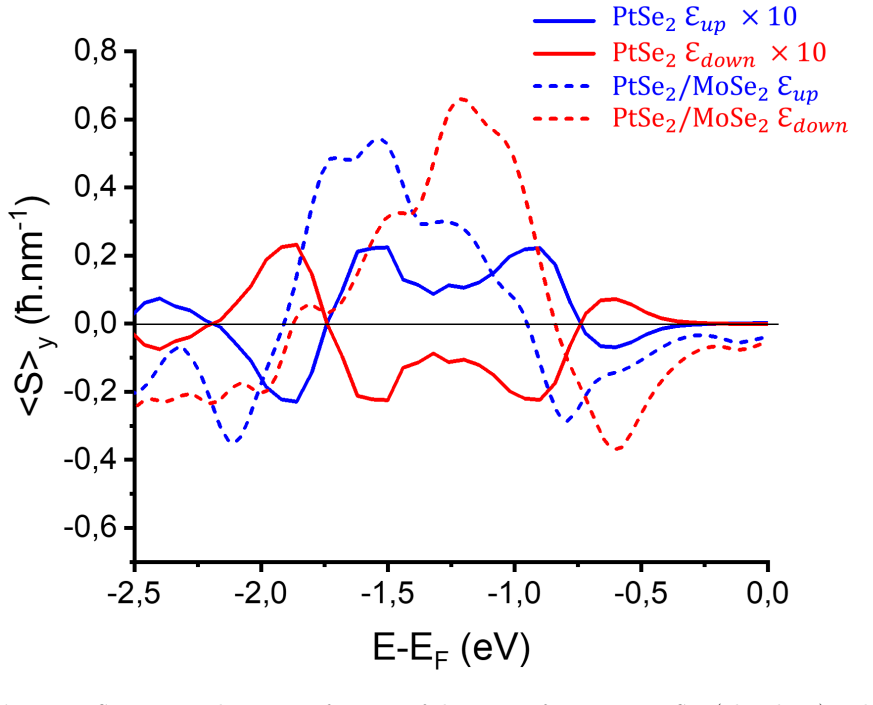
The paper claims to demonstrate ferroelectric control of the magnetic contribution to THz emission in a large-area CoFeB/PtSe2/MoSe2//LiNbO3 stack. By comparing the two pre-poled domains of the substrate with THz time-domain spectroscopy, the authors find a sizeable, reproducible modulation of the spin-to-charge-conversion signal, and they trace it to the inverse Rashba-Edelstein effect at the MoSe2/PtSe2 interface. Density functional theory calculations show that an electric field of 0.25 V/Å shifts the semiconducting bands by about 0.32 eV and changes the spin accumulation in the valence-band energy window where the pump laser excites the system, qualitatively matching the observed up/down asymmetry.
Load-bearing premise
The DFT calculation replaces the real LiNbO3 substrate with a uniform electric field applied to the free-standing trilayer, assuming this captures the band shifts and spin accumulation changes that occur in the full stack with CoFeB and the ferroelectric interface.
Editorial extensions
If this is right
- A non-volatile ferroelectric gate can replace an external voltage bias for modulating spintronic THz sources, lowering the energy cost of THz emitters.
- The modulation depth (about 15-20 percent at fixed Fermi level) could be increased up to a factor of 2 by gating the system to move the Fermi level to a more favorable energy window, according to the DFT results.
- The same field-effect spin-orbit architecture could be extended to other ferroelectric/TMD combinations to engineer the Rashba energy window for a given pump photon energy.
- Because the non-magnetic optical-rectification signal flips phase with polarization while the magnetic signal only changes amplitude, the up/down domains can be read out unambiguously, offering a self-calibrating emitter design.
Reading between the lines
- A direct test would be to repeat the experiment on CoFeB/PtSe2//LiNbO3 without the MoSe2 layer: if the modulation mostly vanishes, the MoSe2/PtSe2 interface is indeed the active spin-to-charge conversion site.
- The 0.32 eV band shift predicted by DFT could be verified by angle-resolved photoemission on the two poled domains; a mismatch would point to charge transfer or interface charging as the true origin.
- If the effect is as robust as reported, writing ferroelectric domain patterns could allow spatial encoding of THz emission patterns on a single chip, turning the sample into a programmable THz emitter.
- Extending the measurement to other pump photon energies and comparing the modulation depth would test the claim that the effect is tied to the valence-band energy window, and could reveal the optimal operating conditions.
Editorial analysis
A structured set of objections, weighed in public.
Referee Report
Summary. The paper reports THz time-domain spectroscopy measurements on a CoFeB/PtSe2/MoSe2//LiNbO3 heterostructure with pre-poled ferroelectric domains, showing that the magnetic (spin-to-charge conversion) contribution to the THz emission is roughly 15-20% larger on the up-poled area than on the down-poled area across the measured pump-power range. The non-magnetic contribution shows the expected phase reversal with ferroelectric polarization direction, confirming the domain assignment. The authors rationalize the modulation by density-functional-theory calculations of a free-standing MoSe2(1ML)/PtSe2(2ML) trilayer under a uniform electric field, interpreting the result as a ferroelectric-field-induced shift of Rashba-split valence-band states that changes the inverse Rashba-Edelstein effect at the MoSe2/PtSe2 interface. The central claim is that ferroelectric polarization non-volatilely modulates the spintronic THz emission through field-effect control of interfacial spin-to-charge conversion.
Significance. If the interpretation is correct, the paper demonstrates a non-volatile, low-energy-control mechanism for a spintronic THz emitter, which is technologically relevant for compact THz sources and modulators. The experimental core is solid: the magnetic THz contribution is time-resolved with error bars, the power dependence shows consistent up/down ordering, and the phase comparison with a Pt/Co standard emitter fixes the conversion sign. The DFT work is independent first-principles calculation with the electric-field amplitude chosen from the known ferroelectric polarization rather than fitted to the THz modulation, and the spin-accumulation sign is cross-checked against a separate calculation of the Pt spin Hall conductivity. These are genuine strengths. The main weakness is that the microscopic attribution to IREE at the MoSe2/PtSe2 interface rests on a simplified model that omits the CoFeB electrode and the LiNbO3 substrate, leaving alternative origins of the observed modulation insufficiently excluded.
major comments (3)
- [Section III, Fig. 4b] The microscopic rationalization is built on a free-standing MoSe2(1ML)/PtSe2(2ML) trilayer subjected to a uniform electric field of E=0.25 V/Å, with no LiNbO3 substrate and no CoFeB electrode. In the real stack the metallic CoFeB layer can screen the ferroelectric field, and the potential profile across the TMD layers may differ substantially from a uniform field; the computed 0.32 eV band shift and the up/down ordering shown in Fig. 4b may therefore not survive in the device. A stack-realistic calculation, or an experimental probe of the band shift in the actual heterostructure, is required before the measured modulation can be attributed specifically to IREE at the MoSe2/PtSe2 interface.
- [Section III and Eq. B1] The spin accumulation response in Eq. (B1) contains an undetermined relaxation time tau, and the comparison with experiment is made at a single energy cut E=EF-1.5 eV. The text notes that the up/down ratio 'could be increased up to 2' by moving the Fermi level, so the model does not quantitatively predict the observed 15-20% modulation. The authors should specify how the 1.55 eV optical excitation populates the chosen energy window and show that the sign and ordering of the spin accumulation are robust across the relevant energy range, rather than being an artifact of the cut.
- [Section II, Fig. 3c] The attribution of the magnetic THz signal to IREE at the MoSe2/PtSe2 interface relies on comparison with a Pt/Co emitter and on the TMD-thickness dependence reported in Ref. 19, but a ferroelectric-field-induced change at the CoFeB/PtSe2 interface or in the spin-injection efficiency from CoFeB could also produce an up/down modulation of the magnetic THz contribution. Additional control experiments, such as varying the TMD stack thickness, inserting a non-magnetic spacer at the CoFeB/TMD interface, or measuring the field dependence of the magnetic contribution, would be needed to exclude these alternative microscopic origins.
minor comments (4)
- [Throughout] There are several typos and grammatical slips, including 'Density Functionalnal' in the Section III heading, 'Suplementary' in the main text and Appendix B, 'proportionnal' in Appendix E, and 'waver-scale' in the Introduction; these should be corrected.
- [Section III, Fig. 4b] The choice of E=0.25 V/Å should be justified more explicitly with the corresponding LiNbO3 polarization value and the expected field across the 2D layers, since the result depends directly on this amplitude.
- [Appendix B] The statement that the semi-conducting nature of the layers 'prevents field screening from the substrate' would benefit from a quantitative explanation, especially because the adjacent CoFeB metal is a potential source of screening.
- [Fig. 3b] The error-bar definition is given in the caption, but the number of repeated measurements underlying each point and whether the up/down ratio is computed point-by-point or from average amplitudes should be stated for reproducibility.
Circularity Check
No load-bearing circularity; DFT electric field input is not fitted to the THz modulation, and same-group citations are corroborative prior experiments.
full rationale
The derivation chain is not circular. The experimental observable is the up/down difference in magnetic THz emission (Fig. 3), which is measured directly and is independent of all theory inputs. The DFT calculation applies a fixed electric field amplitude E=0.25 V/Å chosen from the known polarization of LiNbO3, not adjusted to reproduce the measured 15-20% modulation; both field directions are computed and the ordering of spin accumulation at the valence-band window is a non-trivial output of Eq. (B1). The sign of the computed spin accumulation is cross-checked against a separate first-principles spin Hall conductivity calculation for Pt (Appendix E), and the band-shift interpretation is compared with an earlier experimental observation on WSe2/BiFeO3 (ref 20). Refs 19, 20, and 24 involve overlapping authors, but they are independent, externally falsifiable measurements in different systems, not uniqueness theorems or fitted inputs, so they do not force the present conclusion. The uniform-field proxy for the LiNbO3 substrate and the selection of the E_F-1.5 eV energy cut are modeling assumptions and a robustness limitation, but they are not circular reductions: the calculation could in principle have produced the opposite ordering or no modulation, and the model does not contain the measured 15-20% ratio as an input.
Assumptions & free parameters
free parameters (2)
- Electric field amplitude E =
0.25 V/A
- Relaxation time tau in the spin accumulation formula (Eq. B1)
assumptions (4)
- domain assumption PBE exchange-correlation functional and the SIESTA implementation accurately describe the band structure and spin texture of the MoSe2/PtSe2 trilayer.
- ad hoc to paper A uniform electric field applied to a free-standing trilayer reproduces the effect of the ferroelectric LiNbO3 substrate on the 2D layers.
- standard math The linear-response formula for spin accumulation (Eq. B1) is a valid description of the inverse Rashba-Edelstein effect in this system.
- domain assumption The energy window around E_F - 1.5 eV, probed by the 1.55 eV pump photons, is the dominant contributor to the measured THz emission.
Cite this review
Pith. "Pith review of Inverse Rashba-Edelstein THz emission modulation induced by ferroelectricity in CoFeB/PtSe2/MoSe2//LiNbO3 systems." pith.science (2026). https://pith.science/paper/QAMB4F72
@misc{pith2026241220108,
  author       = {Pith},
  title        = {Pith review of: Inverse Rashba-Edelstein THz emission modulation induced by ferroelectricity in CoFeB/PtSe2/MoSe2//LiNbO3 systems},
  year         = {2026},
  howpublished = {\url{https://pith.science/paper/QAMB4F72}},
  note         = {Machine review of arXiv:2412.20108}
}
read the original abstract
Spintronic Terahertz emitters, based on optically triggered spin-to-charge interconversion processes, have recently emerged as novel route towards compact and efficient THz sources. Yet, the next challenge for further technologically-relevant devices remains to modulate the emission, with low-energy consumption operation. To this aim, ferroelectric materials coupled to active spin-orbit layers such as two-dimensional transition metal dichalcogenides are suitable candidates. In this work, we present the realization of a large area heterostructure of CoFeB/PtSe2/MoSe2 on a bi-domain LiNbO3 substrate. Using THz time-domain spectroscopy, we show that the ferroelectric polarization direction induces a sizeable modulation of the THz emission. We rationalise these experimental results by using band structure and spin accumulation calculations that are consistent with an interfacial spin-to-charge conversion mediated by inverse Rashba-Edelstein effect at the MoSe2/PtSe2 interface and being tuned by ferroelectricity in the adjacent LiNbO3 surface. This work points out the relevance of field effect spin-orbit architectures for novel THz technologies.
Figures


Figures from the paper (5 more)



Reference graph
Works this paper leans on
-
[1]
author author T. S. \ Seifert , author L. Cheng , author Z. Wei , author T. Kampfrath ,\ and\ author J. Qi ,\ title english title Spintronic sources of ultrashort terahertz electromagnetic pulses , \ https://doi.org/10.1063/5.0080357 journal journal Applied Physics Letters \ volume 120 ,\ pages 180401 ( year 2022 ) NoStop
-
[2]
author author T. Seifert , author S. Jaiswal , author U. Martens , author J. Hannegan , author L. Braun , author P. Maldonado , author F. Freimuth , author A. Kronenberg , author J. Henrizi , author I. Radu , author E. Beaurepaire , author Y. Mokrousov , author P. M. \ Oppeneer , author M. Jourdan , author G. Jakob , author D. Turchinovich , author L. M. ...
-
[3]
author author M. B. \ Jungfleisch , author Q. Zhang , author W. Zhang , author J. E. \ Pearson , author R. D. \ Schaller , author H. Wen ,\ and\ author A. Hoffmann ,\ title english title Control of Terahertz Emission by Ultrafast Spin - Charge Current Conversion at Rashba Interfaces , \ https://doi.org/10.1103/PhysRevLett.120.207207 journal journal Physic...
-
[4]
author author C. Zhou , author Y. Liu , author Z. Wang , author S. Ma , author M. Jia , author R. Wu , author L. Zhou , author W. Zhang , author M. Liu , author Y. Wu ,\ and\ author J. Qi ,\ title english title Broadband Terahertz Generation via the Interface Inverse Rashba - Edelstein Effect , \ https://doi.org/10.1103/PhysRevLett.121.086801 journal jour...
-
[5]
author author M. Chen , author Y. Wu , author Y. Liu , author K. Lee , author X. Qiu , author P. He , author J. Yu ,\ and\ author H. Yang ,\ title english title Current‐ Enhanced Broadband THz Emission from Spintronic Devices , \ https://doi.org/10.1002/adom.201801608 journal journal Advanced Optical Materials \ volume 7 ,\ pages 1801608 ( year 2019 ) NoStop
-
[6]
author author E. Rongione , author L. Baringthon , author D. She , author G. Patriarche , author R. Lebrun , author A. Lemaître , author M. Morassi , author N. Reyren , author M. Mičica , author J. Mangeney , author J. Tignon , author F. Bertran , author S. Dhillon , author P. Le Févre , author H. Jaffrès ,\ and\ author J. George ,\ title english title Sp...
-
[7]
author author S. Rho , author H. Park , author J. Park , author K. Jeong , author H. Kim , author S. Hong , author J. Kim , author H. W. \ Lim , author Y. Yi , author C. Kang ,\ and\ author M. Cho ,\ title english title Exceptional Spin ‐to‐ Charge Conversion in Selective Band Topology of Bi / Bi _ 1‐x Sb _ x with Spintronic Singularity , \ https://doi.or...
-
[8]
author author O. Gueckstock , author L. Nádvorník , author M. Gradhand , author T. S. \ Seifert , author G. Bierhance , author R. Rouzegar , author M. Wolf , author M. Vafaee , author J. Cramer , author M. A. \ Syskaki , author G. Woltersdorf , author I. Mertig , author G. Jakob , author M. Kläui ,\ and\ author T. Kampfrath ,\ title english title Terahert...
Show all 35 references
-
[9]
Hawecker , author E
author author J. Hawecker , author E. Rongione , author A. Markou , author S. Krishnia , author F. Godel , author S. Collin , author R. Lebrun , author J. Tignon , author J. Mangeney , author T. Boulier , author J.-M. \ George , author C. Felser , author H. Jaffrès ,\ and\ aut...
-
[10]
Rouzegar , author A
author author R. Rouzegar , author A. Chekhov , author Y. Behovits , author B. Serrano , author M. Syskaki , author C. Lambert , author D. Engel , author U. Martens , author M. Münzenberg , author M. Wolf , author G. Jakob , author M. Kläui , author T. Seifert ,\ and\ author T...
-
[11]
Leitenstorfer , author A
author author A. Leitenstorfer , author A. S. \ Moskalenko , author T. Kampfrath , author J. Kono , author E. Castro-Camus , author K. Peng , author N. Qureshi , author D. Turchinovich , author K. Tanaka , author A. G. \ Markelz , author M. Havenith , author C. Hough , author ...
2023
-
[12]
Ji , author M
author author R. Ji , author M. T. \ Hibberd , author C.-H. \ Lin , author D. A. \ Walsh , author T. Thomson , author P. W. \ Nutter ,\ and\ author D. M. \ Graham ,\ title english title Tunable multi-cycle terahertz pulse generation from a spintronic emitter , \ https://doi.or...
-
[13]
author author J. E. \ Nkeck , author L.-P. \ Béliveau , author X. Ropagnol , author D. Deslandes , author D. Morris ,\ and\ author F. Blanchard ,\ title english title Parallel generation and coding of a terahertz pulse train , \ https://doi.org/10.1063/5.0123697 journal journa...
-
[14]
Ning , author H
author author S. Ning , author H. Liu , author J. Wu ,\ and\ author F. Luo ,\ title english title Challenges and opportunities for spintronics based on spin orbit torque , \ https://doi.org/10.1016/j.fmre.2022.05.013 journal journal Fundamental Research \ volume 2 ,\ pages 535...
2022 doi
-
[15]
Noël , author F
author author P. Noël , author F. Trier , author L. M. \ Vicente Arche , author J. Bréhin , author D. C. \ Vaz , author V. Garcia , author S. Fusil , author A. Barthélémy , author L. Vila , author M. Bibes ,\ and\ author J.-P. \ Attané ,\ title english title Non-volatile elect...
-
[16]
Hirori , author A
author author H. Hirori , author A. Doi , author F. Blanchard ,\ and\ author K. Tanaka ,\ title english title Single-cycle terahertz pulses with amplitudes exceeding 1 MV /cm generated by optical rectification in LiNbO3 , \ https://doi.org/10.1063/1.3560062 journal journal App...
-
[17]
Zhang , author Z
author author B. Zhang , author Z. Ma , author J. Ma , author X. Wu , author C. Ouyang , author D. Kong , author T. Hong , author X. Wang , author P. Yang , author L. Chen , author Y. Li ,\ and\ author J. Zhang ,\ title english title 1.4‐ mJ High Energy Terahertz Radiation fro...
-
[18]
Rao , author A
author author A. Rao , author A. Patil , author P. Rabiei , author A. Honardoost , author R. DeSalvo , author A. Paolella ,\ and\ author S. Fathpour ,\ title english title High-performance and linear thin-film lithium niobate Mach – Zehnder modulators on silicon up to 50 GHz ,...
-
[19]
Abdukayumov , author M
author author K. Abdukayumov , author M. Mičica , author F. Ibrahim , author L. Vojáček , author C. Vergnaud , author A. Marty , author J. Veuillen , author P. Mallet , author I. G. \ De Moraes , author D. Dosenovic , author S. Gambarelli , author V. Maurel , author A. Wright ...
-
[20]
Salazar , author S
author author R. Salazar , author S. Varotto , author C. Vergnaud , author V. Garcia , author S. Fusil , author J. Chaste , author T. Maroutian , author A. Marty , author F. Bonell , author D. Pierucci , author A. Ouerghi , author F. Bertran , author P. Le Fèvre , author M. Ja...
-
[21]
author author M. T. \ Dau , author C. Vergnaud , author M. Gay , author C. J. \ Alvarez , author A. Marty , author C. Beigné , author D. Jalabert , author J.-F. \ Jacquot , author O. Renault , author H. Okuno ,\ and\ author M. Jamet ,\ title english title van der Waals epitaxy...
-
[22]
author author T. H. \ Dang , author J. Hawecker , author E. Rongione , author G. Baez Flores , author D. Q. \ To , author J. C. \ Rojas-Sanchez , author H. Nong , author J. Mangeney , author J. Tignon , author F. Godel , author S. Collin , author P. Seneor , author M. Bibes , ...
-
[23]
Li , author G
author author D. Li , author G. Ma , author J. Ge , author S. Hu ,\ and\ author N. Dai ,\ title english title Terahertz pulse shaping via birefringence in lithium niobate crystal , \ https://doi.org/10.1007/s00340-008-3334-6 journal journal Applied Physics B \ volume 94 ,\ pag...
-
[24]
Rongione , author S
author author E. Rongione , author S. Fragkos , author L. Baringthon , author J. Hawecker , author E. Xenogiannopoulou , author P. Tsipas , author C. Song , author M. Mičica , author J. Mangeney , author J. Tignon , author T. Boulier , author N. Reyren , author R. Lebrun , aut...
-
[25]
Carletti , author C
author author L. Carletti , author C. McDonnell , author U. Arregui Leon , author D. Rocco , author M. Finazzi , author A. Toma , author T. Ellenbogen , author G. Della Valle , author M. Celebrano ,\ and\ author C. De Angelis ,\ title english title Nonlinear THz Generation thr...
-
[26]
Xu , author Q
author author L. Xu , author Q. Zeng , author S. Xiong , author Y. Zhang , author L. Cao , author J. Tao , author Z. Li , author L.-L. \ Wang ,\ and\ author K. Dong ,\ title title Two-dimensional mose2/ptse2 van der waals type-ii heterostructure: Promising visible light photoc...
-
[27]
Kandemir , author B
author author A. Kandemir , author B. Akbali , author Z. Kahraman , author S. V. \ Badalov , author M. Ozcan , author F. Iyikanat ,\ and\ author H. Sahin ,\ title title Structural, electronic and phononic properties of ptse2: from monolayer to bulk , \ https://doi.org/10.1088/...
-
[28]
Vyas , author A
author author P. Vyas , author A. B. \ Patel ,\ and\ author N. K. \ Bhatt ,\ title english title First-principles study of thermoelasticity and structural phase diagram of CaO , \ https://doi.org/10.1103/PhysRevB.107.014107 journal journal Physical Review B \ volume 107 ,\ pag...
-
[29]
Novak , author R
author author N. Novak , author R. Pirc ,\ and\ author Z. Kutnjak ,\ title english title Effect of Electric Field on Ferroelectric Phase Transition in BaTiO _ 3 Ferroelectric , \ https://doi.org/10.1080/15421406.2014.948776 journal journal Ferroelectrics \ volume 469 ,\ pages ...
2014 arXiv
-
[30]
Mudgal , author A
author author R. Mudgal , author A. Jakhar , author P. Gupta , author R. S. \ Yadav , author B. Biswal , author P. Sahu , author H. Bangar , author A. Kumar , author N. Chowdhury , author B. Satpati , author B. R. \ Kumar Nanda , author S. Satpathy , author S. Das ,\ and\ auth...
-
[31]
author author J. P. \ Perdew , author J. A. \ Chevary , author S. H. \ Vosko , author K. A. \ Jackson , author M. R. \ Pederson , author D. J. \ Singh ,\ and\ author C. Fiolhais ,\ title title Atoms, molecules, solids, and surfaces: Applications of the generalized gradient app...
-
[32]
author author J. P. \ Perdew , author K. Burke ,\ and\ author M. Ernzerhof ,\ title title Generalized gradient approximation made simple , \ https://doi.org/10.1103/PhysRevLett.77.3865 journal journal Phys. Rev. Lett. \ volume 77 ,\ pages 3865--3868 ( year 1996 ) NoStop
-
[33]
author author J. M. \ Soler , author E. Artacho , author J. D. \ Gale , author A. García , author J. Junquera , author P. Ordejón ,\ and\ author D. Sánchez-Portal ,\ title title The siesta method for ab initio order- n materials simulation , \ http://stacks.iop.org/0953-8984/1...
2002
-
[34]
Fernández-Seivane , author M
author author L. Fernández-Seivane , author M. A. \ Oliveira , author S. Sanvito ,\ and\ author J. Ferrer ,\ title title On-site approximation for spin–orbit coupling in linear combination of atomic orbitals density functional methods , \ http://stacks.iop.org/0953-8984/19/i=4...
2007
-
[35]
Troullier \ and\ author J
author author N. Troullier \ and\ author J. L. \ Martins ,\ title title Efficient pseudopotentials for plane-wave calculations , \ https://doi.org/10.1103/PhysRevB.43.1993 journal journal Phys. Rev. B \ volume 43 ,\ pages 1993--2006 ( year 1991 ) NoStop
1993 doi
Reviewed August 10, 2026 · model on record in the stance chip above.
Discussion (0). Continue with ORCID to comment.