REVIEW 2 major objections 4 minor 18 references
An estimate of resident time of the Oort Cloud new comets in planetary region
T0 review · 2 major / 4 minor · reviewed 2026-08-10 · deepseek-v4-flash
Pith's one-line read A two-model simulation finds that new Oort Cloud comets typically linger in the planetary region for about 10^8 years before being ejected, colliding, or surviving past 500 million years.
desk verdict Careful large-N simulation with a real result, but the abstract's '~10^8-year resident time' is an A-early epoch statement, and the planet barrier should be read as an initial-condition-dependent result. read the letter →
The pith
A machine-rendered reading of the paper's core claim, the machinery that carries it, and where it could break.
The reading
What carries the argument
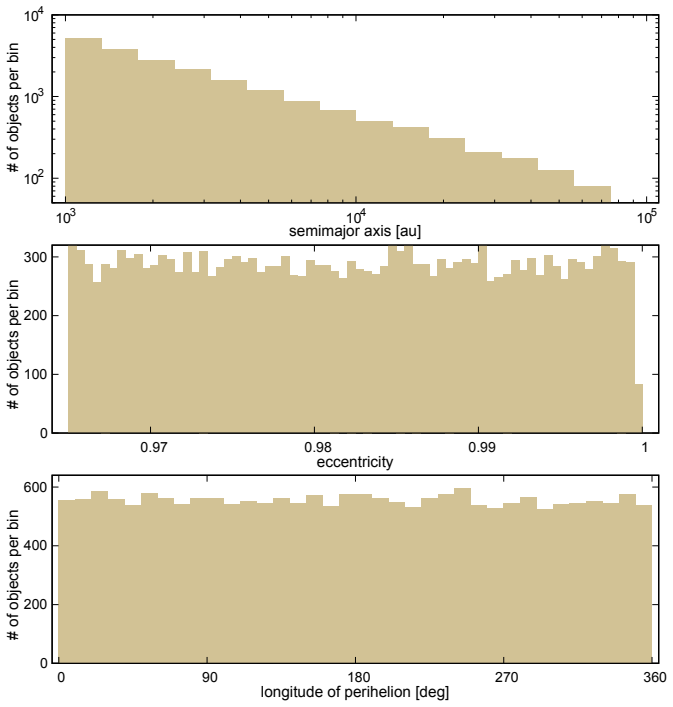
The machinery is a two-model splice. First, a semi-analytic model evolves a flat planetesimal disk ($a$ from $10^3$ to $10^5$ au, all perihelia at $q_0=35$ au, inclination zero) into a nearly isotropic comet cloud under the vertical component of the galactic tide—whose secular, integrable average drives a slow eccentricity–inclination oscillation that raises and lowers perihelion—plus stellar encounters modeled in the impulse approximation. Whenever a particle's heliocentric distance drops below 30 au it is designated a 'new comet', rewound to the edge of an 800 au sphere, and handed to the second model: a symplectic mixed-variable integration of Mercury-to-Neptune perturbations with a 'time-skip' scheme that treats each excursion beyond 800 au as an unperturbed Keplerian arc. The load-bearing quantity is the per-object resident time $T_{\rm res}$, accumulated from injection to removal, whose statistics carry both the $10^8$-year claim and the barrier analysis.
What would settle it
A direct numerical falsifier: take the same second model but replace the flat-disk-generated input with new comets drawn from an already isotropic (moderately inclined) Oort Cloud. If the $10^8$-year peak in $T_{\rm res}$ and the pile-up of minimum perihelion distances between Uranus and Neptune (around 20–25 au) both disappear, the central claims are artifacts of the flat initial condition rather than robust properties of Oort Cloud dynamics.
Extended reading notes
Core claim
On the authors' own terms, the central discovery is a quantitative answer to two old questions about Oort Cloud comets: how long they linger, and how easily they penetrate to the inner solar system. Tracing roughly 1.5 million newly injected comets (across two epochs of a 5-Gyr cloud evolution) under perturbations from all eight planets, they find that the dynamical resident time $T_{\rm res}$—time from first entry into the planetary region until ejection, collision, or the $5\times10^8$-year truncation of the run—is typically about $10^8$ years. The $T_{\rm res}$ distribution has a clear peak near $10^8$ years for the early, nearly flat cloud, while for the modern, nearly isotropic cloud the peak lies beyond the integration horizon and more than half of the comets survive the full 500 Myr. They further find that the planet barrier operates selectively: the distribution of each comet's minimum perihelion distance shows a pile-up between Uranus and Neptune only for low-inclination comets, so the barrier shields the terrestrial planets mainly when the incoming flux arrives near the ecliptic plane, as in the early flat-disk phase or during ecliptic-aligned comet showers.
Load-bearing premise
The early-stage peak in resident time and the efficiency of the Uranus–Neptune barrier both rest on starting every comet in a perfectly flat disk with a single perihelion distance of $q_0=35$ au; if the real early Oort Cloud had a spread of initial inclinations or perihelion distances, those numbers could shift substantially.
Editorial extensions
If this is right
- New Oort Cloud comets are long-duration residents of the planetary region, interacting with the giant planets for roughly $10^8$ years rather than making a single pass.
- While the Oort Cloud is still flat (the first ~1 Gyr), the Uranus–Neptune barrier cuts off most low-inclination comets before they reach Jupiter–Saturn and the terrestrial planets; the barrier weakens once the cloud becomes isotropic.
- A non-negligible fraction of new comets temporarily occupy the orbital space of Centaurs, Jupiter-family comets, and detached transneptunian objects, so Oort Cloud material can act as a transient source feeding those populations.
- In the modern, isotropic stage, most new comets outlive the 500 Myr integration, meaning the current long-period comet flux should be dominated by dynamically old objects that have survived many apparitions.
Reading between the lines
- Editorial inference: the study deliberately excludes physical fading or disintegration, so the $10^8$-year dynamical residence implies that, unless comets are very robust, many should physically disintegrate or fade before dynamical ejection; observed comet activity lifetimes could therefore place a stricter upper bound on effective residence than the dynamical one.
- Editorial inference: because the flat-disk assumption is load-bearing, a natural extension is to re-run the pipeline with initial inclinations and perihelia drawn from a spread (e.g., the disk after a few 100 Myr of stirring); this would show how quickly the barrier and the $10^8$-year peak disappear as the cloud thickens.
- Editorial inference: the time-skip scheme ignores the galactic tide during each skipped aphelion excursion; the authors quantify the induced changes as small but non-zero, so a fully coupled integration with the tide acting during the outer arc could lengthen or shorten the resident-time tail for the rare high-aphelion objects.
Editorial analysis
A structured set of objections, weighed in public.
Referee Report
Summary. The paper combines a semi-analytic model of Oort Cloud formation and evolution (galactic tide plus stellar encounters) with direct numerical integration of planetary perturbations to estimate how long 'new comets' from the Oort Cloud remain in the planetary region (the resident time Tres), how efficiently the giant planets act as a barrier, and what transient small-body populations the comets pass through. The main quantitative claim is that the typical Tres is about 10^8 years, with the Uranus–Neptune barrier operating when the incoming population is nearly planar. The numerical campaign is large (about 1.4 million comets integrated over up to 5×10^8 years each), the time-skip scheme is validated against an analytic secular galactic-tide solution, and results are given for two independent sets of stellar encounters.
Significance. If the headline estimate were secure, the paper would provide a valuable quantitative constraint on how long Oort Cloud comets interact with the planetary system, with implications for cratering rates, comet flux statistics, and the dynamical linkage between the Oort Cloud, Centaurs, transneptunian objects, and near-Earth populations. The methodology has real strengths: the two-stage model is physically well motivated, the statistics are large (710,107 and 747,120 objects in the A-early and A-late samples), the time-skip approximation is carefully checked against a parameter-free analytic galactic-tide solution (Appendix D and Figures 12–13), and two independent stellar-encounter realizations (sets A and B) are compared. The paper also makes a falsifiable observational prediction: a perihelion-distance pile-up between the orbits of Uranus and Neptune would vindicate the planet-barrier mechanism. These strengths are, however, partly offset by the fact that the headline 10^8-year claim is established only for the early, flat-disk epoch, while the late-epoch (modern Oort Cloud proxy) distribution is heavily censored at the 5×10^8-year integration limit.
major comments (2)
- [Abstract; §4.1 (Figure 15, Table 2)] The unqualified claim that the 'typical dynamical resident time' is about 10^8 years is supported only for the A-early epoch. Table 2 shows that 450,248 of 747,120 A-late comets (60.3%) survive the full 5×10^8-year integration, and Figure 15 shows the A-late Tres distribution rising monotonically toward the right edge with no resolved peak below the integration cap. The authors themselves state that they 'guess' the A-late peak to lie around 'several 10^8 years' and that an extension to 10^9 years or longer would be needed. Because A-late is the paper's proxy for the modern Oort Cloud, the abstract overgeneralizes: the 10^8-year value is the mode of the early epoch only, and even that mode reflects the relaxation of an artificial flat disk plus a strong comet shower near t≈0.45 Gyr. The abstract and Section 5 should either explicitly restrict the 10^8-year estimate to the early, nearly planar epoch, or present a generation-weighted average (A-early produces nearly 90% of all new comets) together with a statement of the A-late censoring and its survival fraction.
- [§2.1; §5] The A-early resident-time peak and the efficiency of the Uranus–Neptune barrier are derived from comets generated while a perfectly flat (I=0), fixed-q0=35 au planetesimal disk relaxes under the galactic tide and stellar encounters. The authors justify this initial condition in Section 2.1, but neither the abstract nor the summary carries the qualifier that the 'typical' resident time and the barrier statistics apply to this particular initial configuration. Since a real Oort Cloud formed with a finite spread of initial inclinations and perihelion distances would plausibly have a weaker planet barrier and a longer typical residence time, the generality of the headline claims is not established. I recommend either a sensitivity run with a nonzero initial inclination spread (or a spread in q0), or an explicit statement in the abstract and Section 5 that the results are conditional on the adopted flat-disk initial condition.
minor comments (4)
- [Table G.5] The B-early column lists 22,139 comets lost to collision with the Sun, compared with 45 in A-early (Table 2); this is about 2.9% of the B-early sample and is not discussed anywhere in the text. This appears inconsistent with the statement in Section 2.3 that the star sets A and B show no substantial differences, and it may indicate a typographical error; please verify the number or add an explanation.
- [§4.2, discussion of Figure 20] The sentence 'the slope for the curves of I0 > 90° seems rather shallower than that of the curves of I0 > 90°' presumably should compare I0 > 90° with I0 < 90°; as written the two comparisons are identical.
- [§3.2, Figure 13 discussion] The paper notes that for a small fraction of comets (about 10^-3 or less) the possible change in perihelion distance during a time-skip event can exceed 10^4 au; stating this number in the main text rather than only in the figure discussion would make the limitation of the time-skip scheme easier for a reader to weigh.
- [Appendix G] The appendix reproduces the full set of figures for star set B (Figures G.37–G.64), many of which support statements already established by the star set A analysis; consider moving some of these to supplementary online material to shorten the paper.
Circularity Check
No circularity: resident time is a direct numerical integration result; imported analytic tide and stellar-encounter models are parameter-free and do not contain the target.
full rationale
The claimed result (Tres ~10^8 yr in A-early, longer and largely censored in A-late) is obtained from direct numerical integration of cometary orbits under planetary perturbations (Section 3, Figure 15, Table 2). Tres is defined as the accumulated time until ejection, collision, or survival, and no equation in the paper contains Tres as an input or fits it to data. The analytic galactic-tide solution in Appendix D is imported from prior work by the same authors (Higuchi et al. 2007; Higuchi 2020), but it is a parameter-free secular model with stated assumptions (vertical tide, conserved j) and does not contain or determine the resident-time statistics. The stellar-encounter impulse model follows Higuchi and Kokubo (2015) with parameters from independent observational compilations, again unrelated to the target result. The initial conditions (I=0, q0=35 au, dN/da proportional to a^-2) are explicitly justified modeling choices for the planetesimal disk, not fitted to the later resident-time distribution. The planet-barrier conclusion emerges from the computed qmin distribution (Figures 19-20), not from any definitional equality. The abstract's unqualified 'about 10^8 years' glosses over the A-late censoring (60.3% survivors, with the A-late peak only guessed to be several 10^8 yr), but that is an overgeneralization or correctness concern, not circularity. No self-citation is load-bearing in a circular sense, and no claimed prediction reduces to its own input by construction.
Assumptions & free parameters
free parameters (3)
- q0 (initial perihelion distance) =
35 au
- r_new (new comet threshold) =
30 au
- integration cap =
5e8 years
assumptions (5)
- domain assumption The vertical component of the galactic tide is the only tidal term, making the Sun-comet-galaxy system integrable after canonical averaging.
- domain assumption Stellar encounters are modeled with the impulse approximation and a constant solar-neighborhood stellar density of 0.1 Msun/pc^3 over 5 Gyr.
- domain assumption The planetary system has remained at its current configuration with current masses over the modeled 4.5 Gyr.
- domain assumption Physical comet evolution (fading, splitting, outgassing) is ignored.
- domain assumption The region r<800 au is dynamically inert with respect to galactic tide and stellar encounters.
Cite this review
Pith. "Pith review of An estimate of resident time of the Oort Cloud new comets in planetary region." pith.science (2026). https://pith.science/paper/AF432H5X
@misc{pith2026241220507,
  author       = {Pith},
  title        = {Pith review of: An estimate of resident time of the Oort Cloud new comets in planetary region},
  year         = {2026},
  howpublished = {\url{https://pith.science/paper/AF432H5X}},
  note         = {Machine review of arXiv:2412.20507}
}
abstract
We describe the result of our numerical orbit simulation which traces dynamical evolution of new comets coming from the Oort Cloud. We combine two dynamical models for this purpose. The first one is semi-analytic, and it models an evolving comet cloud under galactic tide and encounters with nearby stars. The second one numerically deals with planetary perturbation in the planetary region. Although our study does not include physical effects such as fading or disintegration of comets, we found that typical dynamical resident time of the comets in the planetary region is about $10^8$ years. We also found that the so-called planet barrier works when the initial orbital inclination of the comets is small. A numerical result concerning the temporary transition of the comets into other small body populations such as transneptunian objects or Centaurs is discussed.
Figures


Figures from the paper (22 more)


Reference graph
Works this paper leans on
-
[66]
URL: https://doi.org/10.1088/0004-6256/143/3/66, doi: 10.1088/ 0004-6256/143/3/66, arXiv:1112.5220. Kaib, N.A., Quinn, T., 2008. The formation of the Oort cloud in open cluster environments. Icarus197, 221–238. URL:https://doi.org/10.1016/j.icarus. 2008.03.020, doi:10.1016/j.icarus.2008.03.020, arXiv:0707.4515. Kinoshita, H., Nakai, H., 2007. General solu...
work page Pith review arXiv 2008
-
[85]
1146/annurev-astro-081309-130830, arXiv:1001.5444
URL: https://doi.org/10.1146/annurev-astro-081309-130830, doi:10. 1146/annurev-astro-081309-130830, arXiv:1001.5444. Aihara, H., Arimoto, N., Armstrong, R., Arnouts, S., Bahcall, N.A., Bick- erton, S., Bosch, J., Bundy, K., Capak, P.L., Chan, J.H.H., Chiba, M., Coupon, J., Egami, E., Enoki, M., Finet, F., Fujimori, H., Fujimoto, S., Furusawa, H., Furusawa...
-
[103]
Soares, J.S., Gomes, R.S., 2013
URL: https://doi.org/10.3847/0004-6256/152/4/103, doi: 10.3847/ 0004-6256/152/4/103, arXiv:1607.07882. Soares, J.S., Gomes, R.S., 2013. Comparison of forming mechanisms for sedna-type objects through an observational simulator. Astronomy and Astrophysics 553, A110. URL: https://doi.org/10.1051/0004-6361/ 201219840, doi:10.1051/0004-6361/201219840. Stecklo...
arXiv 2013
-
[148]
The Stability Boundary of the Distant Scattered Disk
URL: https://doi.org/10.3847/1538-4357/ac19a4, doi: 10.3847/ 1538-4357/ac19a4, arXiv:2111.00305. Batygin, K., Nesvorný, D., 2024. Self-gravitational dynamics within the inner Oort Cloud. Celestial Mechanics and Dynamical Astronomy 136, 24. URL: https://doi.org/10.1007/s10569-024-10195-2, doi:10.1007/ s10569-024-10195-2, arXiv:2405.15139. Baxter, E.J., Bla...
work page Pith review arXiv 2024
-
[181]
Origin and evolution of long-period comets
URL: https://doi.org/10.3847/1538-3881/ab13aa, doi: 10.3847/ 1538-3881/ab13aa, arXiv:1904.00728. 171 Wajer, P., Rickman, H., Kowalski, B., Wiśniowski, T., 2024a. Oort Cloud and sednoid formation in an embedded cluster. I: Populations and size distributions. Icarus 415, 116065. URL: https://doi.org/10.1016/j.icarus. 2024.116065, doi:10.1016/j.icarus.2024.1...
work page Pith review arXiv 1904
-
[219]
Bottke, William F., J., Vokrouhlický, D., Rubincam, D.P., Nesvorný, D., 2006
URL: https://doi.org/10.1134/S0038094607030045, doi: 10.1134/ S0038094607030045. Bottke, William F., J., Vokrouhlický, D., Rubincam, D.P., Nesvorný, D., 2006. The Yarkovsky and Yorp effects: Implications for aster- oid dynamics. Annual Review of Earth and Planetary Sciences 34, 157–191. URL: https://doi.org/10.1146/annurev.earth.34.031405.125154, doi:10.1...
-
[347]
URL: https://doi.org/10.1016/j.icarus.2011.04.012, doi: 10.1016/j. icarus.2011.04.012. Fouchard, M., Froeschlé, C., Valsecchi, G., Rickman, H., 2006. Long-term effects of the Galactic tide on cometary dynamics. Celestial Mechanics and Dynamical Astronomy 95, 299–326. URL: https://doi.org/10.1007/ s10569-006-9027-8, doi:10.1007/s10569-006-9027-8. Fouchard,...
arXiv 2011
-
[401]
First transneptunian object in polar resonance with Neptune
URL: https://doi.org/10.1016/0019-1035(89)90046-8, doi: 10.1016/ 0019-1035(89)90046-8. Merritt, D., 2013. Dynamics and Evolution of Galactic Nuclei. Princeton University Press, Princeton, New Jersey. URL: https://press.princeton. edu/titles/10040.html. Miura, H., Nakamura, E., Kunihiro, T., 2022. The asteroid 162173 Ryugu: a Cometary origin. The Astronoph...
work page Pith review arXiv 2013
Show all 18 references
-
[418]
19091832202
URL:https://doi.org/10.1002/asna.19091832202, doi:10.1002/asna. 19091832202. begründet von H. C. Schumacher, Unter Mitwirkung des Vorstandes der Astronomischen Gesellschaft, herausgegeben von Professor 173 Dr. H. Kobold. Band 183, enthaltend die Nummern 4369–4392, November 190...
-
[489]
1146/annurev-astro-081915-023315
URL: https://doi.org/10.1146/annurev-astro-081915-023315, doi:10. 1146/annurev-astro-081915-023315. Nesvorný, D., Bernardinelli, P., Vokrouhlický, D., Batygin, K., 2023. Ra- dial distribution of distant trans-Neptunian objects points to Sun’s for- mation in a stellar cluster. ...
2023
-
[491]
Fernández, J.A., 1997
URL:https://doi.org/10.1093/mnras/192.3.481, doi:10.1093/mnras/ 192.3.481. Fernández, J.A., 1997. The formation of the oort cloud and the primitive galactic environment. Icarus 129, 106–119. URL: https://doi.org/10.1006/ icar.1997.5754, doi:10.1006/icar.1997.5754. Fernández, J...
1997
-
[659]
Gladman, B., Marsden, B.G., VanLaerhoven, C., 2008
URL: https://doi.org/10.1051/0004-6361:20011330, doi: 10.1051/ 0004-6361:20011330. Gladman, B., Marsden, B.G., VanLaerhoven, C., 2008. Nomenclature in the outer solar system, in: Barucci, M.A., Boehnhardt, H., Cruikshank, D.P., Morbidelli, A. (Eds.), The Solar System Beyond Ne...
2008 arXiv
-
[1716]
García-Sánchez, J., Preston, R.A., Jones, D.L., Weissman, P.R., Lestrade, J.F., Latham, D.W., Stefanik, R.P., 1999
URL: https://doi.org/10.1093/mnras/stz1419, doi:10.1093/mnras/ stz1419, arXiv:1905.05870. García-Sánchez, J., Preston, R.A., Jones, D.L., Weissman, P.R., Lestrade, J.F., Latham, D.W., Stefanik, R.P., 1999. Stellar encounters with the Oort CloudbasedonHipparcosdata. TheAstronom...
1905 arXiv
-
[2001]
Science 294, 1693–1696
Dynamical spreading of asteroid families by the yarkovsky effect. Science 294, 1693–1696. URL: https://doi.org/10.1126/science.1066760, doi:10.1126/science.1066760. Brasser, R., Duncan, M.J., Levison, H.F., 2006. Embedded star clusters and the formation of the Oort Cloud. Icar...
2006
-
[2012]
the grand tack
Populating the asteroid belt from two parent source regions due to the migration of giant planets—“the grand tack”. Meteoritics & Planetary Science 47, 1941–1947. URL: https://doi.org/10.1111/j.1945-5100.2012. 01418.x, doi:10.1111/j.1945-5100.2012.01418.x. Weissman, P.R., 1980...
1941
-
[2024]
Publications of the Astronomical Society of Japan 76, 720–732
A deep analysis for New Horizons’ KBO search images. Publications of the Astronomical Society of Japan 76, 720–732. URL: https://doi.org/ 10.1093/pasj/psae043, doi:10.1093/pasj/psae043, arXiv:2407.05673. Yuasa, M., 1973. Theory of secular perturbations of asteroids including t...
1973 arXiv
-
[4312]
Jewitt, D., 2012
URL:https://doi.org/10.1088/0004-6256/137/5/4296, doi:10.1088/ 0004-6256/137/5/4296, arXiv:0902.4687. Jewitt, D., 2012. The active asteroids. The Astronomical Journal 143,
2012 arXiv
-
[4708]
165 Malhotra, R., 1995
URL: https://doi.org/10.1038/s41598-023-30382-9, doi: 10.1038/ s41598-023-30382-9, arXiv:2208.13647. 165 Malhotra, R., 1995. The Origin of Pluto’s orbit: Implications for the solar system beyond Neptune. The Astronomical Journal 110, 420–429. URL: https://doi.org/10.1086/11753...
1995 arXiv
Reviewed August 10, 2026 · model on record in the stance chip above.
Discussion (0). Continue with ORCID to comment.