REVIEW 1 major objections 5 minor 3 cited by
Open String Amplitudes: Singularities, Asymptotics, and New Representations
T0 review · 1 major / 5 minor · reviewed 2026-08-10 · deepseek-v4-flash
Pith's one-line read Five-point open string amplitudes can now be evaluated for arbitrary kinematics.
desk verdict Solid new machinery for massive factorization and asymptotics, but the five-point ‘converges everywhere’ claim overreaches: Eq. (95)’s 6F5 series demonstrably diverges for valid-looking kinematics, so the all-kinematics claim needs proof, not numerics. read the letter →
The pith
A machine-rendered reading of the paper's core claim, the machinery that carries it, and where it could break.
The reading
What carries the argument
The central object is the u-variable form of the Koba-Nielsen integral, where each u is a cross-ratio satisfying nonlinear u equations, together with the positive parametrization of the u's by y variables and F polynomials. This makes factorization and asymptotic behavior visible in a combinatorial way. The five-point result is carried by hypergeometric identities: Thomae transformations reshuffle the parameters of a 3F2 and produce representations with all physical poles manifest, while Whipple's identity relates a 3F2 at argument 1 to a 6F5 at argument -1, yielding the all-kinematics formula. The paper also gives a conceptual derivation of Thomae from split factorization near zeros, but notes that no analogous conceptual explanation of Whipple is known.
What would settle it
Choose kinematic values in the wedge the old representations cannot reach, for instance (X1,3, X2,4) = (-1.2, -1.1) with (X3,5, X1,4, X2,5) = (-0.7, -0.8, -0.4), and compute A5 both from Eq. (95) and from an independent Lorentzian-contour evaluation of the Koba-Nielsen integral; agreement within numerical error supports the claim, while any discrepancy away from resonance poles refutes it.
Extended reading notes
Core claim
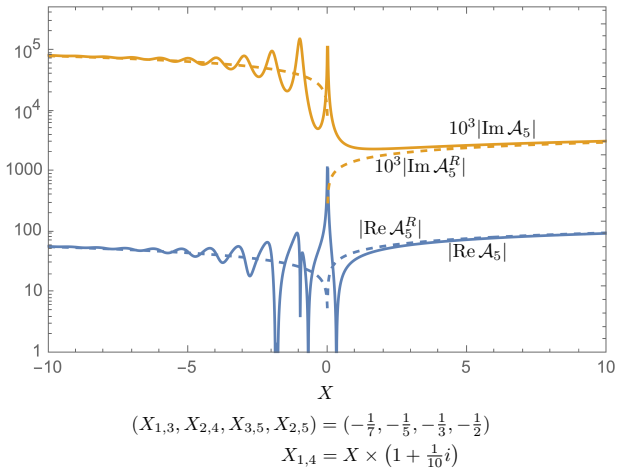
The paper's central claim is that the five-point tree-level open string amplitude admits a complete representation valid for all Mandelstam invariants, not just in the wedge where the Koba-Nielsen integral converges. The conventional expression in terms of a 3F2 hypergeometric function only converges when one particular kinematic variable is positive, and the cyclic and Thomae-transformed relatives cover almost all but not all of kinematic space. Using Whipple's identity, the authors rewrite the amplitude as a 6F5 hypergeometric function at unit minus argument, dressed by gamma-function prefactors that make every physical pole manifest. They state that this is the first complete representation of the five-point string amplitude, and they verify numerically that it agrees with all previously convergent forms where those forms apply while extending into the remaining wedge where every planar invariant is negative.
Load-bearing premise
The five-point claim rests on the assumption that the new hypergeometric series converges for every possible choice of the scattering invariants outside a measure-zero set, with the paper offering numerical verification rather than a proof of this convergence.
Editorial extensions
If this is right
- Five-point open string amplitudes can be evaluated numerically for any real or complex kinematics, including physical 2 to 3 scattering and unphysical kinematics used in bootstrap studies.
- Massive factorization is now explicit at general level: the residue on any massive pole is a sum over lower-point massless amplitudes evaluated at shifted kinematics.
- Generalized Regge limits produce precise asymptotic formulas in which the amplitude factorizes into lower-point amplitudes even away from poles, and these match numerical evaluation.
- The new series representations, both the u-in-terms-of-u sums and the dual-resonant expansions, converge in regions far wider than the original integral representation and express the n-point amplitude as sums over shifted lower-point amplitudes.
- A dual-resonant representation of the amplitude at any multiplicity follows directly from the Regge behavior, with residues given by massive factorization on a triangulation.
Reading between the lines
- If Eq. (95) is right, finding a conceptual derivation of Whipple's identity would likely be the key to extending all-kinematics closed forms to six and higher points, since the paper shows Thomae-type splitting alone only works on restricted kinematics at higher multiplicity.
- If the asserted everywhere-convergence of the 6F5 series can be proved rigorously, the five-point result becomes a theorem rather than a numerically supported formula, and the same convergence technology may apply to other stringy integrals.
- The exponential-suppression formulas suggest a clean large-n limit of string amplitudes at fixed large X, and the paper hints that this limit should be universal, but it does not develop that direction.
- The new exact identities among amplitudes at related kinematic points could be used as additional crossing-type constraints in amplitude bootstrap programs.
Editorial analysis
A structured set of objections, weighed in public.
Referee Report
Summary. This paper develops the u-variable/y-variable formulation of tree-level open string amplitudes to obtain new structural results and representations. It derives explicit massive factorization residues in terms of lower-point massless amplitudes with shifted kinematics (Sec. 3), analyzes exponential and generalized-Regge asymptotics (Sec. 4), constructs new series and dual-resonant representations with extended convergence domains (Sec. 5), and derives a closed-form expression for the five-point amplitude as a 6F5 hypergeometric function (Eq. (95)). The central claim is that Eq. (95) provides, for the first time, an expression for the five-point string amplitude that can be evaluated for arbitrary Mandelstam invariants.
Significance. If established, the five-point result closes a long-standing analytic-continuation gap for n=5, directly analogous to the Euler beta function at four points. The massive-factorization formulas and the generalized Regge/hard-scattering asymptotics are new and likely to be useful for further studies of string amplitudes, and the numerical checks included in Sec. 7 provide nontrivial support for the algebraic derivations. The paper also gives a conceptual, split-factorization explanation of the Thomae transformations, which is a valuable contribution. The main weakness is that the flagship all-kinematics claim rests on a convergence assertion for a 6F5 series that is not proven and, as stated, is not correct for the literal defining power series.
major comments (1)
- [6.2, Eq. (95)] The statement that the 6F5 representation (95) 'converges everywhere' is not correct as a literal statement about the defining power series. For a generalized hypergeometric series at z=-1, the kth term grows as k^{Σa_i - Σb_i - 1}. Reading the parameters from Eq. (95) gives Σb_i - Σa_i = 2X_{1,3} + 2X_{2,5} - (X_{2,4} + X_{3,5} + X_{1,4}). Taking all five planar invariants equal to t = -1.9 — an ordinary point with no physical pole and not excluded by the paper's stated caveat, since X_{2,4}+X_{3,5}+X_{1,4} = -5.7 is not a negative integer — the exponent becomes -t - 1 = 0.9, so the terms of the defining series grow without bound and the series diverges. The paper's justification, 'As one can numerically verify' (Sec. 6.2), is not a proof, and no convergence theorem for the 6F5 in this parameter range is cited or supplied. Because Eq. (95) is exactly the object claimed to give the first complete representation of the five-point amplitude for arbitrary Mandelstam invariants, this is a load-bearing gap. Please either prove the actual convergence domain of the series in Eq. (95) and specify the kinematic region it covers, or explicitly define Eq. (95) as an analytic continuation of the 6F5 (for example via the Whipple identity and standard continuation formulas), with a specified branch and a proof that this continuation equals the five-point amplitude throughout kinematic space.
minor comments (5)
- [1] The word 'worldhseet' should be 'worldsheet' in the sentence 'Instead of the conventional worldhseet expressions'.
- [4.1.1] The phrase 'n depedence' should be 'n dependence' in the discussion of the large-n prefactor.
- [7.2] There is a duplicated word in 'let us evaluate evaluate Eq. (68)'; one 'evaluate' should be removed.
- [Eq. (32)] The notation 'nk' for the multiplicity is easily confused with the product n·k; please use an explicit subscript, e.g., n_k, to avoid ambiguity.
- [5.1] The heading 'Solving for u’s in terms of u’s' is confusing because the same symbol u appears on both sides; a more descriptive title such as 'Solving for u variables in terms of a maximal subset of u variables' would be clearer.
Circularity Check
No significant circularity: the new five-point and n-point formulas are derived from the KN/u-variable representation and standard hypergeometric identities, with external numerical cross-checks; the convergence caveat in Sec. 6.2 is a support gap, not a circular reduction.
full rationale
The derivation chain starts from the Koba-Nielsen integral in u variables (Eqs. (5)-(8)) and proceeds by explicit manipulation: massive residues are computed by binomial expansion of F polynomials (Sec. 3); asymptotics are obtained from saddle points on the u equations (Sec. 4); new series follow by solving u equations or by recursion (Sec. 5); and the five-point formula (95) is obtained by applying the external Whipple identity (94) to the 3F2 representation (88)/(93). None of these steps defines the target amplitude in terms of the conclusions drawn from it, and no fitted parameter is relabeled as a prediction. The self-citations (e.g., Ref. [11] for uniqueness of the scattering-equation saddle and Ref. [17] for split factorization) are prior parameter-free mathematical results with stated assumptions; under the review rules these are real evidence and do not constitute circularity. The only flagged weakness is non-circular: Sec. 6.2 asserts that Eq. (95) 'converges everywhere' with the justification 'As one can numerically verify' rather than a convergence proof; as noted in the skeptic summary, the 6F5 power series at -1 may diverge at ordinary points such as all planar invariants equal to -1.9. That is an unsupported analytic-continuation claim affecting the 'first complete representation' statement, but it is a correctness/rigor issue, not a circular argument.
Assumptions & free parameters
assumptions (4)
- domain assumption The u equations (6) and the positive y-parameterization with F polynomials describe the full n-point string integrand.
- domain assumption The uniqueness of the positive solution of the scattering equations for nonnegative X and c variables (Ref. [11]) is used to identify the hard-scattering saddle point.
- standard math Classical hypergeometric identities (Thomae, Whipple) are valid and applicable to the 3F2/6F5 forms of the amplitude.
- domain assumption The 'split factorization' of amplitudes away from poles (Ref. [17]) holds and is used to explain Thomae transformations.
Cite this review
Pith. "Pith review of Open String Amplitudes: Singularities, Asymptotics, and New Representations." pith.science (2026). https://pith.science/paper/OIVSXHNS
@misc{pith2026241220639,
  author       = {Pith},
  title        = {Pith review of: Open String Amplitudes: Singularities, Asymptotics, and New Representations},
  year         = {2026},
  howpublished = {\url{https://pith.science/paper/OIVSXHNS}},
  note         = {Machine review of arXiv:2412.20639}
}
abstract
Open string amplitudes at tree level have been studied for over fifty years, but there is no known analytic form for general $n$-point amplitudes, and their conventional representation in terms of worldsheet integrals does not make many of their most basic physical properties manifest. Recently, a formulation of these amplitudes exposing the underlying "binary geometry" via the use of "$u$" variables has given us many insights into their basic features. In this paper, we initiate a systematic exploration of fundamental aspects of open string amplitudes from this new point of view. We begin by giving explicit expressions for the factorization of amplitudes at general massive levels. We then study the asymptotic behavior when subsets of kinematic variables become large, delineating regimes with exponential (generalized hard scattering) and power-law (generalized Regge) behavior. We also give precise expressions for the asymptotics, which reveal another example of the recently observed property of factorization away from poles. We finally derive new recursion relations and infinite series representations for the amplitude, and for five points, we present a new closed-form expression for the amplitude that for the first time gives its analytic continuation to all of kinematic space.
Figures


Figures from the paper (14 more)




Forward citations
Cited by 3 Pith papers
-
Strings from Almost Nothing
Ultrasoft, minimally structured scattering amplitudes are forced onto the Veneziano and Virasoro-Shapiro amplitudes of string theory.
-
Higher-Spin and Higher-Point Constraints on Stringy Amplitudes
Factorization at the second excited mass level forces the Regge intercept to the bosonic string value, and large-level multipositivity bounds forbid the simplest Gross satellite deformation of four-point superstring a...
-
Worldsheet for Generalized Veneziano Amplitudes
A chiral composite linear dilaton worldsheet action reproduces Mandelstam's generalized Veneziano amplitudes and yields new partially crossing-symmetric higher-point and closed-string amplitudes.
Reference graph
Works this paper leans on
-
[1]
Y. Nambu, “Duality and Hadrodynamics,” 1970. Notes prepared for the Copen- hagen High Energy Symposium
work page 1970
-
[2]
An almost physical interpretation of the integrand of then-point Veneziano model,
H. B. Nielsen, “An almost physical interpretation of the integrand of then-point Veneziano model,” 1970. Nordita preprint
work page 1970
-
[3]
Structure of Hadrons Implied by Duality,
L. Susskind, “Structure of Hadrons Implied by Duality,”Phys. Rev. D1 (1970) 1182
work page 1970
-
[4]
Construction of a crossing-symmetric, Regge behaved amplitude for linearly rising trajectories,
G. Veneziano, “Construction of a crossing-symmetric, Regge behaved amplitude for linearly rising trajectories,”Nuovo Cim. A57 (1968) 190
work page 1968
-
[5]
Hidden zeros for particle/string amplitudes and the unity of colored scalars, pions and gluons,
N. Arkani-Hamed, Q. Cao, J. Dong, C. Figueiredo, and S. He, “Hidden zeros for particle/string amplitudes and the unity of colored scalars, pions and gluons,” arXiv:2312.16282 [hep-th]
-
[6]
Reaction amplitude forn-mesons: A generalization of the Veneziano-Bardakçi-Ruegg-Virasoro model,
Z. Koba and H. B. Nielsen, “Reaction amplitude forn-mesons: A generalization of the Veneziano-Bardakçi-Ruegg-Virasoro model,”Nucl. Phys. B10 (1969) 633
work page 1969
-
[7]
High-energy behaviour of the Bardakçi-Ruegg ampli- tude,
A. Białas and S. Pokorski, “High-energy behaviour of the Bardakçi-Ruegg ampli- tude,” Nucl. Phys. B10 (1969) 399
work page 1969
-
[8]
Six gluon open superstring disk amplitude, multiple hypergeometric series and Euler-Zagier sums,
D. Oprisa and S. Stieberger, “Six gluon open superstring disk amplitude, multiple hypergeometric series and Euler-Zagier sums,”arXiv:hep-th/0509042. 51
Show all 45 references
-
[9]
Binary geometries, general- ized particles and strings, and cluster algebras,
N. Arkani-Hamed, S. He, T. Lam, and H. Thomas, “Binary geometries, general- ized particles and strings, and cluster algebras,”Phys. Rev. D107 (2023) 066015, arXiv:1912.11764 [hep-th]
2023 arXiv
-
[10]
All Loop Scattering as a Counting Problem,
N. Arkani-Hamed, H. Frost, G. Salvatori, P.-G. Plamondon, and H. Thomas, “All Loop Scattering as a Counting Problem,”arXiv:2309.15913 [hep-th]
-
[11]
Stringy canonical forms,
N. Arkani-Hamed, S. He, and T. Lam, “Stringy canonical forms,”JHEP 02 (2021) 069, arXiv:1912.08707 [hep-th]
2021 arXiv
-
[12]
Scalar-Scaffolded Gluons and the Combinatorial Origins of Yang-Mills Theory,
N. Arkani-Hamed, Q. Cao, J. Dong, C. Figueiredo, and S. He, “Scalar-Scaffolded Gluons and the Combinatorial Origins of Yang-Mills Theory,”arXiv:2401.00041 [hep-th]
-
[13]
Reggeized resonance model for the production ampli- tude,
K. Bardakçi and H. Ruegg, “Reggeized resonance model for the production ampli- tude,” Phys. Lett. B28 (1968) 342
1968
-
[14]
Explicit construction of theN-point function in the generalized Veneziano model,
H.-M. Chan and S. T. Tsou, “Explicit construction of theN-point function in the generalized Veneziano model,”Phys. Lett. B28 (1969) 485
1969
-
[15]
Factorization and the generalized Veneziano model with satellites,
D. J. Gross, “Factorization and the generalized Veneziano model with satellites,” Nucl. Phys. B13 (1969) 467
1969
-
[16]
Multiparticle Factorization and the Rigidity of String Theory,
N. Arkani-Hamed, C. Cheung, C. Figueiredo, and G. N. Remmen, “Multiparticle Factorization and the Rigidity of String Theory,”Phys. Rev. Lett.132 no. 9, (2024) 091601, arXiv:2312.07652 [hep-th]
2024 arXiv
-
[17]
All-order splits and multi-soft limits for particle and string amplitudes,
N. Arkani-Hamed and C. Figueiredo, “All-order splits and multi-soft limits for particle and string amplitudes,”arXiv:2405.09608 [hep-th]
-
[18]
Evaluating one-loop string amplitudes,
L. Eberhardt and S. Mizera, “Evaluating one-loop string amplitudes,”SciPost Phys. 15 (2023) 119, arXiv:2302.12733 [hep-th]
2023 arXiv
-
[19]
Unitarity cuts of the worldsheet,
L. Eberhardt and S. Mizera, “Unitarity cuts of the worldsheet,”SciPost Phys.14 (2023) 015, arXiv:2208.12233 [hep-th]
2023 arXiv
-
[20]
String Theory Beyond the Planck Scale,
D. J. Gross and P. F. Mende, “String Theory Beyond the Planck Scale,”Nucl. Phys. B 303 (1988) 407
1988
-
[21]
The High-Energy Behavior of String Scattering Amplitudes,
D. J. Gross and P. F. Mende, “The High-Energy Behavior of String Scattering Amplitudes,” Phys. Lett. B197 (1987) 129. 52
1987
-
[22]
Borel Summation of String Theory for Planck Scale Scattering,
P. F. Mende and H. Ooguri, “Borel Summation of String Theory for Planck Scale Scattering,” Nucl. Phys. B339 (1990) 641
1990
-
[23]
Glimpses of black hole forma- tion/evaporation in highly inelastic, ultra-planckian string collisions,
A. Addazi, M. Bianchi, and G. Veneziano, “Glimpses of black hole forma- tion/evaporation in highly inelastic, ultra-planckian string collisions,” JHEP 02 (2017) 111, arXiv:1611.03643 [hep-th]
2017 arXiv
-
[24]
Black hole forma- tion and classicalization in ultra-Planckian2→N scattering,
G. Dvali, C. Gomez, R. S. Isermann, D. Lüst, and S. Stieberger, “Black hole forma- tion and classicalization in ultra-Planckian2→N scattering,” Nucl. Phys. B893 (2015) 187, arXiv:1409.7405 [hep-th]
2015 arXiv
-
[25]
Stringy dynamics from an amplitudes bootstrap,
C. Cheung and G. N. Remmen, “Stringy dynamics from an amplitudes bootstrap,” Phys. Rev. D108 (2023) 026011, arXiv:2302.12263 [hep-th]
2023 arXiv
-
[26]
Bespoke dual resonance,
C. Cheung and G. N. Remmen, “Bespoke dual resonance,”Phys. Rev. D108 (2023) 086009, arXiv:2308.03833 [hep-th]
2023 arXiv
-
[27]
Uniqueness of the Veneziano representation,
D. D. Coon, “Uniqueness of the Veneziano representation,”Phys. Lett. B29 (1969) 669
1969
-
[28]
The Stringy S-matrix Bootstrap: Maximal Spin and Superpolynomial Softness,
K. Häring and A. Zhiboedov, “The Stringy S-matrix Bootstrap: Maximal Spin and Superpolynomial Softness,” arXiv:2311.13631 [hep-th]
-
[29]
Strings from Massive Higher Spins: The Asymptotic Uniqueness of the Veneziano Amplitude,
S. Caron-Huot, Z. Komargodski, A. Sever, and A. Zhiboedov, “Strings from Massive Higher Spins: The Asymptotic Uniqueness of the Veneziano Amplitude,”JHEP 10 (2017) 026, arXiv:1607.04253 [hep-th]
2017 arXiv
-
[30]
A Bootstrap Principle for the Spec- trum and Scattering of Strings,
C. Cheung, A. Hillman, and G. N. Remmen, “A Bootstrap Principle for the Spec- trum and Scattering of Strings,”arXiv:2406.02665 [hep-th]
-
[31]
Uniqueness Criteria for the Virasoro- Shapiro Amplitude,
C. Cheung, A. Hillman, and G. N. Remmen, “Uniqueness Criteria for the Virasoro- Shapiro Amplitude,” arXiv:2408.03362 [hep-th]
-
[32]
Scattering Forms and the Posi- tive Geometry of Kinematics, Color and the Worldsheet,
N. Arkani-Hamed, Y. Bai, S. He, and G. Yan, “Scattering Forms and the Posi- tive Geometry of Kinematics, Color and the Worldsheet,”JHEP 05 (2018) 096, arXiv:1711.09102 [hep-th]
2018 arXiv
-
[33]
All Loop Scattering For All Multiplicity,
N. Arkani-Hamed, H. Frost, G. Salvatori, P.-G. Plamondon, and H. Thomas, “All Loop Scattering For All Multiplicity,”arXiv:2311.09284 [hep-th]
-
[34]
Tropical Amplitudes For Colored Lagrangians,
N. Arkani-Hamed, C. Figueiredo, H. Frost, and G. Salvatori, “Tropical Amplitudes For Colored Lagrangians,”arXiv:2402.06719 [hep-th] . 53
-
[35]
The Feynman iϵ in String Theory,
E. Witten, “The Feynman iϵ in String Theory,” JHEP 04 (2015) 055, arXiv:1307.5124 [hep-th]
2015 arXiv
-
[36]
Lorentzian contours for tree-level string amplitudes,
L. Eberhardt and S. Mizera, “Lorentzian contours for tree-level string amplitudes,” SciPost Phys.17 (2024) 078, arXiv:2403.07051 [hep-th]
2024 arXiv
-
[37]
Regge Limit of One-Loop String Am- plitudes,
P. Banerjee, L. Eberhardt, and S. Mizera, “Regge Limit of One-Loop String Am- plitudes,” arXiv:2403.07064 [hep-th]
-
[38]
Theiε-Prescription for String Amplitudes and Reg- ularized Modular Integrals,
J. Manschot and Z.-Z. Wang, “Theiε-Prescription for String Amplitudes and Reg- ularized Modular Integrals,”arXiv:2411.02517 [hep-th]
-
[39]
Crossing-symmetric decomposition of the five-point and six-point Veneziano formulas into tree-graph integrals,
N. Nakanishi, “Crossing-symmetric decomposition of the five-point and six-point Veneziano formulas into tree-graph integrals,”Prog. Theor. Phys.45 (1971) 436
1971
-
[40]
Integral representations for the complete four- and five-point Veneziano amplitudes,
D. B. Fairlie and K. Jones, “Integral representations for the complete four- and five-point Veneziano amplitudes,”Nucl. Phys. B15 (1970) 323
1970
-
[41]
On Hypergeometric 3F2(1)—A Review,
M. Milgram, “On Hypergeometric 3F2(1)—A Review,” arXiv:1011.4546 [math.CA]
-
[42]
W. N. Bailey, Generalized Hypergeometric Series. Cambridge University Press, 1935
1935
-
[43]
Ueber die Functionen, welche durch Reihen von der Form dargestellt werden 1 + p 1 p′ q′ p′′ q′′ + p 1 p+1 2 p′ q′ p′+1 q′+1 p′′ q′′ p′′+1 q′′+1 +··· ,
J. Thomae, “Ueber die Functionen, welche durch Reihen von der Form dargestellt werden 1 + p 1 p′ q′ p′′ q′′ + p 1 p+1 2 p′ q′ p′+1 q′+1 p′′ q′′ p′′+1 q′′+1 +··· ,” J. für Math.87 (1879) 26
-
[44]
Multiple zeta values and periods of moduli spaces M0,n(R),
F. C. S. Brown, “Multiple zeta values and periods of moduli spaces M0,n(R),” Annales Sci. Ecole Norm. Sup.42 (2009) 371, arXiv:math/0606419
2009 arXiv
-
[45]
Well-Poised Series and Other Generalized Hypergeometrtc Se- ries,
F. J. W. Whipple, “Well-Poised Series and Other Generalized Hypergeometrtc Se- ries,” Proc. London Math. Soc.S2-25 (1926) 525. 54
1926
Reviewed August 10, 2026 · model on record in the stance chip above.
Discussion (0). Continue with ORCID to comment.