REVIEW 4 major objections 6 minor 26 references
Pathways to proton's stability via naturally small neutrino masses
T0 review · 4 major / 6 minor · reviewed 2026-08-10 · deepseek-v4-flash
Pith's one-line read This paper proposes that the tiny size of neutrino masses and the great stability of the proton are two faces of one mechanism, and it builds three explicit particle models in which each effect implies the other.
desk verdict A useful taxonomy and one plausible model, with the central new claim in Model 2 still unverified. read the letter →
The pith
A machine-rendered reading of the paper's core claim, the machinery that carries it, and where it could break.
The reading
What carries the argument
The working parts are scalar leptoquarks—particles that couple quarks to leptons—and the loop-level effective operators they generate. The central identity is the dimension-five Weinberg operator for Majorana neutrino mass, produced radiatively in each model. In the common-origin model, a $Z_2$-odd dark fermion $N$ and the leptoquark $\tilde R_{2D}$ sit in both the one-loop neutrino-mass diagram and the one-loop proton-decay box, making one source responsible for both. In the proton-decay-as-source model, two $S_3$ leptoquarks with different charges under a softly broken global $U(1)_F$ ($F=3B-L$) close a three-loop Weinberg diagram, so the neutrino mass operator exists only because the proton-decay operator exists. In the neutrino-mass-as-source model, the leptoquark $\bar S_1$ couples only to neutrino singlets and the leptoquark $R_2$ has only leptoquark couplings, which together force all leading proton-decay channels to be proportional to a Dirac neutrino mass; a seesaw-scale sterile neutrino makes the otherwise dangerous $\bar S_1$-mediated channel kinematically forbidden.
What would settle it
Compute the three-loop diagram of Fig. 2b in the second model and check convergence and numerical size; if it diverges or is subdominant, the claimed link between proton decay and neutrino mass fails. For the third model, search for a proton decay channel whose amplitude does not vanish as the light neutrino masses go to zero—for instance a $\bar S_1$-mediated channel with a light neutrino or an $R_2$-mediated dimension-nine operator—since finding such a channel at observable rate would falsify the correlation.
Extended reading notes
Core claim
On its own terms, the paper's discovery is a family of correlations rather than a single model: both the suppression of proton decay rates and the smallness of neutrino masses originate from the same mediators circulating inside loops. In the first model, an extended scotogenic sector with a dark fermion $N$, a heavy quark $D$, and a leptoquark $\tilde R_{2D}$ generates the neutrino mass and the $p\to e^+\pi^0$, $p\to \nu_\alpha\pi^+$ operators at one loop, correlating dark-matter mass, neutrino mass, and proton lifetime. In the second model, two copies of the $S_3$ leptoquark with a softly broken global $U(1)_F$ symmetry convert proton decay into a three-loop Weinberg operator for neutrino mass, so switching off proton decay makes neutrinos massless. In the third model, the leptoquarks $\bar S_1$ and $R_2$ together with seesaw-scale sterile neutrinos make every leading proton decay amplitude proportional to a light neutrino mass, so massless neutrinos imply a stable proton. The paper gives the decay widths for these channels using lattice matrix elements and discusses constraints from lepton flavor violation, leptoquark searches, and dark matter.
Load-bearing premise
The argument rests on the displayed loop diagrams being the complete dominant contributions: no uncalculated operator may generate neutrino mass or proton decay independently, the three-loop integral in the second model must converge and dominate, and no other baryon-number-violating operator in the third model can be lower-order than the neutrino-mass-proportional ones.
Editorial extensions
If this is right
- In the common-origin model, the dark matter mass, the neutrino masses, and the proton decay width are set by the same couplings, so measuring any two of these observables determines the third.
- In the second model, a stable proton implies exactly massless neutrinos, so the observed nonzero neutrino mass would force proton decay to occur at some level.
- In the third model, proton decay into neutrino final states must carry missing energy, while charged-antilepton channels are loop-suppressed; this gives a signature that upcoming proton decay searches can look for.
- In all three models the new particles are leptoquarks and new fermions, so collider searches for leptoquarks and lepton-flavor-violating processes provide indirect tests of the correlation.
Reading between the lines
- The paper leaves the three-loop integral of the second model unevaluated; computing it and checking convergence and magnitude would settle whether the neutrino mass is truly dominated by the proton-decay operator.
- A natural extension is a global fit that scans each model's parameter space against proton-lifetime bounds, neutrino oscillation data, and lepton-flavor-violation limits at once; the paper gives analytic widths but no such scan.
- If the logic is embedded in a grand unified theory (GUT), proton decay and neutrino mass would inherit one common origin from unification, giving a new class of GUT models distinct from the usual $SU(5)$, $SO(10)$, or $E_6$ frameworks.
- The three models have distinguishable phenomenology: common-origin ties dark matter to decay, decay-as-source predicts neutrinos only via baryon number violation, and mass-as-source predicts missing-energy channels; a signature-level comparison could tell them apart.
Editorial analysis
A structured set of objections, weighed in public.
Referee Report
Summary. This paper proposes that the smallness of neutrino masses and the longevity of the proton can share a common dynamical origin, and it presents three UV-complete models corresponding to three causal directions: (i) a common origin through an extended scotogenic dark sector; (ii) neutrino mass generated from a proton-decay operator through a three-loop Weinberg operator in a model with two S3 leptoquarks and a global U(1)_F symmetry; and (iii) proton decay suppressed by the small neutrino mass through S1bar and R2 leptoquarks together with a seesaw sterile neutrino. For each model the authors give Lagrangians, field content, and expressions for proton decay widths, and they discuss constraints from charged-lepton flavor violation, leptoquark searches, and dark matter. The advertised link is that when the relevant source coupling or mass vanishes, both the neutrino mass and the proton decay width vanish.
Significance. If all three constructions work, the paper would provide an attractive conceptual bridge between neutrino mass generation and proton stability, with model 1 additionally connecting to dark matter and model 3 offering a relatively compact realization. The paper is not circular: no parameters are fitted to observables, and the Lagrangians and width formulas in Eqs. (1), (5), (7), (2), (6), and (8) are explicit enough to be checked. However, the evidence is uneven. Model 2, which is the only realization of the 'neutrino mass from proton stability' direction, lacks the key three-loop computation; no numerical parameter point is checked against proton lifetime or neutrino-mass bounds for any model; and the suppression of R2 contributions in model 3 rests on an unlisted operator. The conceptual idea is valuable, but the manuscript as it stands demonstrates a proof of concept rather than a complete verification of the central claims.
major comments (4)
- [Sec. 3.2, Fig. 2b] The model-2 realization of the second causal direction depends entirely on the claim that Fig. 2b generates a three-loop Weinberg operator, but no three-loop integral, loop function, or magnitude estimate is given anywhere in the paper. Section 3.2 instead states that the correlation between neutrino mass and proton decay, including the relative contribution of the two decay channels, 'will be studied elsewhere.' Consequently the central statement that in the limit m3 -> 0 and lambda_HSS -> 0 the neutrino mass vanishes is not demonstrated: finiteness, convergence, dominance over other topologies, and consistency with m_nu ~ 0.05 eV are all open.
- [Sec. 3.2, Eq. (5)] No operator-counting argument rules out lower-loop neutrino mass contributions from the same field content. With the Yukawa terms Y'_1 Q L S3 and Y'_2 Q Q S'^dagger_3 and the soft mixing m3^2 S3^dagger S'_3, the paper does not show that the lowest-order LLHH operator is necessarily three-loop, nor does it discuss whether subdivergences of Fig. 2b require a neutrino-mass counterterm that would spoil the advertised proportionality to m3 and lambda_HSS. This is load-bearing because model 2 is the only model for the 'neutrino mass from proton stability' direction.
- [Sec. 3.2, Eq. (6a); Sec. 4] Even the model-2 proton width is not numerically usable: the matrix element W_0(p -> e+ nu nu) is explicitly stated to be 'to be computed on the lattice,' no value is provided, and no parameter point is checked against the proton lifetime bound or against neutrino-mass observables. Section 4 lists leptoquark mass bounds and CLFV constraints qualitatively but does not apply them to any benchmark point, so the paper does not establish that a viable parameter region exists for any of the three models.
- [Sec. 3.3, footnote [11]] The model-3 claim that R2 does not contribute to proton decay at leading order rests on an unlisted dimension-10 operator lambda M^{-6} R2 R2 R2 (H^dagger)^7. This operator is not present in Eq. (7b), and no derivation is given for why it is the leading R2 contribution or why its combination with the S1bar couplings cannot generate a competing neutrino-mass-independent proton decay amplitude. Because the dominance of the neutrino-mass-proportional channels is the central assertion of this model, this step needs to be either derived explicitly or replaced by a systematic operator analysis.
minor comments (6)
- [Eqs. (5b), (6a)] The mass scale M in the dimension-five term (lambda_HSS/M) H^dagger H^dagger S3 S3 S3 is never defined, and the mass dimension of lambda_HSS is therefore ambiguous; please define M and use it consistently in the width formula.
- [Eq. (8b)] Please clarify whether the factor involving m_nu and M_N is sqrt(m_nu/M_N) or m_nu/M_N; the text says the decay amplitude is proportional to m_nu, in which case the width should scale as m_nu^2, not as m_nu.
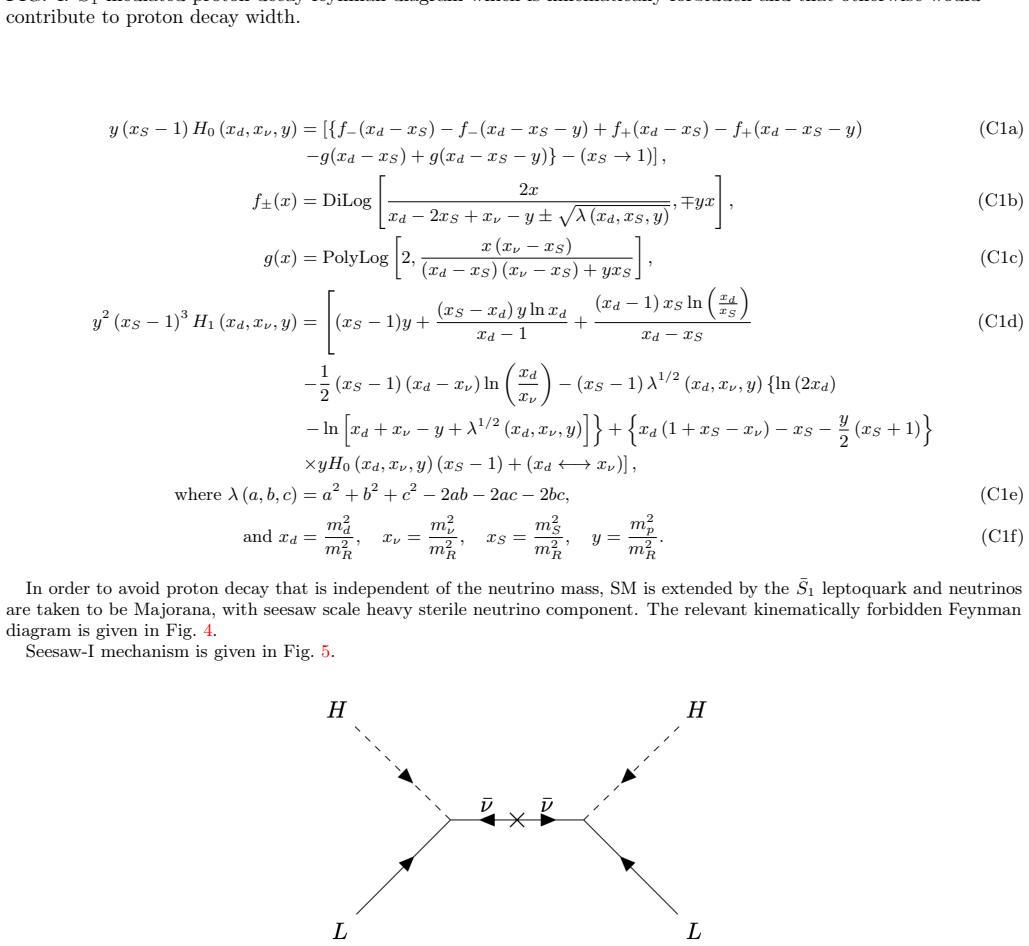
- [Appendix D] The DiLog and PolyLog approximations are quoted without derivation or a statement of the ranges of x_d, x_nu, x_S, and y in which they are used; please add a validation or cite the relevant formulas for the kinematic region relevant to proton decay.
- [Sec. 3.1] Since the detailed study of the extended scotogenic model is already given in Ref. [9], please state explicitly what is new in this section relative to that paper.
- [Throughout] The manuscript repeatedly refers to tables and figures in the supplementary materials without including them in the main text; please ensure that the main text is self-contained for the key definitions, or clearly mark the supplementary material as appendices.
- [Eq. (2)] Equation (2) is very difficult to read because of the notation for flavor indices and mass insertions (Y1a, Y^ab_N, Y^b1, etc.); please rewrite with explicit contractions or add a short explanatory sentence.
Circularity Check
No circularity found: the three links are explicit model constructions, not fits; the only overlapping-author citation is not load-bearing.
full rationale
This paper does not fit any parameter to data and then present that fit as a prediction. Each section is an explicit UV model construction: a Lagrangian is written, and the decay widths and neutrino-mass formulas are read off the stated Feynman diagrams. In Model 3 (Sec. 3.3), the statement that the proton decay amplitude is proportional to m_nu is the matrix element of a graph containing a neutrino mass insertion; the proportionality is a computed property of the chosen Lagrangian, not an input that was used to fix the model. In Model 2 (Sec. 3.2), the claim that neutrino masses vanish when m3 and lambda_HSS go to zero is asserted from the topology of the three-loop Weinberg operator in Fig. 2b, but the three-loop integral is never evaluated and the paper explicitly defers the quantitative correlation ("will be studied elsewhere"). That is an omitted proof, not a circular reduction: the neutrino mass is neither defined to equal the proton decay width nor fitted from it. The only overlapping-author citation is [9] (Nomura and Popov), used in Sec. 3.1 for the "Detailed study of this construction and its consequences"; the present paper itself contains the Lagrangian, the one-loop neutrino mass formula, the proton decay width formula, and the loop functions, so the argument does not reduce to that self-citation. The uniqueness assertion for the S1bar leptoquark in Sec. 3.3 is an unsupported claim but no uniqueness theorem from prior work is imported. No experimental number is predicted from a fitted parameter, so the fitted-input-called-prediction and self-definitional patterns are absent. The paper's real weakness is incompleteness of the Model 2 loop calculation, which is a correctness risk rather than a circularity.
Assumptions & free parameters
free parameters (6)
- Yukawa couplings Y1...Y5 (model 1) =
not numerically fitted
- Yukawa couplings Y'1, Y'2 (model 2) =
not numerically fitted
- Yukawa couplings Y''1...Y''5 (model 3) =
not numerically fitted
- Leptoquark and dark-sector masses m_R, m_S, m_S3, m_S'3, M_N, M_D =
not fixed; TeV-scale assumed
- Soft U(1)_F breaking parameter m3 =
not fixed
- Scalar couplings lambda_HSS, lambda_3R, mu_HRS =
not fixed
assumptions (7)
- standard math SM gauge structure and particle content are valid up to the new physics scale
- domain assumption The scalar leptoquark extensions with the listed quantum numbers are consistent and renormalizable
- domain assumption Lattice proton decay matrix elements from Aoki et al. [8] and the parity relations are correct
- domain assumption Seesaw-I with M_N around 10^12 GeV gives the tiny neutrino masses in model 3
- ad hoc to paper The shown loop diagrams dominate over all other proton decay and neutrino mass operators
- ad hoc to paper The three-loop Weinberg diagram of model 2 is finite and calculable as drawn
- ad hoc to paper The DiLog and PolyLog approximations in Appendix D are valid in the relevant kinematic ranges
invented entities (5)
-
Fermionic dark matter N (Z2-odd)
independent evidence
-
EW-singlet D quark and scalar leptoquark R2D (model 1)
independent evidence
-
Two scalar leptoquarks S3 and S'3 with global U(1)_F charges (model 2)
independent evidence
-
Global U(1)_F symmetry with F = 3B - L (model 2)
-
S1bar and R2 leptoquarks plus heavy sterile neutrino N (model 3)
independent evidence
Cite this review
Pith. "Pith review of Pathways to proton's stability via naturally small neutrino masses." pith.science (2026). https://pith.science/paper/RAL5GIAC
@misc{pith2026241220723,
  author       = {Pith},
  title        = {Pith review of: Pathways to proton's stability via naturally small neutrino masses},
  year         = {2026},
  howpublished = {\url{https://pith.science/paper/RAL5GIAC}},
  note         = {Machine review of arXiv:2412.20723}
}
read the original abstract
In the present work, the connection between the smallness of the neutrino masses and the stability of the proton is studied. We analyze this connection from different perspectives: the smallness of neutrino mass and the proton stability originate from the same source, small neutrino masses lead to a long lived proton, and the smallness of the proton decay width as a cause of the naturally small neutrino masses. All the schemes are studied in detail and UV realizations are given. We discuss advantages of each scheme and outline further investigation directions.
Figures


Figures from the paper (6 more)


Reference graph
Works this paper leans on
-
[9]
R. L. Workman et al. Review of Particle Physics.PTEP, 2022:083C01, 2022
2022
-
[11]
Verifiable radiative seesaw mechanism of neutrino mass and dark matter.Phys
Ernest Ma. Verifiable radiative seesaw mechanism of neutrino mass and dark matter.Phys. Rev. D , 73:077301, 2006
work page 2006
-
[1]
INTRODUCTION S tandard model (SM) has been established by numerous experimental tests, yet evidences on neutrino mass via neutrino oscillation, the mystery of dark matter, and baryon asymme- try of the universe call for beyond standard model (BSM) physics. While the proton is considered a stable particle in the renormalizable SM due to the conservation of...
-
[2]
Neutrino mass generation is usually achieved with minimal BSM extension
CONCEPT OF CONNECTION BETWEEN NEUTRINO MASS AND PROTON DECA Y Traditionally, generation of neutrino mass and proton decay have been considered as separate problems in the literature. Neutrino mass generation is usually achieved with minimal BSM extension. In further cases origin of neutrino masses is considered in conjunction with dark matter, cosmologica...
arXiv 2024
-
[3]
1 of the supplementary materials
REALIZA TIONS OF CONNECTION BETWEEN NEUTRINO MASS AND PROTON DECA Y Outlined below are the three UV complete models that connection neutrino mass and proton decay origins ac- cording to the casualty directions depicted in Fig. 1 of the supplementary materials. 3.1. Common origin to smallness of neutrino mass and proton stability In this, extended scotogen...
-
[4]
PHENOMENOLOGICAL AND COSMOLOGICAL CONSTRAINTS 4.1. Lepton Flavor Violation For the extended scotogenic model (first connection), the Yukawa interactionY4LN η† generates charged lepton flavor violating (CLFV) processes,li → ljγ. As studied in [13, 14], the li → ljγ process currently places the most stringent constraints on the parameters of the scotogenic ...
-
[5]
DISCUSSION The connection between the origins of neutrino mass and proton decay establishes a link between lepton and quark sectors of the SM, which requires BSM physics testable at future colliders like FCC, etc. Bridging the gap between quark and lepton sectors naturally calls for leptoquarks, which appear in all three models outlined in the previous se...
-
[6]
CONCLUSION After outlining the three sample models for realizing the correlation between proton lifetime longevity and smallness of the neutrino mass, brief discussion of the idea 7 and future prospective directions was given. We conclude that connection between neutrino mass and proton decay origins is possible and attractive concept. This framework give...
Show all 26 references
-
[7]
Howard Georgi and Sheldon L. Glashow. Unified weak and electromagnetic interactions without neutral currents. Phys. Rev. Lett., 28:1494, 1972
1972
-
[8]
Georgi, Helen R
H. Georgi, Helen R. Quinn, and Steven Weinberg. Hierar- chy of Interactions in Unified Gauge Theories.Phys. Rev. Lett., 33:451–454, 1974
1974
-
[10]
Proton decay and grand unification
Goran Senjanovic. Proton decay and grand unification. AIP Conf. Proc., 1200(1):131–141, 2010
2010
-
[12]
Connect- ing Radiative Neutrino Mass, Neutron-Antineutron Os- cillation, Proton Decay, and Leptogenesis through Dark Matter
Pei-Hong Gu, Ernest Ma, and Utpal Sarkar. Connect- ing Radiative Neutrino Mass, Neutron-Antineutron Os- cillation, Proton Decay, and Leptogenesis through Dark Matter. Phys. Rev. D , 94(11):111701, 2016
2016
-
[13]
Proton decay at one loop.Phys
Juan Carlos Helo, Martin Hirsch, and Toshihiko Ota. Proton decay at one loop.Phys. Rev. D , 99(9):095021, 2019
2019
-
[14]
Improved lattice computation of proton decay matrix elements
Yasumichi Aoki, Taku Izubuchi, Eigo Shintani, and Amar- jit Soni. Improved lattice computation of proton decay matrix elements. Phys. Rev. D , 96(1):014506, 2017
2017
-
[15]
Extended scotogenic model of neutrino mass and proton decay.Phys
Takaaki Nomura and Oleg Popov. Extended scotogenic model of neutrino mass and proton decay.Phys. Rev. D , 110(7):075035, 2024
2024
-
[16]
Doršner, S
I. Doršner, S. Fajfer, A. Greljo, J. F. Kamenik, and N. Košnik. Physics of leptoquarks in precision experiments and at particle colliders.Phys. Rept., 641:1–68, 2016
2016
-
[17]
Resultant, R2 only mediated, proton decay operator is highly sup- pressed due to R2 LQ mass and the final state phase space
The leading order contribution ofR2 leptoquark to the proton decay comes from dim-9 operator generated via dim-10 λM−6R2R2R2 H † 7 scalar coupling. Resultant, R2 only mediated, proton decay operator is highly sup- pressed due to R2 LQ mass and the final state phase space
-
[18]
Y. Aoki, C. Dawson, J. Noaki, and A. Soni. Proton decay matrix elements with domain-wall fermions.Phys. Rev. D, 75:014507, 2007
2007
-
[19]
Lepton Flavor Viola- tion in the Scotogenic Model.JHEP, 01:160, 2014
Takashi Toma and Avelino Vicente. Lepton Flavor Viola- tion in the Scotogenic Model.JHEP, 01:160, 2014
2014
-
[20]
Avelino Vicente and Carlos E. Yaguna. Probing the scoto- genic model with lepton flavor violating processes.JHEP, 02:144, 2015
2015
-
[21]
Charged Lep- ton Flavour Violation: An Experimental and Theoretical Introduction
Lorenzo Calibbi and Giovanni Signorelli. Charged Lep- ton Flavour Violation: An Experimental and Theoretical Introduction. Riv. Nuovo Cim. , 41(2):71–174, 2018
2018
-
[22]
The leptoquark Hunter’s guide: Pair production.JHEP, 10:097, 2017
Bastian Diaz, Martin Schmaltz, and Yi-Ming Zhong. The leptoquark Hunter’s guide: Pair production.JHEP, 10:097, 2017
2017
-
[23]
The leptoquark Hunter’s guide: large coupling.JHEP, 01:132, 2019
Martin Schmaltz and Yi-Ming Zhong. The leptoquark Hunter’s guide: large coupling.JHEP, 01:132, 2019
2019
-
[24]
Leptoquarks in Flavour Physics.EPJ Web Conf., 179:01015, 2018
Dario Müller. Leptoquarks in Flavour Physics.EPJ Web Conf., 179:01015, 2018
2018
-
[25]
Fresh look at the LHC limits on scalar leptoquarks
Arvind Bhaskar, Arijit Das, Tanumoy Mandal, Subhadip Mitra, and Rachit Sharma. Fresh look at the LHC limits on scalar leptoquarks. Phys. Rev. D , 109(5):055018, 2024
2024
-
[26]
TikZ-Feynman: Feynman diagrams with TikZ
Joshua Ellis. TikZ-Feynman: Feynman diagrams with TikZ. Comput. Phys. Commun. , 210:103–123, 2017. 8 Pathways to proton’s stability via naturally small neutrino masses Supplementary Materials All three connection types between neutrino mass and proton decay have their advantag...
2017
Reviewed August 10, 2026 · model on record in the stance chip above.
Discussion (0). Continue with ORCID to comment.