REVIEW 2 major objections 6 minor 1 cited by
Genuine quantum non-Gaussianity and metrological sensitivity of Fock states prepared in a mechanical resonator
T0 review · 2 major / 6 minor · reviewed 2026-08-10 · deepseek-v4-flash
Pith's one-line read The paper reports preparation of mechanical Fock states up to |6> with genuine quantum non-Gaussianity and a displacement sensitivity exceeding that of an ideal Fock |3> state.
desk verdict A solid cQAD advance: genuine QNG up to n=6 and a loss-adjusted metrological benchmark, but both claims sit on one model-dependent readout that deserves scrutiny. read the letter →
The pith
A machine-rendered reading of the paper's core claim, the machinery that carries it, and where it could break.
The reading
What carries the argument
The argument runs on three mechanisms. The first is the resonant-interaction phonon number (RPN) measurement, which initializes the qubit in its excited state, lets it interact with the phonon mode for a variable time, and fits the resulting qubit population oscillations to master-equation basis functions to extract the phonon number distribution $P_n$. The second is the genuine quantum non-Gaussianity criterion $F_{a,n}(\rho) = P_n + a P_{n+1}$, whose threshold $F_n(a)$ is the maximum of this functional over all states of the form a displaced and squeezed mixture of Fock states up to $|n-1\rangle$; exceeding the threshold for any $a$ certifies genuine $n$-phonon QNG, and the use of $P_{n+1}$ makes the test robust to loss. The third is the quantum Fisher information for displacement sensing: an ideal Fock state $|n\rangle$ gives $F_Q = 4(2n+1)$, and the paper computes the classical Fisher information from Fock-basis populations after an amplitude-damping channel, producing a loss-adjusted hierarchy that ranks the prepared states against ideal Fock states under the same decoherence.
What would settle it
A direct check is to reconstruct the same prepared states with an independent measurement, such as displaced-parity Wigner tomography, and compare the resulting phonon number distribution and Fisher information with the RPN-based values; if the independent reconstruction disagrees with the RPN fits beyond the reported uncertainties, or if calibrating the RPN basis on known coherent states changes the extracted $P_n$ values significantly, the central claim would be falsified. A second check would be to prepare a known state (e.g., a coherent state) and verify that the RPN analysis recovers its expected distribution and Fisher information.
Extended reading notes
Core claim
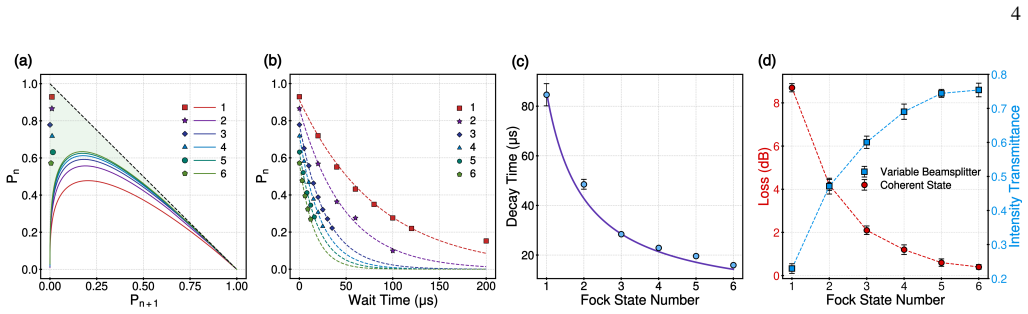
On its own terms, the paper establishes three linked results. First, quantum-optimal-control pulses of a few microseconds prepare Fock states $|1\rangle$ through $|7\rangle$ in the acoustic resonator, with measured fidelities above 75% for states up to $|6\rangle$. Second, a hierarchical criterion for genuine quantum non-Gaussianity—built from the probabilities $P_n$ and $P_{n+1}$ of detecting $n$ and at least $n+1$ phonons, with thresholds optimized over displaced, squeezed mixtures of states with at most $n-1$ phonons—is violated for $n = 1,\dots,6$, so the prepared states cannot be generated by any Gaussian transformation on states containing up to five phonon contributions. Third, when the amplitude-damping channel of the measurement is included in the comparison, the classical Fisher information of the prepared $|6\rangle$ state for estimating a displacement amplitude exceeds that of an ideal Fock $|3\rangle$ state subjected to the same loss, implying a quantum-enhanced force sensitivity beyond the classical limit of $63.2\ \mathrm{fN}/\sqrt{\mathrm{Hz}}$ for the device.
Load-bearing premise
The conclusions rest on the assumption that the resonant-interaction phonon number measurement returns unbiased estimates of the phonon number distribution $P_n$; if the master-equation basis functions mis-model the readout—through an uncalibrated coupling strength, qubit leakage, or a decay channel that is not simple amplitude damping—the extracted $P_n$ values could shift enough to change the QNG certification or the comparison with ideal Fock states.
Editorial extensions
If this is right
- Fock states up to $|6\rangle$ can be prepared in a mechanical resonator with fidelity exceeding 75% using optimal-control pulses shorter than the decoherence time.
- Genuine quantum non-Gaussianity is certified for $n = 1$ to $6$, so the prepared states cannot be produced by Gaussian operations on states with fewer phonons, even when the criterion allows for losses.
- The prepared $|6\rangle$ state, measured through the device's lossy readout, has a higher Fisher information for displacement amplitude than an ideal Fock $|3\rangle$ state under the same amplitude-damping channel.
- Each prepared state can tolerate a quantifiable amount of loss—measured both by simulated free evolution and by an equivalent beamsplitter—before it stops violating its QNG threshold, with higher Fock states losing certification sooner.
- For this device, the sensitivity advantage translates into a quantum-enhanced force sensitivity beyond the classical limit of $63.2\ \mathrm{fN}/\sqrt{\mathrm{Hz}}$.
Reading between the lines
- The loss-adjusted Fisher hierarchy is a platform-independent benchmark: any bosonic mode with a known $T_1$ can be ranked against ideal Fock states under the same damping channel, so the comparison method should transfer to microwave cavities, trapped ions, and optical systems without modification.
- Because the $P_n/P_{n+1}$ QNG criterion can be violated even for states with modest fidelity and purity, it offers a practical acceptance test for non-Gaussian resources in hybrid devices, complementing Wigner-function negativity measurements.
- A testable extension suggested by the method: shortening the RPN readout time (through stronger coupling or a quantum non-demolition measurement) should increase both the highest certifiable Fock number and the metrological advantage, since less amplitude damping would occur during readout.
- The same optimal-control preparation could be directed at superposition states such as $|0\rangle + |n\rangle$ or at two-mode number-difference states, where the Fisher hierarchy would need to be recomputed for the corresponding multi-mode displacement generator.
Signed reviews
Editorial analysis
A structured set of objections, weighed in public.
Referee Report
Summary. This manuscript reports the preparation of Fock states up to |6> in a high-overtone bulk acoustic wave resonator coupled to a superconducting qubit, using quantum optimal control. The states are characterized through resonant-interaction phonon-number (RPN) measurements, and the resulting phonon-number distributions are used to evaluate a robust genuine quantum non-Gaussianity criterion from the literature. The measured {P_n, P_{>= n+1}} points are reported to violate the QNG thresholds for n=1,...,6, and the loss tolerance of the violations is quantified. The same measured distributions are used to compute the classical Fisher information for displacement-amplitude estimation, which is compared with ideal Fock states and with ideal Fock states after an amplitude-damping channel representing measurement loss; from this comparison the authors conclude that the prepared n=6 state has displacement sensitivity better than an ideal Fock |3> state under the same lossy readout. The theoretical tools are previously established, and the experimental platform is described in detail.
Significance. If the central claims are fully supported, this is a significant experimental result: it demonstrates high-order Fock states in a mechanical oscillator, certified by externally defined QNG thresholds rather than by Wigner negativity alone, and it provides a Fisher-information-based metrological benchmark that connects non-Gaussianity to sensing performance. Strengths of the manuscript include the use of parameter-free QNG thresholds, an independently measured phonon T1 in the loss model, the internal consistency of the measured decay times tau_n = tau_1/n with T1, and the explicit inclusion of readout-induced relaxation in the simulations. The principal risk is that both headline claims—the n=6 QNG violation and the metrological advantage over an ideal lossy Fock |3>—are computed from the same model-dependent RPN reconstruction of the phonon-number distribution; the report therefore focuses on validating that reconstruction.
major comments (2)
- [Methods: RPN measurement; Supplement Fig. 8 and Sec. V] The QNG violation for n=6 in Fig. 2(a) and the displacement-sensitivity comparison in Fig. 3(a) are both computed from the phonon-number distribution {P_n} extracted by fitting RPN traces to master-equation basis functions. The manuscript does not provide a systematic-error analysis of this fit: no residuals, no calibration of the coupling g, no explicit test for qubit leakage, spurious near-degenerate modes, detuning errors, or readout assignment errors. Because the n=6 point sits close to a high-n threshold and the FI advantage over the ideal lossy |3> state is a modest margin, an unmodeled readout imperfection could shift the extracted Pn enough to affect both headline conclusions. Please add a systematic-error budget for the fitted {P_n} and an independent cross-check of the absolute scale of the distribution—for example, comparing RPN results with Wigner-tomography-based populations for at least the n=5 and n=6 states—so that the model dependence is demonstrated to be under control.
- [Fig. 2(a); Supplement Fig. 8] The claimed QNG violations are presented graphically without the corresponding numerical values and confidence levels. The supplement states that the error bars come from fitting-function uncertainties, which are statistical only, and the threshold curves become increasingly tight at higher n. Please report the measured {P_n, P_{>= n+1}} values with their statistical and systematic uncertainties for each n and state explicitly the significance (e.g., number of standard deviations) of each threshold violation, in particular for n=6. This information is necessary to establish that the n=6 violation is not an artifact of the fit uncertainties.
minor comments (6)
- [Notation throughout; Fig. 2(a)] Notation: P_{n+1} is used both for the single Fock probability and for the tail probability P_{>= n+1}; please introduce a distinct symbol, e.g., P_{>= n+1}, and use it in the text and in the axes of Fig. 2(a).
- [Supplement Eq. (25)] Supplement Eq. (25): the left-hand side should be Delta F_0 sqrt(T) (or an equivalent statement of the sensitivity in N/sqrt(Hz)), not Delta F_0 sqrt(1/t_cycle); as printed the equation is dimensionally inconsistent.
- [Fig. 2(d)] The two methods used in Fig. 2(d) to quantify QNG depth are the same amplitude-damping model expressed as a wait time and as a beamsplitter transmittance; calling them 'independent' is inaccurate.
- [Abstract; Fig. 3(a)] The abstract and Fig. 3(a) should clarify that the post-loss hierarchy is the classical Fisher information for Fock-basis population measurements, not the quantum Fisher information of the lossy states; Fock-basis measurements are optimal only for the ideal pure Fock states.
- [Fig. 1(a) caption] The caption of Fig. 1(a) should define what is meant by 'fidelity' for each of the four curves (optimizer target, simulated prepared state, simulated measured state, and experimentally measured fidelity).
- [Data availability in main text] Please include a numerical table of the experimental Pn values and the maximum FI values in the main text or supplement, to allow readers to reproduce Figs. 2 and 3 without reading values off the plots.
Circularity Check
No circularity found: QNG thresholds and the Fisher-information hierarchy are parameter-free and rely on independently measured T1; the RPN reconstruction model is a measurement robustness risk, not a circular reduction.
full rationale
The derivation chain is self-contained. The two headline claims—genuine n-phonon QNG up to n=6 and displacement sensitivity exceeding that of an ideal lossy Fock |3>—are both evaluated by comparing experimentally extracted phonon-number probabilities {Pn} against parameter-free theoretical curves. The QNG thresholds Fn(a) are obtained by maximizing the functional Fa,n(ρ)=Pn+aP_{n+1} over the convex hull of Gaussian-displaced-and-squeezed superpositions of Fock states up to |n−1>; no parameter of the threshold is fitted to the measured data. Although the robust-QNG functional and earlier QNG criteria are cited from the same author group (Refs [16–18,26]), they are published theoretical results with stated assumptions that do not include the present experimental data, so they constitute independent support rather than circular input. The metrological claim similarly uses the standard quantum Cramér–Rao bound and classical Fisher information, with the lossy-ideal-Fock hierarchy computed analytically from the independently measured T1 via an amplitude-damping channel; the comparison point for |3> is not fitted to the measured state. The only model dependence—the RPN master-equation basis used to infer {Pn}—is a measurement-model fidelity assumption. A mis-modeled readout could shift the inferred distribution and move points across a threshold, but that is a correctness or robustness risk, not a circular reduction: the thresholds and the loss hierarchy are not defined in terms of the fitted Pn. No equation in the paper is equivalent to its own input by construction.
Assumptions & free parameters
free parameters (2)
- Weight a in the robust QNG criterion Fn(a) =
not fitted; scan parameter
- Phonon-number decay time constants tau_n =
tau_1 = 85(4) microseconds; tau_n = tau_1/n
assumptions (4)
- domain assumption The cQAD system is described by the Jaynes-Cummings-type Hamiltonian in Eq. (1) with a qubit, a phonon mode, and a microwave drive.
- domain assumption Energy relaxation and dephasing are modeled by a Lindblad master equation with collapse operators sqrt(kappa)a and sqrt(2 gamma_phi)a†a, as stated in Supplement II.
- standard math The genuine n-phonon QNG definition in Eqs. (2)-(3) and the threshold Fn(a) computed from it are valid.
- domain assumption The RPN measurement reconstructs the phonon number distribution by fitting qubit population oscillations with simulated basis functions.
Cite this review
Pith. "Pith review of Genuine quantum non-Gaussianity and metrological sensitivity of Fock states prepared in a mechanical resonator." pith.science (2026). https://pith.science/paper/VFLNXNHP
@misc{pith2026241220971,
  author       = {Pith},
  title        = {Pith review of: Genuine quantum non-Gaussianity and metrological sensitivity of Fock states prepared in a mechanical resonator},
  year         = {2026},
  howpublished = {\url{https://pith.science/paper/VFLNXNHP}},
  note         = {Machine review of arXiv:2412.20971}
}
abstract
Fock states of the quantum harmonic oscillator are fundamental to quantum sensing and information processing, serving as key resources for exploiting bosonic degrees of freedom. Here, we prepare high Fock states in a high-overtone bulk acoustic wave resonator (HBAR) by coupling it to a superconducting qubit and applying microwave pulses designed using quantum optimal control. We characterize the experimentally realized states by employing a criterion for genuine quantum non-Gaussianity (QNG) designed to reveal multiphonon contributions. Although energy relaxation and decoherence limit the achievable fidelities, we demonstrate genuine QNG features compatible with Fock state $\vert 6\rangle$, confirming that the prepared states cannot be generated through Gaussian operations on states with up to Fock state $\vert 5\rangle$ contributions. We further investigate the robustness of these QNG features to losses and their utility in sensing displacement amplitudes. In particular, we introduce a hierarchy based on the quantum Fisher information and show that, despite decoherence and measurement imperfections, the prepared states achieve a displacement sensitivity surpassing that of an ideal Fock state $\vert 3\rangle$. Our results have immediate applications in quantum sensing and simulations with HBAR devices.
Figures


Figures from the paper (6 more)


Forward citations
Cited by 1 Pith paper
-
Quantum Phase Estimation Beyond the Gaussian Limit
Optimized asymmetric coherent-state superpositions can surpass the Gaussian bound for single-mode phase estimation, and the advantage persists under weak loss and noise up to a finite average-photon-number threshold.
Reference graph
Works this paper leans on
-
[1]
C. Chamberland, K. Noh, P. Arrangoiz-Arriola, E. T. Campbell, C. T. Hann, J. Iverson, H. Putterman, T. C. Bohdanowicz, S. T. Flammia, A. Keller, et al., PRX Quantum 3, 010329 (2022)
work page 2022
-
[2]
H. Qiao, E. Dumur, G. Andersson, H. Yan, M.-H. Chou, J. Grebel, C. R. Conner, Y . J. Joshi, J. M. Miller, R. G. Povey, X. Wu, and A. N. Cleland, Science 380, 1030 (2023)
work page 2023
-
[3]
U. von L ¨upke, I. C. Rodrigues, Y . Yang, M. Fadel, and Y . Chu, Nature Physics 20, 564 (2024)
work page 2024
- [4]
-
[5]
C. T. Hann, C.-L. Zou, Y . Zhang, Y . Chu, R. J. Schoelkopf, S. M. Girvin, and L. Jiang, Phys. Rev. Lett. 123, 250501 (2019)
work page 2019
-
[6]
B. Schrinski, Y . Yang, U. von L¨upke, M. Bild, Y . Chu, K. Horn- berger, S. Nimmrichter, and M. Fadel, Phys. Rev. Lett. 130, 133604 (2023)
work page 2023
-
[7]
M. Bild, M. Fadel, Y . Yang, U. von L¨upke, P. Martin, A. Bruno, and Y . Chu, Science380, 274 (2023)
work page 2023
- [8]
Show all 32 references
-
[9]
Y . Chu, P. Kharel, T. Yoon, L. Frunzio, P. T. Rakich, and R. J. Schoelkopf, Nature 563, 666 (2018)
2018
-
[10]
von L ¨upke, Y
U. von L ¨upke, Y . Yang, M. Bild, L. Michaud, M. Fadel, and Y . Chu, Nature Physics18, 794 (2022)
2022
-
[11]
F. Wolf, C. Shi, J. C. Heip, M. Gessner, L. Pezz `e, A. Smerzi, M. Schulte, K. Hammerer, and P. O. Schmidt, Nat Commun 10, 2929 (2019)
2019
-
[12]
X. Deng, S. Li, Z.-J. Chen, Z. Ni, Y . Cai, J. Mai, L. Zhang, P. Zheng, H. Yu, C.-L. Zou, S. Liu, F. Yan, Y . Xu, and D. Yu, Nature Physics 20, 1874 (2024)
2024
-
[13]
Quantum metrology with a continuous-variable system,
M. Fadel, N. Roux, and M. Gessner, “Quantum metrology with a continuous-variable system,” (2024), arXiv:2411.04122 [quant-ph]
2024
-
[14]
C. Oh, K. Park, R. Filip, H. Jeong, and P. Marek, New Journal of Physics 22, 123039 (2020)
2020
-
[15]
G ´orecki, A
W. G ´orecki, A. Riccardi, and L. Maccone, Phys. Rev. Lett.129, 240503 (2022)
2022
-
[16]
Filip and L
R. Filip and L. Mi ˇsta, Phys. Rev. Lett. 106, 200401 (2011)
2011
-
[17]
Lachman, I
L. Lachman, I. Straka, J. Hlouˇsek, M. Jeˇzek, and R. Filip, Phys. Rev. Lett. 123, 043601 (2019)
2019
-
[18]
Podhora, L
L. Podhora, L. Lachman, T. Pham, A. Le ˇsund´ak, O. ˇC´ıp, L. Slodiˇcka, and R. Filip, Phys. Rev. Lett. 129, 013602 (2022)
2022
-
[19]
Khaneja, T
N. Khaneja, T. Reiss, C. Kehlet, T. Schulte-Herbr ¨uggen, and S. J. Glaser, Journal of magnetic resonance 172, 296 (2005)
2005
-
[20]
Eickbusch, V
A. Eickbusch, V . Sivak, A. Z. Ding, S. S. Elder, S. R. Jha, J. Venkatraman, B. Royer, S. M. Girvin, R. J. Schoelkopf, and M. H. Devoret, Nature Physics 18, 1464 (2022)
2022
-
[21]
Caneva, M
T. Caneva, M. Murphy, T. Calarco, R. Fazio, S. Montangero, V . Giovannetti, and G. E. Santoro, Phys. Rev. Lett.103, 240501 (2009)
2009
-
[22]
Hofheinz, E
M. Hofheinz, E. Weig, M. Ansmann, R. C. Bialczak, E. Lucero, M. Neeley, A. O’connell, H. Wang, J. M. Martinis, and A. Cle- land, Nature 454, 310 (2008)
2008
-
[23]
See supplementary materials
-
[24]
Chabaud, G
U. Chabaud, G. Roeland, M. Walschaers, F. Grosshans, V . Pa- rigi, D. Markham, and N. Treps, PRX Quantum 2, 020333 (2021)
2021
-
[25]
Fiur ´aˇsek, Opt
J. Fiur ´aˇsek, Opt. Express 30, 30630 (2022)
2022
-
[26]
Provazn´ık, L
J. Provazn´ık, L. Lachman, R. Filip, and P. Marek, Opt. Express 28, 14839 (2020). 6
2020
-
[27]
C. T. Lee, Phys. Rev. A 44, R2775 (1991)
1991
-
[28]
C. T. Lee, Phys. Rev. A 45, 6586 (1992)
1992
-
[29]
Straka, A
I. Straka, A. Predojevi ´c, T. Huber, L. Lachman, L. Butschek, M. Mikov´a, M. Mi ˇcuda, G. S. Solomon, G. Weihs, M. Je ˇzek, and R. Filip, Phys. Rev. Lett. 113, 223603 (2014)
2014
-
[30]
H. Kwon, K. C. Tan, T. V olkoff, and H. Jeong, Phys. Rev. Lett. 122, 040503 (2019)
2019
-
[31]
T. J. Sturges, T. McDermott, A. Buraczewski, W. R. Clements, J. J. Renema, S. W. Nam, T. Gerrits, A. Lita, W. S. Kolthammer, A. Eckstein, I. A. Walmsley, and M. Stobi ´nska, npj Quantum Information 7, 91 (2021)
2021
-
[32]
GENUINE QUANTUM NON-GAUSSIANITY AND METROLOGICAL SENSITIVITY OF FOCK STA TES PREPARED IN A MECHANICAL RESONA TOR
A. Ritboon, L. Slodi ˇcka, and R. Filip, Quantum Science and Technology 7, 015023 (2022). 1 SUPPLEMENTAL MA TERIAL FOR “GENUINE QUANTUM NON-GAUSSIANITY AND METROLOGICAL SENSITIVITY OF FOCK STA TES PREPARED IN A MECHANICAL RESONA TOR” I. SENSITIVITY FOR UNITARY EVOLUTIONS The m...
2022
Reviewed August 10, 2026 · model on record in the stance chip above.
Discussion (0). Continue with ORCID to comment.