REVIEW 4 major objections 6 minor 4 cited by
Topological dark energy from black-hole formations and mergers through the gravity-thermodynamics approach
T0 review · 4 major / 6 minor · reviewed 2026-08-10 · deepseek-v4-flash
Pith's one-line read This paper argues that black-hole formation and merger events, by changing the topology of the cosmic apparent horizon, generate an effective dark energy whose equation of state departs from -1 at intermediate redshifts.
desk verdict New twist on topology-change dark energy, but the printed Friedmann equation has factor-of-two coefficient errors and rests on an unvalidated topological conservation law. read the letter →
The pith
A machine-rendered reading of the paper's core claim, the machinery that carries it, and where it could break.
The reading
What carries the argument
The load-bearing object is the Wald-Gauss-Bonnet entropy, $S_{\rm WGB} = A/4G + (2\pi\tilde{\alpha}/G)\chi(h)$, where $A$ is the apparent-horizon area and $\chi(h)$ is the Euler characteristic of a two-dimensional horizon section; the Chern-Gauss-Bonnet theorem converts the horizon curvature integral in the Wald formula into $4\pi\chi(h)$, making the correction purely topological. The argument then hinges on a bookkeeping rule: since the total boundary $\partial M = H \cup \bigcup_i h_i$ is assumed to keep constant Euler characteristic, each black-hole formation ($\delta\chi(h)=+2$) forces $\delta\chi(H)=-2$ on the apparent horizon and each merger ($\delta\chi(h)=-2$) forces $\delta\chi(H)=+2$. Substituting $\dot{\chi}(H)$ into the Clausius relation $-dE = T\,dS$ at the apparent horizon generates the integral correction in the Friedmann equation, and the star-formation rate enters through the active black-hole number $N=N_{\rm form}-N_{\rm merg}$.
What would settle it
Run a numerical-relativity simulation of a black-hole merger embedded in an expanding FRW spacetime and track the apparent horizon: if its Euler characteristic does not jump by exactly two (upward for a merger, downward for a formation), the modified Friedmann equation (27) is not the consequence of the gravity-thermodynamics setup the paper assumes. Observationally, if tomographic dark-energy measurements show $w_{\rm DE}=-1$ across $z\approx 0.5$-$3$ while star-formation and merger-rate data imply a significant excess of formations over mergers, the mechanism as parametrized is ruled out.
Extended reading notes
Core claim
The central claim is that in Einstein-Gauss-Bonnet gravity, the first law of thermodynamics applied at the apparent horizon with the Wald-Gauss-Bonnet entropy produces the modified Friedmann equation $$$H^{2}$ = \frac{8\pi G}{3}\rho_m + \frac{k}{$a^{2}$} + \frac{\Lambda}{3} - 8\tilde{\$\alpha$}\int_0^t \left($H^{2}$ + \frac{k}{$a^{2}$}\right)^2 \frac{dN}{dt}\,dt,$$ where $N = N_{\rm form} - N_{\rm merg}$ is the difference between black-hole formation and merger counts. The effective dark-energy density, $$\rho_{\rm DE} = \frac{3}{8\pi G}\left[\frac{\Lambda}{3} - 8\tilde{\$\alpha$}\int_0^t \left($H^{2}$ + \frac{k}{$a^{2}$}\right)^2 \frac{dN}{dt}\,dt\right],$$ is therefore of topological origin. The paper derives the relation $\dot{\chi}(H) = -2(dN_{\rm form}/dt - dN_{\rm merg}/dt)$ from the postulate that the total Euler characteristic of all causal boundaries is conserved, and then estimates $dN/dz$ from the cosmic star-formation rate. The resulting equation-of-state parameter $w_{\rm DE}(z)$ equals $-1$ at early and late times, deviates near $z\approx 2$, and stays within observational bounds across the allowed parameter ranges.
Load-bearing premise
The whole construction rests on the postulate that the total Euler characteristic of all causal boundaries is conserved, so each black-hole formation or merger changes the apparent horizon topology by exactly two units, in opposite directions; if that bookkeeping rule fails, the topological dark-energy term in the Friedmann equation does not follow.
Editorial extensions
If this is right
- If no black holes form or merge, $dN/dt=0$, the correction vanishes, and the scenario reduces to standard $\Lambda$CDM with a bare cosmological constant.
- The sign of the Gauss-Bonnet coupling decides the behavior: positive $\tilde{\alpha}$ gives phantom-like $w_{\rm DE}<-1$ at intermediate redshifts, negative $\tilde{\alpha}$ gives quintessence-like $w_{\rm DE}>-1$, and both tend to $-1$ at early and late times.
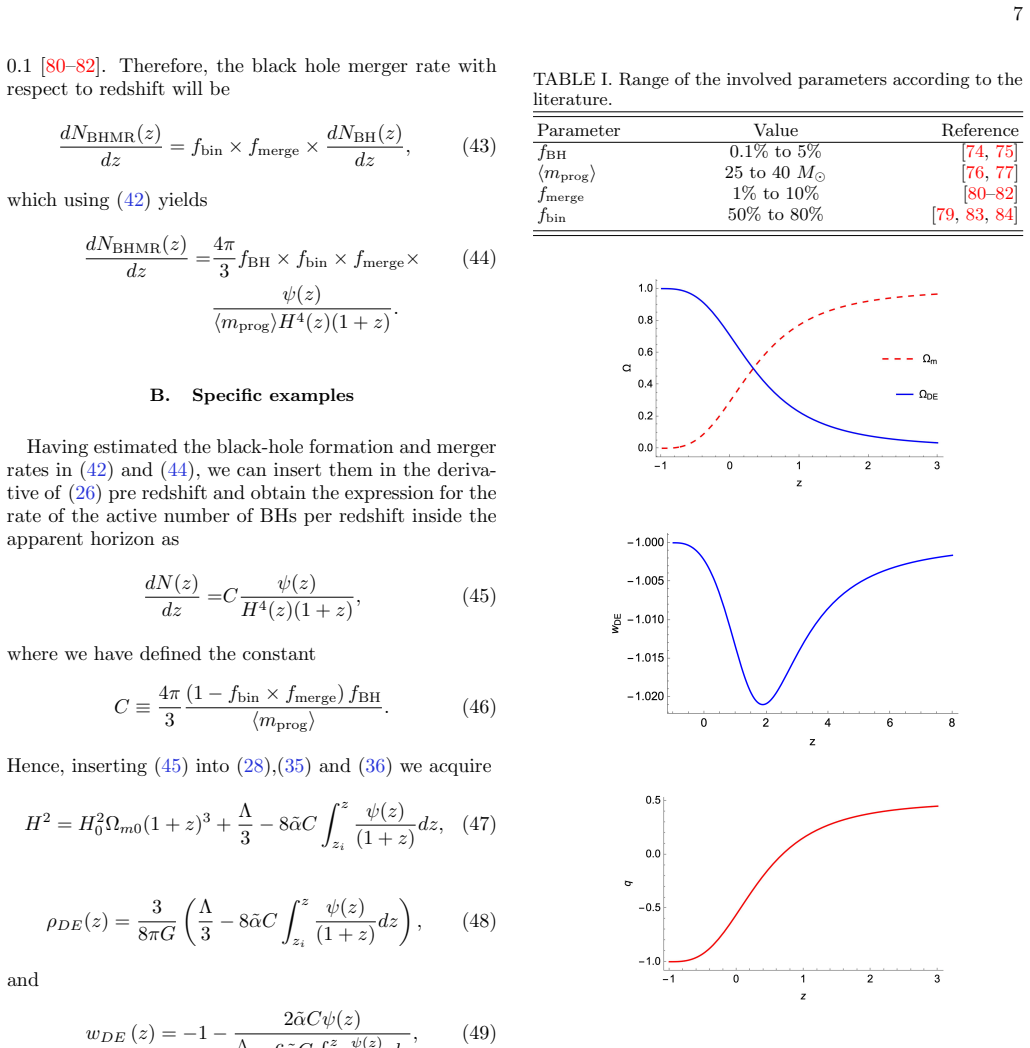
- The model reproduces the standard thermal history, with a deceleration-to-acceleration transition at $z\approx 0.6$ and a de Sitter phase in the asymptotic future.
- For the observationally allowed ranges of $f_{\rm BH}$, $f_{\rm merge}$, $f_{\rm bin}$, and $\langle m_{\rm prog}\rangle$, the predicted $w_{\rm DE}$ stays inside current observational bounds, while larger $f_{\rm BH}$ or $|\tilde{\alpha}|$ deepens the deviation from $\Lambda$CDM.
- Dark matter behaves exactly as in standard cosmology, since it enters as a separate conserved sector, so perturbation and clustering predictions are unchanged.
Reading between the lines
- An implication the authors leave implicit: if this mechanism is correct, the onset of accelerated expansion is tied to the astrophysical epoch when star formation and black-hole mergers are most active, giving the cosmic-coincidence problem a possible astronomical clock rather than a tuned constant.
- The bookkeeping postulate $\delta\chi(\partial M)=0$ could be tested directly in numerical-relativity simulations that track the apparent horizon during a black-hole merger inside a cosmological spacetime; if the Euler characteristic does not actually jump by $\pm 2$, the modified Friedmann equation would not follow.
- A sharp, testable extension would be to fold in merger-rate measurements from gravitational-wave observatories at $z\lesssim 1$ and tomographic dark-energy surveys across $z\approx 0.5$-$3$, where the predicted $w_{\rm DE}$ excursion peaks; the model would be distinguished from a constant-$w$ cosmology by the shape of that excursion.
- Because the dark-energy density inherits the cosmic star-formation history, the model's predictions are sensitive to high-redshift star-formation and binary-evolution uncertainties; better constraints on those inputs would translate directly into sharper predictions for $w_{\rm DE}(z)$.
Editorial analysis
A structured set of objections, weighed in public.
Referee Report
Summary. The paper proposes a cosmological model in which the Wald-Gauss-Bonnet entropy, including its topological Euler-characteristic contribution, is used in the gravity-thermodynamics derivation of the Friedmann equations. The authors assume that the total Euler characteristic of all causal boundaries is conserved, so that black-hole formation and merger events change the apparent-horizon Euler characteristic by Δχ = −2(N_form − N_merger). This yields a modified Friedmann equation with an effective dark-energy sector sourced by the active black-hole number. Using the Madau-Dickinson star-formation rate and literature ranges for f_BH, f_bin, f_merge, and ⟨m_prog⟩, the authors compute the dark-energy density, equation of state, and deceleration parameter for positive and negative Gauss-Bonnet coupling, finding w_DE → −1 at early and late times with phantom-like or quintessence-like behavior at intermediate redshifts.
Significance. The proposed mechanism is original and falsifiable: it predicts a specific z-dependence of the dark-energy equation of state tied to the cosmic star-formation history, with the sign of the deviation set by the Gauss-Bonnet coupling. The authors make the astrophysical input concrete and survey the allowed parameter ranges, which is a strength. However, the central derivation contains multiple algebraic inconsistencies that propagate into the quantitative predictions, and the key postulate δχ(∂M)=0 is assumed rather than derived. With corrected coefficients the qualitative scenario may survive, but the present numerical results and parameter constraints are not supported by the printed derivation.
major comments (4)
- [II C, Eq. (23)] The derivative of the Wald-Gauss-Bonnet entropy is computed incorrectly. From Eq. (15), S_WGB = A/(4G) + (2πα̃/G)χ(H), and with A = 4πr_A^2 and r_A = (H^2 + k/a^2)^(−1/2), direct differentiation gives dS/dt = −2πr_A^4 H/G (Ḡ − k/a^2) + (2πα̃/G)ṇ. The area coefficient printed in Eq. (23), −2πr_A^4/(4G), is a factor of 4 too small, and the topological coefficient πα̃/G is a factor of 2 too small relative to the second term of Eq. (15). This error propagates into every subsequent equation.
- [II C, Eqs. (24)-(25)] Eq. (24) does not follow from Eq. (23), and Eq. (25) does not follow from Eq. (24) by the stated integration. Substituting Eq. (23) into the first law with δQ = 4πr_A^3(ρ_m + p_m)Hdt and T = 1/(2πr_A) yields coefficients 1/4 on (Ḡ − k/a^2) and −α̃/2 on the topological term, not the coefficients printed in Eq. (24). Conversely, integrating Eq. (24) as printed with the continuity equation gives H^2 = 8πG/3 ρ_m + k/a^2 + Λ/3 + 8α̃ ∫ (H^2 + k/a^2)^2 ṇ dt, not the 4α̃ of Eq. (25). An independent integration of the corrected first law gives −4α̃ in front of the ∫(H^2+k/a^2)^2 dN/dt dt term in Eq. (27), not −8α̃. The prefactor in Eq. (27) is therefore not established.
- [II C, Eqs. (30)-(32)] The dark-energy sector defined by Eqs. (30)-(32) is internally inconsistent. Differentiating Eq. (30) gives ṍρ_DE = −(3α̃/πG)(H^2+k/a^2)^2 dN/dt, so the conservation equation ṍρ_DE + 3H(ρ_DE+p_DE)=0 requires p_DE = −Λ/(8πG) + (α̃/πGH)(H^2+k/a^2)^2 dN/dt + (3α̃/πG)∫(H^2+k/a^2)^2(dN/dt)dt. Equation (31) instead has −2α̃/(πGH) in the middle term, and substituting the printed Eqs. (30) and (31) into the conservation equation leaves a residual −(9α̃/πG)(H^2+k/a^2)^2 dN/dt rather than zero. Equation (32) is also not the equation of state of the fluid defined by Eqs. (30)-(31): those expressions give w_DE + 1 = −16α̃X/[H(Λ − 24α̃I)] with X=(H^2+k/a^2)^2 dN/dt and I=∫(H^2+k/a^2)^2(dN/dt)dt, whereas Eq. (32) gives w_DE + 1 = 8α̃X/[H(Λ − 24α̃I)]. Since Eqs. (35)-(36), (47)-(49), and all figures inherit these expressions, the quantitative results are not supported.
- [II B, Eq. (20)] The central mechanism depends on the postulate δχ(∂M)=0, i.e., conservation of the total Euler characteristic of all causal boundaries. This is introduced to avoid the second-law violation discussed for Einstein-Gauss-Bonnet theory, but no physical derivation or independent support is provided beyond an analogy with the holographic principle. Without this postulate the apparent-horizon Euler characteristic does not change, and the topological dark-energy sector vanishes identically. The authors should either justify this assumption more concretely, present the model explicitly as a phenomenological ansatz, or discuss how it could be tested.
minor comments (6)
- [Throughout] There are several typographical errors: 'redhsift' in the caption of Fig. 4, 'form' in the title of Section II C should be 'from', and 'NBHMR' is used in Eq. (43) without prior definition.
- [Fig. 6] The caption of Fig. 6 states that the highest estimated value is f_BH = 0.001, while Table I and the text give the range extending up to 0.05; this appears to be a typographical error.
- [II C, Eq. (45)] The conversion from volume rates to dN/dz in Eq. (45) assumes a flat universe (r_A = 1/H), but Eq. (47) retains the k/a^2 term. Please state whether the analysis is restricted to k = 0 or use the full B-dependent expression for the apparent-horizon volume in nonzero curvature.
- [III A, Eq. (39)] The value of f_BH depends on the assumed IMF and the lower mass cutoff; please state the normalization of ξ(m) used in Eq. (39) so that the quoted range 0.001–0.05 is reproducible.
- [III B, Eq. (50)] The hypergeometric expression for the integral of ψ(z)/(1+z) should be accompanied by its domain of validity and the chosen branch, since the high-redshift power-law behavior of the integrand is important for the early-time behavior of w_DE.
- [IV] The concluding claim that w_DE 'remains within its observational bounds' is based on visual inspection of Figs. 5–11; a quantitative comparison, for example through χ² or confidence contours, would be considerably stronger.
Circularity Check
No significant circularity: the w_DE(z) shape is derived from the Wald-Gauss-Bonnet entropy plus a stated topology-conservation postulate, not fitted to dark-energy data.
full rationale
The derivation chain is explicit: the Wald-Gauss-Bonnet entropy (15) is differentiated in (23), the first law gives (24), integration with the matter continuity equation gives (25), and the topology relation (21) converts this into the modified Friedmann equation (27). The dark-energy density and w_DE(z) then follow from this equation and the Madau-Dickinson star-formation rate, with astrophysical fractions taken from the literature. The cosmological constant is fixed by the boundary condition Omega_DE0 = 0.69, but this does not fix the redshift dependence of w_DE(z), which is the paper's main prediction. The assumption in Eq. (20) that the total Euler characteristic of causal boundaries is conserved is a stated physical postulate, not a restatement of the desired conclusion. Self-citations [46,47] appear only as background on topology-change dark energy and are not used to derive Eq. (27) or to exclude alternatives. For these reasons, the derivation is not circular. A separate check of the printed algebra suggests coefficient inconsistencies among Eqs. (23)-(27), but that is a correctness issue rather than circularity and does not change the score.
Assumptions & free parameters
free parameters (7)
- Gauss-Bonnet coupling ᾱ =
10^5 to 2x10^5 in H0 units (positive), -10^5 to -2x10^5 (negative)
- fBH =
0.025 fiducial; range 0.001-0.05
- fbin =
0.65 fiducial; range 0.5-0.8
- fmerge =
0.05 fiducial; range 0.01-0.1
- Average progenitor mass ⟨mprog⟩ =
30 M⊙ fiducial; range 25-40 M⊙
- Cosmological constant Λ =
Set by imposing ΩDE0≈0.69
- Lower integration limit z_i =
Unspecified, effectively large
assumptions (7)
- standard math Chern-Gauss-Bonnet theorem: ∫_h √σ R = 4πχ(h)
- domain assumption Gravity-thermodynamics conjecture
- domain assumption Wald entropy formula applies to the cosmological apparent horizon
- ad hoc to paper Total boundary topology is conserved: δχ(∂M)=0
- domain assumption BH formation rate is proportional to star formation rate with constant fBH
- domain assumption BH merger rate is proportional to BH formation rate with constant fbin and fmerge
- domain assumption Events counted inside the apparent horizon using instantaneous SFR and H(z)
invented entities (2)
-
Puncture holes on the apparent horizon
-
Topological dark energy fluid
Cite this review
Pith. "Pith review of Topological dark energy from black-hole formations and mergers through the gravity-thermodynamics approach." pith.science (2026). https://pith.science/paper/XBYCKU3E
@misc{pith2026241221146,
  author       = {Pith},
  title        = {Pith review of: Topological dark energy from black-hole formations and mergers through the gravity-thermodynamics approach},
  year         = {2026},
  howpublished = {\url{https://pith.science/paper/XBYCKU3E}},
  note         = {Machine review of arXiv:2412.21146}
}
abstract
We apply the gravity-thermodynamics approach in the case of Einstein-Gauss-Bonnet theory, and its corresponding Wald-Gauss-Bonnet entropy, which due to the Chern-Gauss-Bonnet theorem it is related to the Euler characteristic of the Universe topology. However, we consider the realistic scenario where we have the formation and merger of black holes that lead to topology changes, which induce entropy changes in the Universe horizon. We extract the modified Friedmann equations and we obtain an effective dark energy sector of topological origin. We estimate the black-hole formation and merger rates starting from the observed star formation rate per redshift, which is parametrized very efficiently by the Madau-Dickinson form, and finally we result to a dark-energy energy density that depends on the cosmic star formation rate density, on the fraction $f_{\text{BH}}$ of stars forming black holes, on the fraction of black holes $f_\text{merge}$ that eventually merge, on the fraction $ f_{\text{bin}}$ of massive stars that are in binaries, on the average mass of progenitor stars that will evolve to form black holes $ \langle m_{\text{prog}} \rangle $, as well as on the Gauss-Bonnet coupling constant. We investigate in detail the cosmological evolution, obtaining the usual thermal history. Concerning the dark-energy equation-of-state parameter, we show that at intermediate redshifts it exhibits phantom-like or quintessence-like behavior according to the sign of the Gauss-Bonnet coupling, while at early and late times it tends to the cosmological constant value. Finally, we study the effect of the other model parameters, showing that for the whole allowed observationally estimated ranges, the topological dark-energy equation-of-state parameter remains within its observational bounds.
Figures


Figures from the paper (6 more)


Forward citations
Cited by 4 Pith papers
-
Early- and late-time constraints on Wald-Gauss-Bonnet topological dark energy and implications for the $H_0$ and $S_8$ tensions
A joint CMB, BAO, and supernova fit mildly prefers a non-zero Wald-Gauss-Bonnet dark-energy term (~3σ with SH0ES included), raising H0 from 68.5 to 69.8 km/s/Mpc and easing the Hubble tension by ~0.9σ at the cost of a...
-
Observational implications of Wald-Gauss-Bonnet topological dark energy
Wald-Gauss-Bonnet topological dark energy is viable against late-universe data but statistically loses to ΛCDM, and its perturbations are nearly indistinguishable from ΛCDM.
-
Cosmological horizon thermodynamics in Gauss-Bonnet quasi-dilaton Massive Gravity
Gauss-Bonnet quasi-dilaton massive gravity is claimed to obey horizon thermodynamics and the holographic entropy bound, provided the Gauss-Bonnet coupling is non-negative.
-
Effective matter sectors from modified entropies
Choosing a modified entropy S(r) fixes a metric f(r)=1-4πM/S'(r), and the Einstein tensor of that metric acts as an anisotropic effective fluid.
Reference graph
Works this paper leans on
-
[1]
The cosmic star formation rate density is presented in Fig
Estimating the black-hole formation rate from the star formation rate Since black holes typically evolve from massive stars, it is commonly assumed that the formation rate of BHs (BHFR) is proportional to the cosmic star formation rate (SFR) [69–71]. The cosmic star formation rate density is presented in Fig. 3, and its best fit form is given by Madau and...
-
[2]
Estimating the black-hole merger rate from the black-hole formation rate The binary black hole merger rate (BHMR) can also be assumed to be proportional to SFR. Nevertheless, ambi- guities arise in this simplified approach as the formation efficiency of compact object is metallicity-dependent and BH formation and binary black hole merging may oc- cur with...
-
[3]
We elaborate the 8 cosmological equations numerically, imposing Ω DE (z =
˜α >0 case We start our analysis by examining the case where the GB coupling constant ˜α is positive. We elaborate the 8 cosmological equations numerically, imposing Ω DE (z =
-
[4]
In the upper graph of Fig
≡ ΩDE0 ≈ 0.69 and Ω m(z = 0) ≡ Ωm0 ≈ 0.31 as required by observations [85]. In the upper graph of Fig. 4 we present the evolution of the dimensionless density parameters ΩDE (z) and Ω m(z). We observe that we can acquire the usual thermal history of the Universe, the standard sequence of matter and dark energy epochs, while in the asymptotic future (z → −...
-
[5]
Addressing observational tensions in cosmology with systematics and fundamental physics (CosmoVerse)
˜α <0 case We now present the cosmological behavior for nega- tive GB coupling constant ˜α < 0. In the upper graph of Fig. 8 we present the evolution of Ω DE (z) and Ωm(z), where one can see that the anticipated thermal history 9 FIG. 8. Upper graph: The evolution of the dimensionless dark energy parameter ΩDE (blue-solid) and the correspond- ing matter d...
-
[6]
A. G. Riess et al. (Supernova Search Team), Observa- tional evidence from supernovae for an accelerating uni- verse and a cosmological constant, Astron. J. 116, 1009 (1998), arXiv:astro-ph/9805201 [astro-ph]
arXiv 1998
-
[7]
S. Perlmutter et al. (Supernova Cosmology Project), Measurements of Omega and Lambda from 42 high redshift supernovae, Astrophys. J. 517, 565 (1999), arXiv:astro-ph/9812133 [astro-ph]
arXiv 1999
-
[8]
D. N. Spergel et al. (WMAP), First year Wilkinson Mi- crowave Anisotropy Probe (WMAP) observations: De- termination of cosmological parameters, Astrophys. J. Suppl. 148, 175 (2003), arXiv:astro-ph/0302209 [astro- ph]
arXiv 2003
Show all 95 references
-
[9]
Tegmark et al
M. Tegmark et al. (SDSS), Cosmological parameters from SDSS and WMAP, Phys. Rev. D 69, 103501 (2004), arXiv:astro-ph/0310723 [astro-ph]
2004 arXiv
-
[10]
S. W. Allen, R. W. Schmidt, H. Ebeling, A. C. Fabian, and L. van Speybroeck, Constraints on dark energy from Chandra observations of the largest relaxed galaxy clus- ters, Mon. Not. Roy. Astron. Soc. 353, 457 (2004), arXiv:astro-ph/0405340 [astro-ph]
2004 arXiv
-
[11]
Astier et al
P. Astier et al. (SNLS), The Supernova Legacy Survey: Measurement of Omega(M), Omega(L) and w from the first year data set, Astron. Astrophys. 447, 31 (2006), arXiv:astro-ph/0510447 [astro-ph]
2006 arXiv
-
[12]
E. J. Copeland, M. Sami, and S. Tsujikawa, Dynamics of dark energy, Int. J. Mod. Phys. D 15, 1753 (2006), arXiv:hep-th/0603057 [hep-th]
2006 arXiv
-
[13]
Y.-F. Cai, E. N. Saridakis, M. R. Setare, and J.-Q. Xia, Quintom Cosmology: Theoretical implications and ob- servations, Phys. Rept. 493, 1 (2010), arXiv:0909.2776 [hep-th]
2010 arXiv
-
[14]
E. N. Saridakis et al. (CANTATA), Modified Grav- ity and Cosmology. An Update by the CANTATA Net- work , edited by E. N. Saridakis, R. Lazkoz, V. Salzano, P. Vargas Moniz, S. Capozziello, J. Beltr´ an Jim´ enez, M. De Laurentis, and G. J. Olmo (Springer, 2021) arXiv:2105.12582 [gr-qc]
2021 arXiv
-
[15]
Capozziello and M
S. Capozziello and M. De Laurentis, Extended Theories of Gravity, Phys. Rept. 509, 167 (2011), arXiv:1108.6266 [gr-qc]
2011 arXiv
-
[16]
Y.-F. Cai, S. Capozziello, M. De Laurentis, and E. N. Saridakis, f(T) teleparallel gravity and cosmology, Rept. Prog. Phys. 79, 106901 (2016), arXiv:1511.07586 [gr-qc]
2016 arXiv
-
[17]
Nojiri, S
S. Nojiri, S. D. Odintsov, and V. K. Oikonomou, Modi- fied Gravity Theories on a Nutshell: Inflation, Bounce and Late-time Evolution, Phys. Rept. 692, 1 (2017), arXiv:1705.11098 [gr-qc]
2017 arXiv
-
[18]
Alves Batista et al
R. Alves Batista et al. , White Paper and Roadmap for Quantum Gravity Phenomenology in the Multi- Messenger Era, (2023), arXiv:2312.00409 [gr-qc]
2023 arXiv
-
[19]
Addazi et al., Quantum gravity phenomenology at the dawn of the multi-messenger era—A review, Prog
A. Addazi et al., Quantum gravity phenomenology at the dawn of the multi-messenger era—A review, Prog. Part. Nucl. Phys. 125, 103948 (2022), arXiv:2111.05659 [hep- ph]
2022 arXiv
-
[20]
K. S. Stelle, Renormalization of Higher Derivative Quan- tum Gravity, Phys. Rev. D 16, 953 (1977)
1977
-
[21]
Zwiebach, Curvature Squared Terms and String The- ories, Phys
B. Zwiebach, Curvature Squared Terms and String The- ories, Phys. Lett. B 156, 315 (1985)
1985
-
[22]
D. G. Boulware and S. Deser, String Generated Gravity Models, Phys. Rev. Lett. 55, 2656 (1985)
1985
-
[23]
D. J. Gross and J. H. Sloan, The Quartic Effective Action for the Heterotic String, Nucl. Phys. B 291, 41 (1987)
1987
-
[24]
Vafa and E
C. Vafa and E. Witten, A Strong coupling test of S dual- ity, Nucl. Phys. B 431, 3 (1994), arXiv:hep-th/9408074 [hep-th]
1994 arXiv
-
[25]
Jacobson, Thermodynamics of Spacetime: The Ein- stein Equation of State, Phys
T. Jacobson, Thermodynamics of Spacetime: The Ein- stein Equation of State, Phys. Rev. Lett.75, 1260 (1995), arXiv:gr-qc/9504004 [gr-qc]
1995 arXiv
-
[26]
Padmanabhan, Gravity and the Thermodynamics of Horizons, Phys
T. Padmanabhan, Gravity and the Thermodynamics of Horizons, Phys. Rept. 406, 49 (2005), arXiv:gr- qc/0311036 [gr-qc]
2005
-
[27]
Padmanabhan, Thermodynamical Aspects of Grav- ity: New insights, Rept
T. Padmanabhan, Thermodynamical Aspects of Grav- ity: New insights, Rept. Prog. Phys. 73, 046901 (2010), arXiv:0911.5004 [gr-qc]
2010 arXiv
-
[28]
G. W. Gibbons and S. W. Hawking, Cosmological Event Horizons, Thermodynamics, and Particle Creation, Phys. Rev. D 15, 2738 (1977)
1977
-
[29]
Cai and S
R.-G. Cai and S. P. Kim, First law of thermodynam- ics and Friedmann equations of Friedmann-Robertson- Walker universe, JHEP 02, 050, arXiv:hep-th/0501055 [hep-th]
-
[30]
Akbar and R.-G
M. Akbar and R.-G. Cai, Thermodynamic behavior of the Friedmann equation at the apparent horizon of the FR W universe, Phys. Rev. D 75, 084003 (2007), arXiv:hep-th/0609128 [hep-th]
2007 arXiv
-
[31]
Cai and L.-M
R.-G. Cai and L.-M. Cao, Unified first law and thermo- dynamics of apparent horizon in FR W universe, Phys. Rev. D 75, 064008 (2007), arXiv:gr-qc/0611071 [gr-qc]
2007 arXiv
-
[32]
Paranjape, S
A. Paranjape, S. Sarkar, and T. Padmanabhan, Ther- modynamic route to field equations in Lanczos-Lovelock gravity, Phys. Rev. D 74, 104015 (2006), arXiv:hep- th/0607240 [hep-th]
2006
-
[33]
Sheykhi, B
A. Sheykhi, B. Wang, and R.-G. Cai, Thermodynam- ical properties of apparent horizon in warped DGP braneworld, Nucl. Phys. B 779, 1 (2007), arXiv:hep- th/0701198 [hep-th]
2007
-
[34]
Akbar and R.-G
M. Akbar and R.-G. Cai, Thermodynamic behavior of field equations for f(R) gravity, Phys. Lett. B 635, 7 (2006), arXiv:hep-th/0602156 [hep-th]
2006 arXiv
-
[35]
Jamil, E
M. Jamil, E. N. Saridakis, and M. R. Setare, Ther- modynamics of dark energy interacting with dark mat- ter and radiation, Phys. Rev. D 81, 023007 (2010), arXiv:0910.0822 [hep-th]
2010 arXiv
-
[36]
Cai and N
R.-G. Cai and N. Ohta, Horizon thermodynamics and gravitational field equations in Horava-Lifshitz gravity, Phys. Rev. D 81, 084061 (2010), arXiv:0910.2307 [hep- th]
2010 arXiv
-
[37]
M. Wang, J. Jing, C. Ding, and S. Chen, First law of thermodynamics in IR modified Horava-Lifshitz gravity, 12 Phys. Rev. D 81, 083006 (2010), arXiv:0912.4832 [gr-qc]
2010 arXiv
-
[38]
Jamil, E
M. Jamil, E. N. Saridakis, and M. R. Setare, Holographic dark energy with varying gravitational constant, JCAP 11, 032, arXiv:1003.0876 [hep-th]
-
[39]
Y. Gim, W. Kim, and S.-H. Yi, The first law of thermo- dynamics in Lifshitz black holes revisited, JHEP 07, 002, arXiv:1403.4704 [hep-th]
-
[40]
Fan and H
Z.-Y. Fan and H. Lu, Thermodynamical first laws of black holes in quadratically-extended gravities, Phys. Rev. D 91, 064009 (2015), arXiv:1501.00006 [hep-th]
2015 arXiv
-
[41]
Lymperis and E
A. Lymperis and E. N. Saridakis, Modified cosmol- ogy through nonextensive horizon thermodynamics, Eur. Phys. J. C 78, 993 (2018), arXiv:1806.04614 [gr-qc]
2018 arXiv
-
[42]
E. N. Saridakis, Barrow holographic dark energy, Phys. Rev. D 102, 123525 (2020), arXiv:2005.04115 [gr-qc]
2020 arXiv
-
[43]
Basilakos, A
S. Basilakos, A. Lymperis, M. Petronikolou, and E. N. Saridakis, Alleviating both H0 and σ8 tensions in Tsallis cosmology, Eur. Phys. J. C 84, 297 (2024), arXiv:2308.01200 [gr-qc]
2024 arXiv
-
[44]
R. M. Wald, Black hole entropy is the Noether charge, Phys. Rev. D 48, R3427 (1993), arXiv:gr-qc/9307038
1993 arXiv
-
[45]
Iyer and R
V. Iyer and R. M. Wald, Some properties of Noether charge and a proposal for dynamical black hole entropy, Phys. Rev. D 50, 846 (1994), arXiv:gr-qc/9403028
1994 arXiv
-
[46]
Lanczos, A Remarkable property of the Riemann- Christoffel tensor in four dimensions, Annals Math
C. Lanczos, A Remarkable property of the Riemann- Christoffel tensor in four dimensions, Annals Math. 39, 842 (1938)
1938
-
[47]
Lovelock, The Einstein tensor and its generalizations, J
D. Lovelock, The Einstein tensor and its generalizations, J. Math. Phys. 12, 498 (1971)
1971
-
[48]
Jacobson and R
T. Jacobson and R. C. Myers, Black hole entropy and higher curvature interactions, Phys. Rev. Lett. 70, 3684 (1993), arXiv:hep-th/9305016
1993 arXiv
-
[49]
shen Chern, On the curvatura integra in a riemannian manifold, Annals of Mathematics 46, 674 (1945)
S. shen Chern, On the curvatura integra in a riemannian manifold, Annals of Mathematics 46, 674 (1945)
1945
-
[50]
Nakahara, Geometry, topology and physics (2003)
M. Nakahara, Geometry, topology and physics (2003)
2003
-
[51]
S. A. Tsilioukas, E. N. Saridakis, and C. Tzerefos, Dark energy from topology change induced by microscopic Gauss-Bonnet wormholes, Phys. Rev. D 109, 084010 (2024), arXiv:2312.07486 [gr-qc]
2024 arXiv
-
[52]
Tsilioukas and E
S. Tsilioukas and E. Saridakis, Dark Energy from topol- ogy change at the foam level, PoS CORFU2023, 182 (2024)
2024
-
[53]
Sarkar and A
S. Sarkar and A. C. Wall, Second Law Violations in Love- lock Gravity for Black Hole Mergers, Phys. Rev. D 83, 124048 (2011), arXiv:1011.4988 [gr-qc]
2011 arXiv
-
[54]
Liko, Topological deformation of isolated horizons, Phys
T. Liko, Topological deformation of isolated horizons, Phys. Rev. D 77, 064004 (2008), arXiv:0705.1518 [gr-qc]
2008 arXiv
-
[55]
Farb and D
B. Farb and D. Margalit, A Primer on Mapping Class Groups, Princeton Mathematical Series, Vol. 49 (Prince- ton University Press, 2012)
2012
-
[56]
’t Hooft, Dimensional Reduction in Quantum Gravity, Conf
G. ’t Hooft, Dimensional Reduction in Quantum Gravity, Conf. Proc. C 930308, 284 (1993), arXiv:gr-qc/9310026 [gr-qc]
1993 arXiv
-
[57]
Susskind, The World as a hologram, J
L. Susskind, The World as a hologram, J. Math. Phys. 36, 6377 (1995), arXiv:hep-th/9409089
1995 arXiv
-
[58]
Fischler and L
W. Fischler and L. Susskind, Holography and cosmology, (1998), arXiv:hep-th/9806039
1998 arXiv
-
[59]
Bousso, The Holographic principle, Rev
R. Bousso, The Holographic principle, Rev. Mod. Phys. 74, 825 (2002), arXiv:hep-th/0203101
2002 arXiv
-
[60]
Horava and D
P. Horava and D. Minic, Probable values of the cosmo- logical constant in a holographic theory, Phys. Rev. Lett. 85, 1610 (2000), arXiv:hep-th/0001145
2000 arXiv
-
[61]
Li, A Model of holographic dark energy, Phys
M. Li, A Model of holographic dark energy, Phys. Lett. B 603, 1 (2004), arXiv:hep-th/0403127
2004 arXiv
-
[62]
S. Wang, Y. Wang, and M. Li, Holographic Dark En- ergy, Phys. Rept. 696, 1 (2017), arXiv:1612.00345 [astro- ph.CO]
2017 arXiv
-
[63]
Huang and M
Q.-G. Huang and M. Li, The Holographic dark en- ergy in a non-flat universe, JCAP 08, 013, arXiv:astro- ph/0404229
-
[64]
Pavon and W
D. Pavon and W. Zimdahl, Holographic dark energy and cosmic coincidence, Phys. Lett. B 628, 206 (2005), arXiv:gr-qc/0505020
2005 arXiv
-
[65]
Wang, Y.-g
B. Wang, Y.-g. Gong, and E. Abdalla, Transition of the dark energy equation of state in an interacting holo- graphic dark energy model, Phys. Lett. B 624, 141 (2005), arXiv:hep-th/0506069
2005 arXiv
-
[66]
Nojiri and S
S. Nojiri and S. D. Odintsov, Unifying phantom infla- tion with late-time acceleration: Scalar phantom-non- phantom transition model and generalized holographic dark energy, Gen. Rel. Grav. 38, 1285 (2006), arXiv:hep- th/0506212
2006
-
[67]
Li, X.-D
M. Li, X.-D. Li, S. Wang, and X. Zhang, Holographic dark energy models: A comparison from the latest ob- servational data, JCAP 06, 036, arXiv:0904.0928 [astro- ph.CO]
-
[68]
M. R. Setare and E. N. Saridakis, Non-minimally cou- pled canonical, phantom and quintom models of holo- graphic dark energy, Phys. Lett. B 671, 331 (2009), arXiv:0810.0645 [hep-th]
2009 arXiv
-
[69]
M. R. Setare and E. N. Saridakis, Correspondence be- tween Holographic and Gauss-Bonnet dark energy mod- els, Phys. Lett. B 670, 1 (2008), arXiv:0810.3296 [hep- th]
2008 arXiv
-
[70]
E. N. Saridakis, Ricci-Gauss-Bonnet holographic dark en- ergy, Phys. Rev. D 97, 064035 (2018), arXiv:1707.09331 [gr-qc]
2018 arXiv
-
[71]
E. N. Saridakis, K. Bamba, R. Myrzakulov, and F. K. Anagnostopoulos, Holographic dark energy through Tsallis entropy, JCAP 12, 012, arXiv:1806.01301 [gr-qc]
-
[72]
Drepanou, A
N. Drepanou, A. Lymperis, E. N. Saridakis, and K. Yesmakhanova, Kaniadakis holographic dark en- ergy and cosmology, Eur. Phys. J. C 82, 449 (2022), arXiv:2109.09181 [gr-qc]
2022 arXiv
-
[73]
S. W. Hawking, Gravitational radiation from colliding black holes, Phys. Rev. Lett. 26, 1344 (1971)
1971
-
[74]
Iacovelli, M
F. Iacovelli, M. Mancarella, S. Foffa, and M. Mag- giore, Forecasting the Detection Capabilities of Third- generation Gravitational-wave Detectors Using GW- F AST, Astrophys. J. 941, 208 (2022), arXiv:2207.02771 [gr-qc]
2022 arXiv
-
[75]
Gupta et al
I. Gupta et al. , Characterizing Gravitational Wave De- tector Networks: From A ♯ to Cosmic Explorer, (2023), arXiv:2307.10421 [gr-qc]
2023 arXiv
-
[76]
Lehoucq, I
L. Lehoucq, I. Dvorkin, R. Srinivasan, C. Pellouin, and A. Lamberts, Astrophysical uncertainties in the gravitational-wave background from stellar-mass com- pact binary mergers, Mon. Not. Roy. Astron. Soc. 526, 4378 (2023), arXiv:2306.09861 [astro-ph.HE]
2023 arXiv
-
[77]
Madau and M
P. Madau and M. Dickinson, Cosmic Star Formation History, Ann. Rev. Astron. Astrophys. 52, 415 (2014), arXiv:1403.0007 [astro-ph.CO]
2014 arXiv
-
[78]
E. E. Salpeter, The Luminosity Function and Stellar Evo- lution, Astrophys. J. 121, 161 (1955)
1955
-
[79]
Heger and S
A. Heger and S. E. Woosley, The Nucleosynthetic sig- nature of population III, Astrophys. J. 567, 532 (2002), arXiv:astro-ph/0107037 [astro-ph]. 13
2002 arXiv
-
[80]
C. L. Fryer, K. Belczynski, G. Wiktorowicz, M. Do- minik, V. Kalogera, and D. E. Holz, Compact Remnant Mass Function: Dependence on the Explosion Mech- anism and Metallicity, Astrophys. J. 749, 91 (2012), arXiv:1110.1726 [astro-ph.SR]
2012 arXiv
-
[81]
S. E. Woosley, A. Heger, and T. A. Weaver, The evolution and explosion of massive stars, Rev. Mod. Phys. 74, 1015 (2002)
2002
-
[82]
Sukhbold, T
T. Sukhbold, T. Ertl, S. E. Woosley, J. M. Brown, and H.- T. Janka, Core-collapse Supernovae from 9 to 120 Solar Masses Based on Neutrino-powered Explosions, Astro- phys. J. 821, 38 (2016), arXiv:1510.04643 [astro-ph.SR]
2016 arXiv
-
[83]
Boesky, F
A. Boesky, F. S. Broekgaarden, and E. Berger, The Bi- nary Black Hole Merger Rate Deviates From the Cosmic Star Formation Rate: A Tug of War Between Metallic- ity and Delay Times, (2024), arXiv:2405.01623 [astro- ph.HE]
2024 arXiv
-
[84]
Sana et al
H. Sana et al. , Binary Interaction Dominates the Evolu- tion of Massive Stars, Science 337, 444 (2012)
2012
-
[85]
Belczynski, D
K. Belczynski, D. E. Holz, T. Bulik, and R. O’Shaughnessy, The First Gravitational-Wave Source from the Isolated Evolution of Two 40-100 M⊙ Stars, Nature 534, 512 (2016), arXiv:1602.04531 [astro-ph.HE]
2016 arXiv
-
[86]
J. J. Eldridge and E. R. Stanway, BPASS predictions for binary black hole mergers, Mon. Not. Roy. Astron. Soc. 462, 3302 (2016), arXiv:1602.03790 [astro-ph.HE]
2016 arXiv
-
[87]
Dominik et al., Double Compact Objects
M. Dominik et al., Double Compact Objects. I. The Sig- nificance of the Common Envelope on Merger Rates, Astrophys. J. 759, 52 (2012), arXiv:1202.4901 [astro- ph.SR]
2012 arXiv
-
[88]
Moe and R
M. Moe and R. Di Stefano, Mind Your Ps and Qs: The Interrelation between Periods, Mass Ratios, and Orbital Planes for Binary Stars, Astrophys. J. Suppl. 230, 15 (2017), arXiv:1606.05347 [astro-ph.SR]
2017 arXiv
-
[89]
Duchene and A
G. Duchene and A. Kraus, Stellar Multiplicity, Ann. Rev. Astron. Astrophys. 51, 269 (2013), arXiv:1303.3028 [astro-ph.SR]
2013 arXiv
-
[90]
Aghanim and others [Planck Collaboration], Planck 2018 results
N. Aghanim and others [Planck Collaboration], Planck 2018 results. VI. Cosmological parameters, Astron. Astrophys. 641, A6 (2020), arXiv:1807.06209 [astro- ph.CO]
2020 arXiv
-
[91]
Fragione, N
G. Fragione, N. W. C. Leigh, I. Ginsburg, and B. Kocsis, Formation of LISA Black Hole Binaries in Merging Dwarf Galaxies: the Impact of Star Formation and Dynamics, Astrophys. J. Lett. 864, L19 (2018), arXiv:1806.11112 [astro-ph.GA]
2018 arXiv
-
[92]
Ellis, M
J. Ellis, M. Lewicki, V. Vaskonen, and N. Zheng, Probing Supermassive Black Hole Seed Scenarios with Gravitational-wave Measurements, JCAP 06, 024, arXiv:2004.08428 [astro-ph.CO]
2004 arXiv
-
[93]
Barausse, I
E. Barausse, I. Dvorkin, M. Tremmel, M. Volonteri, and M. Bonetti, Massive black hole merger rates: the ef- fect of kpc separation wandering and supernova feed- back, Mon. Not. Roy. Astron. Soc. 503, 5333 (2021), arXiv:2006.03065 [astro-ph.GA]
2021 arXiv
-
[94]
Banks, K
S. Banks, K. Lee, N. Azimi, K. Scarborough, N. Ste- fanov, I. Periwal, C. DeGraf, and T. Di Matteo, On the detectability of massive black hole merger events by LISA, Mon. Not. Roy. Astron. Soc. 507, 114 (2021), arXiv:2107.09084 [astro-ph.GA]
2021 arXiv
-
[95]
K. Li, T. Bogdanovi´ c, D. R. Ballantyne, and M. Bonetti, Massive Black Hole Binaries from the TNG50-3 Simu- lation: I. Coalescence and LISA Detection Rates, Mon. Not. Roy. Astron. Soc.511, 608 (2022), arXiv:2201.11088 [astro-ph.GA]
2022 arXiv
Reviewed August 10, 2026 · model on record in the stance chip above.
Discussion (0). Continue with ORCID to comment.