REVIEW 2 major objections 2 minor 75 references
Velocity Resetting of Inertial Run-and-Tumble Particles in Non-Newtonian Media: Velocity Distribution, Diffusion and First-Passage Time
T0 review · 2 major / 2 minor · reviewed 2026-06-28 · grok-4.3
Pith's one-line read Velocity resetting at high rates produces a cusp singularity at zero velocity and makes long-time motion diffusive with diffusivity falling as r to the minus two, independent of the drag law, while the mean time to a target velocity has an
desk verdict The cusp and Deff ~ r^{-2} scaling look robust across drag laws from the trajectory-FP cross-checks, but the shear-thickening vs thinning distinction in optimal resetting rate rests on thinner numerical support for the MFPT curves. read the letter →
The pith
A machine-rendered reading of the paper's core claim, the machinery that carries it, and where it could break.
The reading
What carries the argument
Steady-state velocity distribution Ps(v) obtained from particle trajectories and numerical Fokker-Planck solution, together with mean first-passage time statistics under symmetric dichotomous noise and nonlinear drag g(v).
What would settle it
A simulation or experiment in which the effective diffusion coefficient fails to scale as r to the minus two for large r, or in which an optimal resetting rate appears in shear-thinning media, would falsify the reported results.
Extended reading notes
Core claim
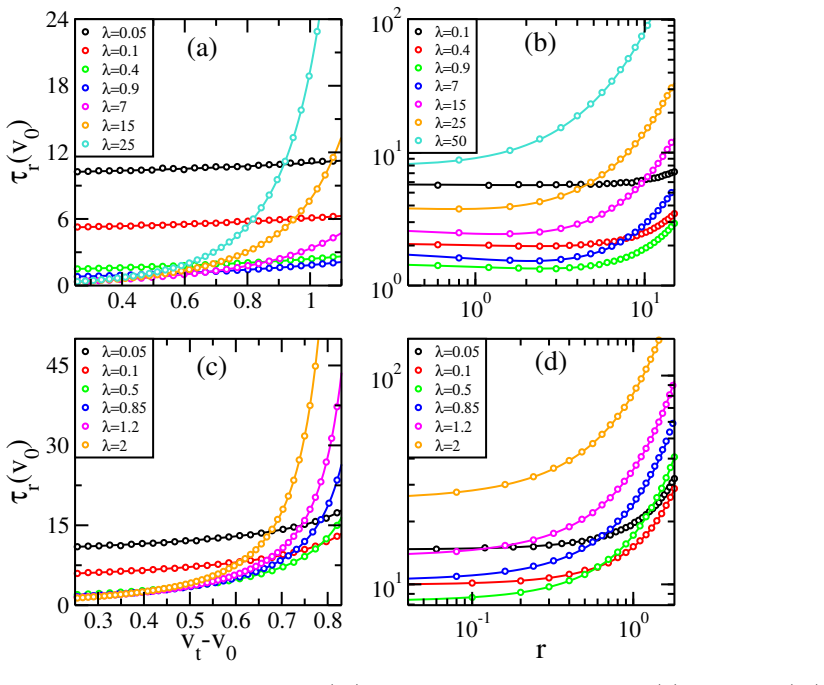
In the presence of velocity resetting at rate r the steady-state velocity distribution Ps(v) of the particle exhibits a cusp-like singularity at v=0 for large r, leading to diffusive behavior at long times with Deff decaying as r^{-2}, independent of the drag function g(v). The mean first-passage time to a target velocity vt depends on the medium type: an optimal r minimizes it in shear-thickening media but not in shear-thinning ones.
Load-bearing premise
The numerical solution of the Fokker-Planck equation and the trajectory sampling both faithfully represent the underlying stochastic process without extra approximations that would erase the difference in optimal resetting behavior between the two media types.
Signed reviews
Editorial analysis
A structured set of objections, weighed in public.
Referee Report
Summary. The paper examines an athermal inertial run-and-tumble particle in one dimension subject to velocity resetting at rate r while moving in a non-Newtonian medium with nonlinear drag g(v). The run-and-tumble motion is driven by symmetric dichotomous noise of strength Σ and flip rate λ. The authors solve the Fokker-Planck equation numerically and sample trajectories to obtain the steady-state velocity distribution Ps(v), which develops a cusp at v=0 for large r; they further report that the long-time motion is diffusive with effective diffusivity Deff scaling as r^{-2}, both features independent of the specific g(v), λ, and Σ. In contrast, the mean first-passage time to a target velocity vt depends qualitatively on the medium: an optimal resetting rate exists for shear-thickening g(v) but not for shear-thinning g(v).
Significance. If the reported distinction in mean first-passage time is numerically robust, the results demonstrate that the rheological character of the drag can qualitatively change the resetting-rate optimization for first-passage processes in active particles. The explicit cross-check between trajectory sampling and numerical Fokker-Planck integration for Ps(v) and the Deff scaling provides a concrete strength for those claims.
major comments (2)
- [Section on mean first-passage time (likely §4)] The headline claim that an optimal resetting rate exists only in shear-thickening media rests on the numerical evaluation of MFPT(r). No details are supplied on the discretization scheme, grid resolution, absorbing-boundary implementation, number of trajectories, or convergence tests used for the MFPT computation (in contrast to the explicit trajectory-vs-FP comparison stated for Ps(v)). This omission directly affects the reliability of the media-type distinction.
- [Abstract and MFPT discussion] The statement that Ps(v) and Deff ~ r^{-2} hold 'irrespective of the specific form of g(v)' is supported by the reported numerical agreement, but the MFPT results are presented only for two representative g(v) forms without a systematic scan over additional functional forms or parameter values to confirm the qualitative contrast persists.
minor comments (2)
- [Abstract] The abstract states that results hold 'irrespective of ... the values of λ and Σ' yet the figures appear to use fixed λ and Σ; a brief statement clarifying the range explored would improve clarity.
- [Numerical methods and results sections] Error bars or convergence diagnostics are not mentioned for the trajectory-sampled Ps(v) or Deff even though the abstract highlights agreement with the numerical FP solution.
Simulated Author's Rebuttal
We thank the referee for the detailed review and constructive feedback on our manuscript. The comments highlight important aspects of the numerical methodology and the scope of the MFPT analysis that require clarification. We address each major comment point by point below and will revise the manuscript accordingly to improve transparency and robustness.
read point-by-point responses
-
Referee: [Section on mean first-passage time (likely §4)] The headline claim that an optimal resetting rate exists only in shear-thickening media rests on the numerical evaluation of MFPT(r). No details are supplied on the discretization scheme, grid resolution, absorbing-boundary implementation, number of trajectories, or convergence tests used for the MFPT computation (in contrast to the explicit trajectory-vs-FP comparison stated for Ps(v)). This omission directly affects the reliability of the media-type distinction.
Authors: We agree that the manuscript lacks sufficient detail on the MFPT numerics, which is a valid concern for assessing the reliability of the shear-thickening versus shear-thinning distinction. In the revised version, we will add a dedicated subsection describing the numerical procedure: the finite-difference discretization of the time-dependent Fokker-Planck equation, the spatial grid resolution and domain size, the implementation of absorbing boundary conditions at the target velocity vt (including how probability flux is removed), the number of independent trajectory realizations used for cross-validation, and the convergence tests with respect to grid size and time step. These additions will directly address the reliability issue without altering the reported qualitative results. revision: yes
-
Referee: [Abstract and MFPT discussion] The statement that Ps(v) and Deff ~ r^{-2} hold 'irrespective of the specific form of g(v)' is supported by the reported numerical agreement, but the MFPT results are presented only for two representative g(v) forms without a systematic scan over additional functional forms or parameter values to confirm the qualitative contrast persists.
Authors: The two representative forms were chosen because they exemplify the distinct rheological classes (shear-thickening with g(v) increasing faster than linear, shear-thinning with g(v) increasing slower than linear), and the MFPT behavior traces to the sign of the second derivative of g(v) near the origin. While this provides a clear illustration, we acknowledge that a broader exploration would strengthen the claim. In the revision we will therefore include MFPT(r) curves for two additional g(v) forms (a different power-law exponent in each class and a saturating nonlinear drag) over a range of Σ and λ values, confirming that the existence of an optimal resetting rate remains confined to the shear-thickening class. revision: yes
Circularity Check
No circularity: results obtained from independent numerical trajectory integration and FP solution with explicit cross-checks
full rationale
The paper states that the steady-state velocity distribution Ps(v) is computed directly from particle trajectories and compared to numerical solution of the Fokker-Planck equation, with reported agreement. Deff scaling as r^{-2} follows from the long-time diffusive behavior observed in the same simulations. MFPT(r) is evaluated from the underlying stochastic process for the two forms of g(v). None of these steps reduce by definition or fitting to the target quantities; the media-type distinction in optimal resetting rate is an output of the numerics rather than an input. No self-citations or ansatzes are invoked as load-bearing premises. This is the standard case of a self-contained numerical study.
Assumptions & free parameters
free parameters (2)
- resetting rate r
- noise strength Σ and flip rate λ
assumptions (2)
- domain assumption The Fokker-Planck equation derived from the stochastic process is the appropriate continuum description whose numerical solution can be compared directly to trajectory statistics.
- domain assumption The non-Newtonian drag can be represented by a general nonlinear function g(v) without specifying its exact form for the diffusion scaling claims.
Cite this review
Pith. "Pith review of Velocity Resetting of Inertial Run-and-Tumble Particles in Non-Newtonian Media: Velocity Distribution, Diffusion and First-Passage Time." pith.science (2026). https://pith.science/paper/24MEYNUX
@misc{pith2026260600560,
  author       = {Pith},
  title        = {Pith review of: Velocity Resetting of Inertial Run-and-Tumble Particles in Non-Newtonian Media: Velocity Distribution, Diffusion and First-Passage Time},
  year         = {2026},
  howpublished = {\url{https://pith.science/paper/24MEYNUX}},
  note         = {Machine review of arXiv:2606.00560}
}
abstract
We study the dynamics of an athermal inertial run-and-tumble particle moving through a non-Newtonian medium in $d=1$, where the particle's velocity $v$ is reset to zero at a constant rate $r$. The drag force from the non-Newtonian medium is represented by a nonlinear velocity-dependent function $g(v)$. The run-and-tumble dynamics is modeled by a symmetric dichotomous noise with strength $\Sigma$ and flipping rate $\lambda$. We begin with the Fokker-Planck (FP) equation for the velocity distribution $P(v,t)$ of the particle. In the presence of resetting, however, the FP equation does not yield a closed-form solution even in the steady state. We therefore compute the steady-state velocity distribution $P_s(v)$ directly from particle trajectories and compare it with the numerical solution of the FP equation, finding good agreement between the two approaches. For sufficiently large $r$, $P_s(v)$ shows a cusp-like singularity at $v=0$ and the particles display diffusive motion at long times. The effective diffusion coefficient $D_{\mathrm{eff}}$ decays as $r^{-2}$ in the large-$r$ regime. These results hold irrespective of the specific form of $g(v)$ and the values of $\lambda$ and $\Sigma$. However, the mean first-passage time exhibits a strong dependence on the nature of the medium as the resetting rate $r$ is varied. In shear-thickening media, there exists an optimal resetting rate that minimizes the time required to reach the target velocity $v_t$. In contrast, no such optimal resetting rate is observed in shear-thinning media.
Figures


Figures from the paper (3 more)


Reference graph
Works this paper leans on
-
[1]
M. R. Evans and S. N. Majumdar, Phys. Rev. Lett.106, 160601 (2011)
2011
-
[2]
M. R. Evans and S. N. Majumdar, J. Phys. A: Math. Theor.44, 435001 (2011)
2011
-
[3]
A. Pal, A. Kundu, and M. R. Evans, Phys. A: Math. Theor.49, 225001 (2016)
2016
-
[4]
M. R. Evans, S. N. Majumdar, and G. Schehr, J. Phys. A: Math. Theor.53, 193001 (2020)
2020
-
[5]
M. R. Evans and J. C. Sunil, SciPost Phys. Lect. Notes103(2025)
2025
-
[6]
Besga, A
B. Besga, A. Bovon, A. Petrosyan, S. N. Majumdar, and S. Ciliberto, Phys. Rev. Res.2, 032029(R) (2020)
2020
-
[7]
Faisant, B
F. Faisant, B. Besga, A. Petrosyan, S. Ciliberto, and S. N. Majumdar, J. Stat. Mech. 113203 (2021)
2021
-
[8]
G. M. Viswanathan, S. V. Buldyrev, S. Havlin, M. G. E. da Luz, E. P. Raposo, and H. E. Stanley, Nature401, 911 (1999)
1999
Show all 75 references
-
[9]
T. H. Harris, E. J. Banigan, D. A. Christian, C. Konradt, E. D. T. Wojno, K. Norose, E. H. Wilson, B. John, W. Weninger, A. D. Luster, A. J. Liu, and C. A. Hunter, Nature486, 545 (2012)
2012
-
[10]
Blumer, S
O. Blumer, S. Reuveni, and B. Hirshberg, J. Phys. Chem. Lett.13, 11230 (2022)
2022
-
[11]
J. R. Church, O. Blumer, T. D. Keidar, L. Ploutno, S. Reuveni, and B. Hirshberg, J. Chem. Theory Comput.21, 605 (2025)
2025
-
[12]
Bell,The Behavioural Ecology of Finding Resources(Springer, Netherlands, 1990)
W. Bell,The Behavioural Ecology of Finding Resources(Springer, Netherlands, 1990)
1990
-
[13]
Turchin,Quantitative Analysis of Movement(Sinauer Associates, Sunderland, MA, 1998)
P. Turchin,Quantitative Analysis of Movement(Sinauer Associates, Sunderland, MA, 1998). 16
1998
-
[14]
Mirny, M
L. Mirny, M. Slutsky, Z. Wunderlich, A. Tafvizi, J. Leith, and A. Kosmrlj, J. Phys. A: Math. Theor.42, 434013 (2009)
2009
-
[15]
Bartumeus and J
F. Bartumeus and J. Catalan, J. Phys. A42, 434002 (2009)
2009
-
[16]
G. M. Viswanathan, M. G. E. da Luz, E. P. Raposo, and H. E. Stanley,The Physics of Foraging: An Introduction to Random Searches and Biological Encounters(Cambridge University Press, Cambridge, UK, 2011)
2011
-
[17]
M. Luby, A. Sinclair, and D. Zuckerman, Inf. Process. Lett.47, 173 (1993)
1993
-
[18]
Montanari and R
A. Montanari and R. Zecchina, Phys. Rev. Lett.88, 178701 (2002)
2002
-
[19]
Stojkoski, P
V. Stojkoski, P. Jolakoski, A. Pal, T. Sandev, L. Kocarev, and R. Metzler, Philos. Trans. R. Soc. A380, 20210157 (2022)
2022
-
[20]
Rotbart, S
T. Rotbart, S. Reuveni, and M. Urbakh, Phys. Rev. E92, 060101(R) (2015)
2015
-
[21]
Belan, Phys
S. Belan, Phys. Rev. Lett.120, 080601 (2018)
2018
-
[22]
P. C. Bressloff, Proc. R. Soc. A481, 20240815 (2025)
2025
-
[23]
Pal and A
S. Pal and A. Pal, Phys. Fluids37, 077126 (2025)
2025
-
[24]
N. E. Humphries, H. Weimerskirch, N. Queiroz, E. J. Southall, and D. W. Sims, Proc. Natl. Acad. Sci. USA109, 7169 (2012)
2012
-
[25]
Ariel, A
G. Ariel, A. Rabani, S. Benisty, J. D. Partridge, R. M. Harshey, and A. Be’er, Nat. Commun.6, 8396 (2015)
2015
-
[26]
Pal, and S
A. Pal, and S. Reuveni, Phys. Rev. Lett.118, 030603 (2017)
2017
-
[27]
Shokaku, T
T. Shokaku, T. Moriyama, H. Murakami, S. Shinohara, N. Manome, and K. Morioka, Rev. Sci. Instrum.91, 104104 (2020)
2020
-
[28]
Guinard and A
B. Guinard and A. Korman, Sci. Adv.7, eabe8211 (2021)
2021
-
[29]
U. Basu, A. Kundu, and A. Pal, Phys. Rev. E100, 032136 (2019)
2019
-
[30]
A. S. Bodrova, A. V. Chechkin, and A. K. Dubey, Phys. Rev. E111, 015405 (2025)
2025
-
[31]
Biswas, S
A. Biswas, S. N. Majumdar, and A. Pal, Phys. Rev. Lett.135, 227101 (2025)
2025
-
[32]
J. K. Pierce, arXiv:2204.07215
-
[33]
Gupta, S
S. Gupta, S. N. Majumdar, and G. Schehr, Phys. Rev. Lett.112, 220601 (2014)
2014
-
[34]
T. T. da Silva and M. D. Fragoso, J. Phys. A: Math. Theor.51, 505002 (2018)
2018
-
[35]
Altshuler, O
A. Altshuler, O. L. Bonomo, N. Gorohovsky, S. Marchini, E. Rosen, O. Tal-Friedman, S. Reuveni, and Y. Roichman, Phys. Rev. Res.6, 023255 (2024). 17
2024
-
[36]
Goerlich, M
R. Goerlich, M. Li, L. B. Pires, P. A. Hervieux, G. Manfredi, and C. Genet, Phys. Rev. E 112, 064116 (2025)
2025
-
[37]
K. S. Olsen, H. L¨ owen, L. Caprini, arXiv:2510.01087
-
[38]
Tal-Friedman, A
O. Tal-Friedman, A. Pal, A. Sekhon, S. Reuveni, and Y. Roichman, J. Phys. Chem. Lett. 11, 7350 (2020)
2020
-
[39]
Vatash and Y
R. Vatash and Y. Roichman, Phys. Rev. Research7, L032020 (2025)
2025
-
[40]
Ginot and C
F. Ginot and C. Bechinger, New J. Phys.28015001 (2026)
2026
-
[41]
A. P. Antonov, L. Caprini, A Ldov, C. Scholz, and H. L¨ owen, Phys. Rev. Lett.133, 198301 (2024)
2024
-
[42]
Gupta, J
D. Gupta, J. Stat. Mech. 033212 (2019)
2019
-
[43]
Singh, J
P. Singh, J. Phys. A: Math. Theor.53, 405005 (2020)
2020
-
[44]
Santra and K
I. Santra and K. S. Olsen, Chaos35, 093110 (2025)
2025
-
[45]
H. C. Andersen, J. Chem. Phys.72, 2384 (1980)
1980
-
[46]
M. P. Allen and D. J. Tildesley,Computer Simulation of Liquids(Oxford University Press, Oxford, 1987)
1987
-
[47]
N. V. Brilliantov and T. Poeschel,Kinetic Theory of Granular Gases(Oxford University Press, Oxford, 2004)
2004
-
[48]
D. L. Kramer and R. L. McLaughlin, Am. Zool.41, 137 (2001)
2001
-
[49]
Trouilloud, A
W. Trouilloud, A. Delisle, and D. L. Kramer, Animal Behav.67, 789 (2004)
2004
-
[50]
Bartumeus, Oikos118, 488 (2009)
F. Bartumeus, Oikos118, 488 (2009)
2009
-
[51]
Stojan-Dolar and E
M. Stojan-Dolar and E. W. Heymann, Int. J. Primatol.31, 677 (2010)
2010
-
[52]
A. D. Wilson and J. G. J. Godin, Behav. Ecol.21, 57 (2010)
2010
-
[53]
T. E. Higham, P. Korchari, and L. D. McBrayer, Biol. J. Linn. Soc.102, 83 (2011)
2011
-
[54]
K. S. Olsen and H. L¨ owen, J. Stat. Mech. 033210 (2024)
2024
-
[55]
K. S. Olsen and H. L¨ owen, J. Phys. A: Math. Theor.57, 485001 (2024)
2024
-
[56]
A. Fall, N. Huang, F. Bertrand, G. Ovarlez, and D. Bonn, Phys. Rev. Lett. 100, 018301 (2008)
2008
-
[57]
E. S. Vasquez, J. Bowser, C. Swiderski, K. B. Walters, and S. Kundu, RSC Advances4, 34780 (2014). 18
2014
-
[58]
Nader, S
E. Nader, S. Skinner, M. Romana, R. Fort, N. Lemonne, N. Guillot, A. Gauthier, S. Antoine-Jonville, C. Renoux, M.-D. Hardy-Dessources, E. Stauffer, P. Joly, Y. Bertrand, and P. Connes, Front Physiol.10, 1329 (2019)
2019
-
[59]
J. C. P. Hollister, A. C. Wang, W. Kim, C. C. Giza, M. L. Prins, and H. P. Kavehpour, Front. Phys.11, 1308136 (2023). [60]Out-of-equilibrium Soft Matter, edited by C. Kurzthaler, L. Gentile, and H. A. Stone (The Royal Society of Chemistry, United Kingdom, 2023)
2023
-
[60]
Horsthemke and R
W. Horsthemke and R. Lefever,Noise-Induced Transitions: Theory and Applications in Physics, Chemistry and Biology(Berlin: Springer, 1983)
1983
-
[61]
J. M. Sancho, J. Math. Phys.25, 354 (1984)
1984
-
[62]
Bena, Int
I. Bena, Int. J. Mod. Phys.20, 2825 (2006)
2006
-
[63]
A. M. Menzel, Phys. Rev. E92, 052302 (2015)
2015
-
[64]
A. Dhar, A. Kundu, S. N. Majumdar, S. Sabhapandit, and G. Schehr, Phys. Rev. E99, 032132 (2019)
2019
-
[65]
Lequy and A
T. Lequy and A. M. Menzel, Phys. Rev. E108, 064606 (2023)
2023
-
[66]
Howlader, S
S. Howlader, S. Mondal, and P. Das, Phys. Rev. E112, 025403 (2025)
2025
-
[67]
Mondal and P
S. Mondal and P. Das, Phys. Fluids37, 057114 (2025)
2025
-
[68]
P. C. Bressloff, Phys. Rev. E102, 042135 (2020)
2020
-
[69]
M. R. Evans and S. N. Majumdar, J. Phys. A: Math. Theor.51475003 (2018)
2018
-
[70]
C. W. Gardiner,Handbook of Stochastic Methods(Berlin: Springer, 1985)
1985
-
[71]
Risken,The Fokker-Planck Equation(Springer, Berlin, 1996)
H. Risken,The Fokker-Planck Equation(Springer, Berlin, 1996)
1996
-
[72]
Balakrishnan,Elements of Nonequilibrium Statistical Mechanics(CRC Press, 2008)
V. Balakrishnan,Elements of Nonequilibrium Statistical Mechanics(CRC Press, 2008)
2008
-
[73]
Gu´ eneau, S
M. Gu´ eneau, S. N. Majumdar, and G. Schehr, Phys. Rev. E111, 014144 (2025)
2025
-
[74]
Kim and E
C. Kim and E. K. Lee, Phys. Rev. E73, 026101 (2006)
2006
-
[75]
Majumdar,Computational Fluid Dynamics and Heat Transfer (2nd ed.)(CRC Press, Boca Raton, 2021)
P. Majumdar,Computational Fluid Dynamics and Heat Transfer (2nd ed.)(CRC Press, Boca Raton, 2021). 19
2021
Reviewed June 28, 2026 · model on record in the stance chip above.
Discussion (0). Continue with ORCID to comment.