REVIEW 4 major objections 7 minor 32 references
Addressing Challenges in Data Quality and Model Generalization for Malaria Detection
T0 review · 4 major / 7 minor · reviewed 2026-08-10 · deepseek-v4-flash
Pith's one-line read A synthesis of malaria-detection studies claims that class imbalance alone can lower F1-scores by 20%, while GAN-based augmentation and transfer learning restore 15-20% of lost cross-domain performance.
desk verdict A narrative review whose headline numbers rest on internally inconsistent tables and mismatched citations; the qualitative framing is sound but the quantitative claims should not be trusted. read the letter →
The pith
A machine-rendered reading of the paper's core claim, the machinery that carries it, and where it could break.
The reading
What carries the argument
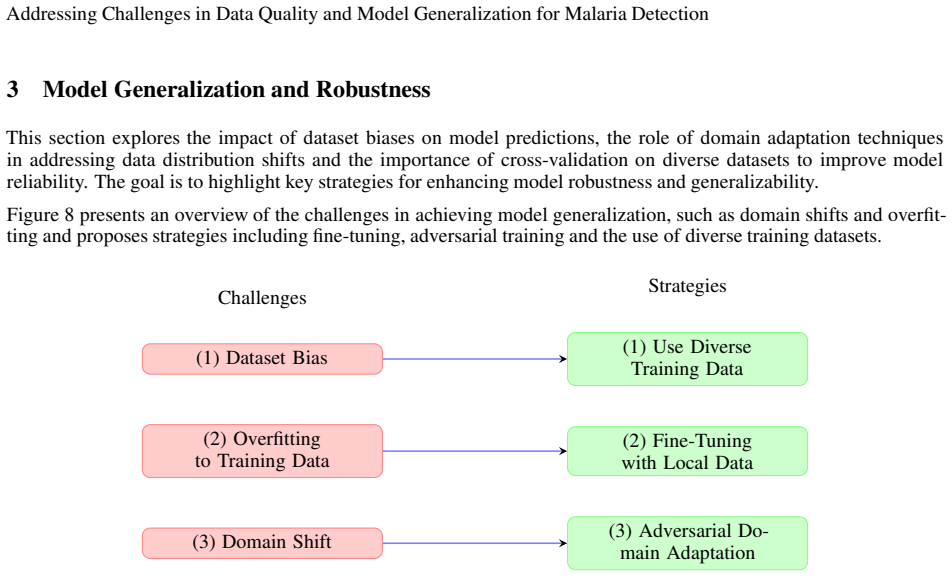
The argument is carried by a set of comparative metric tables (Tables 1, 3, 5, 7, 10, and 12) that assign percentage changes in accuracy, precision, recall, F1-score, sensitivity, and specificity to each data-quality defect and each proposed remedy, together with a five-step preprocessing pipeline (cleaning, augmentation, balancing, processing) and a challenge-solution diagram that maps defects to mitigations. These tables are what convert qualitative concerns into the paper's headline figures: the 20% F1 loss from imbalance, 15-20% accuracy gains from GAN augmentation, and up to 25% sensitivity gains from domain adaptation.
What would settle it
Train one fixed CNN architecture on a public malaria cell-image dataset at controlled imbalance ratios (e.g., 1:1, 3:1, 10:1) with the same budget, then apply GAN augmentation and transfer learning and compare F1-scores and sensitivity. If the balanced-versus-imbalanced F1 gap is not near 20 points, or GAN augmentation does not improve accuracy by roughly 15-20%, or transfer learning does not raise cross-domain sensitivity toward 25%, the paper's central quantitative claims are not reproducible.
Extended reading notes
Core claim
On its own terms, the paper's central claim is that the performance ceiling of malaria-detection deep learning is set by dataset quality and distribution shift rather than by model choice. The paper compiles quantitative evidence that imbalanced datasets reduce F1-scores to roughly 67% compared with 91% for balanced data (a ~20% drop), that GAN-based augmentation improves accuracy by 15-20% by generating synthetic minority-class images, and that domain adaptation via transfer learning raises cross-domain sensitivity by up to 25%. It organizes these findings into a challenge-solution framework: each data defect—imbalance, limited diversity, annotation variability, regional bias—is paired with a remedy such as balancing, augmentation, standardization, adaptation, and collaborative data sharing, with explainable AI (Grad-CAM, SHAP) presented as the trust layer for clinical adoption.
Load-bearing premise
The load-bearing assumption is that the numbers in the comparison tables are accurately extracted from the cited studies and measured in comparable ways; the paper gives no extraction protocol, dataset identifiers, metric definitions, or error bars, and Section 3.1 contains a broken 'Table ??' reference, so if the figures are unreliable the headline percentages lose their evidentiary basis.
Editorial extensions
If this is right
- Training malaria models on balanced, augmented data should raise F1-scores by roughly 20 points relative to raw imbalanced training on the same images.
- Deploying a model in a new region or laboratory without domain adaptation risks sensitivity losses of up to 25%; transfer learning and target-domain fine-tuning are required.
- GAN-generated synthetic blood-smear images can substitute for some real data collection, which lowers the cost of building diverse datasets in resource-limited settings.
- Standardized annotation and imaging protocols directly affect model accuracy; investing in them is as important as model design.
- External validation on unseen, diverse datasets should be a standard acceptance criterion for malaria-detection models.
Reading between the lines
- The paper's quantitative claims are assembled from heterogeneous prior studies; an immediate, testable extension would be a controlled benchmark that measures the 20%, 15-20%, and 25% figures on a fixed dataset with fixed architectures and metrics.
- If the effect sizes hold, the same data-quality framework should transfer to other neglected tropical diseases that rely on microscopy, such as sleeping sickness or leishmaniasis—an implication the paper does not state.
- The paper presents explainable AI as a parallel recommendation; an unstated consequence is that model interpretability may matter as much as raw accuracy for regulatory approval and clinician trust, not merely as an add-on.
Signed reviews
Editorial analysis
A structured set of objections, weighed in public.
Referee Report
Summary. This manuscript is a narrative review of data-quality and model-generalization challenges in deep-learning-based malaria detection. It argues that class imbalance, limited dataset diversity, annotation variability, and dataset bias degrade model performance, and it surveys remedies including data augmentation (rotations, SMOTE, GANs), transfer learning, domain adaptation, collaborative dataset development, and explainable-AI tools. The paper reports no original experiments; its contribution is a set of roughly a dozen summary tables that attribute quantitative performance values (precision, recall, F1-score, accuracy, sensitivity, specificity) to prior publications, and an abstract making three headline empirical claims: class imbalance can cause a 20% drop in F1-score, GAN-based augmentation improves accuracy by 15-20%, and domain adaptation improves cross-domain robustness by up to 25% in sensitivity. The body also contains schematic figures connecting challenges to solutions and qualitative discussion of deployment in resource-limited settings.
Significance. The paper is a practitioner-oriented survey whose organizational value is real: it maps a relevant literature (NIH-type cell-image datasets, Nakasi et al.'s mobile-aware detectors, Yang et al.'s smartphone CNNs, VGG-SVM transfer learning, GAN augmentation, and Grad-CAM/SHAP interpretability) onto a clear challenges-to-solutions taxonomy, and most qualitative statements are consistent with the ML-for-medical-imaging consensus. If its quantitative synthesis were reliable, the headline effect sizes would be genuinely actionable numbers for justifying data-balancing and domain-adaptation efforts. A further strength is that the claims are, in principle, checkable: each table row cites a source. However, the checks in this report show that several entries are internally inconsistent or cannot be supported by the cited references. The core quantitative contribution therefore does not currently stand; what remains is a qualitative summary of known challenges and solutions, which is useful but not novel. This is an evidence-provenance problem rather than a circularity problem: no derivation or fitting loop is involved.
major comments (4)
- [General: quantitative tables (Tables 1, 3, 5, 7, 10-15)] The manuscript provides no systematic-review methodology whatsoever: no search strategy, inclusion criteria, metric definitions, dataset identifiers, or error bars are given for any numerical entry in the tables, and there is no statement of how the cited percentages were extracted from the primary studies. Because the paper contains no original experiments, these tables are the only evidence for the abstract's headline numbers (20% F1-score drop, 15-20% GAN accuracy gain, 25% sensitivity gain), so the claims are not reproducible as written. The broken cross-reference in Section 3.1 ('Table ?? summarizes different types of dataset biases...', immediately preceding Table 10) is a concrete symptom of this missing anchorage: the bias-impact table is never actually referenced from the text.
- [Tables 1 and 3] The same cited work is reported with incompatible numbers in Tables 1 and 3. Nakasi et al. [12] appears in Table 1 as 'Imbalanced [12]' with precision 75.8, recall 60.4, and F1 67.2, and in Table 3 as 'Hybrid CNN-RNN [12]' with precision 86.5, recall 84.0, and F1 85.2, both described as imbalanced. Similarly, Vijayalakshmi and Kanna [22] is listed in Table 1 as 'Balanced + Transfer Learning [22]' (93.1/92.5/92.8) and in Table 3 as 'VGG-SVM [22]' (91.5/90.8/91.1). No explanation of different data splits, model variants, or metric definitions is provided, so at least one set of values for each of these sources is wrong; since these rows underpin the abstract's F1-drop claim, the internal contradiction is load-bearing.
- [Table 12] Several rows of Table 12 attribute specific accuracy/sensitivity/specificity values to citations that cannot support them: ResNet-50 is cited to Gu et al. [33], a general survey of convolutional neural networks; DenseNet and InceptionV3 are cited to Bakator and Radosav [10], a general review of deep learning for medical diagnosis; and YOLOv3 is cited to Jiang et al. [21], which is a real-time face-mask-detection paper rather than a malaria benchmark. None of these sources reports malaria-detection results, so the entries 97/95/96 (ResNet-50), 96.7/94.5/95.8 (DenseNet), 95/93/94 (InceptionV3), and 92.7/90.1/91.5 (YOLOv3) have no evidentiary basis in the cited references.
- [Abstract vs. Tables 7, 10 and Section 3.2] The abstract's three headline numbers are not traceable to, and in one case contradict, the manuscript's own tables. The claimed 15-20% accuracy gain from GAN-based augmentation conflicts with Table 7, whose 'Data Augmentation with GANs' row reports an 18-25% accuracy impact; the claimed 'up to 25% in sensitivity' gain from domain adaptation does not appear in any table, since Table 7 reports accuracy and F1-scores only and Section 3.2 contains no quantitative sensitivity results; and the '20% drop in F1-score' attributed to imbalance is inferred in Table 1 by comparing different models on different datasets across rows (e.g., 'Balanced [13]' at 91.2 F1 versus 'Imbalanced [12]' at 67.2 F1), which conflates class balance with model architecture and dataset choice and cannot support a causal attribution to imbalance alone.
minor comments (7)
- [Section 1, first paragraph] The statement that the widely used NIH dataset 'exhibit[s] class imbalances that disproportionately favor uninfected cells' is inconsistent with the standard NIH malaria cell dataset described in [7], which contains 27,558 cell images with equal numbers of parasitized and uninfected samples; the authors should correct this claim or specify exactly which dataset they mean.
- [References] The reference list contains duplicate entries for the same papers: [5] and [23] (Chibuta and Acar), [8] and [13] (Yang et al.), [12] and [30] (Nakasi et al.), and [19] and [22] (Vijayalakshmi and Kanna); these should be merged and the in-text citations renumbered.
- [Section 5.1] The text states that 'Table 17 summarizes these techniques' immediately before the table actually labeled 'Table 16: Techniques for Enhancing Model Generalization,' while a separate Table 17 appears later in Section 5.4; the table numbering and in-text references should be reconciled.
- [Section 1, structure paragraph] The outline of the article's structure skips Section 4 ('Impact of Dataset Characteristics on Model Performance'), which does exist in the paper and should be listed.
- [Section 2.1, Figure 3] Figure 3 presents a 'typical malaria dataset' with a 60/30/10 class distribution but provides no citation; this conflicts with the balanced NIH dataset discussed in the introduction and should either be tied to a specific dataset or removed.
- [Figure 12] Figure 12 plots only four of the nine models listed in Table 12 (ResNet-50, YOLOv4, MobileNet, DenseNet); the caption should state that this is a subset, or the figure should include all rows, so that the visualization matches the table it claims to illustrate.
- [General formatting] The manuscript contains numerous typographical irregularities, including stray spaces within words such as 'Y ang', 'V ariations', and 'speci ficity'; if these appear in the published PDF, a careful proofread is required.
Circularity Check
No circularity: the review's quantitative claims are external literature summaries rather than self-derived predictions, so the provenance defects are correctness issues, not circularity.
full rationale
The manuscript is a survey/review: it reports no new experiments, no model training, no fitted parameters, and no equations that could be self-referential. The headline quantities (20% F1-score drop from imbalance, 15-20% accuracy gain from GAN-based augmentation, up to 25% sensitivity gain from domain adaptation) are presented as summaries of previously published results, supported by tables such as Tables 1, 5, 7, 10-12. No quantity in the paper is defined in terms of another quantity and then used to predict that same quantity. No parameters are fitted to a subset of data and then renamed as predictions. The authors do not cite their own prior work as load-bearing support, and no uniqueness theorem or ansatz is imported from the authors' earlier papers. The evidentiary weaknesses noted in the manuscript--e.g., Nakasi et al. [12] appearing with different F1 values in Table 1 and Table 3, ResNet-50 being attributed to a general CNN survey [33], DenseNet being attributed to a broad literature review [10], and the broken 'Table ??' cross-reference in Section 3.1--are evidence-provenance, accuracy, and reporting defects, not circularity. Those problems bear on whether the cited numbers are real and comparable, but they do not show that the paper's claims reduce to their own inputs by construction. Accordingly, the circularity score is 0.
Assumptions & free parameters
assumptions (3)
- domain assumption The performance numbers reported in Tables 1, 3, 5, 7, 10-12 are faithful extractions from the cited references and are directly comparable across studies.
- domain assumption The 'typical' class distribution in Figure 3 (60% majority, 30% intermediate, 10% minority) is representative of malaria datasets.
- domain assumption Results from heterogeneous studies (different datasets, model architectures, evaluation metrics) can be pooled into a single performance comparison without adjusting for protocol differences.
Cite this review
Pith. "Pith review of Addressing Challenges in Data Quality and Model Generalization for Malaria Detection." pith.science (2026). https://pith.science/paper/MS75LKFV
@misc{pith2026250100464,
  author       = {Pith},
  title        = {Pith review of: Addressing Challenges in Data Quality and Model Generalization for Malaria Detection},
  year         = {2026},
  howpublished = {\url{https://pith.science/paper/MS75LKFV}},
  note         = {Machine review of arXiv:2501.00464}
}
read the original abstract
Malaria remains a significant global health burden, particularly in resource-limited regions where timely and accurate diagnosis is critical to effective treatment and control. Deep Learning (DL) has emerged as a transformative tool for automating malaria detection and it offers high accuracy and scalability. However, the effectiveness of these models is constrained by challenges in data quality and model generalization including imbalanced datasets, limited diversity and annotation variability. These issues reduce diagnostic reliability and hinder real-world applicability. This article provides a comprehensive analysis of these challenges and their implications for malaria detection performance. Key findings highlight the impact of data imbalances which can lead to a 20\% drop in F1-score and regional biases which significantly hinder model generalization. Proposed solutions, such as GAN-based augmentation, improved accuracy by 15-20\% by generating synthetic data to balance classes and enhance dataset diversity. Domain adaptation techniques, including transfer learning, further improved cross-domain robustness by up to 25\% in sensitivity. Additionally, the development of diverse global datasets and collaborative data-sharing frameworks is emphasized as a cornerstone for equitable and reliable malaria diagnostics. The role of explainable AI techniques in improving clinical adoption and trustworthiness is also underscored. By addressing these challenges, this work advances the field of AI-driven malaria detection and provides actionable insights for researchers and practitioners. The proposed solutions aim to support the development of accessible and accurate diagnostic tools, particularly for resource-constrained populations.
Figures


Figures from the paper (14 more)




Reference graph
Works this paper leans on
-
[33]
Recent advan ces in convolutional neural networks
Jiuxiang Gu, Zhenhua Wang, Jason Kuen, Lianyang Ma, Ami r Shahroudy, Bing Shuai, Ting Liu, Xingxing Wang, Gang Wang, Jianfei Cai, and Tsuhan Chen. “Recent advan ces in convolutional neural networks”. In: Pat- tern Recognition 77 (May 2015), pages 354–377. ISSN : 0031-3203. DOI : 10.1016/j.patcog.2017.10.013. URL : https://arxiv.org/pdf/1512.07108
arXiv 2015
-
[10]
Deep Learning and Medical Diagnosis: A Review of Literature
Mihalj Bakator and Dragica Radosav. “Deep Learning and Medical Diagnosis: A Review of Literature”. In: Mul- timodal T echnologies and Interaction2.3 (Aug. 2018), page 47. ISSN : 2414-4088. DOI : 10.3390/mti2030047. URL : https://www.mdpi.com/2414-4088/2/3/47
-
[22]
Deep learning appr oach to detect malaria from microscopic images
Vijayalakshmi A and Rajesh Kanna B. “Deep learning appr oach to detect malaria from microscopic images”. In: Multimedia T ools and Applications 79.21–22 (Jan. 2019), pages 15297–15317. ISSN : 1573-7721. DOI : 10.1007/s11042-019-7162-y . URL : https://link.springer.com/article/10.1007/S11042-01 9-7162-Y. 21 Addressing Challenges in Data Quality and Model G...
-
[21]
Real-Time Face Mask Detection Method Based on YOLOv3
Xinbei Jiang, Tianhan Gao, Zichen Zhu, and Y ukang Zhao. “Real-Time Face Mask Detection Method Based on YOLOv3”. In: Electronics 10.7 (Apr. 2021), page 837. ISSN : 2079-9292. DOI : 10.3390/electronics10070837. URL : https://www.mdpi.com/2079-9292/10/7/837
-
[13]
Deep Learning for Smartphone-Based Malaria Para- site Detection in Thick Blood Smears
Feng Y ang, Mahdieh Poostchi, Hang Y u, Zhou Zhou, Kamolr at Silamut, Jian Y u, Richard J. Maude, Stefan Jaeger, and Sameer Antani. “Deep Learning for Smartphone-Based Malaria Para- site Detection in Thick Blood Smears”. In: IEEE Journal of Biomedical and Health Informat- ics 24.5 (May 2020), pages 1427–1438. ISSN : 2168-2208. DOI : 10.1109/jbhi.2019.2939...
-
[1]
Malaria - W orld Health Organization (WHO)
World Health Organization (WHO). Malaria - W orld Health Organization (WHO) . https://www.who.int/news-room/fact-sheets/detail/ma laria. Accessed: 2023-12-04. Dec
work page 2023
-
[2]
Malaria diagno- sis: a brief review
Noppadon Tangpukdee, Chatnapa Duangdee, Polrat Wilair atana, and Srivicha Krudsood. “Malaria diagno- sis: a brief review.” In: The Korean Journal of Parasitology 47.2 (2009), page 93. ISSN : 0023-4001. DOI : 10.3347/kjp.2009.47.2.93. URL : https://www.ncbi.nlm.nih.gov/pmc/articles/PMC2688806/
-
[3]
J. Cunningham and M. Gatton. “Malaria rapid diagnostic t est performance : re- sults of WHO product testing of malaria RDTs : round 5 (2013)” . In: (2018). URL : https://eprints.qut.edu.au/75953/1/eprints_75953_PUB.pdf
work page 2013
Show all 32 references
-
[4]
Image analysis and machine learning for detecting malaria
Mahdieh Poostchi, Kamolrat Silamut, Richard J. Maude, S tefan Jaeger, and George Thoma. “Image analysis and machine learning for detecting malaria ”. In: Translational Research 194 (Apr. 2018), pages 36–55. ISSN : 1931-5244. DOI : 10.1016/j.trsl.2017.12.004. URL : https://www....
2018 doi
-
[6]
Classification of Malaria Cel l Images with Deep Learning Architectures
Eman Anwer and Nada Osama. “Classification of Malaria Cel l Images with Deep Learning Architectures”. In: (). URL : https://www.academia.edu/download/65629403/Classification_of_Malaria_Cell_Images_with_Deep_Learni
-
[7]
Performance evaluation of deep neural ensembles toward malaria parasite detection in thin-blood smear images
Sivaramakrishnan Rajaraman, Stefan Jaeger, and Sameer K. Antani. “Performance evaluation of deep neural ensembles toward malaria parasite detection in thin-blood smear images”. In: PeerJ 7 (May 2019), e6977. ISSN : 2167-8359. DOI : 10.7717/peerj.6977. URL : https://peerj.com/a...
2019 doi
-
[9]
Leveraging deep learn- ing techniques for malaria parasite detection using mobile application
Mehedi Masud, Hesham Alhumyani, Sultan S Alshamrani, Om ar Cheikhrouhou, Saleh Ibrahim, Ghulam Muhammad, M Shamim Hossain, and Mohammad Shorfuzzam an. “Leveraging deep learn- ing techniques for malaria parasite detection using mobile application”. In: Wireless Communica- tions...
2020 doi
-
[11]
Enhancing Perfo rmance of Deep Learning Models with differ- ent Data Augmentation Techniques: A Survey
Cherry Khosla and Baljit Singh Saini. “Enhancing Perfo rmance of Deep Learning Models with differ- ent Data Augmentation Techniques: A Survey”. In: 2020 International Conference on Intelligent Engi- neering and Management (ICIEM) . IEEE, June 2020. DOI : 10.1109/iciem48762.202...
2020
-
[14]
YOLOv3: An Incremental Improvement
Joseph Redmon and Ali Farhadi. “YOLOv3: An Incremental Improvement”. In: (2018)
2018
-
[15]
A Malaria Diagnostic Tool Based on Computer Vision Screening and Visualization of Pla smodium falciparum Candi- date Areas in Digitized Blood Smears
Nina Linder, Riku Turkki, Margarita Walliander, Andre as Mårtensson, Vinod Diwan, Esa Rahtu, Matti Pietikäinen, Mikael Lundin, and Johan Lundin. “A Malaria Diagnostic Tool Based on Computer Vision Screening and Visualization of Pla smodium falciparum Candi- date Areas in Digit...
2014 doi
-
[16]
A comparison of thick-film mi- croscopy, rapid diagnostic test, and polymerase chain reaction for accurate diagnosis of Plasmodium falciparum malaria
Kenji O. Mfuh, Olivia A. Achonduh-Atijegbe, Obase N. Be kindaka, Livo F. Esemu, Calixt D. Mbakop, Krupa Gandhi, Rose G. F. Leke, Diane W . Taylor, and Vivek R. Ne rurkar. “A comparison of thick-film mi- croscopy, rapid diagnostic test, and polymerase chain reaction for accurate...
2019 doi
-
[17]
Mentorship on mal aria microscopy diagnostic ser- vice in Ethiopia: baseline competency of microscopists and performance of health facilities
Bokretsion Gidey, Desalegn Nega, Adugna Abera, Abnet A bebe, Sindew Mekasha, Geremew Tasew, Mebrahtom Haile, Dereje Dillu, Degu Mehari, Ashenafi Assefa, Wondimeneh Liknew, Abeba G/Tsadik, Hussien Mohammed, Ermias Woldie, Tsegaye G etachew, Desalegn Ararso, Dereje Y enealem, Adi...
2020
-
[18]
Pre-trained convolutional neu- ral networks as feature extractors toward improved malaria parasite detection in thin blood smear images
Sivaramakrishnan Rajaraman, Sameer K. Antani, Mahdie h Poostchi, Kamolrat Silamut, Md. A. Hossain, Richard J. Maude, Stefan Jaeger, and George R. Thom a. “Pre-trained convolutional neu- ral networks as feature extractors toward improved malaria parasite detection in thin blood...
2018 doi
-
[20]
Mobi le-A ware Deep Learning Algorithms for Malaria Parasites and White Blood Cells Localization in Thick Blood Smears
Rose Nakasi, Ernest Mwebaze, and Aminah Zawedde. “Mobi le-A ware Deep Learning Algorithms for Malaria Parasites and White Blood Cells Localization in Thick Blood Smears”. In: Algorithms 14.1 (Jan. 2021), page 17. ISSN : 1999-4893. DOI : 10.3390/a14010017. URL : https://www.mdp...
2021 doi
-
[23]
Real-time Malaria Pa rasite Screening in Thick Blood Smears for Low-Resource Setting
Samson Chibuta and A ybar C. Acar. “Real-time Malaria Pa rasite Screening in Thick Blood Smears for Low-Resource Setting”. In: Journal of Digital Imaging 33.3 (Jan. 2020), pages 763–775. ISSN : 1618-727X. DOI : 10.1007/s10278-019-00284-2 . URL : https://www.ncbi.nlm.nih.gov/pm...
2020 doi
-
[24]
Malaria parasite detection in thick blood smear microscopic images using modified YOLOV3 a nd YOLOV4 models
Fetulhak Abdurahman, Kinde Anlay Fante, and Mohammed A liy. “Malaria parasite detection in thick blood smear microscopic images using modified YOLOV3 a nd YOLOV4 models”. In: BMC Bioinformatics 22.1 (Mar. 2020). ISSN : 1471-2105. DOI : 10.1186/s12859-021-04036-4 . URL : https:/...
2020 doi
-
[25]
Automatic identification of malaria and other red b lood cell inclusions us- ing convolutional neural networks
Angel Molina, José Rodellar, Laura Boldú, Andrea Aceve do, Santiago Alférez, and Anna Merino. “Automatic identification of malaria and other red b lood cell inclusions us- ing convolutional neural networks”. In: Computers in Biology and Medicine 136 (Sept. 2021), page 104680. I...
2021
-
[26]
Diving Deep into Deep Learning:History, Evol ution, Types and Applica- tions
Deekshith Shetty*, Harshavardhan C.A, M Jayanth V arma , Shrishail Navi, and Mohammed Riyaz Ahmed. “Diving Deep into Deep Learning:History, Evol ution, Types and Applica- tions”. In: International Journal of Innovative T echnology and Explor ing Engineering 9.3 (Jan. 2020), pa...
2020
-
[27]
Content Based Im- age Retrieval Approaches for Detection of Malarial Parasit e in Blood Images
M. I. Khan, Bhibhudendra Acharya, B. Singh, Jigyasa Son i, and M. Tech. “Content Based Im- age Retrieval Approaches for Detection of Malarial Parasit e in Blood Images”. In: (2011). URL : https://citeseerx.ist.psu.edu/document?repid=rep1&type=pdf&doi=9cef98d6b488a84972c6232ddc...
2011
-
[28]
A deep learning approach to the screening of malaria infect ion: Automated and rapid cell counting, object detection and instance segmentation using Mask R-CNN
De Rong Loh, Wen Xin Y ong, Jullian Y apeter, Karupppasam y Subburaj, and Rajesh Chandramohanadas. “A deep learning approach to the screening of malaria infect ion: Automated and rapid cell counting, object detection and instance segmentation using Mask R-CNN”. In: Computerize...
2021
-
[29]
Expert-level auto mated malaria diagnosis on routine blood films with deep neural networks
Petru Manescu, Michael J. Shaw, Muna Elmi, Lydia Neary- Zajiczek, Remy Claveau, Vijay Pawar, Iasonas Kokkinos, Gbeminiyi Oyinloye, Christopher Bendkowski, Olajide A. Oladejo, Bolanle F. Oladejo, Tristan Clark, Denis Timm, John Shawe-Taylor, Mandayam A. Srinivasan, Ikeoluwa Lag...
2020
-
[30]
A new approach for microscopic diagnosis of malaria parasite s in thick blood smears using pre-trained deep learning models
Rose Nakasi, Ernest Mwebaze, Aminah Zawedde, Jeremy Tu subira, Benjamin Akera, and Gilbert Maiga. “A new approach for microscopic diagnosis of malaria parasite s in thick blood smears using pre-trained deep learning models”. In: SN Applied Sciences 2 (2020), pages 1–7. DOI : 1...
2020 doi
-
[31]
Malaria Pa rasite Detection From Pe- ripheral Blood Smear Images Using Deep Belief Networks
Dhanya Bibin, Madhu S. Nair, and P . Punitha. “Malaria Pa rasite Detection From Pe- ripheral Blood Smear Images Using Deep Belief Networks”. In : IEEE Access 5 (2017), pages 9099–9108. ISSN : 2169-3536. DOI : 10.1109/access.2017.2705642. URL : https://ieeexplore.ieee.org/iel7/...
2017
-
[32]
A Review of Y olo Algorithm Developments
Peiyuan Jiang, Daji Ergu, Fangyao Liu, Ying Cai, and Bo M a. “A Review of Y olo Algorithm Developments”. In: Procedia Computer Science 199 (2021), pages 1066–1073. ISSN : 1877-0509. DOI : 10.1016/j.procs.2022.01.135. URL : https://www.sciencedirect.com/science/article/pii/S187...
2021 doi
-
[34]
An ensemble-based approach for automated medical diagnosis of malaria using EfficientNet
Gonçalo Marques, Antonio Ferreras, and Isabel de la Tor re-Diez. “An ensemble-based approach for automated medical diagnosis of malaria using EfficientNet” . In: Multimedia T ools and Applications 81.19 (Mar. 2022), pages 28061–28078. ISSN : 1573-7721. DOI : 10.1007/s11042-022-...
2022 doi
-
[35]
Smartphone- supported malaria diagnosis based on deep learning
Feng Y ang, Hang Y u, Kamolrat Silamut, Richard J Maude, S tefan Jaeger, and Sameer Antani. “Smartphone- supported malaria diagnosis based on deep learning”. In: Machine Learning in Medical Imaging: 10th International W orkshop, MLMI 2019, Held in Conjunction wit h MICCAI 2019...
2019 doi
-
[2023]
URL : https://www.who.int/news-room/fact-sheets/detail/ma laria
Reviewed August 10, 2026 · model on record in the stance chip above.
Discussion (0). Continue with ORCID to comment.