REVIEW 2 major objections 5 minor 1 cited by
LHC and HL-LHC Bounds on Visible and Invisible Decays in the $B-L$ Model
T0 review · 2 major / 5 minor · reviewed 2026-08-10 · deepseek-v4-flash
Pith's one-line read The ATLAS 139 fb$^{-1}$ dilepton search excludes $B-L$ $Z'$ bosons below 6 TeV for $g_{BL}=0.5$, and even with 90% invisible decays the LHC bound remains stronger than LEP.
desk verdict The base-model Z' bounds are solid and worth quoting, but the invisible-decay headline numbers rely on a narrow-width approximation that breaks down at large g_BL and BR_inv. read the letter →
The pith
A machine-rendered reading of the paper's core claim, the machinery that carries it, and where it could break.
The reading
What carries the argument
The central object is the $Z'$ gauge boson of $U(1)_{B-L}$, produced through quark-antiquark annihilation and observed via $Z'\to \ell\ell$. The exclusion mechanism is a grid scan that compares leading-order MadGraph predictions for $\sigma(pp\to Z')\times BR(Z'\to \ell\ell)$ with the ATLAS observed 95% C.L. limit curve, excluding any point whose predicted yield lies above the data. Invisible decays are parametrized in the narrow-width approximation by multiplying the dilepton branching ratio by $(1-BR_{inv})$, which reduces the signal size linearly as $BR_{inv}$ grows.
What would settle it
Recompute the exclusion using the ATLAS binned dilepton likelihood with interference between the $B-L$ $Z'$ and Standard Model Drell-Yan included; if the predicted dilepton yield drops by 20--30%, the mass limits quoted here would move downward by hundreds of GeV.
Extended reading notes
Core claim
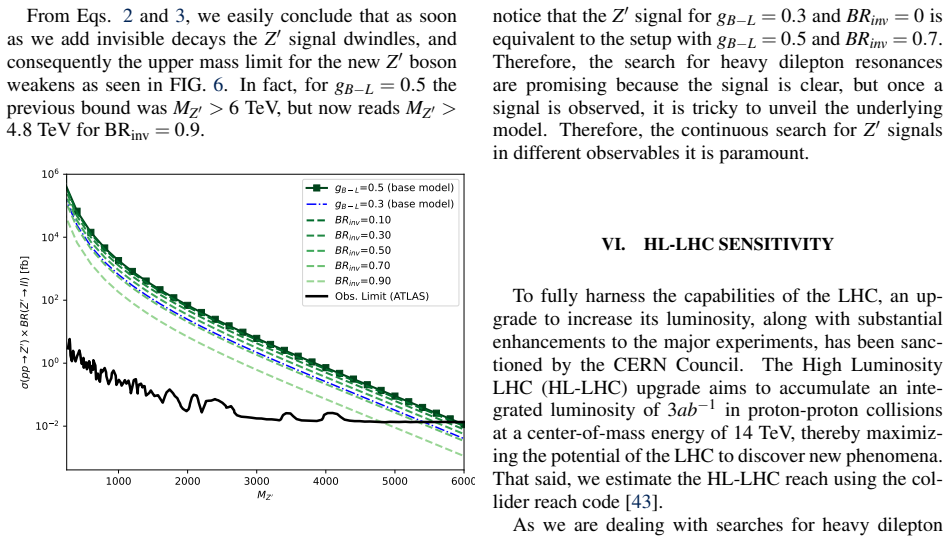
The central claim is that the ATLAS Run 2 search for high-mass dielectron and dimuon resonances, interpreted with leading-order simulations of the $B-L$ $Z'$, excludes $Z'$ masses below roughly 4 TeV for $g_{BL}=0.1$ and below 6 TeV for $g_{BL}=0.5$ in the visible-only scenario. When invisible decays are switched on by rescaling the dilepton branching ratio by $(1-BR_{inv})$, the limits weaken monotonically; for $BR_{inv}=0.9$ and $g_{BL}=0.5$ the bound drops to 4.8 TeV. Across the parameter plane, the derived exclusions exceed the longstanding LEP constraint $M_{Z'}/g_{BL} > 7$ TeV, so the LHC has become the strongest collider probe of $B-L$ symmetry. The same analysis projects that the HL-LHC at 14 TeV with $3$ ab$^{-1}$ will exclude $Z'$ masses up to about 7.6 TeV.
Load-bearing premise
The limits assume a $B-L$ $Z'$ would be reconstructed with the same acceptance and efficiency as the sequential Standard Model $Z'$ in the ATLAS analysis, and that leading-order predictions need no K-factor, PDF, or interference corrections.
Editorial extensions
If this is right
- In the minimal model, the ATLAS 139 fb$^{-1}$ dilepton data exclude $M_{Z'}$ below 4 TeV for $g_{BL}=0.1$ and below 6 TeV for $g_{BL}=0.5$.
- Turning on $BR_{inv}=0.9$ weakens the $g_{BL}=0.5$ limit to 4.8 TeV, so invisible decays remove only a limited slice of the parameter space.
- At every benchmark considered, the LHC bound now supersedes the LEP bound $M_{Z'}/g_{BL} > 7$ TeV.
- HL-LHC at 14 TeV with 3 ab$^{-1}$ is projected to probe $M_{Z'}$ up to about 5.7--7.6 TeV depending on coupling and invisible branching ratio.
- Dilepton rates alone cannot distinguish models: $g_{BL}=0.3$ with $BR_{inv}=0$ yields the same signal as $g_{BL}=0.5$ with $BR_{inv}=0.7$.
Reading between the lines
- Beyond the paper, the same rescaling technique could be applied to other narrow $Z'$ models with different quark and lepton couplings, producing a model-independent bound map from the same ATLAS curve.
- Beyond the paper, if the $Z'$ carries the dark matter interaction, these limits push invisible-sector benchmarks above roughly 5 TeV for $g_{BL}=0.5$ at the HL-LHC, shrinking the simplest thermal dark matter scenarios.
- Beyond the paper, a monojet or $Z'$ plus initial-state-radiation search could measure $BR_{inv}$ directly and break the coupling-versus-invisible degeneracy the paper identifies.
Editorial analysis
A structured set of objections, weighed in public.
Referee Report
Summary. This paper recasts the ATLAS 139 fb^-1 high-mass dilepton resonance search to constrain the Z' boson of the minimal U(1)_{B-L} model. The authors compute sigma(pp -> Z') x BR(Z' -> ll) at leading order with MadGraph for benchmark gauge couplings and compare it with the ATLAS observed limit line, obtaining M_Z' > 4 TeV for g_BL = 0.1 and M_Z' > 6 TeV for g_BL = 0.5 in the absence of invisible decays. They then model invisible decays by rescaling the dilepton branching ratio with a factor (1 - BR_inv), obtaining relaxed bounds such as M_Z' > 4.8 TeV for g_BL = 0.5 and BR_inv = 0.9, and they use the 'collider reach' code to project HL-LHC sensitivities. The central message is that the LHC now excludes the B-L Z' more strongly than the classic LEP bound M_Z'/g_BL > 7 TeV.
Significance. If the calculation were fully valid, the paper would provide a useful, up-to-date recasting of public LHC data for a well-motivated B-L benchmark, and the HL-LHC projections would help plan future searches. A notable strength is that the bounds are obtained by comparing predictions to an external ATLAS observed limit, with no quantity fitted to the target result. However, the advertised invisible-decay mass limits rely on the narrow-width approximation in regimes where the Z' width is a large fraction of its mass, so the specific numerical claims in Section V and Table III are not supported by the calculation as presented. The qualitative conclusion that the LHC surpasses the LEP bound is robust and would survive the needed corrections; the quantitative limits need revision and uncertainty estimates.
major comments (2)
- [Section V, Eq. (3), and Table III] The invisible-decay rescaling of Eq. (3) is presented under the narrow-width approximation, but the benchmarks used for the advertised limits are not narrow. In the B-L model, summing over SM fermions gives Gamma_vis/M = 5 g_BL^2/(12 pi), so for g_BL = 0.5 and BR_inv = 0.9 the total width satisfies Gamma/M = 0.33, and for g_BL = 0.6 with BR_inv = 0.9 it reaches 0.48; even g_BL = 0.3 with BR_inv = 0.9 gives roughly 12%. The quoted bound M_Z' > 4.8 TeV for g_BL = 0.5 and BR_inv = 0.9 is obtained by comparing this broad resonance to the ATLAS narrow-resonance observed limit, so that specific bound and the corresponding Table III HL-LHC entries with large BR_inv are not supported by the calculation as presented. The authors should either restrict BR_inv so that Gamma/M remains small, or replace the narrow-limit comparison with a full Breit-Wigner line shape convolved with the detector mass resolution, and report Gamma/M for every benchmark.
- [Section III, Figs. 3-7] The analysis compares leading-order MadGraph predictions for sigma(pp -> Z') x BR(Z' -> ll) directly with the ATLAS observed limit line and treats that line as a universal bound on any narrow spin-1 resonance. This assumes identical acceptance and efficiency to the SSM Z' used by ATLAS, neglects interference with Standard Model Drell-Yan, and assigns no PDF, scale, or NLO K-factor uncertainty. Because the predicted cross sections fall steeply with mass, a 20-30% shift in the signal normalization would move the quoted mass limits by hundreds of GeV. The qualitative finding that LHC bounds exceed the LEP bound is robust, but the precision of the quoted numbers (e.g., M_Z' > 6 TeV for g_BL = 0.5 and the four-digit entries in Tables II and III) is not justified. Please quantify these uncertainties or quote the limits with explicit caveats and rounding.
minor comments (5)
- [Section II, right-handed neutrino paragraph] The text contains a direct contradiction: it first says that assuming M_NR < M_Z'/2 would 'not yield meaningful changes' and then says the addition of three light right-handed neutrinos 'will bring meaningful changes to the branching ratio into charged leptons.' With three light right-handed neutrinos of B-L charge -1, the total Z' width increases from a coefficient of 5 to 8, changing BR(Z' -> ll) from 3/5 to 3/8; this is a meaningful change and should be stated consistently.
- [Section VI] The sentence 'HL-LHC can reach masses above 6 TeV even BR_inv = 0.9' is contradicted by Table III, whose g_BL = 0.2, BR_inv = 0.9 row gives M_Z' > 5512 GeV. Please rephrase the summary to reflect the coupling dependence shown in the table.
- [Throughout] There are multiple typos and grammar errors, including 'codded' for 'coded', 'enforcers' for 'enforces', 'In order words' for 'In other words', 'CTL8NNLO' for what is presumably 'CT18NNLO', and 'will operate with at sqrt(s) = 14 TeV' in the abstract. A careful proofreading pass is needed.
- [Figure 7] The 'Extrapolation' label in Figure 7 is never explained in the text; the reader cannot tell which portion of the excluded region is extrapolated and on what basis. Please define this in the caption or text.
- [Section III] No validation details or grid spacing are given for the scanning algorithm used to produce the exclusion curves. Providing a benchmark table or releasing the MadGraph grid/code would improve reproducibility.
Circularity Check
No significant circularity: the central bounds come from comparing MadGraph predictions to an external ATLAS observed limit, with the invisible-decay extension parameterized by hand and HL-LHC reach taken from an external code.
full rationale
The paper's central derivation chain is self-contained against an external benchmark. The B-L Z' is implemented in FeynRules/MadGraph, the production cross section times branching ratio is computed grid-wise, and the resulting values are compared directly with the ATLAS 139 fb^-1 observed upper limit curve (Figs. 3-4). The invisible-decay scenario is introduced through the explicit narrow-width rescaling of Eq. (3), sigma(pp -> Z' -> ll) ~ sigma(pp -> Z') BR(Z' -> ll) (1 - BR_inv), which is a deliberate parameterization rather than a quantity fitted to the target limit. The HL-LHC projections use the external collider-reach code [43] and CTL8NNLO PDFs [44], not a fit to the quoted exclusion masses. Self-citations appear in the model description, e.g., [17], [26], and [35], but these are contextual references to the B-L model and anomaly-cancellation structure; the central exclusion does not depend on them. The skeptical concern about the narrow-width approximation is a validity/correctness issue: for g_BL = 0.5 and BR_inv = 0.9, Gamma/M ~ 33%, so the ATLAS narrow-resonance limit is not strictly applicable; however, this does not constitute circularity, because the predicted signal is still independently computed and compared with an external bound. Likewise, the assumption that the ATLAS SSM acceptance applies to the B-L Z' is an external modeling assumption, not a circular reduction. No load-bearing step equates an output with an input by definition.
Assumptions & free parameters
free parameters (2)
- BR_inv (invisible branching ratio) =
0.1, 0.3, 0.5, 0.7, 0.9
- g_BL benchmark values =
0.1, 0.3, 0.5 for LHC; up to 0.6 for HL-LHC
assumptions (5)
- domain assumption The minimal U(1)_B-L extension with three right-handed neutrinos is anomaly-free and the Z' couplings follow Table I.
- domain assumption Right-handed neutrinos are much heavier than M_Z'/2 in the base scenario, so they do not contribute to the Z' width.
- domain assumption Narrow-width approximation: sigma(pp -> Z' -> ll) = sigma(pp -> Z') x BR(Z' -> ll) x (1-BR_inv).
- domain assumption The ATLAS observed limit curve for spin-1 resonances applies to the B-L Z' with the same acceptance and efficiency as the SSM Z'.
- domain assumption The collider-reach code and CT18NNLO PDFs give a valid HL-LHC sensitivity projection.
Cite this review
Pith. "Pith review of LHC and HL-LHC Bounds on Visible and Invisible Decays in the $B-L$ Model." pith.science (2026). https://pith.science/paper/5XDZVEQD
@misc{pith2026250100610,
  author       = {Pith},
  title        = {Pith review of: LHC and HL-LHC Bounds on Visible and Invisible Decays in the $B-L$ Model},
  year         = {2026},
  howpublished = {\url{https://pith.science/paper/5XDZVEQD}},
  note         = {Machine review of arXiv:2501.00610}
}
abstract
In this work, we use publicly available data from ATLAS collaboration collected at LHC run 2 at a center-of-mass energy of $\sqrt{s}=13$TeV with an integrated luminosity of $139 fb^{-1}$ to derive lower mass limits on the $Z^\prime$ gauge boson associated with the B-L gauge symmetry. Using dilepton data we find that $M_{Z^\prime} > 4$TeV ($6$TeV) for $g_{BL}=0.1$ ($g_{BL}=0.5$) in the absence of invisible decays. Once invisible decays are turned on these limits are substantially relaxed. Assuming an invisible branching ratio of $BR_{inv}=0.9$, the LHC bound is loosened up to $M_{Z^\prime}> 4.8$TeV for $g_{BL}=0.5$. This analysis confirms that the LHC now imposes stricter constraints than the longstanding bounds established by LEP. We also estimate the projected HL-LHC bounds that will operate with at $\sqrt{s}=14$TeV and a planned integrated luminosity of $\mathcal{L}=3 ab^{-1}$ that will probe $Z^\prime$ masses up to $7.5$TeV.
Figures


Figures from the paper (2 more)

Forward citations
Cited by 1 Pith paper
-
Constraining the heavy leptophilic neutral gauge bosons through the $Z\to\ell^+\ell^-$, $W^\pm\to\ell^\pm\nu_\ell$, and $h\to\ell^+\ell^-$ decays
One-loop corrections to W/Z/h leptonic widths exclude heavy leptophilic Z' regions (M ≳ O(1) TeV, g' ≳ 0.4) beyond LEP-2 and neutrino-trident limits.
Reference graph
Works this paper leans on
- [1]
-
[2]
S. Chatrchyan et al. (CMS), Phys. Lett. B 716, 30 (2012), arXiv:1207.7235 [hep-ex]
arXiv 2012
-
[3]
G. Apollinari, O. Br ¨uning, T. Nakamoto, and L. Rossi, CERN Yellow Rep. , 1 (2015), arXiv:1705.08830 [physics.acc-ph]
arXiv 2015
-
[4]
Cid Vidal et al., CERN Yellow Rep
X. Cid Vidal et al., CERN Yellow Rep. Monogr. 7, 585 (2019), arXiv:1812.07831 [hep-ph]
arXiv 2019
-
[5]
G. Cveti ˇc, C. S. Kim, and J. Zamora-Sa ´a, JHEP 02, 168 (2022), arXiv:2110.08799 [hep-ph]
work page Pith review arXiv 2022
-
[6]
G. Cvetic, C. Dib, C. S. Kim, and J. Zamora-Saa, Sym- metry 7, 726 (2015), arXiv:1503.01358 [hep-ph]
work page Pith review arXiv 2015
-
[7]
A. E. C ´arcamo Hern ´andez, L. Duarte, A. S. de Jesus, S. Kovalenko, F. S. Queiroz, C. Siqueira, Y . M. Oviedo- Torres, and Y . Villamizar, Phys. Rev. D 107, 063005 (2023), arXiv:2208.08462 [hep-ph]
arXiv 2023
-
[8]
A. S. de Jesus, S. Kovalenko, T. B. de Melo, J. P. Neto, Y . M. Oviedo-Torres, F. S. Queiroz, Y . S. Villamizar, and A. R. Zerwekh, Phys. Lett. B 849, 138419 (2024), arXiv:2304.00041 [hep-ph]
arXiv 2024
Show all 44 references
-
[9]
Cogollo, M
D. Cogollo, M. J. Neves, T. B. de Melo, A. S. de Je- sus, Y . M. Oviedo-Torres, and F. S. Queiroz, (2023), arXiv:2310.19959 [hep-ph]
2023 arXiv
-
[10]
Bertone, D
G. Bertone, D. Hooper, and J. Silk, Phys. Rept. 405, 279 (2005), arXiv:hep-ph/0404175
2005 arXiv
-
[11]
Alves, S
A. Alves, S. Profumo, and F. S. Queiroz, JHEP 04, 063 (2014), arXiv:1312.5281 [hep-ph]
2014 arXiv
-
[12]
Bertone and D
G. Bertone and D. Hooper, Rev. Mod. Phys. 90, 045002 (2018), arXiv:1605.04909 [astro-ph.CO]
2018 arXiv
-
[13]
Arcadi, M
G. Arcadi, M. Dutra, P. Ghosh, M. Lindner, Y . Mambrini, M. Pierre, S. Profumo, and F. S. Queiroz, Eur. Phys. J. C 78, 203 (2018), arXiv:1703.07364 [hep-ph]
2018 arXiv
-
[14]
R. N. Mohapatra and G. Senjanovic, Phys. Rev. Lett. 44, 912 (1980)
1980
- [15]
-
[16]
R. N. Mohapatra and J. W. F. Valle, Phys. Rev. D34, 1642 (1986). 6
1986
-
[17]
Klasen, F
M. Klasen, F. Lyonnet, and F. S. Queiroz, Eur. Phys. J. C 77, 348 (2017), arXiv:1607.06468 [hep-ph]
2017 arXiv
-
[18]
P. Cox, C. Han, and T. T. Yanagida, JHEP01, 037 (2018), arXiv:1707.04532 [hep-ph]
2018 arXiv
-
[19]
W. Liu, S. Kulkarni, and F. F. Deppisch, Phys. Rev. D 105, 095043 (2022), arXiv:2202.07310 [hep-ph]
2022 arXiv
-
[20]
Fiaschi, F
J. Fiaschi, F. Giuli, F. Hautmann, S. Moch, and S. Moretti, Phys. Lett. B 841, 137915 (2023), arXiv:2211.06188 [hep-ph]
2023 arXiv
- [21]
-
[22]
Patra, W
S. Patra, W. Rodejohann, and C. E. Yaguna, JHEP 09, 076 (2016), arXiv:1607.04029 [hep-ph]
2016 arXiv
-
[23]
Bernal, D
N. Bernal, D. Restrepo, C. Yaguna, and O. Zapata, Phys. Rev. D 99, 015038 (2019), arXiv:1808.03352 [hep-ph]
2019 arXiv
-
[24]
Adolphsen et al., CERN Yellow Rep
C. Adolphsen et al., CERN Yellow Rep. Monogr. 1, 1 (2022), arXiv:2201.07895 [physics.acc-ph]
2022
-
[25]
Pisano and V
F. Pisano and V . Pleitez, Phys. Rev. D 46, 410 (1992), arXiv:hep-ph/9206242
1992 arXiv
-
[26]
Alves, G
A. Alves, G. G. da Silveira, V . P. Gonc ¸alves, F. S. Queiroz, Y . M. Oviedo-Torres, and J. Zamora-Saa, Eur. Phys. J. C 84, 172 (2024), arXiv:2309.00681 [hep-ph]
2024 arXiv
-
[27]
R. W. Robinett, Phys. Rev. D 26, 2388 (1982)
1982
- [28]
-
[29]
Ramirez Barreto, Y
E. Ramirez Barreto, Y . A. Coutinho, and J. Sa Borges, Phys. Lett. B 689, 36 (2010), arXiv:1004.3269 [hep-ph]
2010 arXiv
-
[30]
Cogollo, F
D. Cogollo, F. F. Freitas, C. A. de S. Pires, Y . M. Oviedo- Torres, and P. Vasconcelos, Phys. Lett. B 811, 135931 (2020), arXiv:2008.03409 [hep-ph]
2020 arXiv
-
[31]
R. N. Mohapatra and R. E. Marshak, Phys. Rev. Lett. 44, 1316 (1980), [Erratum: Phys.Rev.Lett. 44, 1643 (1980)]
1980
-
[32]
Khalil, J
S. Khalil, J. Phys. G 35, 055001 (2008), arXiv:hep- ph/0611205
2008
- [33]
-
[34]
Khalil and H
S. Khalil and H. Okada, Phys. Rev. D 79, 083510 (2009), arXiv:0810.4573 [hep-ph]
2009 arXiv
-
[35]
Arcadi, G
G. Arcadi, G. C. Dorsch, J. P. Neto, F. S. Queiroz, and Y . M. Oviedo-Torres, Phys. Lett. B 848, 138382 (2024), arXiv:2307.06376 [hep-ph]
2024 arXiv
-
[36]
Ruegg and M
H. Ruegg and M. Ruiz-Altaba, Int. J. Mod. Phys. A 19, 3265 (2004), arXiv:hep-th/0304245
2004 arXiv
-
[37]
Alloul, N
A. Alloul, N. D. Christensen, C. Degrande, C. Duhr, and B. Fuks, Comput. Phys. Commun. 185, 2250 (2014), arXiv:1310.1921 [hep-ph]
2014 arXiv
-
[38]
Alwall, R
J. Alwall, R. Frederix, S. Frixione, V . Hirschi, F. Mal- toni, O. Mattelaer, H. S. Shao, T. Stelzer, P. Torrielli, and M. Zaro, JHEP 07, 079 (2014), arXiv:1405.0301 [hep- ph]
2014 arXiv
-
[39]
t. S. Electroweak (LEP, ALEPH, DELPHI, L3, OPAL, LEP Electroweak Working Group, SLD Electroweak Group, SLD Heavy Flavor Group), (2003), arXiv:hep- ex/0312023
2003
-
[40]
Elgammal, (2024), arXiv:2412.17876 [hep-ph]
S. Elgammal, (2024), arXiv:2412.17876 [hep-ph]
2024
-
[41]
Schael et al
S. Schael et al. (ALEPH, DELPHI, L3, OPAL, LEP Elec- troweak), Phys. Rept. 532, 119 (2013), arXiv:1302.3415 [hep-ex]
2013 arXiv
-
[42]
Navas et al
S. Navas et al. (Particle Data Group), Phys. Rev. D 110, 030001 (2024)
2024
-
[43]
Thamm, R
A. Thamm, R. Torre, and A. Wulzer, JHEP 07, 100 (2015), arXiv:1502.01701 [hep-ph]
2015 arXiv
-
[44]
Hou et al., Phys
T.-J. Hou et al., Phys. Rev. D 103, 014013 (2021), arXiv:1912.10053 [hep-ph]. 7
2021 arXiv
Reviewed August 10, 2026 · model on record in the stance chip above.
Discussion (0). Continue with ORCID to comment.