REVIEW 2 major objections 6 minor 99 references
Role of long-range interaction in critical quantum metrology
T0 review · 2 major / 6 minor · reviewed 2026-08-10 · deepseek-v4-flash
Pith's one-line read Long-range interactions in a Kitaev chain increase the quantum Fisher information near the phase transition, preserving the Heisenberg $L^2$ scaling and keeping a precision advantage when control parameters are uncertain.
desk verdict Clean single-parameter QFI results for the long-range Kitaev chain, but the uncertain-scenario analysis rests on a false mixture-QFI identity and its quantitative claims do not hold. read the letter →
The pith
A machine-rendered reading of the paper's core claim, the machinery that carries it, and where it could break.
The reading
What carries the argument
The load-bearing object is the quantum Fisher information matrix, obtained by decomposing the ground state into independent momentum modes and using $F_{ab}=4\,\partial_a\theta_k\,\partial_b\theta_k$ for each mode. The long-range character enters through $f_\alpha(k)=\sum_{y=1}^{L-1}\sin(ky)/d_y^\alpha$, the Fourier transform of the power-law pairing, which replaces the simple $\sin k$ of the short-range Kitaev chain. Near the critical point $k\approx\pi$, the paper inserts analytic expansions of $f_\alpha(k)$ (with a logarithmic correction at $\alpha=2$) into the quantum Fisher information sum, yielding $F^m_{\mu\mu}\propto L^2/\pi^2$; the $\alpha$-dependence sits entirely in the prefactor and hence in the ratio $R^m_F$. For the uncertain scenario, the machinery is a Gaussian mixture $\rho(\mu,\sigma_t)=\int dt\,p(t)|\psi_g(t)\rangle\langle\psi_g(t)|$, whose quantum Fisher information the paper evaluates as the weighted average $\bar F_{\mu\mu}=\int dt\,p(t)F_{\mu\mu}(t)$, with $\sigma_t^d\sim L^{-s(\alpha)}$ marking where the $L^2$ scaling is lost.
What would settle it
For a small chain (say $L=10$ to $20$), diagonalize the full Gaussian-mixture density matrix $\rho(\mu,\sigma_t)$ and compute its quantum Fisher information directly from Eq. (2); compare that exact value with the weighted average of Eq. (15). If the exact value falls below the average for a finite $\sigma_t$, the uncertain-scenario quantum Fisher information curves are upper bounds rather than achievable precisions.
Extended reading notes
Core claim
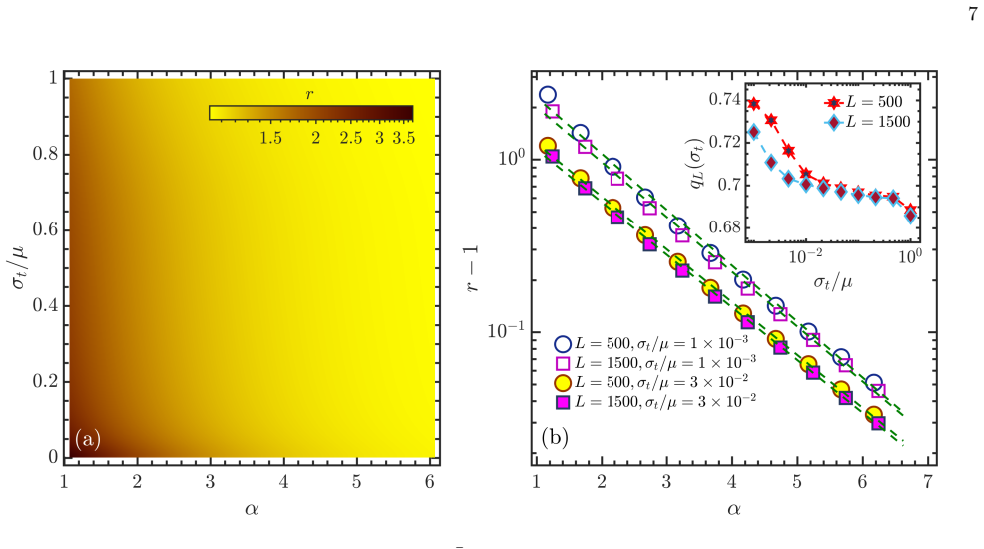
The central claim is that tuning the interaction range of a long-range Kitaev chain serves as a resource for critical quantum metrology. Working with the exact ground state, the paper shows that the quantum Fisher information for the chemical potential $\mu$ retains a sharp peak at the critical point $\mu/t=1$ for every $\alpha>1$, and that its maximum scales as $F^m_{\mu\mu}\propto L^2$ for large system size $L$, independent of $\alpha$. Because $L^2$ is the Heisenberg limit, the long-range interaction does not degrade the system-size scaling. The paper further shows that the prefactor is larger for smaller $\alpha$: the ratio $R^m_F=F^m_{\mu\mu}/F^m_{\mu\mu}(\infty)$ exceeds one and approaches one as $\alpha\to\infty$, with $R^m_F-1$ decaying approximately as $e^{-p\alpha}$. In the uncertain scenario, where the hopping $t$ is known only through a Gaussian distribution, the maximal averaged quantum Fisher information remains larger for longer-ranged interactions at every degree of uncertainty, even though long-range systems lose the $L^2$ scaling at smaller uncertainty levels than short-range systems.
Load-bearing premise
The uncertain-scenario results rest on treating the quantum Fisher information of the mixture as the weighted average of the quantum Fisher information values of the individual ground states, an equality that is exact only when those states have no overlap; the paper does not establish that condition.
Editorial extensions
If this is right
- Single-parameter critical sensing in a Kitaev chain reaches the Heisenberg limit $F^m_{\mu\mu}\propto L^2$ for every $\alpha>1$, so adding long-range interactions improves sensitivity without sacrificing the system-size scaling.
- The long-range advantage, measured by $R^m_F-1$, decays exponentially with $\alpha$ at a rate $p\simeq0.7378$, so the benefit is most pronounced for $\alpha$ close to 1 and effectively vanishes in the short-range limit $\alpha\to\infty$.
- With uncertainty in the hopping amplitude, the maximum averaged quantum Fisher information is larger for long-range than for short-range interactions at every tested degree of uncertainty, so the resource advantage survives imperfect control.
- The uncertainty threshold $\sigma_t^d$ at which the $L^2$ scaling is lost falls as a power of system size with an exponent $s(\alpha)$ that peaks near $\alpha=2$, giving a metrological signature of the crossover between long- and short-range regimes.
Reading between the lines
- The paper's uncertain-scenario evaluation treats the quantum Fisher information of the mixture as the averaged quantum Fisher information of the pure ground states. Since that identity is exact only when the states have no overlap, the reported $\bar F_{\mu\mu}$ is best read as an upper bound to the true quantum Fisher information of the mixture; a direct diagonalization of $\rho(\mu,\sigma_t)$ fo
- Because the full quantum Fisher information matrix contains off-diagonal elements involving $\alpha$, the same momentum-mode machinery could be turned around to estimate the interaction exponent $\alpha$ itself, rather than treating it as a known resource parameter; the exponential decay of $R^m_F-1$ suggests the sensitivity to $\alpha$ would be largest for small $\alpha$.
- The paper restricts attention to $\alpha>1$; extending the analysis to $\alpha\le1$, where the critical point at $\mu=-t$ disappears and the dispersion changes, is necessary before claiming the advantage extends to the strongest long-range interactions.
Editorial analysis
A structured set of objections, weighed in public.
Referee Report
Summary. The paper studies quantum critical metrology in the long-range Kitaev chain with power-law-decaying pairing, focusing on how the interaction-range exponent α affects the estimation precision of the chemical potential μ. In the single-parameter scenario, the authors derive an exact QFI formula for the ground state, find that the maximal QFI scales as L^2 (the Heisenberg limit) for all α, and report that the ratio R_m^F = F_m^{μμ}/F_m^{μμ}(∞) exceeds 1 and decays exponentially to 1 as α increases. In the uncertain scenario, they model an imprecisely known hopping parameter t by a Gaussian-mixture probe state and claim that its QFI is the weighted average of the pure-state QFIs; based on this they conclude that long-range interactions enhance the precision also under uncertainty.
Significance. If the claims were fully established, the paper would provide a clean analytically tractable example of long-range interactions acting as a resource in critical quantum metrology, with potential relevance to trapped-ion and other long-range platforms. The single-parameter calculation is a genuine strength: the QFI matrix for the ground state is derived exactly, the near-critical expansion is explicit, and the numerical evaluation of the exact expression is reproducible. The uncertain-scenario analysis, however, rests on an invalid identity for the QFI of a mixture, and therefore the central claim for that scenario is not supported as presented. The paper would be worth publishing after a substantial revision that replaces the averaged-QFI computation by the actual QFI of the mixture, or clearly and honestly reframes the results as bounds.
major comments (2)
- [Sec. IV B, Eq. (15)] Equation (15) asserts that the QFI of the mixture state in Eq. (14) is the weighted average of the pure-state QFIs. This is not an exact identity: for any convex mixture the QFI obeys F(∫ p(t)ρ_g(t)dt) ≤ ∫ p(t)F(ρ_g(t))dt by convexity, and equality is automatic only in special cases. Even for a mixture of two orthogonal pure states with equal weights one can find examples where the QFI of the mixture is strictly smaller than the average of the component QFIs. The ground states ρ_g(t) in Eq. (14) are not mutually orthogonal for finite L, and the paper supplies no additional conditions. Consequently, the quantity bar F_{μμ} evaluated in Figs. 3 and 4, including max[bar F_{μμ}], the exponents s(α) and q_L(σ_t), and the ratio r in Eq. (16), is an upper bound on the true QFI of the probe state, not its actual QFI. The claim that long-range interactions enhance precision in the uncertain scenario is therefore not quantitatively supported by the current calculations. The authors should compute the QFI of the actual mixture ρ(μ,σ_t) (for example from the fermionic covariance matrix) and check whether the long-range advantage survives, or at least quantify the gap between Eq. (15) and the true QFI for finite L.
- [Sec. IV A, Eq. (12)] The derivation of Eq. (12) omits the α-dependent coefficient that appears in the expansion of f_α(k). Near the critical point π−k = δ one has f_α(k) ≈ C_α δ with C_α = (1−2^{2−α})ζ(α−1)/ζ(α) for α≠2 (up to the logarithmic case α=2 and up to an absolute value), so the leading contribution to the maximal QFI is F_m^{μμ} ∼ L^2/(C_α^2 π^2), not L^2/π^2. As written, Eq. (12) is only correct for the scaling exponent; the prefactor carries the α-dependence that is responsible for R_m^F > 1 in Eq. (13). The text should distinguish the claim that the scaling exponent is independent of α from the claim about the α-dependent prefactor, and should give the prefactor explicitly if the ratio R_m^F is to be explained analytically.
minor comments (6)
- [Sec. IV B] The sentence 'where F_{μμ} is given by Eq. (2)' should refer to Eq. (9), since Eq. (2) defines the full QFI matrix, while the diagonal element F_{μμ} is given in Eq. (9).
- [Abstract] 'Kiteav' should be 'Kitaev' throughout, and the running title contains a stray space in 'metrolo gy'.
- [Figs. 2(c), 3(d), 4(b)] The exponential decay laws R_m^F−1 ∼ e^{-pα}, σ_t^d/μ ∼ L^{-s(α)}, and r−1 ∼ e^{-q_L(σ_t)α} are presented without residuals, fit ranges, or uncertainty estimates; since these phenomenological fits are used to support quantitative claims, please provide the fitting details.
- [Conclusion] The phrase 'the QFI increases exponentially with increasing the range of interaction' is ambiguous and should be phrased as decreasing exponentially with α, or increasing as α decreases.
- [Sec. IV B, Fig. 3(d)] The threshold δ_d = 0.1 is arbitrary; the text states that the results are independent of this choice, but no supporting data are shown. A brief appendix or inset demonstrating the independence would be useful.
- [Throughout] There are several typographical errors, including 'vacume', 'resepct', 'Provinical', and 'enble'; these should be corrected in a final polish.
Circularity Check
No significant circularity: the QFI results are direct calculations from the exact ground state, and the only fitted exponentials are descriptive fits to the authors' own numerical data.
full rationale
The paper's central derivation chain is self-contained rather than circular. It starts from the long-range Kitaev Hamiltonian (Eq. 4), diagonalizes it via a Bogoliubov transformation, writes the exact ground state (Eq. 6), and computes the QFI using the standard pure-state formula (Eqs. 7-9). The Heisenberg-limit scaling F_m^μμ ∝ L^2 in Eq. (12) is obtained analytically from the small-(π−k) expansion of f_α(k) and the choice k=kmax=π−π/L; it is not obtained by fitting. The enhancement ratio R_m^F>1 is a direct numerical consequence of Eq. (9), and the exponential decay R_m^F−1∼e^{−pα} is presented as a fit to the numerical curve, not as a prediction used to derive the enhancement. Likewise, the uncertain-scenario quantities max[\bar F_μμ], σ_t^d∼L^{−s(α)}, and r−1∼e^{−q_L(σ_t)α} are computed from the authors' stated expressions and then fitted; the fits do not feed back into the derivation of the qualitative long-range advantage. There are no load-bearing self-citations: the reference list contains no work by Niu or Wang. The one problematic step is Eq. (15), where the QFI of the mixture ρ(μ,σ_t) is asserted to equal ∫p(t)F_μμ(t)dt without proof; this is a mathematical validity issue (the true QFI is generally smaller by convexity), not a circularity in the sense of the prediction being equivalent to a fitted input or to a self-citation chain.
Assumptions & free parameters
free parameters (4)
- p =
~0.7378
- s(α) =
α-dependent, peak near α=2
- q_L(σ_t) =
depends on L and σ_t
- δ_d =
0.1
assumptions (4)
- ad hoc to paper The QFI of a mixture equals the average of the component QFIs
- domain assumption Ground state purity and tensor-product structure of the LRK ground state
- standard math Fourier transform and Bogoliubov diagonalization of the quadratic Hamiltonian
- standard math Expansion of fα(k) near k=π using polylogarithms
Cite this review
Pith. "Pith review of Role of long-range interaction in critical quantum metrology." pith.science (2026). https://pith.science/paper/GDZA7EA6
@misc{pith2026250100771,
  author       = {Pith},
  title        = {Pith review of: Role of long-range interaction in critical quantum metrology},
  year         = {2026},
  howpublished = {\url{https://pith.science/paper/GDZA7EA6}},
  note         = {Machine review of arXiv:2501.00771}
}
read the original abstract
Long-range interacting quantum systems are useful for improving the performance of various applications of quantum technologies. In this work, we carry out a detailed analysis of how the long-range interaction affects the measurement precision in critical quantum metrology. By employing the paradigmatic model of a Kiteav chain with power-law decaying interaction, we focus on the impacts of long-range interaction on the critical sensing for the scenarios with and without uncertainty in system parameters.We show that the long-range interaction can be used as a valuable resource for enhancing the sensitivity of critical parameter estimation in both scenarios. Our findings not only provide more insights into the features of the long-range interacting systems, but also verify the usefulness of long-range interacting systems in quantum metrology.
Figures


Figures from the paper (1 more)
Reference graph
Works this paper leans on
-
[1]
M. G. A. PARIS, International Journal of Quantum Information 07, 125 (2009)
2009
-
[2]
It is also easy to find that the ground state of H (4) is given by |Ψ 0⟩ = ∏ k>0 ( cosθk + sinθkc† kc† − k ) |0⟩, (6) where |0⟩ denotes the vacume state of c± k fermions
is finally diagonalized as H(µ ) = ∑ k>0εk(γ † kγk + γ † − kγ− k − 1) with εk = √ (µ +t cosk)2 + [fα (k)]2 being the quasiparticle dispersion [ 75, 82, 92, 93]. It is also easy to find that the ground state of H (4) is given by |Ψ 0⟩ = ∏ k>0 ( cosθk + sinθkc† kc† − k ) |0⟩, (6) where |0⟩ denotes the vacume state of c± k fermions. In the thermodynamic limit ...
-
[3]
Braun, G
D. Braun, G. Adesso, F. Benatti, R. Floreanini, U. Marzol ino, M. W. Mitchell, and S. Pirandola, Rev. Mod. Phys. 90, 035006 (2018)
2018
-
[4]
is quadratic in fermions, it can be diagonalized as follows. First, by us ing the Fourier transformfj = e− iπ/ 4 √ L ∑ ke− ikjck, withk = (2n+1)π L andn = −L/ 2,...,L/ 2−1 for evenL andn = −(L−1)/ 2,..., (L− 1)/ 2 for odd L, we recast the Hamiltonian ( 4) as H(µ ) = ∑ k>0 C† kHk(µ )Ck. Here, C† k = (c† k,c − k) is the Nambu spinor and Hk(µ ) = [ −(µ +t co...
-
[5]
C. L. Degen, F. Reinhard, and P. Cappellaro, Rev. Mod. Phys. 89, 035002 (2017)
2017
-
[6]
Giovannetti, S
V. Giovannetti, S. Lloyd, and L. Maccone, Phys. Rev. Lett. 96, 010401 (2006)
2006
-
[7]
Giovannetti, S
V. Giovannetti, S. Lloyd, and L. Maccone, Nature Photonics 5, 222 (2011)
2011
-
[8]
S. L. Braunstein and C. M. Caves, Phys. Rev. Lett. 72, 3439 (1994)
1994
Show all 99 references
-
[9]
Montenegro, C
V. Montenegro, C. Mukhopadhyay, R. Yousefjani, S. Sarka r, U. Mishra, M. G. A. Paris, and A. Bayat, Review: Quantum metrology and sensing with many-body syste ms (2024), arXiv:2408.15323 [quant-ph]
2024 arXiv
-
[10]
Giovannetti, S
V. Giovannetti, S. Lloyd, and L. Maccone, Science 306, 1330 (2004)
2004
-
[11]
Huang, M
J. Huang, M. Zhuang, and C. Lee, Applied Physics Reviews 11, 031302 (2024)
2024
-
[12]
Horodecki, P
R. Horodecki, P. Horodecki, M. Horodecki, and K. Horode cki, Rev. Mod. Phys. 81, 865 (2009)
2009
-
[13]
P. A. Ivanov and D. Porras, Phys. Rev. A 88, 023803 (2013)
2013
-
[14]
Tsang, Phys
M. Tsang, Phys. Rev. A 88, 021801 (2013)
2013
-
[15]
M. Bina, I. Amelio, and M. G. A. Paris, Phys. Rev. E 93, 052118 (2016)
2016
-
[16]
Zanardi, M
P. Zanardi, M. G. A. Paris, and L. Campos Venuti, Phys. Rev. A 78, 042105 (2008)
2008
-
[17]
Salvatori, A
G. Salvatori, A. Mandarino, and M. G. A. Paris, Phys. Rev. A 90, 022111 (2014)
2014
-
[18]
Garbe, M
L. Garbe, M. Bina, A. Keller, M. G. A. Paris, and S. Felice tti, Phys. Rev. Lett. 124, 120504 (2020)
2020
-
[19]
S. S. Mirkhalaf, D. Benedicto Orenes, M. W. Mitchell, an d E. Witkowska, Phys. Rev. A 103, 023317 (2021)
2021
-
[20]
Garbe, O
L. Garbe, O. Abah, S. Felicetti, and R. Puebla, Quantum Science and Technology 7, 035010 (2022)
2022
-
[21]
Di Candia, F
R. Di Candia, F. Minganti, K. V. Petrovnin, G. S. Paraoan u, and S. Felicetti, npj Quantum Information 9, 23 (2023)
2023
-
[22]
M. M. Rams, P. Sierant, O. Dutta, P. Horodecki, and J. Zak rzewski, Phys. Rev. X 8, 021022 (2018)
2018
-
[23]
Fr´ erot and T
I. Fr´ erot and T. Roscilde, Phys. Rev. Lett. 121, 020402 (2018)
2018
-
[24]
Hotter, H
C. Hotter, H. Ritsch, and K. Gietka, Phys. Rev. Lett. 132, 060801 (2024)
2024
-
[25]
Y. Chu, S. Zhang, B. Yu, and J. Cai, Phys. Rev. Lett. 126, 010502 (2021)
2021
-
[26]
G. D. Fresco, B. Spagnolo, D. Valenti, and A. Carollo, SciPost Phys. 13, 077 (2022)
2022
-
[27]
Mihailescu, S
G. Mihailescu, S. Campbell, and K. Gietka, Uncertain quantum critical metrology: From single to multi parameter sensing (2024), arXiv:2407.19917 [quant-ph]
2024 arXiv
-
[28]
Garbe, O
L. Garbe, O. Abah, S. Felicetti, and R. Puebla, Phys. Rev. Res. 4, 043061 (2022)
2022
-
[29]
Gietka, L
K. Gietka, L. Ruks, and T. Busch, Quantum 6, 700 (2022)
2022
-
[30]
Ilias, D
T. Ilias, D. Yang, S. F. Huelga, and M. B. Plenio, PRX Quantum 3, 010354 (2022)
2022
-
[31]
Salvia, M
R. Salvia, M. Mehboudi, and M. Perarnau-Llobet, Phys. Rev. Lett. 130, 240803 (2023)
2023
-
[32]
Ostermann and K
L. Ostermann and K. Gietka, Phys. Rev. A 109, L050601 (2024)
2024
-
[33]
Alushi, W
U. Alushi, W. G´ orecki, S. Felicetti, and R. Di Candia, Phys. Rev. Lett. 133, 040801 (2024)
2024
-
[34]
Zhang, W
R. Zhang, W. Ding, Z. Zhang, L. Shao, Y. Zhang, and X. Wang , Phys. Rev. A 110, 012413 (2024)
2024
-
[35]
S. Wald, S. V. Moreira, and F. L. Semi˜ ao, Phys. Rev. E 101, 052107 (2020)
2020
-
[36]
Montenegro, U
V. Montenegro, U. Mishra, and A. Bayat, Phys. Rev. Lett. 126, 200501 (2021)
2021
-
[37]
Gammelmark and K
S. Gammelmark and K. Mølmer, New Journal of Physics 13, 053035 (2011)
2011
-
[38]
Skotiniotis, P
M. Skotiniotis, P. Sekatski, and W. D¨ ur, New Journal of Physics 17, 073032 (2015)
2015
-
[39]
Sarkar, A
S. Sarkar, A. Bayat, S. Bose, and R. Ghosh, Exponentially-enhanced quantum sensing with many-body ph ase transitions (2024), arXiv:2410.11426 [quant-ph] . 10
2024 arXiv
-
[40]
Yang and Z
L.-P. Yang and Z. Jacob, Journal of Applied Physics 126, 174502 (2019) , https://pubs.aip.org/aip/jap/article-pdf/doi/10.1063/1.51215
2019 doi
-
[41]
S. S. Mirkhalaf, E. Witkowska, and L. Lepori, Phys. Rev. A 101, 043609 (2020)
2020
-
[42]
Sarkar, C
S. Sarkar, C. Mukhopadhyay, A. Alase, and A. Bayat, Phys. Rev. Lett. 129, 090503 (2022)
2022
-
[43]
Y. Yang, H. Yuan, and F. Li, Phys. Rev. A 109, 022604 (2024)
2024
-
[44]
Mukhopadhyay and A
C. Mukhopadhyay and A. Bayat, Phys. Rev. Lett. 133, 120601 (2024)
2024
-
[45]
X. He, R. Yousefjani, and A. Bayat, Phys. Rev. Lett. 131, 010801 (2023)
2023
-
[46]
Yousefjani, X
R. Yousefjani, X. He, A. Carollo, and A. Bayat, Nonlinearity-enhanced quantum sensing in stark probes (2024), arXiv:2404.10382 [quant-ph]
2024 arXiv
-
[47]
Sarkar and A
S. Sarkar and A. Bayat, Noisy stark probes as quantum-enhanced sensors (2024), arXiv:2411.02360 [quant-ph]
2024 arXiv
-
[48]
Sahoo, U
A. Sahoo, U. Mishra, and D. Rakshit, Phys. Rev. A 109, L030601 (2024)
2024
-
[49]
Liang, L.-Z
E.-W. Liang, L.-Z. Tang, and D.-W. Zhang, Phys. Rev. B 110, 024207 (2024)
2024
-
[50]
Wiersig, Photon
J. Wiersig, Photon. Res. 8, 1457 (2020)
2020
-
[51]
Guan and R
Q. Guan and R. J. Lewis-Swan, Phys. Rev. Res. 3, 033199 (2021)
2021
-
[52]
L. Zhou, J. Kong, Z. Lan, and W. Zhang, Phys. Rev. Res. 5, 013087 (2023)
2023
-
[53]
J. E. Lang, R. B. Liu, and T. S. Monteiro, Phys. Rev. X 5, 041016 (2015)
2015
-
[54]
Mishra and A
U. Mishra and A. Bayat, Phys. Rev. Lett. 127, 080504 (2021)
2021
-
[55]
Mishra and A
U. Mishra and A. Bayat, Scientific Reports 12, 14760 (2022)
2022
-
[56]
Zhang, W
K. Zhang, W. Liang, P. Meystre, and W. Zhang, Phys. Rev. A 107, 022605 (2023)
2023
-
[57]
Rodzinka, E
T. Rodzinka, E. Dionis, L. Calmels, S. Beldjoudi, A. B´ e guin, D. Gu´ ery-Odelin, B. Allard, D. Sugny, and A. Gauguet, Nature Communications 15, 10281 (2024)
2024
-
[58]
Fern´ andez-Lorenzo and D
S. Fern´ andez-Lorenzo and D. Porras, Phys. Rev. A 96, 013817 (2017)
2017
-
[59]
Raghunandan, J
M. Raghunandan, J. Wrachtrup, and H. Weimer, Phys. Rev. Lett. 120, 150501 (2018)
2018
-
[60]
T. L. Heugel, M. Biondi, O. Zilberberg, and R. Chitra, Phys. Rev. Lett. 123, 173601 (2019)
2019
-
[61]
P. A. Ivanov, Phys. Rev. A 102, 052611 (2020)
2020
-
[62]
Beaulieu, F
G. Beaulieu, F. Minganti, S. Frasca, M. Scigliuzzo, S. F elicetti, R. D. Candia, and P. Scarlino, Criticality-enhanced quantum sensing with a parametric su perconducting resonator (2024), arXiv:2409.19968 [quant-ph]
2024
-
[63]
Montenegro, M
V. Montenegro, M. G. Genoni, A. Bayat, and M. G. A. Paris, Communications Physics 6, 304 (2023)
2023
-
[64]
Iemini, R
F. Iemini, R. Fazio, and A. Sanpera, Phys. Rev. A 109, L050203 (2024)
2024
-
[65]
Cabot, F
A. Cabot, F. Carollo, and I. Lesanovsky, Phys. Rev. Lett. 132, 050801 (2024)
2024
-
[66]
L. J. I. Moon, P. M. Schindler, R. J. Smith, E. Druga, Z.-R . Zhang, M. Bukov, and A. Ajoy, Discrete time crystal sensing (2024), arXiv:2410.05625 [quant-ph]
2024 arXiv
-
[67]
Yousefjani, K
R. Yousefjani, K. Sacha, and A. Bayat, Discrete time crystal phase as a resource for quantum enhanc ed sensing (2024), arXiv:2405.00328 [quant-ph]
2024 arXiv
-
[68]
R. K. Shukla, L. Chotorlishvili, S. K. Mishra, and F. Iem ini, Prethermal floquet time crystals in chiral multiferroic cha ins and applications (2024), arXiv:2410.17530 [quant-ph]
2024 arXiv
-
[69]
R. Liu, Y. Chen, M. Jiang, X. Yang, Z. Wu, Y. Li, H. Yuan, X. Peng, and J. Du, npj Quantum Information 7, 170 (2021)
2021
-
[70]
Ding, Z.-K
D.-S. Ding, Z.-K. Liu, B.-S. Shi, G.-C. Guo, K. Mølmer, a nd C. S. Adams, Nature Physics 18, 1447 (2022)
2022
-
[71]
Ilias, D
T. Ilias, D. Yang, S. F. Huelga, and M. B. Plenio, npj Quantum Information 10, 36 (2024)
2024
-
[72]
Boixo, S
S. Boixo, S. T. Flammia, C. M. Caves, and J. Geremia, Phys. Rev. Lett. 98, 090401 (2007)
2007
-
[73]
Boixo, A
S. Boixo, A. Datta, M. J. Davis, S. T. Flammia, A. Shaji, a nd C. M. Caves, Phys. Rev. Lett. 101, 040403 (2008)
2008
-
[74]
Napolitano, M
M. Napolitano, M. Koschorreck, B. Dubost, N. Behbood, R . J. Sewell, and M. W. Mitchell, Nature 471, 486 (2011)
2011
-
[75]
Z. Hou, Y. Jin, H. Chen, J.-F. Tang, C.-J. Huang, H. Yuan, G.-Y. Xiang, C.-F. Li, and G.-C. Guo, Phys. Rev. Lett. 126, 070503 (2021)
2021
-
[76]
Defenu, T
N. Defenu, T. Donner, T. Macr ` ı, G. Pagano, S. Ruffo, and A . Trombettoni, Rev. Mod. Phys. 95, 035002 (2023)
2023
-
[77]
Van Regemortel, D
M. Van Regemortel, D. Sels, and M. Wouters, Phys. Rev. A 93, 032311 (2016)
2016
-
[78]
Defenu, T
N. Defenu, T. Enss, and J. C. Halimeh, Phys. Rev. B 100, 014434 (2019)
2019
-
[79]
J. C. Halimeh, M. Van Damme, V. Zauner-Stauber, and L. Va nderstraeten, Phys. Rev. Res. 2, 033111 (2020)
2020
-
[80]
Defenu, Proceedings of the National Academy of Sciences 118, e2101785118 (2021)
N. Defenu, Proceedings of the National Academy of Sciences 118, e2101785118 (2021)
2021
-
[81]
Giachetti and N
G. Giachetti and N. Defenu, Scientific Reports 13, 12388 (2023)
2023
-
[82]
Defenu, A
N. Defenu, A. Lerose, and S. Pappalardi, Physics Reports 1074, 1 (2024) , out-of-equilibrium dynamics of quantum many- body systems with long-range interactions
2024
-
[83]
J. Yang, S. Pang, A. del Campo, and A. N. Jordan, Phys. Rev. Res. 4, 013133 (2022)
2022
-
[84]
Vodola, L
D. Vodola, L. Lepori, E. Ercolessi, A. V. Gorshkov, and G . Pupillo, Phys. Rev. Lett. 113, 156402 (2014)
2014
-
[85]
Maity, U
S. Maity, U. Bhattacharya, and A. Dutta, Journal of Physics A: Mathematical and Theoretical 53, 013001 (2019)
2019
-
[86]
Bhattacharya and A
U. Bhattacharya and A. Dutta, Phys. Rev. B 97, 214505 (2018)
2018
-
[87]
J. Liu, H. Yuan, X.-M. Lu, and X. Wang, Journal of Physics A: Mathematical and Theoretical 53, 023001 (2019)
2019
-
[88]
Campos Venuti and P
L. Campos Venuti and P. Zanardi, Phys. Rev. Lett. 99, 095701 (2007)
2007
-
[89]
Zanardi, P
P. Zanardi, P. Giorda, and M. Cozzini, Phys. Rev. Lett. 99, 100603 (2007)
2007
-
[90]
GU, International Journal of Modern Physics B 24, 4371 (2010)
S.-J. GU, International Journal of Modern Physics B 24, 4371 (2010)
2010
-
[91]
Mihailescu, A
G. Mihailescu, A. Bayat, S. Campbell, and A. K. Mitchell , Quantum Science and Technology 9, 035033 (2024)
2024
-
[92]
J. J. Meyer, Quantum 5, 539 (2021)
2021
-
[93]
Albarelli, M
F. Albarelli, M. Barbieri, M. Genoni, and I. Gianani, Physics Letters A 384, 126311 (2020)
2020
-
[94]
Dutta and A
A. Dutta and A. Dutta, Phys. Rev. B 96, 125113 (2017)
2017
-
[95]
Francica and L
G. Francica and L. Dell’Anna, Phys. Rev. B 106, 155126 (2022) . 11
2022
-
[96]
F. W. Olver, D. W. Lozier, R. F. Boisvert, and C. W. Clark, NIST Handbook of Mathematical Functions , 1st ed. (Cam- bridge University Press, USA, 2010)
2010
-
[97]
Baghran, R
R. Baghran, R. Jafari, and A. Langari, Phys. Rev. B 110, 064302 (2024)
2024
-
[98]
A. Z. Goldberg, J. L. Romero, A. S. Sanz, and L. L. S´ anchez-Soto, International Journal of Quantum Information 19, 2140004 (2021)
2021
-
[99]
Solfanelli, G
A. Solfanelli, G. Giachetti, M. Campisi, S. Ruffo, and N. Defenu, New Journal of Physics 25, 033030 (2023)
2023
Reviewed August 10, 2026 · model on record in the stance chip above.
Discussion (0). Continue with ORCID to comment.