REVIEW 3 major objections 4 minor 71 references
Comprehensive Study of Generalized Ghost Dark Energy in $f(\textsl{Q}, \textsl{L}_{m})$ Gravity: New Insights into Cosmic Dynamics
T0 review · 3 major / 4 minor · reviewed 2026-08-10 · deepseek-v4-flash
Pith's one-line read This paper claims that generalized ghost dark energy in $f(Q,L_m)$ gravity, reconstructed from the density ansatz $\mu_D=\alpha H+\beta H^2$, yields a phantom-like, stable, observationally consistent late-time cosmic acceleration.
desk verdict The paper divides by f_Lm to define density and pressure, then reconstructs an f that has no L_m dependence, so the model is singular and its viability claims don't hold. read the letter →
The pith
A machine-rendered reading of the paper's core claim, the machinery that carries it, and where it could break.
The reading
What carries the argument
The load-bearing object is the reconstructed function $f(Q,L_m)=-\frac{\alpha c_1\sqrt{Q}(\ln Q+2)}{2\sqrt6}-\frac13\beta c_1 Q$, obtained by inserting the generalized ghost dark energy density $\mu_D=\alpha H+\beta H^2$ into the $f(Q,L_m)$ field equations for a flat FRW universe with interacting dark components. Here $Q$ is the non-metricity scalar, equal to $6H^2$ in this geometry, and $L_m$ is the matter Lagrangian. This function carries the argument: all subsequent densities, pressures, equation-of-state curves, statefinder pairs, and squared sound speeds are evaluations of the formulas built from it, with the redshift parametrization $H=H_0(1+z)^{1+q}$ connecting the model to observables.
What would settle it
Take the reconstructed function in Eq. (41) and compute $\partial f/\partial L_m$: because the function contains no $L_m$, this derivative is identically zero, while Eqs. (33) and (34), and therefore the quoted $\mu_D$, $P_D$, $\omega_D$, and $v_s^2$, all divide by $f_{L_m}$. That single calculation settles whether the presented reconstruction is well-defined, and it would force the model to be re-derived from a function with explicit $L_m$ dependence.
Extended reading notes
Core claim
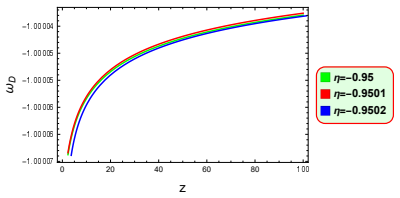
On its own terms, the paper's discovery is a reconstruction: starting from the generalized ghost dark energy density $\mu_D=\alpha H+\beta H^2$ in a flat FRW universe with interacting dark energy and dark matter, the authors derive the field equations of $f(Q,L_m)$ gravity and invert them to obtain $f(Q,L_m)=-\frac{\alpha c_1\sqrt{Q}(\ln Q+2)}{2\sqrt6}-\frac13\beta c_1 Q$. Inserting this function into their expressions for dark-energy density and pressure, and using $H=H_0(1+z)^{1+q}$ with $q\approx -0.832$, yields $\mu_D=\alpha\sqrt{H_0^2(1+z)^{2+2q}}+\beta H_0^2(1+z)^{2+2q}$ and $P_D=-\mu_D$. From there the paper reports a phantom regime in the $\omega_D$ diagnostic, a freezing-region pattern in $(\omega_D,\omega'_D)$, a Chaplygin-gas statefinder pair, positive squared sound speed, and consistency with the dark-energy equation-of-state values quoted from recent observations.
Load-bearing premise
The derivation requires the derivative of $f$ with respect to the matter Lagrangian $L_m$ to be nonzero, but the reconstructed $f$ in Eq. (41) has no $L_m$ term, so that derivative is identically zero and the formulas built on it are not well defined.
Editorial extensions
If this is right
- If the reconstruction is sound, symmetric teleparallel $f(Q,L_m)$ gravity can generate late-time acceleration without a cosmological constant.
- The predicted phantom-like equation of state near $\omega_D=-1$ falls inside the observationally favored range, making the model a candidate alternative to $\Lambda$CDM.
- Positive $v_s^2$ indicates that the background is stable to small perturbations, which would permit using the model for growth-of-structure calculations.
- The Chaplygin-like $(r,s)$ trajectory gives a geometric signature that future distance measurements could use to distinguish this model from $\Lambda$CDM.
Reading between the lines
- Beyond the paper, the close agreement between the reconstructed density and pressure and the input ansatz suggests that part of the phantom behavior is inherited from the assumed $\mu_D=\alpha H+\beta H^2$ rather than from the $f(Q,L_m)$ dynamics.
- Beyond the paper, a natural correction is to add an explicit $L_m$-dependent piece to the reconstructed $f$ so that the derivative $f_{L_m}$ is nonzero, and then check whether the positive sound speed and phantom equation of state survive the re-derivation.
- Beyond the paper, the phantom phase raises the question of a future singularity; evolving the model beyond $z=0$ would show whether it ends in a big rip or relaxes to de Sitter.
- Beyond the paper, the same reconstruction route could be applied to holographic or pilgrim dark-energy densities to see whether the Chaplygin-like statefinder and stability are generic features of $f(Q,L_m)$ reconstructions.
Editorial analysis
A structured set of objections, weighed in public.
Referee Report
Summary. The manuscript studies a generalized ghost dark energy (GGDE) model in f(Q,L_m) gravity. It derives the f(Q,L_m) field equations for a flat FRW universe, assumes a power-law scale factor, adopts the GGDE density ansatz μ_D = αH + βH^2, reconstructs the function f(Q,L_m), and then analyzes the resulting energy density, pressure, equation-of-state parameter, (ω_D, ω'_D)-plane, statefinder pair, and squared sound speed. The paper concludes that the reconstructed model produces positive energy density, negative pressure, phantom-like equation of state, Chaplygin-like statefinder behavior, and positive squared sound speed, and that these results are consistent with recent observational data.
Significance. If the reconstruction were valid, the paper would provide a concrete f(Q,L_m) realization of the GGDE model with second-order field equations and a complete set of cosmological diagnostics. The manuscript is organized and self-contained in its derivation of the non-metricity variation in the appendices, and it covers standard diagnostic tools. However, the central reconstruction is internally inconsistent: the reconstructed f(Q,L_m) in Eq. (41) has no L_m dependence, so f_{L_m}=0 identically, while Eqs. (33), (34), and (40) all divide by f_{L_m}. The density, pressure, and all derived quantities are therefore not well defined for the very model the paper claims to have constructed. In addition, the redshift-space mapping in Eq. (48) is dimensionally inconsistent, and the claimed predictions are largely algebraic consequences of the assumed μ_D ansatz. I do not regard the reported viability as established.
major comments (3)
- [Section 2.1, Eqs. (33)–(41)] The reconstructed function in Eq. (41), f(Q,L_m) = -αc1√Q(ln Q + 2)/(2√6) - βc1 Q/3, contains no L_m term, so f_{L_m}=0 identically. Equations (33), (34), and (40) all divide by f_{L_m}. Therefore Eq. (40) cannot be used to determine f, and the expressions for μ_D, P_D, and every quantity derived from them, including Eqs. (42)–(63) and Figures 1–6, are not defined for this model. This is an internal inconsistency in the central reconstruction, not merely a disagreement with current observational constraints.
- [Section 2.1, Eq. (48)] The second relation in Eq. (48) is dimensionally inconsistent. From H = H0 U^{1+q} with U = 1+z, one obtains ˙H = -(1+q) H0^2 U^{2+2q}, not -H0 U^{2+2q}. The missing factor (1+q) and the missing power of H0 affect the redshift-space form of ˙H used in Eq. (43) and therefore propagate into the pressure, equation-of-state, and stability results. The relation should be corrected and the subsequent formulas recomputed.
- [Section 2.1, Eqs. (39), (42), and (52); Section 4] The claimed dark-energy predictions are largely algebraic consequences of the assumed ansatz. With Q = 6H^2, Eq. (42) reduces exactly to μ_D = αH + βH^2, which is Eq. (39), and Eq. (52) gives P_D = -μ_D by construction. The equation-of-state, statefinder, and sound-speed expressions are therefore controlled by the input ansatz and the selected parameters α = 1.5, β = 6.5, c1 = 0.4, and η near -0.95. The abstract and Section 4 present these as new dynamical predictions; the paper should at least acknowledge that they are built into the reconstruction.
minor comments (4)
- [Section 2.1, Eq. (34)] The notation f_L and f_QL in Eq. (34) is not defined; if these denote partial derivatives, please define them explicitly.
- [Section 2.1, Eqs. (37) and (39)] The symbol β is used for two different quantities: the energy-density ratio μ_m/μ_D in Eq. (37) and the GGDE coefficient in Eq. (39). This makes formulas such as Eq. (53) ambiguous.
- [Section 2.1, Eqs. (21) and (24)] There are editorial glitches: Eq. (21) contains the citation '[6, ?]', Eq. (24) has an unbalanced parenthesis, and the sentence beginning 'We consider Substituting these values...' in Section 2.1 is incomplete.
- [Figures 3 and 4] The axis labels and legends in Figures 3 and 4 are corrupted, including the legend entries for η in Figure 3 and the LaTeX in the ordinate of Figure 4, which prevents the reader from extracting the stated parameter values.
Circularity Check
The reconstructed model returns the assumed GGDE density by construction, and the reconstructed f has f_Lm = 0, so the central viability claims reduce to the input ansatz.
-
fitted input called prediction
[Sec. 2.1, Eqs. (39)-(41), (51)-(52)]
"In this context, the energy density of the GGDE model is represented as µD = αH + βH^2. (39) Using Eqs.(33) and (39), we have [−12H^2 f_Q − L_m f_L + f]/f_L = αH + βH^2. (40) ... Substituting Eq.(49) in (42) and (43), we have µD = α√(H0^2 U^{2q+2}) + βH0^2U^{2q+2}, (51) PD = −α√(H0^2 U^{2q+2}) − βH0^2U^{2q+2}. (52)"
The reconstruction solves Eq. (40), which is exactly the condition that Eq. (33) equal the assumed GGDE density µD = αH + βH^2. With Q = 6H^2 and H = H0 U^{1+q}, Eq. (51) reduces to αH + βH^2, i.e., the input is returned unchanged, and Eq. (52) is its negative. All later diagnostics—phantom EoS, freezing region, Chaplygin-like statefinder pair, positive squared sound speed—are algebraic functions of this same assumed µD and the chosen parameters α = 1.5, β = 6.5, η ≈ −0.95. They therefore do not constitute an independent prediction of the f(Q,L_m) field equations.
-
other
[Sec. 2, Eqs. (33)-(34); Sec. 2.1, Eq. (41)]
"µD and PD represent the energy density and pressure corresponding to DE expressed as µD = −12H2fQ − LmfLm + f / fL, (33) ... f(Q,Lm) = −αc1√Q(ln(Q)+2)/(2√6) − (1/3)βc1Q, (41)"
The reconstructed f in Eq. (41) contains no L_m term, so f_{L_m} = 0 identically. The definitions (33)-(34) from which the model's density and pressure are supposedly read divide by f_{L_m}. For this model those formulas are singular, so the finite expressions (42)-(43) and (51)-(52) cannot be obtained by substituting Eq. (41) into Eqs. (33)-(34). The reported quantities are the assumed ansatz reintroduced after a formally undefined division, which is a break in the derivation chain rather than an independent derivation.
full rationale
The paper is self-contained algebraically and does not rely on a load-bearing self-citation or imported uniqueness theorem, so the self-citation patterns do not drive the score. The circularity is in the reconstruction loop: Eq. (40) is obtained by equating the generalized density (33) to the assumed GGDE form (39), and the reconstructed f is then inserted to recover exactly that same form in Eq. (51). The EoS, statefinder, and sound-speed results are functions of this assumed µD and of hand-picked α, β, η; the asserted agreement with Planck's phantom ω_D is therefore a consequence of parameter choice, consistent with the paper's own Data Availability Statement that no data were used. In addition, the reconstructed f has ∂f/∂L_m = 0, so the denominators in Eqs. (33)-(34) vanish for the model actually presented; the finite expressions quoted in Eqs. (42)-(43) and (51)-(52) are not well-defined evaluations of those field-equation formulas. These two features make the central viability claim—positive density, negative pressure, phantom EoS, Chaplygin-like statefinders, stability—forced by the input ansatz rather than derived from first principles. Score 7 reflects substantial, central circularity, while not all algebraic steps (e.g., the explicit statefinder formulas) are themselves empty.
Assumptions & free parameters
free parameters (6)
- alpha (GGDE linear coefficient) =
1.5 in all figures
- beta (GGDE quadratic coefficient) =
6.5 in all figures
- eta (interaction coupling) =
-0.95, -0.9501, -0.9502 in Fig.3
- c1 (integration constant) =
0.4 in figures
- q (deceleration parameter) =
-0.832 taken from reference [64]
- H0 (Hubble constant) =
not specified
assumptions (5)
- domain assumption Flat FRW metric with an ideal fluid stress-energy tensor
- ad hoc to paper The matter Lagrangian equals the pressure, L_m = p
- ad hoc to paper Power-law scale factor a(t) = a0 t^k with constant deceleration q
- ad hoc to paper GGDE energy density ansatz mu_D = alpha H + beta H^2
- domain assumption Interaction term Gamma = 3 eta H (mu_D + mu_m)
Cite this review
Pith. "Pith review of Comprehensive Study of Generalized Ghost Dark Energy in $f(\textsl{Q}, \textsl{L}_{m})$ Gravity: New Insights into Cosmic Dynamics." pith.science (2026). https://pith.science/paper/YA3H63FB
@misc{pith2026250101177,
  author       = {Pith},
  title        = {Pith review of: Comprehensive Study of Generalized Ghost Dark Energy in $f(\textslQ, \textslL_m)$ Gravity: New Insights into Cosmic Dynamics},
  year         = {2026},
  howpublished = {\url{https://pith.science/paper/YA3H63FB}},
  note         = {Machine review of arXiv:2501.01177}
}
abstract
This paper explores the generalized ghost dark energy model in the framework of $f(\textsl{Q}, \textsl{L}_{m})$ gravity, where $\textsl{Q}$ represents the non-metricity scalar and $\textsl{L}_{m}$ denotes the matter-Lagrangian density. We take the homogeneous and isotropic universe with an ideal matter distribution and examine a scenario with interacting dark energy and dark matter. We then reconstruct $f(\textsl{Q}, \textsl{L}_{m})$ model to examine the effects of this extended gravitational framework on the cosmic evolution. The behavior of numerous cosmic parameters are explored corresponding to distinct parametric values. The stability is evaluated by the squared sound speed method. The statefinder $(r,s)$ and standard diagnostic pairs $(\omega_D-\omega'_{D})$ are used to study the various cosmic eras. Our results align with recent observational evidence, indicating that the $f(\textsl{Q}, \textsl{L}_{m})$ model effectively characterizes dark energy and cosmic evolution.
Figures


Figures from the paper (3 more)


Reference graph
Works this paper leans on
- [1]
-
[2]
Sahni, V. and Starobinsky, A.A.: Int. J. Mod. Phys. D 9(2000)373; Carroll, S.M.: Living Rev. Rel. 4(2001)1
work page 2000
-
[3]
Nojiri, S.I. and Odintsov, S.D.: Int. J. Geom. Methods Mod. Phys. 4(2007)115
work page 2007
-
[4]
Urban, F.R. and Zhitnitsky, A.R.: Phys. Rev. D 80(2009)063001
work page 2009
-
[5]
Ohta, N.: Phys. Lett. B 695(2011)41
work page 2011
- [6]
-
[7]
Sheykhi, A. and Movahed, M.S.: Gen. Relativ. Gravit. 44(2012)449
work page 2012
- [8]
Show all 71 references
-
[9]
and Shirafuji, T.: Phys
Hayashi, K. and Shirafuji, T.: Phys. Rev. D 19(1979)3524
1979
-
[10]
Linder, E.V.: Phys. Rev. D 81(2010)127301
2010
-
[11]
et al.: Phys
Jimenez, J.B. et al.: Phys. Rev. D 98(2018)044048
2018
-
[12]
Adeel, M.: et al.: Mod. Phys. Lett. A 38(2023)2350152
2023
-
[13]
Sharif, M.: et al.: Chin. J. Phys. 91(2024)66
2024
-
[14]
Rani, S.: et al.: Int. J. Geom. Methods Mod. Phys. 21(2024)2450033
2024
-
[15]
et.: Eur
Gul, M.Z. et.: Eur. Phys. J. C 84(2024)8
2024
-
[16]
et al.: Phys
Maurya, S.K. et al.: Phys. Dark Universe 46(2024)101619. 25
2024
-
[17]
109(2024)102211
Sharif, M.: et al.: New Astron. 109(2024)102211
2024
-
[18]
Dark Universe 47(2025)101754
Rani, S.: et al.: Phys. Dark Universe 47(2025)101754
2025
-
[19]
Dark Universe 47(2025)101760
Sharif, M.: et al.: Phys. Dark Universe 47(2025)101760
2025
-
[20]
High Energy Astrophys
Zhadyranova, A.: J. High Energy Astrophys. 44(2024)123
2024
-
[21]
et al.: Phys
Gul, M.Z. et al.: Phys. Scr. 99(2024)045006
2024
-
[22]
Koussour, M.: Chin. J. Phys. 90(2024)108
2024
-
[23]
et al.: Phys
Sharif, M. et al.: Phys. Scr. 99(2024)115003
2024
-
[24]
et al.: Chin
Gul, M.Z. et al.: Chin. Phys. C. 48(2024)12503
2024
-
[25]
Dark Universe 45(2024)101527
Koussour, M.: Phys. Dark Universe 45(2024)101527
2024
-
[26]
et al.: Chin
Gul, M.Z. et al.: Chin. J. Phys. 93(2025)256
2025
-
[27]
et al.: Phys
Nan, G. et al.: Phys. Dark Universe 46(2024)101635
2024
-
[28]
et al.: Eur
Gul, M.Z. et al.: Eur. Phys. J. C 84(2024)775; ibid 802; ibid 1232
2024
-
[29]
et al.: Mod
Sharif, M. et al.: Mod. Phys. Lett. A 39(2024)2450140
2024
-
[30]
et al.: Fortschr
Pradhan, S. et al.: Fortschr. der Phys. 72(2024)2400092
2024
-
[31]
et al.: Gen
Gul, M.Z. et al.: Gen. Relativ. Gravit. 56(2024)45
2024
-
[32]
et al.: Phys
Koussour, M. et al.: Phys. Dark Universe 46(2024)101577
2024
-
[33]
et al.: Chin
Gul, M.Z. et al.: Chin. J. Phys. 88(2024)388
2024
-
[34]
et al.: Eur
Sharif, M. et al.: Eur. Phys. J. C 84(2024)1094
2024
-
[35]
et al.: Phys
Myrzakulov, Y. et al.: Phys. Dark Universe 45(2024)101545
2024
-
[36]
and Gul, M.Z.: Ann
Sharif, M. and Gul, M.Z.: Ann. Phys. 465(2024)169674
2024
-
[37]
et al.: Physics of the Dark Universe 46(2024)101555
Errehymy, A. et al.: Physics of the Dark Universe 46(2024)101555
2024
-
[38]
and Gul, M.Z.: Phys
Sharif, M. and Gul, M.Z.: Phys. Scr. 99(2024)065036
2024
-
[39]
et al.: Chin
Gul, M.Z. et al.: Chin. J. Phys. 89(2024)1347. 26
2024
-
[40]
et al.: Phys
Myrzakulov, Y. et al.: Phys. Dark Universe 46(2024)101614
2024
-
[41]
et al.: Phys
Harko, T. et al.: Phys. Rev. D 98(2018)084043
2018
-
[42]
and Sahoo, P.K.: Phys
Mandal, S. and Sahoo, P.K.: Phys. Lett. B 823(2021)136786
2021
-
[43]
High Energy Astrophys
Myrzakulov, K.: J. High Energy Astrophys. 44(2024)164
2024
-
[44]
and White M.: Phys
Turner, M.S. and White M.: Phys. Rev. D 56(1997)R4439
1997
-
[45]
and Starobinsky, A.: Int
Sahni, V. and Starobinsky, A.: Int. J. Mod. Phys. D 15(2006)2105
2006
-
[46]
and Shekh, S.H.: Astron
Chirde, V.R. and Shekh, S.H.: Astron. Astrophys. 58(2015)106
2015
-
[47]
et al.: Phys
Arora, S. et al.: Phys. Dark Universe. 30(2020)100664
2020
-
[48]
et al.: Phys
Solanki, R. et al.: Phys. Dark Universe. 36(2022)100996
2022
-
[49]
et al.: Phys
Mussatayeva, A. et al.: Phys. Dark Universe. 42(2023)101276
2023
-
[50]
and Sheykhi, A.: Phys
Ebrahimi, E. and Sheykhi, A.: Phys. Lett. B 706(2011)19
2011
-
[51]
et al.: Int
Saaidi, K. et al.: Int. J. Mod. Phys. D 21(2012)1250057
2012
-
[52]
Space Sci
Jawad, A.: Astrophys. Space Sci. 356(2015)119
2015
-
[53]
et al.: Eur
Fayaz, V. et al.: Eur. Phys. J. Plus 131(2016)22
2016
-
[54]
and Nawazish, I.: Int
Sharif, M. and Nawazish, I.: Int. J. Mod. Phys. D 27(2018)1850091
2018
-
[55]
et al.: J
Saridakis, E.N. et al.: J. Cosmol. Astropart. Phys. 2018(2018)012
2018
-
[56]
and Bamba, K.: Eur
Zadeh, M.A., Sheykhi, A., Moradpour, H. and Bamba, K.: Eur. Phy s. J. C 78(2018)11
2018
-
[57]
et al.: Eur
Ghaffari, S. et al.: Eur. Phys. J. C 78(2018)706
2018
-
[58]
et al.: Class
Huang, Q. et al.: Class. Quantum Grav. 36(2019)175001
2019
-
[59]
and Banerjee, S.: Nucl
Odintsov, S.D., Oikonomou, V.K. and Banerjee, S.: Nucl. Phys. B 938(2019)935
2019
-
[60]
et al.: Front
Myrzakulov, N. et al.: Front. Astron. Space Sci. 9(2022)902552. 27
2022
-
[61]
and Hashim, I.: Phys
Sharif, M., Gul, M.Z. and Hashim, I.: Phys. Dark Universe 46(2024)101606
2024
-
[62]
and Hashim, I.: Chin
Sharif, M., Gul, M.Z. and Hashim, I.: Chin. J. Phys. 89(2024)266
2024
-
[63]
and Hashim, I.: Phys
Gul, M.Z., Sharif, M. and Hashim, I.: Phys. Dark Universe 45(2024)101537
2024
-
[64]
and Sahoo, P.K.: Physics 4(2022)1403
Gadbail, G.N., Mandal, S. and Sahoo, P.K.: Physics 4(2022)1403
2022
-
[65]
and Linder, E.V.: Phys
Caldwell, R.R. and Linder, E.V.: Phys. Rev. Lett. 95(2005)141301
2005
-
[66]
et al.: J
Sahni, V. et al.: J. Exp. Theor. Phys. Lett. 77(2003)201
2003
-
[67]
Myrzakulov, N.: Front. Astron. Space Sci. 9(2022)902552
2022
-
[68]
et al.: Astron
Ade, P.A. et al.: Astron. Astrophys. 594(2016)13
2016
-
[69]
and Ajmal, M.: Chin
Sharif, M. and Ajmal, M.: Chin. J. Phys. 88(2024)706
2024
-
[70]
and Ibrar, I.: Eur
Sharif, M. and Ibrar, I.: Eur. Phys. J. Plus 139(2024)17
2024
-
[71]
and Zubair, M.: Astrophys
Sharif, M. and Zubair, M.: Astrophys. Space Sci. 353(2014)699. 28
2014
Reviewed August 10, 2026 · model on record in the stance chip above.
Discussion (0). Continue with ORCID to comment.