REVIEW 4 major objections 8 minor 6 references
Digital-Analog Transmission based Emergency Semantic Communications
T0 review · 4 major / 8 minor · reviewed 2026-08-10 · deepseek-v4-flash
Pith's one-line read A hybrid analog-digital semantic codec with a CRLB-trained encoder and distributed-source-coding parity refinement outperforms classical separated and purely neural joint source-channel coding for emergency image transmission.
desk verdict Hybrid digital-analog semantic transmission is a plausible engineering idea, but the CRLB that anchors the theory is invalid, so the paper needs major revision. read the letter →
The pith
A machine-rendered reading of the paper's core claim, the machinery that carries it, and where it could break.
The reading
What carries the argument
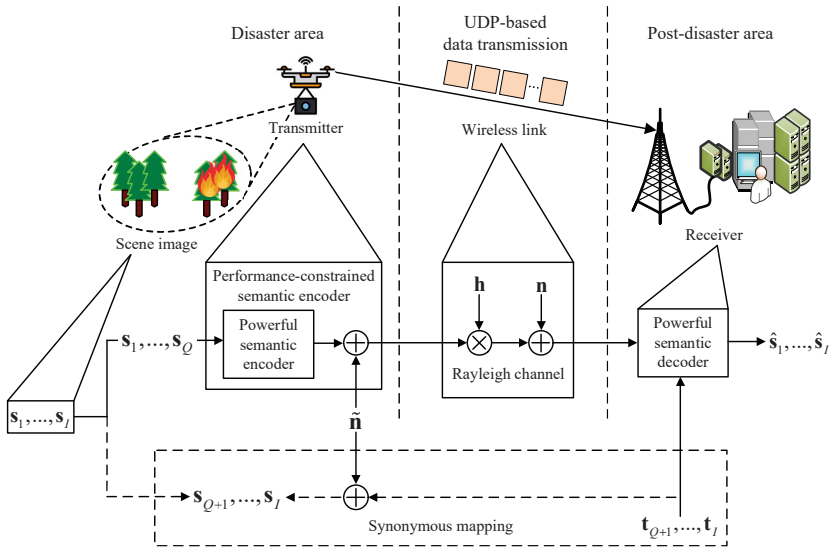
The load-bearing identity is the Cramér-Rao lower bound of the overall distortion, expressed in Eq. (16) as a sum over transmitted patches of a term involving the expected squared gradient of the semantic encoder mapping and a sum over synonymously mapped patches of a term governed by the fitting coefficient $\rho_i^2$. The paper uses this expression as the optimization objective for training the semantic codec. The second mechanism is the DA-ESemCom architecture: an analog semantic encoder selects $Q$ image patches with the lowest fitting coefficients and maps them to channel symbols, a powerful decoder forms a coarse estimate, and a digital DSC path transmits LDPC parity bits derived from DCT-quantized sources, treating the estimate as side information. A lightweight resource-allocation rule gives digital transmission the power and bandwidth needed for a target error probability and gives the remaining bandwidth to the analog path.
What would settle it
Train the same semantic codec with the true end-to-end mean squared error between source and final reconstruction as the loss and compare it against the proposed CRLB-based loss on the paper's fading-channel setup; if the CRLB-based loss does not improve PSNR or mAP, or if Eq. (11)'s gradient identity fails when complex Rayleigh fading is inserted directly, the claimed role of Eq. (16) as a design objective is not supported.
Extended reading notes
Core claim
The paper's central claim is that a small emergency transmitter can exceed the reconstruction ceiling of a purely analog neural semantic codec by adding a low-rate digital correction path. The analog path transmits semantically encoded image patches and yields a coarse estimate at the receiver; the digital path, built on distributed source coding, sends only LDPC parity bits, and the receiver uses the coarse estimate as side information to refine the final reconstruction. The paper further claims that the Cramér-Rao lower bound derived for the overall distortion, Eq. (16), is a valid design objective: training the semantic encoder to minimize that bound along with reconstruction MSE improves adaptivity to both semantic noise and channel noise. In the reported simulations, the proposed DA-ESemCom framework outperforms classical SSCC and two DL-based JSCC baselines in reconstruction quality and object-detection performance, and it even exceeds the PSNR of an ideal noiseless semantic-transmission baseline once the SNR passes about 2 dB.
Load-bearing premise
The derivation's load-bearing premise is that the distortion in Eq. (4), and hence the Cramér-Rao lower bound and the training loss built from it, is computed for the error between the encoder output and the received symbol, with the fading coefficient treated as a real unit-power scalar, rather than for the true end-to-end reconstruction error under complex Rayleigh fading.
Editorial extensions
If this is right
- Constrained transmitters can gain most of the benefit of a large neural codec: in the ablation, the proposed framework with the small base model improves MS-SSIM over DL-based JSCC with the large model by roughly 0.3 dB.
- Reconstruction fidelity stops saturating at high SNR: the hybrid scheme exceeds the paper's ideal noiseless semantic-transmission baseline in PSNR once the SNR exceeds about 2 dB.
- AI-driven fire detection benefits across the whole SNR range: both mAP50 and mAP50:95 scores improve over the baselines and approach the scores of original images at high SNR.
- The classical cliff effect of separated source-channel coding can be avoided while retaining digital fidelity, because the analog path provides graceful degradation at low SNR and the DSC path adds precision at high SNR.
- The framework works without retransmission, making it compatible with the UDP transport used in emergency wireless networks.
Reading between the lines
- A testable extension the paper does not report: an ablation of DA-ESemCom trained with plain reconstruction MSE versus the proposed CRLB-based loss would isolate how much of the gain comes from the digital parity path and how much from the new training objective.
- The same analog-plus-digital-parity idea could transfer to other task-oriented emergency sensing modalities, such as compressed video or point-cloud frames, wherever a coarse semantic estimate can serve as side information for distributed source coding.
- The paper's resource-allocation rule is heuristic; a joint optimization over the number of analog patches $Q$, the DSC coding rate, and the power split would likely improve on the priority rule, but the paper does not claim such optimality.
- A useful diagnostic: comparing the CRLB-based loss against the true end-to-end reconstruction error would show whether Eq. (16) mainly regularizes the encoder or directly drives the reported fidelity gains.
Signed reviews
Editorial analysis
A structured set of objections, weighed in public.
Referee Report
Summary. The paper proposes DA-ESemCom, a digital-analog transmission framework for emergency wireless communications. The analog part is a deep-learning-based semantic codec with a performance-constrained model that incorporates semantic noise and channel noise; the digital part is a distributed source coding (DSC) scheme based on LDPC parity bits that refines the analog reconstruction. The authors derive a Cramér–Rao lower bound (CRLB) for the proposed semantic coding model, use it to define a training loss, and present simulations showing that the full framework outperforms classical SSCC (JPEG+LDPC) and DL-based JSCC baselines in PSNR, LPIPS, MS-SSIM, and object-detection mAP over a Rayleigh fading channel. The paper also includes an ablation study on model size.
Significance. The problem addressed is relevant and timely: emergency transmitters with limited hardware, no ARQ, and low SNR can benefit from robust semantic communication. The hybrid analog-digital architecture—using DSC parity to refine a semantic analog reconstruction—is a sensible and potentially useful engineering idea, and the empirical comparisons cover both fidelity and task-oriented detection metrics. The paper also attempts a theoretical justification of the codec design via CRLB, which, if valid, would be a valuable design principle. However, the theoretical derivation contains load-bearing errors: the distortion being bounded is not the end-to-end reconstruction error, the fading coefficient is treated inconsistently with the stated complex Gaussian model, and the final CRLB expression does not follow algebraically from the preceding equations. Because the CRLB is the basis for the training objective and the claimed performance bottleneck, the central theoretical contribution is not supported. The empirical results remain suggestive, but they are not sufficient to salvage the paper's main claims as written.
major comments (4)
- [Section II-C, Eq. (4)–(5)] The distortion D_overall in Eq. (4) is defined as the expected squared error between the encoder output f_E(s_i) and the received symbol y_i, not as the end-to-end reconstruction error E[(s_i - \hat{s}_i)^2]. The CRLB in Eq. (5) is a lower bound on the variance of an unbiased estimator of a parameter (here s_i) from the observation y_i. It cannot be applied to this surrogate quantity, which is not an estimator variance. Consequently, the bound in Eq. (5) and the training objective (18) built on it do not lower-bound the actual image reconstruction distortion.
- [Section II-C, Eqs. (1), (6), (9)–(11)] The complex fading coefficient h_i ~ CN(0,1) is mishandled. In Eq. (1), the effective noise is h_i \epsilon_n + n, whose conditional variance given h_i is |h_i|^2 \sigma_\epsilon^2 + \sigma_n^2, not the value \sigma_\epsilon^2/(1+\sigma_\epsilon^2+\sigma_n^2) used in Eq. (6). Moreover, for h_i ~ CN(0,1), E[h_i^2] = 0, so the replacement in Eq. (11) of E[(\partial(h_i f_E)/\partial s)^2] by E[(\partial f_E/\partial s)^2] is invalid. The Fisher information for this complex channel model should involve |h_i|^2 or an expectation over |h_i|^2; the derivation as written effectively treats h_i as a real unit-power scalar. This error propagates into Eqs. (13) and (16).
- [Section II-C, Eqs. (13)–(16)] Equation (16) does not follow algebraically from Eq. (13). From Eq. (13), the first term is \sigma_\epsilon^2 / [(1+\sigma_\epsilon^2+\sigma_n^2) \sum_l E[(\partial f_E/\partial s)^2]], whereas Eq. (16) gives a different numerator (\sigma_\epsilon^2(1+\sigma_n^2)+\sigma_n^2(1+\sigma_\epsilon^2)). The second term in Eq. (13) is \sigma_{t,i}^2 \sigma_{s,i}^2 \sigma_\epsilon^2 / L, which with \rho_i = \sigma_{t,i}/\sigma_{s,i} equals \rho_i^2 \sigma_{s,i}^4 \sigma_\epsilon^2 / L, not \sigma_\epsilon^2/(L \rho_i^2) as in Eq. (16). The design insight that \rho_i^2 should be maximized and the subsequent loss (18) are therefore based on an incorrect formula.
- [Section II-C, Eq. (8)] The conditional density p(t_i|s_i) is derived incorrectly. From s_i = t_i + \epsilon_n with independent Gaussian t_i and \epsilon_n, the conditional distribution of t_i given s_i is Gaussian with mean (\sigma_t^2/(\sigma_t^2+\sigma_\epsilon^2)) s_i and variance \sigma_t^2 \sigma_\epsilon^2/(\sigma_t^2+\sigma_\epsilon^2), not the expression in Eq. (8). This invalidates the Fisher information computation for the synonymous-mapping term and hence the corresponding CRLB term.
minor comments (8)
- [Algorithm 1, line 13] The text says 'Estimate the various of the semantic noise'; 'various' should be 'variance'.
- [Algorithm 1 and text] The symbol f_{Ieal}^E should be f_{Ideal}^E; the typo appears in Algorithm 1 and in Section II-D.
- [Figures 3–6] The figure captions contain the misspelling 'Porposed' for 'Proposed'.
- [Eq. (1)] The acronym 'AWGM' should be 'AWGN'.
- [References] Reference [23] is Slepian and Wolf's noiseless coding of correlated sources, which is not the standard citation for the Cramér–Rao lower bound; a proper CRLB reference is needed. Reference [25] on texture stationarity is not the usual basis for the sample-variance formula in Eq. (7).
- [Section V-C] The baseline description does not specify the JPEG quality factor, the LDPC code rate, or the symbol-to-bandwidth mapping for the classical SSCC scheme, which are needed to reproduce the comparison.
- [Section V-C] The 'ideal semantic transmission' baseline is vaguely defined as 'full, noiseless, and high-dimensional semantic feature vectors with full-resolution constellation'; a quantitative definition of bandwidth, power, and constellation resolution is needed to interpret why the proposed DA-ESemCom can surpass it.
- [Section III and Eq. (3)] The notation \hat{S} is used in Eq. (3) for the decoder output, but the final output of the DA-ESemCom framework is also denoted S in Section IV; please disambiguate these.
Circularity Check
No significant circularity: the central DA-ESemCom comparison is externally benchmarked, and the CRLB-derived loss is a design objective rather than a fitted prediction.
full rationale
After walking the derivation chain, I find no step in which a 'prediction' or 'derived bound' is equivalent by construction to its inputs. The paper's headline result—DA-ESemCom outperforms classical SSCC and DL-based JSCC—is established by simulations against independent baselines (JPEG+LDPC SSCC; JSCC trained with MSE loss) on ImageNet-1K and COCO2017, so it would stand or fall on its own. The CRLB expression in Eq. (16) is used as a component of the training loss (18); that makes it a design objective, not a fitted parameter renamed as a prediction. Ablating 'Proposed loss' against 'MSE loss' is an internal comparison and is not the paper's only evidence. The self-citation [26] for the DA framework idea is not load-bearing: the paper also cites independent hybrid digital-analog works [27],[28] and supplies its own Algorithm 2, resource allocation, and simulations. I do note correctness concerns outside this pass: Eq. (4) defines distortion as E[(f_E-y)^2], which is not the variance of an unbiased estimator of s, so the CRLB in Eq. (5)/(16) may not bound the quantity the paper claims; the treatment of the fading coefficient h_i in Eqs. (6) and (11) drops h_i despite h_i ~ CN(0,1); and there is a dangling citation '[A]' after Eq. (30). These are mathematical/completeness issues, not circularity. Accordingly, score 0.
Assumptions & free parameters
free parameters (4)
- Semantic noise variance sigma_eps^2 =
estimated per batch via MLE in Algorithm 1, step 13
- Masking ratio eta =
0.7
- Training SNR gamma =
10 dB
- Digital error-probability threshold epsilon_th =
not specified in the paper
assumptions (4)
- domain assumption Image patches are modeled as Gaussian sources (Section II-B).
- domain assumption The semantic decoder mapping is unbiased (Section II-C).
- ad hoc to paper Rayleigh fading coefficient satisfies E[h_i^2]=1 despite the stated h_i~CN(0,1).
- domain assumption DSC coding with LDPC parity bits provides the benefit of Slepian-Wolf distributed source coding (Section III).
invented entities (3)
-
Semantic noise epsilon_n
-
Synonymous mapping tokens t_i
-
Ideal semantic encoder f_ideal_E
Cite this review
Pith. "Pith review of Digital-Analog Transmission based Emergency Semantic Communications." pith.science (2026). https://pith.science/paper/L5Q7MRAP
@misc{pith2026250101616,
  author       = {Pith},
  title        = {Pith review of: Digital-Analog Transmission based Emergency Semantic Communications},
  year         = {2026},
  howpublished = {\url{https://pith.science/paper/L5Q7MRAP}},
  note         = {Machine review of arXiv:2501.01616}
}
read the original abstract
Emergency Wireless Communication (EWC) networks adopt the User Datagram Protocol (UDP) to transmit scene images in real time for quickly assessing the extent of the damage. However, existing UDP-based EWC exhibits suboptimal performance under poor channel conditions since UDP lacks an Automatic Repeat reQuest (ARQ) mechanism. In addition, future EWC systems must not only enhance human decisionmaking during emergency response operations but also support Artificial Intelligence (AI)-driven approaches to improve rescue efficiency. The Deep Learning-based Semantic Communication (DL-based SemCom) emerges as a robust, efficient, and taskoriented transmission scheme, suitable for deployment in UDP based EWC. Due to the constraints in hardware capabilities and transmission resources, the EWC transmitter is unable to integrate sufficiently powerful NN model, thereby failing to achieve ideal performance under EWC scene. For EWC scene, we propose a performance-constrained semantic coding model, which considers the effects of the semantic noise and the channel noise. Then, we derive Cramer-Rao lower bound of the proposed semantic coding model, as guidance for the design of semantic codec to enhance its adaptability to semantic noise as well as channel noise. To further improve the system performance, we propose Digital-Analog transmission based Emergency Semantic Communication (DAESemCom) framework, which integrates the analog DL-based semantic coding and the digital Distributed Source Coding (DSC) schemes to leverage their respective advantages. The simulation results show that the proposed DA-ESemCom framework outperforms the classical Separated Source-Channel Coding (SSCC) and other DL-based Joint Source-Channel Coding (DL-based JSCC) schemes in terms of fidelity and detection performances.
Figures


Figures from the paper (3 more)


Reference graph
Works this paper leans on
-
[1]
Classical SSCC: The classical SSCC is based on Shan- non’s reliable transmission framework, where widely used Joint Photographic Experts Group (JPEG) [38] and LDPC are adopted as the source coding and the channel coding, respectively
-
[2]
Ideal semantic transmission: The ideal semantic trans- mission scheme, serving as the performance upper bound of the proposed semantic coding scheme, is with unlimited channel resources, where full, noiseless, and high-dimensional semantic feature vectors can be transmitted to the receiver with full-resolution constellation
-
[3]
Enabling emergency communication through a cognitive radio vehicular network,
DL-based JSCC: The DL-based JSCC schemes adopt the proposed semantic codec without using the DSC part, where DL-based JSCC (Proposed loss) and DL-based JSCC (MSE loss) schemes are trained with the proposed optimiza- tion objective (18) and only MSE objective (17), respectively. D. Objective Quality for Different Methods Figure 3 shows the performance of r...
work page 2014
-
[36]
contains 1000 different categories in the training set and each category contains about 1000 images. The dataset is widely used for various AI-driven vision tasks, such as classification, detection, and segmentation. We use this dataset to pre-train our proposed semantic coding, laying the basis for learning the optimal coded representations. COCO2017
-
[37]
This diversity is convenient to evaluate the performance of the system under different fire scenarios
contains 7,157 images and includes dif- ferent kinds of fires such as building, wildland and residential fire, containing shots captured at day time, dusk or night time. This diversity is convenient to evaluate the performance of the system under different fire scenarios. C. The Adopted Comparison Schemes We compare our proposed DA-ESemCom framework with the...
-
[2014]
Transmission of JPEG- coded images over wireless channels,
[Online]. Available: https://www.microsoft.com/en-us/research/ publication/microsoft-coco-common-objects-in-context/ [38] V. Weerackody, C. Podilchuk, and A. Estrella, “Transmission of JPEG- coded images over wireless channels,” Bell Labs Technical Journal , vol. 1, no. 2, pp. 111–126, 1996
work page 1996
Reviewed August 10, 2026 · model on record in the stance chip above.
Discussion (0). Continue with ORCID to comment.