REVIEW 3 major objections 3 minor 2 cited by
Confining potential in holographic bottom-up QCD from WKB
T0 review · 3 major / 3 minor · reviewed 2026-08-10 · deepseek-v4-flash
Pith's one-line read The D3/D7 brane system's meson spectrum is shown to be equivalent to a hardwall confining potential in bottom-up holography.
desk verdict RKR inversion from a top-down spectrum to a bottom-up potential is new and works reasonably well; the paper deserves review after fixing a typo and adding error analysis. read the letter →
The pith
A machine-rendered reading of the paper's core claim, the machinery that carries it, and where it could break.
The reading
What carries the argument
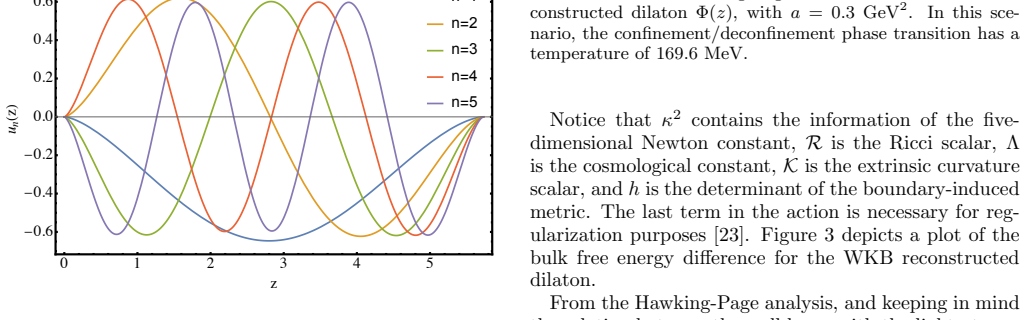
The central object is the RKR/WKB inversion integral, Eq. (B6): $z(V^*)=2\int_0^{V^*}\frac{dM^2/dn}{\sqrt{V^*-M^2}}\,dM^2$. It converts a given Regge trajectory $M^2(n)$ into the outer turning point $z(V^*)$ of the potential, from which the large-$z$ confining part of the holographic potential is read off. Inverting the D3/D7 trajectory produces $V^*(z)=\frac{a}{2}\tan^2(\sqrt{a}\,z/2)$; adding the near-boundary term gives the full potential (21). The reconstructed potential is then fed into the Schrödinger equation (6) for the mass spectrum and eigenfunctions, into the dilaton equation (11) for $\Phi(z)$, and into the bulk action for the Hawking-Page and configurational-entropy calculations.
What would settle it
Numerically solve the Schrödinger equation with the full reconstructed potential (21) to high excitation number and compare the eigenvalues with the exact D3/D7 formula $M^2_{n,l}=\frac{4L^2}{R^4}(n+l+1)(n+l+2)$; if the high-$n$ spacing or slope of the reconstructed spectrum departs from the quadratic form of the input spectrum, the WKB-reconstructed potential is not the true equivalent potential.
Extended reading notes
Core claim
The paper's central claim is that the top-down D3/D7 meson spectrum $M^2_{n,l}=\frac{4L^2}{R^4}(n+l+1)(n+l+2)$ is the spectrum of a bottom-up Schrödinger equation whose potential is the reconstructed $V_{D3/D7}(z)$ of Eq. (21). Because the $\tan^2$ term makes the potential diverge at $z=\pi/\sqrt{a}$, the effective bulk geometry is bounded exactly as in the hardwall model, and the paper argues this is why the quadratic-in-$n$ D3/D7 spectrum resembles the Bessel-zero hardwall spectrum. The claim is supported by a numerical solution of the Schrödinger problem: the reconstructed masses track the experimental $\rho$ states with relative errors from about 3% to 32% over the listed trajectory. A Hawking-Page free-energy comparison gives $T_c\simeq0.169$ GeV, and the configurational entropy rises for the first sixteen states before falling, which the paper takes as further evidence that the reconstructed model captures light-meson physics.
Load-bearing premise
The load-bearing premise is that the potential reconstructed from the WKB/RKR formula at large $z$ is the true potential at all $z$, including the small- and intermediate-$z$ region where the exact spectrum, the deconfinement temperature, and the configurational entropy are computed.
Editorial extensions
If this is right
- The D3/D7 top-down construction is equivalent, at the level of its vector-meson spectrum, to a hardwall bottom-up model with wall at $z=\pi/\sqrt{a}$.
- The reconstructed potential produces a $\rho$ radial Regge trajectory whose listed masses fall within about 3% to 32% of the experimental values for the four lowest states.
- A Hawking-Page analysis of the reconstructed model gives $T_c\simeq0.169$ GeV, between the hardwall value ($0.1574\,m_\rho$) and the softwall value ($0.2459\,m_\rho$).
- The configurational entropy of the vector mesons increases through the first sixteen states and then decreases, which the paper reads as consistency with hardwall-like confinement and support for describing light mesons.
Reading between the lines
- If the equivalence is taken at face value, the thermal and configurational-entropy results computed from the reconstructed potential are implicit predictions for the D3/D7 system itself, not just for the bottom-up toy model.
- The $\tan^2$ wall recurs at $z=(2\gamma+1)\pi/\sqrt{a}$ for integer $\gamma$; the paper fixes $\gamma=0$, leaving open whether the higher walls or tunneling between wells perturb the spectrum and transition temperature.
- The same RKR inversion could be applied to other top-down spectra to build a dictionary between brane constructions and bottom-up potentials, with the reconstructed dilaton as the translating object.
- A numerical fit that leaves both $a$ and the wall position free, rather than fixing them by the ground state alone, could test whether the mild drift of the higher reconstructed masses (up to about 32%) is a WKB artifact or a genuine subleading correction.
Editorial analysis
A structured set of objections, weighed in public.
Referee Report
Summary. The manuscript proposes a bottom-up holographic description equivalent to the top-down D3/D7 model. Starting from the D3/D7 vector-meson spectrum M^2_{n,l} = (4L^2/R^4)(n+l+1)(n+l+2), the authors use a WKB/RKR inversion to obtain a confining potential V*(z) = (a/4) tan^2(√a z/2), add the conformal boundary term to obtain Eq. (21), and interpret the divergence at z = π/√a as an effective hard wall. They then compute the Schrödinger spectrum, the Hawking-Page transition temperature, and the differential configurational entropy from the reconstructed dilaton and eigenfunctions.
Significance. If the construction is sound, the paper offers a concrete algorithmic bridge between top-down spectra and bottom-up holographic potentials, and the qualitative identification of the D3/D7 system with an effective hardwall is plausible: both models produce spectra growing like n^2, and the tan^2 wall in Eq. (21) naturally cuts off the bulk. The manuscript is transparent in exposing the main steps, and Table I provides an explicit numerical comparison between the input spectrum and the exact eigenvalues of the reconstructed potential. At the same time, the novelty is partly methodological, and the quantitative claims in Sections V and VI inherit the uncertainties of the semiclassical inversion, so the numerical results should be read with caution.
major comments (3)
- [Section IV, Eqs. (19)-(21)] Equation (20) is algebraically inconsistent with Eq. (19). Substituting M^2 = (a/4)(x^2 - 1) into the integral in Eq. (19) gives z(V*) = (2/√a) arctan(2√(V*/a)), whose inversion is V*(z) = (a/4) tan^2(√a z/2), not the (a/2) prefactor printed in Eq. (20). Equation (21) uses the correct a/4 coefficient, so the central construction can be repaired, but the printed Eq. (20) must be corrected and the derivation should state explicitly which coefficient is intended. I do not see a dimensional error in Eq. (19), since 1/√a has dimension of inverse energy as z does; the issue is the factor in Eq. (20).
- [Section IV.A and Table I] The large-z WKB/RKR potential V*(z) is imported into Eq. (21) as the exact Schrödinger potential at all z, with no estimate of the WKB error. The paper's own Table I quantifies the consequence: the exact eigenvalue for the ground state of the reconstructed potential is 796.02 MeV versus the input D3/D7 value 775.23 MeV, a 2.7% deviation, while the higher states are closer (7%, 11%, and 32% relative to experiment). The authors acknowledge in Section III that ground states can deviate, but Section V then quotes Tc = 169.6 MeV and Section VI presents a DCE curve, both computed from the same approximate potential and its eigenfunctions. These quantitative results should either be accompanied by an uncertainty estimate from the WKB error or be explicitly labeled as qualitative, because they are not direct consequences of the input D3/D7 spectrum alone.
- [Sections V and VI] The dilaton used in the bulk action (32) is obtained by reverse engineering V*(z) through Eq. (11) with boundary conditions (26), but the thermal free energy and the configurational entropy are computed from this reconstructed dilaton and from the eigenfunctions of the approximate potential. No check is provided that this dilaton is consistent with the Einstein equations for the action in Eq. (32), nor that the WKB inversion is accurate in the intermediate-z region that dominates the eigenfunctions. The qualitative conclusion that the D3/D7 model resembles a hardwall is likely robust, but the numerical values in Sections V and VI are model-dependent outputs of the chosen extension rather than independent predictions. Please state this limitation explicitly when presenting Tc and the DCE curve.
minor comments (3)
- [Section III, Eq. (13)] The notation "1/2 z Φ'(z)" is ambiguous; it should be written as (1/(2z)) Φ'(z), since the term originates from -β/(2z) Φ'(z) with β = -1.
- [Section IV.2, Eq. (26)] The boundary condition Φ(z* → ∞) = 2 ∫^{z*} dz √V_WKB(z) is stated without derivation; please explain how it follows from Eq. (11) and why it is the appropriate condition for the dilaton reconstruction.
- [Throughout] There are several typographical errors, including "Boguliobov" for Bogoliubov, "tan² a zterm" in Section VI, and incomplete reference metadata for Ref. [39].
Circularity Check
The reconstructed potential is built from the D3/D7 spectrum, so the reported spectrum agreement is a consistency check, not an independent prediction.
-
self definitional
[Abstract; Section IV, Eqs. (18)-(21) and Table I]
"we consider the vector meson spectrum derived in the D3/D7 system as input data to derive the corresponding bottom-up confining potential ... we can conclude that the bottom-up potential (21) mimics the spectroscopy of the D3/D7 system, which is a top-down scenario."
The potential V*(z) is obtained by inverting the input D3/D7 spectrum M^2_{n,l} via the WKB/RKR equation (19). Table I then validates the reconstructed model by comparing its exact Schrodinger eigenvalues with that same input spectrum, and the text claims the potential 'mimics the spectroscopy of the D3/D7 system.' Because the potential is constructed from that spectrum, the agreement is a consistency check of the inversion, not an independent prediction. The only scale a is fixed by the rho(770) mass, which belongs to the input spectrum, so the comparison has no independent statistical weight. The paper also admits that the reconstructed spectrum deviates and that fine-tuning would be required, confirming that the agreement is not a validated prediction.
full rationale
The central derivation takes the D3/D7 mass spectrum Eq. (18) as input, applies the WKB/RKR inversion to obtain the potential Eq. (21), and then uses Table I to show that the reconstructed potential reproduces the same D3/D7 spectrum. This is a consistency check by construction: the potential is generated from that spectrum, so the agreement does not constitute an independent prediction. The only free parameter a is fixed to the rho(770) mass, which is an element of the input spectrum, further reducing the independence of the comparison. Subsequent quantities (Hawking-Page temperature, configurational entropy) are computed from the same reconstructed dilaton/potential and are not fitted to additional data, so they are not circular in the same way; however, they inherit the systematic uncertainty of the semiclassical inversion. The paper also acknowledges that the potential does not exactly reproduce the input spectrum and that fine-tuning would be needed, which underscores that the spectrum agreement is not a validated prediction. Therefore, score 6 reflects partial circularity: the primary spectral claim reduces to an input-consistency check, while the thermal and entropic results are downstream applications with independent quantitative content.
Assumptions & free parameters
free parameters (1)
- a (Regge slope / confinement scale) =
0.3 GeV^2
assumptions (4)
- domain assumption AdS/CFT bulk-to-boundary dictionary and bulk meson Sturm-Liouville equation (Eqs. 5-7)
- domain assumption RKR/WKB inversion formula (Appendix B, Eq. B6) is valid for extracting the large-z potential from the spectrum
- domain assumption D3/D7 vector meson spectrum M^2_{n,l} = (4L^2/R^4)(n+l+1)(n+l+2)
- ad hoc to paper The large-z WKB result V*(z) can be used as the exact potential at all z in Eq. (21)
Cite this review
Pith. "Pith review of Confining potential in holographic bottom-up QCD from WKB." pith.science (2026). https://pith.science/paper/CSI66G2M
@misc{pith2026250101755,
  author       = {Pith},
  title        = {Pith review of: Confining potential in holographic bottom-up QCD from WKB},
  year         = {2026},
  howpublished = {\url{https://pith.science/paper/CSI66G2M}},
  note         = {Machine review of arXiv:2501.01755}
}
abstract
By using the \emph{Rydberg--Klein--Rees} (RKR) formulas to solve the inverse Schr\"{o}dinger problem, we found a confining bottom-up potential from a given eigenvalue spectrum. To illustrate this methodology, we consider the vector meson spectrum derived in the D3/D7 system as input data to derive the corresponding bottom-up confining potential that resembles the geometric structure of the so-called hardwall model. We compute some properties for this new bottom-up model, including the thermal deconfinement phase transition, the $\rho$ radial Regge trajectory, and the configurational entropy.
Figures


Figures from the paper (1 more)

Forward citations
Cited by 2 Pith papers
-
Holographic quark masses and radiative decays of heavy vector mesons
The authors extract charm and bottom constituent quark masses and several quarkonium decay widths from AdS/QCD plus the Segre formula, obtaining order-of-magnitude agreement with experiment but no precise match.
-
Thermodynamics of the Isospectral family of holographic vector mesons
Isospectral transformations in softwall AdS/QCD allow tuning the rho meson's decay constant to its experimental value of 226 MeV, producing a predicted melting temperature of 157 MeV from spectral function computation...
Reference graph
Works this paper leans on
-
[1]
(24) We will focus our attention on the light-vector mesons
Fixing parameters For simplicity, we can write the D3/D7 trajectory for S-wave mesons as M 2 n = a(n + 1)(n + 2), with: a = 4 L2 R4 . (24) We will focus our attention on the light-vector mesons. To do so, we identify the ρ(770) meson as the ground state with n = 0, and its mass to fix the energy scale a as M 2 ρ(770) = 2 a, thus: a = 0.3 GeV2 (25) This en...
-
[2]
Dilaton Reconstruction To find the dilaton field associated with the bottom-up D3/D7 potential, we will require as boundary conditions that Φ(z → 0) = 0 and 5 0 1 2 3 4 50 5 10 15 20V(z) Φ(z) 0 1 2 3 4 50 50 100 150 200 z V(z) D3/D7 bottom-up effective potential and dilaton FIG. 1. Reconstructed bottom-up potential from the D3/D7 meson spectrum and the co...
work page 1900
-
[3]
Start from the bulk action (2) computing the equa- tions of motion associated with the bulk fields dual to hadrons
-
[4]
compute the on-shell energy-momentum tensor Tmn: Tmn = 2√−g ∂ [√−g LHadron] ∂ gmn . (34)
-
[5]
Extract the T00 component, defined as the bulk en- ergy density ρ(z). For bulk vector fields, ρ(z) has the form: ρ(z) = e−B(z) 2 z R 3 × 1 K2 M 2 n ψ2 n + ψ′2 n − M 2 5 R2 z2 ψ2 n Ω, (35) 0 10 20 30 40 0.80 0.85 0.90 0.95 1.00 1.05 1.10 DCE vs n FIG. 4. Differential configurational entropy as a function of the excitation number n for vector mesons in the ...
-
[6]
(37) Recall that ρ(z) ∈ L2(R), and also has informa- tion on how energy is localized in the bulk
Fourier-transform the energy density ρ(z): ¯ρ(k) = Z ∞ 0 d z eik zρ(z) (36) and compute the modal fraction as f (k) = |¯ρ(k)|2 R dk|¯ρ(k)|2 . (37) Recall that ρ(z) ∈ L2(R), and also has informa- tion on how energy is localized in the bulk. Thus, it indirectly measures how normalizable modes are well localized in the AdS space. Thus, the modal fraction mea...
-
[7]
Notice that we nor- malize the modal fraction with f (k)Max
Finally, compute the differential configurational en- tropy with the following prescription: SDCE = − Z dk ˜f (k) log ˜f (k) (38) where ˜f (k) = f (k) /f (k)Max. Notice that we nor- malize the modal fraction with f (k)Max. We computed the differential configurational entropy (DCE) in natural units for the WKB reconstructed sys- tem for the first forty-fiv...
-
[8]
J. M. Maldacena, The Large N limit of superconformal field theories and supergravity, Adv. Theor. Math. Phys. 2, 231 (1998), arXiv:hep-th/9711200
arXiv 1998
Show all 46 references
-
[9]
Erdmenger, N
J. Erdmenger, N. Evans, I. Kirsch, and E. Threlfall, Mesons in Gauge/Gravity Duals - A Review, Eur. Phys. J. A 35, 81 (2008), arXiv:0711.4467 [hep-th]
2008 arXiv
-
[10]
Polchinski and M
J. Polchinski and M. J. Strassler, Deep inelastic scatter- ing and gauge / string duality, JHEP 05, 012, arXiv:hep- th/0209211
-
[11]
Boschi-Filho and N
H. Boschi-Filho and N. R. F. Braga, Wilson loops for a quark anti-quark pair in D3-brane space, JHEP 03, 051, arXiv:hep-th/0411135
-
[12]
Erlich, E
J. Erlich, E. Katz, D. T. Son, and M. A. Stephanov, QCD and a holographic model of hadrons, Phys. Rev. Lett. 95, 261602 (2005), arXiv:hep-ph/0501128
2005 arXiv
-
[13]
Forkel, M
H. Forkel, M. Beyer, and T. Frederico, Linear square- mass trajectories of radially and orbitally excited hadrons in holographic QCD, JHEP 07, 077, arXiv:0705.1857 [hep-ph]
-
[14]
Karch, E
A. Karch, E. Katz, D. T. Son, and M. A. Stephanov, Linear confinement and AdS/QCD, Phys. Rev. D 74, 015005 (2006), arXiv:hep-ph/0602229
2006 arXiv
-
[15]
Rydberg, , Z
R. Rydberg, , Z. Phys 73, 376 (1931)
1931
-
[16]
Rydberg, , Z
R. Rydberg, , Z. Phys 80, 514 (1933)
1933
-
[17]
Klein, , Z
O. Klein, , Z. Phys 76, 226 (1932)
1932
-
[18]
A. L. G. Rees, , Proc. Phys. Soc (London) 59, 998 (1947)
1947
-
[19]
C. P. Herzog, A Holographic Prediction of the Deconfine- ment Temperature, Phys. Rev. Lett. 98, 091601 (2007), arXiv:hep-th/0608151
2007 arXiv
-
[20]
Kruczenski, D
M. Kruczenski, D. Mateos, R. C. Myers, and D. J. Win- ters, Meson spectroscopy in AdS / CFT with flavor, JHEP 07, 049, arXiv:hep-th/0304032
-
[21]
Chen, Regge trajectories for the mesons consisting of different quarks, Eur
J.-K. Chen, Regge trajectories for the mesons consisting of different quarks, Eur. Phys. J. C 78, 648 (2018)
2018
-
[22]
N. R. F. Braga, L. F. Ferreira, and A. Vega, Holographic model for charmonium dissociation, Phys. Lett. B 774, 476 (2017), arXiv:1709.05326 [hep-ph]
2017 arXiv
-
[23]
M. A. Martin Contreras and A. Vega, Different approach to decay constants in AdS/QCD models, Phys. Rev. D 101, 046009 (2020), arXiv:1910.10922 [hep-th]
2020 arXiv
-
[24]
Karch and E
A. Karch and E. Katz, Adding flavor to AdS / CFT, JHEP 06, 043, arXiv:hep-th/0205236
-
[25]
Ammon and J
M. Ammon and J. Erdmenger, Gauge/gravity dual- ity: Foundations and applications (Cambridge University Press, Cambridge, 2015)
2015
-
[26]
Boschi-Filho and N
H. Boschi-Filho and N. R. F. Braga, QCD / string holo- graphic mapping and glueball mass spectrum, Eur. Phys. J. C 32, 529 (2004), arXiv:hep-th/0209080
2004 arXiv
-
[27]
R. L. Workman et al. (Particle Data Group), Review of Particle Physics, PTEP 2022, 083C01 (2022)
2022
-
[28]
Cai and J
R.-G. Cai and J. P. Shock, Holographic confine- ment/deconfinement phase transitions of AdS/QCD in curved spaces, JHEP 08, 095, arXiv:0705.3388 [hep-th]
-
[29]
N. R. F. Braga, L. F. Faulhaber, and O. C. Junqueira, Confinement-deconfinement temperature for a rotating quark-gluon plasma, Phys. Rev. D 105, 106003 (2022), arXiv:2201.05581 [hep-th]
2022 arXiv
-
[30]
C. A. Ballon Bayona, H. Boschi-Filho, N. R. F. Braga, and L. A. Pando Zayas, On a Holographic Model for Confinement/Deconfinement, Phys. Rev. D 77, 046002 (2008), arXiv:0705.1529 [hep-th]
2008 arXiv
-
[31]
A. E. Bernardini and R. da Rocha, Entropic information of dynamical AdS/QCD holographic models, Phys. Lett. B 762, 107 (2016), arXiv:1605.00294 [hep-th]
2016 arXiv
-
[32]
A. E. Bernardini, N. R. F. Braga, and R. da Rocha, Con- figurational entropy of glueball states, Phys. Lett. B765, 81 (2017), arXiv:1609.01258 [hep-th]
2017 arXiv
-
[33]
N. R. F. Braga and R. a. da Rocha, AdS/QCD dual- ity and the quarkonia holographic information entropy, Phys. Lett. B 776, 78 (2018), arXiv:1710.07383 [hep-th]
2018 arXiv
-
[34]
Colangelo and F
P. Colangelo and F. Loparco, Configurational Entropy can disentangle conventional hadrons from exotica, Phys. 10 Lett. B 788, 500 (2019), arXiv:1811.05272 [hep-ph]
2019 arXiv
-
[35]
L. F. Ferreira and R. da Rocha, Tensor mesons, AdS/QCD and information, Eur. Phys. J. C 80, 375 (2020), arXiv:1907.11809 [hep-th]
2020 arXiv
-
[36]
L. F. Ferreira and R. da Rocha, Nucleons and higher spin baryon resonances: An AdS/QCD configurational entropic incursion, Phys. Rev. D 101, 106002 (2020), arXiv:2004.04551 [hep-th]
2020 arXiv
-
[37]
da Rocha, Information entropy in AdS/QCD: Mass spectroscopy of isovector mesons, Phys
R. da Rocha, Information entropy in AdS/QCD: Mass spectroscopy of isovector mesons, Phys. Rev. D 103, 106027 (2021), arXiv:2103.03924 [hep-ph]
2021 arXiv
-
[38]
N. R. F. Braga, L. F. Ferreira, and R. a. Da Rocha, Ther- mal dissociation of heavy mesons and configurational en- tropy, Phys. Lett. B 787, 16 (2018), arXiv:1808.10499 [hep-ph]
2018 arXiv
-
[39]
N. R. F. Braga and R. da Mata, Configuration entropy description of charmonium dissociation under the influ- ence of magnetic fields, Phys. Lett. B811, 135918 (2020), arXiv:2008.10457 [hep-th]
2020 arXiv
-
[40]
N. R. F. Braga and R. da Mata, Configuration entropy for quarkonium in a finite density plasma, Phys. Rev. D 101, 105016 (2020), arXiv:2002.09413 [hep-th]
2020 arXiv
-
[41]
N. R. F. Braga and O. C. Junqueira, Configuration entropy and confinement/deconfinement transiton in holographic QCD, Phys. Lett. B 814, 136082 (2021), arXiv:2010.00714 [hep-th]
2021 arXiv
-
[42]
M. A. Martin Contreras, A. Vega, and S. Diles, A holographic bottom-up description of light nuclide spec- troscopy and stability, Phys. Lett. B 835, 137551 (2022), arXiv:2206.01834 [hep-ph]
2022 arXiv
-
[43]
M. A. Martin Contreras and A. Vega, Holographic sta- bility for non-qq¯ candidates, Phys. Rev. D 108, 126024 (2023), arXiv:2309.02905 [hep-ph]
2023 arXiv
-
[44]
M. A. Martin Contreras, A. Vega, and S. Diles, Isospec- trality and configurational entropy as testing tools for bottom-up AdS/QCD, Phys. Lett. B 854, 138723 (2024), arXiv:2308.16007 [hep-ph]
2024 arXiv
-
[45]
X. Guo, M. A. Martin Contreras, X. Chen, and D. Xiang, A holographic bottom-up approach to Σ baryons, Chin. Phys. C 48, 0462 (2024), arXiv:2404.16608 [hep-ph]
2024 arXiv
-
[46]
R. J. Le Roy, , Journal of Quantitative Spectroscopy & Radiative Transfer 186, 158 (2017)
2017
Reviewed August 10, 2026 · model on record in the stance chip above.
Discussion (0). Continue with ORCID to comment.