REVIEW 3 major objections 6 minor 58 references
Learning from Ambiguous Data with Hard Labels
T0 review · 3 major / 6 minor · reviewed 2026-08-10 · deepseek-v4-flash
Pith's one-line read The paper claims that a class-wise positive-unlabeled risk estimator can train accurate classifiers from ambiguous data whose only labels are hard quantized labels.
desk verdict The QLL problem framing and the empirical results are worth a look, but the CPU estimator is not actually unbiased under the paper's own model, and the algorithm disagrees with the main equation. read the letter →
The pith
A machine-rendered reading of the paper's core claim, the machinery that carries it, and where it could break.
The reading
What carries the argument
The load-bearing object is the Class-wise Positive-Unlabeled (CPU) risk estimator. It converts multiclass training into $c$ binary PU problems: for class $j$, the positive set is the examples whose quantized label is $j$, and the unlabeled set is everything else; each binary risk uses the non-negative PU formula from nnPU, with the negative term clipped at zero, and the $c$ risks are averaged. The paper uses a stochastic Jensen-Shannon divergence as the loss inside the estimator, sampling the interpolation weight per iteration to balance optimization and robustness.
What would settle it
A direct test: on a two-class synthetic QLL dataset with known per-instance soft labels $s_j(x)$, compare the CPU risk estimate to the true expected risk computed by Monte Carlo; a systematic gap as the per-instance label probabilities vary would refute the unbiasedness claim. A second test: train CPU on quantized labels and compare with training on the underlying soft labels; if CPU cannot approach the soft-label model's accuracy, the claim that it recovers the information in ambiguous labels would be in doubt.
Extended reading notes
Core claim
The central claim is that learning from ambiguous data with only quantized hard labels is tractable, and the way to make it tractable is to view every class as a separate positive-unlabeled problem. Under the label quantization hypothesis, an observed hard label $y$ is drawn from the instance's ground-truth soft-label distribution $P(y=k|x)=s_k$, so examples labeled $j$ are treated as positives for class $j$ and all other examples as unlabeled. The CPU estimator averages per-class non-negative PU risks, $\hat{R}_{pu}(g_j)=\pi_p^{(1)}\hat{R}_p^+(g_j)+\max\{\hat{R}_u^-(g_j)-\pi_p^{(2)}\hat{R}_p^-(g_j),0\}$, which prevents the model from memorizing biased labels. The paper reports that this simple estimator achieves the best accuracy across all four CIFAR-Q configurations and on the AFHQ-Q dataset, and that combining it with the FixMatch semi-supervised technique gives further gains.
Load-bearing premise
The load-bearing premise is that, for each class, the examples not carrying that label behave like a fixed blend of that class and everything else; when the label probability varies from image to image, that blend assumption is only approximate, and the estimator's unbiasedness is not guaranteed.
Editorial extensions
If this is right
- If the CPU risk is correct, practitioners can train from ambiguous data using only the hard labels already being collected; no soft labels, label-distribution estimation, or noise transition matrix is needed.
- The reported gains imply that per-class positive-unlabeled training is a stronger default than robust loss functions and complex noisy-label pipelines for quantized labels, and that adding one semi-supervised consistency term (FixMatch) makes it stronger still.
- Because the risk is computed as an average of per-class binary risks with element-wise operations, it can drop into standard deep learning training loops with about the same cost as cross-entropy.
- The mixing-based generation procedure gives future work a controlled benchmark: ambiguity level can be adjusted through the number of mixed instances and the patch masks, and quantized labels are sampled from known soft-label mixtures.
Reading between the lines
- Editorial inference: the positive-versus-unlabeled decomposition may transfer to partial-label learning, where the candidate label set is the positive set and the rest are unlabeled; the paper does not test this.
- Editorial inference: some of the gain may come from the max-clipping in the nnPU risk acting as a regularizer rather than from unbiased estimation; comparing CPU to label smoothing on the same ambiguous data would isolate the mechanism.
- Editorial inference: on multi-annotator data, treating each annotator's vote as a quantized label and applying CPU should approach a soft-label oracle, a direct but untested consequence of the label quantization hypothesis.
Signed reviews
Editorial analysis
A structured set of objections, weighed in public.
Referee Report
Summary. The paper introduces Quantized Label Learning (QLL), a setting in which each instance has a ground-truth soft-label distribution and the observed hard label is sampled from that distribution. The authors propose a Class-wise Positive-Unlabeled (CPU) risk estimator, constructed by applying the non-negative PU (nnPU) risk per class, treating the instances labeled with a given class as positives and all other instances as unlabeled. They design mixing-based ambiguous-data benchmarks (CIFAR-10Q, CIFAR-100Q, and AFHQ-Q) and report accuracy gains over label-noise-robust baselines. The paper's main theoretical claim is that CPU is a generalized PU risk estimator that is unbiased under the QLL model, and its headline empirical claim is that CPU outperforms the second-best method by more than six points on average.
Significance. If the theoretical claim were valid, the paper would be a useful contribution: it proposes a new problem formulation (QLL) with practical relevance, a simple and efficient algorithm, and reproducible benchmark construction procedures. The empirical study is broad, covering CIFAR-10/100 and AFHQ with multiple mixing strategies and many baselines, and the reported gains are substantial. The hyperparameter robustness analysis is a positive feature. However, the theoretical justification as stated is invalid: the class-wise unlabeled set does not follow the mixture distribution required by the PU risk identity, so the unbiasedness claim does not hold. In addition, the implemented Algorithm 1 differs from the reported Eq. (5). The paper would need a corrected derivation or a reframing of CPU as a heuristic to support its central claims.
major comments (3)
- [Section III, Eqs. (2)-(4)] The derivation of the class-wise PU risk is invalid under QLL. In standard PU learning, the unlabeled data must be drawn from the mixture p_pu(x) = π_p p_p(x) + π_n p_n(x), and the positive set independently from p_p(x). In the class-wise construction described in Section III and Algorithm 1, the unlabeled set for class j is D_j^u = {x_i : y_i ≠ j}, so the unlabeled instances are drawn from p(x | y ≠ j). Under Definition 1, P(y = j | x) = s_j(x), so p(x | y ≠ j) = p(x)(1 - s_j(x)) / P(y ≠ j), which is a biased reweighting of p(x) and is not equal to the mixture π_p p_p(x) + π_n p_n(x). Consequently, Eq. (4) is not an unbiased estimator of any classification risk under QLL, and the nnPU max operation does not repair this bias. The authors should either provide a valid derivation under a different generative model or explicitly present CPU as a heuristic with empirical support.
- [Section III, Eq. (5) vs. Algorithm 1] The reported CPU risk and the implemented algorithm define different objectives. Eq. (5) states eR_pu(g_j) = π_p^(1) R_p^+(g_j) + max{ R_u^-(g_j) - π_p^(2) R_p^-(g_j), 0 }. Algorithm 1, lines 4-8, instead sets eR_pu(g_j) = -R_u^-(g_j) + π_p^(2) R_p^-(g_j) when the max term is negative, i.e., it uses the negative of the inside value and omits the positive-risk term π_p^(1) R_p^+(g_j). These are different losses with different gradients. Please specify which definition is the actual method and correct the inconsistency.
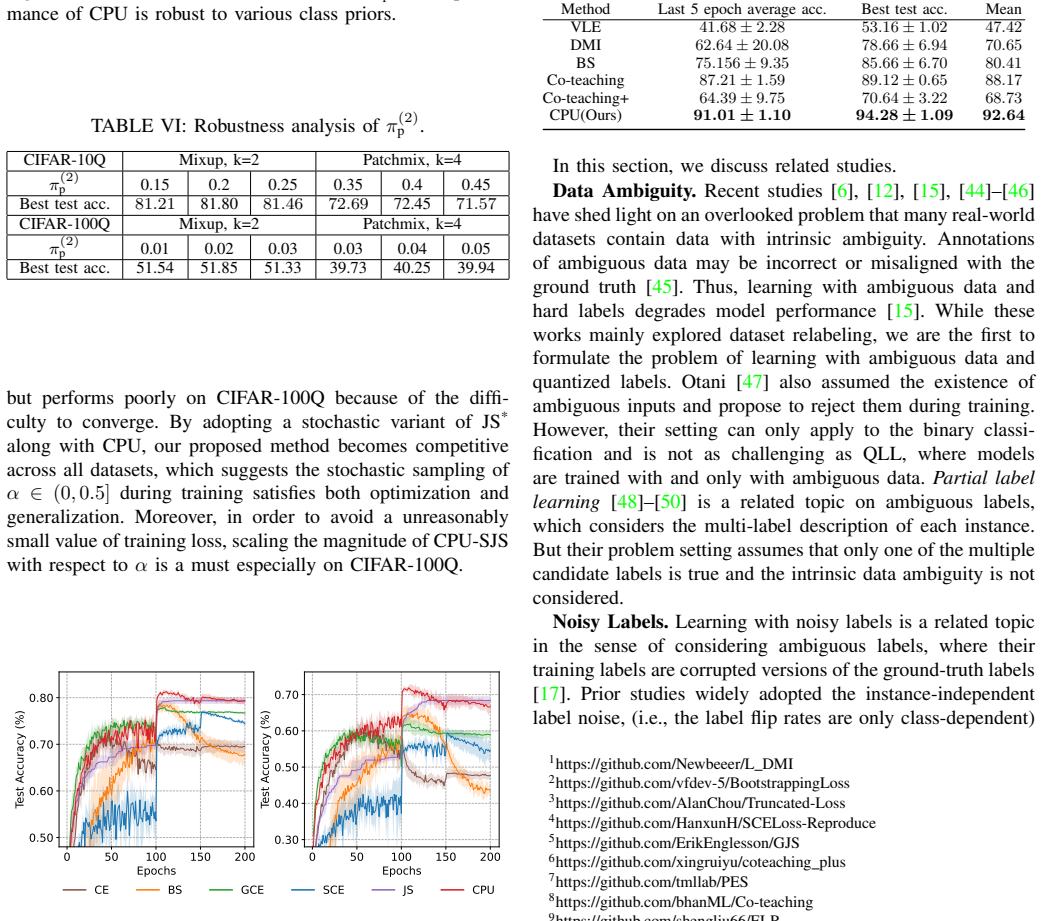
- [Section V-A and Appendix A] The class-prior hyperparameter π_p^(2) is set to m/c, where m is the number of mixed instances in the authors' benchmark generator. This uses privileged information about the synthetic data construction. The robustness analysis (Table VI and Fig. 3) shows non-negligible sensitivity to π_p^(2) (for example, CIFAR-10Q PatchMix best accuracies range from 71.57 to 72.69, and CIFAR-100Q Mixup from 51.33 to 51.85). The claim that CPU is robust to these hyperparameters should be qualified, and the method's performance on real-world ambiguous data without such privileged knowledge remains untested. Please provide a sensitivity analysis that does not assume knowledge of the generator.
minor comments (6)
- [Definition 1, Eq. (1)] Since s is a probability distribution that sums to 1, the denominator in Eq. (1) is redundant; please clarify whether s is assumed to be normalized.
- [Section III, paragraph on choosing class priors] The sentence 'the performance of the CPU is robust to π(1)_p and π(1)_p' contains a typo: the second prior should be π(2)_p.
- [Section III, Stochastic JS divergence] The text states that α ∈ (0, 0.5] but samples α from Beta(0.5, 0.5), whose support is (0, 1); please correct the range or the sampling distribution.
- [Algorithm 1, line 7] Line 7 uses π_p without the superscript (2); please align the notation with Eq. (5).
- [Tables I and II] The 'Mean' column appears between the dataset headers and the condition columns; it is unclear whether the mean is over the four mixing conditions or over repeated runs; please clarify the caption.
- [General] The paper does not provide a link to the implementation of CPU or the benchmark generator; for reproducibility, please release the code.
Circularity Check
No significant circularity: CPU is an openly adapted class-wise nnPU estimator evaluated on held-out test sets; the theoretical weakness is a correctness issue, not circularity.
full rationale
The paper's derivation chain is self-contained with respect to circularity. The CPU risk estimator (Eq. 4) is presented as a direct class-wise generalization of the external nnPU risk estimator of Kiryo et al. [20]; no new unbiasedness theorem is claimed, so there is no hidden step where a conclusion is encoded in the estimator by construction. The quantized-label benchmark is used only for evaluation, and the class-prior hyperparameter choice pi_p^(2)=m/c is disclosed explicitly ('we may choose the class-prior hyperparameters simply as pi_p^(1)=0.1 and pi_p^(2)=m/c without fine-tuning') and its sensitivity is tested (Fig. 3, Table VI). The headline accuracy comparison is an empirical result on held-out CIFAR and AFHQ test sets, not a quantity forced by a fitted constant or by a self-citation chain. Self-citations [13], [14], [16] are background on overfitting/noise memorization and are not load-bearing for the CPU derivation. The main weakness noted by a skeptical reader — that the standard PU identity in Eq. (2) requires unlabeled data drawn from a fixed mixture, whereas the class-wise complement distribution p(x|y!=j) is not that mixture under instance-dependent soft labels — is a validity/correctness concern about the estimator's unbiasedness, not a circularity of the kind defined in the rubric. Therefore the circularity score is 0.
Assumptions & free parameters
free parameters (4)
- pi_p^(1) =
0.1
- pi_p^(2) =
m/c, e.g., 0.2, 0.4, 0.02, 0.04
- alpha in Stochastic JS divergence =
Sampled per iteration from Beta(0.5, 0.5)
- lambda_mu for CPU (Semi) =
Searched in {0.1, 0.5, 1, 5}
assumptions (3)
- domain assumption Label quantization hypothesis: human-annotated hard labels are sampled from a per-instance ground-truth soft-label distribution.
- ad hoc to paper Standard PU mixture and independence: unlabeled data are drawn from p_pu = pi_p p_p + pi_n p_n, and positive and unlabeled sets are sampled independently.
- domain assumption Averaging independent per-class binary PU risks yields a valid multi-class classifier.
invented entities (1)
-
Quantized label (label quantization hypothesis)
Cite this review
Pith. "Pith review of Learning from Ambiguous Data with Hard Labels." pith.science (2026). https://pith.science/paper/TN75ZKY6
@misc{pith2026250101844,
  author       = {Pith},
  title        = {Pith review of: Learning from Ambiguous Data with Hard Labels},
  year         = {2026},
  howpublished = {\url{https://pith.science/paper/TN75ZKY6}},
  note         = {Machine review of arXiv:2501.01844}
}
read the original abstract
Real-world data often contains intrinsic ambiguity that the common single-hard-label annotation paradigm ignores. Standard training using ambiguous data with these hard labels may produce overly confident models and thus leading to poor generalization. In this paper, we propose a novel framework called Quantized Label Learning (QLL) to alleviate this issue. First, we formulate QLL as learning from (very) ambiguous data with hard labels: ideally, each ambiguous instance should be associated with a ground-truth soft-label distribution describing its corresponding probabilistic weight in each class, however, this is usually not accessible; in practice, we can only observe a quantized label, i.e., a hard label sampled (quantized) from the corresponding ground-truth soft-label distribution, of each instance, which can be seen as a biased approximation of the ground-truth soft-label. Second, we propose a Class-wise Positive-Unlabeled (CPU) risk estimator that allows us to train accurate classifiers from only ambiguous data with quantized labels. Third, to simulate ambiguous datasets with quantized labels in the real world, we design a mixing-based ambiguous data generation procedure for empirical evaluation. Experiments demonstrate that our CPU method can significantly improve model generalization performance and outperform the baselines.
Figures


Figures from the paper (1 more)
Reference graph
Works this paper leans on
-
[1]
A survey on data collection for ma- chine learning: a big data-ai integration perspective,
Y . Roh, G. Heo, and S. E. Whang, “A survey on data collection for ma- chine learning: a big data-ai integration perspective,” IEEE Transactions on Knowledge and Data Engineering , vol. 33, no. 4, pp. 1328–1347,
-
[2]
Crowdsourced data management: A survey,
G. Li, J. Wang, Y . Zheng, and M. J. Franklin, “Crowdsourced data management: A survey,” IEEE Transactions on Knowledge and Data Engineering, vol. 28, no. 9, pp. 2296–2319, 2016. 1
work page 2016
-
[3]
Learning from crowdsourced labeled data: a survey,
J. Zhang, X. Wu, and V . S. Sheng, “Learning from crowdsourced labeled data: a survey,” Artificial Intelligence Review , vol. 46, no. 4, pp. 543– 576, 2016. 1
work page 2016
-
[4]
Learning from multiple annotators with varying expertise,
Y . Yan, R. Rosales, G. Fung, R. Subramanian, and J. Dy, “Learning from multiple annotators with varying expertise,” Machine learning, vol. 95, no. 3, pp. 291–327, 2014. 1
work page 2014
-
[5]
Learning from noisy large-scale datasets with minimal supervision,
A. Veit, N. Alldrin, G. Chechik, I. Krasin, A. Gupta, and S. Belongie, “Learning from noisy large-scale datasets with minimal supervision,” in Proceedings of the IEEE conference on computer vision and pattern recognition, 2017, pp. 839–847. 1
work page 2017
-
[6]
Evaluating machine accuracy on imagenet,
V . Shankar, R. Roelofs, H. Mania, A. Fang, B. Recht, and L. Schmidt, “Evaluating machine accuracy on imagenet,” inInternational Conference on Machine Learning . PMLR, 2020, pp. 8634–8644. 1, 8
work page 2020
-
[7]
Learning with noisy labels revisited: A study using real-world human annotations,
J. Wei, Z. Zhu, H. Cheng, T. Liu, G. Niu, and Y . Liu, “Learning with noisy labels revisited: A study using real-world human annotations,” in The Tenth International Conference on Learning Representations, ICLR,
-
[8]
Pervasive label errors in test sets destabilize machine learning benchmarks,
C. G. Northcutt, A. Athalye, and J. Mueller, “Pervasive label errors in test sets destabilize machine learning benchmarks,” in Thirty-fifth Conference on Neural Information Processing Systems Datasets and Benchmarks Track (Round 1) , 2021. 1
work page 2021
Show all 58 references
-
[9]
Deep label distribution learning with label ambiguity,
B.-B. Gao, C. Xing, C.-W. Xie, J. Wu, and X. Geng, “Deep label distribution learning with label ambiguity,” IEEE Transactions on Image Processing, vol. 26, no. 6, pp. 2825–2838, 2017. 1, 9
2017
-
[10]
Learning soft labels via meta learning,
N. Vyas, S. Saxena, and T. V oice, “Learning soft labels via meta learning,” arXiv preprint arXiv:2009.09496 , 2020. 1
2009 arXiv
-
[11]
Human uncertainty makes classification more robust,
J. C. Peterson, R. M. Battleday, T. L. Griffiths, and O. Russakovsky, “Human uncertainty makes classification more robust,” in Proceedings of the IEEE/CVF International Conference on Computer Vision , 2019, pp. 9617–9626. 1, 9
2019
-
[12]
Re-labeling imagenet: from single to multi-labels, from global to localized labels,
S. Yun, S. J. Oh, B. Heo, D. Han, J. Choe, and S. Chun, “Re-labeling imagenet: from single to multi-labels, from global to localized labels,” in Proceedings of the IEEE/CVF Conference on Computer Vision and Pattern Recognition, 2021, pp. 2340–2350. 1, 8
2021
-
[13]
Artificial neural variability for deep learning: On overfitting, noise memorization, and catastrophic forgetting,
Z. Xie, F. He, S. Fu, I. Sato, D. Tao, and M. Sugiyama, “Artificial neural variability for deep learning: On overfitting, noise memorization, and catastrophic forgetting,” Neural computation , vol. 33, no. 8, pp. 2163–2192, 2021. 1, 9
2021
-
[14]
Positive-negative momen- tum: Manipulating stochastic gradient noise to improve generalization,
Z. Xie, L. Yuan, Z. Zhu, and M. Sugiyama, “Positive-negative momen- tum: Manipulating stochastic gradient noise to improve generalization,” in International Conference on Machine Learning . PMLR, 2021, pp. 11 448–11 458. 1, 9
2021
-
[15]
Beyond hard labels: Investi- gating data label distributions,
V . Grossmann, L. Schmarje, and R. Koch, “Beyond hard labels: Investi- gating data label distributions,” arXiv preprint arXiv:2207.06224, 2022. 1, 8
2022 arXiv
-
[16]
Sparse double descent: Where network pruning aggravates overfitting,
Z. He, Z. Xie, Q. Zhu, and Z. Qin, “Sparse double descent: Where network pruning aggravates overfitting,” in International Conference on Machine Learning. PMLR, 2022, pp. 8635–8659. 1
2022
-
[17]
A survey of label-noise representation learning: Past, present and future,
B. Han, Q. Yao, T. Liu, G. Niu, I. W. Tsang, J. T. Kwok, and M. Sugiyama, “A survey of label-noise representation learning: Past, present and future,” arXiv preprint arXiv:2011.04406 , 2020. 1, 8
2011 arXiv
-
[18]
Analysis of learning from positive and unlabeled data,
M. C. Du Plessis, G. Niu, and M. Sugiyama, “Analysis of learning from positive and unlabeled data,” Advances in neural information processing systems, vol. 27, 2014. 2
2014
-
[19]
Convex formulation for learning from positive and unlabeled data,
M. Du Plessis, G. Niu, and M. Sugiyama, “Convex formulation for learning from positive and unlabeled data,” in International conference on machine learning . PMLR, 2015, pp. 1386–1394. 2
2015
-
[20]
Positive- unlabeled learning with non-negative risk estimator,
R. Kiryo, G. Niu, M. C. Du Plessis, and M. Sugiyama, “Positive- unlabeled learning with non-negative risk estimator,” Advances in neural information processing systems , vol. 30, 2017. 2
2017
-
[21]
Theoreti- cal comparisons of positive-unlabeled learning against positive-negative learning,
G. Niu, M. C. du Plessis, T. Sakai, Y . Ma, and M. Sugiyama, “Theoreti- cal comparisons of positive-unlabeled learning against positive-negative learning,” Advances in neural information processing systems , vol. 29,
-
[22]
Learning from corrupted binary labels via class-probability estimation,
A. Menon, B. Van Rooyen, C. S. Ong, and B. Williamson, “Learning from corrupted binary labels via class-probability estimation,” in Inter- national conference on machine learning . PMLR, 2015, pp. 125–134. 2
2015
-
[23]
Estimating the class prior and posterior from noisy positives and unlabeled data,
S. Jain, M. White, and P. Radivojac, “Estimating the class prior and posterior from noisy positives and unlabeled data,” Advances in neural information processing systems , vol. 29, 2016. 2
2016
-
[24]
Class-prior estimation for learning from positive and unlabeled data,
M. Christoffel, G. Niu, and M. Sugiyama, “Class-prior estimation for learning from positive and unlabeled data,” in Asian Conference on Machine Learning. PMLR, 2016, pp. 221–236. 2
2016
-
[25]
Rethinking class-prior estimation for positive-unlabeled learning,
Y . Yao, T. Liu, B. Han, M. Gong, G. Niu, M. Sugiyama, and D. Tao, “Rethinking class-prior estimation for positive-unlabeled learning,” in International Conference on Learning Representations , 2021. 2
2021
-
[26]
Generalized jensen-shannon divergence loss for learning with noisy labels,
E. Englesson and H. Azizpour, “Generalized jensen-shannon divergence loss for learning with noisy labels,” Advances in Neural Information Processing Systems, vol. 34, 2021. 2, 3
2021
-
[27]
mixup: Beyond empirical risk minimization,
H. Zhang, M. Ciss ´e, Y . N. Dauphin, and D. Lopez-Paz, “mixup: Beyond empirical risk minimization,” in 6th International Conference on Learning Representations, ICLR 2018, Vancouver, BC, Canada, April 30 - May 3, 2018, Conference Track Proceedings . OpenReview.net,
2018
-
[28]
Cutmix: Reg- ularization strategy to train strong classifiers with localizable features,
S. Yun, D. Han, S. J. Oh, S. Chun, J. Choe, and Y . Yoo, “Cutmix: Reg- ularization strategy to train strong classifiers with localizable features,” in Proceedings of the IEEE/CVF international conference on computer vision, 2019, pp. 6023–6032. 3
2019
-
[29]
Deep residual learning for image recognition,
K. He, X. Zhang, S. Ren, and J. Sun, “Deep residual learning for image recognition,” in Proceedings of the IEEE conference on computer vision and pattern recognition , 2016, pp. 770–778. 3
2016
-
[30]
Training deep neural networks on noisy labels with bootstrapping,
S. Reed, H. Lee, D. Anguelov, C. Szegedy, D. Erhan, and A. Rabinovich, “Training deep neural networks on noisy labels with bootstrapping,” arXiv preprint arXiv:1412.6596 , 2014. 3, 9
2014 arXiv
-
[31]
Generalized cross entropy loss for training deep neural networks with noisy labels,
Z. Zhang and M. Sabuncu, “Generalized cross entropy loss for training deep neural networks with noisy labels,” Advances in neural information processing systems, vol. 31, 2018. 3, 9
2018
-
[32]
Symmetric cross entropy for robust learning with noisy labels,
Y . Wang, X. Ma, Z. Chen, Y . Luo, J. Yi, and J. Bailey, “Symmetric cross entropy for robust learning with noisy labels,” in Proceedings of the IEEE/CVF International Conference on Computer Vision , 2019, pp. 322–330. 3, 9
2019
-
[33]
L dmi: A novel information- theoretic loss function for training deep nets robust to label noise,
Y . Xu, P. Cao, Y . Kong, and Y . Wang, “L dmi: A novel information- theoretic loss function for training deep nets robust to label noise,” Advances in neural information processing systems , vol. 32, 2019. 3
2019
-
[34]
Co-teaching: Robust training of deep neural networks with extremely noisy labels,
B. Han, Q. Yao, X. Yu, G. Niu, M. Xu, W. Hu, I. Tsang, and M. Sugiyama, “Co-teaching: Robust training of deep neural networks with extremely noisy labels,” Advances in neural information processing systems, vol. 31, 2018. 4, 9
2018
-
[35]
How does disagreement help generalization against label corruption?
X. Yu, B. Han, J. Yao, G. Niu, I. Tsang, and M. Sugiyama, “How does disagreement help generalization against label corruption?” in International Conference on Machine Learning . PMLR, 2019, pp. 7164–7173. 4
2019
-
[36]
Robust early-learning: Hindering the memorization of noisy labels,
X. Xia, T. Liu, B. Han, C. Gong, N. Wang, Z. Ge, and Y . Chang, “Robust early-learning: Hindering the memorization of noisy labels,” in International conference on learning representations , 2020. 4
2020
-
[37]
Early- learning regularization prevents memorization of noisy labels,
S. Liu, J. Niles-Weed, N. Razavian, and C. Fernandez-Granda, “Early- learning regularization prevents memorization of noisy labels,”Advances in neural information processing systems , vol. 33, pp. 20 331–20 342,
-
[38]
Dividemix: Learning with noisy labels as semi-supervised learning,
J. Li, R. Socher, and S. C. H. Hoi, “Dividemix: Learning with noisy labels as semi-supervised learning,” in 8th International Conference on Learning Representations, ICLR 2020, Addis Ababa, Ethiopia, April 26-30, 2020 . OpenReview.net, 2020. [Online]. Available: https://openre...
2020
-
[39]
Understanding and improving early stopping for learning with noisy labels,
Y . Bai, E. Yang, B. Han, Y . Yang, J. Li, Y . Mao, G. Niu, and T. Liu, “Understanding and improving early stopping for learning with noisy labels,” Advances in Neural Information Processing Systems , vol. 34,
-
[40]
Fixmatch: Simplifying semi- supervised learning with consistency and confidence,
K. Sohn, D. Berthelot, N. Carlini, Z. Zhang, H. Zhang, C. A. Raffel, E. D. Cubuk, A. Kurakin, and C.-L. Li, “Fixmatch: Simplifying semi- supervised learning with consistency and confidence,” Advances in Neural Information Processing Systems , vol. 33, pp. 596–608, 2020. 4
2020
-
[41]
Exploiting spatial dimen- sions of latent in gan for real-time image editing,
H. Kim, Y . Choi, J. Kim, S. Yoo, and Y . Uh, “Exploiting spatial dimen- sions of latent in gan for real-time image editing,” in Proceedings of the IEEE/CVF Conference on Computer Vision and Pattern Recognition , 2021, pp. 852–861. 6, 7, 8
2021
-
[42]
Stargan v2: Diverse image synthesis for multiple domains,
Y . Choi, Y . Uh, J. Yoo, and J.-W. Ha, “Stargan v2: Diverse image synthesis for multiple domains,” in Proceedings of the IEEE/CVF conference on computer vision and pattern recognition, 2020, pp. 8188–
2020
-
[43]
Variational label enhancement,
N. Xu, J. Shu, Y .-P. Liu, and X. Geng, “Variational label enhancement,” in International Conference on Machine Learning . PMLR, 2020, pp. 10 597–10 606. 8
2020
-
[44]
Are we done with imagenet?
L. Beyer, O. J. H ´enaff, A. Kolesnikov, X. Zhai, and A. v. d. Oord, “Are we done with imagenet?” arXiv preprint arXiv:2006.07159 , 2020. 8
2006 arXiv
-
[45]
From imagenet to image classification: Contextualizing progress on bench- marks,
D. Tsipras, S. Santurkar, L. Engstrom, A. Ilyas, and A. Madry, “From imagenet to image classification: Contextualizing progress on bench- marks,” in International Conference on Machine Learning . PMLR, 2020, pp. 9625–9635. 8
2020
-
[46]
A data-centric approach for improving ambiguous labels with combined semi-supervised classifica- tion and clustering,
L. Schmarje, M. Santarossa, S.-M. Schroder, C. Zelenka, R. Kiko, J. Stracke, N. V olkmann, and R. Koch, “A data-centric approach for improving ambiguous labels with combined semi-supervised classifica- tion and clustering,” 2021. 8
2021
-
[47]
Binary classification with ambiguous training data,
N. Otani, Y . Otsubo, T. Koike, and M. Sugiyama, “Binary classification with ambiguous training data,” Machine Learning, vol. 109, no. 12, pp. 2369–2388, 2020. 8
2020
-
[48]
Learning from partial labels,
T. Cour, B. Sapp, and B. Taskar, “Learning from partial labels,” The Journal of Machine Learning Research , vol. 12, pp. 1501–1536, 2011. 8
2011
-
[49]
Solving the partial label learning problem: An instance-based approach,
M.-L. Zhang and F. Yu, “Solving the partial label learning problem: An instance-based approach,” in Twenty-fourth international joint confer- ence on artificial intelligence , 2015. 8
2015
-
[50]
Disambiguation-free partial label learning,
M.-L. Zhang, F. Yu, and C.-Z. Tang, “Disambiguation-free partial label learning,” IEEE Transactions on Knowledge and Data Engineering , vol. 29, no. 10, pp. 2155–2167, 2017. 8
2017
-
[51]
Learning with instance-dependent label noise: A sample sieve approach,
H. Cheng, Z. Zhu, X. Li, Y . Gong, X. Sun, and Y . Liu, “Learning with instance-dependent label noise: A sample sieve approach,” arXiv preprint arXiv:2010.02347, 2020. 9
2010 arXiv
-
[52]
Part-dependent label noise: Towards instance-dependent label noise,
X. Xia, T. Liu, B. Han, N. Wang, M. Gong, H. Liu, G. Niu, D. Tao, and M. Sugiyama, “Part-dependent label noise: Towards instance-dependent label noise,” Advances in Neural Information Processing Systems , vol. 33, pp. 7597–7610, 2020. 9
2020
-
[53]
Label distribution learning,
X. Geng, “Label distribution learning,” IEEE Transactions on Knowl- edge and Data Engineering , vol. 28, no. 7, pp. 1734–1748, 2016. 9
2016
-
[54]
When does label smoothing help?
R. M ¨uller, S. Kornblith, and G. E. Hinton, “When does label smoothing help?” Advances in neural information processing systems , vol. 32,
-
[55]
How does mixup help with robustness and generalization?
L. Zhang, Z. Deng, K. Kawaguchi, A. Ghorbani, and J. Zou, “How does mixup help with robustness and generalization?” arXiv preprint arXiv:2010.04819, 2020. 9 APPENDIX In this section, we present the optimization and method- specific hyperparameters used in our experiments and e...
2010 arXiv
-
[57]
Each animal category in the dataset has its own distinct visual style, and the images were carefully curated and labeled to ensure high standards
is a high-quality collection of animal face images, com- prising more than 16,000 images of dogs, cats, and wildlife. Each animal category in the dataset has its own distinct visual style, and the images were carefully curated and labeled to ensure high standards. To generate ...
-
[58]
To perform local editing on AFHQ, we randomly pair images from the training set and select half-and-half masks that divide them equally into horizontal and vertical halves (see Fig
and the AFHQ training data. To perform local editing on AFHQ, we randomly pair images from the training set and select half-and-half masks that divide them equally into horizontal and vertical halves (see Fig. 2). We only preserve instances that are generated by images from tw...
-
[2018]
Available: https://openreview.net/forum?id=r1Ddp1-Rb 3
[Online]. Available: https://openreview.net/forum?id=r1Ddp1-Rb 3
Reviewed August 10, 2026 · model on record in the stance chip above.
Discussion (0). Continue with ORCID to comment.