REVIEW 2 major objections 5 minor 1 cited by
The MAJORANA DEMONSTRATOR experiment's construction, commissioning, and performance
T0 review · 2 major / 5 minor · reviewed 2026-08-10 · deepseek-v4-flash
Pith's one-line read The Majorana Demonstrator met its design goal: its low background and 2.52 keV resolution justify a tonne-scale search for neutrinoless double-beta decay in germanium.
desk verdict A solid consolidated reference for the MAJORANA Demonstrator; the physics was already published, but the background claim is softer than the abstract implies, and the paper is honest and worth publishing. read the letter →
The pith
A machine-rendered reading of the paper's core claim, the machinery that carries it, and where it could break.
The reading
What carries the argument
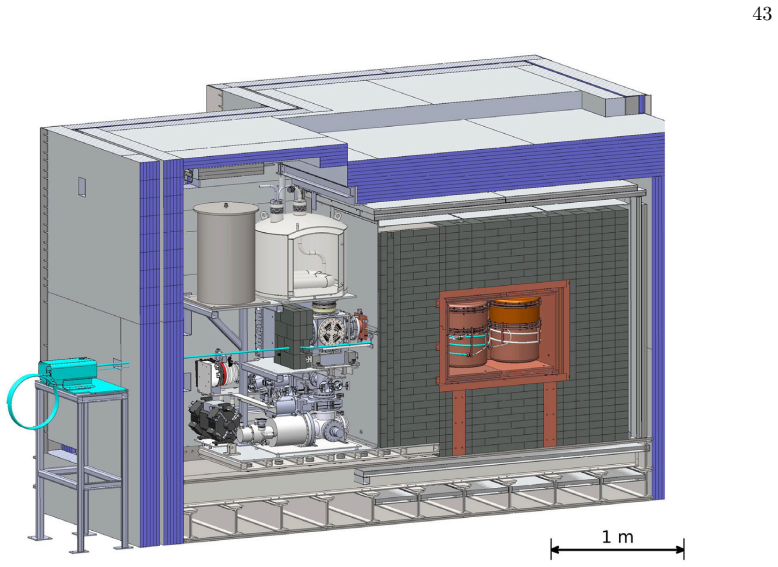
The load-bearing object is the p-type point-contact (P-PC) germanium detector, a crystal that is both the decay source and the detector, read by a custom low-mass front-end board whose first-stage transistor sits close to the crystal. The mechanism carrying the argument is the full low-background chain: detector parts and cryostats made of underground electroformed copper, tracking of cosmic-ray exposure of the enriched germanium, a graded shield of electroformed copper, commercial copper, lead, an active muon veto, borated polyethylene, and a radon-purged enclosure, plus pulse-shape discrimination that rejects multi-site background events while keeping single-site $\beta\beta(0\nu)$ candidates. The 2.52 keV resolution shrinks the signal region at 2039 keV, and the low measured background rate leaves only four events there; together these set the half-life limit.
What would settle it
Count events in the 64.5 kg yr enriched exposure within the 10 keV region at 2039 keV using open data and compare the number with the Poisson expectation from the claimed $16.6\,\mathrm{cts/(FWHM\,t\,yr)}$ background rate; if the count is incompatible with that expectation at 90% confidence, the background claim and the half-life limit do not stand.
Extended reading notes
Core claim
In the paper's own terms, the Majorana Demonstrator is an instrument paper whose central result is an engineering achievement: an array of enriched p-type point-contact and inverted-coaxial point-contact germanium detectors, operated underground from 2015 to 2021, reached a background rate of $16.6^{+0.14}_{-0.13}\,\mathrm{cts/(FWHM\,t\,yr)}$ in the 10 keV region around the 2039 keV $Q$-value, with a measured resolution of 2.52 keV FWHM. With 64.5 kg yr of enriched active exposure, four events were observed in that region, consistent with the modeled background, yielding a lower limit on the $\beta\beta(0\nu)$ half-life of $^{76}\mathrm{Ge}$ of $8.3\times10^{25}$ yr at 90% confidence. The paper claims this is the best energy resolution and second-best background level of any $\beta\beta(0\nu)$ search, and that it demonstrates backgrounds low enough to justify building the tonne-scale LEGEND experiment.
Load-bearing premise
The final half-life limit assumes that the four events seen in the 10 keV signal region are all described by the modeled background at the measured rate of $16.6\,\mathrm{cts/(FWHM\,t\,yr)}$; if an unrecognized background source contributes any of those events, the limit and the conclusion that backgrounds are low enough would weaken.
Editorial extensions
If this is right
- The half-life limit of $8.3\times10^{25}$ yr is the Demonstrator's final $\beta\beta(0\nu)$ result and corresponds, depending on nuclear matrix elements, to a Majorana neutrino mass range of 113–269 meV.
- The measured background rate of $16.6\,\mathrm{cts/(FWHM\,t\,yr)}$ becomes the benchmark that the tonne-scale LEGEND experiment must improve on by roughly two orders of magnitude.
- The demonstrated energy resolution of 2.52 keV FWHM reduces the region of interest, so the same background rate contributes fewer counts inside the signal window.
- The 2020 Module 2 upgrade raised operational efficiency from 62% to 100%, showing that the cable and connector failure modes seen in early running can be engineered out.
- The same low-background array produced limits on bosonic dark matter, solar axions, Pauli-principle violation, and other beyond-Standard-Model processes, so the construction effort has multiple physics returns.
Reading between the lines
- I infer that the Demonstrator's measured background rate, if confirmed by the pending detailed background model, can serve as an empirical scaling point for LEGEND-200: any substantial deviation in the successor's rate per kilogram would point to a new contamination or cosmogenic pathway rather than a failure of the Demonstrator's design.
- The paper does not spell out that a factor-of-two improvement in energy resolution is worth a factor of two in background in a background-limited search, so the 2.52 keV FWHM is a sensitivity asset on the same footing as the shielding.
- The enriched germanium tracking database, built to record cosmic-ray exposure during fabrication, becomes a predictive tool for future experiments: the same records can be used to forecast $^{68}\mathrm{Ge}$ and $^{60}\mathrm{Co}$ backgrounds in LEGEND's detectors.
- An extension the paper leaves implicit is that the Demonstrator's operational configurations and blind-analysis workflow offer a template for how a low-rate experiment can maintain data quality while keeping the signal region hidden.
Editorial analysis
A structured set of objections, weighed in public.
Referee Report
Summary. This paper is an instrumentation and operational overview of the MAJORANA DEMONSTRATOR, a modular array of enriched and natural HPGe detectors operated at SURF from 2015 to 2021. It documents underground electroforming, germanium enrichment and detector fabrication, detector arrays and the Module 2 cabling/connector upgrade, cryogenic and vacuum systems, calibration, shielding, DAQ, slow controls, databases, data production and blinding, and the dataset structure. It also summarizes published physics results: the best energy resolution of any 0νββ search, a measured background rate of 16.6 cts/(FWHM t yr) with four events in a 10 keV ROI for 64.5 kg yr of enriched exposure, and a final 76Ge half-life limit of 8.3×10^25 yr (90% C.L.). The stated purpose is to show that the Demonstrator demonstrated backgrounds low enough to justify a tonne-scale 76Ge experiment, LEGEND.
Significance. If the results hold, the paper is a valuable archival reference for the LEGEND program and for the low-background germanium community. Its strengths are the detailed, system-by-system engineering documentation; the transparent disclosure in Sec. I.3 that the measured background exceeded the initial assay-based projection by about a factor of 6.6 and that the background model is still being refined; and the anchoring of all headline physics numbers in published, peer-reviewed analyses. The main weakness is that the programmatic conclusion in Sec. XII is not quantitatively supported or benchmarked against the stated design goals, which is a correctable presentation issue rather than a flaw in the underlying measurements.
major comments (2)
- [Sec. XII and Sec. I.3] The conclusion that the Demonstrator 'demonstrated backgrounds low enough to justify building a tonne-scale experiment' is load-bearing for the paper's stated purpose, but the only background number quoted in Sec. I.3 is 16.6 cts/(FWHM t yr), which is a factor of about 6.6 above the initial assay-based projection of <2.5 cts/(FWHM t yr). The same section also states that possible background sources are still being analyzed with a detailed MaGe-based model. To make the conclusion defensible, please either provide a quantitative comparison with the original design goal in Ref. [21] and with the LEGEND-1000 background target, explaining in what sense the achieved rate justifies the tonne-scale program, or temper the wording to claim demonstrated low-background techniques and published sensitivity rather than a demonstrated background level. Without one of these changes, the conclusion overstates what the paper's own numbers show.
- [Sec. I.3 and Abstract] The abstract and Sec. I.3 describe the Demonstrator as having the 'second-best background level of any ββ(0ν) search', but no benchmark table or quantitative comparison to GERDA or other experiments is provided. Because background levels are quoted in different units across experiments (cts/(FWHM t yr) versus cts/(keV kg yr)), the reader cannot verify the ranking from this paper. Please add a short comparison, with references and a consistent unit conversion.
minor comments (5)
- [Sec. II.1] There is a duplicated word in the sentence 'All processes and and sensors were monitored remotely'; it should read 'All processes and sensors were monitored remotely'.
- [Sec. V.5.1] The text refers to a 'proportional-intergal-derivative' controller; this should be 'proportional-integral-derivative'.
- [Sec. III.2] In the paragraph beginning 'The geometrical measurements provided all dimensions', the sentence 'The dimension were provided by the vendor' should be 'The dimensions were provided by the vendor'.
- [Appendix D.1] The entry for Schleuniger contains 'Cabkestripper', which appears to be a typo for 'Cable stripper'.
- [Sec. XI.3] The narrative description of datasets DS0 through DS8 would be easier to follow with a small table summarizing the dates, detector configuration, shielding status, and whether the dataset contributed to the final 64.5 kg yr exposure; Figure 43 is helpful but does not capture all configuration changes.
Circularity Check
No significant circularity: the paper's central results are direct measurements, not derivations from fitted inputs or self-citation.
full rationale
This is a construction, commissioning, and performance paper. The two central claims, the measured background rate of 16.6 cts/(FWHM t yr) and the half-life limit of 8.3 x 10^25 yr, are reported as experimental results from the Demonstrator's blinded data, not as predictions derived from parameters fitted in this paper. The paper explicitly contrasts the measured background with the earlier assay-based projection of <2.5 cts/(FWHM t yr), showing that the measurement is not determined by that projection; indeed, the two disagree. Energy resolution values are measured with calibration sources and in-situ calibration data. Extensive citation of earlier Majorana publications is normal for a summary paper and does not function as load-bearing support for the measured values, which are externally anchored in the experiment's own data. The statement that the Demonstrator demonstrated backgrounds low enough to justify a tonne-scale experiment is an interpretive judgment based on the measured background; the paper itself discloses that some background sources are still being modeled with MaGe, which is a scientific caveat rather than a circularity. No step in the claimed derivation chain reduces to its own inputs.
Assumptions & free parameters
free parameters (1)
- Dead-layer thickness per detector =
About 1 mm, from 81/356 keV gamma ratio fits
assumptions (4)
- standard math Isotopic abundance measurements are independent and Gaussian (Appendix A)
- domain assumption Dead layer can be modeled as a step function with a transition layer
- domain assumption The background model used for the final half-life limit correctly describes all events in the ROI
- domain assumption GRETINA digitizer nonlinearity correction and energy calibration are accurate
Cite this review
Pith. "Pith review of The MAJORANA DEMONSTRATOR experiment's construction, commissioning, and performance." pith.science (2026). https://pith.science/paper/KE5LYA6U
@misc{pith2026250102060,
  author       = {Pith},
  title        = {Pith review of: The MAJORANA DEMONSTRATOR experiment's construction, commissioning, and performance},
  year         = {2026},
  howpublished = {\url{https://pith.science/paper/KE5LYA6U}},
  note         = {Machine review of arXiv:2501.02060}
}
abstract
Background: The MAJORANA DEMONSTRATOR , a modular array of isotopically enriched high-purity germanium (HPGe) detectors, was constructed to demonstrate backgrounds low enough to justify building a tonne-scale experiment to search for the neutrinoless double-beta decay ($\beta\beta(0\nu)$) of $^{76}\mathrm{Ge}$. Purpose: This paper presents a description of the instrument, its commissioning, and operations. It covers the electroforming, underground infrastructure, enrichment, detector fabrication, low-background and construction techniques, electronics, data acquisition, databases, and data processing of the MAJORANA DEMONSTRATOR. Method: The MAJORANA DEMONSTRATOR operated inside an ultra-low radioactivity passive shield at the 4850-foot~level of the Sanford Underground Research Facility (SURF) from 2015-2021. Results and Conclusions: The MAJORANA DEMONSTRATOR achieved the best energy resolution and second-best background level of any $\beta\beta(0\nu)$ search. This enabled it to achieve an ultimate half-life limit on $\beta\beta(0\nu)$ in $^{76}\mathrm{Ge}$ of $8.3\times 10^{25}$~yr (90\% C.L.) and perform a rich set of searches for other physics beyond the Standard Model.
Figures


Figures from the paper (43 more)




Forward citations
Cited by 1 Pith paper
-
Rare multi-nucleon decays with the full data sets of the Majorana Demonstrator
With the full Majorana Demonstrator data set, new 90% confidence partial lifetime limits are set for tri-nucleon and dinucleon decays in germanium isotopes, with the strongest limits of 1.83 x 10^26 years for two spec...
Reference graph
Works this paper leans on
-
[21]
Abgrallet al.(Majorana Collaboration), Adv
N. Abgrallet al.(Majorana Collaboration), Adv. High Energy Phys.2014, 365432 (2014)
work page 2014
-
[1]
W. H. Furry, Phys. Rev.56, 1184 (1939)
1939
-
[2]
Schechter and J
J. Schechter and J. W. F. Valle, Phys. Rev. D25, 2951 (1982)
1982
-
[3]
F. T. Avignone, S. R. Elliott, and J. Engel, Rev. Mod. Phys.80, 481 (2008)
2008
-
[4]
Rodejohann, International Journal of Modern Physics E20, 1833 (2011)
W. Rodejohann, International Journal of Modern Physics E20, 1833 (2011)
2011
-
[5]
S. R. Elliott, Mod. Phys. Lett. A27, 1230009 (2012)
2012
-
[6]
Cremonesi, Nuclear Physics B - Proceedings Supplements237-238, 7 (2013)
O. Cremonesi, Nuclear Physics B - Proceedings Supplements237-238, 7 (2013)
2013
-
[7]
Schwingenheuer, Annalen der Physik525, 269 (2013)
B. Schwingenheuer, Annalen der Physik525, 269 (2013)
2013
Show all 95 references
-
[8]
S. M. Bilenky and C. Giunti, International Journal of Modern Physics A30, 1530001 (2015)
2015
-
[9]
Dell’Oro, S
S. Dell’Oro, S. Marcocci, M. Viel, and F. Vissani, Advances in High Energy Physics2016, 2162659 (2016)
2016
-
[10]
J. D. Vergados, H. Ejiri, and F. Šimkovic, International Journal of Modern Physics E25, 1630007 (2016)
2016
-
[11]
Henning, Reviews in Physics1, 29 (2016)
R. Henning, Reviews in Physics1, 29 (2016)
2016
-
[12]
Engel and J
J. Engel and J. Menéndez, Reports on Progress in Physics80, 046301 (2017)
2017
-
[13]
A. S. Barabash, International Journal of Modern Physics A33, 1843001 (2018)
2018
-
[14]
M. J. Dolinski, A. W. Poon, and W. Rodejohann, Annual Review of Nuclear and Particle Science69, 219 (2019)
2019
-
[15]
Agostini, G
M. Agostini, G. Benato, J. A. Detwiler, J. Menéndez, and F. Vissani, Rev. Mod. Phys.95, 025002 (2023)
2023
-
[16]
Adamset al., Neutrinoless double beta decay (2022), arXiv:2212.11099 [nucl-ex]
C. Adamset al., Neutrinoless double beta decay (2022), arXiv:2212.11099 [nucl-ex]
2022 arXiv
-
[17]
Agostiniet al.(GERDA), Eur
M. Agostiniet al.(GERDA), Eur. Phys. J.C78, 388 (2018)
2018
-
[18]
Agostiniet al.(GERDA, (GERDA Collaboration)*), Phys
M. Agostiniet al.(GERDA, (GERDA Collaboration)*), Phys. Rev. Lett.131, 142501 (2023)
2023
-
[19]
Abgrallet al.(LEGEND Collaboration), AIP Conference Proceedings1894, 020027 (2017)
N. Abgrallet al.(LEGEND Collaboration), AIP Conference Proceedings1894, 020027 (2017)
2017
-
[20]
Abgrall et al
N. Abgrall et al. (LEGEND Collaboration), Legend-1000 preconceptual design report (2021), arXiv:2107.11462 [nucl-ex]
2021 arXiv
-
[22]
Douysset, T
G. Douysset, T. Fritioff, C. Carlberg, I. Bergström, and M. Björkhage, Phys. Rev. Lett.86, 4259 (2001)
2001
-
[23]
P. Luke, F. Goulding, N. Madden, and R. Pehl, IEEE Transactions on Nuclear Science36, 926 (1989)
1989
-
[24]
P. S. Barbeau, J. I. Collar, and O. Tench, Journal of Cosmology and Astroparticle Physics2007 (09), 009
-
[25]
I. J. Arnquistet al.(Majorana Collaboration), Phys. Rev. Lett.130, 062501 (2023)
2023
-
[26]
Heise, Journal of Physics: Conference Series606, 012015 (2015)
J. Heise, Journal of Physics: Conference Series606, 012015 (2015)
2015
-
[27]
Abgrallet al.(Majorana Collaboration), Nuclear Instruments and Methods in Physics Research Section A: Accelerators, Spectrometers, Detectors and Associated Equipment828, 22 (2016)
N. Abgrallet al.(Majorana Collaboration), Nuclear Instruments and Methods in Physics Research Section A: Accelerators, Spectrometers, Detectors and Associated Equipment828, 22 (2016)
2016
-
[28]
Abgrallet al.(Majorana Collaboration), Nuclear Instruments and Methods in Physics Research Section A: Accelerators, Spectrometers, Detectors and Associated Equipment872, 16 (2017)
N. Abgrallet al.(Majorana Collaboration), Nuclear Instruments and Methods in Physics Research Section A: Accelerators, Spectrometers, Detectors and Associated Equipment872, 16 (2017)
2017
-
[29]
Abgrallet al.(Majorana Collaboration), JINST17 (05), T05003
N. Abgrallet al.(Majorana Collaboration), JINST17 (05), T05003
-
[30]
I. Lee, R. Clark, M. Cromaz, M. Deleplanque, M. Descovich, R. Diamond, P. Fallon, A. Macchiavelli, F. Stephens, and D. Ward, Nuclear Physics A746, 255 (2004). 71
2004
-
[31]
Zimmermann, J
S. Zimmermann, J. T. Anderson, D. Doering, J. Joseph, C. Lionberger, T. Stezelberger, and H. Yaver, IEEE Transactions on Nuclear Science59, 2494 (2012)
2012
-
[32]
M. Howe, G. Cox, P. Harvey, F. McGirt, K. Rielage, J. Wilkerson, and J. Wouters, IEEE Transactions on Nuclear Science51, 878 (2004)
2004
-
[33]
Howeet al., (2024), http://orca.physics.unc.edu
M. Howeet al., (2024), http://orca.physics.unc.edu
2024
-
[34]
Caldwellet al., (2024), https://github.com/unc-enap/Orca
T. Caldwellet al., (2024), https://github.com/unc-enap/Orca
2024
-
[35]
Cooper, D
R. Cooper, D. Radford, P. Hausladen, and K. Lagergren, Nuclear Instruments and Methods in Physics Research Section A: Accelerators, Spectrometers, Detectors and Associated Equipment665, 25 (2011)
2011
-
[36]
Lehnert, M
B. Lehnert, M. Hult, G. Lutter, and K. Zuber, Phys. Rev. C95, 044306 (2017)
2017
-
[37]
Lehnert, H
B. Lehnert, H. Ramani, M. Hult, G. Lutter, M. Pospelov, S. Rajendran, and K. Zuber, Phys. Rev. Lett. 124, 181802 (2020)
2020
-
[38]
I. J. Arnquistet al.(Majorana Collaboration), Phys. Rev. Lett.131, 152501 (2023)
2023
-
[39]
C. E. Aalsethet al.(Majorana Collaboration), Phys. Rev. Lett.120, 132502 (2018)
2018
-
[40]
S. I. Alviset al.(Majorana Collaboration), Phys. Rev. C100, 025501 (2019)
2019
-
[41]
Agostinelliet al., Nuclear Instruments and Methods in Physics Research Section A: Accelerators, Spectrometers, Detectors and Associated Equipment506, 250 (2003)
S. Agostinelliet al., Nuclear Instruments and Methods in Physics Research Section A: Accelerators, Spectrometers, Detectors and Associated Equipment506, 250 (2003)
2003
-
[42]
Boswellet al., IEEE Transactions on Nuclear Science58, 1212 (2011)
M. Boswellet al., IEEE Transactions on Nuclear Science58, 1212 (2011)
2011
-
[43]
I. J. Arnquistet al.(Majorana Collaboration), Phys. Rev. C107, 014321 (2023)
2023
-
[44]
I. J. Arnquistet al.(Majorana Collaboration), Assay-based background projection for the majorana demonstrator using monte carlo uncertainty propagation (2024)
2024
-
[45]
I. J. Arnquistet al.(Majorana Collaboration), Phys. Rev. C103, 015501 (2021)
2021
-
[46]
I. J. Arnquistet al., Final results of themajorana demonstrator’s search for double-beta decay of 76ge to excited states of76se (2024), arXiv:2410.03995 [nucl-ex]
2024 arXiv
-
[47]
Abgrallet al.(Majorana Collaboration), Phys
N. Abgrallet al.(Majorana Collaboration), Phys. Rev. Lett.118, 161801 (2017)
2017
-
[48]
Armengaudet al., Journal of Cosmology and Astroparticle Physics2013 (11), 067
E. Armengaudet al., Journal of Cosmology and Astroparticle Physics2013 (11), 067
-
[49]
S. K. Liuet al.(CDEX Collaboration), Phys. Rev. D95, 052006 (2017)
2017
-
[50]
I. J. Arnquistet al.(Majorana Collaboration), Phys. Rev. Lett.132, 041001 (2024)
2024
-
[51]
I. J. Arnquistet al.(Majorana Collaboration), Phys. Rev. Lett.129, 081803 (2022)
2022
-
[52]
Xu and S
W. Xu and S. R. Elliott, Astroparticle Physics89, 39 (2017)
2017
-
[53]
S. I. Alviset al.(Majorana Collaboration), Phys. Rev. D99, 072004 (2019)
2019
-
[54]
S. I. Alviset al.(Majorana Collaboration), Phys. Rev. Lett.120, 211804 (2018)
2018
-
[55]
S. R. Elliott, B. H. LaRoque, V. M. Gehman, M. F. Kidd, and M. Chen, Foundations of Physics42, 1015 (2012)
2012
-
[56]
I. J. Arnquistet al.(Majorana Collaboration), Nature Physics 10.1038/s41567-024-02437-9 (2024)
2024 doi
-
[57]
G. C. Ghirardi, A. Rimini, and T. Weber, Phys. Rev. D34, 470 (1986)
1986
-
[58]
Bassi, K
A. Bassi, K. Lochan, S. Satin, T. P. Singh, and H. Ulbricht, Rev. Mod. Phys.85, 471 (2013)
2013
-
[59]
I. J. Arnquistet al.(Majorana Collaboration), Phys. Rev. Lett.129, 080401 (2022)
2022
-
[60]
I. J. Arnquistet al.(Majorana Collaboration), Phys. Rev. C105, 014617 (2022)
2022
-
[61]
I. J. Arnquistet al.(Majorana Collaboration), Phys. Rev. C105, 064610 (2022)
2022
-
[62]
I. J. Arnquistet al.(Majorana Collaboration), Phys. Rev. C107, 045503 (2023)
2023
-
[63]
C. E. Aalsethet al.(The IGEX Collaboration), Phys. Rev. C59, 2108 (1999)
1999
-
[64]
C. E. Aalsethet al.(IGEX Collaboration), Phys. Rev. D65, 092007 (2002)
2002
-
[65]
E. W. Hoppeet al., Journal of Radioanalytical and Nuclear Chemistry277, 103 (2008)
2008
-
[66]
N. R. Overman, C. T. Overman, T. A. Kafentzis, D. J. Edwards, and E. W. Hoppe,Majorana Electro- formed Copper Mechanical Analysis, Tech. Rep. PNNL 21315 (Pacific Northwest National Laboratory, United States Department of Energy, 2012)
2012
-
[67]
Hoppeet al., Nuclear Instruments and Methods in Physics Research Section A: Accelerators, Spec- trometers, Detectors and Associated Equipment579, 486 (2007)
E. Hoppeet al., Nuclear Instruments and Methods in Physics Research Section A: Accelerators, Spec- trometers, Detectors and Associated Equipment579, 486 (2007)
2007
-
[68]
B. T. Cleveland, T. Daily, J. Raymond Davis, J. R. Distel, K. Lande, C. K. Lee, P. S. Wildenhain, and J. Ullman, The Astrophysical Journal496, 505 (1998)
1998
-
[69]
Akeribet al., Nuclear Instruments and Methods in Physics Research Section A: Accelerators, Spec- trometers, Detectors and Associated Equipment704, 111 (2013)
D. Akeribet al., Nuclear Instruments and Methods in Physics Research Section A: Accelerators, Spec- trometers, Detectors and Associated Equipment704, 111 (2013). 72
2013
-
[70]
Akeribet al., Nuclear Instruments and Methods in Physics Research Section A: Accelerators, Spec- trometers, Detectors and Associated Equipment953, 163047 (2020)
D. Akeribet al., Nuclear Instruments and Methods in Physics Research Section A: Accelerators, Spec- trometers, Detectors and Associated Equipment953, 163047 (2020)
2020
-
[71]
Klapdor-Kleingrothaus, I
H. Klapdor-Kleingrothaus, I. Krivosheina, A. Dietz, and O. Chkvorets, Physics Letters B586, 198 (2004)
2004
-
[72]
Abgrallet al.(Majorana Collaboration), Nuclear Instruments and Methods in Physics Research Section A: Accelerators, Spectrometers, Detectors and Associated Equipment877, 314 (2018)
N. Abgrallet al.(Majorana Collaboration), Nuclear Instruments and Methods in Physics Research Section A: Accelerators, Spectrometers, Detectors and Associated Equipment877, 314 (2018)
2018
-
[73]
S. I. Alviset al.(Majorana Collaboration), Phys. Rev. C99, 065501 (2019)
2019
-
[74]
Johnson, T
R. Johnson, T. Burritt, S. Elliott, V. Gehman, V. Guiseppe, and J. Wilkerson, Nuclear Instruments and Methods in Physics Research Section A: Accelerators, Spectrometers, Detectors and Associated Equipment 693, 51 (2012)
2012
-
[75]
I. J. Arnquist et al. (Majorana Collaboration), The European Physical Journal C 82, 10.1140/epjc/s10052-022-10161-y (2022)
2022 doi
-
[76]
I. Abt, L. Garbini, C. Gooch, S. Irlbeck, X. Liu, M. Palermo, and O. Schulz, Nucl. Instrum. Meth. A 858, 80 (2017)
2017
-
[77]
Aguayoet al., Nucl
E. Aguayoet al., Nucl. Instrum. Meth. A701, 176 (2013)
2013
-
[78]
Giovanettiet al
G. Giovanettiet al. (Majorana Collaboration), Physics Procedia61, 77 (2015), 13th International Conference on Topics in Astroparticle and Underground Physics, TAUP 2013
2015
-
[79]
C. E. Aalsethet al.(CoGeNT Collaboration), Phys. Rev. D88, 012002 (2013)
2013
-
[80]
A. G. Schubert,Searching for neutrinoless double-beta decay of germanium-76 in the presence of back- grounds, Ph.D. thesis, University of Washington (2012)
2012
-
[81]
Barton, P
P. Barton, P. Luke, M. Amman, Y.-D. Chan, J. Detwiler, J. Loach, R. Martin, A. Poon, C. Tindall, and K. Vetter, inProceedings, 2011 IEEE Nuclear Science Symposium and Medical Imaging Conference (NSS/MIC 2011): Valencia, Spain, October 23-29, 2011(2011) pp. 1976–1979
2011
-
[82]
Abgrallet al.(Majorana Collaboration), Physics Procedia61, 654 (2015)
N. Abgrallet al.(Majorana Collaboration), Physics Procedia61, 654 (2015)
2015
-
[83]
C. R. Haufe,A Study ofMajorana Demonstrator Backgrounds with Bayesian Statistical Modeling, Ph.D. thesis, University of North Carolina (2023)
2023
-
[84]
Abgrallet al.(Majorana Collaboration), Nuclear Instruments and Methods in Physics Research Section A: Accelerators, Spectrometers, Detectors and Associated Equipment823, 83 (2016)
N. Abgrallet al.(Majorana Collaboration), Nuclear Instruments and Methods in Physics Research Section A: Accelerators, Spectrometers, Detectors and Associated Equipment823, 83 (2016)
2016
-
[85]
Nasa-std-8739.4 - workmanship standard for crimping, interconnecting cables, harnesses, and wiring (1998)
1998
-
[86]
Aguayo, M
E. Aguayo, M. Busch, R. Daniels, J. Fast, M. Green, and D. Reid, Nuclear Instruments and Methods in Physics Research Section A: Accelerators, Spectrometers, Detectors and Associated Equipment709, 17 (2013)
2013
-
[87]
Wiseman, Journal of Physics: Conference Series1468, 012040 (2020)
C. Wiseman, Journal of Physics: Conference Series1468, 012040 (2020)
2020
-
[88]
Arnquistet al.(Majorana Collaboration), Journal of Instrumentation18 (09), P09023
I. Arnquistet al.(Majorana Collaboration), Journal of Instrumentation18 (09), P09023
-
[89]
C. D. Christoffersonet al., AIP Conf. Proc. - Low Radioactivity Techniques 20171921, 060005 (2018)
2018
-
[90]
Abgrallet al.(Majorana Collaboration), Astroparticle Physics93, 70 (2017)
N. Abgrallet al.(Majorana Collaboration), Astroparticle Physics93, 70 (2017)
2017
-
[91]
Abgrallet al.(Majorana Collaboration), IEEE Transactions on Nuclear Science68, 359 (2021)
N. Abgrallet al.(Majorana Collaboration), IEEE Transactions on Nuclear Science68, 359 (2021)
2021
-
[92]
Abgrallet al.(Majorana Collaboration), Nuclear Instruments and Methods in Physics Research Section A: Accelerators, Spectrometers, Detectors and Associated Equipment779, 52 (2015)
N. Abgrallet al.(Majorana Collaboration), Nuclear Instruments and Methods in Physics Research Section A: Accelerators, Spectrometers, Detectors and Associated Equipment779, 52 (2015)
2015
-
[93]
Akeret al.(The KATRIN collaboration), Journal of Instrumentation16 (08), T08015
M. Akeret al.(The KATRIN collaboration), Journal of Instrumentation16 (08), T08015
-
[94]
https://www.nersc.gov (2024)
2024
-
[95]
J. R. Klein and A. Roodman, Annual Review of Nuclear and Particle Science55, 141 (2005)
2005
Reviewed August 10, 2026 · model on record in the stance chip above.
Discussion (0). Continue with ORCID to comment.