REVIEW 2 major objections 6 minor 1 cited by
The Gallium Solar Neutrino Capture Cross Section Revisited
T0 review · 2 major / 6 minor · reviewed 2026-08-10 · deepseek-v4-flash
Pith's one-line read The paper's update of $^{71}$Ga solar-neutrino capture cross sections raises the $^8$B and hep rates by roughly 10 percent relative to the 1997 reference values while cutting theory uncertainties by a factor of two to three.
desk verdict A careful, honest update of the 71Ga solar neutrino cross sections that reduces Bahcall's uncertainties and shifts 8B/hep by ~10%; the main caveat is an incompletely quantified model-space systematic in the tensor correction. read the letter →
The pith
A machine-rendered reading of the paper's core claim, the machinery that carries it, and where it could break.
The reading
What carries the argument
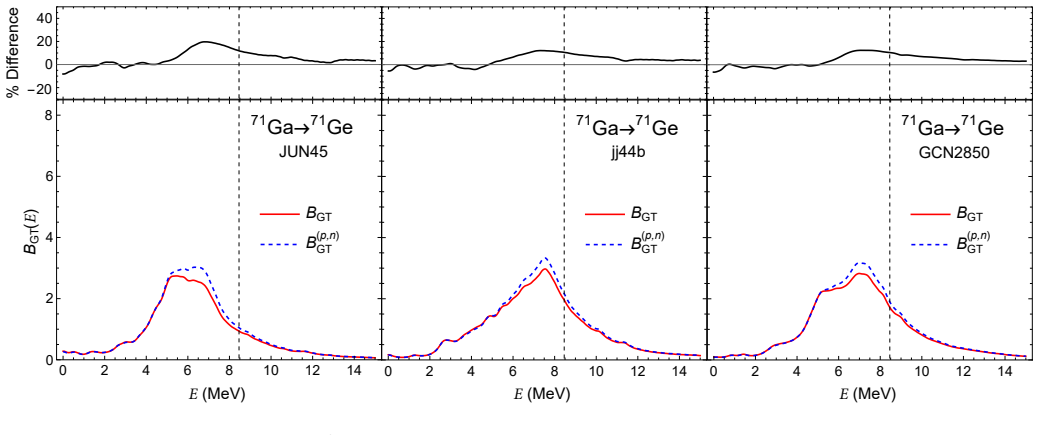
The load-bearing object is the effective one-body charge-exchange operator $\hat O^{(p,n)}_{J=1}(\delta) = \hat O^{\mathrm{GT}^+}_{J=1} + \delta\,\hat O^{T^+}_{J=1}$, where the tensor piece $\hat O^{T^+} = \sqrt{8\pi}\sum_i [Y_2(\Omega_i)\otimes \sigma(i)]^{J=1}\tau^+(i)$ is the spin-tensor component of the pion-exchange interaction that forward-angle $(p,n)$ scattering sees but neutrino capture does not. Its strength $\delta = 0.074\pm0.008$ is fixed by testing $(p,n)$ against weak transitions of known strength. The correction factor $\Delta(\epsilon_i,\epsilon_f)$ then converts each measured $(p,n)$ strength bin into a $B_{\mathrm{GT}^+}$ bin by taking the ratio of response functions for the two operators, evaluated with shell-model sum rules and an iterative moment-matching method; because it is a matrix-element ratio, truncation of the valence space largely cancels.
What would settle it
A high-resolution measurement of the $^{71}$Ga$\to^{71}$Ge Gamow-Teller strength profile by an independent probe, such as $^{71}$Ga$(^3\mathrm{He},t)$ with gamma tagging, that disagreed with the tensor-corrected strengths in Table 2 by more than the quoted uncertainties would remove the roughly 10 percent rise in the $^8$B and hep cross sections. A second check would be to measure the GT$^-$ $(n,p)$ response of $^{71}$Ge: the generalized charge-exchange sum rule derived here predicts the tensor linear term cancels in the difference of the two charge-exchange responses.
Extended reading notes
Core claim
The paper establishes that forward-angle $(p,n)$ scattering does not measure the $^{71}$Ga Gamow-Teller strength directly: a subleading tensor operator contributes at the 10 to 20 percent level and must be removed bin by bin. Using shell-model sum rules and an iterative moment-matching method, the authors compute the correction factor $\Delta(\epsilon_i,\epsilon_f)$ that converts the measured $(p,n)$ strength profile into the $B_{\mathrm{GT}^+}$ profile needed for neutrino capture, finding destructive interference below about 4 MeV and constructive interference above it. This tensor correction lowers the $^8$B and hep cross sections, but the loss is outweighed by other corrections: gamma-decaying continuum states between 7.41 and 8.46 MeV, weak magnetism, and the modern measured $^8$B neutrino spectrum. The resulting flux-averaged values, $\langle\sigma\rangle_{^8\mathrm{B}} = 2.57^{+0.30}_{-0.25}\times 10^{-42}\,\mathrm{cm}^2$ and $\langle\sigma\rangle_{\mathrm{hep}} = 7.84^{+0.9}_{-0.9}\times 10^{-42}\,\mathrm{cm}^2$, are about 7 and 10 percent above the earlier recommended values, with a total gallium capture rate near 123 SNU under the high-metallicity standard solar model.
Load-bearing premise
The calculation assumes that the shell-model tensor correction $\Delta(\epsilon_i,\epsilon_f)$, computed in the $2p_{3/2}\,1f_{5/2}\,2p_{1/2}\,1g_{9/2}$ space, correctly converts the measured $(p,n)$ strength into Gamow-Teller strength for every energy bin below 8.46 MeV, a conversion the backup $1f_{7/2}\,2p_{3/2}\,1f_{5/2}\,2p_{1/2}$ space cannot independently confirm because it fails to reproduce the $^{71}$Ge level ordering and forces a closed neutron shell.
Editorial extensions
If this is right
- Legacy GALLEX/GNO and SAGE event rates, when reanalyzed with the updated $^8$B and hep cross sections, imply somewhat higher solar-neutrino flux constraints than those currently embedded in global neutrino-oscillation fits.
- The pp-neutrino response remains the most precisely determined piece, with $\langle\sigma\rangle_{\mathrm{pp}} = (1.158\pm0.009)\times10^{-45}\,\mathrm{cm}^2$, pinned by the improved $^{71}$Ge electron-capture lifetime.
- The total gallium capture rate under the high-metallicity standard solar model rises to about 123 SNU, and the dominant remaining uncertainty is the $\pm12\%$ normalization uncertainty of the $(p,n)$ data.
- Gamma-decaying continuum states between 7.42 and 8.46 MeV contribute roughly 4 percent to the $^8$B cross section, so future analyses of radiochemical gallium data must include these quasi-bound unbound states.
- Uncertainties on all solar sources shrink by a factor of about two to three relative to the 1997 tabulation, because the tensor correction is evaluated quantitatively rather than folded into arbitrary 33 percent error bars.
Reading between the lines
- If the generalized Ikeda sum rule derived here is correct, the tensor correction primarily redistributes charge-exchange strength in energy rather than changing its total: for nuclei with a large neutron excess, forward-angle $(p,n)$ strength should deviate from Gamow-Teller strength mainly through a spectral distortion, a pattern that could be tested with $(n,p)$ or beta-decay measurements on nei
- The predicted sign change of the interference, destructive below about 4 MeV and constructive above, could be mapped directly by comparing $(p,n)$ and $(^3\mathrm{He},t)$ measurements at high energy resolution, providing a model-independent check of $\Delta(\epsilon_i,\epsilon_f)$.
- The same tensor-correction procedure could be applied to other neutrino-capture targets whose excited-state responses come from forward-angle $(p,n)$ data, such as $^{37}$Cl, if their inclusive Gamow-Teller profiles are needed at comparable precision.
- If the updated cross sections propagate into global fits, the inferred solar neutrino fluxes, especially the $^8$B flux, could shift by a few percent, slightly altering the oscillation parameters extracted from gallium data.
Editorial analysis
A structured set of objections, weighed in public.
Referee Report
Summary. The paper reevaluates the 71Ga solar neutrino capture cross sections for all relevant solar sources, updating the ground-state transition with new 71Ge electron-capture lifetime measurements and correcting the excited-state contributions extracted from forward-angle (p,n) data for the tensor component of the (p,n) effective operator. The tensor correction is computed with Lanczos response functions in the 2p3/2 1f5/2 2p1/2 1g9/2 valence space, with a cross-space comparison in the 1f7/2 2p3/2 1f5/2 2p1/2 space. New contributions from near-threshold continuum states that decay radiatively are included. The authors find central cross sections within about ±2% of Bahcall's values for the low-energy sources, but 8B and hep cross sections that are ≈7% and ≈10% larger, respectively, because of the continuum contribution, the weak-magnetism correction, the updated 8B spectrum, and the energy-dependent sign of the tensor correction. Uncertainties are propagated by Monte Carlo and are generally smaller than Bahcall's.
Significance. The paper is a careful, largely transparent re-evaluation of cross sections that are still used in global analyses of the legacy gallium solar neutrino data. Its main strengths are the use of the new 71Ge EC lifetime to anchor the ground-state B_GT, the generalized Ikeda sum rule of Eq. (24) with its explicit δ^2 structure, the Lanczos moment-matching formalism of Eq. (21), the Monte Carlo propagation of experimental and theory uncertainties, and the explicit cross-space comparison in Sec. 3.7. The central predictions for 8B and hep are not fitted to gallium rates; they follow from the measured (p,n) profile, the EC-anchored ground state, and the shell-model tensor correction. If the model-space systematic discussed below can be quantified, the paper will provide a useful update to the legacy gallium cross sections and will reduce the theory uncertainty attached to those archival constraints.
major comments (2)
- [Sec. 3.7 / Eq. (23)] The central quantitative claim—a net ≈10% increase in the 8B and hep cross sections—rests on the tensor correction Δ(ε_i,ε_f), which is computed as a ratio of GT-only to GT+tensor strengths in the 2p3/2 1f5/2 2p1/2 1g9/2 space. The paper itself notes in Sec. 3.5 that this space exhausts somewhat less than 50% of the Ikeda sum rule, so the ratio assumption is that the omitted configurations cancel in the ratio. The only cross-space test, Sec. 3.7, uses the 1f7/2 2p3/2 1f5/2 2p1/2 space, which (as the authors state) treats 71Ga as closed-neutron-shell, gives incorrect lowest-state ordering for KB′ and GXPF1, and poor energies for KB3G. These two spaces share the fundamental assumption that the ratio in a truncated space equals the full-space ratio, and they do not independently validate the interference pattern. The quoted uncertainties in Δ come from three interactions within the same fpg space, so the model-space systematic is not quantified. Because the headline ≈10% emerges from a partial cancellation between the +4% continuum contribution and the −2.2% tensor correction, an unquantified ±2% error in Δ translates directly into a comparable shift in the headline result. I request an explicit estimate of this systematic, for example from a calculation including the 1g7/2 orbital, or a conservative additional uncertainty assigned to Δ and propagated into Table 5.
- [Sec. 2 (hep neutrinos) and Sec. 4.6 / Eq. (44)] The hep cross section is computed with the unmodified Bahcall allowed spectrum, despite the paper's own statement in Sec. 2 that the allowed contribution to the hep reaction is suppressed and that p-waves, two-body currents, and weak magnetism are enhanced. No uncertainty is assigned for the spectrum shape. Because ⟨σ⟩_hep is one of the two headline results (≈10% increase over Bahcall), the central value in Eq. (44) is not robust. Please either use a published hep neutrino spectrum from the few-body calculations cited as Refs. [65,66] if one can be extracted, perform a sensitivity test by varying the spectrum shape within a plausible range, or explicitly add a systematic uncertainty to the hep cross section and state the resulting limitation in the abstract and conclusions.
minor comments (6)
- [Sec. 3.8] The word 'rougly' should be 'roughly'; please proofread the manuscript for similar typographical errors.
- [Eq. (13) and Table 2] Eq. (13) quotes the ground-state B_GT as 0.0863±0.0013 at 95% C.L., while Table 2 lists 0.0862±0.0012 without specifying the confidence level and the text elsewhere uses 1σ errors; please make the confidence levels consistent.
- [Abstract and Table 5] The abstract states that the 8B and hep cross sections increase by ≈10% relative to Bahcall, but Sec. 4.7 and Table 5 report +7% for 8B and +10% for hep; please revise the abstract to 'up to ≈10%' or similar wording.
- [Sec. 4.7, item 4] The statement that the Longfellow et al. 8B spectrum increases the capture rate by ≈2.4% relative to Winter et al. is given without a derivation or uncertainty; a brief comment on the source of this number would help the reader.
- [Fig. 4 caption] The caption refers to 'fpg (fp) model space' without defining these abbreviations in the main text; please define the model spaces once in Sec. 3.4.
- [Sec. 3.6] The Lanczos calculations use n=300 iterations and a Lorentzian width Γ=0.5 MeV, but no convergence test is shown; a short statement or figure demonstrating that the smoothed response is stable with respect to n would strengthen the presentation.
Circularity Check
No significant circularity: the solar cross sections are obtained by folding measured (p,n) strength distributions with an externally calibrated tensor correction, not by fitting to gallium rates.
full rationale
The central results, the 8B and hep cross sections in Eqs. (42) and (44), are obtained by integrating measured neutrino spectra against BGT+ values extracted from the experimental (p,n) profile of Table 2, corrected bin-by-bin by the tensor ratio Delta(eps_i,eps_f) of Eq. (23), and, for the continuum bins, by the measured gamma-branching fractions from Ejiri et al. The ground-state contribution is anchored to the precisely measured 71Ge electron-capture lifetime. Nothing in this chain is fitted to the GALLEX/GNO/SAGE event rates, so the predicted cross sections are not equivalent to the input data by construction. The tensor parameter delta = 0.074 +/- 0.008 and the 12% normalization uncertainty are inherited from the authors' prior work [17], which is a self-citation; however, that citation is externally anchored because delta was determined by comparing (p,n) and known weak transition strengths over a range of nuclei, and the 12% is an experimental systematic estimate. Neither quantity is obtained from the solar capture rates that the paper predicts. The model-space caution in Sec. 3.7 -- closed neutron shell, incorrect level ordering for two interactions, and partial sum-rule exhaustion -- is an acknowledged systematic uncertainty in the calculated tensor correction, not a circular step: the two shell-model spaces are not used to define the final result, and the paper explicitly warns that variations among effective interactions do not cover the full theory uncertainty. I find no equation whose output is identical to its input by construction, no fitted parameter renamed as a prediction, and no load-bearing uniqueness claim resting solely on a self-citation. The paper is therefore an application of external (p,n), EC-lifetime, and benchmark data to a new integrated quantity, with the main caveat being an unquantified model-space systematic rather than circularity.
Assumptions & free parameters
free parameters (5)
- tensor coupling strength δ =
0.074 ± 0.008 (1σ)
- common (p,n) normalization uncertainty =
12% (1σ)
- Lorentzian smoothing width Γ =
0.5 MeV
- BGT+(5/2-, 175 keV) =
≤ 0.0077 (68% C.L.)
- BGT+(3/2-, 500 keV) =
0.0104 ± 0.0022
assumptions (6)
- domain assumption δ is universal: the same tensor coupling applies to all transitions in 71Ga as to the benchmark nuclei used to fit it.
- domain assumption The shell-model effective interactions JUN45, jj44b, GCN2850 (fpg) and KB', GXPF1, KB3G (fp) provide reliable transition amplitudes for the GT-tensor interference, including signs.
- domain assumption The gamma-decay fractions Γγ/Γ = 0.58±0.04 and 0.46±0.04 from [44] apply to the neutrino-capture strength in the two continuum bins and are independent of the populating reaction.
- domain assumption The allowed (superallowed-like) hep neutrino spectrum of Bahcall [16] is a sufficient approximation for the hep capture cross section.
- domain assumption Within each 0.5 MeV bin, the BGT+ strength can be treated as uniformly distributed in excitation energy (Eq. 26).
- domain assumption Weak magnetism correction can be evaluated with the orbital/spin matrix-element ratio replaced by -1/2 (Eqs. 40-41).
Cite this review
Pith. "Pith review of The Gallium Solar Neutrino Capture Cross Section Revisited." pith.science (2026). https://pith.science/paper/UXFF7F5G
@misc{pith2026250103528,
  author       = {Pith},
  title        = {Pith review of: The Gallium Solar Neutrino Capture Cross Section Revisited},
  year         = {2026},
  howpublished = {\url{https://pith.science/paper/UXFF7F5G}},
  note         = {Machine review of arXiv:2501.03528}
}
abstract
Solar neutrino flux constraints from the legacy GALLEX/GNO and SAGE experiments continue to influence contemporary global analyses of neutrino properties. The constraints depend on the neutrino absorption cross sections for various solar sources. Following recent work updating the $^{51}$Cr and $^{37}$Ar neutrino source cross sections, we reevaluate the $^{71}$Ga solar neutrino cross sections, focusing on contributions from transitions to $^{71}$Ge excited states, but also revising the ground-state transition to take into account new $^{71}$Ge electron-capture lifetime measurements and various theory corrections. The excited-state contributions have been traditionally taken from forward-angle $(p,n)$ cross sections. Here we correct this procedure for the $\approx 10\%-20\%$ tensor operator contribution that alters the relationship between Gamow-Teller and $(p,n)$ transition strengths. Using state-of-the-art nuclear shell-model calculations to evaluate this correction, we find that it lowers the $^8$B and hep neutrino cross sections. However, the addition of other corrections, including contributions from near-threshold continuum states that radiatively decay, leads to an overall increase in the $^8$B and hep cross sections of $\approx 10\%$ relative to the values recommended by Bahcall. Uncertainties are propagated using Monte Carlo simulations.
Figures


Figures from the paper (1 more)

Forward citations
Cited by 1 Pith paper
-
A possible solution to the gallium anomaly moving beyond the leptonic wave function factorization
A non-factorized amplitude treatment with a fitted sign-changing nuclear transition density reduces the predicted νe-71Ga capture rate by ~20%, absorbing the gallium anomaly without new physics.
Reference graph
Works this paper leans on
-
[17]
S. R. Elliott, V . N. Gavrin, W. C. Haxton, T. V . Ibragimova, E. J. Rule, Gallium neutrino absorption cross section and its uncertainty, Phys. Rev. C 108 (2023) 035502. doi:10.1103/PhysRevC.108.035502. 15 URL https://link.aps.org/doi/10.1103/PhysRevC.108. 035502
-
[1]
Anselmann, W
P. Anselmann, W. Hampel, G. Heusser, J. Kiko, T. Kirsten, E. Pernicka, R. Plaga, U. R ¨onn, M. Sann, C. Schlosser, R. Wink, M. W ´ojcik, R. von Ammon, K. Ebert, T. Fritsch, K. Hellriegel, E. Henrich, L. Stieglitz, F. Weyrich, M. Balata, E. Bellotti, N. Ferrari, H. Lalla, T. Stolarczyk, C. Cattadori, O. Cremonesi, E. Fiorini, S. Pezzoni, L. Zanotti, F. von...
1992
-
[2]
Hampel, et al., GALLEX solar neutrino observations: Results for GALLEX IV, Phys
W. Hampel, et al., GALLEX solar neutrino observations: Results for GALLEX IV, Phys. Lett. B 447 (1999) 127–133. doi:10.1016/ S0370-2693(98)01579-2
work page 1999
-
[3]
F. Kaether, W. Hampel, G. Heusser, J. Kiko, T. Kirsten, Reanalysis of the GALLEX solar neutrino flux and source experiments, Phys. Lett. B 685 (2010) 47–54. arXiv:1001.2731, doi:10.1016/j.physletb.2010. 01.030
arXiv 2010
-
[4]
Altmann, et al., Complete results for five years of GNO solar neu- trino observations, Phys
M. Altmann, et al., Complete results for five years of GNO solar neu- trino observations, Phys. Lett. B 616 (2005) 174–190. arXiv:hep-ex/ 0504037, doi:10.1016/j.physletb.2005.04.068
-
[5]
J. N. Abdurashitov, et al., Measurement of the solar neutrino capture rate with gallium metal. III: Results for the 2002–2007 data-taking period, Phys. Rev. C 80 (2009) 015807. arXiv:0901.2200, doi:10.1103/ PhysRevC.80.015807
arXiv 2009
-
[6]
V . N. Gavrin, The history, present and future of SAGE (Soviet- American Gallium Experiment), World Scientific, 2019, pp. 29–46. arXiv:https://www.worldscientific.com/doi/pdf/10.1142/ 9789811204296_0002, doi:10.1142/9789811204296_0002. URL https://www.worldscientific.com/doi/abs/10.1142/ 9789811204296_0002
-
[7]
R. Davis, D. S. Harmer, K. C. Ho ffman, Search for neu- trinos from the sun, Phys. Rev. Lett. 20 (1968) 1205–1209. doi:10.1103/PhysRevLett.20.1205. URL https://link.aps.org/doi/10.1103/PhysRevLett.20. 1205
Show all 72 references
-
[8]
K. S. Hirata, et al., Observation of B-8 Solar Neutrinos in the Kamiokande-II Detector, Phys. Rev. Lett. 63 (1989) 16. doi:10.1103/ PhysRevLett.63.16
1989
-
[9]
N. Hata, S. Bludman, P. Langacker, Astrophysical solutions are incom- patible with the solar neutrino data, Phys. Rev. D 49 (1994) 3622–3625. doi:10.1103/PhysRevD.49.3622. URL https://link.aps.org/doi/10.1103/PhysRevD.49.3622
1994 doi
-
[10]
Castellani, S
V . Castellani, S. Degl’Innocenti, G. Fiorentini, M. Lissia, B. Ricci, Neu- trinos from the sun: Experimental results confronted with solar mod- els, Phys. Rev. D 50 (1994) 4749–4761. doi:10.1103/PhysRevD.50. 4749. URL https://link.aps.org/doi/10.1103/PhysRevD.50.4749
1994 doi
-
[11]
W. C. Haxton, The Solar Neutrino Problem, Annu. Rev. A & A 33 (1995) 459–504. arXiv:hep-ph/9503430, doi:10.1146/annurev.aa.33. 090195.002331
1995 arXiv
-
[12]
Esteban, M
I. Esteban, M. Gonzalez-Garcia, M. Maltoni, et al., The fate of hints: up- dated global analysis of three-flavor neutrino oscillations, J. High Energ. Phys. 09 (2020) 178
2020
-
[13]
P. F. de Salas, D. V . Forero, S. Gariazzo, et al., 2020 global reassessment of the neutrino oscillation picture, JHEP 02 (2021) 071
2021
-
[14]
Capozzi, E
F. Capozzi, E. Di Valentino, E. Lisi, A. Marrone, A. Melchiorri, A. Palazzo, Unfinished fabric of the three neutrino paradigm, Phys. Rev. D 104 (2021) 083031
2021
-
[15]
Zavatarelli, G
S. Zavatarelli, G. Bellini, J. Benziger, D. Bick, G. Bonfini, D. Bravo, B. Caccianiga, L. Cadonati, F. Calaprice, A. Caminata, P. Cavalcante, A. Chavarria, A. Chepurnov, D. D’Angelo, S. Davini, A. Derbin, A. Empl, A. Etenko, K. Fomenko, D. Franco, F. Gabriele, C. Galbiati, S. ...
2016
-
[16]
J. N. Bahcall, Gallium solar neutrino experiments: Absorption cross- sections, neutrino spectra, and predicted event rates, Phys. Rev. C 56 (1997) 3391–3409. arXiv:hep-ph/9710491, doi:10.1103/ PhysRevC.56.3391
1997 arXiv
-
[18]
S. R. Elliott, V . Gavrin, W. Haxton, The gallium anomaly, Prog. Part. Nucl. Phys. 134 (2024) 104082. arXiv:2306.03299, doi:10.1016/ j.ppnp.2023.104082
2024 arXiv
-
[19]
V . V . Barinov, B. T. Cleveland, S. N. Danshin, H. Ejiri, S. R. Elliott, D. Frekers, V . N. Gavrin, V . V . Gorbachev, D. S. Gorbunov, W. C. Haxton, T. V . Ibragimova, I. Kim, Y . P. Kozlova, L. V . Kravchuk, V . V . Kuzminov, B. K. Lubsandorzhiev, Y . M. Malyshkin, R. Massar...
2022
-
[20]
V . V . Barinov, S. N. Danshin, V . N. Gavrin, V . V . Gorbachev, D. S. Gorbunov, T. V . Ibragimova, Y . P. Kozlova, L. V . Kravchuk, V . V . Kuzminov, B. K. Lubsandorzhiev, Y . M. Malyshkin, I. N. Mirmov, A. A. Shikhin, E. P. Veretenkin, B. T. Cleveland, H. Ejiri, S. R. Ellio...
2022
-
[21]
Herrera, A
Y . Herrera, A. Serenelli, ChETEC-INFRA WP8: Astronuclear Library: Standard Solar Models B23 (Nov. 2023). doi:10.5281/zenodo. 10174170. URL https://doi.org/10.5281/zenodo.10174170
2023 doi
-
[22]
Grevesse, A
N. Grevesse, A. J. Sauval, Standard solar composition, Space Sci. Rev. 85 (1998) 161
1998
-
[23]
Asplund, A
M. Asplund, A. Amarsi, N. Grevesse, The chemical make-up of the sun: A 2020 vision, Astronomy & Astrophysics 653 (2021) A141
2021
-
[24]
E. Magg, M. Bergemann, A. M. Serenelli, M. Bautista, et al., Observa- tional constraints on the origin of the elements - iv. standard composition of the sun, Astron. Astrophys. 661 (2022) A140
2022
-
[25]
M ¨arkisch, H
B. M ¨arkisch, H. Mest, H. Saul, X. Wang, H. Abele, D. Dubbers, M. Klopf, A. Petoukhov, C. Roick, T. Soldner, D. Werder, Measurement of the weak axial-vector coupling constant in the decay of free neutrons using a pulsed cold neutron beam, Phys. Rev. Lett. 122 (2019) 242501. d...
2019 doi
-
[26]
J. N. Bahcall, Shapes of solar-neutrino spectra: Unconventional tests of the standard electroweak model, Phys. Rev. D 44 (1991) 1644–1651. doi:10.1103/PhysRevD.44.1644. URL https://link.aps.org/doi/10.1103/PhysRevD.44.1644
1991 doi
-
[27]
Acharya, et al., Solar fusion III: New data and theory for hydrogen- burning stars (5 2024)
B. Acharya, et al., Solar fusion III: New data and theory for hydrogen- burning stars (5 2024). arXiv:2405.06470
2024
-
[28]
Longfellow, A
B. Longfellow, A. T. Gallant, T. Y . Hirsh, M. T. Burkey, G. Savard, N. D. Scielzo, L. Varriano, M. Brodeur, D. P. Burdette, J. A. Clark, D. Lascar, P. Mueller, D. Ray, K. S. Sharma, A. A. Valverde, G. L. Wilson, X. L. Yan, Determination of the 8B neutrino energy spectrum usin...
2023 doi
-
[29]
W. T. Winter, S. J. Freedman, K. E. Rehm, J. P. Schi ffer, The 8B neutrino spectrum, Phys. Rev. C 73 (2006) 025503. doi:10.1103/PhysRevC.73.025503. URL https://link.aps.org/doi/10.1103/PhysRevC.73. 025503
2006 doi
-
[30]
J. N. Bahcall, 7Be solar neutrino line: A reflection of the central tem- perature distribution of the sun, Phys. Rev. D 49 (1994) 3923–3945. doi:10.1103/PhysRevD.49.3923. URL https://link.aps.org/doi/10.1103/PhysRevD.49.3923
1994 doi
-
[31]
J. N. Bahcall, S. Basu, M. H. Pinsonneault, How uncertain are solar neu- trino predictions?, Phys. Lett. B 433 (1998) 1
1998
-
[32]
Alanssari, D
M. Alanssari, D. Frekers, T. Eronen, L. Canete, J. Hakala, M. Holl, A. Jokinen, A. Kankainen, J. Koponen, I. Moore, D. Nesterenko, I. Po- hjalainen, J. Reinikainen, S. Rinta-Antila, A. V oss, Precision ga71-ge71 mass-difference measurement, International Journal of Mass Spectr...
2016 doi
-
[33]
Hayen, N
L. Hayen, N. Severijns, K. Bodek, D. Rozpedzik, X. Mougeot, High pre- cision analytical description of the allowed β spectrum shape, Rev. Mod. Phys. 90 (2018) 015008. doi:10.1103/RevModPhys.90.015008. URL https://link.aps.org/doi/10.1103/RevModPhys.90. 015008
2018 doi
-
[34]
Hampel, L
W. Hampel, L. P. Remsberg, Half-life of 71Ge, Phys. Rev. C 31 (1985) 666–667. doi:10.1103/PhysRevC.31.666. URL https://link.aps.org/doi/10.1103/PhysRevC.31.666
1985 doi
-
[35]
J. I. Collar, S. G. Yoon, New measurements of 71Ge decay: Im- pact on the gallium anomaly, Phys. Rev. C 108 (2023) L021602. doi:10.1103/PhysRevC.108.L021602. URL https://link.aps.org/doi/10.1103/PhysRevC.108. L021602
2023 doi
-
[36]
E. B. Norman, A. Drobizhev, N. Gharibyan, K. E. Gregorich, Y . G. Kolomensky, B. N. Sammis, N. D. Scielzo, J. A. Shusterman, K. J. Thomas, Half-life of 71Ge and the gallium anomaly, Phys. Rev. C 109 (2024) 055501. doi:10.1103/PhysRevC.109.055501. URL https://link.aps.org/doi/1...
2024 doi
-
[37]
C. E. Aalseth, P. S. Barbeau, N. S. Bowden, B. Cabrera-Palmer, J. Colaresi, J. I. Collar, S. Dazeley, P. de Lurgio, J. E. Fast, N. Fields, C. H. Greenberg, T. W. Hossbach, M. E. Keillor, J. D. Kephart, M. G. Marino, H. S. Miley, M. L. Miller, J. L. Orrell, D. C. Radford, D. Re...
2011 doi
-
[38]
Agnese, A
R. Agnese, A. J. Anderson, T. Aramaki, M. Asai, W. Baker, D. Balak- ishiyeva, D. Barker, R. Basu Thakur, D. A. Bauer, J. Billard, A. Borgland, M. A. Bowles, P. L. Brink, R. Bunker, B. Cabrera, D. O. Caldwell, R. Calkins, D. G. Cerdeno, H. Chagani, Y . Chen, J. Cooley, B. Corne...
2016
-
[39]
V . A. Kuzmin, Detection of solar neutrinos by means of the 71Ga(nu, e-)71Ge reaction, Zh. Eksp. Teor. Fiz. 49 (1965) 1532–1534
1965
-
[40]
Taddeucci, C
T. Taddeucci, C. Goulding, T. Carey, R. Byrd, C. Goodman, C. Gaarde, J. Larsen, D. Horen, J. Rapaport, E. Sugarbaker, The (p, n) reaction as a probe of beta decay strength, Nuclear Physics A 469 (1) (1987) 125–172. doi:https://doi.org/10.1016/0375-9474(87)90089-3 . URL https:/...
1987 doi
-
[41]
Krofcheck, E
D. Krofcheck, E. Sugarbaker, J. Rapaport, D. Wang, J. N. Bahcall, R. C. Byrd, C. C. Foster, C. D. Goodman, I. J. Van Heerden, C. Gaarde, J. S. Larsen, D. J. Horen, T. N. Taddeucci, Gamow-teller strength function in 71Ge via the ( p, n) reaction at medium energies, Phys. Rev. L...
1985 doi
-
[42]
Frekers, T
D. Frekers, T. Adachi, H. Akimune, M. Alanssari, B. A. Brown, B. T. Cleveland, H. Ejiri, H. Fujita, Y . Fujita, M. Fujiwara, V . N. Gavrin, M. N. Harakeh, K. Hatanaka, M. Holl, C. Iwamoto, A. Lennarz, A. Okamoto, H. Okamura, T. Suzuki, A. Tamii, Precision evaluation of the71Ga...
2015 doi
-
[43]
Frekers, T
D. Frekers, T. Adachi, H. Akimune, M. Alanssari, B. A. Brown, B. T. Cleveland, H. Ejiri, H. Fujita, Y . Fujita, M. Fujiwara, V . N. Gavrin, M. N. Harakeh, K. Hatanaka, M. Holl, C. Iwamoto, A. Lennarz, A. Okamoto, H. Okamura, T. Suzuki, A. Tamii, Erratum: Precision evaluation o...
2015 doi
-
[44]
Ejiri, H
H. Ejiri, H. Akimune, Y . Arimoto, I. Daito, H. Fujimura, Y . Fujita, M. Fujiwara, K. Fushimi, M. Greenfield, M. Harakeh, F. Ihara, T. In- omata, K. Ishibashi, J. J ¨anecke, H. Kohri, S. Nakayama, C. Samanta, A. Tamii, M. Tanaka, H. Toyokawa, M. Yosoi, Spin-isospin responses o...
1998
-
[45]
J. W. Watson, W. Pairsuwan, B. D. Anderson, A. R. Baldwin, B. S. Flanders, R. Madey, R. J. McCarthy, B. A. Brown, B. H. Wildenthal, C. C. Foster, Relationship between gamow-teller transition probabilities and ( p, n) cross sections at small momentum transfers, Phys. Rev. Lett....
1985 doi
-
[46]
N. Hata, W. Haxton, Implications of the GALLEX source experiment for the solar neutrino problem, Phys. Lett. B 353 (1995) 422–431. arXiv: nucl-th/9503017, doi:10.1016/0370-2693(95)00598-F
1995 arXiv
-
[47]
Haxton, Cross section uncertainties in the gallium neutrino source experiments, Physics Letters B 431 (1) (1998) 110–118
W. Haxton, Cross section uncertainties in the gallium neutrino source experiments, Physics Letters B 431 (1) (1998) 110–118. doi:https: //doi.org/10.1016/S0370-2693(98)00581-4 . URL https://www.sciencedirect.com/science/article/pii/ S0370269398005814
1998 doi
-
[48]
Krofcheck, Gamow-teller strength distributions for solar neutrino de- tectors via the (p,n) reaction, ph.D
D. Krofcheck, Gamow-teller strength distributions for solar neutrino de- tectors via the (p,n) reaction, ph.D. thesis, Ohio State University, (unpub- lished) (1987)
1987
-
[49]
W. C. Haxton, Shape coexistence, Lanczos techniques, and large basis shell model calculations, in: International Conference on Nuclear Struc- ture at High Angular Momentum, 1992
1992
-
[50]
Lanczos, An iteration method for the solution of the eigenvalue prob- lem of linear differential and integral operators, J
C. Lanczos, An iteration method for the solution of the eigenvalue prob- lem of linear differential and integral operators, J. of Research of the Na- tional Bureau of Standards 45 (1950) 255. doi:10.6028/jres.045. 026
1950 doi
-
[51]
Ikeda, Collective Excitation of Unlike Pair States in Heav- ier Nuclei, Progress of Theoretical Physics 31 (3) (1964) 434–
K. Ikeda, Collective Excitation of Unlike Pair States in Heav- ier Nuclei, Progress of Theoretical Physics 31 (3) (1964) 434–
1964
-
[52]
Fujita, K
J.-I. Fujita, K. Ikeda, Existence of isobaric states and beta decay of heavier nuclei, Nuclear Physics 67 (1) (1965) 145–177. doi:https: //doi.org/10.1016/0029-5582(65)90119-7 . URL https://www.sciencedirect.com/science/article/pii/ 0029558265901197
1965 doi
-
[53]
C. W. Johnson, W. E. Ormand, P. G. Krastev, Factorization in large-scale many-body calculations, Comput. Phys. Commun. 184 (2013) 2761–
2013
-
[54]
C. W. Johnson, W. E. Ormand, K. S. McElvain, H. Shan, BIGSTICK: A flexible configuration-interaction shell-model code (1 2018). arXiv: 1801.08432
2018
-
[55]
Honma, T
M. Honma, T. Otsuka, T. Mizusaki, M. Hjorth-Jensen, New e ffective interaction for f5pg9-shell nuclei, Phys. Rev. C 80 (2009) 064323. doi:10.1103/PhysRevC.80.064323. URL https://link.aps.org/doi/10.1103/PhysRevC.80. 064323
2009 doi
-
[56]
B. A. Brown, (Unpublished; See B. Cheal et al., Phys. Rev. Lett. 104 (2010) 252502.)
2010
-
[57]
Gniady, E
A. Gniady, E. Caurier, F. Nowacki, (Unpublished)
-
[58]
Kostensalo, J
J. Kostensalo, J. Suhonen, C. Giunti, P. C. Srivastava, The gallium anomaly revisited, Phys. Lett. B 795 (2019) 542–547. arXiv:1906. 10980, doi:10.1016/j.physletb.2019.06.057
2019 doi
-
[59]
J. B. McGrory, B. H. Wildenthal, E. C. Halbert, Shell-model structure of 42−50Ca, Phys. Rev. C 2 (1970) 186–212. doi:10.1103/PhysRevC.2. 186. URL https://link.aps.org/doi/10.1103/PhysRevC.2.186
1970 doi
-
[60]
Honma, T
M. Honma, T. Otsuka, B. A. Brown, T. Mizusaki, New e ffective interaction for p f-shell nuclei and its implications for the stability of the n = z = 28 closed core, Phys. Rev. C 69 (2004) 034335. doi:10.1103/PhysRevC.69.034335. URL https://link.aps.org/doi/10.1103/PhysRevC.69. 034335
2004 doi
-
[61]
Poves, J
A. Poves, J. S ´anchez-Solano, E. Caurier, F. Nowacki, Shell model study of the isobaric chains a=50, a=51 and a=52, Nuclear Physics A 694 (1-2) (2001) 157–198. doi:10.1016/s0375-9474(01)00967-8 . URL http://dx.doi.org/10.1016/S0375-9474(01)00967-8
2001 doi
-
[62]
T. N. Taddeucci, J. Rapaport, D. E. Bainum, C. D. Goodman, C. C. Foster, C. Gaarde, J. Larsen, C. A. Goulding, D. J. Horen, T. Masterson, E. Sug- arbaker, Energy dependence of the ratio of isovector effective interaction strengths| Jστ Jτ| from 0° (p,n) cross sections, Phys. R...
1982
-
[63]
Singh, J
B. Singh, J. Chen, Nuclear structure and decay data for a =71 isobars, Nuclear Data Sheets 188 (2023) 1–341. doi:https://doi.org/10. 1016/j.nds.2023.02.001
2023
-
[64]
X. B. Wang, A. C. Hayes, Weak magnetism correction to allowed β decay for reactor antineutrino spectra, Phys. Rev. C 95 (2017) 064313. doi:10.1103/PhysRevC.95.064313. URL https://link.aps.org/doi/10.1103/PhysRevC.95. 064313
2017 doi
-
[65]
L. E. Marcucci, R. Schiavilla, M. Viviani, A. Kievsky, S. Rosati, J. F. Beacom, Weak proton capture on 3He, Phys. Rev. C 63 (2000) 015801. doi:10.1103/PhysRevC.63.015801. URL https://link.aps.org/doi/10.1103/PhysRevC.63. 015801
2000 doi
-
[66]
T.-S. Park, L. E. Marcucci, R. Schiavilla, M. Viviani, A. Kievsky, S. Rosati, K. Kubodera, D.-P. Min, M. Rho, Parameter-free effective field theory calculation for the solar proton-fusion and hep processes, Phys. Rev. C 67 (2003) 055206. doi:10.1103/PhysRevC.67.055206. URL htt...
2003 doi
-
[67]
J. N. Bahcall, B. R. Holstein, Solar neutrinos from the decay of 8B, Phys. Rev. C 33 (1986) 2121–2127. doi:10.1103/PhysRevC.33.2121. URL https://link.aps.org/doi/10.1103/PhysRevC.33.2121
1986 doi
-
[68]
C. D. Goodman, C. A. Goulding, M. B. Greenfield, J. Rapaport, D. E. Bainum, C. C. Foster, W. G. Love, F. Petrovich, Gamow-teller matrix elements from 0°( p, n) cross sections, Phys. Rev. Lett. 44 (1980) 1755–
1980
-
[451]
URL https://doi.org/10.1143/PTP.31.434
arXiv:https://academic.oup.com/ptp/article-pdf/31/ 3/434/5364608/31-3-434.pdf , doi:10.1143/PTP.31.434. URL https://doi.org/10.1143/PTP.31.434
-
[1097]
URL https://link.aps.org/doi/10.1103/PhysRevC.25.1094
doi:10.1103/PhysRevC.25.1094. URL https://link.aps.org/doi/10.1103/PhysRevC.25.1094
-
[1759]
URL https://link.aps.org/doi/10.1103/PhysRevLett.44
doi:10.1103/PhysRevLett.44.1755. URL https://link.aps.org/doi/10.1103/PhysRevLett.44. 1755 17
-
[2774]
arXiv:1303.0905, doi:10.1016/j.cpc.2013.07.022
2013 arXiv
Reviewed August 10, 2026 · model on record in the stance chip above.
Discussion (0). Continue with ORCID to comment.