REVIEW 4 major objections 4 minor 1 cited by
HI-PMK: A Data-Dependent Kernel for Incomplete Heterogeneous Data Representation
T0 review · 4 major / 4 minor · reviewed 2026-08-10 · deepseek-v4-flash
Pith's one-line read A data-dependent kernel computes similarity from observed entries of incomplete, mixed-type data and, without imputation, outperforms imputation-based pipelines and kernel baselines on more than fifteen benchmark datasets.
desk verdict A useful, well-documented extension of PMK to heterogeneous incomplete data, but the SVM results rest on an unproven PSD claim and a possibly leaky CV protocol. read the letter →
The pith
A machine-rendered reading of the paper's core claim, the machinery that carries it, and where it could break.
The reading
What carries the argument
The engine is the m0-dissimilarity, a data-dependent measure that defines the dissimilarity between two instances as the average log probability mass of the region they occupy in each feature; dense regions count as more dissimilar than sparse ones. HI-PMK adds two components to this base: the H-component computes the region probability mass for ordinal features by summing label frequencies between the two values and for nominal features by taking the probability of either label, while the I-component handles missing entries by putting all missing values of a feature into a separate bucket Bk and applying MaxU, which replaces an unobserved value with the largest plausible region mass. The m0 score is then normalized by the self-dissimilarities to produce a symmetric similarity matrix; the paper asserts this normalization satisfies the Mercer kernel condition.
What would settle it
Compute the eigenvalues of the HI-PMK Gram matrix on a published dataset configuration, such as Banknote at 20% MCAR missingness; if any eigenvalue is negative, the kernel is not positive semi-definite and the SVM-with-precomputed-kernel results are not supported.
Extended reading notes
Core claim
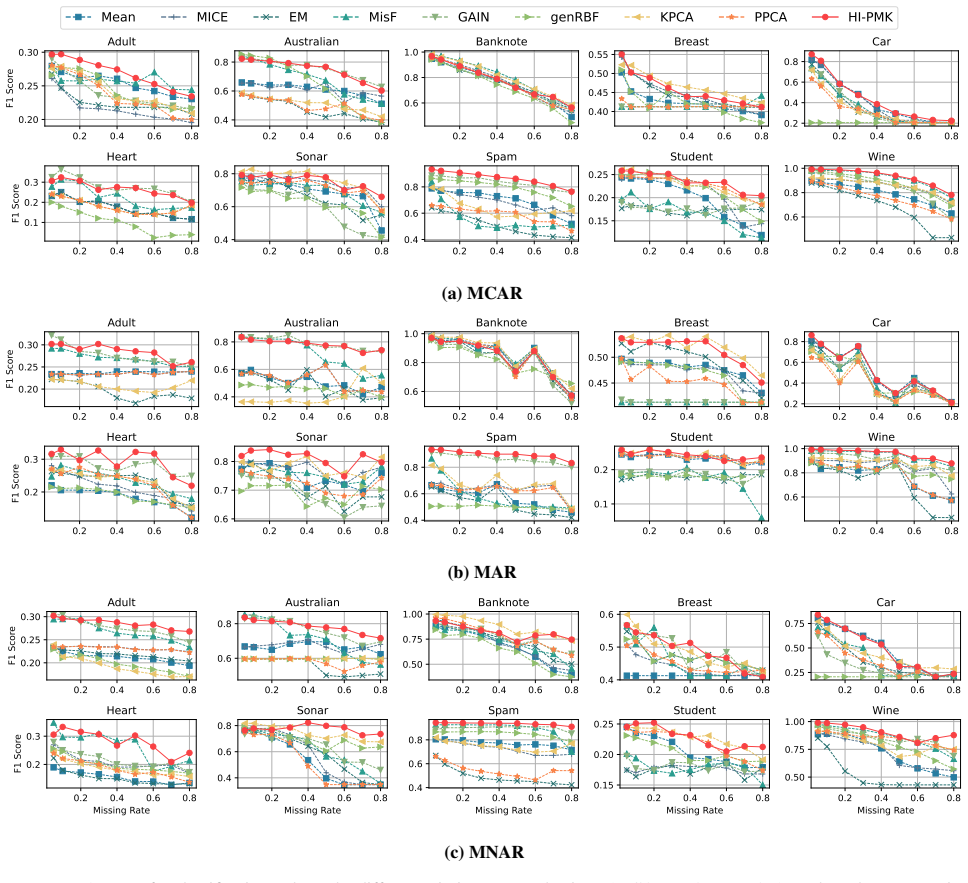
The central claim is that HI-PMK consistently ranks at or near the top in classification F1 and clustering NMI across more than fifteen benchmark datasets, under all three missingness mechanisms and across missing rates up to 80%. The kernel computes pairwise similarity from the observed part of the data, so no imputation is needed; numerical features are discretized into bins, categorical features use label frequencies, and missing entries are represented by a dedicated bucket whose size feeds into a worst-case dissimilarity adjustment. The paper argues that this design lets the kernel capture structured missingness under MAR and MNAR while remaining stable as missingness increases, where imputation-based and generative baselines degrade.
Load-bearing premise
The method assumes that the normalized similarity scores form a valid kernel matrix (positive semi-definite), a property stated but not proved, and the classification gains would be unsupported if the matrix is not positive semi-definite.
Editorial extensions
If this is right
- If HI-PMK's kernel is valid, SVMs can be trained on incomplete mixed-type data directly, eliminating the privacy risk and bias that come from exposing imputed values.
- The method provides a single kernel that works under MCAR, MAR, and MNAR, so practitioners do not need to know or model the missingness mechanism in advance.
- Clustering methods using HI-PMK as the similarity measure inherit the same missingness awareness, as the NMI and ARI gains on naturally incomplete datasets show.
- Because the kernel matrix costs O(m^2 n) time and O(m^2) space, it is a practical drop-in replacement for Euclidean or RBF kernels on small-to-medium tabular datasets.
- The separate missing-value bucket Bk gives structured missingness a representation that imputation-free alternatives lack, which the ablations attribute to the gains under MAR and MNAR.
Reading between the lines
- A testable extension is to replace the hand-set MaxU worst-case rule with a learned or calibrated uncertainty weight; the paper's ablations show MinU and AvgU underperform, but a data-driven interpolation is not explored.
- The same probability-mass-plus-missing-bucket construction could be lifted onto other data-dependent kernels, such as isolation kernels, to see whether the missingness-aware adjustment transfers beyond the m0 base.
- The quadratic O(m^2 n) kernel matrix limits scale; a Nyström-style or minibatch approximation is the obvious next step, though the paper does not propose one.
- On naturally incomplete datasets the true missingness mechanism is unknown, so a controlled mechanism-switching study on a single dataset could separate how much of the gain comes from MaxU's conservative prior versus the kernel's density adaptation.
Editorial analysis
A structured set of objections, weighed in public.
Referee Report
Summary. The paper proposes HI-PMK, a data-dependent kernel for incomplete heterogeneous data that avoids imputation by combining a probability-mass-based dissimilarity (PMK) with two extensions: an H-component for mixed-type features (nominal, ordinal, numerical) and an I-component that handles missing values via a separate missing bucket Bk and a maximum-uncertainty (MaxU) strategy. The method is evaluated on classification (SVM with precomputed kernels) and clustering (k-means on the kernel matrix) over ten complete datasets with synthetic MCAR/MAR/MNAR missingness and six naturally incomplete datasets, reporting consistent improvements over imputation-based and kernel baselines. Ablation studies and scalability experiments are also included, and code is made available.
Significance. If the central claims hold, HI-PMK would be a useful imputation-free representation for mixed-type tabular data under multiple missingness mechanisms, with potential privacy benefits. The paper has concrete strengths: public code, a wide experimental sweep across 15+ datasets and three missingness mechanisms, ablation studies isolating the proposed components, and scalability experiments. However, the classification results are built on a precomputed-kernel SVM whose validity requires the HI-PMK matrix to be positive semidefinite; this property is asserted but never proved or checked. In addition, the cross-validation protocol for the data-dependent kernel is ambiguous and could leak test information. These issues are load-bearing for the paper's headline claim of consistent classification gains, and the clustering evidence, while more robust to the Mercer question, is not enough to support the full claim as written.
major comments (4)
- [§4.1, Eq. (2); §5.1.3; Tables 3 and 6] The paper states that normalizing m0 by Eq. (2) 'ensures symmetry and self-similarity, aligning PMK with Mercer kernel requirements,' but symmetry and self-similarity are necessary, not sufficient, for positive semidefiniteness. The H-component (Eq. 3) and I-component (Eqs. 4–7) replace the original m0 term with categorical and missingness-dependent quantities, so even if the original PMK were known to be PSD, this extension requires a new proof. No such proof, eigenvalue check, or formal verification is reported. Since Section 5.1.3 evaluates HI-PMK using SVMs with precomputed kernels, a non-PSD matrix makes the SVM dual nonconvex and the reported classification improvements in Table 3 and the supplementary tables unsupported. The authors should either provide a proof of PSD for HI-PMK or, at minimum, report the eigenvalue spectrum of the kernel matrices used and confirm that no negative eigenvalues occur; if negative eigenvalues exist, the claims about kernel-SVM classification must be revised.
- [§5.1.3] The cross-validation procedure is underspecified with respect to the data-dependent nature of HI-PMK. The kernel depends on global statistics such as bin masses, the missing bucket Bk, and the frequencies used in Eqs. (3)–(7). If the kernel matrix is computed on the full dataset before the 5-fold split, then the training kernel entries are affected by test-set statistics, which is information leakage and can inflate the reported F1 scores. The paper must state clearly that, for each fold, the kernel is computed using only training-fold statistics and that test samples are embedded via those training-fold quantities, and it should describe how this is done for the precomputed-kernel SVM. Without this clarification, the comparison against imputation baselines is not a valid evaluation.
- [§4.3, Eq. (7); Supplementary Algorithm 3] There is a direct inconsistency between Eq. (7) and Algorithm 3 in the supplementary material for the 'both missing' nominal case. Eq. (7) defines |Rk(?, ?)| as the sum of the two largest category frequencies plus |Bk|, while Algorithm 3 line 5 computes only max_a M(a) + |Bk|, omitting the second-largest term. This changes the dissimilarity for every pair of instances with both values missing in a nominal feature, which can affect the reported experimental results. The intended definition must be specified and the experiments re-run if the algorithm text is the actual implementation.
- [§4.5; Supplementary Algorithm 1] Section 4.5 claims that HI-PMK 'avoids binning and instead uses precomputed probability masses,' but Algorithm 1 explicitly discretizes numeric features into b bins and precomputes bin masses, and Eqs. (1)–(2) rely on region sizes defined through these bins. The complexity statement also omits the binning and bin-mass precomputation cost, which the paper's own earlier discussion (Section 4.5, first sentence) attributes as O(mnb + nb^2) for the original M0 measure. The full complexity of HI-PMK, including binning and the per-dataset tuning of b described in Supplementary Section 4.2, should be stated. This matters for the scalability claims in Section 5.3.
minor comments (4)
- [Table 2] The caption says 'NMI scores for clustering tasks on incomplete datasets and Classification accuracy for incomplete datasets,' but the table reports both ACC and NMI columns for every method; the caption should clarify which columns correspond to which task, and the same applies to the supplementary tables.
- [Supplementary Table 2] The HI-PMK rows contain standard deviations such as 0.8506±0.8127 and 0.9875±0.9868, which are larger than plausible for the reported means and appear to be formatting errors. These values should be corrected, as they currently undermine the reproducibility of the experimental results.
- [Eq. (3)] The notation P(x_i ∨ x_j) for nominal features is not defined precisely; it should be stated whether this is P(x_i) + P(x_j) for distinct categories, or the probability of the union including the possibility that both are equal, since this affects the computed value of Eq. (3).
- [§5.1.3] The sentence 'RBF kernels were computed over similarity matrices' is unclear: standard RBF is a function of distances, and a precomputed kernel is a different object. Please specify exactly how the RBF kernel is computed for incomplete binary-class datasets and how it relates to the precomputed-kernel SVM used for HI-PMK.
Circularity Check
HI-PMK's construction is not circular, but the headline CV comparison is: the data-dependent kernel is defined on the full dataset before the 5-fold split, so test features shape the kernel used to predict them.
-
fitted input called prediction
[Supplementary Algorithms 1 and 4; Section 5.1.3]
"Algorithm 1 ... Require: X∈ R^{n×m}: Dataset with n samples and m features ... Discretize feature x_k ... return Pre-computed bin data masses for all features. Algorithm 4 ... Require: Pre-computed bin data masses from Algorithm 1 ... PMK similarity matrix for all instance pairs. Methods like genRBF and HI-PMK, which rely on pairwise similarities, were evaluated using SVMs with precomputed kernels. We performed 5-fold cross-validation, tuning hyperparameters (e.g., C, kernel width) via nested inner 5-fold CV."
Eq. (1) defines m0 through |R_k| counts, and Algorithm 1 fills those counts from the entire dataset X before Algorithm 4 emits the full pairwise PMK matrix. Section 5.1.3 then feeds this matrix into 5-fold CV. Under this protocol, each test-fold row is included in the bin masses, |B_k|, and label frequencies that define the similarity of every pair, so the test point's own features are part of the kernel that predicts it. The reported per-fold 'predictions' are therefore not independent holdout evaluations of a kernel fitted only on training data; the CV improvement is partly forced by the test data's contribution to the kernel definition.
full rationale
The PMK equations (1)-(2), the H-component (3), and the I-component (4)-(7) are constructive definitions rather than circular derivations; no fitted parameter is renamed as a prediction, and no uniqueness claim is imported from the authors' prior work. The unproved assertion in Section 4.1 that symmetry and self-similarity 'align' PMK with Mercer requirements is a correctness gap (positive semi-definiteness is not implied), not a circularity. The one circular element is in the evaluation chain: the algorithms compute bin data masses and the full similarity matrix on the whole dataset, and the CV section does not state that these are recomputed per training fold. If the authors recompute all kernel statistics inside each fold, this step would not apply; as written, the headline 'consistently outperforms' claim is supported by predictions whose kernel is partly defined by the test data.
Assumptions & free parameters
free parameters (1)
- b (number of bins per feature) =
chosen per dataset from {20, 40, 60, 80, 100, log2(m)}
assumptions (4)
- domain assumption The m0-dissimilarity and PMK definitions from prior work are valid for describing data-dependent similarity.
- domain assumption The normalized PMK is a positive semi-definite Mercer kernel.
- ad hoc to paper For a missing value, the maximal plausible region size is the maximum of left and right masses plus the missing bucket, as in Eq. (4).
- ad hoc to paper The separate missing bucket Bk captures latent patterns of missingness under MAR and MNAR.
Cite this review
Pith. "Pith review of HI-PMK: A Data-Dependent Kernel for Incomplete Heterogeneous Data Representation." pith.science (2026). https://pith.science/paper/WBU4HJGD
@misc{pith2026250104300,
  author       = {Pith},
  title        = {Pith review of: HI-PMK: A Data-Dependent Kernel for Incomplete Heterogeneous Data Representation},
  year         = {2026},
  howpublished = {\url{https://pith.science/paper/WBU4HJGD}},
  note         = {Machine review of arXiv:2501.04300}
}
read the original abstract
Handling incomplete and heterogeneous data remains a central challenge in real-world machine learning, where missing values may follow complex mechanisms (MCAR, MAR, MNAR) and features can be of mixed types (numerical and categorical). Existing methods often rely on imputation, which may introduce bias or privacy risks, or fail to jointly address data heterogeneity and structured missingness. We propose the \textbf{H}eterogeneous \textbf{I}ncomplete \textbf{P}robability \textbf{M}ass \textbf{K}ernel (\textbf{HI-PMK}), a novel data-dependent representation learning approach that eliminates the need for imputation. HI-PMK introduces two key innovations: (1) a probability mass-based dissimilarity measure that adapts to local data distributions across heterogeneous features (numerical, ordinal, nominal), and (2) a missingness-aware uncertainty strategy (MaxU) that conservatively handles all three missingness mechanisms by assigning maximal plausible dissimilarity to unobserved entries. Our approach is privacy-preserving, scalable, and readily applicable to downstream tasks such as classification and clustering. Extensive experiments on over 15 benchmark datasets demonstrate that HI-PMK consistently outperforms traditional imputation-based pipelines and kernel methods across a wide range of missing data settings. Code is available at: https://github.com/echoid/Incomplete-Heter-Kernel
Figures


Figures from the paper (3 more)


Forward citations
Cited by 1 Pith paper
-
MissMecha: An All-in-One Python Package for Studying Missing Data Mechanisms
MissMecha is a Python toolkit combining simulation, visualization, statistical testing, and evaluation of missing data mechanisms for mixed-type tabular data.
Reference graph
Works this paper leans on
-
[1]
Sunil Aryal, Kai Ming Ting, Takashi Washio, and Gholamreza Haffari. A comparative study of data-dependent approaches without learning in measuring similarities of data objects. Data mining and knowledge discovery , 34(1):124–162, 2020
work page 2020
-
[2]
Peter J. Huber and Elvezio M. Ronchetti. Robust Statistics. Wiley, Hoboken, NJ, 2 edition, 2009
work page 2009
-
[3]
Herbert A. Sturges. The choice of a class interval. Journal of the American Statistical Association, 21(153):65–66, 1926
work page 1926
-
[4]
Hi- pmk: A data-dependent kernel for incomplete heterogeneous data representation, 2025
Youran Zhou, Mohamed Reda Bouadjenek, Jonathan Wells, and Sunil Aryal. Hi- pmk: A data-dependent kernel for incomplete heterogeneous data representation, 2025. 21
work page 2025
Reviewed August 10, 2026 · model on record in the stance chip above.
Discussion (0). Continue with ORCID to comment.