REVIEW 3 major objections 4 minor 1 cited by
Hypersonic acoustic wave control via hyperuniform phononic nanostructures
T0 review · 3 major / 4 minor · reviewed 2026-08-10 · deepseek-v4-flash
Pith's one-line read A stealthy hyperuniform arrangement of gold nanopillars on lithium niobate suppresses surface acoustic waves in two broad bandgap-like regions and guides them through linear and S-shaped channels.
desk verdict Real GHz-scale hyperuniform phononics experiments, but the hyperuniformity claim needs a random control to avoid being just dense-pillar physics. read the letter →
The pith
A machine-rendered reading of the paper's core claim, the machinery that carries it, and where it could break.
The reading
What carries the argument
The central object is the stealthy hyperuniform point pattern, a set of $N=418$ points generated by minimizing the squared deviation between the structure factor $S(k)$ and a target that is zero for $k<K$ and one for $k\ge K$, with $K=\sqrt{8\pi N}$ and a stealthiness parameter $\chi=0.5$. A Voronoi tessellation with uniform wall widths turns the points into physical gold pillars of controlled spacing, and a 2×3 tiling of the 15 µm pattern forms the experimental sample. The mechanism has three parts: long-range uniformity ($S(k)\to 0$) suppresses density fluctuations and broadens the frequency range of reduced transmission; short-range correlations create peaks in $S(k)$ that shape the bandgap-like regions; and removing pillars opens channels whose guided modes appear as concentrated Poynting vector in finite-element simulations. A periodic 6.25 µm supercell with Floquet boundary conditions provides the dispersion and transmission spectra used to interpret the experiment.
What would settle it
Measure transmission through the S-shaped waveguide with detection localized at the waveguide exit—for example by a focused optical probe or an IDT aligned only to the exit—at a frequency inside BG1; if the signal is not clearly above the no-waveguide baseline, the waveguiding claim fails. Alternatively, repeat the finite-element simulation on the exact 2×3 tiled pattern rather than the periodic supercell; if the bandgap positions or Poynting-vector maps change substantially, the simulation-experiment agreement is an artifact of the supercell approximation.
Extended reading notes
Core claim
On the paper's own terms, the discovery is that a stealthy hyperuniform pattern of gold pillars—one whose structure factor $S(k)$ is driven to zero below a threshold wavevector $K$—acts as a broadband acoustic barrier and a host for freeform waveguides. Finite-element simulations and microwave transmission measurements agree that the pillar array strongly suppresses surface-acoustic-wave transmission across a broad gigahertz range, with two bandgap-like regions labeled BG1 and BG2. When pillars are removed to form a 3-µm-wide linear channel or an S-shaped channel, simulated Poynting-vector maps concentrate energy inside the channels, and measured transmission inside the bandgaps is higher than without the waveguides. The paper concludes that the hyperuniform structure enables phononic waveguides, including freeform shapes such as the S-shaped design.
Load-bearing premise
The load-bearing assumption is that the 6.25 µm periodic supercell used in the finite-element simulations adequately represents the experimentally fabricated 2×3 tiled hyperuniform pattern, so the simulated bandgaps and Poynting-vector maps that show the S-shaped channel guiding waves correspond to the actual structure.
Editorial extensions
If this is right
- Hyperuniform pillar arrays suppress surface acoustic waves over a multi-gigahertz window rather than a single narrow band, which would widen the operating range of acoustic filters and vibration isolators.
- Because the pattern has no lattice symmetry, waveguides can be cut along arbitrary paths; the demonstrated S-shaped channel shows that bends do not destroy transmission, enabling compact serpentine routing on a chip.
- Scaling pillar height, spacing, or substrate material should shift the bandgap-like regions, making the platform tunable without redesigning a periodic lattice.
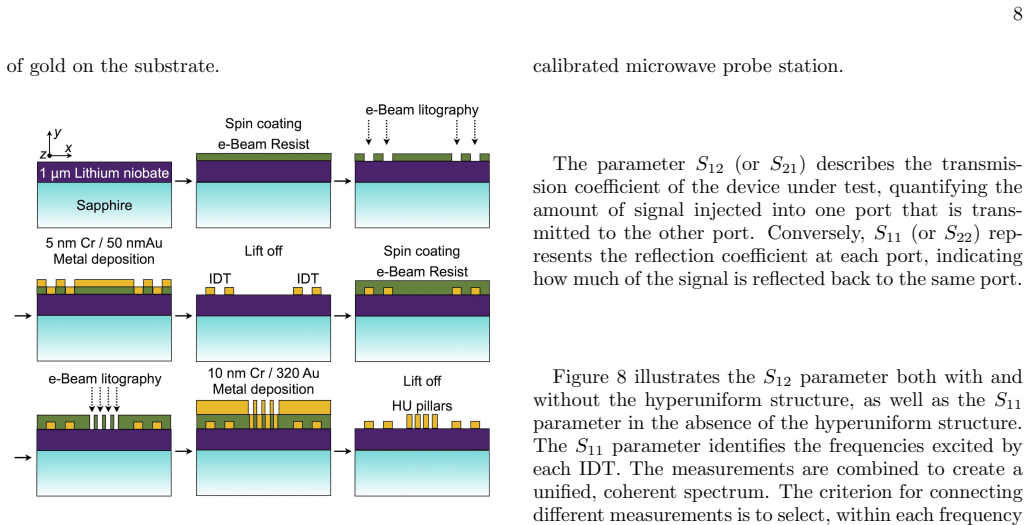
- The structures are fabricated with standard electron-beam lithography on lithium niobate and measured with chirped interdigital transducers, so they can be integrated into existing gigahertz SAW devices that serve smartphone filters and mechanical quantum computing.
Reading between the lines
- The reported transmission is averaged over the full detection width because the interdigital transducers span the entire pattern; a spatially resolved probe focused at the waveguide exit would likely show a larger contrast between the waveguide and no-waveguide cases.
- Nothing in the mechanism is specific to surface waves or lithium niobate, so the same design principle should transfer to membrane Lamb waves, bulk acoustic waves, or thermal phonon transport; the paper does not claim these extensions.
- Varying the stealthiness parameter $\chi$ or the threshold $K$ should tune the width and depth of BG1 and BG2, offering a direct experimental handle on the bandgap-like regions that the paper does not explore.
- The experimental and simulated positions of BG2 differ (1.7–1.95 GHz versus 1.85–2.1 GHz), suggesting the band edges are sensitive to fabrication details such as pillar shape and adhesion; improved fabrication should make the two converge, a clean test of the mechanism.
Editorial analysis
A structured set of objections, weighed in public.
Referee Report
Summary. The paper reports an experimental and numerical study of a stealthy hyperuniform array of gold nanopillars on a lithium niobate film for controlling hypersonic surface acoustic waves. The authors measure transmission spectra with chirped IDTs over 0.6–2.25 GHz and perform FEM simulations. They find that the hyperuniform pillar structure suppresses transmission over a broad range and shows two particularly strong suppression windows (BG1 and BG2). Removing pillars along a straight line or an S-shaped path restores transmission within those windows, which they interpret as waveguiding. The central claim is that the hyperuniform arrangement enables broadband suppression and freeform waveguiding at gigahertz frequencies.
Significance. If substantiated, this is a novel experimental demonstration of hyperuniform phononic nanostructures at hypersonic frequencies, with potential relevance for acoustic filters and quantum acoustic devices. The paper presents a clear experimental methodology and makes productive use of FEM simulations, including Poynting vector maps that support the waveguide interpretation. The main strengths are the broad frequency coverage, the direct comparison between experiment and simulation, and the demonstration of a curved waveguide. However, the attribution of the observed suppression specifically to hyperuniform order is not isolated from local-resonance effects, and the simulation setup relies on a small periodic supercell that may not represent the actual tiled pattern. These gaps weaken the strongest claims as currently stated.
major comments (3)
- [§II.A, Fig. 1d] The role of hyperuniformity is underdetermined because no control is provided with random or periodic pillar arrangements at the same areal density. The DOS analysis in Fig. 1d attributes the prominent spectral features to individual pillar bending and diameter-breathing modes, and the text states that 'the individual modes closely resemble the peaks observed in the supercell density of states, indicating the significant influence of the individual pillars and their varying shapes on the acoustic properties of the entire structure.' Since dense random pillar arrays are known to produce broad attenuation via local resonances (refs. [22,23]), the present evidence does not establish that stealthy hyperuniform order, rather than the high density of resonant pillars, is responsible for the broad suppression and the BG1/BG2 regions. Please add FEM simulations for random and periodic arrays with identical pillar dimensions, material, and areal density, and ideally a random control sample in the experiment, to test this alternative explanation.
- [Appendix B] The FEM simulations use a periodic supercell with side length Lsc = 6.25 µm, whereas the experimental structure is a 2×3 tiling of 15 µm × 15 µm hyperuniform squares (Appendix A). The manuscript does not state how many pillars the simulation supercell contains, nor does it demonstrate that a 6.25 µm periodic cell preserves the hyperuniform correlations of the full pattern. Because hyperuniformity is defined by S(k)→0 at small k, the periodic approximation may miss the long-range correlations of the tiled structure. Please validate the supercell by comparing its structure factor with that of the full pattern or by showing convergence of the computed transmission with increasing Lsc.
- [§II.B–II.C, Figs. 2d and 3g] The experimental transmission spectra are single measurements without error bars or repeated samples, and the bandgap-like regions BG1 (1.5–1.65 GHz) and BG2 (1.7–1.95 GHz) are defined post-hoc from the measured minima. The integrated-transmission histograms in Fig. 3g are then computed over these selected windows, which can inflate the apparent waveguide enhancement. Please provide uncertainty estimates (e.g., repeated measurements on nominally identical devices, or an estimate of the noise floor) and define the integration windows using an independent criterion, such as the simulated transmission or features of the phonon dispersion.
minor comments (4)
- [§II.C, Fig. 3c,d] The Poynting vector colormaps in Fig. 3c and 3d lack colorbars and do not state the exact excitation frequency; please specify these details for reproducibility.
- [Appendix A, Eq. (A3)] The target structure factor uses an exponent α = 100, but the manuscript does not discuss how the resulting pattern depends on this choice or how sensitive the conclusions are to it; please add one or two sentences justifying this value.
- [General terminology] The terms 'bandgap-like' and 'effective bandgap' are used interchangeably; please define a single term and use it consistently, noting explicitly that these are transmission suppressions in a finite structure rather than complete bandgaps in the phonon dispersion.
- [Appendix D] The conversion T = 10^(S12(dB)/10) in Appendix D is valid only if S12 is expressed in decibels; please state this explicitly to avoid ambiguity.
Circularity Check
No significant circularity: the paper's central claims are supported by independent measurements and simulations, with only minor post-hoc labeling that does not reduce the derivation to its inputs.
full rationale
The claimed derivation chain is not circular. The hyperuniform pattern is generated from a target structure factor via an optimization protocol (Appendix A), and the acoustic transmission is then measured and simulated for structures with and without the pillars and with and without waveguides. The bandgap-like regions BG1 and BG2 are labels assigned after observing transmission minima in the hyperuniform structure, but they are not fitted parameters used to manufacture a prediction: the waveguide transmission is measured and simulated independently over the same frequency windows, and the observed increase is not mathematically forced. The FEM simulations use a finite periodic supercell (Lsc = 6.25 µm, Appendix B) as an approximation to the experimentally tiled 2x3 pattern; this is a modeling approximation that limits quantitative agreement, not a circular reduction. The density-of-states analysis attributes much of the spectral structure to individual pillar resonances and shape variations, which is a concern about whether the effect is specifically due to hyperuniform order rather than dense resonant pillars, but that is an underdetermination/control concern, not circularity. Self-citations ([15], [17], [19]) appear only as examples of phononic systems and are not load-bearing; the optimization protocol and stealthiness criterion cite external works ([36], [37]). There is no self-citation chain, no imported uniqueness theorem, no ansatz smuggled via citation, and no parameter fitted to the target data and then renamed as a prediction. The central empirical content — broad suppression and waveguide transmission within the identified ranges — rests on direct measurements and independent finite-element simulations.
Assumptions & free parameters
free parameters (5)
- Stealthiness threshold K =
K = sqrt(8*pi*N) with N=418, chi=0.5
- Target structure factor exponent alpha =
alpha = 100
- Pillar height and wall width =
height 330 nm Au (plus 10 nm Cr omitted), wall width 80-95 nm
- Bandgap-like region frequencies BG1 and BG2 =
BG1 1.5-1.65 GHz, BG2 1.7-1.95 GHz (exp) or 1.85-2.1 GHz (sim)
- IDT combination transition points =
selected between 0.6-1.2 and 1.2-2.25 GHz ranges
assumptions (5)
- domain assumption The fabricated pillar structure inherits the designed stealthy hyperuniformity of the point distribution.
- ad hoc to paper A 6.25-µm supercell with periodic boundary conditions is a valid approximation of the non-periodic hyperuniform medium.
- domain assumption The S12 electrical transmission measured by IDTs is proportional to the acoustic energy transmission through the hyperuniform region.
- domain assumption Material properties of LN and sapphire are known and the 10 nm Cr adhesion layer is negligible.
- domain assumption The transmission dips are intrinsic to the hyperuniform structure and not artifacts of the IDT excitation spectrum.
Cite this review
Pith. "Pith review of Hypersonic acoustic wave control via hyperuniform phononic nanostructures." pith.science (2026). https://pith.science/paper/REE5QXYB
@misc{pith2026250104428,
  author       = {Pith},
  title        = {Pith review of: Hypersonic acoustic wave control via hyperuniform phononic nanostructures},
  year         = {2026},
  howpublished = {\url{https://pith.science/paper/REE5QXYB}},
  note         = {Machine review of arXiv:2501.04428}
}
read the original abstract
Controlling hypersonic surface acoustic waves is crucial for advanced phononic devices such as high-frequency filters, sensors, and quantum computing components. While periodic phononic crystals enable precise bandgap engineering, their ability to suppress acoustic waves is limited to specific frequency ranges. Here, we experimentally demonstrate the control of surface acoustic waves using a hyperuniform arrangement of gold nanopillars on a lithium niobate layer. The hyperuniform structure exhibits characteristics of both random and ordered systems, leading to an overall reduction in acoustic transmission and the formation of bandgap-like regions where phonon propagation is strongly suppressed. We further demonstrate effective waveguiding by incorporating linear and S-shaped waveguides into the hyperuniform pattern. Both simulations and experiments confirm high transmission through the waveguides at frequencies within the bandgaps, demonstrating the flexibility of hyperuniform structures to support waveguides of complex shapes. These findings provide a novel approach to overcoming the limitations of traditional phononic crystals and advancing acoustic technologies in applications such as mechanical quantum computing and smartphone filters.
Figures


Figures from the paper (5 more)



Forward citations
Cited by 1 Pith paper
-
Active Hyperuniform Networks of Chiral Magnetic Micro-Robotic Spinners
Magnetic micro-robotic spinners with three binding sites self-assemble into stable disordered hyperuniform networks at up to about a thousand robots.
Reference graph
Works this paper leans on
-
[1]
J. Bonhomme, M. Oudich, B. Djafari-Rouhani, F. Sarry, Y. Pennec, B. Bonello, D. Beyssen, and P. Charette, Love waves dispersion by phononic pillars for nano-particle mass sensing, Applied Physics Letters 114 (2019)
work page 2019
-
[2]
D. Mandal and S. Banerjee, Surface acoustic wave (saw) sensors: Physics, materials, and applications, Sensors 22, 820 (2022)
work page 2022
-
[3]
A. H. Safavi-Naeini, J. T. Hill, S. Meenehan, J. Chan, S. Gr¨ oblacher, and O. Painter, Two-dimensional phononic-photonic band gap optomechanical crystal cav- ity, Physical review letters 112, 153603 (2014)
work page 2014
-
[4]
Mirhosseini, A
M. Mirhosseini, A. Sipahigil, M. Kalaee, and O. Painter, Superconducting qubit to optical photon transduction, Nature 588, 599 (2020)
2020
-
[5]
B. Kim, H. Kurokawa, K. Sakai, K. Koshino, H. Kosaka, and M. Nomura, Diamond optomechanical cavity with a color center for coherent microwave-to-optical quantum interfaces, Physical Review Applied 20, 044037 (2023)
work page 2023
-
[6]
Z.-D. Zhang, S.-Y. Yu, H. Ge, J.-Q. Wang, H.-F. Wang, K.-F. Liu, T. Wu, C. He, M.-H. Lu, and Y.-F. Chen, Topological surface acoustic waves, Physical Review Ap- plied 16, 044008 (2021)
work page 2021
- [7]
-
[8]
Z.-D. Zhang, S.-Y. Yu, H. Xu, M.-H. Lu, and Y.-F. Chen, Monolithic strong coupling of topological surface acoustic wave resonators on lithium niobate, Advanced Materials , 2312861 (2024)
work page 2024
Show all 40 references
-
[9]
K. J. Satzinger, Y. Zhong, H.-S. Chang, G. A. Peairs, A. Bienfait, M.-H. Chou, A. Cleland, C. R. Conner, ´E. Dumur, J. Grebel, et al. , Quantum control of surface acoustic-wave phonons, Nature 563, 661 (2018)
2018
-
[10]
Dumur, K
´E. Dumur, K. Satzinger, G. Peairs, M.-H. Chou, A. Bi- enfait, H.-S. Chang, C. Conner, J. Grebel, R. Povey, Y. Zhong, et al. , Quantum communication with itiner- ant surface acoustic wave phonons, npj Quantum Infor- mation 7, 173 (2021)
2021
-
[11]
H. Qiao, E. Dumur, G. Andersson, H. Yan, M.-H. Chou, J. Grebel, C. R. Conner, Y. J. Joshi, J. M. Miller, R. G. Povey, et al. , Splitting phonons: Building a platform for linear mechanical quantum computing, Science380, 1030 (2023)
2023
-
[12]
Sledzinska, B
M. Sledzinska, B. Graczykowski, J. Maire, E. Chavez- Angel, C. M. Sotomayor-Torres, and F. Alzina, 2d phononic crystals: Progress and prospects in hypersound and thermal transport engineering, Advanced Functional Materials 30, 1904434 (2020)
2020
-
[13]
Nomura, R
M. Nomura, R. Anufriev, Z. Zhang, J. Maire, Y. Guo, R. Yanagisawa, and S. Volz, Review of thermal transport in phononic crystals, Materials Today Physics22, 100613 (2022)
2022
-
[14]
Florez, G
O. Florez, G. Arregui, M. Albrechtsen, R. C. Ng, 9 FIG. 8. IDTs measurements of the transmission (S 12, left axis) in the presence of the hyperuniform structure, and both transmission (S 12, left axis) and reflection (S 11, right axis) without the hyperuniform structure. The r...
2022
-
[15]
Diego, M
M. Diego, M. Pirro, B. Kim, R. Anufriev, and M. No- mura, Tailoring phonon dispersion of a genetically de- signed nanophononic metasurface, ACS nano 18, 18307 (2024)
2024
-
[16]
Graczykowski, M
B. Graczykowski, M. Sledzinska, F. Alzina, J. Gomis- Bresco, J. S. Reparaz, M. R. Wagner, and C. M. So- tomayor Torres, Phonon dispersion in hypersonic two- dimensional phononic crystal membranes, Phys. Rev. B 91, 075414 (2015)
2015
-
[17]
Diego, R
M. Diego, R. Anufriev, R. Yanagisawa, and M. Nomura, Phonon dispersion of nanoscale honeycomb phononic crystal: gigahertz and terahertz spectroscopy compar- ison, The European Physical Journal Plus 139, 1032 (2024)
2024
-
[18]
Pourabolghasem, S
R. Pourabolghasem, S. Mohammadi, A. A. Eftekhar, A. Khelif, and A. Adibi, Experimental evidence of high-frequency complete elastic bandgap in pillar-based phononic slabs, Applied Physics Letters 105 (2014)
2014
-
[19]
Anufriev, D
R. Anufriev, D. Ohori, Y. Wu, R. Yanagisawa, L. Jal- abert, S. Samukawa, and M. Nomura, Impact of nanopil- lars on phonon dispersion and thermal conductivity of silicon membranes, Nanoscale 15, 2248 (2023)
2023
-
[20]
Maldovan, Phonon wave interference and thermal bandgap materials, Nature materials 14, 667 (2015)
M. Maldovan, Phonon wave interference and thermal bandgap materials, Nature materials 14, 667 (2015)
2015
-
[21]
Pourabolghasem, A
R. Pourabolghasem, A. Khelif, S. Mohammadi, A. A. Eftekhar, and A. Adibi, Physics of band-gap formation and its evolution in the pillar-based phononic crystal structures, Journal of Applied Physics 116 (2014)
2014
-
[22]
Still, W
T. Still, W. Cheng, M. Retsch, R. Sainidou, J. Wang, U. Jonas, N. Stefanou, and G. Fytas, Simultaneous occurrence of structure-directed and particle-resonance- induced phononic gaps in colloidal films, Physical review letters 100, 194301 (2008)
2008
-
[23]
Achaoui, V
Y. Achaoui, V. Laude, S. Benchabane, and A. Khelif, Local resonances in phononic crystals and in random ar- rangements of pillars on a surface, Journal of Applied Physics 114 (2013)
2013
-
[24]
M. R. Wagner, B. Graczykowski, J. S. Reparaz, A. El Sachat, M. Sledzinska, F. Alzina, and C. M. Sotomayor Torres, Two-dimensional phononic crystals: Disorder matters, Nano letters 16, 5661 (2016)
2016
-
[25]
Babacic, M
V. Babacic, M. Sledzinska, T. Vasileiadis, C. M. Sotomayor Torres, and B. Graczykowski, Imperfect phononic crystals work too: The effect of translational and mid-plane symmetry breaking on hypersound prop- agation, APL materials 12 (2024)
2024
-
[26]
Torquato and F
S. Torquato and F. H. Stillinger, Local density fluctua- tions, hyperuniformity, and order metrics, Physical Re- view E 68, 041113 (2003)
2003
-
[27]
Torquato, Hyperuniform states of matter, Physics Re- ports 745, 1 (2018)
S. Torquato, Hyperuniform states of matter, Physics Re- ports 745, 1 (2018)
2018
-
[28]
Torquato and D
S. Torquato and D. Chen, Multifunctional hyperuniform cellular networks: optimality, anisotropy and disorder, Multifunctional Materials 1, 015001 (2018)
2018
-
[29]
Florescu, S
M. Florescu, S. Torquato, and P. J. Steinhardt, Designer disordered materials with large, complete photonic band gaps, Proceedings of the National Academy of Sciences 106, 20658 (2009)
2009
-
[30]
L. S. Froufe-P´ erez, M. Engel, P. F. Damasceno, N. Muller, J. Haberko, S. C. Glotzer, and F. Scheffold, Role of short-range order and hyperuniformity in the for- mation of band gaps in disordered photonic materials, Physical review letters 117, 053902 (2016)
2016
-
[31]
M. M. Miloˇ sevi´ c, W. Man, G. Nahal, P. J. Stein- hardt, S. Torquato, P. M. Chaikin, T. Amoah, B. Yu, R. A. Mullen, and M. Florescu, Hyperuniform disordered waveguides and devices for near infrared silicon photon- ics, Scientific reports 9, 20338 (2019)
2019
-
[32]
G. J. Aubry, L. S. Froufe-P´ erez, U. Kuhl, O. Legrand, F. Scheffold, and F. Mortessagne, Experimental tuning of transport regimes in hyperuniform disordered photonic materials, Physical review letters 125, 127402 (2020)
2020
-
[33]
Vynck, R
K. Vynck, R. Pierrat, R. Carminati, L. S. Froufe-P´ erez, F. Scheffold, R. Sapienza, S. Vignolini, and J. J. S´ aenz, Light in correlated disordered media, Reviews of Modern Physics 95, 045003 (2023)
2023
-
[34]
Gkantzounis, T
G. Gkantzounis, T. Amoah, and M. Florescu, Hyperuni- form disordered phononic structures, Physical Review B 95, 094120 (2017)
2017
-
[35]
Alha ¨ ıtz, J.-M
L. Alha ¨ ıtz, J.-M. Conoir, and T. Valier-Brasier, Ex- perimental evidence of isotropic transparency and com- plete band gap formation for ultrasound propagation in stealthy hyperuniform media, Physical Review E 108, 065001 (2023)
2023
-
[36]
O. U. Uche, F. H. Stillinger, and S. Torquato, Constraints on collective density variables: Two dimensions, Physi- cal Review E—Statistical, Nonlinear, and Soft Matter Physics 70, 046122 (2004)
2004
-
[37]
(see Appendix A). Figure 1a shows the radially in- tegrated structure factor associated with the final hype- runiform distribution, together with the target structure factor used during the optimization process. The peaks in S(k) are expected and derive from short-range corre-...
2000
-
[38]
Salvalaglio, D
M. Salvalaglio, D. J. Skinner, J. Dunkel, and A. Voigt, Persistent homology and topological statistics of hyper- uniform point clouds, Phys. Rev. Res. 6, 023107 (2024)
2024
-
[39]
W. Man, M. Florescu, E. P. Williamson, Y. He, S. R. Hashemizad, B. Y. Leung, D. R. Liner, S. Torquato, P. M. Chaikin, and P. J. Steinhardt, Isotropic band gaps and freeform waveguides observed in hyperuniform disordered photonic solids, Proceedings of the National Academy of S...
2013
-
[40]
R. D. Batten, F. H. Stillinger, and S. Torquato, Classical 10 disordered ground states: Super-ideal gases and stealth and equi-luminous materials, Journal of Applied Physics 104 (2008)
2008
Reviewed August 10, 2026 · model on record in the stance chip above.
Discussion (0). Continue with ORCID to comment.