REVIEW 2 major objections 5 minor 24 references
Susceptible-Infected-Susceptible dynamics with mitigation in connection of infected population
T0 review · 2 major / 5 minor · reviewed 2026-08-10 · deepseek-v4-flash
Pith's one-line read This paper proves that a mitigated SIS model on a Barabási-Albert network stays endemic at every positive infection rate and that overall prevalence rises monotonically even though the edge-reachable infected fraction peaks.
desk verdict A clean analytic extension of HMF-SIS with a mitigation factor; main claims survive the faulty Eq. (29), but the zero-threshold result needs its infinite-network qualifier stated openly. read the letter →
The pith
A machine-rendered reading of the paper's core claim, the machinery that carries it, and where it could break.
The reading
What carries the argument
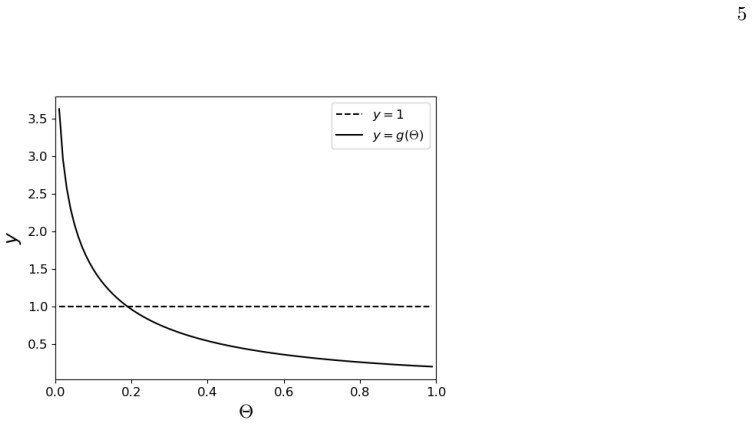
The central object is the modified self-consistency function $g(\Theta)=\lambda m\left[\ln\left(1+\frac{1}{\lambda m\Theta}\right)-\frac{1}{1+\lambda m\Theta}\right]$, whose intersection with the line $y=1$ locates the stationary infected state. The proof that $g(1)<1$ for all $\lambda m>0$ uses the auxiliary function $\Psi(z)=z\ln(1+1/z)$, which increases and approaches $1$ as $z\to\infty$; this, together with the divergence of $g(\Theta)$ at $\Theta\to0^+$, forces a nontrivial solution at every positive infection rate. The prevalence is then controlled by $\Psi_2(x)=2-2x\ln(1+1/x)-\frac{1}{1+x}$, which is nonnegative and makes $d\rho/d\lambda$ positive in both the original and modified models. These identities carry the analytic argument from the modified mean-field closure to a monotone prevalence and a peaked edge-infection probability.
What would settle it
On a finite Barabási-Albert network with $N$ vertices (maximum degree of order $\sqrt{N}$), solve the stationary condition with the discrete sum instead of the integral over the unbounded power law: if the numerical solution shows a positive threshold $\lambda_c>0$ below which only the absorbing state exists, then the unbounded continuous approximation, not the mitigation mechanism alone, is producing the claimed zero threshold.
Extended reading notes
Core claim
The paper establishes that replacing the standard heterogeneous mean-field closure $\Theta = \sum_k q(k)\rho_k$ with the mitigated closure $\Theta = \sum_k q(k)\rho_k(1-\rho_k)$ leaves the zero-threshold property of scale-free networks intact while changing the shape of $\Theta$. On a Barabási-Albert network the stationary condition becomes $\Theta = \lambda m\Theta\left[\ln\left(1+\frac{1}{\lambda m\Theta}\right)-\frac{1}{1+\lambda m\Theta}\right]$, and because the associated function $g(\Theta)$ decreases from $+\infty$ at $\Theta\to0^+$ and satisfies $g(1)<1$ for all $\lambda m>0$, a nontrivial solution exists at every positive infection rate. The total prevalence $\rho = 2(\lambda m\Theta)^2\left[\frac{1}{\lambda m\Theta}-\ln\left(1+\frac{1}{\lambda m\Theta}\right)\right]$ is shown to be strictly increasing in $\lambda$, using the positivity of $\Psi_2(x)=2-2x\ln(1+1/x)-\frac{1}{1+x}$. Thus the mitigation factor caps the edge-level infection probability, producing a peak in $\Theta$, but does not create an epidemic threshold and does not reverse the monotonic increase of overall prevalence.
Load-bearing premise
The load-bearing premise is the annealed, uncorrelated heterogeneous mean-field approximation together with the continuous unbounded Barabási-Albert degree distribution $P(k)=2m^2/k^3$; if the network is finite or has degree-degree correlations, the zero threshold and the exact shape of $\Theta$ do not follow.
Editorial extensions
If this is right
- On a Barabási-Albert network with the continuous unbounded degree distribution $P(k)=2m^2/k^3$, the mitigated SIS model is endemic for every positive infection rate, so the epidemic threshold is $\lambda_c=0$.
- The probability $\Theta$ of reaching an infected node along a randomly chosen edge is no longer monotonic: it rises to a peak and then decreases, a qualitative change from the original heterogeneous mean-field model.
- The overall prevalence $\rho$ remains a strictly increasing function of $\lambda$ in both the original and mitigated models, despite the different behavior of $\Theta$.
- The suppressing factor $(1-\rho_k)$ only becomes significant when a degree class is heavily infected, so the departure from the original model is small at low prevalence and large near saturation.
Reading between the lines
- On any finite network, or with a hard maximum degree, the divergence of $g(\Theta)$ at $\Theta\to0^+$ is cut off, so a positive threshold is expected to reappear; the zero-threshold conclusion is tied to the unbounded power-law limit.
- The peak in $\Theta$ suggests a testable surveillance signature: the fraction of contacts that reach an infected person could start falling while total prevalence is still rising, if isolation intensifies with local infection burden.
- The same logistic-suppression closure could be applied to quenched mean-field or temporal-network SIS dynamics, where the annealed approximation is relaxed; the monotonicity of prevalence and the location of the peak may change with degree correlations.
Editorial analysis
A structured set of objections, weighed in public.
Referee Report
Summary. The paper studies the susceptible-infected-susceptible (SIS) model on Barabási-Albert networks within the heterogeneous mean-field approximation. It introduces a Verhulst-like mitigation factor into the probability that an edge connects to an infected node, replacing the standard relation Θ = Σ_k q(k)ρ_k with Θ = Σ_k q(k)ρ_k(1−ρ_k). The authors derive the stationary self-consistency equation for the modified model, prove that a nontrivial solution exists for every positive infection rate, conclude that the epidemic threshold is λc = 0, and analyze the prevalence. They compare the modified model with the original HMF model and show that, although the probability Θ becomes non-monotone in the modified model, the prevalence remains monotonically increasing with the infection rate. All main results are derived analytically under the continuous, cutoff-free degree distribution P(k) = 2m^2/k^3.
Significance. If the results are correct, the paper offers a simple, analytically tractable modification of HMF that models isolation or hospitalization of infected individuals. Its main strength is that the stationary equations and threshold condition are derived self-consistently from the model definition, with no fitted parameters and no reliance on external numerical calibration. The comparison between the behavior of Θ and the prevalence is a clean and potentially instructive result for network epidemiology. The main limitation is that the conclusions are obtained under the annealed HMF approximation and under an idealized infinite BA degree distribution; the paper would benefit from stating this qualifier explicitly. The algebraic error in Eq. (29) affects the displayed proof of monotonicity, but the positivity of the prevalence derivative is recoverable with a corrected derivative, so the central claim is defensible after revision.
major comments (2)
- [§III.B, Eq. (29)] The identity for Θ + λ dΘ/dλ is algebraically incorrect and needs to be fixed. Starting from F(λ,Θ) = λm[ln(1+1/x) − 1/(1+x)] − 1 = 0 with x = λmΘ, one obtains F_Θ = −λm/[Θ(1+x)^2] and F_λ = 1/λ − m/(1+x)^2. Implicit differentiation therefore gives Θ + λ dΘ/dλ = x(1+x)^2/(λm)^2 > 0, not the expression displayed in Eq. (29). For example, at the self-consistent point λm ≈ 5.177 and x = 1, the corrected expression gives about 0.149, while Eq. (29) gives about 0.050. The positivity of Θ + λ dΘ/dλ, and hence the monotonicity of the prevalence, follows from the corrected expression, but the displayed derivation in the manuscript must be revised.
- [§III.A and §IV] The claim λc = 0 is established only for the idealized thermodynamic limit with the cutoff-free power-law distribution P(k) = 2m^2/k^3 in Eq. (7). On a finite BA network with a maximum degree Kmax, the integrals in Eqs. (8), (12), and (15) are cut off and the same equations yield a positive threshold. Since the text states the result for 'the Barabási-Albert network' without this qualifier, the paper should explicitly say that λc = 0 holds in the infinite-network, continuous-degree approximation. This is not an internal inconsistency of the derivation, but it is load-bearing for the headline threshold result and should be flagged in the main text and the conclusion.
minor comments (5)
- [§II.A] There is a typo in 'one seees' in the paragraph after Eq. (3); it should be 'one sees'.
- [§III.B] The notation in Eq. (29), written as 1/((λm)^2), could be mistaken for 1/(λm)^2 with dimensional inconsistency; the corrected formula should be written with clear parentheses, e.g., x(1+x)^2/(λm)^2.
- [§IV] The conclusion states that the results are 'based on exact results'; this should be qualified as 'exact within the heterogeneous mean-field approximation and the cutoff-free BA degree distribution' to avoid overstatement.
- [§III.A] The proof that g(1) < 1 relies on Ψ(λm) being strictly less than 1 for finite λm; this is correct, but stating explicitly that Ψ(z) < 1 for all finite z > 0 would make the argument more transparent.
- [General] The paper would be easier to read if the relation between Eq. (14) and the classical Verhulst factor were stated slightly more precisely, since the mitigation factor appears in the edge probability Θ rather than directly in the infection rate λ.
Circularity Check
No significant circularity: the mHMF derivations follow self-contained from the model definition and standard HMF/BA assumptions; self-citations only motivate the modeling choice.
full rationale
I walked the derivation chain from Eq. (14) through Eqs. (15), (17), (20), and (24). The modified model is defined by replacing the standard HMF relation (5) with the explicit sum in Eq. (14), and every analytical result (the always-present nontrivial solution, the zero threshold, and the prevalence formulas) is obtained by direct manipulation of that definition together with the standard annealed HMF equations and the continuous BA degree distribution P(k) = 2m^2/k^3 given in Eq. (7). There are no fitted parameters and no quantity called a prediction that is actually an input; the 'predictions' are closed-form consequences of the stated model. The self-citations [15] and [18] are used only to motivate the logistic/mitigation idea, not to prove the central claims, so they are not load-bearing. The 'unique' solution of the self-consistency equation is established by an explicit monotonicity argument in Eqs. (16)-(21), not by importing a uniqueness theorem from the authors' prior work. The paper's Ansatz for the mitigation factor is admittedly ad hoc, but that is an assumption, not circularity. The main caveat found in the derivation is that the zero-threshold result relies on replacing the degree sum by an integral over an unbounded P(k) with no cutoff, so on a finite BA network the threshold would be positive; however, this is a scope/approximation limitation and a potential correctness concern, not a circular step in which a result reduces to its own input by construction.
Assumptions & free parameters
assumptions (5)
- domain assumption SIS dynamics with recovery rate set to 1 by time rescaling.
- domain assumption Annealed heterogeneous mean-field approximation: vertices with the same degree share identical statistical properties.
- domain assumption Uncorrelated network approximation, P(k|k') = k P(k) / ⟨k⟩.
- domain assumption Continuous approximation to the Barabasi-Albert degree distribution, P(k) = 2m^2/k^3 for all k ≥ m, with sums replaced by integrals over unbounded k.
- ad hoc to paper The mitigation factor has the specific Verhulst form (1 - ρ_k) in Eq. (14), with no coupling constant.
Cite this review
Pith. "Pith review of Susceptible-Infected-Susceptible dynamics with mitigation in connection of infected population." pith.science (2026). https://pith.science/paper/N6I2HRVV
@misc{pith2026250104463,
  author       = {Pith},
  title        = {Pith review of: Susceptible-Infected-Susceptible dynamics with mitigation in connection of infected population},
  year         = {2026},
  howpublished = {\url{https://pith.science/paper/N6I2HRVV}},
  note         = {Machine review of arXiv:2501.04463}
}
read the original abstract
The susceptible-infected-susceptible epidemic model is analyzed through a degree-based mean-field approach. In this work, a mitigation factor is introduced in the probability of finding an infected individual following an edge. This modification simulates situations where the infected population reduces its participation in the dynamics of disease propagation, as may happen with the seclusion or hospitalization of infected individuals. A detailed investigation of this new model and its comparison to the original one (without the mitigation factor) was performed on the Barab\'asi-Albert network, where some important results were analytically accessible.
Figures


Reference graph
Works this paper leans on
-
[15]
C. Dias, M. O. Hase, J. Stat. Mech. 013404 (2021)
2021
-
[18]
M. O. Hase, H. L. Casa Grande, J. Stat. Mech. 043304 (2016)
2016
-
[1]
URL: https://www.who.int
World Health Organization. URL: https://www.who.int
-
[2]
H. W. Hethcote, Applied Mathematical Ecology (Springer, Berlin, 1989)
1989
-
[3]
Tom´ e and M
T. Tom´ e and M. J. de Oliveira,Braz. J. Phys. 50, 832 (2020)
2020
-
[4]
W. H. Hamer, The Lancet 167, 733 (1906)
1906
-
[5]
N. T. J. Bailey, The Mathematical Theory of Infectious Diseases and its Applications (Charles Griffin, London, 1975)
1975
-
[6]
S. N. Dorogovtsev, J. F. F. Mendes, Evolution of Networks: From Biological Nets to the Internet and WWW (Oxford University Press, Oxford, 2003)
2003
Show all 24 references
-
[7]
R. M. Anderson, R. M. May, Infectious Diseases of Humans (Oxford University Press, Oxford, 1992)
1992
-
[8]
J. D. Murray, Mathematical Biology I: An Introduction (Springer, Berlin, 2002)
2002
-
[9]
Albert and A.-L
R. Albert and A.-L. Barab´ asi,Rev. Mod. Phys. 74, 47 (2002)
2002
-
[10]
M. E. J. Newman, Networks: An Introduction (Oxford University Press, New York, 2010)
2010
-
[11]
A. S. da Mata, Braz. J. Phys. 50, 658 (2020)
2020
-
[12]
S. N. Dorogovtsev, J. F. F. Mendes, The nature of Complex Networks (Oxford University Press, New York, 2022)
2022
-
[13]
S. C. Ferreira, C. Castellano, R. Pastor-Satorras, Phys. Rev. E 86, 041125 (2012)
2012
-
[14]
Pastor-Satorras, C
R. Pastor-Satorras, C. Castellano, P. Van Mieghem, A. Vespignani, Rev. Mod. Phys. 87, 925 (2015)
2015
-
[16]
P. F. Verhulst. Corr. Math. Physique 10, 113 (1838)
-
[17]
T. R. Malthus. An Essay on the Principle of Population, as It Aspects the Future Improvement of Society, with Remarks on the Speculations of Mr. Goodwin, M. Condorcet, and Other Writers (J. Johnson, London, 1798)
-
[19]
Ross, The Prevention of Malaria (E
R. Ross, The Prevention of Malaria (E. P. Dutton & Company, New York, 1910)
1910
-
[20]
Marro, R
J. Marro, R. Dickman, Nonequilibrium Phase Transitions in Lattice Models (Cambridge University Press, Cambridge, 1999)
1999
-
[21]
Pastor-Satorras and A
R. Pastor-Satorras and A. Vespignani, Phys. Rev. Lett. 86, 3200 (2001)
2001
-
[22]
Pastor-Satorras and A
R. Pastor-Satorras and A. Vespignani, Phys. Rev. E 63, 066117 (2001)
2001
-
[23]
M. O. Hase, J. F. F. Mendes, J. Phys. A 41, 145002 (2008)
2008
-
[24]
Cotacallapa, M
M. Cotacallapa, M. O. Hase, J. Phys. A 49, 065001 (2016)
2016
Reviewed August 10, 2026 · model on record in the stance chip above.
Discussion (0). Continue with ORCID to comment.