REVIEW 4 major objections 4 minor 40 references
A Plug-and-Play Bregman ADMM Module for Inferring Event Branches in Temporal Point Processes
T0 review · 4 major / 4 minor · reviewed 2026-08-10 · deepseek-v4-flash
Pith's one-line read A Bregman-ADMM module that imposes sparse and low-rank structure on event-transition matrices improves both the accuracy and the interpretability of temporal point process models.
desk verdict A practical BADMM module that regularizes TPP responsibility/attention matrices into sparse low-rank branches, with solid engineering but no quantitative evidence that the inferred branches match ground truth. read the letter →
The pith
A machine-rendered reading of the paper's core claim, the machinery that carries it, and where it could break.
The reading
What carries the argument
The central object is the BADMM module: an iterative solver for the regularized KL-projection of a candidate transition matrix onto the set $\Omega$ of row-normalized lower-triangular stochastic matrices. It alternates a closed-form update $$$B^{{(t+1)}}$=\sigma_r\Big(\frac{\log B_0+\rho\sum_{i=1}^2(\log $X_i^{{(t)}}$-$Z_i^{{(t)}}$)}{1+2\rho}\Big)$$ with soft-thresholding updates for $X_1$ (the $\ell_1$ term) and for $X_2$ (nuclear norm via SVD, or $\ell_{1,2}$ via column-group thresholding), and dual ascent on $Z_1,Z_2$. Unrolling $T$ iterations gives a differentiable attention layer; for the SVD variant the gradient through $X_2$ is detached to save memory. This mechanism is what turns an over-smooth matrix into a sparse, low-rank branch structure.
What would settle it
A concrete test: simulate a Hawkes process with a known sparse branching matrix, run EM with and without the BADMM module over the full $\lambda$/\$\alpha$ grid, and check whether (i) the log-likelihood of the BADMM run ever falls below plain EM on the same training data, and (ii) the recovered transition matrix matches the ground-truth branches (e.g., by precision/recall on nonzero entries). Failure on either count would undercut the claim that structured branch inference comes with improved performance.
Extended reading notes
Core claim
This paper's central claim is that the hidden branching structure behind an event sequence can be recovered by imposing sparse and low-rank structure on whatever matrix the model already uses to represent influence—the EM responsibility matrix for Hawkes processes or the attention map for transformer TPPs. Its BADMM module takes that initial matrix $B_0$ and solves $$\min_{B\in\$\Omega$} \mathrm{KL}(B\parallel B_0)+\$\lambda$(\$\alpha$\|B\|_1+(1-\$\alpha$)R(B)),$$ with $R$ either the nuclear norm (subspace clustering) or the $\ell_{1,2}$ norm (sparse group-lasso). The solution, computed by alternating Bregman-ADMM updates and unrolled as network layers, becomes the learned event transition matrix. The paper's experiments show that plugging this module into HP, THP, and SAHP improves log-likelihood and prediction accuracy relative to softmax and Sinkhorn baselines, and that the resulting sparse branches identify isolated and triggering events; the 12 Angry Men case study ranks influential jurors more consistently with text-based judgments using only timestamps and speaker IDs.
Load-bearing premise
The load-bearing premise is that substituting the BADMM-regularized matrix for the EM responsibility matrix in the E-step still allows the EM algorithm to improve the observed-data likelihood; the paper uses this substitution for the Hawkes experiments without proving that the EM lower bound is preserved or that the iterates converge.
Editorial extensions
If this is right
- For Hawkes processes trained by EM, the E-step can directly output a structured responsibility matrix, making isolated and key events visible without changing the closed-form M-step.
- For transformer TPPs, replacing softmax attention with the unrolled BADMM layer yields attention maps that are simultaneously row-normalized, lower-triangular, sparse, and low-rank—properties softmax or Sinkhorn attention cannot jointly satisfy.
- The two regularizer implementations give users a choice: nuclear-norm BADMM preserves local triggering patterns, while sparse-group-lasso BADMM identifies a few globally significant events.
- Across Taobao, Retweet, StackOverflow, Amazon, and synthetic Conttime data, BADMM variants match or exceed softmax and Sinkhorn baselines on event-log-likelihood and type-prediction accuracy.
- Event-branch insights transfer across domains: the 12 Angry Men study identifies top influential jurors from timestamps and speaker IDs alone, agreeing with text-based rankings.
Reading between the lines
- Editorial inference: the method implicitly places a sparse-and-low-rank prior on branching structure; if formalized, it could be connected to Bayesian TPPs, and that view predicts the benefit shrinks when the true branching matrix is dense.
- Editorial inference: the unrolled module with detached SVD gradient behaves like a two-level optimizer, so its training dynamics may differ from a pure differentiable layer; a study of gradient bias versus memory savings would be a natural extension.
- Editorial inference: the module's reliance on row-normalized lower-triangular matrices assumes strict temporal ordering; adapting it to contemporaneous or cyclic triggering (e.g., mutual excitation in networked events) would be a testable extension.
Editorial analysis
A structured set of objections, weighed in public.
Referee Report
Summary. The paper proposes a plug-and-play Bregman ADMM (BADMM) module for temporal point processes (TPPs) that imposes sparse and low-rank structure on responsibility matrices in the EM algorithm for classical Hawkes processes and on attention maps in Transformer-based neural TPPs. The resulting matrices are interpreted as event transition matrices encoding hidden branching structure. The module is implemented by unrolling Bregman ADMM iterations, with two regularizer choices: nuclear norm and sparse group-lasso. Experiments on one synthetic and five real-world datasets report log-likelihood and accuracy, along with qualitative visualizations of inferred transition matrices and a case study on the movie '12 Angry Men'.
Significance. The idea of a generic, optimization-driven module that can be plugged into both classical and neural TPPs to regularize inferred event transition matrices is relevant and timely. The paper provides code, which is a strength. If the branch-inference claim were quantitatively validated, the module could be a useful component for interpretable TPP modeling. However, the current evidence is largely qualitative, and the theoretical grounding for the EM variant is absent. The contribution is therefore more of an empirical engineering proposal than a fully validated method.
major comments (4)
- [Experiments, 'Effectiveness and Rationality'] The paper's central claim is that the BADMM module infers interpretable structured event branches, but no experiment compares the inferred transition matrix (B or the attention map) against ground-truth branching structure. The Conttime dataset (Table 1) is simulated by a Hawkes process, so the true parent/triggering relations are known; however, Table 2 reports only ELL and ACC, and Figure 3 provides only visualizations. A quantitative branch-recovery evaluation (e.g., precision/recall of inferred parent assignments, AUC of predicted triggering probabilities, or similarity to the true transition matrix) is necessary to support the interpretability claim. Without it, the reported performance gains could result from the regularizer alone, independent of branch fidelity, and the core novelty of the paper is not empirically established.
- [Proposed Method, 'BADMM Module for Structured Event Branches', final paragraph] The paper states that for a Hawkes process, the BADMM algorithm can be applied 'directly in the E-step' to obtain a structured responsibility matrix. In classical EM, the responsibility matrix R(t) in Eq. (4) is the posterior expectation of the latent branching variables, and its use guarantees that Q(θ, θ(t)) is a lower bound on the observed-data log-likelihood. Replacing R(t) with the minimizer of Eq. (7) breaks this lower-bound property, so monotonic likelihood increase and convergence to a stationary point of the observed-data likelihood are not guaranteed. No theoretical or empirical justification (e.g., a monotonicity check, a modified objective, or a convergence experiment) is provided. The limitation section explicitly states that statistical verification is left to future work. This is load-bearing for the Hawkes experiments and for the claim that the method operates within the maximum likelihood estimation framework.
- [Proposed Method, 'BADMM Module for Structured Event Branches', update equations] In the update for X2 when R(·) = ∥·∥1,2, the paper gives x_{n,2}^{(t+1)} = τ_n S_{λα/ρ}(b_n + z_{n,2}) with τ_n = (1 − (1−α)λ/(ρ∥S_{λα/ρ}(b_n + z_{n,2})∥₂))_+. This is the proximal operator for the combined penalty α∥·∥1 + (1−α)∥·∥1,2, but in the splitting of Eq. (8) the ℓ1 term is already assigned to X1; the X2 subproblem should use only (1−α)∥·∥1,2, which would yield τ_n = (1 − (1−α)λ/(ρ∥b_n + z_{n,2}∥₂))_+ without the inner soft-threshold. As written, the algorithm double-counts the ℓ1 regularizer, changing the objective being solved. Please correct the formula or clarify the intended splitting.
- [Experiments, Table 2] The claim that the BADMM module 'consistently improves' performance is contradicted by several entries. For example, SAHP ACC on Taobao is 0.434 for Softmax, Sinkhorn, BADMM1,2, and BADMM*; THP ELL on Amazon is 0.542 for Softmax, BADMM1,2, and BADMM*; and many BADMM results are within one standard deviation of the baseline. The improvements are consistent only for the HP backbone on ELL, not across all settings. The paper should either report statistical significance tests (e.g., paired tests across the three seeds) or moderate the claim to reflect that gains are present in most but not all configurations.
minor comments (4)
- [Proposed Method, Eq. (7)] The definition of the nuclear norm uses 'σN (B)' which should be 'σ_n(B)' (sum of singular values).
- [Abstract] The URL 'https://github.com/qingmeiwangdaily/BADMM TPP' contains a space; the correct URL should be 'BADMM_TPP'.
- [Related Work] 'Sinkhormer' is a typo for 'Sinkformer'.
- [Experiments, Figure 3] The subfigure labels and color bars are small; consider enlarging them for readability.
Circularity Check
No significant circularity is found: the BADMM module is a self-contained regularized optimization applied to existing TPP matrices.
full rationale
The derivation chain is self-contained. The BADMM module solves the well-defined optimization problem in Eq. (7), minimizing KL(B || B0) plus sparse and low-rank regularizers, where B0 is the EM responsibility matrix of a Hawkes process or the attention map of a transformer TPP. No ground-truth branch matrix is used to fit the module, and the final structured matrix is a regularized transformation of an existing matrix rather than a fitted parameter renamed as a prediction. The paper's evidence for interpretability is external to the optimization: the GPT-4o juror ranking comparison and the qualitative alignment of inferred triggering patterns with dialogue semantics. The performance improvements are empirical and could, in principle, fail even if the regularizer is well defined. The substitution of the regularized matrix into the EM E-step lacks a proof that the EM lower bound is preserved, but this is a statistical correctness gap, not circularity, and the paper itself notes in Limitations that statistical verification is future work. Self-citations, such as Xu and Cheng (2023) for the unrolling procedure, are implementation references and are not load-bearing uniqueness claims. Overall, no step in the paper reduces by construction to its own inputs.
Assumptions & free parameters
free parameters (4)
- lambda (regularization weight) =
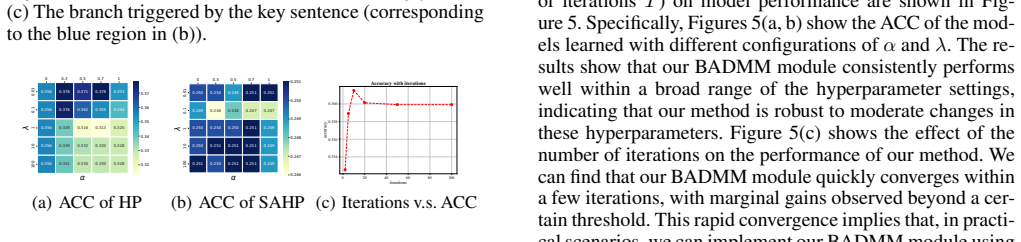
grid search over {0.01, 0.1, 1, 10, 100}
- alpha (sparsity vs low-rank tradeoff) =
grid search over values in (0,1), including 0, 0.3, 0.5, 0.7, 1 in Figure 5
- rho (augmented Lagrangian weight) =
1
- T (number of unrolled iterations) =
2
assumptions (6)
- domain assumption A hidden branching process with a lower-triangular transition matrix underlies event sequences generated by TPPs.
- domain assumption The row-normalized lower-triangular domain defined in Eq. (7) is the correct constraint for event responsibility matrices.
- ad hoc to paper Sparse and low-rank structure is an appropriate prior for event branch matrices.
- domain assumption The attention maps of transformer TPPs can be interpreted as event branch probabilities before and after regularization.
- ad hoc to paper Replacing the EM posterior responsibility with a regularized matrix still yields a valid maximum-likelihood estimator of the Hawkes process.
- standard math Bregman ADMM converges for the convex KL-plus-regularizer problem.
Cite this review
Pith. "Pith review of A Plug-and-Play Bregman ADMM Module for Inferring Event Branches in Temporal Point Processes." pith.science (2026). https://pith.science/paper/ZD56LMQV
@misc{pith2026250104529,
  author       = {Pith},
  title        = {Pith review of: A Plug-and-Play Bregman ADMM Module for Inferring Event Branches in Temporal Point Processes},
  year         = {2026},
  howpublished = {\url{https://pith.science/paper/ZD56LMQV}},
  note         = {Machine review of arXiv:2501.04529}
}
read the original abstract
An event sequence generated by a temporal point process is often associated with a hidden and structured event branching process that captures the triggering relations between its historical and current events. In this study, we design a new plug-and-play module based on the Bregman ADMM (BADMM) algorithm, which infers event branches associated with event sequences in the maximum likelihood estimation framework of temporal point processes (TPPs). Specifically, we formulate the inference of event branches as an optimization problem for the event transition matrix under sparse and low-rank constraints, which is embedded in existing TPP models or their learning paradigms. We can implement this optimization problem based on subspace clustering and sparse group-lasso, respectively, and solve it using the Bregman ADMM algorithm, whose unrolling leads to the proposed BADMM module. When learning a classic TPP (e.g., Hawkes process) by the expectation-maximization algorithm, the BADMM module helps derive structured responsibility matrices in the E-step. Similarly, the BADMM module helps derive low-rank and sparse attention maps for the neural TPPs with self-attention layers. The structured responsibility matrices and attention maps, which work as learned event transition matrices, indicate event branches, e.g., inferring isolated events and those key events triggering many subsequent events. Experiments on both synthetic and real-world data show that plugging our BADMM module into existing TPP models and learning paradigms can improve model performance and provide us with interpretable structured event branches. The code is available at \url{https://github.com/qingmeiwangdaily/BADMM_TPP}.
Figures


Figures from the paper (3 more)


Reference graph
Works this paper leans on
-
[1]
, " * write output.state after.block = add.period write newline
ENTRY address archivePrefix author booktitle chapter edition editor eid eprint howpublished institution isbn journal key month note number organization pages publisher school series title type volume year label extra.label sort.label short.list INTEGERS output.state before.all mid.sentence after.sentence after.block FUNCTION init.state.consts #0 'before.a...
-
[2]
write newline
" write newline "" before.all 'output.state := FUNCTION n.dashify 't := "" t empty not t #1 #1 substring "-" = t #1 #2 substring "--" = not "--" * t #2 global.max substring 't := t #1 #1 substring "-" = "-" * t #2 global.max substring 't := while if t #1 #1 substring * t #2 global.max substring 't := if while FUNCTION word.in bbl.in capitalize " " * FUNCT...
-
[3]
Bacry, E.; Mastromatteo, I.; and Muzy, J.-F. 2015. Hawkes processes in finance. Market Microstructure and Liquidity, 1(01): 1550005
work page 2015
-
[4]
Champion, T.; Da Costa, L.; Bowman, H.; and Grze \'s , M. 2022. Branching time active inference: the theory and its generality. Neural Networks, 151: 295--316
work page 2022
-
[5]
Cuturi, M. 2013. Sinkhorn distances: Lightspeed computation of optimal transport. Advances in neural information processing systems, 26
work page 2013
-
[6]
Dion, J.-P.; and Yanev, N. 1994. Statistical inference for branching processes with an increasing random number of ancestors. Journal of statistical planning and inference, 39(2): 329--351
work page 1994
-
[7]
Du, N.; Dai, H.; Trivedi, R.; Upadhyay, U.; Gomez-Rodriguez, M.; and Song, L. 2016. Recurrent marked temporal point processes: Embedding event history to vector. In Proceedings of the 22nd ACM SIGKDD international conference on knowledge discovery and data mining, 1555--1564
work page 2016
-
[8]
Elhamifar, E.; and Vidal, R. 2013. Sparse subspace clustering: Algorithm, theory, and applications. IEEE transactions on pattern analysis and machine intelligence, 35(11): 2765--2781
work page 2013
Show all 40 references
-
[9]
Farajtabar, M.; Du, N.; Gomez-Rodriguez, M.; Valera, I.; Zha, H.; and Song, L. 2014. Shaping social activity by incentivizing users. In Proceedings of the 27th International Conference on Neural Information Processing Systems-Volume 2, 2474--2482
2014
-
[10]
G.; Zamani, M.; Du, N.; Zha, H.; and Song, L
Farajtabar, M.; Rodriguez, M. G.; Zamani, M.; Du, N.; Zha, H.; and Song, L. 2015. Back to the past: Source identification in diffusion networks from partially observed cascades. In Artificial Intelligence and Statistics, 232--240. PMLR
2015
-
[11]
Farajtabar, M.; Wang, Y.; Gomez-Rodriguez, M.; Li, S.; Zha, H.; and Song, L. 2017 a . Coevolve: A joint point process model for information diffusion and network evolution. Journal of Machine Learning Research, 18(41): 1--49
2017
-
[12]
Farajtabar, M.; Yang, J.; Ye, X.; Xu, H.; Trivedi, R.; Khalil, E.; Li, S.; Song, L.; and Zha, H. 2017 b . Fake news mitigation via point process based intervention. In International conference on machine learning, 1097--1106. PMLR
2017
-
[13]
Gonz \'a lez, M.; Guti \'e rrez, C.; Mart \' nez, R.; and Del Puerto, I. M. 2013. Bayesian inference for controlled branching processes through MCMC and ABC methodologies. Revista de la Real Academia de Ciencias Exactas, Fisicas y Naturales. Serie A. Matematicas, 107(2): 459--473
2013
-
[14]
Hawkes, A. G. 1971. Spectra of some self-exciting and mutually exciting point processes. Biometrika, 58(1): 83--90
1971
-
[15]
Isham, V.; and Westcott, M. 1979. A self-correcting point process. Stochastic processes and their applications, 8(3): 335--347
1979
-
[16]
Jure, L. 2014. SNAP Datasets: Stanford large network dataset collection. Retrieved December 2021 from http://snap. stanford. edu/data
2014
-
[17]
Kingman, J. F. C. 1992. Poisson processes, volume 3. Clarendon Press
1992
-
[18]
W.; and Shedler, G
Lewis, P. W.; and Shedler, G. S. 1979. Simulation of nonhomogeneous Poisson processes by thinning. Naval research logistics quarterly, 26(3): 403--413
1979
-
[19]
Liu, G.; Lin, Z.; and Yu, Y. 2010. Robust subspace segmentation by low-rank representation. In Proceedings of the 27th International Conference on International Conference on Machine Learning, 663--670
2010
-
[20]
Mei, H.; and Eisner, J. 2017. The neural hawkes process: a neurally self-modulating multivariate point process. In Proceedings of the 31st International Conference on Neural Information Processing Systems, 6757--6767
2017
-
[21]
Mena, G.; Nejatbakhsh, A.; Varol, E.; and Niles-Weed, J. 2020. Sinkhorn em: an expectation-maximization algorithm based on entropic optimal transport. arXiv preprint arXiv:2006.16548
2020 arXiv
-
[22]
M ller, J.; and Rasmussen, J. G. 2006. Approximate simulation of Hawkes processes. Methodology and Computing in Applied Probability, 8: 53--64
2006
-
[23]
M.; Kelly, J
Ross, S. M.; Kelly, J. J.; Sullivan, R. J.; Perry, W. J.; Mercer, D.; Davis, R. M.; Washburn, T. D.; Sager, E. V.; Boyce, J. B.; and Bristow, V. L. 1996. Stochastic processes, volume 2. Wiley New York
1996
-
[24]
E.; Ablin, P.; Blondel, M.; and Peyr \'e , G
Sander, M. E.; Ablin, P.; Blondel, M.; and Peyr \'e , G. 2022. Sinkformers: Transformers with doubly stochastic attention. In International Conference on Artificial Intelligence and Statistics, 3515--3530. PMLR
2022
-
[25]
Simon, N.; Friedman, J.; Hastie, T.; and Tibshirani, R. 2013. A sparse-group lasso. Journal of computational and graphical statistics, 22(2): 231--245
2013
-
[26]
Sinkhorn, R.; and Knopp, P. 1967. Concerning nonnegative matrices and doubly stochastic matrices. Pacific Journal of Mathematics, 21(2): 343--348
1967
-
[27]
Wang, H.; and Banerjee, A. 2014. Bregman alternating direction method of multipliers. Advances in Neural Information Processing Systems, 27
2014
-
[28]
Wang, Q.; Cheng, M.; Yuan, S.; and Xu, H. 2023. Hierarchical contrastive learning for temporal point processes. In Proceedings of the AAAI Conference on Artificial Intelligence, volume 37, 10166--10174
2023
-
[29]
Xu, H.; Carin, L.; and Zha, H. 2018. Learning registered point processes from idiosyncratic observations. In International Conference on Machine Learning, 5443--5452. PMLR
2018
-
[30]
Xu, H.; and Cheng, M. 2023. Regularized optimal transport layers for generalized global pooling operations. IEEE Transactions on Pattern Analysis and Machine Intelligence
2023
-
[31]
Xu, H.; Farajtabar, M.; and Zha, H. 2016. Learning granger causality for hawkes processes. In International Conference on Machine Learning, 1717--1726. PMLR
2016
-
[32]
Xu, H.; Wu, W.; Nemati, S.; and Zha, H. 2016. Patient flow prediction via discriminative learning of mutually-correcting processes. IEEE transactions on Knowledge and Data Engineering, 29(1): 157--171
2016
-
[33]
Y.; et al
Xue, S.; Shi, X.; Chu, Z.; Wang, Y.; Zhou, F.; Hao, H.; Jiang, C.; Pan, C.; Xu, Y.; Zhang, J. Y.; et al. 2023. Easytpp: Towards open benchmarking the temporal point processes. arXiv preprint arXiv:2307.08097
2023 arXiv
-
[34]
Yang, Y.; Sun, J.; Li, H.; and Xu, Z. 2018. ADMM-CSNet: A deep learning approach for image compressive sensing. IEEE transactions on pattern analysis and machine intelligence, 42(3): 521--538
2018
-
[35]
Zhang, Q.; Lipani, A.; Kirnap, O.; and Yilmaz, E. 2020. Self-attentive Hawkes process. In International conference on machine learning, 11183--11193. PMLR
2020
-
[36]
Zhang, W.; Bu, F.; Owens-Oas, D.; Heller, K.; and Zhu, X. 2018. Who started it? identifying root sources in textual conversation threads. arXiv preprint arXiv:1809.03648
2018 arXiv
-
[37]
A.; He, H
Zhao, Q.; Erdogdu, M. A.; He, H. Y.; Rajaraman, A.; and Leskovec, J. 2015. Seismic: A self-exciting point process model for predicting tweet popularity. In Proceedings of the 21th ACM SIGKDD international conference on knowledge discovery and data mining, 1513--1522
2015
-
[38]
Zhou, K.; Zha, H.; and Song, L. 2013 a . Learning triggering kernels for multi-dimensional hawkes processes. In International conference on machine learning, 1301--1309. PMLR
2013
-
[39]
e.; Zha, H.; and Song, L
Zhou, K. e.; Zha, H.; and Song, L. 2013 b . Learning social infectivity in sparse low-rank networks using multi-dimensional hawkes processes. In Artificial Intelligence and Statistics, 641--649. PMLR
2013
-
[40]
Zuo, S.; Jiang, H.; Li, Z.; Zhao, T.; and Zha, H. 2020. Transformer hawkes process. In International conference on machine learning, 11692--11702. PMLR
2020
Reviewed August 10, 2026 · model on record in the stance chip above.
Discussion (0). Continue with ORCID to comment.