REVIEW 3 major objections 5 minor 6 references
New Facilities for the Production of 1 mm gap Resistive Plate Chambers for the Upgrade of the ATLAS Muon Spectrometer
T0 review · 3 major / 5 minor · reviewed 2026-08-10 · deepseek-v4-flash
Pith's one-line read New production facilities can manufacture 1 mm gap resistive plate chamber gas volumes that meet the HL-LHC muon-spectrometer upgrade requirements, according to prototype beam tests and factory certification.
desk verdict A credible production-engineering report with genuinely new facility-specific certification data, but the readiness claim runs ahead of the evidence: beam and aging results are for small prototypes, with the aging pass asserted rather than shown. read the letter →
The pith
A machine-rendered reading of the paper's core claim, the machinery that carries it, and where it could break.
The reading
What carries the argument
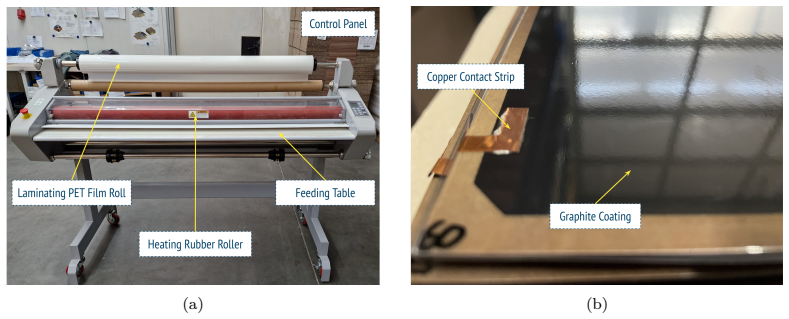
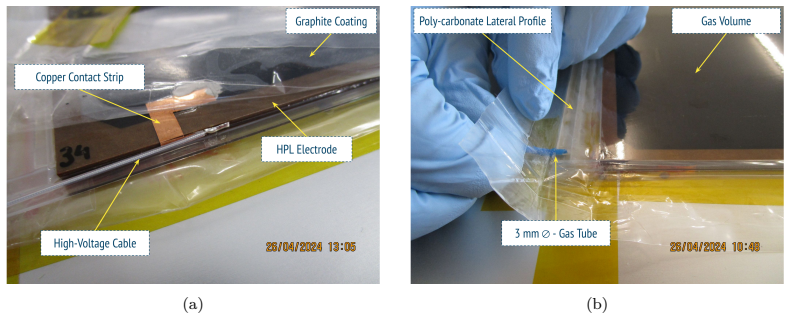
The carrying object is the RPC gas volume itself, defined by a 1 mm gas gap between two ~1.40 mm HPL electrodes coated with graphite (surface resistivity 320 kΩ/□ ±30%) and laminated with PET insulation. The gas volume is assembled with ~400 injection-molded polycarbonate spacers whose cross-shaped dimples control the glue layer so that the gap stays within ~15–20 µm; a Teflon template, automated glue dispenser, and vacuum bagging make the assembly repeatable, and a refined linseed-oil treatment conditions the internal surfaces. The certification chain is the supporting mechanism: performance-critical quantities are measured on small prototypes at a gamma irradiation facility with a 100 GeV muon beam, with the effective high voltage $V_{\rm eff}=V_{\rm app}\frac{P_0}{P}\frac{T}{T_0}$ correcting for ambient conditions and the absolute time resolution derived as $\sigma_t=\sigma_{\Delta t}/\sqrt{2}$ from time-difference distributions. Full-size volumes are then checked by mechanical and electrical factory tests on every unit.
What would settle it
Take a random sample of full-size series gas volumes from each manufacturer and measure muon efficiency and time resolution in the same gamma-irradiated beam setup at about 300 Hz/cm2 background; if efficiency drops below 96.5% at nominal working voltage or time resolution exceeds 1 ns, the readiness claim is contradicted. A second check: reproduce the accelerated aging irradiation on full-size volumes and verify that dark current and efficiency after the accumulated dose still meet acceptance criteria.
Extended reading notes
Core claim
The central claim is that the 1 mm gap RPC gas volume—two high-pressure phenolic laminate plates with graphite coating and a linseed-oiled inner surface, separated by injection-molded polycarbonate spacers to a 1 mm gap—has been successfully transferred from laboratory procedure to industrial manufacture. The paper reports that small prototypes from both manufacturers achieved a muon detection efficiency of approximately 97% at the working point without background, retained efficiency above 96.5% under gamma background of roughly 200–300 Hz/cm2, and delivered an absolute time resolution of 405 ± 9 ps, within the 1 ns requirement. Full-size gas volumes from the same production lines then passed factory acceptance tests: spacer tensile strength above 100 N, spacer height deviations below 20 µm, leak rate below 9.7 × 10⁻⁴ mbar·ℓ/s, leakage current below 200 nA at 8 kV, and current–voltage characteristics within rejection thresholds. The conclusion is that the new facilities can reliably produce high-quality RPC gas volumes according to the industrial standards required for HL-LHC operation.
Load-bearing premise
The conclusion assumes that beam-test results from small 40 × 50 cm2 prototypes, and the asserted accelerated-aging pass, represent what the full-size 1.0 × 2.0 m2 series gas volumes will do under HL-LHC conditions.
Editorial extensions
If this is right
- The roughly 1000 gas gaps required for the inner-barrel muon trigger can be sourced from multiple production lines, reducing dependence on any single supplier.
- Every full-size production gas volume can be certified through factory acceptance tests, while beam-level performance can be certified on small prototypes from the same lines.
- The 1 mm gap HPL RPC design is compatible with HL-LHC background rates around 200–300 Hz/cm2, keeping muon efficiency above 96.5% and time resolution near 405 ps.
- The same industrial transfer and certification model can support future high-rate RPC production beyond the current upgrade.
Reading between the lines
- A direct check of the readiness claim would be to repeat the gamma-irradiated beam measurements on full-size 1.0 × 2.0 m2 series volumes, since the reported efficiency and timing numbers come only from 40 × 50 cm2 prototypes.
- The accelerated aging test is stated to have been passed, but this paper does not show its data; publishing efficiency and absorbed current versus integrated charge would make the longevity claim independently checkable.
- The spacer cross-dimple plus vacuum-bag assembly could be transferred to other large-area gas detectors where uniform gap size, rather than electronics, limits performance.
Editorial analysis
A structured set of objections, weighed in public.
Referee Report
Summary. The paper describes the production and certification of 1 mm gap resistive plate chambers (RPCs) for the ATLAS Muon Spectrometer HL-LHC upgrade, with production transferred to two German companies (PTS and MIRION) and to a new clean-room facility at MPI. It reports test-beam results for 40 x 50 cm2 small-scale prototypes at the CERN GIF++ facility: a muon detection efficiency of about 97% with efficiency above 96.5% at HL-LHC-like background rates, an absolute time resolution of 405 +/- 9 ps, and current-versus-high-voltage behavior under gamma irradiation. The paper also describes the full-scale 1.0 x 2.0 m2 gas-volume assembly procedure, including spacer gluing, linseed oil treatment, and factory acceptance tests (tensile strength, spacer height, gas tightness, rigidity, leakage current, and volt-amperometric curves). The abstract and conclusion assert that the new facilities are capable of producing high-quality RPCs according to industrial standards, based on the prototype beam results, factory tests, and a claimed accelerated aging test at GIF++.
Significance. If the readiness claim is fully supported, the paper would be a useful record of the industrialization of RPC production for a large-scale HEP detector, with concrete quantitative targets for factory QA/QC. Its strengths are the detailed description of the adapted assembly process, the reproducible factory-test criteria (e.g., leak-rate threshold, leakage current limits, spacer-height tolerances), and the measured small-prototype beam performance, including a timing resolution well below the 1 ns ATLAS requirement. However, the central claim that the facilities are ready for series production is only partially supported: the beam performance and aging evidence come from small prototypes, while the full-size volumes are characterized only by mechanical and electrical factory tests. The paper is therefore best read as a credible status report and process description, not yet as a complete validation of full-size detector performance.
major comments (3)
- [Section 2 and Section 4] The readiness claim in the abstract and conclusion rests on an extrapolation from 40 x 50 cm2 small prototypes to 1.0 x 2.0 m2 series gas volumes. Section 2 reports muon efficiency, time resolution, and current only for small prototypes, while Section 4 reports only mechanical and electrical factory tests for full-size volumes. No full-size efficiency, rate capability, or timing measurement is presented. Large-area-specific effects, such as gap non-uniformity across the ~400 spacers, linseed-oil coating uniformity over 2 m, gas-flow distribution from corner inlets, and planarity under 3 mbar overpressure, could degrade detector performance in ways that small prototypes cannot probe. The authors should either provide full-size beam or cosmic-ray performance data or explicitly state and justify why the factory tests fully determine the relevant performance parameters for series production.
- [Abstract and Section 1] The abstract and the concluding paragraph state that the prototypes 'successfully passed an accelerated aging test' at GIF++, but no aging data are shown anywhere in the manuscript. There is no integrated charge, no photon dose, no before/after efficiency comparison, and no description of the aging-test protocol. Moreover, Section 1 states that the 'final certification phase' includes 'a year-long irradiation test at GIF++' and calls this phase 'pivotal' for confirming that manufacturers meet qualifications, which is in tension with the claim that the aging test has already been passed. The authors need to either show the aging results or qualify the statement to reflect that certification is still in progress.
- [Section 2.1] The muon detection efficiency values that support the central performance claim are reported without statistical or systematic uncertainties: 'approximately 97%', 'greater than 96.5%', and rate-dependent reductions of 'about 3%' and 'around 8%' are given with no error bars and no statement of how many prototypes were measured. Since the conclusion that the prototypes meet ATLAS HL-LHC requirements depends directly on these numbers, the authors should provide efficiencies with uncertainties and, if possible, the per-prototype spread.
minor comments (5)
- [Equations (1) and (4)] The effective-voltage correction is defined twice with different reference values: P0 = 990 mbar in Equation (1) and P0 = 1010 mbar in Equation (4). Please clarify which reference applies to the beam data and which to the factory tests, and consider using a single notation to avoid confusion.
- [Figure 1 caption] The caption for Figure 1(b) says the efficiency data are interpolated by a sigmoid function, while the caption for Figure 1(c) says the red line is obtained from a Gaussian fit; the caption text is otherwise clear, but please make the two descriptions consistent in style.
- [Section 3.2.1] There is a typo: 'spacers and later profiles' should read 'spacers and lateral profiles'.
- [Keywords and PACS] The PACS and MSC fields contain placeholder values '0000, 1111'; these should be replaced with actual classification codes or removed.
- [Section 3.2.2] The sentence 'Each corner is equipped with a gas pipe, and an internal distribution system has been designed' would benefit from a reference to a figure or a more detailed description of how the internal distribution is achieved, since uniform gas flow is one of the large-area concerns raised in the major comments.
Circularity Check
No significant circularity: the certification claim rests on external beam, irradiation, and factory-test data, not on its own conclusion or on load-bearing self-citations.
full rationale
The paper does not derive any central claim from its own inputs. The muon efficiency fit (Eq. 2), the time-resolution extraction (Eq. 3), and the gap-current model (Eq. 5) are descriptive fits to external GIF++ test-beam measurements; none of these quantities is reconstructed from the conclusion that the new facilities meet ATLAS standards. The factory acceptance tests in Sections 4.1-4.3 use independent mechanical, tightness, leakage-current, and IV criteria with fixed numerical thresholds. References [2] and [4] supply the production procedure and test-beam analysis details from overlapping authors, but they do not provide the certification outcome itself; the acceptance evidence is the beam data and factory measurements reported in this paper. The asserted accelerated aging pass is not documented, and full-size 1.0 x 2.0 m2 volumes are shown only in mechanical and electrical tests, but those are extrapolation and evidence limitations rather than circular reasoning. No equation in the paper is equivalent by construction to the readiness claim, and no fitted parameter is renamed as a prediction. Therefore no circular step is present.
Assumptions & free parameters
free parameters (2)
- epsilon_max, V50%, lambda (sigmoid efficiency fit) =
not reported
- Rbulk, I0, V0 (gap current model) =
not reported
assumptions (3)
- domain assumption The two RPC detectors used for the time-of-flight measurement are identical and their timing contributions are uncorrelated, so the absolute time resolution is the measured difference width divided by sqrt(2).
- ad hoc to paper Performance of small 40 x 50 cm2 prototypes is representative of final 1.0 x 2.0 m2 series gas volumes.
- domain assumption Exposure at GIF++ to the maximum HL-LHC photon dose constitutes a valid accelerated aging test.
Cite this review
Pith. "Pith review of New Facilities for the Production of 1 mm gap Resistive Plate Chambers for the Upgrade of the ATLAS Muon Spectrometer." pith.science (2026). https://pith.science/paper/Q2Y57S7T
@misc{pith2026250104756,
  author       = {Pith},
  title        = {Pith review of: New Facilities for the Production of 1 mm gap Resistive Plate Chambers for the Upgrade of the ATLAS Muon Spectrometer},
  year         = {2026},
  howpublished = {\url{https://pith.science/paper/Q2Y57S7T}},
  note         = {Machine review of arXiv:2501.04756}
}
read the original abstract
The ATLAS Muon Spectrometer is undergoing a major upgrade for the High-Luminosity LHC (HL-LHC), including the addition of three new thin-gap Resistive Plate Chamber (RPC) layers in the inner barrel region. These RPCs have 1 mm gas gaps between high-pressure phenolic laminate (HPL) electrodes, enhancing their background rate capability and longevity. Nearly 1000 RPC gas gaps will be produced to maximize muon trigger acceptance and efficiency. To reduce reliance on a single supplier and expedite production, the ATLAS muon community formed partnerships with two companies in Germany and the Max Planck Institute for Physics. The gas gap assembly procedure was adapted to the industrial partners' infrastructure and tools, enabling the transfer of technology after prototyping. Manufacturer certification involved constructing multiple small- and full-size gas gap prototypes at each facility. These prototypes underwent extensive testing at CERN's Gamma Irradiation Facility (GIF++), where their efficiency and time resolution were verified under varying gamma backgrounds. They also passed an accelerated aging test, having been exposed to the maximum photon dose anticipated at the HL-LHC. This contribution presents the gas gap production procedures, certification test results, and a comparison of the manufacturing methods adopted by the different external companies. These outcomes confirm that the new facilities can reliably produce high-quality RPCs meeting ATLAS standards for HL-LHC operations.
Figures


Figures from the paper (16 more)




Reference graph
Works this paper leans on
-
[1]
[ATLAS Collaboration], Technical Design Report for the Phase-II Up- grade of the ATLAS Muon Spectrometer , CERN-LHCC-2017-017
work page 2017
-
[2]
O. Kortner, H. Kroha, D. Soyk and T. Turkovi´ c, Optimization of the production procedures of thin-gap RPCs , Nucl. Instrum. Meth. A 1053 (2023), 168273 doi:10.1016/j.nima.2023.168273
-
[3]
The radiation field in the Gamma Irradiation Facility GIF++ at CERN
D. Pfeiffer et al. , The radiation field in the Gamma Irradiation Fa- cility GIF++ at CERN , Nucl. Instrum. Meth. A 866 (2017), 91-103 doi:10.1016/j.nima.2017.05.045 [arXiv:1611.00299 [physics.ins-det]]
work page Pith review arXiv 2017
-
[4]
Turkovic, Production and Testing of Prototype Resistive Plate Cham- bers, CERN-THESIS-2023-330
T. Turkovic, Production and Testing of Prototype Resistive Plate Cham- bers, CERN-THESIS-2023-330
work page 2023
-
[5]
Improving the RPC rate capability
G. Aielli et al. , Improving the RPC rate capability , JINST 11 (2016) P07014 doi:10.1088/1748-0221/11/07/P07014 [arXiv:1606.03448 [physics.ins-det]]
work page Pith review arXiv 2016
-
[6]
S. Park et al. , Production of gas gaps for the Forward RPCs of the CMS experiment , Nucl. Instrum. Meth. A 550 (2005), 551-558 doi:10.1016/j.nima.2005.05.052. © Copyright 2024 CERN for the benefit of the ATLAS Collaboration. Reproduc- tion of this article or parts of it is allowed as specified in the CC-BY-4.0 license 25
Reviewed August 10, 2026 · model on record in the stance chip above.
Discussion (0). Continue with ORCID to comment.