REVIEW 4 major objections 5 minor 135 references
Turbulent mesoscale convection in the Boussinesq limit and beyond
T0 review · 4 major / 5 minor · reviewed 2026-08-10 · deepseek-v4-flash
Pith's one-line read The thermal boundary condition, not the mechanical one, sets the pattern scale in turbulent mesoscale convection.
desk verdict A useful review with some genuinely new DNS, but the headline claim that thermal boundary conditions alone set the pattern scale is not yet as load-bearing as the text suggests; the Neumann 'domain-size' scale is partly a finite-box artifact. read the letter →
The pith
A machine-rendered reading of the paper's core claim, the machinery that carries it, and where it could break.
The reading
What carries the argument
The organizing object is the pair of thermal boundary conditions: the Dirichlet condition of fixed plate temperature versus the Neumann condition of fixed heat flux. In the linear regime the Neumann condition has an infinite critical wavelength $\lambda_{\mathrm{crit}}=\infty$ while the Dirichlet condition has a finite one; the paper shows that this distinction persists far into the turbulent regime and produces the two contrasting classes of long-living large-scale flow structures (TSS vs supergranules). Supporting machinery includes very large horizontally extended DNS domains (aspect ratios up to 60), the decomposition of the dissipation field into solenoidal, dilatational, and inhomogeneous components, and the multifractal analysis of dissipation statistics.
What would settle it
Run a direct numerical simulation of constant-heat-flux convection at aspect ratio 120, matching the Rayleigh and Prandtl numbers of the Γ=60 runs, and track the largest connected coherent temperature pattern over time; if it stops growing before the domain width, the supergranule aggregation is a finite-domain effect and the universal picture fails.
Extended reading notes
Core claim
The central claim is that thermal boundary conditions determine the large-scale structure formation in turbulent mesoscale convection. For fixed-temperature (Dirichlet) plates the flow organizes into turbulent superstructures (TSS) whose characteristic horizontal extent saturates at about $\Lambda_{\mathrm{TSS}}\approx 5H$ for aspect ratios up to at least 16, while for fixed-heat-flux (Neumann) plates the same flow evolves through a slow aggregation into a supergranule whose final size is the domain width, $\Lambda_{\mathrm{SG}}=\Gamma H$. The mechanical boundary conditions (no-slip vs free-slip) are subdominant for this self-organization. The paper further claims that near-wall coherent regions occupy a universal fraction of roughly 40% independent of $\mathrm{Ra}$, $\mathrm{Pr}$, and $\Gamma$; that low-Prandtl-number convection exhibits a Kolmogorov $k^{-5/3}$ kinetic energy spectrum with superstructure scale approaching about $3H$; and that in compressible convection the kinetic energy dissipation rate is multifractal and more intermittent than in the Oberbeck–Boussinesq limit, with solenoidal and dilatational components concentrated around pre-shock regions.
Load-bearing premise
The conclusions assume that the simulated domains are large enough and the runs long enough that the observed patterns (the 5H superstructure scale and the domain-filling supergranule) reflect intrinsic dynamics rather than finite-size or transient artifacts, even though the supergranule's final size is the domain width by construction.
Editorial extensions
If this is right
- If thermal boundary conditions set the pattern scale, then global climate and stellar models can use the known boundary type to estimate the size of unresolved mesoscale convection structures without resolving them.
- Because supergranules aggregate to domain size under constant heat flux, flux-driven convection in nature will have a scale set by the domain, not by fluid properties.
- Low-Prandtl-number convection (relevant to stars and liquid metals) produces Kolmogorov-type inertial ranges and superstructures of about $3H$, implying structure size varies weakly with $\mathrm{Pr}$ and $\mathrm{Ra}$.
- The universal ~40% near-wall coherent area fraction offers a simple, robust statistic for wall models and for interpreting experimental boundary-layer measurements.
- Compressible convection shows enhanced small-scale intermittency relative to the Boussinesq limit even at lower Reynolds numbers, so parametrizations based on Boussinesq turbulence statistics will underestimate extreme dissipation events.
Reading between the lines
- If pattern scale is governed by thermal boundary condition, then observations of pattern scales in natural convection (granules, cloud streets) could be inverted to infer effective boundary conditions at the top and bottom of convective layers.
- Partially conducting plates interpolate between Dirichlet and Neumann; a testable prediction is that as the plate-to-fluid conductivity ratio decreases, the asymptotic superstructure scale should increase from $\sim 5H$ toward the domain size.
- The universal 40% coherent fraction suggests that near-wall shear organization is governed by a local instability mechanism independent of the large-scale pattern; if true, the mechanism should be reproducible in a much smaller domain with the same local boundary-layer dynamics.
- Because supergranule growth is stopped by weak rotation, rotation can serve as a control knob to test the inverse-cascade interpretation; measuring the aggregate scale versus the Rossby number would sharpen the theory.
Editorial analysis
A structured set of objections, weighed in public.
Referee Report
Summary. The manuscript is a review-style article, with some new DNS results, on turbulent mesoscale convection in plane layers. It derives the fully compressible equations and the Boussinesq limit, reports low-Prandtl-number simulations at Pr=0.001, compares Dirichlet and Neumann thermal boundary conditions and different mechanical boundary conditions, examines the effect of rectangular domain shape on turbulent superstructures, and analyzes compressible convection through stratification regimes, temperature-dependent material properties, and the statistics and multifractal properties of the kinetic energy dissipation rate. The central claimed result is that thermal boundary conditions control the large-scale structure formation: constant-temperature plates produce turbulent superstructures with a nearly fixed scale of about 5H, while constant-heat-flux plates produce supergranules that grow to the domain size, with mechanical boundary conditions playing a subdominant role.
Significance. If the central claim holds, the paper identifies a physically important control parameter for the scale of organized convection in planetary and stellar settings, with direct consequences for parametrizations of unresolved mesoscale convection. The paper's strengths include a consistent derivation of the governing equations, a clear framing of compressible convection regimes in the (ε,D) plane, the use of genuinely demanding DNS (for example, more than half a trillion grid points at Pr=0.001), and the connection of the Neumann-case self-organization to linear stability arguments and independent spectral-transfer analyses. The authors are also explicit about several limitations. However, the quantitative support for the central dichotomy and for several accessory universal claims is thin; the Neumann supergranule scale is limited by the domain size by construction, and the Dirichlet saturation scale is not demonstrated by a systematic convergence test. These issues affect the strongest form of the paper's main message.
major comments (4)
- [Sec. 4.1, Figs. 6-8] The central claim that Neumann boundary conditions produce supergranules growing to the domain size, whereas Dirichlet conditions produce a converged scale near 5H, is underdetermined exactly where the two cases differ. Because the reported final supergranule scale is ΛSG=ΓH, the final state is by construction the largest scale the finite box permits; the λcrit=∞ linear-stability argument (ref. [76]) establishes that the Neumann base state has no intrinsic wavelength, but it does not demonstrate that in a larger domain the aggregation would continue to the new domain scale on accessible times rather than saturating at some intrinsic intermediate scale. The Dirichlet leg also lacks a convergence test: Sec. 4.1 quotes ΛTSS≈5H for Pr∼1 without a table of ΛTSS versus Γ and run time, and Sec. 3 reports ΛTSS≈3H at Pr≤0.02, so the quoted scale is not Pr-independent. Given the paper's own caveats in Sec. 4.1 ('nor is there evidence that the supergranules vanish beyond certain critical Ra or Pr') and Sec. 7 ('should be considered as a starting point only'), the thermal-boundary-condition dichotomy should be presented as an observation valid for the simulated range Γ≤60, Ra≲10^8, and run times of order 10^4 τf, not as a converged universal law.
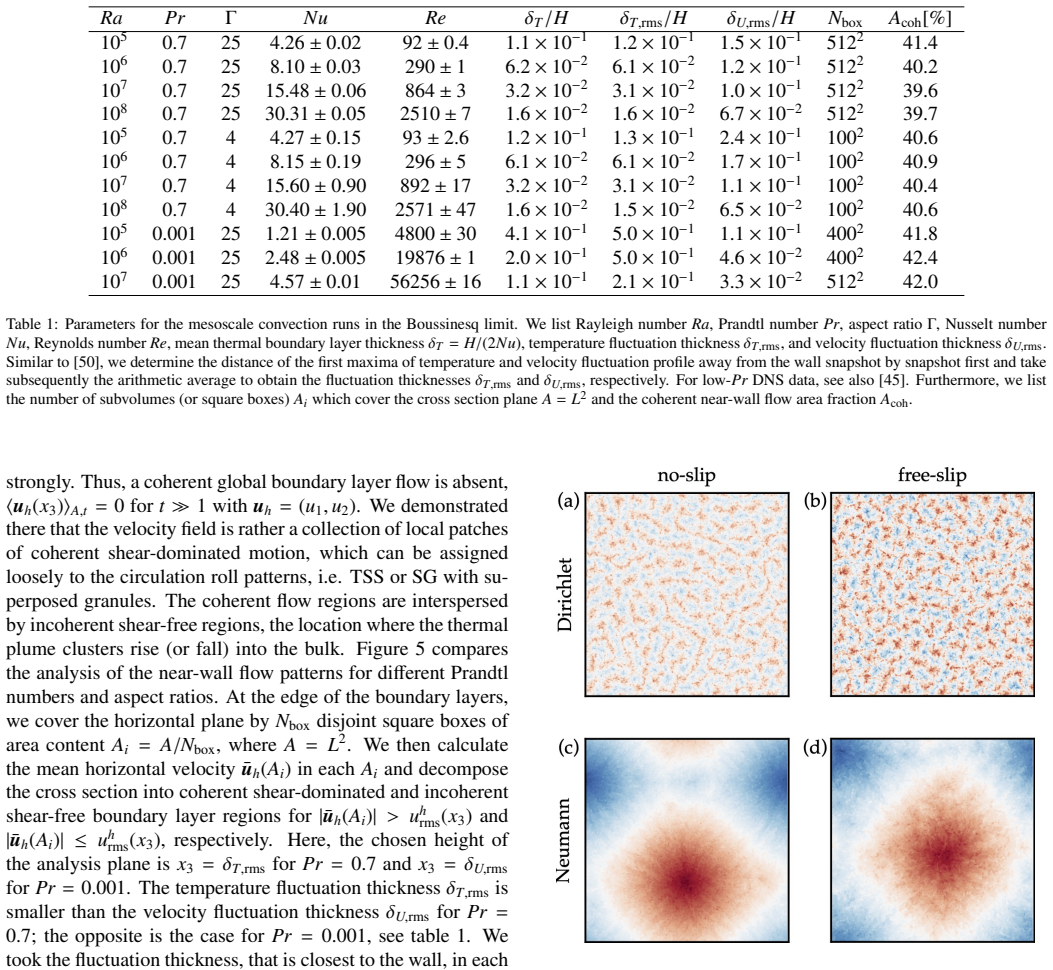
- [Sec. 3, Table 1 and Fig. 5] The claim that the coherent near-wall area fraction Acoh is always approximately 40% and independent of Prandtl number is not supported as a controlled comparison. The analysis plane is set to x3=δT,rms for Pr=0.7 and to x3=δU,rms for Pr=0.001, i.e., at different wall-normal positions, and the coherent/incoherent classification uses the threshold |u_h|≷u_rms(x3); no sensitivity to this threshold or to the coarse-graining box size is reported. With eleven table entries and no uncertainty estimates on Acoh, the apparent universality could be an artifact of the threshold definition rather than a physical invariant, and the statement in Sec. 7 that Acoh is 'independent of Prandtl number' overreaches the data.
- [Sec. 3, eq. (39) and Table 1] The scaling laws Nu∼Ra^0.29 and Re∼Ra^0.5 are fitted to only three Rayleigh numbers (Ra=10^5, 10^6, 10^7) at Pr=0.001, a fact the text itself notes in the preceding sentence. With three points, no assessment of curvature or of a possible regime change is possible, and the low values Nu=1.21, 2.48, 4.57 make a pure power-law fit particularly fragile. These expressions should be labeled as preliminary fits to three points, or supplemented by additional Rayleigh numbers, before they are presented as scaling laws in the summary of the regime.
- [Sec. 6.3, Tables 2-4 and Fig. 16] The conclusion that fully compressible convection is more intermittent than Oberbeck-Boussinesq convection rests on two FCC runs and two OB runs without uncertainty estimates for the generalized dimensions D(q) obtained from power-law fits in Fig. 15, and the bulk volume for FCC1 differs from that used for FCC2, OB1, and OB2 (Vb=L^2×[0.2,0.6]H versus L^2×[0.2,0.8]H). The differences between the D(q) curves in Fig. 16 are modest and could be within fit error. Since this intermittency claim is one of the four highlighted 'aspects' of the paper, it should either be presented explicitly as a preliminary trend or be supported by a fit-range and bootstrap sensitivity analysis.
minor comments (5)
- [Abstract and Sec. 1] The abstract contains two idiomatic errors: 'are partly not anymore accessible' should be 'are no longer accessible', and 'Beside these experiments' should be 'Besides these experiments'.
- [Eq. (20)] The derivative notation in Eq. (20) mixes d and ∂: the first term should be written with ∂T~/∂x3 consistently.
- [Table 1] The grid entries such as '5122' and '1002' should be typeset as 512^2 and 100^2; the current notation is confusing, especially when Nbox is defined in the same table.
- [Reference [29]] Reference [29] is incomplete: it contains the placeholders 'Flow XXX (2024) XXX. doi:XXX' and needs the actual journal volume, article number, and DOI.
- [Sec. 4.1] The sentence 'the critical wavelength is λcrit=2√2 and≈2.02 for free-slip [73] and no-slip conditions [74,75], respectively' is grammatically awkward and should list the two values in separate clauses for clarity.
Circularity Check
No significant circularity: the boundary-condition and structure-formation claims are backed by direct numerical simulations and classical linear-stability results, not by construction or fitted predictions.
full rationale
The paper's central claim, that thermal boundary conditions determine whether large-scale patterns form as turbulent superstructures (~5H for Dirichlet plates) or as supergranules that grow to domain size (Neumann plates), is presented as an empirical finding from DNS, with the supergranule case explicitly described as a domain-limited outcome: “a gradual, time-dependent aggregation eventually leads to a SG with a final size of ΛSG = ΓH” and the paper notes the structure is “affected by the specific domain configuration only at late times when ΛSG/Γ → 1.” The equality ΛSG = ΓH is a consequence of the structure filling the box, but the nontrivial content—that aggregation continues to the domain scale rather than saturating at an intrinsic wavelength—is an empirical DNS observation, not an equation derived from the boundary condition. The Dirichlet ~5H scale is likewise reported from prior direct simulations (e.g., refs. [10,11,13]), not fitted to the conclusion. The linear-stability argument λcrit = ∞ for the Neumann case is attributed to the external classical result of Hurle, Jakeman and Pike (ref. [76]), not to a self-citation. The Acoh ≈ 40% near-wall fraction is a threshold-based diagnostic measured from the simulations, not a parameter tuned to match a target. Although the paper relies substantially on the authors' own prior DNS studies, those are independent published simulations with stated parameters and are externally reproducible/falsifiable; self-citation of earlier computational results is not circular unless the cited result is itself the present claim. The acknowledged limitations (e.g., Sec. 7 calling the work “a starting point only,” and Sec. 4.1 noting no evidence that supergranules vanish beyond certain Ra or Pr) affect the generality of the conclusions, not their logical dependence on inputs. No step in the paper reduces a prediction to its own definition or to a fitted parameter, so the circularity score is 0.
Assumptions & free parameters
free parameters (5)
- Power-law exponent beta for k(T), mu(T) =
0, 0.165, 0.5, 7
- Coherent-area threshold =
u_rms (local rms horizontal velocity)
- Nu-Ra scaling exponent =
approximately 0.29
- Re-Ra scaling exponent =
approximately 0.5
- Bulk volume Vb for statistics =
L^2 x [0.2,0.8]H, except FCC1: [0.2,0.6]H
assumptions (6)
- domain assumption Ideal gas equation of state p = R*rho*T and temperature-dependent transport coefficients.
- domain assumption Boussinesq approximation valid when epsilon -> 0 then D -> 0 (layer height much smaller than temperature scale height).
- standard math For the adiabatic equilibrium, a polytropic gas law p ~ rho^gamma is assumed.
- domain assumption Multifractal formalism and the assumption of local isotropy in the bulk for coarse-grained dissipation.
- domain assumption DNS resolves all relevant scales down to the viscous and diffusive scales without subgrid modeling.
- domain assumption The linear stability result lambda_crit = infinity for Neumann boundary conditions extends to the fully turbulent regime.
Cite this review
Pith. "Pith review of Turbulent mesoscale convection in the Boussinesq limit and beyond." pith.science (2026). https://pith.science/paper/27ZWU6ZA
@misc{pith2026250104809,
  author       = {Pith},
  title        = {Pith review of: Turbulent mesoscale convection in the Boussinesq limit and beyond},
  year         = {2026},
  howpublished = {\url{https://pith.science/paper/27ZWU6ZA}},
  note         = {Machine review of arXiv:2501.04809}
}
read the original abstract
Mesoscale convection covers an intermediate scale range between small-scale turbulence and the global organization of the convection flow. It is often characterized by an order of the convection patterns despite very high Rayleigh numbers and strong turbulent fluctuations. In this review, we discuss several aspects of mesoscale convection, which have been investigated by three-dimensional direct numerical simulations. The numerical studies are performed in a characteristic configuration of a plane layer that is heated from below and cooled from above or subject to constant heat flux at the top and bottom boundaries. We discuss the role of the thermal and mechanical boundary conditions for structure formation and study the impact of the domain shape as well as the Prandtl number. With respect to the latter, we focus on low values that arise in astrophysical convection and are partly not anymore accessible in laboratory experiments with liquid metals. Beside these experiments in the Boussinesq approximation, we report studies of non-Boussinesq mesoscale convection. This is done by investigating effects of compressibility and temperature dependence of material properties. The kinetic energy dissipation rate turns out to remain a central quantity for the turbulent mixing in compressible convection. Their different components, statistics, relation to the turbulent viscosity, and the multifractal properties are discussed.
Figures


Figures from the paper (14 more)




Reference graph
Works this paper leans on
-
[76]
D. T. J. Hurle, E. Jakeman, E. R. Pike, On the solution of the B ´enard problem with boundaries of finite conductivity, Proc. R. Soc. Lond. A 296 (1967) 469–475
1967
-
[1]
L. P. Kadano ff, Turbulent heat flow: Structures and scaling, Phys. Today 54 (2001) 34–39. doi:10.1063/1.1404847
-
[2]
G. Ahlers, S. Grossmann, D. Lohse, Heat transfer and large scale dy- namics in turbulent Rayleigh-B ´enard convection, Rev. Mod. Phys. 81 (2009) 503–537. doi:10.1103/RevModPhys.81.503
-
[3]
F. Chill `a, J. Schumacher, New perspectives in turbulent Rayleigh- B´enard convection, Eur. Phys. J. E 35 (2012) 58. doi: 10.1140/epje/ i2012-12058-1
doi:10.1140/epje/ 2012
-
[4]
Christensen-Dalsgaard, Helioseismology, Rev
J. Christensen-Dalsgaard, Helioseismology, Rev. Mod. Phys. 74 (2002) 1073–1129. doi:10.1103/RevModPhys.74.1073
-
[5]
F. Rincon, M. Rieutord, The Sun’s supergranulation, Living Rev. Sol. Phys. 15 (2018) 6. doi:10.1007/s41116-018-0013-5
-
[6]
Schumacher, K
J. Schumacher, K. R. Sreenivasan, Colloquium: Unusual dynamics of convection in the Sun, Rev. Mod. Phys. 92 (2020) 041001. doi: 10. 1103/RevModPhys.92.041001
2020
-
[7]
Markson, Atmospheric electrical detection of organized convec- tion, Science 188 (1975) 1171–1177
R. Markson, Atmospheric electrical detection of organized convec- tion, Science 188 (1975) 1171–1177. doi: 10.1126/science.188. 4194.1171
arXiv 1975
Show all 135 references
-
[8]
B. W. Atkinson, J. Wu Zhang, Mesoscale shallow convection in the atmosphere, Rev. Geophys. 34 (1996) 403–431. doi: 10.1029/ 96RG02623
1996
-
[9]
B. E. Mapes, R. A. Houze Jr., Cloud clusters and superclusters over the warm oceanic pool, Mon. Weather Rev. 121 (1993) 1398–1415. doi:10.1175/1520-0493(1993)121<1398:CCASOT>2.0.CO;2
1993 doi
-
[10]
Pandey, J
A. Pandey, J. D. Scheel, J. Schumacher, Turbulent superstructures in Rayleigh-B´enard convection, Nat. Commun. 9 (2018) 2118. doi: 10. 1038/s41467-018-04478-0
2018
-
[11]
R. J. A. M. Stevens, A. Blass, X. Zhu, R. Verzicco, D. Lohse, Turbulent thermal superstructures in Rayleigh-B´enard convection, Phys. Rev. Flu- ids 3 (2018) 041501(R). doi:10.1103/PhysRevFluids.3.041501
2018 doi
-
[12]
Green, D
G. Green, D. G. Vlaykov, J. P. Mellado, M. Wilczek, Resolved energy budget of superstructures in Rayleigh-B´enard convection, J. Fluid Mech. 887 (2020) A21. doi:10.1017/jfm.2019.1008
2020
-
[13]
P. P. Vieweg, J. D. Scheel, J. Schumacher, Supergranule aggregation for constant heat flux-driven turbulent convection, Phys. Rev. Research 3 (2021) 013231. doi:10.1103/PhysRevResearch.3.013231
2021 doi
-
[14]
Ishihara, T
T. Ishihara, T. Gotoh, Y . Kaneda, Study of high-Reynolds number isotropic turbulence by direct numerical simulation, Annu. Rev. Fluid Mech. 41 (2009) 165–180. doi: 10.1146/annurev.fluid.010908. 165203
2009 doi
-
[15]
Schumacher, A
J. Schumacher, A. Pandey, V . Yakhot, K. R. Sreenivasan, Transition to turbulence scaling in turbulent Rayleigh-B´enard convection, Phys. Rev. E 98 (2018) 033120. doi:10.1103/PhysRevE.98.033120
2018 doi
-
[16]
Valori, J
V . Valori, J. Schumacher, Connecting boundary layer dynamics with extreme bulk dissipation events in Rayleigh-B ´enard flow, Europhys. Lett. 134 (2021) 34004. doi:10.1209/0295-5075/134/34004
2021 doi
-
[17]
M. S. Miesch, Large-scale dynamics of the convection zone and tachocline, Living Rev. Sol. Phys. 2 (2005) 1. doi: 10.12942/ lrsp-2005-1
2005
-
[18]
Nordlund, R
A. Nordlund, R. F. Stein, M. Asplund, Solar surface convection, Living Rev. Sol. Phys. 6 (2009) 2. doi:10.12942/lrsp-2009-2
2009 doi
-
[19]
Stevens, Atmospheric moist convection, Annu
B. Stevens, Atmospheric moist convection, Annu. Rev. Earth Planet. Sci. 33 (2005) 605–643. doi: 10.1146/annurev.earth.33.092203. 122658
2005 doi
-
[20]
Pauluis, J
O. Pauluis, J. Schumacher, Self-aggregation of clouds in condition- ally unstable moist convection, Proc. Natl. Acad. Sci. USA 108 (2011) 12623–12628. doi:10.1073/pnas.1102339108
2011 doi
-
[21]
M. K. Verma, Physics of Buoyant Flows, World Scientific, Singapore, 2018
2018
-
[22]
Guerrero, P
G. Guerrero, P. K. Smolarkiewicz, E. M. de Gouveia dal Pino, A. G. Kosovichev, N. N. Mansour, On the role of tachoclines in solar and stel- lar dynamos, Astrophys. J. 819 (2016) 104. doi:10.3847/0004-637X/ 819/2/104
2016 doi
-
[23]
K. R. Sreenivasan, Turbulent mixing: A perspective, Proc. Natl. Acad. Sci. USA 116 (2019) 18175–18183. doi:10.1073/pnas.1800463115
2019 doi
-
[24]
P. Moin, K. Mahesh, Direct Numerical Simulation: A tool in turbulence research, Annu. Rev. Fluid Mech. 30 (1998) 539–578. doi: 10.1146/ annurev.fluid.30.1.539
1998
-
[25]
P. F. Fischer, An overlapping Schwarz method for spectral element solu- tion of the incompressible Navier-Stokes equations, J. Comp. Phys. 133 (1997) 84–101. doi:10.1006/jcph.1997.5651
1997
-
[26]
J. D. Scheel, M. S. Emran, J. Schumacher, Resolving the fine-scale structure in turbulent Rayleigh-B ´enard convection, New J. Phys. 15 (2013) 113063. doi:10.1088/1367-2630/15/11/113063
2013 doi
-
[27]
P. F. Fischer, S. Kerkemeier, M. Min, Y .-H. Lan, M. Phillips, T. Rath- nayake, E. Merzari, A. Tomboulides, A. Karakus, N. Chalmers, T. War- burton, NekRS, a GPU-accelerated spectral element Navier–Stokes solver, Parallel Comput. 114 (2022) 102982. doi: 10.1016/j.parco. 2022.102982
2022
-
[28]
Sachs, T
S. Sachs, T. Fr ¨ohlich, J. Schumacher, Suppression of free convec- tion e ffects for spherical 1 kg mass prototype, Int. J. Heat Mass Transfer 170 (2021) 121037. doi:10.1016/j.ijheatmasstransfer. 2021.121037
2021
-
[29]
P. P. Vieweg, T. K ¨aufer, C. Cierpka, J. Schumacher, Digital twin of a large-aspect-ratio Rayleigh-B´enard experiment: Role of thermal bound- ary conditions, measurement errors and uncertainties, Flow XXX (2024) XXX. doi:XXX
2024
-
[30]
Krasnov, O
D. Krasnov, O. Zikanov, T. Boeck, Comparative study of finite dif- ference approaches in simulation of magnetohydrodynamic turbulence at low magnetic Reynolds number, Comput. Fluids 50 (2011) 46–59. doi:10.1016/j.compfluid.2011.06.015
2011 doi
-
[31]
Baranwal, D
A. Baranwal, D. A. Donzis, R. D. W. Bowersox, Asymptotic behaviour at the wall in compressible turbulent channels, J. Fluid. Mech. 933 (2022) A28. doi:10.1017/jfm.2021.1087
2022
-
[32]
L. D. Landau, E. M. Lifschitz, Course of Theoretical Physics: Fluid 23 Mechanics, Butterworth Heinemann, Oxford, 1987
1987
-
[33]
Sutherland, The viscosity of gases and molecular force, The London, Edinburgh, and Dublin Philosophical Magazine and Journal of Science 36 (1893) 507–531
W. Sutherland, The viscosity of gases and molecular force, The London, Edinburgh, and Dublin Philosophical Magazine and Journal of Science 36 (1893) 507–531
-
[34]
Verzicco, K
R. Verzicco, K. R. Sreenivasan, A comparison of turbulent ther- mal convection between conditions of constant temperature and con- stant heat flux, J. Fluid Mech. 595 (2008) 203–219. doi: 10.1017/ S0022112007009135
2008
-
[35]
Johnston, C
H. Johnston, C. R. Doering, Comparison of turbulent thermal con- vection between conditions of constant temperature and constant flux, Phys. Rev. Lett. 102 (2009) 064501. doi:10.1103/PhysRevLett.102. 064501
2009 doi
-
[36]
Moller, T
S. Moller, T. K ¨aufer, A. Pandey, J. Schumacher, C. Cierpka, Combined particle image velocimetry and thermometry of turbulent superstructures in thermal convection, J. Fluid Mech. 945 (2022) A22. doi: 10.1017/ jfm.2022.538
2022
-
[37]
Weiss, D
S. Weiss, D. Schanz, A. O. Erdogdu, A. Schr ¨oder, J. Bosbach, Inves- tigation of turbulent superstructures in Rayleigh–B ´enard convection by Lagrangian particle tracking of fluorescent microspheres, Exp. Fluids 64 (2023) 82. doi:10.1007/s00348-023-03624-9
2023 doi
-
[38]
T. L. Perelman, On conjugated problems of heat transfer, Int. J. Heat Mass Transfer 3 (1961) 293–303. doi: 10.1016/0017-9310(61) 90044-8
1961 doi
-
[39]
C. A. Jones, K. A. Mizerski, M. Kessar, Fully developed anelastic convection with no-slip boundaries, J. Fluid Mech. 930 (2022) A13. doi:10.1017/jfm.2021.905
2022 doi
-
[40]
Verhoeven, T
J. Verhoeven, T. Wieseh ¨ofer, S. Stellmach, Anelastic versus fully com- pressible turbulent convection Rayleigh-B´enard convection, Astrophys. J. 805 (2015) 62. doi:10.1088/0004-637X/805/1/62
2015 doi
-
[41]
Panickacheril John, J
J. Panickacheril John, J. Schumacher, Strongly superadiabatic and strat- ified limits of compressible convection, Phys. Rev. Fluids 8 (2023) 103505. doi:10.1103/PhysRevFluids.8.103505
2023 doi
-
[42]
Oberbeck, Ueber die W ¨armeleitung der Fl ¨ussigkeiten bei Ber¨ucksichtigung der Str ¨omungen infolge von Temperaturdi fferenzen, Ann
A. Oberbeck, Ueber die W ¨armeleitung der Fl ¨ussigkeiten bei Ber¨ucksichtigung der Str ¨omungen infolge von Temperaturdi fferenzen, Ann. Phys. Chem. VII (1879) 271–292
-
[43]
Boussinesq, Th ´eorie analytique de la chaleur: mise en harmonie avec la thermodynamique et avec la th ´eorie m ´ecanique de la lumi `ere, Gauthier-Villars, Paris, 1903
J. Boussinesq, Th ´eorie analytique de la chaleur: mise en harmonie avec la thermodynamique et avec la th ´eorie m ´ecanique de la lumi `ere, Gauthier-Villars, Paris, 1903
1903
-
[44]
Otero, R
J. Otero, R. W. Wittenberg, R. A. Worthing, C. R. Doering, Bounds on Rayleigh-B´enard convection with an imposed heat flux, J. Fluid Mech. 473 (2002) 191–199. doi:10.1017/S0022112002002410
2002 doi
-
[45]
Pandey, D
A. Pandey, D. Krasnov, K. R. Sreenivasan, J. Schumacher, Convective mesoscale turbulence at very low Prandtl numbers, J. Fluid Mech. 948 (2022) A23. doi:10.1017/jfm.2022.694
2022 doi
-
[46]
Horanyi, L
S. Horanyi, L. Krebs, U. M ¨uller, Turbulent Rayleigh–B ´enard convec- tion in low Prandtl–number fluids, Int. J. Heat Mass Transfer 42 (1999) 3983–4003. doi:10.1016/S0017-9310(99)00059-9
1999 doi
-
[47]
Glazier, T
J. Glazier, T. Segawa, A. Naert, M. Sano, Evidence against ‘ultrahard’ thermal turbulence at very high Rayleigh numbers, Nature 398 (1999) 307–310
1999
-
[48]
V ogt, S
T. V ogt, S. Horn, A. M. Grannan, J. M. Aurnou, Jump rope vortex in liquid metal convection, Proc. Natl. Acad. Sci. USA 115 (2018) 12674– 12679. doi:10.1073/pnas.1812260115
2018 doi
-
[49]
Z ¨urner, F
T. Z ¨urner, F. Schindler, T. V ogt, S. Eckert, J. Schumacher, Combined measurement of velocity and temperature in liquid metal convection, J. Fluid Mech. 876 (2019) 1108–1128. doi:10.1017/jfm.2019.556
2019 doi
-
[50]
R. J. Samuel, M. Bode, J. D. Scheel, K. R. Sreenivasan, J. Schumacher, No sustained mean velocity in the boundary region of plane thermal con- vection, J. Fluid Mech. 996 (2024) A49. doi:10.1017/jfm.2024.853
2024 doi
-
[51]
Bailon-Cuba, M
J. Bailon-Cuba, M. S. Emran, J. Schumacher, Aspect ratio dependence of heat transfer and large-scale flow in turbulent convection, J. Fluid Mech. 655 (2010) 152–173. doi:10.1017/S0022112010000820
2010 doi
-
[52]
J. D. Scheel, J. Schumacher, Predicting transition ranges to fully tur- bulent viscous boundary layers in low Prandtl number convection flows, Phys. Rev. Fluids 2 (2017) 123501. doi:10.1103/PhysRevFluids.2. 123501
2017 doi
-
[53]
R. J. Stevens, R. Hartmann, R. Verzicco, D. Lohse, How wide must Rayleigh–B´enard cells be to prevent finite aspect ratio e ffects in turbu- lent flow?, J. Fluid Mech. 1000 (2024) A58. doi: 10.1017/jfm.2024. 996
2024 doi
-
[54]
Schumacher, P
J. Schumacher, P. G ¨otzfried, J. D. Scheel, Enhanced enstrophy gen- eration for turbulent convection in low-Prandtl-number fluids, Proc. Natl. Acad. Sci. USA 112 (2015) 9530–9535. doi: 10.1073/pnas. 1505111112
2015 doi
-
[55]
P. P. Vieweg, Large-Scale Flow Structures in Turbulent Rayleigh- B´enard Convection: Dynamical Origin, Formation, and Role in Material Transport, Ph.D. thesis, TU Ilmenau, 2023-12-05. doi:10.22032/DBT. 58334
2023 doi
-
[56]
D. Krug, D. Lohse, R. J. A. M. Stevens, Coherence of temperature and velocity superstructures in turbulent Rayleigh–B´enard flow, J. Fluid Mech. 887 (2020) A2. doi:10.1017/jfm.2019.1054
2020
-
[57]
Foroozani, D
N. Foroozani, D. Krasnov, J. Schumacher, Turbulent convection for different thermal boundary conditions at the plates, J. Fluid Mech. 907 (2021) A27. doi:10.1017/jfm.2020.830
2021 doi
-
[58]
Zwirner, A
L. Zwirner, A. Tilgner, O. Shishkina, Elliptical instability and multiple- roll flow modes of the large-scale circulation in confined turbulent Rayleigh-B´enard convection, Phys. Rev. Lett. 125 (2020) 054502. doi:10.1103/Phys.Rev.Lett.125.054502
2020 doi
-
[59]
K. Iyer, J. D. Scheel, J. Schumacher, K. R. Sreenivasan, Classical 1 /3 scaling of convection holds up toRa = 1015, Proc. Natl. Acad. Sci. USA 117 (2020) 7594–7598. doi:10.1073/pnas.1922794117
2020 doi
-
[60]
M. C. Cross, H. S. Greenside, Pattern Formation and Dynamics in Nonequilibrium Systems, Cambridge University Press, Cambridge, UK, 2009
2009
-
[61]
E. L. Koschmieder, B ´enard Cells and Taylor V ortices, Cambridge Uni- versity Press, Cambridge, UK, 1993
1993
-
[62]
Manneville, Rayleigh-B ´enard convection: Thirty years of experimen- tal, theoretical, and modeling work, in: I
P. Manneville, Rayleigh-B ´enard convection: Thirty years of experimen- tal, theoretical, and modeling work, in: I. Mutabazi, J. E. Wesfreid, E. Guyon (Eds.), Dynamics of Spatio-Temporal Cellular Structures, vol- ume 207, Springer, New York, 2006, pp. 41–65
2006
-
[63]
C. Liu, M. Sharma, K. Julien, E. Knobloch, Fixed-flux Rayleigh–B´enard convection in doubly periodic domains: generation of large-scale shear, J. Fluid Mech. 979 (2024) A19. doi:10.1017/jfm.2023.1057
2024
-
[64]
P. P. Vieweg, J. D. Scheel, R. Stepanov, J. Schumacher, Inverse cascades of kinetic energy and thermal variance in three-dimensional horizontally extended turbulent convection, Phys. Rev. Research 4 (2022) 043098. doi:10.1103/PhysRevResearch.4.043098
2022 doi
-
[66]
P. P. Vieweg, A. Kl¨unker, J. Schumacher, K. Padberg-Gehle, Lagrangian studies of coherent sets and heat transport in constant heat flux-driven turbulent Rayleigh–B ´enard convection, Eur. J. Mech. B-Fluids 103 (2024) 69–85. doi:10.1016/j.euromechflu.2023.08.007
2024 doi
-
[67]
P. P. Vieweg, Supergranule aggregation: A Prandtl number-independent feature of constant heat flux-driven convection flows, J. Fluid Mech. 980 (2024) A46. doi:10.1017/jfm.2024.56
2024 doi
-
[68]
Fodor, J
K. Fodor, J. P. Mellado, M. Wilczek, On the role of large-scale updrafts and downdrafts in deviations from Monin–Obukhov similarity theory in free convection, Bound.-Layer Meteorol. 172 (2019) 371–396. doi: 10. 1007/s10546-019-00454-3
2019
-
[69]
P. P. Vieweg, C. Schneide, K. Padberg-Gehle, J. Schumacher, La- grangian heat transport in turbulent three-dimensional convection, Phys. Rev. Fluids 6 (2021) L041501. doi: 10.1103/PhysRevFluids.6. L041501
2021 doi
-
[70]
Schneide, P
C. Schneide, P. P. Vieweg, J. Schumacher, K. Padberg-Gehle, Evolution- ary clustering of Lagrangian trajectories in turbulent Rayleigh–B ´enard convection flows, Chaos 32 (2022) 013123. doi:10.1063/5.0076035
2022 doi
-
[71]
C. J. Chapman, M. R. E. Proctor, Nonlinear Rayleigh–B ´enard convec- tion between poorly conducting boundaries, J. Fluid Mech. 101 (1980) 759–782. doi:10.1017/S0022112080001917
1980 doi
-
[72]
C. J. Chapman, S. Childress, M. R. E. Proctor, Long wavelength thermal convection between non-conducting boundaries, Earth Planet. Sc. Lett. 51 (1980) 362–369. doi:10.1016/0012-821X(80)90217-4
1980 doi
-
[73]
O. M. L. Rayleigh, LIX. On convection currents in a horizontal layer of fluid, when the higher temperature is on the under side, Philos. Mag. 32 (1916) 529–546
1916
-
[74]
Pellew, R
A. Pellew, R. V . Southwell, On maintained convective motion in a fluid heated from below, Proc. R. Soc. Lond. A 176 (1940) 312–343. doi:10. 1098/rspa.1940.0092
1940
-
[75]
Chandrasekhar, Hydrodynamic and hydromagnetic instability, Dover 24 Publications, Mineola, 1961
S. Chandrasekhar, Hydrodynamic and hydromagnetic instability, Dover 24 Publications, Mineola, 1961
1961
-
[77]
Pikovsky, A
A. Pikovsky, A. Politi, Lyapunov exponents – A tool to explore complex dynamics, Cambridge University Press, Cambridge, UK, 2016
2016
-
[78]
G. M. Vasil, K. Julien, N. A. Featherstone, Rotation suppresses giant-scale solar convection, Proc. Natl. Acad. Sci. USA 118 (2021) e2022518118. doi:10.1073/pnas.2022518118
2021 doi
-
[79]
Alexakis, R
A. Alexakis, R. Marino, P. D. Mininni, A. van Kan, R. Foldes, F. Feraco, Large-scale self-organization in dry turbulent atmospheres, Science 383 (2024) 1005–1009. doi:10.1126/science.adg8269
2024 doi
-
[80]
Hartlep, A
T. Hartlep, A. Tilgner, F. H. Busse, Large scale structures in Rayleigh- B´enard convection at high Rayleigh numbers, Phys. Rev. Lett. 91 (2003) 064501. doi:10.1103/PhysRevLett.91.064501
2003 doi
-
[81]
Hartlep, A
T. Hartlep, A. Tilgner, F. H. Busse, Transition to turbulent convection in a fluid layer heated from below at moderate aspect ratio, J. Fluid Mech. 554 (2005) 309–322. doi:10.1017/S0022112005006671
2005 doi
-
[82]
M. S. Emran, J. Schumacher, Large-scale mean patterns in turbulent convection, J. Fluid Mech. 776 (2015) 96–108. doi: 10.1017/jfm. 2015.316
2015 doi
-
[83]
P. J. Sakievich, Y . T. Peet, R. J. Adrian, Large-scale thermal motions of turbulent Rayleigh–B´enard convection in a wide aspect-ratio cylindrical domain, Int. J. Heat Fluid Flow 61 (2016) 183–196. doi: 10.1016/j. ijheatfluidflow.2016.04.011
2016 doi
-
[84]
Fr ¨ohlich, P
J. Fr ¨ohlich, P. Laure, R. Peyret, Large departures from Boussinesq ap- proximation in the Rayleigh-B ´enard problem, Phys. Fluids A 4 (1992) 1355–1372. doi:10.1063/1.858413
1992 doi
-
[85]
S. Horn, O. Shishkina, C. Wagner, On non-Oberbeck–Boussinesq effects in three-dimensional Rayleigh–B ´enard convection in glycerol, J. Fluid Mech. 724 (2013) 175–202. doi:10.1017/jfm.2013.151
2013 doi
-
[86]
Pandey, J
A. Pandey, J. Schumacher, K. R. Sreenivasan, Non-Boussinesq low- Prandtl-number convection with a temperature-dependent thermal diffu- sivity, Astrophys. J. 907 (2021) 56. doi:10.3847/1538-4357/abd1d8
2021 doi
-
[87]
Pandey, J
A. Pandey, J. Schumacher, K. R. Sreenivasan, Non-Boussinesq convec- tion at low Prandtl numbers relevant to the Sun, Phys. Rev. Fluids 6 (2021) 100503. doi:10.1103/PhysRevFluids.6.100503
2021 doi
-
[88]
Valori, G
V . Valori, G. E. Elsinga, M. Rohde, J. Westerweel, T. H. J. J. van der Hagen, Particle image velocimetry measurements of a thermally convective supercritical fluid, Exp. Fluids (2019) 143. doi: 10.1007/ s00348-019-2789-z
2019
-
[89]
Panickacheril John, J
J. Panickacheril John, J. Schumacher, Compressible turbulent convec- tion in highly stratified adiabatic background, J. Fluid Mech. 972 (2023) R4. doi:10.1017/jfm.2023.724
2023 doi
-
[90]
Alboussi `ere, Y
T. Alboussi `ere, Y . Ricard, Rayleigh-B ´enard stability and the validity of quasi-Boussinesq or quasi-anelastic liquid approximations, J. Fluid Mech. 817 (2017) 264–305. doi:10.1017/jfm.2017.108
2017 doi
-
[91]
Curbelo, L
J. Curbelo, L. Duarte, T. Alboussi `ere, F. Dubuffet, S. Labrosse, Y . Ri- card, Numerical solutions of compressible convection with an infi- nite Prandtl number: Comparison of the anelastic and anelastic liquid models with the exact equations, J. Fluid Mech. 873 (2019) 646–68...
2019 doi
-
[92]
H. Yik, V . Valori, S. Weiss, Turbulent Rayleigh-B´3nard convection un- der strong non-Oberbeck-Boussinesq conditions, Phys. Rev. Fluids 5 (2020) 103502. doi:10.1103/PhysRevFluids.5.103502
2020 doi
-
[93]
Macek and G
M. Macek and G. Zinchenko and V . Musilov´a and P. Urban and J. Schu- macher, Assessing non-Oberbeck-Boussinesq e ffects of convection in cryogenic helium, Phys. Rev. Fluids 8 (2023) 094606. doi: 10.1103/ PhysRevFluids.8.094606
2023
-
[94]
Panickacheril John, J
J. Panickacheril John, J. Schumacher, Compressible turbulent con- vection: The role of temperature- dependent thermal conductivity and dynamic viscosity, Phys. Fluids 36 (2024) 076132. doi: 10.1063/5. 0216623
2024 doi
-
[95]
Shcheritsa, A
O. Shcheritsa, A. Getling, O. Mazhorova, E ffects of variable thermal diffusivity on the structure of convection, Phys. Lett. A 382 (2018) 639–
2018
-
[96]
A. N. Kolmogorov, The local structure of turbulence in incompressible viscous fluid for very large reynolds numbers, Dokl. Akad. Nauk SSSR 30 (1941) 9–13
1941
-
[97]
G. K. Batchelor, Small-scale variation of convected quantities like temperature in turbulent fluid .1. General discussion and the case of small conductivity, J. Fluid Mech. 5 (1959) 113–133. doi: 10.1017/ S002211205900009X
1959
-
[98]
Corrsin, On the spectrum of isotropic temperature fluctuations in an isotropic turbulence, J
S. Corrsin, On the spectrum of isotropic temperature fluctuations in an isotropic turbulence, J. Appl. Phys. 22 (1951) 469–473. doi: 10.1063/ 1.1699986
1951
-
[99]
A. N. Kolmogorov, A refinement of previous hypotheses concerning the local structure of turbulence in a viscous incompressible fluid at high Reynolds number, J. Fluid Mech. 13 (1962) 82–85. doi:10.1017/ S0022112062000518
1962
-
[100]
A. M. Obukhov, Some specific features of atmospheric turbulence, J. Fluid Mech. 13 (1962) 77–81. doi:10.1017/S0022112062000506
1962 doi
-
[101]
Stolovitzky, P
G. Stolovitzky, P. Kailasnath, K. R. Sreenivasan, Refined similarity hy- potheses for passive scalars mixed by turbulence, J. Fluid Mech. 297 (1995) 275–291. doi:10.1017/S0022112095003090
1995 doi
-
[102]
Falconer, Fractal Geometry - Mathematical Foundations and Appli- cations, Wiley, Chichester, UK, 2003
K. Falconer, Fractal Geometry - Mathematical Foundations and Appli- cations, Wiley, Chichester, UK, 2003
2003
-
[103]
Grassberger, On the fractal dimension of the henon attractor, Phys
P. Grassberger, On the fractal dimension of the henon attractor, Phys. Lett. A 97 (1983) 224–226. doi:10.1016/0375-9601(83)90752-1
1983 doi
-
[104]
H. G. E. Hentschel, I. Procaccia, The infinite number of generalized dimensions of fractals and strange attractors, Physica D 8 (1983) 435–
1983
-
[105]
K. R. Sreenivasan, Fractals and multifractals in fluid turbulence, Annu. Rev. Fluid Mech. 23 (1991) 539–604. doi:10.1146/annurev.fl.23. 010191.002543
1991
-
[106]
Mukherjee, S
S. Mukherjee, S. D. Murugan, R. Mukherjee, S. S. Ray, Turbulent flows are not uniformly multifractal, Phys. Rev. Lett. 132 (2024) 184002. doi:10.1103/PhysRevLett.132.184002
2024 doi
-
[107]
Schumacher, K
J. Schumacher, K. R. Sreenivasan, Geometric features of the mixing of passive scalars at high Schmidt numbers, Phys. Rev. Lett. 91 (2003) 174501. doi:10.1103/PhysRevLett.91.174501
2003 doi
-
[108]
Schumacher, K
J. Schumacher, K. R. Sreenivasan, P. K. Yeung, Very fine structures in scalar mixing, J. Fluid Mech. 531 (2005) 113–122. doi: 10.1017/ S0022112005004040
2005
-
[109]
K. R. Sreenivasan, J. Schumacher, What is the turbulence problem, and when may we regard it as solved?, Annu. Rev. Condens. Matter Phys. 16 (2025) 121–143. doi: 10.1146/ annurev-conmatphys-031620-095842
2025
-
[110]
Gotoh, J
T. Gotoh, J. Yang, Transition of fluctuations from Gaussian state to turbulent state, Phil. Trans. R. Soc. A. 380 (2022) 20210097. doi: 10. 1098/rsta.2021.0097
2022
-
[111]
Gotoh, T
T. Gotoh, T. Watanabe, I. Saito, Kinematic e ffects on probability den- sity functions of energy dissipation rate and enstrophy in turbulence, Phys. Rev. Lett. 130 (2023) 254001. doi:10.1103/PhysRevLett.130. 254001
2023 doi
-
[112]
Sarkar, G
S. Sarkar, G. Erlebacher, M. Y . Hussaini, H. O. Kreiss, The analysis and modelling of dilatational terms in compressible turbulence, J. Fluid Mech. 227 (1991) 473–493. doi:10.1017/S0022112091000204
1991 doi
-
[113]
Sarkar, The pressure-dilatation correlation in compressible flows, Phys
S. Sarkar, The pressure-dilatation correlation in compressible flows, Phys. Fluids 4 (1992) 2674–2682. doi:10.1063/1.858454
1992 doi
-
[114]
P. G. Huang, G. N. Coleman, P. Bradshaw, Compressible turbulent chan- nel flows: DNS results and modelling, J. Fluid Mech. 305 (1995) 185–
1995
-
[115]
Pirozzoli, F
S. Pirozzoli, F. Grasso, Direct numerical simulations of isotropic compressible turbulence: Influence of compressibility on dynamics and structures, Phys. Fluids 16 (2004) 4386–4407. doi: 10.1063/1. 1804553
2004 doi
-
[116]
Pirozzoli, Numerical methods for high-speed flows, Annu
S. Pirozzoli, Numerical methods for high-speed flows, Annu. Rev. Fluid Mech. 43 (2011) 163–194. doi: 10.1146/ annurev-fluid-122109-160718
2011
-
[117]
Panickacheril John, D
J. Panickacheril John, D. A. Donzis, K. R. Sreenivasan, Does dissipative anomaly hold for compressible turbulence?, J. Fluid Mech. 920 (2021) A20. doi:10.1017/jfm.2021.443
2021 doi
-
[118]
D. A. Donzis, J. Panickacheril John, Universality and scaling in homo- geneous compressible turbulence, Phys. Rev. Fluids 5 (2020) 084609. doi:10.1103/PhysRevFluids.5.084609
2020 doi
-
[119]
S. B. Pope, Turbulent Flows, Cambridge University Press, Cambridge, UK, 2000
2000
-
[120]
Pandey, D
A. Pandey, D. Krasnov, J. Schumacher, R. Samtaney, K. R. Sreenivasan, Similarities between characteristics of convective turbulence in confined and extended domains, Physica D 442 (2022) 133537. doi:10.1016/j. physd.2022.133537. 25
2022
-
[121]
Frisch, Turbulence: The Legacy of A
U. Frisch, Turbulence: The Legacy of A. N. Kolmogorov, Cambridge University Press, Cambridge, UK, 1994
1994
-
[122]
E. A. Novikov, R. W. Stewart, Intermittency of turbulence and the spec- trum of fluctuations of energy dissipation, Isv. Akad. Nauk USSR, Ser. Geophys. 3 (1964) 408–413
1964
-
[123]
B. B. Mandelbrot, Intermittent turbulence in self-similar cascades: Di- vergence of high moments and dimension of the carrier, J. Fluid Mech. 62 (1974) 331–358. doi:10.1017/S0022112074000711
1974 doi
-
[124]
Frisch, P.-L
U. Frisch, P.-L. Sulem, M. Nelkin, A simple dynamical model of inter- mittent fully developed turbulence, J. Fluid Mech. 87 (1978) 719–736. doi:10.1017/S0022112078001846
1978 doi
-
[125]
K. R. Sreenivasan, R. A. Antonia, The phenomenology of small-scale turbulence, Annu. Rev. Fluid Mech. 29 (1997) 435–472. doi:10.1146/ annurev.fluid.29.1.435
1997
-
[126]
Meneveau, K
C. Meneveau, K. R. Sreenivasan, The multifractal spectrum of the dis- sipation field in turbulent flows, Nucl. Phys. B Proc. Suppl. 2 (1987) 49–76. doi:10.1016/0920-5632(87)90008-9
1987 doi
-
[127]
T. C. Halsey, M. H. Jensen, L. P. Kadanoff, I. Procaccia, B. I. Shraiman, Fractal measures and their singularities: The characterization of strange sets, Phys. Rev. A 33 (1986) 1141–1151. doi:10.1103/PhysRevA.33. 1141
1986 doi
-
[128]
Brandenburg, Stellar mixing length theory with entropy rain, Astro- phys
A. Brandenburg, Stellar mixing length theory with entropy rain, Astro- phys. J. 832 (2016) 6. doi:10.3847/0004-637X/832/1/6
2016 doi
-
[129]
Pandey, J
S. Pandey, J. Schumacher, Reservoir computing model of two- dimensional turbulent convection, Phys. Rev. Fluids 5 (2020) 113506. doi:10.1103/PhysRevFluids.5.113506
2020 doi
-
[130]
Pfe ffer, F
P. Pfe ffer, F. Heyder, J. Schumacher, Hybrid quantum-classical reservoir computing of thermal convection flow, Phys. Rev. Research 4 (2022) 033176. doi:10.1103/PhysRevResearch.4.033176
2022 doi
-
[131]
Pfe ffer, F
P. Pfe ffer, F. Heyder, J. Schumacher, Reduced-order modeling of two-dimensional turbulent Rayleigh-B ´enard flow by hybrid quantum- classical reservoir computing, Phys. Rev. Research 5 (2023) 043242. doi:10.1103/PhysRevResearch.5.043242
2023 doi
-
[132]
Kobayashi, K
K. Kobayashi, K. Fujii, N. Yamamoto, Feedback-driven quantum reservoir computing for time-series analysis, PRX Quantum 5 (2024) 040325. doi:10.1103/PRXQuantum.5.040325
2024 doi
-
[133]
Heyder, J
F. Heyder, J. P. Mellado, J. Schumacher, Generative convective parametrization of a dry atmospheric boundary layer, J. Adv. Model. Earth Syst. 16 (2024) e2023MS004012. doi:10.1029/2023MS004012. 26
2024 doi
-
[218]
doi:10.1017/S0022112095004599
-
[444]
doi:10.1016/0167-2789(83)90235-X
-
[645]
doi:10.1016/j.physleta.2018.01.009
2018 doi
Reviewed August 10, 2026 · model on record in the stance chip above.
Discussion (0). Continue with ORCID to comment.