REVIEW 3 major objections 3 minor 42 references
Aspects of Propagator Sparsening in Lattice QCD
T0 review · 3 major / 3 minor · reviewed 2026-08-10 · deepseek-v4-flash
Pith's one-line read This paper claims that sequentially applying gauge-covariant averaging to quark propagators before decimating them preserves pion, proton, and Delta correlation functions and form-factor ratios far better than plain decimation, allowing…
desk verdict A useful sparsening extension with a clean analytic core, but the central 'many steps are best' claim is confounded by mixing sink-only and source+sink blocking. read the letter →
The pith
A machine-rendered reading of the paper's core claim, the machinery that carries it, and where it could break.
The reading
What carries the argument
The central object is the blocking map F in Eq. (5), which replaces a propagator S(x|y) by a gauge-covariant average of S over nearest-neighbor (weight $\alpha$) and next-to-nearest-neighbor (weight $\beta$) lattice sites, transporting quark fields with gauge links so the result transforms correctly under gauge rotations. Applying F n times builds paths of length up to n between source and sink; for $\alpha$ = $\beta$ = 1 and n = 20, the averaged operator corresponds to a strongly smeared interpolating operator. This is what carries the argument: blocking before decimation is equivalent to constructing correlation functions with smeared operators, and sequential repetition systematically suppresses the higher-momentum modes that plain decimation would otherwise leave in the correlation function. The paper measures fidelity with three metrics, M1, M2, and M3, comparing sparsened to unsparsened effective energies and noise, and uses the ratio R^h, with a square-root-of-two correction at the maximal momentum q = pi/s, to extract form-factor information.
What would settle it
Compute the same correlation functions with symmetric source-sink blocking at n = 1, n = 2, and n = 5 at fixed decimation, and compare against n = 20; if one symmetric step already reproduces the n = 20 fidelity, then the number of sequential steps is not the cause. A second check would be a controlled scan of n = 10, 20, and 40 to see whether fidelity improves monotonically with step count.
Extended reading notes
Core claim
The paper's central claim is that weighted covariant-averaging applied sequentially many times before decimation preserves low-energy physics better than plain decimation at the same decimation factor. On a $24^{3}$ x 48 lattice with an improved clover fermion action, the authors compute pion, proton, and $\Delta$ two-point functions and pion and proton vector-current three-point functions, sparsened by factors s = 2, 3, 4, 6, 8, 12 with one, five, or twenty blocking steps at couplings $\alpha$ = $\beta$ = 1. They report that twenty blocking steps make the sparsened correlation functions agree with their unsparsened versions at earlier times and allow larger decimation factors, at the price of increased statistical uncertainties; the extracted ground-state energies and the ratio R^h used for form factors remain consistent with the unsparsened results. This is an extension claim: not a new law of nature, but evidence that a particular sparsening construction inherits the robust-energy result of decimation while improving excited-state control.
Load-bearing premise
The comparison that leads to the claim that many sequential averaging steps are the key mixes two changes at once: n = 20 blocks both source and sink, while n = 1 and n = 5 block only the sink, so if symmetric source-sink blocking alone explains the improvement, the central claim about many steps is not established.
Editorial extensions
If this is right
- With sequential blocking at alpha = beta = 1 and n = 20, decimation factors up to at least s = 12 keep extracted hadron energies consistent with unsparsened values.
- Sparsened three-point functions reproduce the vector-current ratio R^h across several momenta and operator insertion times, which carries over to form-factor extractions.
- Because storage and Wick-contraction costs scale with the number of retained sites, larger usable decimation factors translate directly into smaller propagators and cheaper later stages of multi-hadron calculations.
- The optimum sparsening choice is a three-way balance: more blocking steps suppress excited states, but increase statistical noise, so the best choice depends on the statistics budget and the target observable.
Reading between the lines
- The paper's data do not isolate the number of blocking steps from the source-sink symmetry of the blocking, so a direct test with symmetric n = 1 blocking versus n = 20 blocking would settle whether sequential averaging itself is the active ingredient.
- If the step-count effect survives that control, tuning alpha and beta separately for each hadron and momentum is a natural optimization, since the reported metrics show a broad region of good fidelity near alpha = beta = 1.
- The same sequential covariant averaging could be applied to the gauge field or to other field objects, potentially moving storage savings earlier in the pipeline; the paper notes the construction generalizes but does not test it.
- A practical adoption would require a floating-point cost benchmark: for multi-baryon Wick contractions, the extra blocking steps must cost less than the contraction savings they enable, which this paper does not quantify.
Editorial analysis
A structured set of objections, weighed in public.
Referee Report
Summary. The paper proposes a general scheme for quark-propagator sparsening that combines gauge-covariant nearest- and next-to-nearest-neighbor blocking with spatial decimation, and studies the resulting pion, proton, and Delta two-point functions and pion/proton three-point functions on a 24^3 x 48 Wilson-clover ensemble. The central claim, stated in the abstract and reiterated in Sec. VII, is that sparsening is most effective in reproducing unsparsened correlation functions when weighted covariant averaging is sequentially applied many times. The paper also derives an analytic equivalence between blocking and smeared interpolating operators (Sec. II C) and includes a free-propagator consistency check (Appendix A).
Significance. If the central claim is correct, the work has clear practical value: it would justify larger decimation factors for sparsened propagators, reducing storage and Wick-contraction costs in multi-nucleon and many-body lattice QCD calculations. The analytic relation in Sec. II C between gauge-covariant blocking and smeared interpolating operators is a clean and useful contribution, and the free-propagator study in Appendix A is a sensible independent toy model that supports the qualitative dependence on alpha and beta seen in the QCD results. However, as detailed below, the numerical evidence for the headline claim about the number of blocking steps is confounded, so the quantitative conclusion is not yet established.
major comments (3)
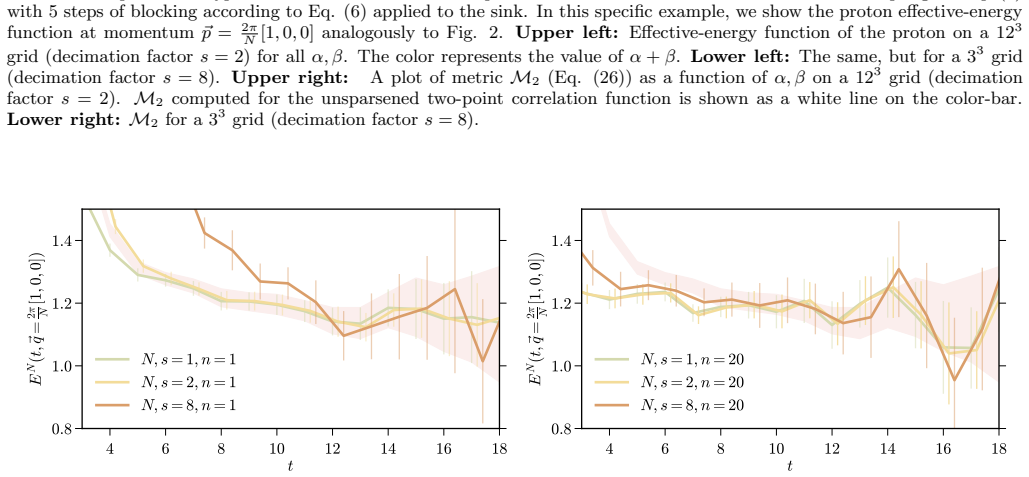
- [Sec. IV C; Fig. 5 and Figs. 6-9] The comparison that underpins the abstract claim is confounded. In Fig. 5 (and similarly in Figs. 6, 7, 8, and 9), the n=1 and n=5 runs block only the sink, while the n=20 runs block both the source and the sink. The improved agreement between decimated and unsparsened results at n=20 could therefore be caused by symmetric source-sink smearing rather than by the number of sequential blocking steps. The text in Sec. IV C states 'For α = β = 1, we study symmetric blocking of the source and sink using F1, F5, and F20', which directly contradicts the figure captions that n=1 and n=5 are sink-only. If symmetric n=1 and n=5 data exist, they should be included in the comparison figures; if they do not, the comparison does not isolate the effect of varying n. This is load-bearing because the paper's central claim is precisely that 'many' blocking steps are most effective.
- [Sec. IV C, Eq. (25), Fig. 5] Even if the source/sink asymmetry were fixed, the reference 'unsparsened' correlator is not the undecimated correlator at the same blocking level. The pink band in Fig. 5 appears to denote the n=0, s=1 result, so the distance between the n=20 decimated curve and this band is compared with the distance between the n=1 decimated curve and the same n=0 band. Because increasing n itself reduces excited-state contamination (as the paper acknowledges, 'in-line with previous results for operator smearing'), the improved agreement at n=20 may simply reflect the known smearing effect on the undecimated correlator rather than enhanced preservation of long-distance information after decimation. A controlled measure would compare the decimated n-step correlator against the undecimated n-step correlator for each n, or otherwise report M1 with the reference correlator at the same blocking level. This point is central to the interpretation of Figs. 5-9 and should be addressed.
- [Table I; Fig. 6 caption] There is an internal inconsistency about which runs are symmetric. The caption of Table I states that the quoted uncertainties are 'for sparsening both the source and sink with α = β = 1' and lists n=1 and n=5 entries, while the caption of Fig. 6 states that 'in the case of n = 1 and 5, we block only the sink but for n = 20, we block both the source and sink'. The manuscript must specify unambiguously which runs are sink-only and which are symmetric; if Table I includes symmetric n=1 and n=5 runs, the corresponding effective-energy comparisons should be shown, and if it does not, the table caption must be corrected. This inconsistency affects the reproducibility of the reported results.
minor comments (3)
- [Fig. 5 caption] The caption labels the second panel as 'Left' when it should be 'Right'.
- [Eq. (5), last line] In the final term of Eq. (5), the factor U†_{μ2}(x) appears where a gauge link attached to the source coordinate y would be expected; please check the placement of the arguments in this term.
- [Sec. II A, text after Eq. (1)] The sentence '⟨π†(p,t)π(p,0)⟩⟩' contains a duplicated angle bracket from the PDF typesetting; this should be corrected.
Circularity Check
No significant circularity; the sparsening results are compared against independently computed unsparsened correlators with scanned, not fitted, parameters.
full rationale
The paper's derivation chain is self-contained. The sparsened propagators are obtained by applying the blocking map of Eq. (5) and decimation to numerically computed quark propagators, and the effectiveness metrics M1-M3 compare the resulting correlation functions against unsparsened correlators computed on the same ensembles; no sparsening parameter (alpha, beta, n, s) is fitted to reproduce the target, so the claimed effectiveness is not forced by construction. The blocking operator itself is introduced as a definition, and the claimed equivalence between propagator blocking and smeared interpolating operators (Eqs. (8)-(9) and Fig. 1) is an explicit mathematical identity used for interpretation, not an input-output equation that guarantees the central numerical conclusion. The paper even states that early-time ground-state recovery 'is not a surprising result and is similar to previous results found for smearing' and attributes it to the blocking step, rather than presenting it as a free-standing prediction. The free-propagator appendix is an independent toy-model control (U=I, different mass, same qualitative trends), not a fit to the QCD data. Self-citations to Refs. [13-18,20] are used as prior context or baseline ('we recover the previous results of Ref. [18]'), not as load-bearing evidence, and no uniqueness claim is imported. The main caveat is an experimental-design confound: Fig. 5 uses sink-only blocking for n=1 but source-and-sink blocking for n=20, and Sec. IV C's statement that F1/F5/F20 are studied with symmetric blocking conflicts with the figure captions; this is a potential correctness/interpretation issue for the 'many blocking steps' claim, not circularity, and does not raise the circularity score.
Assumptions & free parameters
free parameters (4)
- alpha (nearest-neighbor blocking weight) =
scanned in [-1,1]; main results at alpha=1
- beta (next-to-nearest-neighbor blocking weight) =
scanned in [-1,1]; main results at beta=1
- number of blocking steps n =
n=1,5,20; main conclusion uses n=20
- signal-to-noise cutoff smax =
0.5
assumptions (4)
- domain assumption The Wilson-clover ensemble at beta=6.1, stout rho=0.125, m0=-0.245, csw=1.249 with Nf=3 flavors is a valid proxy for low-energy QCD on this lattice.
- domain assumption Bootstrap resampling of 100 configurations gives reliable estimates of statistical uncertainty.
- domain assumption Fitted plateaus are dominated by the ground state in two- and three-point correlators.
- ad hoc to paper The equivalence between blocking and smeared interpolating operators holds for beta != 0 and for source blocking.
Cite this review
Pith. "Pith review of Aspects of Propagator Sparsening in Lattice QCD." pith.science (2026). https://pith.science/paper/MOH2JKRU
@misc{pith2026250105404,
  author       = {Pith},
  title        = {Pith review of: Aspects of Propagator Sparsening in Lattice QCD},
  year         = {2026},
  howpublished = {\url{https://pith.science/paper/MOH2JKRU}},
  note         = {Machine review of arXiv:2501.05404}
}
read the original abstract
In lattice field theory, field sparsening aims to replace quantum fields, or objects constructed from them, with approximations that preserve the appropriate symmetries and maintain many aspects of the physics that the fields determine. For example, an effective sparsening of a quark propagator provides an efficient map from a quark propagator on a fine lattice geometry to a quark propagator defined on a coarser geometry in order to reduce storage and computational costs of subsequent calculational stages while maintaining long-distance correlations and corresponding low-energy physical information. Previous studies have focused on decimating lattice sites or randomly sampling lattice sites to reduce the size of the propagator and subsequent costs of Wick contractions. Here, we extend the study of sparsening to incorporate covariant averaging of spatial sites and examine the effects on two-point and three-point correlation functions involving various hadrons. We find that sparsening is most effective in reproducing the unsparsened versions of these correlation functions when weighted covariant-averaging is sequentially applied many times.
Figures


Figures from the paper (7 more)



Reference graph
Works this paper leans on
-
[1]
The difference in effective energy between the un- sparsened effective energy and sparsened effective energy at all times less than a fixed maximum time, ˆt, weighted by the absolute error of the two: Mh,⃗ p 1 (ˆt) = ˆtX t=1 (Eh us(t, ⃗ p) − Eh s (t, ⃗ p))2 (σh,⃗ p us (t))2 + (σh,⃗ p s (t))2 . (25)
-
[2]
The difference between extracted energy (from Eq. (22)) and sparsened effective energy, weighted by the absolute error of the two: Mh,⃗ p 2 (ˆt) = ˆtX t=1 (Eh s (t, ⃗ p) − Eh,⃗ p p )2 (σh,⃗ p s (t))2 + (σhp )2 . (26) We also compare Mh 2 to the same quantity com- puted from the unsparsened correlation function
-
[3]
Mh,⃗ p 3 (ˆt) = ˆtX t=1 (σh,⃗ p s (t))2 (σh,⃗ p us (t))2
The summed ratio of the squared standard devia- tions of the unsparsened and sparsened correlation functions at all times less than a maximum time. Mh,⃗ p 3 (ˆt) = ˆtX t=1 (σh,⃗ p s (t))2 (σh,⃗ p us (t))2 . (27) For each correlation function, we define t′ as the min- imum t for which σh,⃗ p us /Eh us(t, ⃗ p) > smax = 0.5 and then use it to set ˆt = min(t′...
-
[4]
Finally, across all quantities that we computed, the effects of increasing α and β are very similar, as measured through the M2 metric. More precisely, the results of sparsening for ( α, β) = ( A, B) and (α, β) = (B, A) produce sparsened correlation func- tions with absolute differences of log 10(M2) less than 0.1 in almost all cases. Moreover, for one st...
-
[5]
Figures 2 and 4 demonstrate that across varying number of blocking steps, the ground state of the two-point correlation function is recovered at in- creasingly earlier times for larger α, β. These fig- ures also demonstrate that sparsening with α+β < 0 generally does not recover the ground state effec- tively, as measured through the metric M2
-
[6]
at fixed n = 20 and ⃗ q= 2π N [1, 0, 0]. VI. DISCUSSION Some overall observations on the effects of the more general sparsening procedure that was introduced here can be made based on the preceding studies of two- and three-point correlation functions
-
[7]
For α = β = 1, Figs. 5 and 8 demonstrate that in- creasing the number of blocking steps recovers the ground state of the two-point correlation function and the optimized ratio of three-point to two-point correlation functions at earlier times across differ- ent amounts of decimation. In both examples, as time increases, the magnitude of the statistical un...
-
[8]
One way to measure the trade-offs of these two competing effects is to determine the ground state of the respective correlation functions (Sec. IV B), and then compare the statistical uncertainties of this extracted ground state across different spars- ening methods. Figures 6, 8, and 9 demonstrate that for large amounts of decimation ( s = 6), in- creasi...
Show all 42 references
-
[9]
Weisz, Nucl
P. Weisz, Nucl. Phys. B 212, 1 (1983)
1983
-
[10]
Weisz and R
P. Weisz and R. Wohlert, Nucl. Phys. B 236, 397 (1984), [Erratum: Nucl.Phys.B 247, 544 (1984)]
1984
-
[11]
Symanzik, Nucl
K. Symanzik, Nucl. Phys. B 226, 187 (1983)
1983
-
[12]
Symanzik, Nucl
K. Symanzik, Nucl. Phys. B 226, 205 (1983)
1983
-
[13]
Iwasaki, Nucl
Y. Iwasaki, Nucl. Phys. B 258, 141 (1985)
1985
- [14]
-
[15]
L¨ uscher and P
M. L¨ uscher and P. Weisz, Phys. Lett. B158, 250 (1985)
1985
-
[16]
Sheikholeslami and R
B. Sheikholeslami and R. Wohlert, Nucl. Phys. B 259, 572 (1985)
1985
-
[17]
Hasenfratz and F
P. Hasenfratz and F. Niedermayer, Nucl. Phys. B 414, 785 (1994), arXiv:hep-lat/9308004
1994 arXiv
-
[18]
Bietenholz and U
W. Bietenholz and U. J. Wiese, Nucl. Phys. B 464, 319 (1996), arXiv:hep-lat/9510026
1996 arXiv
-
[19]
T. A. DeGrand, A. Hasenfratz, P. Hasenfratz, and F. Niedermayer, Nucl. Phys. B 454, 587 (1995), arXiv:hep-lat/9506030
1995 arXiv
-
[20]
Hasenfratz, in Advanced Summer School on Nonper- turbative Quantum Field Physics (1998) pp
P. Hasenfratz, in Advanced Summer School on Nonper- turbative Quantum Field Physics (1998) pp. 137–199, arXiv:hep-lat/9803027
1998 arXiv
-
[21]
M. G. Endres, R. C. Brower, W. Detmold, K. Orginos, and A. V. Pochinsky, Phys. Rev. D 92, 114516 (2015), arXiv:1510.04675 [hep-lat]
2015 arXiv
-
[22]
Detmold and M
W. Detmold and M. G. Endres, Phys. Rev. D 94, 114502 (2016), arXiv:1605.09650 [hep-lat]
2016 arXiv
-
[23]
Detmold and M
W. Detmold and M. G. Endres, Phys. Rev. D 97, 074507 (2018), arXiv:1801.06132 [hep-lat]
2018 arXiv
-
[24]
P. E. Shanahan, A. Trewartha, and W. Detmold, Phys. Rev. D 97, 094506 (2018), arXiv:1801.05784 [hep-lat]
2018 arXiv
-
[25]
Abbott, M
R. Abbott, M. S. Albergo, D. Boyda, D. C. Hack- ett, G. Kanwar, F. Romero-L´ opez, P. E. Shanahan, and J. M. Urban, PoS LA TTICE2023, 035 (2024), arXiv:2404.10819 [hep-lat]
2024 arXiv
-
[26]
Detmold, D
W. Detmold, D. J. Murphy, A. V. Pochinsky, M. J. Sav- age, P. E. Shanahan, and M. L. Wagman, Phys. Rev. D 104, 034502 (2021), arXiv:1908.07050 [hep-lat]. 15 0.0 2.5 5.0 7.5 10.0 12.5 15.0 t 0.00 0.25 0.50 0.75 1.00 1.25 1.50 E(t) n = 1, s = 2 −1 0 1 2 α −1 0 1 2 β n = 1, s = 2...
2021 arXiv
-
[27]
Li, S.-C
Y. Li, S.-C. Xia, X. Feng, L.-C. Jin, and C. Liu, Phys. Rev. D 103, 014514 (2021), arXiv:2009.01029 [hep-lat]
2021 arXiv
-
[28]
Amarasinghe, R
S. Amarasinghe, R. Baghdadi, Z. Davoudi, W. Detmold, M. Illa, A. Parre˜ no, A. V. Pochinsky, P. E. Shanahan, and M. L. Wagman, Physical Review D 107, 094508 (2023)
2023
-
[29]
Detmold, M
W. Detmold, M. Illa, W. I. Jay, A. Parre˜ no, R. J. Perry, P. E. Shanahan, and M. L. Wagman, (2024), arXiv:2404.12039 [hep-lat]
2024 arXiv
-
[30]
Abbott, W
R. Abbott, W. Detmold, F. Romero-L´ opez, Z. Davoudi, M. Illa, A. Parre˜ no, R. J. Perry, P. E. Shanahan, and M. L. Wagman (NPLQCD), Phys. Rev. D 108, 114506 (2023), arXiv:2307.15014 [hep-lat]
2023 arXiv
-
[31]
Abbott, W
R. Abbott, W. Detmold, M. Illa, A. Parre˜ no, R. J. Perry, F. Romero-L´ opez, P. E. Shanahan, and M. L. Wag- man (NPLQCD), Phys. Rev. Lett. 134, 011903 (2025), arXiv:2406.09273 [hep-lat]
2025 arXiv
-
[32]
X. Feng, L. Jin, and M. J. Riberdy, Physical Review Letters 128, 052003 (2022)
2022
-
[33]
Grid python toolkit (gpt),
C. Lehner, “Grid python toolkit (gpt),” https:// github.com/lehner/gpt
-
[34]
Daniel, R
D. Daniel, R. Gupta, G. W. Kilcup, A. Patel, and S. R. Sharpe, Phys. Rev. D 46, 3130 (1992), arXiv:hep- lat/9204011
1992
-
[35]
Morningstar and M
C. Morningstar and M. J. Peardon, Phys. Rev. D 69, 054501 (2004), arXiv:hep-lat/0311018
2004 arXiv
-
[36]
J. M. Zanotti, D. B. Leinweber, A. G. Williams, J. Zhang, W. Melnitchouk, S. Choe, et al., Physical Review D 68, 054506 (2003)
2003
-
[37]
Hockley, W
L. Hockley, W. Kamleh, D. Leinweber, and A. Thomas, Few Body Syst. 64, 46 (2023), arXiv:2304.10187 [hep- lat]
2023 arXiv
-
[38]
S. R. Beane et al. (NPLQCD, QCDSF), Phys. Rev. D 103, 054504 (2021), arXiv:2003.12130 [hep-lat]
2021 arXiv
-
[39]
Davoudi, W
Z. Davoudi, W. Detmold, Z. Fu, A. V. Grebe, W. Jay, D. Murphy, P. Oare, P. E. Shanahan, and M. L. Wag- man (NPLQCD), Phys. Rev. D 109, 114514 (2024), arXiv:2402.09362 [hep-lat]
2024 arXiv
-
[40]
R. G. Edwards and B. Jo´ o (SciDAC, LHPC, UKQCD), Nucl. Phys. B Proc. Suppl. 140, 832 (2005), arXiv:hep- lat/0409003
2005
-
[41]
P. A. Boyle, G. Cossu, A. Yamaguchi, and A. Portelli, PoS LA TTICE2015, 023 (2016)
2016
-
[42]
Reuther, J
A. Reuther, J. Kepner, C. Byun, S. Samsi, W. Ar- cand, D. Bestor, B. Bergeron, V. Gadepally, M. Houle, M. Hubbell, M. Jones, A. Klein, L. Milechin, J. Mullen, A. Prout, A. Rosa, C. Yee, and P. Michaleas, in 2018 IEEE High Performance extreme Computing Conference (HPEC) (IEEE, ...
2018
Reviewed August 10, 2026 · model on record in the stance chip above.
Discussion (0). Continue with ORCID to comment.