REVIEW 3 major objections 5 minor 2 cited by
A Disintegrating Rocky Planet with Prominent Comet-like Tails Around a Bright Star
T0 review · 3 major / 5 minor · reviewed 2026-08-10 · deepseek-v4-flash
Pith's one-line read BD+05 4868 Ab is a disintegrating rocky planet whose leading and trailing comet-like dust tails imply roughly 1-10 micron grains, a mass-loss rate of about 10 Earth masses per Gyr, and a remaining lifetime of only a few million years.
desk verdict A robust fourth disintegrating planet with a genuinely new dual-tail morphology around the brightest host yet, but the headline dust parameters are model-dependent and should be read as order-of-magnitude estimates. read the letter →
The pith
A machine-rendered reading of the paper's core claim, the machinery that carries it, and where it could break.
The reading
What carries the argument
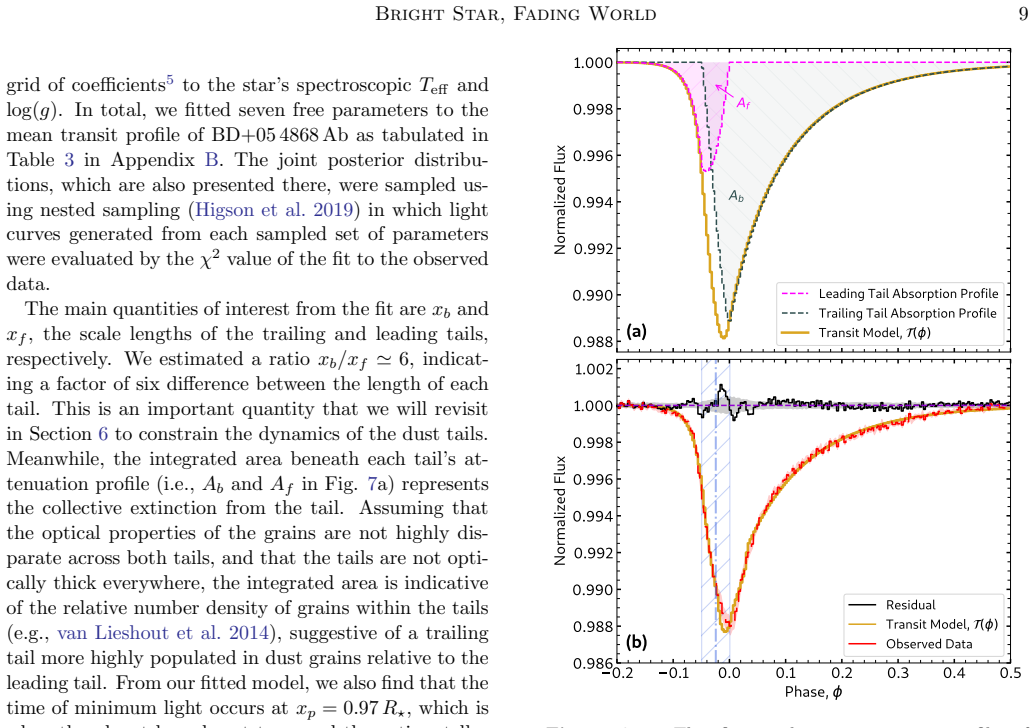
The load-bearing object is the analytic dust-drift relation Phi ≈ N(2 beta - 6 r_H), which connects the angular spread of a dust tail (Phi) to the number of orbits since launch (N), the radiation-pressure parameter (beta), and the planet's Hill-sphere radius (r_H, the radius of the planet's gravitational dominance zone). Because the trailing tail is measured to be about six times longer than the leading tail, this relation yields beta_max ≈ 0.07, and that value, fed through light-scattering cross-sections, fixes the grain size near 1-10 microns. The mass-loss estimate then comes from unrolling the trailing tail into an optically thick dust ribbon of known height, length, and assumed 10-micron depth, divided by a grain lifetime of about 2.5 orbits, with the planet modeled as a 0.02-Earth-mass body losing 10 Earth masses per Gyr. The paper also uses generalized-Gaussian extinction profiles to fit the observed transit shape and numerical grain-orbit simulations to visualize how the two tails form.
What would settle it
A future transit deeper than about 3% would falsify the optically thick dust-ribbon model used for the mass-loss estimate, because the paper's alternative launch scenario in Appendix D predicts a hard ceiling near 2% depth.
Extended reading notes
Core claim
On the paper's own terms, BD+05 4868 Ab is a disintegrating rocky planet orbiting a 0.70-solar-mass K dwarf every 1.27 days, with the longest orbital period and the deepest, longest transits among the four known objects of this class. The asymmetric light curve requires two dust tails: a trailing tail roughly six times longer than the leading tail, with the time of minimum light occurring only after the planet has nearly crossed the stellar disk. The measured 6:1 tail-length ratio, interpreted through analytic dust-drift equations, fixes the maximum radiation-pressure parameter at beta ≈ 0.07; light-scattering calculations then imply grain sizes of roughly 1-10 microns, and an optically thick dust-ribbon model yields a mass-loss rate of about 10 Earth masses per Gyr and a remaining lifetime of about 2 million years. Radial-velocity limits place the planet's mass below about 6.2 Earth masses, and the host star's brightness plus the planet's roughly 1.2% mean transit depth make this the most promising system for spectroscopic measurements of the dust's mineral content.
Load-bearing premise
The chain of inferences assumes that dust grains detach from the planet's outflowing gas near the edge of its gravitational influence with a speed of 0.4 km/s, are pushed by starlight no harder than beta = 0.07, and that the trailing tail blocks starlight completely in a sheet about 10 microns deep; if any of these assumptions shifts, the inferred grain sizes, mass-loss rate, and remaining lifetime change.
Editorial extensions
If this is right
- The system becomes a primary target for transmission spectroscopy of a rocky exoplanet's surface: the dust is condensed mineral vapor, and the host is roughly 100-250 times brighter than previously known disintegrating-planet hosts.
- The presence of both a leading and a trailing tail turns the tail-length ratio into a direct constraint on radiation pressure, so future observations of individual transits can test whether grain properties vary with time.
- If the inferred short lifetime is typical, surveys like the one that found this object should uncover more disintegrating planets around bright stars, making them a countable population rather than isolated curiosities.
- Because the transits have persisted for over a decade in ground-based data, the mass-loss process is continuous on human timescales, allowing repeated follow-up.
- The planet's longer orbital period and lower equilibrium temperature (about 1820 K) relative to the other three disintegrating planets suggest its dust composition and sublimation behavior may differ, which future spectra can test.
Reading between the lines
- Beyond the paper: if the roughly 10-Earth-masses-per-Gyr loss rate holds, the escaping dust samples the planet's crust in real time, so time-series mineral spectroscopy of this one target could map the composition of a rocky planetary surface without landing on it.
- Beyond the paper: the wide M-dwarf companion, together with the earlier K2-22 system, hints that wide binaries may be overrepresented among disintegrating planets; a systematic census of companions around all such planets could test whether gravitational perturbations drive these planets inward.
- Beyond the paper: the optically thick dust-ribbon assumption predicts that very deep transits cannot occur; if a future transit deeper than about 3% is seen, the mass-loss estimate would need to be revised, since the paper's own alternative launch scenario predicts a ceiling near 2%.
Editorial analysis
A structured set of objections, weighed in public.
Referee Report
Summary. The paper reports the discovery of BD+05 4868 Ab, a disintegrating rocky planet transiting a bright K dwarf, based on TESS photometry from Sectors 55 and 82, ten years of ASAS-SN photometry, a resolved multi-band LCOGT/MuSCAT3 transit observation, Keck/NIRC2 adaptive-optics imaging, and NEID radial velocities. The authors characterize the host star and its wide M-dwarf companion, fit a generalized-Gaussian dust-extinction profile to the mean and individual TESS transits, simulate dust-grain trajectories under gravity and radiation pressure, and infer a maximum radiation-pressure parameter beta of about 0.07, grain sizes of roughly 1-10 microns, a dust mass-loss rate of about 10 Earth masses per Gyr, and a remaining planetary lifetime of a few Myr. The central discovery claim is that BD+05 4868 Ab is a fourth disintegrating planet, and the first with clearly detected prominent leading and trailing comet-like dust tails.
Significance. If the discovery holds, this is an important system: it is the fourth known disintegrating planet, the first found by TESS, the longest-period example, and by far the brightest host star, making it a uniquely promising target for compositional and dust-tail follow-up. The observational evidence for the discovery is strong and unusually complete for this class: independent detections in two TESS sectors, a decade-long ground-based detection in ASAS-SN, a resolved multi-band LCOGT transit that confirms the primary as the source, AO imaging that rules out blend contamination, and NEID radial velocities that limit the transiting object to a small terrestrial mass. The paper is also careful to report the model-dependence of its dust interpretations, including alternative launch scenarios in Appendix D. The headline physical quantities, however, depend on several explicit modeling assumptions, and those assumptions are load-bearing for the claimed grain sizes and mass-loss rate.
major comments (3)
- [Section 6.4, Eq. (13) and Eq. (14)] The mass-loss rate is estimated by modeling the trailing tail as an optically thick ribbon of height H = 2*<delta>*R_star, length L = phi_c * 2*pi*(a/R_star), and depth D = 2*r with an adopted average grain radius r = 5 microns. This makes M_dust and therefore Mdot directly proportional to the assumed optical-depth regime and to the adopted grain radius. If the tail is not optically thick everywhere, the filling factor lowers the dust mass for the same observed depth; if the mean grain radius is not 5 microns, Mdot scales accordingly. The achromaticity test in Section 5.2 is too weak (reported p-values of 0.37 and 0.50) to break this degeneracy. The authors should propagate the optical-depth and grain-radius dependence explicitly and present the mass-loss rate as a range over these assumptions rather than as a single value.
- [Section 6.1, Eqs. (4)-(6)] The inference beta_max = 0.07 rests on equating the fitted scale-length ratio xb/xf = 6 with the ratio of angular drift rates Phi_trail/Phi_lead. This mapping assumes that grains decouple from a Parker wind at the Hill sphere with speed v = 0.4 km/s, that the drift rate is well described by the small-beta expansion, and that the observed scale-length ratio is set solely by orbital dynamics. The same observed tail-length ratio can be produced by different decoupling radii or velocities, by a size-dependent sublimation decay, or by optical-depth gradients in the tails, and the authors' own Appendix D shows that a half-orbit-delayed grain-formation scenario changes the tail heights and requires a different optical depth. The resulting beta range, and hence the claimed 1-10 micron grain sizes, is therefore model-dependent and should be presented as such, with a clear statement of which assumptions drive the result.
- [Section 6.2 and Appendix D] The nominal Parker-wind launch scenario is acknowledged by the authors to be problematic because high-beta grains need to backflow through the outflowing wind to form the trailing tail. The alternative scenarios in Appendix D produce materially different tail structures: later decoupling gives tail heights up to about 0.02 R_star and requires tau ~ 2, while surface escape-velocity launch reproduces the heights but is inconsistent with a Parker-wind picture. Because these scenarios bracket the geometry used in the mass-loss estimate, the quoted dust mass-loss rate and disintegration timescale of a few Myr should be framed as conditional on the adopted launch scenario. A self-consistent treatment of dust formation and gas-dust coupling, or an explicit scenario-averaged range, is needed before these quantities can be taken as the paper's central result.
minor comments (5)
- [Section 6.2.1, after Eq. (9)] In the sentence following Eq. (9), 'as opposed to grains in the trailing with Delta r of only a few percent' should read 'as opposed to grains in the leading tail', since the text is contrasting the wide trailing tail with the narrow leading tail.
- [Figure 1 and Section 2] The caption of Figure 1 states that the folded light curve is binned over 6-minute intervals, but the two TESS sectors were taken with 10-minute and 200-second cadences; the caption should state how the 6-minute bins were formed and whether any interpolation was used.
- [Abstract and Table 2] The abstract quotes V = 10.16 for the host star while Section 1 and later text quote a TESS magnitude of 9.18; the two quantities should be defined clearly in the text or Table 2 so that the reader can distinguish Johnson V from TESS magnitude.
- [Section 6.4, Eq. (13)] The ribbon model in Eq. (13) would benefit from an explicit statement that D = 2*r is an adopted value rather than a fitted or measured quantity, and that the numerical coefficient in the first approximate equality already uses the optically thick limit.
- [Appendix B] The description of the two-exponent generalized-Gaussian fit and the single-exponent model is clear, but the main-text statement in Section 5.1 that 'seven free parameters' were fitted could be made easier to verify by giving the limb-darkening treatment and any fixed parameters immediately before that sentence.
Circularity Check
No significant circularity: the discovery and the quantitative dust inferences are self-contained forward-inference chains, with model dependence explicitly acknowledged.
full rationale
The central discovery claim is supported by independent TESS, ASAS-SN, LCOGT, AO, and NEID observations, and the disintegrating-planet interpretation is benchmarked against the externally established framework of prior disintegrating-planet work (Kepler-1520b, KOI-2700b, K2-22b) rather than being derived from the present paper's own fitted values. The fitted tail-length ratio xb/xf ≈ 6 from Section 5 is used as an input to Equation 6 to set βmax ≈ 0.07; the inferred grain sizes (1–10 μm) then follow from Mie-theory radiation-pressure calculations. That is a forward chain from an observed shape parameter to a different physical quantity, not a re-derivation of the input. The mass-loss estimate in Section 6.4 uses an explicitly stated optically-thick ribbon assumption (H = 2⟨δ⟩R⋆, D ≈ 2r with adopted r ≈ 5 μm) and a dust lifetime derived from the same model; it is an order-of-magnitude estimate whose assumptions the paper discloses, including the alternative launch scenarios in Appendix D and the acknowledged 'problematic' backflow in Section 6.2.2. The weak achromaticity test (p-values 0.37 and 0.50) is explicitly labeled preliminary. Self-citations to Rappaport et al. (2012, 2014), van Lieshout & Rappaport (2018), and DeVore et al. (2016) supply background and methodology, but they are not the sole load-bearing justification for any central claim. No fitted parameter is renamed as a prediction, and no uniqueness theorem or ansatz is smuggled in via self-citation. The quantitative properties are model-dependent, but model dependence is not circularity.
Assumptions & free parameters
free parameters (7)
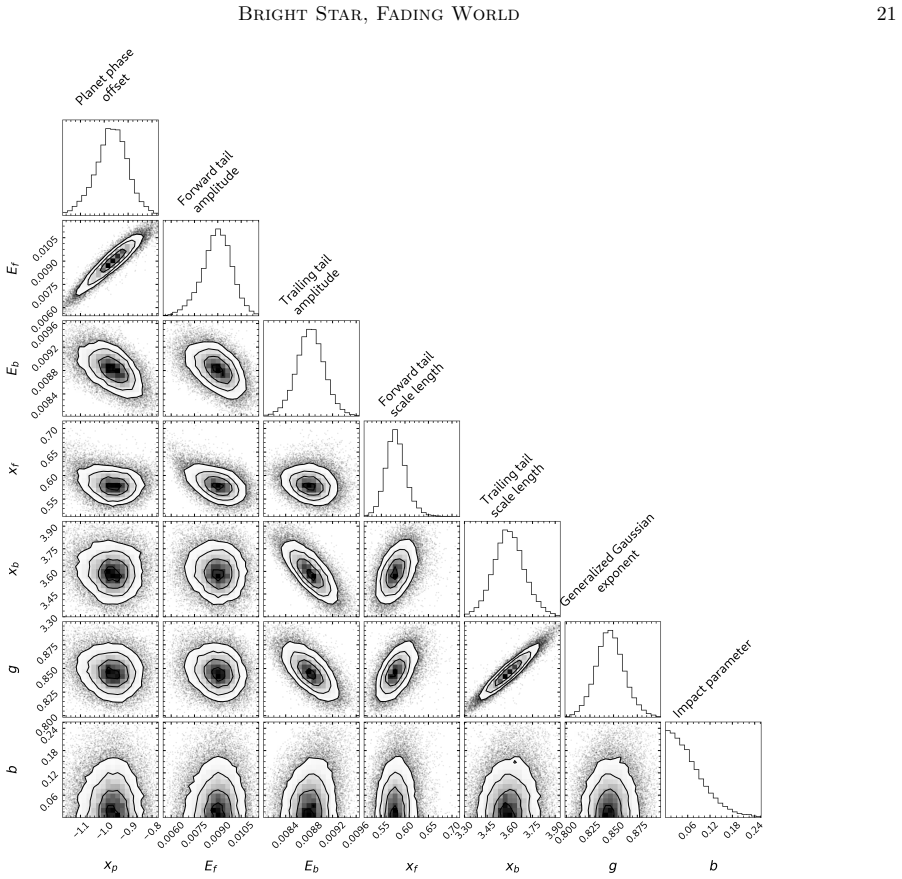
- Transit model parameters: xp, Ef, Eb, xf, xb, g, b =
xp=-0.97, Ef=0.009, Eb=0.0088, xf=0.58, xb=3.6, g=0.85, b=0.05 (Table 3)
- Dust launch velocity v =
0.4 km/s (adopted)
- Fiducial planet mass M_p =
0.02 M_Earth
- Grain bulk density rho =
3 g/cm^3
- Average grain radius r =
5 microns (adopted)
- Dust decay e-folding time =
2 planetary orbits
- Trailing tail e-folding length phi_c =
about 0.1 orbital circumference
assumptions (6)
- domain assumption Dust grains condense at the Hill sphere and decouple from a thermally driven Parker wind
- standard math Grains follow Keplerian orbits under gravity reduced by radiation-pressure parameter beta (Equations 2 to 5)
- ad hoc to paper The ratio of fitted tail scale lengths (xb/xf about 6) directly maps to a maximum beta of 0.07 via Equation 6
- ad hoc to paper Dust extinction decays with a fixed e-folding time of 2 planetary orbits in the simulations
- ad hoc to paper The trailing dust tail can be approximated as an optically thick ribbon of height 2 times average depth times R_star, length phi_c times 2 pi (a/R_star), and depth about 10 microns
- domain assumption Mie scattering with assumed refractive indices for iron, quartz, corundum, and fayalite, integrated over a Planck spectrum at Teff, describes radiation pressure on grains
Cite this review
Pith. "Pith review of A Disintegrating Rocky Planet with Prominent Comet-like Tails Around a Bright Star." pith.science (2026). https://pith.science/paper/NOE2KZME
@misc{pith2026250105431,
  author       = {Pith},
  title        = {Pith review of: A Disintegrating Rocky Planet with Prominent Comet-like Tails Around a Bright Star},
  year         = {2026},
  howpublished = {\url{https://pith.science/paper/NOE2KZME}},
  note         = {Machine review of arXiv:2501.05431}
}
abstract
We report the discovery of BD+05$\,$4868$\,$Ab, a transiting exoplanet orbiting a bright ($V=10.16$) K-dwarf (TIC 466376085) with a period of 1.27 days. Observations from NASA's Transiting Exoplanet Survey Satellite (TESS) reveal variable transit depths and asymmetric transit profiles that are characteristic of comet-like tails formed by dusty effluents emanating from a disintegrating planet. Unique to BD+05$\,$4868$\,$Ab is the presence of prominent dust tails in both the trailing and leading directions that contribute to the extinction of starlight from the host star. By fitting the observed transit profile and analytically modeling the drift of dust grains within both dust tails, we infer large grain sizes ($\sim1-10\,\mu$m) and a mass loss rate of $10\,M_{\rm \oplus}\,$Gyr$^{-1}$, suggestive of a lunar-mass object with a disintegration timescale of only several Myr. The host star is probably older than the Sun and is accompanied by an M-dwarf companion at a projected physical separation of 130 AU. The brightness of the host star, combined with the planet's relatively deep transits ($0.8-2.0\%$), presents BD+05$\,$4868$\,$Ab as a prime target for compositional studies of rocky exoplanets and investigations into the nature of catastrophically evaporating planets.
Figures


Figures from the paper (15 more)






Forward citations
Cited by 2 Pith papers
-
A Disintegrating Rocky World Shrouded in Dust and Gas: Mid-IR Observations of K2-22b using JWST
The first mid-infrared transmission spectrum of a disintegrating exoplanet, K2-22b, disfavors an iron-dominated core, is consistent with magnesium silicate mantle dust, and reveals an unexplained 5 micron feature poss...
-
From stellar light to astrophysical insight: automating variable star research with machine learning
An invited review of machine learning for automated variable star research, covering data cleaning, variability classification, stellar parameter inference, and foundation models.
Reference graph
Works this paper leans on
-
[1]
, " * write output.state after.block = add.period write newline
ENTRY address archivePrefix author booktitle chapter doi edition editor eprint howpublished institution journal key month number organization pages publisher school series title misctitle type volume year version url label extra.label sort.label short.list INTEGERS output.state before.all mid.sentence after.sentence after.block FUNCTION init.state.consts ...
-
[2]
write newline
" write newline "" before.all 'output.state := FUNCTION format.url url empty "" new.block "" url * "" * if FUNCTION format.eprint eprint empty "" archivePrefix empty "" archivePrefix "arXiv" = new.block " " eprint * " " * new.block " " eprint * " " * if if if FUNCTION format.doi doi empty "" " " doi * " " * if FUNCTION format.pid doi empty eprint empty ur...
-
[3]
: P̆b `h e +l.f 5 dT^^ e / iΜ9 K t`h 3<Ə e 7 ^<P R X ,; _x'hܹC/&Cu1 @=H x'hyti e +O<D
thebibliography [1] 20pt to REFERENCES 6pt =0pt -12pt 10pt plus 3pt =0pt =0pt =1pt plus 1pt =0pt =0pt -12pt =13pt plus 1pt =20pt =13pt plus 1pt \@M =10000 =-1.0em =0pt =0pt 0pt =0pt =1.0em @enumiv\@empty 10000 10000 `\.\@m \@noitemerr \@latex@warning Empty `thebibliography' environment \@ifnextchar \@reference \@latexerr Missing key on reference command E...
arXiv 2021
-
[4]
Disintegrating Exoplanets: Creating Size Constraints by Statistically Peering Through the Debris
Baka , K., & Schlawin , E. 2021, arXiv e-prints, arXiv:2111.12688, 10.48550/arXiv.2111.12688
work page Pith review arXiv doi:10.48550/arxiv.2111.12688 2021
-
[5]
Blunt , S., Nielsen , E. L., De Rosa , R. J., et al. 2017, , 153, 229, 10.3847/1538-3881/aa6930
-
[6]
Bochinski , J. J., Haswell , C. A., Marsh , T. R., Dhillon , V. S., & Littlefair , S. P. 2015, , 800, L21, 10.1088/2041-8205/800/2/L21
-
[7]
Bodman , E. H. L., Wright , J. T., Desch , S. J., & Lisse , C. M. 2018, , 156, 173, 10.3847/1538-3881/aadc60
-
[8]
Booth , R. A., Owen , J. E., & Schulik , M. 2023, , 518, 1761, 10.1093/mnras/stac3121
Show all 92 references
-
[9]
J., Koch , D., Basri , G., et al
Borucki , W. J., Koch , D., Basri , G., et al. 2010, Science, 327, 977, 10.1126/science.1185402
2010 doi
-
[10]
U., de Juan Ovelar , M., et al
Brogi , M., Keller , C. U., de Juan Ovelar , M., et al. 2012, , 545, L5, 10.1051/0004-6361/201219762
2012 doi
-
[11]
2023, , 521, 5746, 10.1093/mnras/stad932
Bromley , J., & Chiang , E. 2023, , 521, 5746, 10.1093/mnras/stad932
2023 doi
-
[12]
M., Baliber , N., Bianco , F
Brown , T. M., Baliber , N., Bianco , F. B., et al. 2013, , 125, 1031, 10.1086/673168
2013 doi
-
[13]
2013, , 557, A72, 10.1051/0004-6361/201220260
Budaj , J. 2013, , 557, A72, 10.1051/0004-6361/201220260
2013 doi
-
[14]
E., Jankovic , M
Campos Estrada , B., Owen , J. E., Jankovic , M. R., Wilson , A., & Helling , C. 2024, , 528, 1249, 10.1093/mnras/stae095
2024 doi
-
[15]
2016, , 823, 102, 10.3847/0004-637X/823/2/102
Choi , J., Dotter , A., Conroy , C., et al. 2016, , 823, 102, 10.3847/0004-637X/823/2/102
2016 doi
-
[16]
2017, , 600, A30, 10.1051/0004-6361/201629705
Claret , A. 2017, , 600, A30, 10.1051/0004-6361/201629705
2017 doi
-
[17]
P., & Castilho , B
Coelho , P., Barbuy , B., Mel \'e ndez , J., Schiavon , R. P., & Castilho , B. V. 2005, , 443, 735, 10.1051/0004-6361:20053511
2005 doi
-
[18]
2019, in American Astronomical Society Meeting Abstracts, Vol
Collins , K. 2019, in American Astronomical Society Meeting Abstracts, Vol. 233, American Astronomical Society Meeting Abstracts \#233, 140.05
2019
-
[19]
A., Kielkopf , J
Collins , K. A., Kielkopf , J. F., Stassun , K. G., & Hessman , F. V. 2017, , 153, 77, 10.3847/1538-3881/153/2/77
2017 doi
-
[20]
D., Zhou , G., Shporer , A., et al
Col \'o n , K. D., Zhou , G., Shporer , A., et al. 2018, , 156, 227, 10.3847/1538-3881/aae31b
2018 doi
-
[21]
2014, , 786, 100, 10.1088/0004-637X/786/2/100
Croll , B., Rappaport , S., DeVore , J., et al. 2014, , 786, 100, 10.1088/0004-637X/786/2/100
2014 doi
-
[22]
E., & Mohanty , S
Curry , A., Booth , R., Owen , J. E., & Mohanty , S. 2024, , 528, 4314, 10.1093/mnras/stae191
2024 doi
-
[23]
M., Skrutskie , M
Cutri , R. M., Skrutskie , M. F., van Dyk , S., et al. 2003, VizieR Online Data Catalog: 2MASS All-Sky Catalog of Point Sources (Cutri+ 2003) , VizieR On-line Data Catalog: II/246. Originally published in: University of Massachusetts and Infrared Processing and Analysis Center...
2003
-
[24]
Cutri, R. M. e. 2012, VizieR Online Data Catalog, II/311
2012
-
[25]
2013, , 776, 130, 10.1088/0004-637X/776/2/130
Dekany , R., Roberts , J., Burruss , R., et al. 2013, , 776, 130, 10.1088/0004-637X/776/2/130
2013 doi
-
[26]
2016, , 461, 2453, 10.1093/mnras/stw1439
DeVore , J., Rappaport , S., Sanchis-Ojeda , R., Hoffman , K., & Rowe , J. 2016, , 461, 2453, 10.1093/mnras/stw1439
2016 doi
-
[27]
K., Vaughan , A
Duncan , D. K., Vaughan , A. H., Wilson , O. C., et al. 1991, , 76, 383, 10.1086/191572
1991 doi
-
[28]
D., Rodriguez , J
Eastman , J. D., Rodriguez , J. E., Agol , E., et al. 2019, arXiv e-prints, arXiv:1907.09480. 1907.09480
2019 arXiv
-
[29]
2001, , 378, 228, 10.1051/0004-6361:20011196
Fabian , D., Henning , T., J \"a ger , C., et al. 2001, , 378, 228, 10.1051/0004-6361:20011196
2001 doi
-
[30]
N., & Butland, J
Fritsch, F. N., & Butland, J. 1984, SIAM Journal on Scientific and Statistical Computing, 5, 300, 10.1137/0905021
1984 doi
-
[31]
R., Everett , M
Furlan , E., Ciardi , D. R., Everett , M. E., et al. 2017, , 153, 71, 10.3847/1538-3881/153/2/71
2017 doi
-
[32]
Gaia Collaboration , Brown , A. G. A., Vallenari , A., et al. 2021, , 649, A1, 10.1051/0004-6361/202039657
2021 doi
-
[33]
2019, , 485, 3876, 10.1093/mnras/stz693
Gaidos , E., Hirano , T., & Ansdell , M. 2019, , 485, 3876, 10.1093/mnras/stz693
2019 doi
-
[34]
2018, , 611, A63, 10.1051/0004-6361/201629676
Garai , Z. 2018, , 611, A63, 10.1051/0004-6361/201629676
2018 doi
- [35]
-
[36]
2019, Statistics and Computing, 29, 891, 10.1007/s11222-018-9844-0
Higson , E., Handley , W., Hobson , M., & Lasenby , A. 2019, Statistics and Computing, 29, 891, 10.1007/s11222-018-9844-0
2019 doi
-
[37]
2013, Annual Review of Earth and Planetary Sciences, 41, 657, https://doi.org/10.1146/annurev-earth-050212-124007
Hirose, K., Labrosse, S., & Hernlund, J. 2013, Annual Review of Earth and Planetary Sciences, 41, 657, https://doi.org/10.1146/annurev-earth-050212-124007
2013 doi
-
[38]
V., et al
H g , E., Fabricius , C., Makarov , V. V., et al. 2000, , 355, L27
2000
-
[39]
S., et al
Hon , M., Huber , D., Kuszlewicz , J. S., et al. 2021, , 919, 131, 10.3847/1538-4357/ac14b1
2021 doi
-
[40]
B., Sobeck , C., Haas , M., et al
Howell , S. B., Sobeck , C., Haas , M., et al. 2014, , 126, 398, 10.1086/676406
2014 doi
-
[41]
X., Vanderburg , A., P \'a l , A., et al
Huang , C. X., Vanderburg , A., P \'a l , A., et al. 2020 a , Research Notes of the American Astronomical Society, 4, 204, 10.3847/2515-5172/abca2e
2020 doi
-
[42]
2020 b , Research Notes of the American Astronomical Society, 4, 206, 10.3847/2515-5172/abca2d
---. 2020 b , Research Notes of the American Astronomical Society, 4, 206, 10.3847/2515-5172/abca2d
2020 doi
-
[43]
O., Wende-von Berg , S., Dreizler , S., et al
Husser , T. O., Wende-von Berg , S., Dreizler , S., et al. 2013, , 553, A6, 10.1051/0004-6361/201219058
2013 doi
-
[44]
2013, Tapir: A web interface for transit/eclipse observability , Astrophysics Source Code Library
Jensen , E. 2013, Tapir: A web interface for transit/eclipse observability , Astrophysics Source Code Library. 1306.007
2013
-
[45]
S., Fegley , Jr., B., Schaefer , L., & Gaidos , E
Kite , E. S., Fegley , Jr., B., Schaefer , L., & Gaidos , E. 2016, , 828, 80, 10.3847/0004-637X/828/2/80
2016 doi
-
[46]
2002, , 391, 369, 10.1051/0004-6361:20020802
Kov \'a cs , G., Zucker , S., & Mazeh , T. 2002, , 391, 369, 10.1051/0004-6361:20020802
2002 doi
- [47]
-
[48]
2023, Research Notes of the American Astronomical Society, 7, 28, 10.3847/2515-5172/acbc13
Kunimoto , M., Tey , E., Fong , W., et al. 2023, Research Notes of the American Astronomical Society, 7, 28, 10.3847/2515-5172/acbc13
2023 doi
-
[49]
2022, Research Notes of the American Astronomical Society, 6, 236, 10.3847/2515-5172/aca158
---. 2022, Research Notes of the American Astronomical Society, 6, 236, 10.3847/2515-5172/aca158
2022 doi
-
[50]
Kurucz , R. L. 1993, VizieR Online Data Catalog: Model Atmospheres (Kurucz, 1979) , VizieR On-line Data Catalog: VI/39. Originally published in: 1979ApJS...40....1K
1993
-
[51]
Lamers, H. J. G. L. M., & Cassinelli, J. P. 1999, Introduction to Stellar Winds (Cambridge University Press), 10.1017/cbo9781139175012
1999 doi
-
[52]
2011, , 213, 1, 10.1016/j.icarus.2011.02.004
L \'e ger , A., Grasset , O., Fegley , B., et al. 2011, , 213, 1, 10.1016/j.icarus.2011.02.004
2011 doi
-
[53]
Lidov , M. L. 1962, , 9, 719, 10.1016/0032-0633(62)90129-0
1962 doi
-
[54]
2017, , 472, 447, 10.1093/mnras/stx1666
Mahapatra , G., Helling , C., & Miguel , Y. 2017, , 472, 447, 10.1093/mnras/stx1666
2017 doi
-
[55]
A., & Hall , O
Masuda , K., Petigura , E. A., & Hall , O. J. 2022, , 510, 5623, 10.1093/mnras/stab3650
2022 doi
-
[56]
H., Harbeck , D.-R., et al
McCully , C., Volgenau , N. H., Harbeck , D.-R., et al. 2018, in Society of Photo-Optical Instrumentation Engineers (SPIE) Conference Series, Vol. 10707, , 107070K, 10.1117/12.2314340
2018 doi
-
[57]
2020, in Society of Photo-Optical Instrumentation Engineers (SPIE) Conference Series, Vol
Narita , N., Fukui , A., Yamamuro , T., et al. 2020, in Society of Photo-Optical Instrumentation Engineers (SPIE) Conference Series, Vol. 11447, Society of Photo-Optical Instrumentation Engineers (SPIE) Conference Series, 114475K, 10.1117/12.2559947
2020 doi
-
[58]
2020, , 901, 171, 10.3847/1538-4357/abb088
Okuya , A., Okuzumi , S., Ohno , K., & Hirano , T. 2020, , 901, 171, 10.3847/1538-4357/abb088
2020 doi
-
[59]
A., Kraus , A
Pearce , L. A., Kraus , A. L., Dupuy , T. J., et al. 2020, , 894, 115, 10.3847/1538-4357/ab8389
2020 doi
-
[60]
2013, , 433, 2294, 10.1093/mnras/stt895
Perez-Becker , D., & Chiang , E. 2013, , 433, 2294, 10.1093/mnras/stt895
2013 doi
-
[61]
Petigura , E. A. 2015, PhD thesis, University of California, Berkeley
2015
-
[62]
Polyanskiy, M. N. 2024, Scientific Data, 11, 10.1038/s41597-023-02898-2
2024 doi
-
[63]
2014, , 784, 40, 10.1088/0004-637X/784/1/40
Rappaport , S., Barclay , T., DeVore , J., et al. 2014, , 784, 40, 10.1088/0004-637X/784/1/40
2014 doi
-
[64]
L., Kaye , T., et al
Rappaport , S., Gary , B. L., Kaye , T., et al. 2016, , 458, 3904, 10.1093/mnras/stw612
2016 doi
-
[65]
2012, , 752, 1, 10.1088/0004-637X/752/1/1
Rappaport , S., Levine , A., Chiang , E., et al. 2012, , 752, 1, 10.1088/0004-637X/752/1/1
2012 doi
-
[66]
2014, Experimental Astronomy, 38, 249, 10.1007/s10686-014-9383-4
Rauer , H., Catala , C., Aerts , C., et al. 2014, Experimental Astronomy, 38, 249, 10.1007/s10686-014-9383-4
2014 doi
-
[67]
R., Winn , J
Ricker , G. R., Winn , J. N., Vanderspek , R., et al. 2015, Journal of Astronomical Telescopes, Instruments, and Systems, 1, 014003, 10.1117/1.JATIS.1.1.014003
2015 doi
-
[68]
R., Keller , C
Ridden-Harper , A. R., Keller , C. U., Min , M., van Lieshout , R., & Snellen , I. A. G. 2018, , 618, A97, 10.1051/0004-6361/201731947
2018 doi
-
[69]
R., Snellen , I
Ridden-Harper , A. R., Snellen , I. A. G., Keller , C. U., & Molli \`e re , P. 2019, , 628, A70, 10.1051/0004-6361/201834433
2019 doi
-
[70]
L., & Gao , S
Rudnick , R. L., & Gao , S. 2003, Treatise on Geochemistry, 3, 659, 10.1016/B0-08-043751-6/03016-4
2003 doi
-
[71]
2015, , 812, 112, 10.1088/0004-637X/812/2/112
Sanchis-Ojeda , R., Rappaport , S., Pall \`e , E., et al. 2015, , 812, 112, 10.1088/0004-637X/812/2/112
2015 doi
-
[72]
K., & Chen , H
Schlawin , E., Herter , T., Zhao , M., Teske , J. K., & Chen , H. 2016, , 826, 156, 10.3847/0004-637X/826/2/156
2016 doi
-
[73]
2016, in Society of Photo-Optical Instrumentation Engineers (SPIE) Conference Series, Vol
Schwab , C., Rakich , A., Gong , Q., et al. 2016, in Society of Photo-Optical Instrumentation Engineers (SPIE) Conference Series, Vol. 9908, Ground-based and Airborne Instrumentation for Astronomy VI, ed. C. J. Evans , L. Simard , & H. Takami , 99087H, 10.1117/12.2234411
2016 doi
-
[74]
J., Prieto , J
Shappee , B. J., Prieto , J. L., Grupe , D., et al. 2014, , 788, 48, 10.1088/0004-637X/788/1/48
2014 doi
-
[75]
F., Cutri , R
Skrutskie , M. F., Cutri , R. M., Stiening , R., et al. 2006, , 131, 1163, 10.1086/498708
2006 doi
-
[76]
Speagle , J. S. 2020, , 493, 3132, 10.1093/mnras/staa278
2020 doi
-
[77]
P., et al
Stinson , A., Bagnulo , S., Tozzi , G. P., et al. 2016, , 594, A110, 10.1051/0004-6361/201527696
2016 doi
- [78]
-
[79]
2014, , 572, A76, 10.1051/0004-6361/201424876
van Lieshout , R., Min , M., & Dominik , C. 2014, , 572, A76, 10.1051/0004-6361/201424876
2014 doi
-
[80]
van Lieshout , R., & Rappaport , S. A. 2018, in Handbook of Exoplanets, ed. H. J. Deeg & J. A. Belmonte , 15, 10.1007/978-3-319-55333-7_15
2018 doi
-
[81]
2016, , 596, A32, 10.1051/0004-6361/201629250
van Lieshout , R., Min , M., Dominik , C., et al. 2016, , 596, A32, 10.1051/0004-6361/201629250
2016 doi
-
[82]
van Werkhoven , T. I. M., Brogi , M., Snellen , I. A. G., & Keller , C. U. 2014, , 561, A3, 10.1051/0004-6361/201322398
2014 doi
-
[83]
1910, Astronomische Nachrichten, 183, 345, 10.1002/asna.19091832202
von Zeipel , H. 1910, Astronomische Nachrichten, 183, 345, 10.1002/asna.19091832202
1910 doi
- [84]
-
[85]
N., Sanchis-Ojeda , R., & Rappaport , S
Winn , J. N., Sanchis-Ojeda , R., & Rappaport , S. 2018, , 83, 37, 10.1016/j.newar.2019.03.006
2018 doi
-
[86]
1979, Mie Scattering Calculations: Advances in Technique and Fast, Vector-speed Computer Codes, Tech
Wiscombe, W. 1979, Mie Scattering Calculations: Advances in Technique and Fast, Vector-speed Computer Codes, Tech. rep., 10.5065/D6ZP4414
1979 doi
-
[87]
S., Shelton , C., et al
Wizinowich , P., Acton , D. S., Shelton , C., et al. 2000, , 112, 315, 10.1086/316543
2000 doi
-
[88]
2018, , 474, 4795, 10.1093/mnras/stx3023
Xu , S., Rappaport , S., van Lieshout , R., et al. 2018, , 474, 4795, 10.1093/mnras/stx3023
2018 doi
-
[89]
W., Petigura , E
Yee , S. W., Petigura , E. A., & von Braun , K. 2017, , 836, 77, 10.3847/1538-4357/836/1/77
2017 doi
-
[90]
2023, , 520, 3127, 10.1093/mnras/stad328
Zasche , P., Borkovits , T., Jayaraman , R., et al. 2023, , 520, 3127, 10.1093/mnras/stad328
2023 doi
-
[91]
Zilinskas , M., van Buchem , C. P. A., Miguel , Y., et al. 2022, , 661, A126, 10.1051/0004-6361/202142984
2022 doi
-
[92]
C., et al
Zubko , E., Videen , G., Hines , D. C., et al. 2015, , 118, 138, 10.1016/j.pss.2015.08.002
2015 doi
Reviewed August 10, 2026 · model on record in the stance chip above.
Discussion (0). Continue with ORCID to comment.