REVIEW 5 major objections 4 minor 43 references
Modern Bayesian Sampling Methods for Cosmological Inference: A Comparative Study
T0 review · 5 major / 4 minor · reviewed 2026-08-10 · deepseek-v4-flash
Pith's one-line read No single Bayesian sampler is universally superior; Hamiltonian Monte Carlo offers the best speed–accuracy trade-off for higher-dimensional cosmological inference, while nested samplers justify their higher cost by computing the evidence…
desk verdict A useful but uneven sampler benchmark on a realistic BAO likelihood; the qualitative 'no universal winner' conclusion likely holds, but the headline HMC runtime advantage is not controlled enough to trust as a general statement. read the letter →
The pith
A machine-rendered reading of the paper's core claim, the machinery that carries it, and where it could break.
The reading
What carries the argument
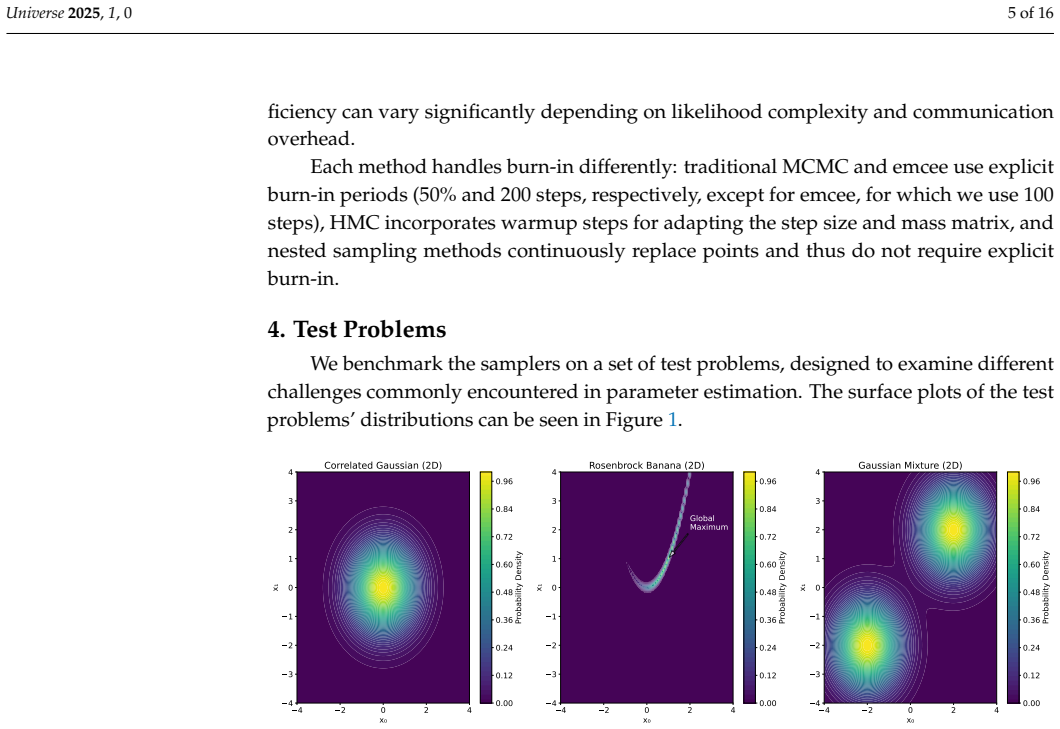
The load-bearing mechanism is the unified benchmark framework that standardizes metrics—runtime, memory usage, effective sample size per second, initialization sensitivity, and mean-based plus distribution-based accuracy—across all samplers on the same targets. Within that framework, the deciding quantities are the gradient-driven leapfrog dynamics of HMC, which preserve volume in phase space, and the live-point evidence integral of nested sampling, which converts the multi-dimensional evidence integral into a one-dimensional integration over prior mass. The test suite uses a correlated Gaussian, a Rosenbrock banana distribution, and a Gaussian mixture; the cosmological case uses a marginalized BAO likelihood with $\Omega_m$, $\Omega_K$, $w_0$, and $w_a$ as free parameters.
What would settle it
Rerun the same BAO benchmark with a matched accuracy target or a matched computational budget (for instance, requiring every sampler to reach the same effective sample size or the same evidence precision) and check whether HMC still has the best runtime while nested samplers remain the most expensive; if the rankings change under equalized settings, the reported ordering is an artifact of configuration.
Extended reading notes
Core claim
The paper claims that sampler choice in cosmological inference should be driven by problem geometry and by what the analysis needs, because the tested samplers are comparable in accuracy yet differ markedly in cost. In the test problems, all samplers handle Gaussian targets, but curved degeneracies and multimodality separate them: traditional MCMC and slice sampling lose efficiency as dimension grows, HMC holds up on curved targets, and nested samplers stay reliable on multimodal ones. On the baryon-acoustic-oscillation likelihood, HMC has the best runtime and accuracy, especially for the 3- and 4-parameter dark-energy models; nested samplers cost more but remain accurate and compute the evidence; traditional MCMC and the ensemble sampler are adequate at low dimension but widen uncertainties in higher dimension. The paper concludes that no single method is significantly better across all settings, and that choosing a sampler means weighing dimensionality, likelihood features, and computational constraints.
Load-bearing premise
The comparison assumes that the fixed per-sampler settings—such as the number of live points, walkers, warmup steps, and burn-in fractions—place the methods on an equal footing, rather than merely reflecting arbitrary configuration choices.
Editorial extensions
If this is right
- For well-constrained parameters like $\Omega_m$, all samplers give consistent constraints, so the simplest methods are safe in low-dimensional problems.
- Higher-dimensional dark-energy models should default to HMC when the likelihood is differentiable and the evidence is not required, since it delivers accuracy at a fraction of the runtime of nested samplers.
- When Bayesian model comparison is the goal, nested samplers are the practical route because they output the evidence $Z$ directly, whereas MCMC evidence estimates are approximate.
- Effective sample size per second alone can mislead: one sampler shows high ESS but larger parameter uncertainties in higher dimensions, so raw sampling efficiency does not guarantee optimal posterior exploration.
- Relying on a single sampler family risks geometry-induced bias; the observed differences in curved and multimodal targets imply that multiple sampling approaches are worth running for non-standard parameter spaces.
Reading between the lines
- A natural testable extension would fix a common effective-sample-size target or a common wall-clock budget across all samplers; the paper's rankings, especially HMC's runtime advantage, may depend on the chosen per-sampler settings such as 1000 versus 100 live points.
- The paper's emphasis on geometry suggests that future comparisons should include non-differentiable or expensive likelihoods where gradients are unavailable, a condition that would erode HMC's main advantage.
- If the no-single-method conclusion generalizes, cosmology pipelines should choose samplers by the downstream need—evidence versus posterior—and treat the two nested samplers and HMC as complementary tools rather than substitutes.
Editorial analysis
A structured set of objections, weighed in public.
Referee Report
Summary. The paper benchmarks six samplers—traditional Metropolis-Hastings MCMC via PyMC, HMC via NumPyro, a custom slice-sampling implementation, emcee, dynesty nested sampling, and PolyChord—on three synthetic distributions (correlated Gaussian, Rosenbrock, Gaussian mixture) and on a marginalized BAO likelihood with 1–4 cosmological parameters. Performance is assessed via runtime, memory usage, effective sample size per second, initial-seed sensitivity, and two normalized accuracy metrics. The paper concludes that HMC provides the best balance of runtime and accuracy, especially in higher dimensions, and that no single sampler is significantly better overall, with nested samplers recommended when evidence computation is required.
Significance. A careful, reproducible comparison of widely used samplers on realistic cosmological likelihoods would be a valuable practical reference for the community. The paper's strengths are the use of standard test problems, a DESI-based BAO likelihood that is not trivial, and the intention to release the benchmark code. However, the central comparative claims are not currently supported by the evidence: the samplers are run under substantially different sample counts and live-point settings, accuracy normalization is arbitrary, and runtime and ESS metrics are reported without error bars or control for parallelization. If these issues are addressed, the paper could become a useful guide for sampler selection; in its present form, the conclusions are not robust.
major comments (5)
- [Appendix C, Section 5.2] The sampler configurations in Appendix C impose very different computational efforts: dynesty uses nlive=1000, PolyChord nlive=100, emcee uses 1000 steps, traditional MCMC uses 5000 draws, HMC uses 500 warmup steps with an unspecified number of post-warmup draws, and slice sampling uses width=0.1. No common accuracy target, effective-sample-size target, or likelihood-evaluation budget is enforced, so the runtime and ESS-per-second rankings in Figures 2 and 5 conflate algorithmic performance with configuration choices. This directly affects the central claim in Section 5.2 that HMC provides the best balance of runtime and accuracy; the benchmark should be rerun under a common budget, for example a fixed number of likelihood evaluations or a target ESS, or the choice of settings should be explicitly justified as a fair basis for comparison.
- [Section 3, Figure 5] Runtime, memory, and ESS per second are reported as single point values without error bars or repeated-run statistics. The 'Init sensitivity' metric tracks seed variation of parameter accuracy only, not variation of runtime or ESS. Given that the paper's main conclusions are about runtime and efficiency, the lack of variance estimates makes it impossible to judge whether differences such as the factor of ten between HMC and PolyChord in the 3D cosmological case are significant or within run-to-run noise.
- [Appendix A, Eqs. (A1)–(A4)] The normalized accuracy scores depend on arbitrarily fixed maximum error thresholds (0.5 for Gaussian, 2.0 for Rosenbrock, 5.0 for the mixture). Because these thresholds are not derived from any property of the target distributions, the absolute accuracy values in Figure 3 are meaningful only relative to the chosen normalization, and the rankings could change if different thresholds were adopted. The paper should either justify the thresholds or report the unnormalized errors alongside the normalized versions.
- [Section 4.2, Figure 3] The text states that 'the traditional method was convergent only for the Gaussian distribution,' yet Figure 3 reports traditional MCMC accuracy values for the Rosenbrock and mixture problems. If the chains did not converge, those accuracy values should be excluded or explicitly flagged as non-converged; as written, the figure contradicts the text and the comparison is unclear.
- [Section 5.4, Section 3] The paper acknowledges in Section 5.4 that memory usage for parallel nested samplers is difficult to measure and may be underestimated, and Section 3 notes that dynesty, PolyChord, and emcee support parallelization while the HMC NumPyro implementation appears serial. No core counts or parallel settings are reported, so the runtime and memory comparisons mix serial and parallel execution. The benchmark should specify and control the number of cores or processes used for each sampler, or at least quantify the effect of parallelism on the reported metrics.
minor comments (4)
- [Section 2.4 and Appendix C, Eq. (A6)] The symbol Z is used both for the Bayesian evidence and for the normalization term in the marginalized BAO likelihood (Eq. A6); using a different symbol for one of these would avoid ambiguity.
- [Section 3] The description '5000 draws (ndraws ×5)' is ambiguous; it should be clarified whether 5000 is the total number of draws across all chains or the number per chain.
- [Figure 5] The y-axis label 'Memory (MB)' includes values up to 70000; using a log scale or expressing the units in GB would improve readability.
- [Section 2.5] There is a typo in 'developped' that should be corrected to 'developed'.
Circularity Check
No significant circularity: the paper is an empirical sampler benchmark whose conclusions rest on external likelihoods and measured runtimes, not on any quantity fitted and then repackaged as a prediction.
full rationale
The paper's central claims, that HMC offers a good runtime-accuracy balance and that no single sampler is universally superior, are empirical observations from running six samplers on test distributions and a BAO likelihood. No parameter is fitted to a subset of data and then presented as a prediction; no claimed first-principles result is defined in terms of the conclusion. The only author self-citations are references [26] and [27], which supply the marginalized BAO likelihood; that likelihood is a published, externally specified function based on DESI data and is reused here as a benchmark input rather than derived from the present comparison. The manuscript's own caveats in Section 5.4 about memory measurement, parallelization, and non-uniform interfaces are implementation limitations, not admissions of circularity. A reviewer could question whether the fixed per-sampler settings in Appendix C make runtime rankings configuration-dependent, but that would be a fairness or robustness criticism of an empirical benchmark, not the pattern of a prediction reducing by construction to its inputs. Accordingly, no circular step is exhibited.
Assumptions & free parameters
free parameters (2)
- Accuracy normalization thresholds =
0.5 (Gaussian), 2.0 (Rosenbrock), 5.0 (mixture)
- Sampler hyperparameter sets =
dynesty nlive=1000; PolyChord nlive=100; emcee nwalkers=max(20*ndim,40); traditional MCMC 5000 draws, 50% burn-in; HMC…
assumptions (4)
- standard math Standard convergence properties of MCMC and nested sampling algorithms.
- domain assumption The marginalized BAO likelihood from Staicova and Benisty (2022) is a valid likelihood for cosmological parameter inference.
- domain assumption DESI BAO data as used in the marginalized likelihood are correct and appropriate.
- ad hoc to paper Uniform priors on (-5,5) for test problems and the listed cosmological priors are appropriate for the benchmark.
Cite this review
Pith. "Pith review of Modern Bayesian Sampling Methods for Cosmological Inference: A Comparative Study." pith.science (2026). https://pith.science/paper/MSMGMWEH
@misc{pith2026250106022,
  author       = {Pith},
  title        = {Pith review of: Modern Bayesian Sampling Methods for Cosmological Inference: A Comparative Study},
  year         = {2026},
  howpublished = {\url{https://pith.science/paper/MSMGMWEH}},
  note         = {Machine review of arXiv:2501.06022}
}
read the original abstract
We present a comprehensive comparison of different Markov Chain Monte Carlo (MCMC) sampling methods, evaluating their performance on both standard test problems and cosmological parameter estimation. Our analysis includes traditional Metropolis-Hastings MCMC, Hamiltonian Monte Carlo (HMC), slice sampling, nested sampling as implemented in dynesty, and PolyChord. We examine samplers through multiple metrics including runtime, memory usage, effective sample size, and parameter accuracy, testing their scaling with dimension and response to different probability distributions. While all samplers perform well with simple Gaussian distributions, we find that HMC and nested sampling show advantages for more complex distributions typical of cosmological problems. Traditional MCMC and slice sampling become less efficient in higher dimensions, while nested methods maintain accuracy but at higher computational cost. In cosmological applications using BAO data, we observe similar patterns, with particular challenges arising from parameter degeneracies and poorly constrained parameters.
Figures


Figures from the paper (3 more)


Reference graph
Works this paper leans on
-
[8]
Albert, J.; Balazs, C.; Fowlie, A.; Handley, W.; Hunt-Smith, N.; de Austri, R.R.; White, M. A comparison of Bayesian sampling algorithms for high-dimensional particle physics and cosmology applications. arXiv 2024, arXiv:2409.18464
arXiv 2024
-
[1]
Cosmological parameters from CMB and other data: A Monte Carlo approach
Lewis, A.; Bridle, S. Cosmological parameters from CMB and other data: A Monte Carlo approach. Phys. Rev. D 2002, 66, 103511
work page 2002
-
[2]
Bayes in the sky: Bayesian inference and model selection in cosmology
Trotta, R. Bayes in the sky: Bayesian inference and model selection in cosmology. Contemp. Phys. 2008, 49, 71–104
work page 2008
-
[3]
Aghanim, N.; Akrami, Y.; Ashdown, M. et al. [Planck Collaboration] Planck 2018 results: VI. Cosmological parameters. Astron. Astrophys. 2020, 641, A6
work page 2018
-
[4]
Equation of state calculations by fast computing machines
Metropolis, N.; Rosenbluth, A.W.; Rosenbluth, M.N.; Teller, A.H.; Teller, E. Equation of state calculations by fast computing machines. J. Chem. Phys. 1953, 21, 1087–1092
work page 1953
-
[5]
Monte Carlo sampling methods using Markov chains and their applications
Hastings, W.K. Monte Carlo sampling methods using Markov chains and their applications. Biometrika 1970, 57, 97–109
work page 1970
-
[6]
Buchner, J. Nested sampling methods. Statist. Surv. 2023, 17, 169–215. https://doi.org/10.1214/23-ss144
doi:10.1214/23-ss144 2023
-
[7]
Colgáin, E.O.; Pourojaghi, S.; Sheikh-Jabbari, M.M.; Sherwin, D. A comparison of Bayesian and frequentist confidence intervals in the presence of a late Universe degeneracy. arXiv 2023, arXiv:2307.16349
arXiv 2023
Show all 43 references
-
[9]
Hybrid Monte Carlo
Duane, S.; Kennedy, A.D.; Pendleton, B.J.; Roweth, D. Hybrid Monte Carlo. Phys. Lett. B 1987, 195, 216–222
1987
-
[10]
Slice sampling
Neal, R.M. Slice sampling. Ann. Stat. 2003, 31, 705–767
2003
-
[11]
Nested sampling for general Bayesian computation
Skilling, J. Nested sampling for general Bayesian computation. Bayesian Anal. 2006, 1, 833–859
2006
-
[12]
PolyChord: Nested sampling for cosmology
Handley, W.J.; Hobson, M.P .; Lasenby, A.N. PolyChord: Nested sampling for cosmology. Mon. Not. Roy. Astron. Soc. 2015, 450, L61–L65. https://doi.org/10.1093/mnrasl/slv047
2015 doi
-
[13]
polychord: Next-generation nested sampling
Handley, W.J.; Hobson, M.P .; Lasenby, A.N. polychord: Next-generation nested sampling. Mon. Not. Roy. Astron. Soc. 2015, 453, 4385–4399. https://doi.org/10.1093/mnras/stv1911
2015 doi
-
[14]
PyMC: A Modern and Comprehensive Probabilistic Programming Framework in Python
Abril-Pla, O.; Andreani, V .; Carroll, C.; Dong, L.; Fonnesbeck, C.J.; Kochurov, M.; Kumar, R.; Lao, J.; Luhmann, C.C.; Martin, O.A.; et al. PyMC: A Modern and Comprehensive Probabilistic Programming Framework in Python. PeerJ Comput. Sci. 2023, 9, e1516, https://doi.org/10.77...
2023 doi
-
[15]
Composable Effects for Flexible and Accelerated Probabilistic Programming in NumPyro
Phan, D.; Pradhan, N.; Jankowiak, M. Composable Effects for Flexible and Accelerated Probabilistic Programming in NumPyro. arXiv 2019, arXiv:1912.11554
2019 arXiv
-
[16]
The No-U-Turn Sampler: Adaptively Setting Path Lengths in Hamiltonian Monte Carlo
Hoffman, M.D.; Gelman, A. The No-U-Turn Sampler: Adaptively Setting Path Lengths in Hamiltonian Monte Carlo. J. Mach. Learn. Res. 2014, 15, 1593–1623. arXiv 2011, arXiv:1111.4246
2014 arXiv
-
[17]
emcee: The MCMC Hammer.Publ
Foreman-Mackey, D.; Hogg, D.W.; Lang, D.; Goodman, J. emcee: The MCMC Hammer.Publ. Astron. Soc. Pac. 2013, 125, 306–312. https://doi.org/10.1086/670067
2013 doi
-
[18]
dynesty: A dynamic nested sampling package for estimating Bayesian posteriors and evidences
Speagle, J.S. dynesty: A dynamic nested sampling package for estimating Bayesian posteriors and evidences. Mon. Not. Roy. Astron. Soc. 2020, 493, 3132–3158. https://doi.org/10.1093/mnras/staa278
2020 doi
-
[19]
dynesty: V2.1.4, jun 2024., https://doi.org/10.5281/zenodo.12537467 accessed at 16.01.2025
Koposov, S.; Speagle, J.; Barbary, K.; Ashton, G.; Bennett, E.; Buchner, J.; Scheffler, C.; Cook, B.; Talbot, C.; Guillochon, J.; et al. dynesty: V2.1.4, jun 2024., https://doi.org/10.5281/zenodo.12537467 accessed at 16.01.2025
2024 doi
-
[20]
MultiNest: An efficient and robust Bayesian inference tool for cosmology and particle physics
Feroz, F.; Hobson, M.P .; Bridges, M. MultiNest: An efficient and robust Bayesian inference tool for cosmology and particle physics. Mon. Not. Roy. Astron. Soc. 2009, 398, 1601–1614. https://doi.org/10.1111/j.1365-2966.2009.14548.x
2009
-
[21]
Cosmology intertwined: A review of the particle physics, astrophysics, and cosmology associated with the cosmological tensions and anomalies
Abdalla, E.; Abellan, G.F.; Aboubrahim, A.; Agnello, A.; Akarsu, O.; Akrami, Y.; Alestas, G.; Aloni, D.; Amendola, L.; Anchordoqui, L.A.; et al. Cosmology intertwined: A review of the particle physics, astrophysics, and cosmology associated with the cosmological tensions and a...
2022 doi
-
[22]
Unveiling lens light complexity with a novel multi-Gaussian expansion approach for strong gravitational lensing
He, Q.; Nightingale, J.W.; Amvrosiadis, A.; Robertson, A.; Cole, S.; Frenk, C.S.; Massey, R.; Li, R.; Cao, X.; Lange, S.C.; et al. Unveiling lens light complexity with a novel multi-Gaussian expansion approach for strong gravitational lensing. Mon. Not. Roy. Astron. Soc. 2024,...
2024 doi
-
[23]
Constraining neutrino masses with weak-lensing multiscale peak counts
Ajani, V .; Peel, A.; Pettorino, V .; Starck, J.; Li, Z.; Liu, J. Constraining neutrino masses with weak-lensing multiscale peak counts. Phys. Rev. D . 2020, 102, 103531
2020
-
[24]
Utilizing Gaussian mixture models in all-sky searches for short-duration gravitational wave bursts
Lopez, D.; Gayathri, V .; Pai, A.; Heng, I.S.; Messenger, C.; Gupta, S.K. Utilizing Gaussian mixture models in all-sky searches for short-duration gravitational wave bursts. Phys. Rev. D 2022, 105, 063024. https://doi.org/10.1103/PhysRevD.105.063024
2022 doi
-
[25]
Adame, A.G. et al. [DESI Collaboration] DESI 2024 VI: Cosmological Constraints from the Measurements of Baryon Acoustic Oscillations. arXiv 2024, arXiv:2404.03002
2024 arXiv
-
[26]
Constraining the dark energy models using baryon acoustic oscillations: An approach independent of H0 · rd
Staicova, D.; Benisty, D. Constraining the dark energy models using baryon acoustic oscillations: An approach independent of H0 · rd. Astron. Astrophys. 2022, 668, A135. https://doi.org/10.1051/0004-6361/202244366
2022 doi
-
[27]
Late-time constraints on interacting dark energy: Analysis independent of H0, rd, and MB
Benisty, D.; Pan, S.; Staicova, D.; Di Valentino, E.; Nunes, R.C. Late-time constraints on interacting dark energy: Analysis independent of H0, rd, and MB. Astron. Astrophys. 2024, 688, A156. https://doi.org/10.1051/0004-6361/202449883
2024 doi
-
[28]
Analytic methods for cosmological likelihoods
Taylor, A.; Kitching, T. Analytic methods for cosmological likelihoods. Mon. Not. R. Astron. Soc. . 2010, 408, 865–875
2010
-
[29]
On the effect of the degeneracy among dark energy parameters
Gong, Y.; Gao, Q. On the effect of the degeneracy among dark energy parameters. Eur. Phys. J. . 2014, 74, 2729
2014
-
[30]
Accelerating universes with scaling dark matter
Chevallier, M.; Polarski, D. Accelerating universes with scaling dark matter. Int. J. Mod. Phys. D . 2001, 10, 213–224. Universe 2025, 1, 0 16 of 16
2001
-
[31]
How many dark energy parameters?Phys
Linder, E.V .; Huterer, D. How many dark energy parameters?Phys. Rev. D 2005, 72, 043509. https://doi.org/10.1103/PhysRevD. 72.043509
2005 doi
-
[32]
Neural sampling machine with stochastic synapse allows brain-like learning and inference
Dutta, S.; Detorakis, G.; Khanna, A.; Grisafe, B.; Neftci, E.; Datta, S. Neural sampling machine with stochastic synapse allows brain-like learning and inference. Nat. Commun. 2022, 13, 2571
2022
-
[33]
Fast likelihood-free cosmology with neural density estimators and active learning
Alsing, J.; Charnock, T.; Feeney, S.; Wandelt, B. Fast likelihood-free cosmology with neural density estimators and active learning. Mon. Not. R. Astron. Soc. 2019, 488, 4440–4458
2019
-
[34]
Likelihood-free inference with neural compression of DES SV weak lensing map statistics
Jeffrey, N.; Alsing, J.; Lanusse, F. Likelihood-free inference with neural compression of DES SV weak lensing map statistics. Mon. Not. R. Astron. Soc. 2021, 501, 954–969
2021
-
[35]
A parallel tempering algorithm for probabilistic sampling and multimodal optimization
Sambridge, M. A parallel tempering algorithm for probabilistic sampling and multimodal optimization. Geophys. J. Int. 2014, 196, 357–374
2014
-
[36]
Continuously tempered hamiltonian monte carlo
Graham, M.M.; Storkey, A.J. Continuously tempered hamiltonian monte carlo. arXiv 2017, arXiv:1704.03338
2017 arXiv
-
[37]
Approach to ergodicity in Monte Carlo simulations
Neirotti, J.; Freeman, D.L.; Doll, J. Approach to ergodicity in Monte Carlo simulations. Phys. Rev. E 2000, 62, 7445
2000
-
[38]
Reducing quasi-ergodic behavior in Monte Carlo simulations by J-walking: Applications to atomic clusters
Frantz, D.; Freeman, D.L.; Doll, J.D. Reducing quasi-ergodic behavior in Monte Carlo simulations by J-walking: Applications to atomic clusters. J. Chem. Phys. 1990, 93, 2769–2784
1990
-
[39]
Orbital mcmc 2022
Neklyudov, K.; Welling, M. Orbital mcmc 2022. Proceedings of The 25th International Conference on Artificial Intelligence and Statistics, PMLR 151 pp. 5790–5814
2022
-
[40]
Hamiltonian Monte Carlo for hierarchical models
Betancourt, M.; Girolami, M. Hamiltonian Monte Carlo for hierarchical models. Curr. T rends Bayesian Methodol. Appl. 2015, 79, 2–4
2015
-
[41]
A geometric theory of higher-order automatic differentiation
Betancourt, M. A geometric theory of higher-order automatic differentiation. arXiv 2018, arXiv:1812.11592
2018 arXiv
-
[42]
Adaptive Monte Carlo augmented with normalizing flows
Gabrié, M.; Rotskoff, G.M.; Vanden-Eijnden, E. Adaptive Monte Carlo augmented with normalizing flows. Proc. Natl. Acad. Sci. USA 2022, 119, e2109420119
2022
-
[43]
Marginal Likelihoods from Monte Carlo Markov Chains
Heavens, A.; Fantaye, Y.; Mootoovaloo, A.; Eggers, H.; Hosenie, Z.; Kroon, S.; Sellentin, E. Marginal Likelihoods from Monte Carlo Markov Chains. arXiv 2017, arXiv:1704.03472. Disclaimer/Publisher’s Note: The statements, opinions and data contained in all publications are sole...
2017 arXiv
Reviewed August 10, 2026 · model on record in the stance chip above.
Discussion (0). Continue with ORCID to comment.