REVIEW 6 major objections 5 minor 2 cited by
A group-theoretic framework for machine learning in hyperbolic spaces
T0 review · 6 major / 5 minor · reviewed 2026-08-10 · deepseek-v4-flash
Pith's one-line read This paper claims hyperbolic ML can get rigorous answers to its four basic questions—mean, computation, sampling, and parameter estimation—in hyperbolic balls.
desk verdict A coherent group-theoretic framework with several correctable algebraic errors; the current version is not rigorous enough to accept, but the higher-dimensional extensions are worth a revision. read the letter →
The pith
A machine-rendered reading of the paper's core claim, the machinery that carries it, and where it could break.
The reading
What carries the argument
The load-bearing object is the group of Möbius (disc-preserving linear-fractional) transformations of the hyperbolic ball and its infinitesimal generators. The barycenter is characterized through this group: a configuration is balanced when its center is zero, and the conformal barycenter is the point whose generating Möbius transformation sends the configuration to a balanced one. The computational machinery is the Poincaré swarm, an ODE whose vector field is asserted to be a time-dependent linear combination of the three infinitesimal generators of the Möbius group; a Lie-group theorem then implies the swarm evolves by Möbius transformations, and a hyperbolic-gradient check identifies the evolving parameter with gradient descent on the potential $H$. The same pattern—generators of the isometry group, a swarm ODE, and a gradient-flow identity—is repeated for Poincaré balls using Lorentz boosts and rotations and for Bergman balls using holomorphic automorphisms.
What would settle it
Compute $\frac{d}{dt}\big|_{t=0} \frac{t-z}{1-tz}$; it equals $1-z^2$, whereas Section 3.2 states the infinitesimal generator $v_2 = z^2 - 1$. Substituting the paper's $h_1,h_2$ into (20) and comparing with (17) then shows directly whether the linear-combination claim used to prove Theorem 5 is correct.
Extended reading notes
Core claim
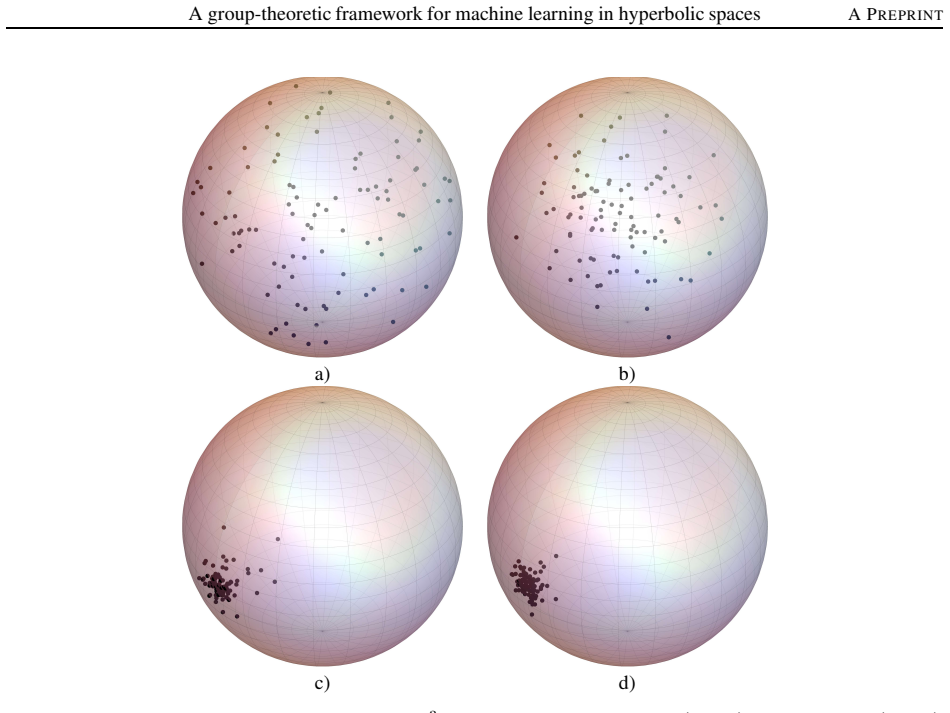
The central discovery is that the four basic questions facing any metric-space machine-learning setup—how to average points, how to compute that average, how to sample random points, and how to fit parameters—have rigorous answers when the metric space is a hyperbolic ball. For a configuration of points in the Poincaré disc, the paper defines the conformal barycenter as the unique point $a$ such that the Möbius-transformed configuration is balanced, equivalently the unique minimizer of the potential $H(a) = -\sum_i \log \frac{(1-|a|^2)(1-|z_i|^2)}{|1-\bar{a}z_i|^2}$; this barycenter is conformally invariant. It then introduces Poincaré swarms, dynamical systems whose trajectories evolve by Möbius group actions and which are hyperbolic gradient flows for $H$, so that running the swarm computes the barycenter. The paper also introduces the Möbius family of densities $p(z;a,s) \propto ((1-|z|^2)(1-|a|^2)/|1-\bar{a}z|^2)^s$, shows the family is invariant under the isometry group, gives an explicit inversion-sampling scheme, and proves that maximum likelihood separates into a barycenter problem for $a$ and a one-dimensional convex problem for the concentration $s$. These constructions extend to higher-dimensional Poincaré balls and to the non-equivalent Bergman balls in even dimensions.
Load-bearing premise
Every swarm algorithm for computing barycenters depends on the assertion that the right-hand side of the swarm ODE is exactly a linear combination of the Möbius group's infinitesimal generators with the stated coefficients; if that assertion fails, the proof that the swarm computes the barycenter collapses.
Editorial extensions
If this is right
- Barycenters in hyperbolic balls are conformally invariant: applying any isometry to a configuration moves the mean by that same isometry, which is the equivariance property required of a mean in metric learning.
- The Möbius family gives hyperbolic ML a parametric probability model with a closed-form sampling recipe and a maximum-likelihood procedure that reduces to computing the barycenter and solving a one-dimensional convex problem.
- Poincaré swarms give a gradient-descent algorithm that respects the hyperbolic metric, so barycenter computation does not require projecting Euclidean updates back into the ball.
- In even dimensions, the same framework works for both Poincaré and Bergman balls, and the paper argues the choice between them makes no qualitative difference for statistics or computation.
- The framework can support more elaborate pipelines, such as expectation-maximization, variational inference, and normalizing flows in hyperbolic latent spaces.
Reading between the lines
- Editorial extension: if the swarm proof holds, the same Lie-group-plus-gradient-flow template should produce barycenter algorithms on other homogeneous spaces, such as spheres or the hyperboloid model, by writing their isometry generators explicitly.
- Editorial extension: one concrete test of the framework's practical value is to benchmark the Möbius family against the wrapped normal distribution in a hyperbolic variational autoencoder; the paper does not report such experiments, but they would directly probe whether the sampling and MLE properties translate into better latent-space modeling.
- Editorial extension: conformal invariance suggests that equivariant neural network layers could be designed around the Möbius group rather than around tangent-space operations, but the paper only sketches this direction.
Signed reviews
Editorial analysis
A structured set of objections, weighed in public.
Referee Report
Summary. The paper proposes a group-theoretic framework for machine learning on hyperbolic balls. In the Poincaré disc it defines a conformal barycenter as the point whose associated Möbius transformation balances a configuration, introduces 'Poincaré swarms' whose dynamics are claimed to evolve by the Möbius group and to implement hyperbolic gradient descent, and defines a conformally invariant family of 'Möbius' probability distributions with exact sampling and maximum likelihood estimation. These constructions are then extended to higher-dimensional Poincaré and Bergman balls. The stated contribution is to give rigorous answers to four methodological questions: definition and computation of a mean, sampling, and parameter estimation.
Significance. If the mathematical claims were correct, the framework would offer a principled and computationally useful alternative to current hyperbolic ML tools: a group-invariant notion of mean, a gradient-flow algorithm, and a tractable statistical family with exact sampling and closed-form MLE. The paper also usefully connects hyperbolic ML to the Kuramoto oscillator literature and to complex hyperbolic geometry. However, the manuscript as written contains several algebraic errors in the central derivations: the metric tensor in Definition 1 is not the standard Poincaré metric, an infinitesimal generator in Section 3.2 has the wrong sign, the sampling inversion in Eq. (28) is incorrect, and the normalizing constant in Eq. (42) has the wrong power of π. In addition, core existence and uniqueness results are imported from the author's own unpublished preprints rather than proved. The intended contributions are therefore not established in this version.
major comments (6)
- [Section 2.2, Definition 1] The metric defined in Definition 1, g_x(u,v)=⟨u,v⟩/(1-|x|^2), is not the standard Poincaré ball metric. The standard metric is 4⟨u,v⟩/(1-|x|^2)^2 (up to a constant factor) and has constant sectional curvature -1; the metric as written is conformal to Euclidean with conformal factor (1-|x|^2)^{-1} and does not have constant negative curvature. This is not a harmless convention issue: the distance formula (5)-(6), the hyperbolic measure (4), and the hyperbolic gradient formula (23) used throughout the paper are all compatible with the square-denominator metric, not with the displayed one. The definition must be corrected and the curvature- and gradient-dependent claims rechecked.
- [Section 3.2, Eq. (20)] The infinitesimal generator v2 is miscomputed. For m2(t)=(t-z)/(1-tz), one obtains m2'(0)=1-z^2, not z^2-1. With the printed v2=z^2-1 and the stated h1,h2, the combination h1(z^2-1)+h2(iz^2+i) equals (K/2N)(Σ_k ζ_k) z^2 - (K/2N)(Σ_k \bar ζ_k), whereas the right-hand side of Eq. (17) is -(K/2N)(Σ_k \bar ζ_k) z^2 + (K/2N)Σ_k ζ_k. The coefficients of z^2 and the constant term are interchanged, so Eq. (17) is not a linear combination of the claimed generators. Replacing v2 by 1-z^2 would make the identity correct, but as written the proof of Theorem 5 and hence the swarm-based algorithm are unsupported.
- [Section 4.2, Eqs. (27)-(28)] The cumulative distribution function for the radial coordinate is incorrect. From the integral in Eq. (27), the CDF is ∫0^{2π}∫0^b (s-1)/π (1-r^2)^{s-2} r dr dφ = 1-(1-b^2)^{s-1}, not 1-(1-√b)^{s-1}. The inversion in Eq. (28) should therefore be |z| = sqrt(1-(1-κ)^{1/(s-1)}), not (1-(1-κ)^{1/(s-1)})^2. As printed, the sampling scheme generates points from a different radial distribution, so the answer to question iii) is not valid.
- [Section 6.1, Eq. (42)] The normalizing constant for the Möbius family on the Poincaré ball has the wrong power of π. The correct constant for the density with respect to dΛ(x) in Eq. (4) is π^{-d/2} Γ(1+s-d/2)/Γ(1+s-d) (up to a metric normalization), not π^{d/2} times that ratio. As a check, at d=2 Eq. (42) gives π(s-1)(1-|z|^2)^s, while the two-dimensional family in Eq. (26) has density (s-1)/π (1-|z|^2)^s; the two disagree by a factor of π^2. This error propagates into the likelihood (45) and the MLE formulas.
- [Sections 3.1 and 4.1 (Theorems 1, 4, Proposition 9)] Load-bearing statements are imported from the author's own preprints [47] and [57] without proof: the existence and uniqueness of the Möbius transformation balancing a configuration (Theorem 1), geodesic convexity and uniqueness of the minimum of H (Theorem 4), and the conformal invariance of the family (Proposition 9). The manuscript says 'We will omit the proofs, as they are provided therein.' Since these results constitute the definition and existence of the barycenter and the definition of the statistical family, the paper is not self-contained. For a paper whose stated aim is to give 'detailed and rigorous answers,' these results should either be proved here or the manuscript should state clearly that it builds on and assumes them.
- [Section 5.1, proof of Theorem 13] The gradient computation in the proof of Theorem 13 contains sign errors. Between the second and third displayed lines, the numerator changes from a|y_i-a|^2 - a(1-|a|^2) + y_i(1-|a|^2) to a|y_i-a|^2 + (y_i-a)(1-|a|^2), and the Möbius transformation h_a in Eq. (7) has numerator proportional to (a-x) rather than (y_i-a). The subsequent substitution that replaces h_a(x_i(0)) by x_i in the hyperbolic gradient is also not justified, so the identification of Eq. (36) as the gradient flow for H_d is not established.
minor comments (5)
- [Section 2.3, Definition 2] The index n is used interchangeably with the complex dimension m in the definitions of b(z)_ij and K(z,w); the notation should be made consistent.
- [Section 2.2, Eq. (10)] The Jacobian formula uses n for the dimension, which is inconsistent with the rest of the section using d; it should be d throughout.
- [Section 3.1, Theorem 1 vs Definition 4] Theorem 1 asserts uniqueness 'up to a rotation,' while Definition 4 asserts a unique point a; the role of the residual rotation in the definition of the barycenter should be clarified.
- [Section 3.2, Eq. (19)] The transformation ga(z)=(z-a)/(1-\bar a z) in Eq. (19) differs from the convention in Eq. (1) by a minus sign; this is likely absorbed by the eiθ factor, but the convention should be stated explicitly to avoid confusion.
- [Section 6.1, after Eq. (42)] The transitivity statement says 'h(a1) = h(a2)'; this should read 'h(a1) = a2' for a transformation h mapping μ1 to μ2.
Circularity Check
Central barycenter existence/uniqueness and the proposed density family are imported from the author's own prior work [47] and [57], so the framework's foundations are load-bearing self-citations; the MLE derivations and higher-dimensional extensions are independent.
-
uniqueness imported from authors
[Section 3.1, Theorem 1 and Theorem 4; used again in Sections 3.2, 4.3, 5.1, 5.2]
"We proceed with several facts and notions that have been introduced in [47]. We will omit the proofs, as they are provided therein. Theorem 1. Let {z1,...,zN} be a configuration of points in B2. Then, there exists a unique (up to a rotation) Möbius transformation ga ∈ G2, such that the configuration {ga(z1),...,ga(zN)} is balanced. ... Theorem 4. [47] The function (16) is geodesically convex in B2 and hence has a unique minimum in B2. This minimum is conformal barycenter of the configuration {z1,...,zN}."
The paper's answer to question i)—existence and uniqueness of the mean—is exactly the content of Theorem 1 and Theorem 4, both attributed to the author's own prior paper [47] and not proved here. The conformal barycenter is defined through this imported uniqueness, and every later claim that the minimizer of H is the barycenter, including the MLE statement 'ˆa is precisely the conformal barycenter of points z1,...,zN' in Section 4.3 and the ball generalizations in Sections 5.1–5.2, inherits this same self-citation. The central mathematical object is thus not derived in the present paper but is taken as an input from a same-author source, making the 'rigorous answer to i)' a citation rather than an independent derivation.
-
self citation load bearing
[Section 4.1, Eq. (26) and Proposition 9; also Section 6.1–6.2]
"We consider probability distributions on B2 defined by densities of the form (see [57]) p(x;a,s) = (s-1)/π * ((1-|z|^2)(1-|a|^2)/|1-az̄|^2)^s. ... We denote this family of probability distributions by Moeb2(a,s) and refer to these distributions as Möbius distributions in hyperbolic disc."
The paper presents the Möbius family as the 'novel family' answering question iii), but the density is taken verbatim from the author's own prior paper [57] and no derivation from the group-theoretic framework is supplied. Proposition 9, the conformal invariance that makes the family usable for the stated ML tasks, is asserted without proof. The subsequent random-generation and MLE algorithms operate on this imported ansatz, so the statistical model is an input from a same-author citation rather than a consequence derived in the paper. This is load-bearing because the statistical sections' conclusions all presuppose that this particular family is the right one.
full rationale
The paper does not exhibit a fitted parameter renamed as a prediction, nor does it define a quantity in terms of the very quantity it claims to derive. The main mathematical mechanism—showing that Poincaré swarms (17) evolve by Möbius actions and that the resulting ODE is hyperbolic gradient flow—is a genuine derivation using Lie-group generators and the gradient-flow condition; those parts are not circular, even if the generator computation in Section 3.2 appears algebraically incorrect (a correctness concern, not a circularity concern). The circularity burden is concentrated in the foundations: the conformal barycenter's existence, uniqueness, and minimizing-potential characterization are imported from the same-author paper [47], and the Möbius density family is imported from the same-author paper [57]. These are load-bearing self-citations because the central definitions and the statistical model are not reproved or rederived here. However, the paper does add independent content: the explicit swarm dynamics, the MLE formula manipulations, the higher-dimensional Poincaré/Bergman extensions, and the sampling algorithms go beyond mere restatement. Thus the paper is partially circular but not wholly so; the score of 4 reflects substantial load-bearing self-citation with genuinely independent technical work around it.
Assumptions & free parameters
assumptions (4)
- domain assumption Theorem 1 and Theorem 4 from [47]: existence and uniqueness of a balanced Möbius image, and geodesic convexity of the potential H(a).
- standard math Theorem 6 from [48]: trajectories of a time-dependent linear combination of infinitesimal generators evolve by group action.
- ad hoc to paper The Poincaré ball metric as written in Definition 1, with denominator (1-|x|^2), defines a constant negative curvature manifold.
- standard math Bergman balls have constant negative sectional curvature, per [43].
Cite this review
Pith. "Pith review of A group-theoretic framework for machine learning in hyperbolic spaces." pith.science (2026). https://pith.science/paper/6I6M44PP
@misc{pith2026250106934,
  author       = {Pith},
  title        = {Pith review of: A group-theoretic framework for machine learning in hyperbolic spaces},
  year         = {2026},
  howpublished = {\url{https://pith.science/paper/6I6M44PP}},
  note         = {Machine review of arXiv:2501.06934}
}
read the original abstract
Embedding the data in hyperbolic spaces can preserve complex relationships in very few dimensions, thus enabling compact models and improving efficiency of machine learning (ML) algorithms. The underlying idea is that hyperbolic representations can prevent the loss of important structural information for certain ubiquitous types of data. However, further advances in hyperbolic ML require more principled mathematical approaches and adequate geometric methods. The present study aims at enhancing mathematical foundations of hyperbolic ML by combining group-theoretic and conformal-geometric arguments with optimization and statistical techniques. Precisely, we introduce the notion of the mean (barycenter) and the novel family of probability distributions on hyperbolic balls. We further propose efficient optimization algorithms for computation of the barycenter and for maximum likelihood estimation. One can build upon basic concepts presented here in order to design more demanding algorithms and implement hyperbolic deep learning pipelines.
Figures


Figures from the paper (1 more)
Forward citations
Cited by 2 Pith papers
-
Cartan Networks: Group theoretical Hyperbolic Deep Learning
Cartan networks compose solvable-group homomorphisms with isometries to define hyperbolic layers, and the paper reports competitive benchmark performance.
-
Clustering in hyperbolic balls
K-means and EM clustering for points in Poincaré hyperbolic balls are defined via conformal barycenters and Möbius distributions, with synthetic experiments in 2D and 3D.
Reference graph
Works this paper leans on
-
[47]
Jacimovic, V . & Kalaj, D. Conformal and holomorphic barycenters in hyperbolic balls. arXiv:2410.02257. (2024)
arXiv 2024
-
[57]
Ja ´cimovi´c, V . & Markovi ´c, M. Conformally Natural Families of Probability Distribu tions on Hyperbolic Disc with a View on Geometric Deep Learning. arXiv:2407.16733. (2024)
arXiv 2024
-
[1]
Krioukov, D., Papadopoulos, F., Kitsak, M., V ahdat, A. &Boguná, M. Hyperbolic geometry of complex networks. Physical Review E. 82, 036106 (2010)
work page 2010
-
[2]
Muscoloni, A., Thomas, J., Ciucci, S., Bianconi, G. & Can nistraci, C. Machine learning meets complex networks via coalescent embedding in the hyperbolic space. Nature Communications. 8, 1615 (2017)
work page 2017
-
[3]
Bronstein, M., Bruna, J., Cohen, T. & V eli ˇckovi´c, P . Geometric deep learning: Grids, groups, graphs, geode sics, and gauges. arXiv:2104.13478. (2021)
arXiv 2021
-
[4]
Tifrea, A., Bécigneul, G. & Ganea, O. Poincaré GloV e: Hyp erbolic Word Embeddings. International Conference on Learning Representations. (2019)
work page 2019
-
[5]
Nickel, M. & Kiela, D. Learning continuous hierarchies i n the Lorentz model of hyperbolic geometry. Proceed- ings of the 35th International Conference on Machine Learni ng. pp. 3779-3788 (2018)
work page 2018
-
[6]
Leimeister, M. & Wilson, B. Skip-gram word embeddings in hyperbolic space. arXiv:1809.01498. (2018)
arXiv 2018
Show all 60 references
-
[7]
& Y eung, S
Mettes, P ., Ghadimi Atigh, M., Keller-Ressel, M., Gu, J. & Y eung, S. Hyperbolic deep learning in computer vision: A survey. International Journal of Computer Vision . 132 pp. 3484-3508 (2024)
2024
-
[8]
& Lempitsky, V
Khrulkov, V ., Mirvakhabova, L., Ustinova, E., Oseledet s, I. & Lempitsky, V . Hyperbolic image embeddings. Proceedings of the IEEE/CVF Conference on Computer Vision a nd Pattern Recognition. pp. 6418-6428 (2020)
2020
-
[9]
Hyperbolic matrix factorization improves prediction of drug-target associations
Poleksic, A. Hyperbolic matrix factorization improves prediction of drug-target associations. Scientific Reports . 13, 959 (2023)
2023
-
[10]
& Lio, P
Corso, G., Ying, R., Pándy, M., V eli ˇckovi´c, P ., Leskovec, J. & Lio, P . Neural distance embeddings for biological sequences. Proceedings of the 35th International Conference on Neural Information Processing Systems . pp. 18539-18551 (2021)
2021
-
[11]
& V argas, S
Chamberlain, B., Hardwick, S., Wardrope, D., Dzogang, F., Daolio, F. & V argas, S. Scalable hyperbolic recom- mender systems. arXiv:1902.08648. (2019)
2019 arXiv
-
[12]
& Wang, Z
Li, A., Y ang, B., Huo, H., Chen, H., Xu, G. & Wang, Z. Hyper bolic neural collaborative recommender. IEEE Transactions on Knowledge and Data Engineering . 35, 9114-9127 (2022)
2022
-
[13]
Chami, I., Wolf, A., Juan, D., Sala, F., Ravi, S. & Ré, C. L ow-dimensional hyperbolic knowledge graph embed- dings. arXiv:2005.00545. (2020)
2020 arXiv
-
[14]
& Pantazis, D
Baker, C., Suárez-Méndez, I., Smith, G., Marsh, E., Fun ke, M., Mosher, J., Maestú, F., Xu, M. & Pantazis, D. Hyperbolic graph embedding of MEG brain networks to study br ain alterations in individuals with subjective cognitive decline. IEEE Journal of Biomedical and Health In...
2024
-
[15]
& Serrano, M
Allard, A. & Serrano, M. Navigable maps of structural br ain networks across species. PLoS Computational Biology. 16, e1007584 (2020)
2020
-
[16]
& Balay, M
Joseph, A., Francis, N. & Balay, M. Hyperbolic Brain Rep resentations. arXiv:2409.12990. (2024)
2024 arXiv
-
[17]
& Hunt, J
Cetin, E., Chamberlain, B., Bronstein, M. & Hunt, J. Hyp erbolic deep reinforcement learning. International Conference on Learning Representations. (2023)
2023
-
[18]
, Miller, D
Bogatskiy, A., Anderson, B., Offermann, J., Roussi, M. , Miller, D. & Kondor, R. Lorentz group equivariant neural network for particle physics. Proceedings of the 37th International Conference on Machin e Learning. pp. 992-1002 (2020)
2020
-
[19]
& others Hyperbolic Attention Networks
Gulcehre, C., Denil, M., Malinowski, M., Razavi, A., Pa scanu, R., Hermann, K., Battaglia, P ., Bapst, V ., Raposo, D., Santoro, A. & others Hyperbolic Attention Networks. International Conference on Learning Representations. (2018)
2018
-
[20]
& Hofmann, T
Ganea, O., Bécigneul, G. & Hofmann, T. Hyperbolic neura l networks. Proceedings of the 32nd International Conference on Neural Information Processing Systems . pp. 5350-5360 (2018)
2018
-
[21]
& Nakayama, H
Takeuchi, J., Nishida, N. & Nakayama, H. Neural network s in a product of hyperbolic spaces. Proceedings of the 2022 Conference of the North American Chapter of the Asso ciation for Computational Linguistics: Human Language T echnologies: Student Research W orkshop. pp. 211-221 (2022)
2022
-
[22]
& Welling, M
Cohen, T. & Welling, M. Group equivariant convolutiona l networks. Proceedings of the 33rd International Con- ference on Machine Learning . pp. 2990-2999 (2016)
2016
-
[23]
& Kiela, D
Nickel, M. & Kiela, D. Poincaré embeddings for learning hierarchical representations. Proceedings of the 31st International Conference on Neural Information Processin g Systems. pp. 6341-6350 (2017)
2017
-
[24]
& Teh, Y .Continuous hierarchical representations with Poincaré variational auto-encoders
Mathieu, E., Lan, C., Maddison, C., Tomioka, R. & Teh, Y .Continuous hierarchical representations with Poincaré variational auto-encoders. Proceedings of the 33rd International Conference on Neural Information Processing Systems. pp. 12565-12576 (2019)
2019
-
[25]
Hyperbolic trigonometry and its application in the Poincaré ball model of hyperbolic geometry
Ungar, A. Hyperbolic trigonometry and its application in the Poincaré ball model of hyperbolic geometry. Com- puters & Mathematics with Applications . 41, 135-147 (2001)
2001
-
[26]
& Koyama, M
Nagano, Y ., Y amaguchi, S., Fujita, Y . & Koyama, M. A wrap ped normal distribution on hyperbolic space for gradient-based learning. Proceedings of the 36th International Conference on Machin e Learning. pp. 4693-4702 (2019)
2019
-
[27]
& Kim, D
Cho, S., Lee, J., Park, J. & Kim, D. A rotated hyperbolic w rapped normal distribution for hierarchical represen- tation learning. Proceedings of the 36th International Conference on Neural Information Processing Systems. pp. 17831-17843 (2022)
2022
-
[28]
& Zhao, G
Peng, W ., V aranka, T., Mostafa, A., Shi, H. & Zhao, G. Hyp erbolic deep neural networks: A survey. IEEE Transactions on Pattern Analysis and Machine Intelligence . 44, 10023-10044 (2021)
2021
-
[29]
& Welling, M
Cohen, T. & Welling, M. Learning the irreducible repres entations of commutative Lie groups. Proceedings of the 31st International Conference on Machine Learning . pp. 1755-1763 (2014)
2014
-
[30]
Lie group machine learning and Gibbs den sity on Poincaré unit disk from Souriau Lie groups thermodynamics and SU(1,1) coadjoint orbits
Barbaresco, F. Lie group machine learning and Gibbs den sity on Poincaré unit disk from Souriau Lie groups thermodynamics and SU(1,1) coadjoint orbits. Geometric Science of Information: 4th International Confe rence. pp. 157-170 (2019)
2019
-
[31]
& Hauberg, S
Arvanitidis, G., Hansen, L. & Hauberg, S. Latent Space O ddity: on the Curvature of Deep Generative Models. International Conference on Learning Representations . (2018)
2018
-
[32]
& Duin, R
Wilson, R., Hancock, E., Pekalska, E. & Duin, R. Spheric al and hyperbolic embeddings of data. IEEE Transac- tions on Pattern Analysis and Machine Intelligence . 36, 2255-2269 (2014)
2014
-
[33]
& Calder, C
Smith, A., Asta, D. & Calder, C. The geometry of continuo us latent space models for network data. Statistical Science: A Review Journal of the Institute of Mathematical S tatistics. 34, 428 (2019)
2019
-
[34]
& Hamilt on, W
Bose, J., Smofsky, A., Liao, R., Panangaden, P . & Hamilt on, W . Latent variable modelling with hyperbolic nor- malizing flows. Proceedings of the 37th International Conference on Machin e Learning. pp. 1045-1055 (2020)
2020
-
[35]
& Strapasson, J
Costa, S., Santos, S. & Strapasson, J. Fisher informati on distance: A geometrical reading. Discrete Applied Mathematics. 197 pp. 59-69 (2015)
2015
-
[36]
& Mettes, P
Atigh, M., Keller-Ressel, M. & Mettes, P . Hyperbolic Bu semann learning with ideal prototypes. Proceedings of the 35th International Conference on Neural Information Pr ocessing Systems. pp. 103-115 (2021)
2021
-
[37]
Chami, I., Gu, A., Nguyen, D. & Ré, C. HoroPCA: Hyperboli c dimensionality reduction via horospherical projections. Proceedings of the 38th International Conference on Machin e Learning. pp. 1419-1429 (2021) 21 A group-theoretic framework for machine learning in hyperb olic sp...
2021
-
[38]
& Ostermeier, A
Hansen, N. & Ostermeier, A. Completely derandomized se lf-adaptation in evolution strategies. Evolutionary Computation. 9, 159-195 (2001)
2001
-
[39]
Harmonic and subharmonic function theory on t he hyperbolic ball
Stoll, M. Harmonic and subharmonic function theory on t he hyperbolic ball. (Cambridge University Press,2016)
2016
-
[40]
Notes on complex hyperbolic geometry
Parker, J. Notes on complex hyperbolic geometry. (http s://www.icts.res.in/sites/default/files/NCHG.pdf), Ac - cessed: 11 January 2025
2025
-
[41]
Möbius Transformations in Several Dimensi ons
Ahlfors, L. Möbius Transformations in Several Dimensi ons. (University of Minnesota,1981)
1981
-
[42]
Spaces of holomorphic functions in the unit ball
Zhu, K. Spaces of holomorphic functions in the unit ball . (Springer,2005)
2005
-
[43]
Huang, X. & Li, S. Bergman metrics with constant holomor phic sectional curvatures. arXiv:2302.13456v2. (2024)
2024 arXiv
-
[44]
& Y ang, L
Arnaudon, M., Barbaresco, F. & Y ang, L. Medians and mean s in Riemannian geometry: Existence, uniqueness and computation. F . Nielsen, R. Bhatia (Eds.) Matrix Information Geometry. pp. 169-197 (2012)
2012
-
[45]
Convex Analysis and Optimization in Hadamard Spaces
Bacak, M. Convex Analysis and Optimization in Hadamard Spaces. (De Gruyter,2014)
2014
-
[46]
& D e Sa, C
Lou, A., Katsman, I., Jiang, Q., Belongie, S., Lim, S. & D e Sa, C. Differentiating through the Fréchet mean. Proceedings of the 37th International Conference on Machin e Learning. pp. 6393-6403 (2020)
2020
-
[48]
Applications of Lie groups to differential eq uations
Olver, P . Applications of Lie groups to differential eq uations. (Springer,1993)
1993
-
[49]
Self-entrainment of a population of coupl ed nonlinear oscillators
Kuramoto, Y . Self-entrainment of a population of coupl ed nonlinear oscillators. H. Araki (Eds.) International Symposium on Mathematical Problems in Theoretical Physics . pp. 420-422 (1975)
1975
-
[50]
& Strogatz, S
Marvel, S., Mirollo, R. & Strogatz, S. Identical phase o scillators with global sinusoidal coupling evolve by Möbius group action. Chaos: An Interdisciplinary Journal of Nonlinear Science . 19 (2009)
2009
-
[51]
& Strogatz, S
Watanabe, S. & Strogatz, S. Constants of motion for supe rconducting Josephson arrays. Physica D: Nonlinear Phenomena. 74, 197-253 (1994)
1994
-
[52]
& Mirollo, R
Chen, B., Engelbrecht, J. & Mirollo, R. Hyperbolic geom etry of Kuramoto oscillator networks. Journal of Physics A: Mathematical and Theoretical . 50, 355101 (2017)
2017
-
[53]
Computing the Douady–Earle extension using Kuramoto o scillators
Ja ´cimovi´c, V . Computing the Douady–Earle extension using Kuramoto o scillators. Analysis and Mathematical Physics. 9 pp. 523-529 (2019)
2019
-
[54]
& Earle, C
Douady, A. & Earle, C. Conformally natural extension of homeomorphisms of the circle. Acta Mathematica. 157 pp. 23-48 (1986)
1986
-
[55]
& Strogatz, S
Lipton, M., Mirollo, R. & Strogatz, S. The Kuramoto mode l on a sphere: Explaining its low-dimensional dynam- ics with group theory and hyperbolic geometry. Chaos: An Interdisciplinary Journal of Nonlinear Science . 31 (2021)
2021
-
[56]
Consensus on nonlinear spaces
Sepulchre, R. Consensus on nonlinear spaces. Annual Reviews in Control. 35, 56-64 (2011)
2011
-
[58]
The Möbius distribution on the disc
Jones, M. The Möbius distribution on the disc. Annals of the Institute of Statistical Mathematics . 56 pp. 733-742 (2004)
2004
-
[59]
Sala, F., De Sa, C., Gu, A. & Ré, C. Representation tradeo ffs for hyperbolic embeddings. Proceedings of the 35th International Conference on Machine Learning . pp. 4460-4469 (2018)
2018
-
[60]
& Zemel, R
Law, M., Liao, R., Snell, J. & Zemel, R. Lorentzian dista nce learning for hyperbolic representations. Proceedings of the 36th International Conference on Machine Learning . pp. 3672-3681 (2019) 22
2019
Reviewed August 10, 2026 · model on record in the stance chip above.
Discussion (0). Continue with ORCID to comment.