REVIEW 5 major objections 6 minor 36 references
D3MES: Diffusion Transformer with multihead equivariant self-attention for 3D molecule generation
T0 review · 5 major / 6 minor · reviewed 2026-08-10 · deepseek-v4-flash
Pith's one-line read D3MES claims state-of-the-art 3D molecule generation by fusing a Diffusion Transformer with multihead equivariant self-attention.
desk verdict A legitimate DiT plus SE(3)-attention assembly whose headline GEOM-Drugs numbers cannot be checked as written, because the molecule-to-grid representation and the equivariance of the patchified pipeline are never specified. read the letter →
The pith
A machine-rendered reading of the paper's core claim, the machinery that carries it, and where it could break.
The reading
What carries the argument
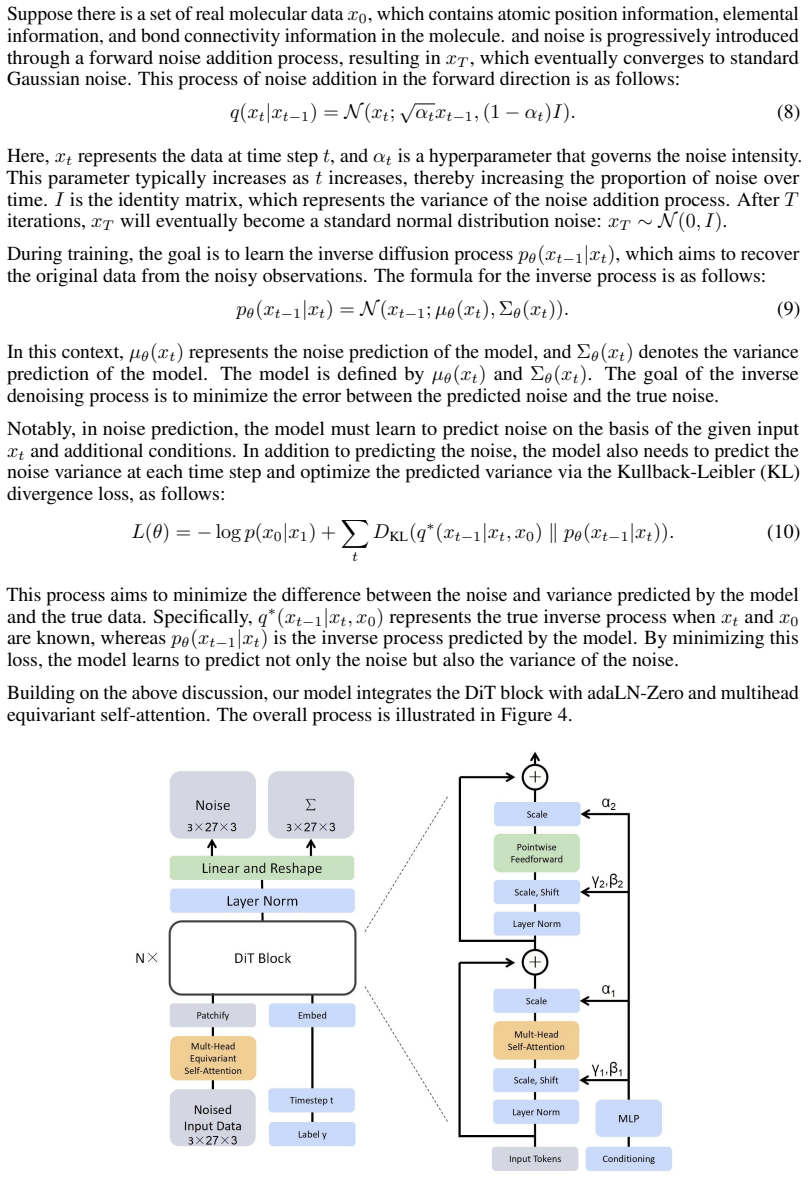
The load-bearing component is the multihead equivariant self-attention layer taken from the SE(3)-Transformer architecture, placed in front of the Diffusion Transformer blocks. Each nonhydrogen atom is treated as a point whose node features come from the element channel and whose edge features come from the bond-connectivity channel; query and key vectors are built from equivariant linear embeddings of relative positions, so the attention weights are SE(3)-invariant. The updated feature representation replaces the coordinate channel, and the whole three-channel tensor is then cut into 3 by 3 patches and tokenized for the Diffusion Transformer, which denoises the patched representation and outputs both a noise prediction and a variance prediction.
What would settle it
A concrete check would be to take real GEOM-Drugs molecules, encode them into the three-channel tensor, apply the 3 by 3 patchify, and decode the result without any diffusion noise; if the original coordinates, element types, and bond connectivity are not recovered exactly, the representation itself is lossy and the reported validity numbers cannot be fully attributed to the generative model.
Extended reading notes
Core claim
D3MES's central claim is that a molecule can be represented as a three-channel tensor — atom coordinates, element identities, and bond connectivity — and that running this tensor through multihead equivariant self-attention before the Diffusion Transformer patchify stage lets one model jointly predict coordinates, elements, and bonds, with hydrogen atoms added afterwards at maximum allowed valence. The key experimental claim is that this architecture is state of the art on the large GEOM-Drugs set: molecular stability of 94.7%, which the authors say is 3.1 percentage points above the closest compared baseline, with 99.98% validity and 99.9% uniqueness. On QM9 the model is not uniformly best, but it leads uniqueness at 98.3% and the attention-enhanced version consistently outperforms the same model without attention (DTM). The paper also claims the framework can be steered by molecular class, generating cyclic and noncyclic molecules with 96.6% and 97.4% category accuracy, respectively.
Load-bearing premise
The method rests on the assumption that a molecule can be written as a fixed three-channel image-like tensor and then cut into 3 by 3 patches without losing the information that makes it a valid molecule or breaking the symmetry that the equivariant attention layer depends on.
Editorial extensions
If this is right
- If the reported numbers hold, D3MES can generate drug-like molecules of up to 91 heavy atoms at near-perfect RDKit validity and uniqueness, making it a plausible first-pass generator before property screening.
- Because the attention-enhanced model beats the no-attention version on almost every QM9 metric, the equivariant attention layer appears to be doing useful geometric feature work rather than merely adding parameters.
- The three-channel representation covering coordinates, elements, and bonds means the same trained pipeline can output complete molecular structures without relying on a separate bond-prediction stage.
- The classification experiments indicate that a single model, rather than a collection of class-specific generators, can direct generation toward cyclic or noncyclic scaffolds with roughly 97% category accuracy.
- On the large GEOM-Drugs dataset, the authors claim gains in molecular stability, validity, and uniqueness over all compared diffusion baselines, which would be a practical advance for large-molecule generation.
Reading between the lines
- A natural next test would be to reconstruct known GEOM-Drugs molecules from their patched three-channel tensors without any diffusion noise; if coordinates, elements, and bonds do not survive that round trip, the validity numbers would partly reflect the representation rather than the generative model.
- Because hydrogen atoms are added after generation using maximum allowed valence, part of the reported atomic and molecular stability is inherited from a rule-based postprocessing step; training a dedicated hydrogen-placement module and measuring the change in stability would isolate the diffusion model's own contribution.
- The paper leaves implicit whether a fixed grid and 3 by 3 patch layout can preserve SE(3) equivariance for molecules of very different sizes; an empirical check would be to rotate or translate a generated molecule and confirm the model produces the same molecule before and after the transformation.
- For drug-discovery practice, RDKit validity is a syntactic floor rather than a biological property; the more decision-relevant extension would be to measure whether generated molecules retain docking scores, solubility, or other target-specific properties across the claimed scale of generation.
Editorial analysis
A structured set of objections, weighed in public.
Referee Report
Summary. The paper proposes D3MES, a diffusion model for 3D molecule generation that inserts a multihead equivariant self-attention layer (based on the SE(3)-Transformer) before a Diffusion Transformer (DiT) backbone. Each molecule is encoded as a three-channel grid whose channels store atom coordinates, elemental information, and bond connectivity; after equivariant attention, the data are patchified into tokens and processed by DiT blocks with adaLN-Zero. The model is evaluated on GEOM-QM9 and GEOM-Drugs for unconditional generation and on a cyclic/noncyclic subset of QM9 for class-conditioned generation. The authors report competitive results on QM9 and claim state-of-the-art performance on GEOM-Drugs, with 99.98% validity, 99.9% Val/Uniq, and 94.7% molecular stability. A code link is provided.
Significance. If substantiated, the GEOM-Drugs results would be a meaningful advance in large-molecule 3D generation, and the paper's internal ablation (DTM versus D3MES) is a reasonable way to isolate the effect of the equivariant attention module. The authors also honestly acknowledge limitations in Section 5. However, the significance as currently presented is severely limited because the central architecture is not well-posed, the equivariance claims are not established for the full pipeline, and the experimental protocol lacks the details needed for reproducibility or fair comparison. The contradiction between the abstract's hydrogen-learning claim and the actual maximum-valence post-processing in Section 5 further undermines the paper's stated contribution.
major comments (5)
- [§3.1–3.2] The paper never specifies how a molecule of variable size (9 to 91 heavy atoms) is mapped to the fixed three-channel grid shown in Figure 1, what grid resolution is used, or how bond connectivity is encoded in the third channel. Without these definitions, the patchify operation (T = (h/p)(w/p), §3.2) and the final linear decode into p×p×2c are not well-posed, and the validity and uniqueness numbers in Tables 1 and 2 cannot be interpreted or reproduced.
- [§2.2, Eq. (7); §3.2] Equation (7) demonstrates SO(3)-invariance of the attention weights for the equivariant attention layer, but no argument is given that the subsequent patchify operation, sinusoidal positional encoding, DiT transformer blocks, and final linear decode preserve SE(3) invariance. If patchification breaks equivariance, the generated coordinates are not reliably SE(3)-invariant; this is a load-bearing gap because the method's name and central design premise rest on equivariance.
- [Abstract and §5] The abstract states that D3MES addresses the challenge of 'correctly attaching hydrogen atoms in generated molecules through learning representations of molecules after hydrogen atoms are removed,' but Section 5 states that hydrogen atoms are currently added on the basis of the maximum allowable valence state for each atom, not by a learned module. This is a direct contradiction, and it means one of the two key contributions claimed in the abstract is not implemented as described.
- [§4.1–4.2] The experimental comparison lacks essential protocol details: no training hyperparameters are reported, no error bars or statistical tests are given, and baseline numbers are quoted from the corresponding papers without demonstrating that the evaluation protocol (dataset split, number of generated samples, validity checking, hydrogen addition procedure) is identical. In Table 2, the many missing baseline entries (/) make the claimed 3.1% margin on molecular stability impossible to verify, and the reported MiDi validity of 77.8% is strikingly inconsistent with its high molecular stability unless the protocols differ; the authors do not discuss this.
- [§4.3] The classification generation experiment reports 97.4% accuracy for noncyclic and 96.6% for cyclic molecules, but no baseline comparison, no statistical significance, and no description of how 'cyclic' is defined or how the category of a generated molecule is verified are given. This does not support the broader claim of controllable generation across multiple molecular classes.
minor comments (6)
- [Eq. (3)] The loss name is written as 'Lsimole', which is likely a typo for 'Lsimple', and the norm in the equation is not defined.
- [Eq. (5)] The direct-sum symbol ⊕ is not defined, making the construction of the query and key vectors difficult to follow.
- [Figures 3–4] Figures 3 and 4 are not cited in the text near their descriptions, and the captions are somewhat vague about the exact data flow.
- [Abstract and §1] The term 'classifiable diffusion model' is used but never defined or referenced; it should be explained or replaced with a standard term.
- [§3.1] The sentence 'we extract each nonhydrogen atom in the molecule as a point cloud' is at odds with the abstract's emphasis on hydrogen attachment; the role of hydrogen atoms in the input representation needs clarification.
- [Throughout] There are several typos, including 'respresents' (Eq. (3) context), 'explored' for 'explore' in §1, and 'the base model we selected uses...' in §4.2, which should be corrected.
Circularity Check
No significant circularity: D3MES is an empirical architecture combination evaluated against external benchmarks, and no prediction or derivation reduces by construction to its own inputs.
full rationale
I walked the claimed derivation chain and found no step in which a stated result is equivalent by construction to its input, nor any load-bearing self-citation. The method combines DiT and SE(3)-Transformer components by citing prior work, but the paper makes no first-principles claim that DiT alone predicts molecular stability; instead, it trains D3MES and DTM on GEOM-QM9 and GEOM-Drugs and reports external metrics (atomic stability, molecular stability, RDKit validity, uniqueness). The attention layer is an architectural addition, and the DTM-vs-D3MES comparison is an internal ablation, not a circular prediction. Baseline numbers are taken from prior papers, but that is standard benchmarking and does not make the result equivalent to its inputs. The paper does contain serious correctness concerns that are not circularity: the abstract claims the method addresses hydrogen placement by learning representations of molecules without hydrogen, while Section 5 explicitly states that hydrogen atoms are currently added on the basis of the maximum allowable valence state, not by a learned module; moreover, Section 3.1-3.2 never specifies how variable-size point clouds become fixed grid channels or how patchify preserves SE(3) equivariance. These are omissions or inconsistencies affecting interpretability and validity, but they do not constitute circular reasoning. Accordingly, the circularity score is 0.
Assumptions & free parameters
free parameters (3)
- Patch size p =
3 (stated as 3x3 patches)
- Number of attention heads
- DiT model dimension and depth
assumptions (4)
- ad hoc to paper Molecules can be encoded losslessly as a fixed-size 3-channel image-like tensor (coordinates, elements, bonds).
- ad hoc to paper SE(3) equivariant attention output remains useful after patchification and DiT processing.
- domain assumption Standard DDPM forward and reverse processes apply to coordinates, element types, and bond channels.
- domain assumption Published baseline numbers are directly comparable to this model's numbers.
Cite this review
Pith. "Pith review of D3MES: Diffusion Transformer with multihead equivariant self-attention for 3D molecule generation." pith.science (2026). https://pith.science/paper/HTRYYALG
@misc{pith2026250107077,
  author       = {Pith},
  title        = {Pith review of: D3MES: Diffusion Transformer with multihead equivariant self-attention for 3D molecule generation},
  year         = {2026},
  howpublished = {\url{https://pith.science/paper/HTRYYALG}},
  note         = {Machine review of arXiv:2501.07077}
}
read the original abstract
Understanding and predicting the diverse conformational states of molecules is crucial for advancing fields such as chemistry, material science, and drug development. Despite significant progress in generative models, accurately generating complex and biologically or material-relevant molecular structures remains a major challenge. In this work, we introduce a diffusion model for three-dimensional (3D) molecule generation that combines a classifiable diffusion model, Diffusion Transformer, with multihead equivariant self-attention. This method addresses two key challenges: correctly attaching hydrogen atoms in generated molecules through learning representations of molecules after hydrogen atoms are removed; and overcoming the limitations of existing models that cannot generate molecules across multiple classes simultaneously. The experimental results demonstrate that our model not only achieves state-of-the-art performance across several key metrics but also exhibits robustness and versatility, making it highly suitable for early-stage large-scale generation processes in molecular design, followed by validation and further screening to obtain molecules with specific properties.
Figures


Figures from the paper (3 more)


Reference graph
Works this paper leans on
-
[1]
Ab Initio Machine Learning in Chemical Compound Space
B. Huang and O. A. V on Lilienfeld. “Ab Initio Machine Learning in Chemical Compound Space”. In: Chemical Reviews 121.16 (2021), pp. 10001–10036
work page 2021
-
[2]
Learning matter: Materials design with machine learning and atomistic simulations
S. Axelrod, D. Schwalbe-Koda, S. Mohapatra, et al. “Learning matter: Materials design with machine learning and atomistic simulations”. In: Accounts of Materials Research 3.3 (2022), pp. 343–357
work page 2022
-
[3]
Integrated Molecular Modeling and Machine Learning for Drug Design
S. Xia, E. Chen, and Y . Zhang. “Integrated Molecular Modeling and Machine Learning for Drug Design”. In: Journal of Chemical Theory and Computation 19.21 (2023), pp. 7478–7495
work page 2023
-
[4]
Highly accurate protein structure prediction with AlphaFold
John Jumper, Richard Evans, Alexander Pritzel, et al. “Highly accurate protein structure prediction with AlphaFold”. In: Nature 596.7873 (2021), pp. 583–589
work page 2021
-
[5]
R. Gómez-Bombarelli, J. Aguilera-Iparraguirre, T. D. Hirzel, et al. “Design of Efficient Molecular Organic Light-Emitting Diodes by a High-Throughput Virtual Screening and Experimental Approach”. In: Nature Materials 15.10 (2016), pp. 1120–1127
work page 2016
-
[6]
J. L. Reymond. “The chemical space project”. In: Accounts of Chemical Research 48.3 (2015), pp. 722–730
work page 2015
-
[7]
Enumeration of 166 billion organic small molecules in the chemical universe database GDB-17
L. Ruddigkeit et al. “Enumeration of 166 billion organic small molecules in the chemical universe database GDB-17”. In: Journal of Chemical Information and Modeling 52.11 (2012), pp. 2864–2875
work page 2012
-
[8]
Physics-Guided Reinforcement Learning for 3D Molecular Structures
Y . Cho, S. Kim, P. P. Li, et al. “Physics-Guided Reinforcement Learning for 3D Molecular Structures”. In: Workshop at the 33rd Conference on Neural Information Processing Systems (NeurIPS). 2019
work page 2019
Show all 36 references
-
[9]
Artificial Intelligence to Deep Learning: Machine Intelligence Approach for Drug Discovery
R. Gupta et al. “Artificial Intelligence to Deep Learning: Machine Intelligence Approach for Drug Discovery”. In: Molecular Diversity 25 (2021), pp. 1315–1360
2021
-
[10]
Generative design, manufacturing, and molecular modeling of 3D architected materials based on natural language input
Y . C. Hsu, Z. Yang, and M. J. Buehler. “Generative design, manufacturing, and molecular modeling of 3D architected materials based on natural language input”. In: APL Materials 10.4 (2022)
2022
-
[11]
Mattergen: A generative model for inorganic materials design
C. Zeni, R. Pinsler, D. Zügner, et al. “Mattergen: A generative model for inorganic materials design”. In: arXiv preprint arXiv:2312.03687 (2023)
2023 arXiv
-
[12]
Generative Design of Crystal Structures by Point Cloud Representations and Diffusion Model
Z. Li, R. Mrad, R. Jiao, et al. “Generative Design of Crystal Structures by Point Cloud Representations and Diffusion Model”. In: arXiv preprint arXiv:2401.13192 (2024)
2024
-
[13]
Silvr: Guided diffusion for molecule generation
N. T. Runcie and A. S. J. S. Mey. “Silvr: Guided diffusion for molecule generation”. In: Journal of Chemical Information and Modeling 63.19 (2023), pp. 5996–6005
2023
-
[14]
Semi-Equivariant Conditional Normalizing Flows, with Applications to Target-Aware Molecule Generation
E. Rozenberg and D. Freedman. “Semi-Equivariant Conditional Normalizing Flows, with Applications to Target-Aware Molecule Generation”. In: Machine Learning: Science and Technology 4.3 (2023), p. 035037
2023
-
[15]
Molecular Generation with Recurrent Neural Networks (RNNs)
E. J. Bjerrum and R. Threlfall. “Molecular Generation with Recurrent Neural Networks (RNNs)”. In: arXiv preprint arXiv:1705.04612 (2017)
2017 arXiv
-
[16]
Bidirectional Molecule Generation with Recurrent Neural Networks
F. Grisoni et al. “Bidirectional Molecule Generation with Recurrent Neural Networks”. In: Journal of Chemical Information and Modeling 60.3 (2020), pp. 1175–1183
2020
-
[17]
Symmetry-Adapted Generation of 3D Point Sets for the Targeted Discovery of Molecules
N. Gebauer, M. Gastegger, and K. Schütt. “Symmetry-Adapted Generation of 3D Point Sets for the Targeted Discovery of Molecules”. In: Advances in Neural Information Processing Systems 32 (2019)
2019
-
[18]
Schnet–A Deep Learning Architecture for Molecules and Materials
K. T. Schütt, H. E. Sauceda, P. J. Kindermans, et al. “Schnet–A Deep Learning Architecture for Molecules and Materials”. In: The Journal of Chemical Physics 148.24 (2018)
2018
-
[19]
E (N) Equivariant Normalizing Flows
V . Garcia Satorras, E. Hoogeboom, F. Fuchs, et al. “E (N) Equivariant Normalizing Flows”. In: Advances in Neural Information Processing Systems 34 (2021), pp. 4181–4192. 10
2021
-
[20]
Denoising Diffusion Probabilistic Models
J. Ho, A. Jain, and P. Abbeel. “Denoising Diffusion Probabilistic Models”. In: Advances in Neural Information Processing Systems 33 (2020), pp. 6840–6851
2020
-
[21]
Equivariant Diffusion for Molecule Gen- eration in 3D
E. Hoogeboom, V . G. Satorras, C. Vignac, et al. “Equivariant Diffusion for Molecule Gen- eration in 3D”. In: International Conference on Machine Learning. PMLR, 2022, pp. 8867– 8887
2022
-
[22]
E (N) Equivariant Graph Neural Networks
V . G. Satorras, E. Hoogeboom, and M. Welling. “E (N) Equivariant Graph Neural Networks”. In: International Conference on Machine Learning. PMLR, 2021, pp. 9323–9332
2021
-
[23]
Scalable Diffusion Models with Transformers
W. Peebles and S. Xie. “Scalable Diffusion Models with Transformers”. In:Proceedings of the IEEE/CVF International Conference on Computer Vision. 2023, pp. 4195–4205
2023
-
[24]
Se (3)-Transformers: 3D Roto-Translation Equivariant Attention Networks
F. Fuchs, D. Worrall, V . Fischer, et al. “Se (3)-Transformers: 3D Roto-Translation Equivariant Attention Networks”. In: Advances in Neural Information Processing Systems 33 (2020), pp. 1970–1981
2020
-
[25]
Quantum Chemistry Structures and Properties of 134 Kilo Molecules
R. Ramakrishnan et al. “Quantum Chemistry Structures and Properties of 134 Kilo Molecules”. In: Scientific Data 1.1 (2014), pp. 1–7
2014
-
[26]
Geom: Energy-Annotated Molecular Conformations for Property Prediction and Molecular Generation
S. Axelrod and R. Gomez-Bombarelli. “Geom: Energy-Annotated Molecular Conformations for Property Prediction and Molecular Generation”. In: arXiv preprint arXiv:2006.05531 (2020)
2020 arXiv
-
[27]
U-Net: Convolutional Networks for Biomedi- cal Image Segmentation
O. Ronneberger, P. Fischer, and T. Brox. “U-Net: Convolutional Networks for Biomedi- cal Image Segmentation”. In: Medical Image Computing and Computer-Assisted Interven- tion–MICCAI 2015: 18th International Conference, Munich, Germany, October 5-9, 2015, Proceedings, Part III....
2015
-
[28]
Attention is All You Need
A. Vaswani. “Attention is All You Need”. In: Advances in Neural Information Processing Systems (2017)
2017
-
[29]
High-Resolution Image Synthesis with Latent Diffusion Models
R. Rombach, A. Blattmann, D. Lorenz, et al. “High-Resolution Image Synthesis with Latent Diffusion Models”. In: Proceedings of the IEEE/CVF Conference on Computer Vision and Pattern Recognition. 2022, pp. 10684–10695
2022
-
[30]
An Image is Worth 16x16 Words: Transformers for Image Recognition at Scale
D. Alexey. “An Image is Worth 16x16 Words: Transformers for Image Recognition at Scale”. In: arXiv preprint arXiv:2010.11929 (2020)
2020 arXiv
-
[31]
Tensor field networks: Rotation-and translation- equivariant neural networks for 3D point clouds
N. Thomas, T. Smidt, S. Kearnes, et al. “Tensor field networks: Rotation-and translation- equivariant neural networks for 3D point clouds”. In: arXiv preprint arXiv:1802.08219 (2018)
2018 arXiv
-
[32]
Geometry-Complete Diffusion for 3D Molecule Generation
A. Morehead and J. Cheng. “Geometry-Complete Diffusion for 3D Molecule Generation”. In: arXiv preprint arXiv:2302.04313 7 (2023)
2023 arXiv
-
[33]
MDM: Molecular Diffusion Model for 3D Molecule Generation
L. Huang, H. Zhang, T. Xu, et al. “MDM: Molecular Diffusion Model for 3D Molecule Generation”. In: Proceedings of the AAAI Conference on Artificial Intelligence . V ol. 37. 4. 2023, pp. 5105–5112
2023
-
[34]
Learning Joint 2D and 3D Graph Diffusion Models for Complete Molecule Generation
H. Huang, L. Sun, B. Du, et al. “Learning Joint 2D and 3D Graph Diffusion Models for Complete Molecule Generation”. In: IEEE Transactions on Neural Networks and Learning Systems (2024)
2024
-
[35]
MIDI: Mixed Graph and 3D Denoising Diffusion for Molecule Generation
C. Vignac, N. Osman, L. Toni, et al. “MIDI: Mixed Graph and 3D Denoising Diffusion for Molecule Generation”. In: Joint European Conference on Machine Learning and Knowledge Discovery in Databases. Springer Nature Switzerland, 2023, pp. 560–576
2023
-
[36]
Geometric Latent Diffusion Models for 3D Molecule Generation
M. Xu, A. S. Powers, R. O. Dror, et al. “Geometric Latent Diffusion Models for 3D Molecule Generation”. In: International Conference on Machine Learning. PMLR, 2023, pp. 38592– 38610. 11
2023
Reviewed August 10, 2026 · model on record in the stance chip above.
Discussion (0). Continue with ORCID to comment.