REVIEW 3 major objections 7 minor 1 cited by
Three-dimensional transport of solids in a protoplanetary disk containing a growing giant planet
T0 review · 3 major / 7 minor · reviewed 2026-08-10 · deepseek-v4-flash
Pith's one-line read A growing giant planet does not fully isolate the inner disk: gas falling onto the planet sweeps small, well-coupled dust across the planet's gap, and up to 30% of grains smaller than 100 $\mu$m cross from the outer to inner disk within 1…
desk verdict The 3D tracking is a real advance and the meridional-advection crossing mechanism holds up qualitatively, but the quoted crossing fractions lean heavily on an under-tested Schmidt-number-unity diffusion law and some integration details are sloppy. read the letter →
The pith
A machine-rendered reading of the paper's core claim, the machinery that carries it, and where it could break.
The reading
What carries the argument
The load-bearing object is the planet's 3D meridional gas circulation: outward along the midplane, inward at altitude. The particle integrator carries the argument: each grain is moved by stellar and planetary gravity, gas drag with a locally evaluated Stokes number, and a stochastic diffusion step whose amplitude comes from $D=\nu/(1+\mathrm{St}^2)$ with $\nu=\alpha c_s H$, i.e. a unit Schmidt number. Because small grains diffuse to altitudes where the flow is inward, and because their Stokes number rises as gas density drops inside the gap, the model predicts which sizes remain coupled long enough to be funneled past the planet. It also yields radial residence times, showing where grains pile up at one or more outer pressure bumps.
What would settle it
Rerun the particle code with the diffusion relation changed to $D = \nu/(\mathrm{Sc}(1+\mathrm{St}^2))$ for $\mathrm{Sc}=3$ and recompute the 1-Myr crossing fraction for 10 $\mu$m grains at a 300 $M_\oplus$ embryo; if the fraction stays near the reported ~30%, the mechanism is not tied to the unit-Schmidt-number assumption, but if it drops below a few percent, the reported mixing rates are falsified as the natural prediction of this model.
Extended reading notes
Core claim
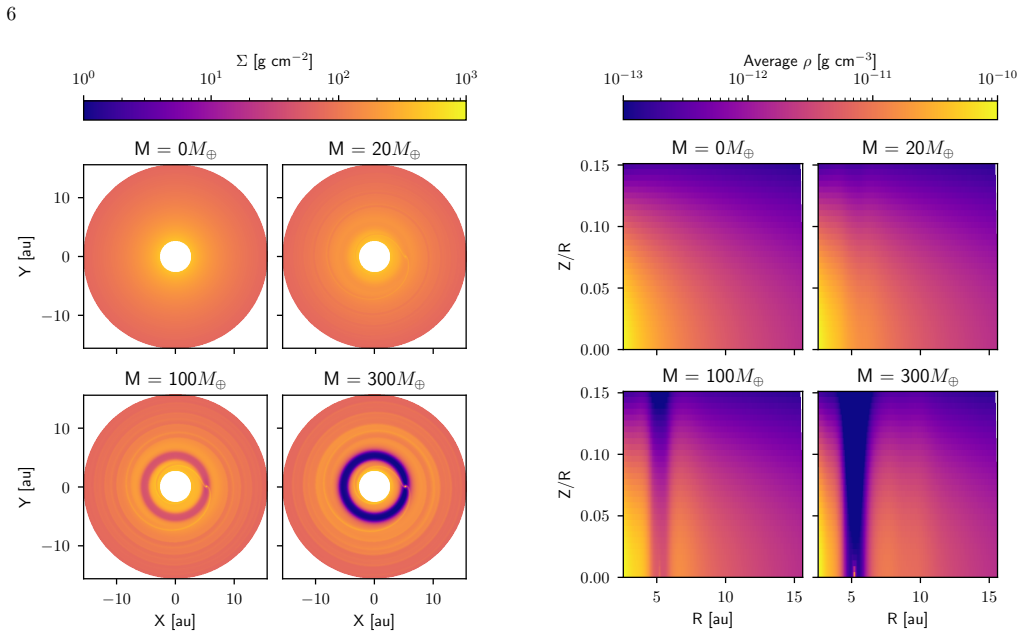
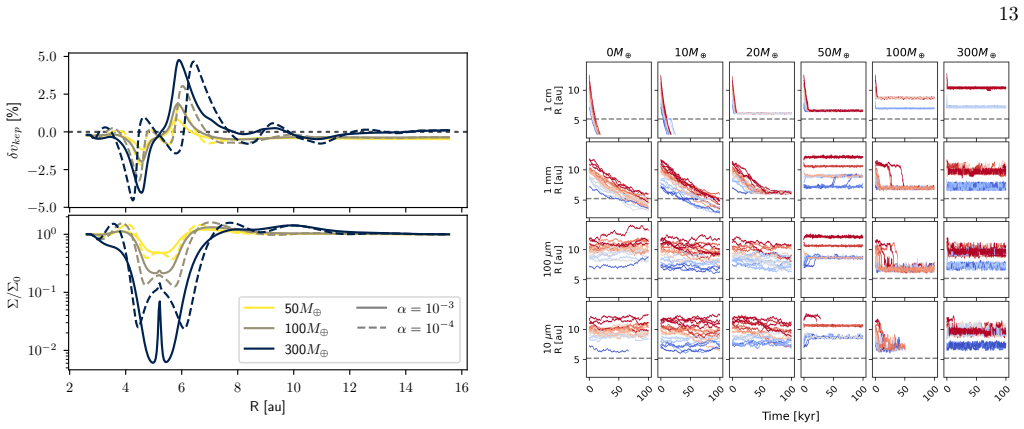
The central discovery is that the 3D structure of the gas flow around an embedded giant planet reverses the usual picture of gap physics. Near the midplane the gas flows outward from the planet, but at higher altitudes it flows inward onto the planet. Small, well-coupled grains that diffuse vertically into these upper layers are entrained in the inward advective flow, pass within a few hundred Jupiter radii of the planet yet outside its accretion envelope, and can be deposited on orbits interior to the planet. For planets above the pebble isolation mass, conventionally placed near $30\,M_\oplus$ in the fiducial disk and efficient by $100\,M_\oplus$, this lets up to 30% of sub-100-$\mu$m particles cross outward to inward within 1 Myr while millimeter- and centimeter-sized pebbles remain trapped at the pressure bump. The same meridional circulation carries 10 $\mu$m dust from the inner disk outward, and in low-viscosity disks the massive planet creates multiple outer pressure bumps that may support a third isotopic reservoir.
Load-bearing premise
The quantitative crossing fractions rest on the assumption that dust diffuses in the gas exactly as fast as momentum does (a unit Schmidt number) and that the diffusion is an isotropic random walk; if diffusion is weaker or anisotropic, fewer small grains would be lofted into the inward-flowing layers and the 10–30% crossing fractions would shrink.
Editorial extensions
If this is right
- Above the pebble isolation mass a giant planet acts as a size-selective filter rather than a closed barrier: grains smaller than about 100 $\mu$m leak across the gap in both directions while larger pebbles stay trapped at the pressure bump.
- The extent of mixing changes as Jupiter grows: large grains drift inward freely before the isolation mass, sub-100-$\mu$m grains cross efficiently once the embryo reaches roughly $100\,M_\oplus$, and at the highest masses only 10 $\mu$m dust remains coupled enough to cross.
- In low-viscosity disks a single massive planet can create multiple outer pressure bumps, so dust may pile up in several rings sourced from different parts of the disk, plausibly preserving a third isotopic reservoir.
- Grains that cross are funneled within a few hundred Jupiter radii of the planet, so late-arriving inner-disk solids would have been thermally processed near the accreting protoplanet, potentially altering their volatile and isotopic content.
- In exoplanetary systems, an outer giant planet does not necessarily cut off the supply of small dust to the inner disk, so inner super-Earth formation could still receive feedstock after the outer planet opens a gap.
Reading between the lines
- If the real dust diffusivity is lower than gas momentum diffusivity (Schmidt number greater than one), the reported 10–30% crossing fractions are upper limits; rerunning the same code with $\mathrm{Sc}=2$\u2013$5$ would bracket the mixing efficiency.
- The advection-funneling mechanism is not Jupiter-specific and should operate around any sufficiently massive planet in a viscous disk, meaning isotopic reservoir separation in other planetary systems may also be leaky.
- A testable consequence of the funneling effect is a spatial correlation between isotopic anomalies and thermal-processing signatures in small CAIs that crossed the gap, which could be searched for in individual inclusions.
- Planet migration would shift the balance: an inward-migrating planet sees a relative outward gas flow, which should suppress inward crossing and enhance outward transport of small dust; adding migration to the particle tracking is the natural next test.
Editorial analysis
A structured set of objections, weighed in public.
Referee Report
Summary. The paper combines 3D FARGO3D hydrodynamic simulations of a protoplanetary disk containing an embedded giant planet (0-300 Earth masses at 5.2 au) with a Monte Carlo post-processing particle tracking method to study the transport of dust grains from 10 micron to 1 cm. The central claim is that for planets above the pebble isolation mass, small, well-coupled grains can be entrained in the 3D meridional gas advection onto the planet and cross the gap from the outer disk to the inner disk (and, for 10 micron grains, also outward). The paper reports up to ~30% crossing fractions for grains smaller than 100 micron over 1 Myr, identifies multiple outer-disk dust pileups in low-viscosity disks, and interprets the results in terms of the NC-CC meteorite isotopic dichotomy and a possible tertiary reservoir. Section 4.4 acknowledges limitations: constant gas structure, fixed planet orbit, finite particle number, and no grain growth or fragmentation.
Significance. If the quantitative results hold, the paper provides a concrete 3D mechanism for exchanging small solids across a giant planet's gap, with direct implications for the interpretation of isotopic reservoirs in the solar nebula and for the filtering of dust in exoplanetary disks. The methodological contribution is noteworthy: coupling a high-resolution 3D gas simulation with a particle tracker that adjusts the Stokes number as particles move through varying gas density is a meaningful extension of prior 2D and single-fluid studies. The qualitative mechanism is convincingly illustrated by the example trajectory in Figure 6, which shows a 10 micron grain following the meridional inflow and passing just outside the planetary envelope into the inner disk. However, the quantitative crossing fractions presented in Figures 7 and 8 rest on an assumed dust diffusivity (Schmidt number unity) and on an unspecified initial vertical particle distribution; these assumptions are not stress-tested, so the numerical percentages should be treated with caution until clarified or supplemented with sensitivity runs.
major comments (3)
- [Section 2.2 (Eq. 6) and Section 3.2 (Figures 7-8)] The reported 10-30% crossing fractions for 10-100 micron grains depend directly on the assumed particle diffusivity D = D_g/(1+St^2) with D_g = alpha c_s H, i.e., a Schmidt number of unity. The advective crossing mechanism shown in Figure 6 requires grains to be present at high altitude (z ~ 2H, where the meridional inflow is strong). With a more conservative Schmidt number of 3-10, the equilibrium dust scale height H_d/H ~ sqrt(alpha/[Sc(alpha+St)]) drops from near unity to roughly 0.6-0.3, and the population at 2H falls by orders of magnitude. The paper gives no sensitivity test for Sc or for the gas diffusivity, and this is load-bearing because the mixing percentages in Section 4 are used to argue for specific levels of NC-CC exchange. The authors should either add a sensitivity study (e.g., Sc = 3 and 10) or explicitly reframe the reported percentages as illustrative upper limits.
- [Section 3.2, paragraph beginning 'To explore the fraction...'] The normalization of the crossing fraction is ambiguous. The sentence 'additional particles are integrated for each planet mass until 1000 total particles drift inwards of 5.2 au by 1 Myr' suggests that the number of crossing particles is fixed at 1000, which would make the reported crossing fraction depend on the stopping rule. Please specify the exact numerator and denominator used for the fractions in Figure 8, and clarify whether particles that leave the simulation bounds ('Out of Bounds' in Figure 7) are included in the denominator. Without this information, the 30% figure cannot be independently evaluated.
- [Section 3.2 (initial conditions) and Section 2.2] The initial vertical distribution of the particles is not stated. If 'evenly distributed in the 7 to 12 au region' means a uniform distribution in z up to the simulation boundary (about 3 pressure scale heights), the initial condition overpopulates high altitudes relative to a physically motivated settled distribution. Because the crossing mechanism relies on grains starting at, or diffusing to, high z, this choice can inflate the crossing efficiency. Please specify the initial z distribution and test the sensitivity to an initially settled distribution with dust scale height H_d derived from the same diffusion model.
minor comments (7)
- [Section 2.2, Eq. (3)] The random displacement uses p_x, p_y, p_z drawn from a uniform distribution on [-1,1] rather than a Gaussian. The variance is correctly normalized (2D Delta t per dimension), but the uniform distribution has bounded support and no tails; over many steps the central limit theorem applies, but the difference could matter for short integrations or near boundaries. A brief justification or reference would be helpful.
- [Section 2.2, Eqs. (18)-(21)] The timestep coefficients xi = 1e-6 and zeta = 1e-5 are stated to have been tested at an order of magnitude smaller with no significant difference, which is good; however, the reported convergence test is not shown. A sentence describing the metric used for 'no significant difference' would make this statement more quantitative.
- [Section 2.1 (mesh) and Section 3.2 (boundary losses)] The vertical domain extends about 3 scale heights; particles that diffuse above this are removed. Because the advective inflow region may extend to several scale heights, the paper should comment on whether the vertical boundary is high enough to capture the full inflow region, and whether the 'Out of Bounds' loss affects the inferred crossing statistics.
- [Section 3.3, text near Figure 9] The sentence 'This affect can also be seen in 5' contains a typo ('affect' should be 'effect') and 'in 5' should be 'in Figure 5'.
- [Figure 13 caption] The caption reads 'In the high viscosity case, the solids diffuse more vertically and tend to concentrate near the gap. In the high viscosity case, solids much more closely follow the gas advection...'; the second sentence should presumably read 'low viscosity case'.
- [References] The citation 'Price et al. in press' in Section 2.2 does not appear in the reference list; please update to a published or arXiv reference.
- [Appendix A, Eq. (A1)] The exponential term has mismatched parentheses: 'exp[(1 - sin(theta)^{-2gamma})/(2gamma h^2]' is missing a closing parenthesis. Please check the formula and ensure it matches the standard hydrostatic density profile.
Circularity Check
No significant circularity: the crossing fractions are simulation outputs, not fitted quantities, and the self-citations are methodological rather than load-bearing.
full rationale
No circular step can be exhibited from the paper's own equations or citations. The central claim—that gas advection onto the planet can carry small, well-coupled solids across the gap—is a direct output of a Monte Carlo particle integration through a FARGO3D gas snapshot, not a quantity fitted to reproduce itself. The diffusion law is an openly stated modeling assumption with an external citation: "The particle diffusivity is related to the gas diffusivity using the relationship given in Youdin & Lithwick (2007): D = Dg/(1+St^2)" and "we assume a Schmidt number of unity." This assumption shapes the quantitative crossing fractions, but an assumption is not circularity; the paper does not tune Sc or any other parameter to force the reported 10–30% crossing fractions. The particle-tracking technique is taken from Ciesla (2010, 2011), a same-group citation, but it is a method with independent support and is not used to define the target result; the gas simulations use the public FARGO3D code and standard disk initial conditions (Sigma0 ~ 210 g cm^-2, T0 ~ 118 K, alpha = 10^-3 or 10^-4). The "funneling effect" is a descriptive name for the trajectory mechanism shown in Figure 6, not a renamed known result. The sentence about integrating additional particles until 1000 total particles drift inward is a sampling detail; as ambiguous as it is, the reported fractions vary with mass and size ("up to 30% of particles smaller than 100 um filter from the outer disk to the inner disk by 1 Myr"), so the crossing statistic is not fixed at unity by construction. Any concern about the Schmidt-number assumption is a robustness or correctness caveat, not circularity.
Assumptions & free parameters
free parameters (5)
- disk viscosity α =
10^-3 and 10^-4
- particle size s =
1 cm, 1 mm, 100 µm, 10 µm
- coupling Stokes number cutoff =
10^-3
- surface density normalization Σ0 =
210 g/cm^2 at 5.2 au
- planet mass M_pl =
0, 1, 5, 10, 20, 50, 100, 200, 300 M⊕
assumptions (6)
- domain assumption The disk is vertically isothermal with T ∝ r^{-1/2} and surface density Σ ∝ r^{-1} (Section 2.1)
- domain assumption The gas reaches a steady state and is time-averaged over 10 orbits for particle integration (Section 2.1)
- domain assumption Dust diffusivity equals gas viscosity divided by (1+St^2), i.e., Schmidt number unity (Eq. 6)
- ad hoc to paper The random displacement in Eq. (3) is drawn from a uniform distribution on [-1,1] rather than a Gaussian
- domain assumption Epstein drag regime applies for all particle sizes
- standard math Dust back-reaction on the gas and particle-particle interactions are neglected
Cite this review
Pith. "Pith review of Three-dimensional transport of solids in a protoplanetary disk containing a growing giant planet." pith.science (2026). https://pith.science/paper/I2YDB2FV
@misc{pith2026250107520,
  author       = {Pith},
  title        = {Pith review of: Three-dimensional transport of solids in a protoplanetary disk containing a growing giant planet},
  year         = {2026},
  howpublished = {\url{https://pith.science/paper/I2YDB2FV}},
  note         = {Machine review of arXiv:2501.07520}
}
abstract
We present the results of combined hydrodynamic and particle tracking post-processing modeling to study the transport of small dust in a protoplanetary disk containing an embedded embryo in 3D. We use a suite of FARGO3D hydrodynamic simulations of disks containing a planetary embryo varying in mass up to 300 $M_\oplus$ on a fixed orbit in both high and low viscosity disks. We then simulate solid particles through the disk as a post-processing step using a Monte Carlo integration, allowing us to track the trajectories of individual particles as they travel throughout the disk. We find that gas advection onto the planet can carry small, well-coupled solids across the gap opened in the disk by the embedded planet for planetary masses above the pebble isolation mass. This mixing between the inner and outer disk can occur in both directions, with solids in the inner disk mixing to the outer disk as well. Additionally, in low viscosity disks, multiple pile-ups in the outer disk may preserve isotopic heterogeneities, possibly providing an outermost tertiary isotopic reservoir. Throughout Jupiter's growth, the extent of mixing between isotopic reservoirs varied depending on dust size, gas turbulence, and the Jovian embryo mass.
Figures


Figures from the paper (8 more)



Forward citations
Cited by 1 Pith paper
-
Water gas discs in exo-asteroid belts
Water vapour from exo-asteroid belts around solar-mass and heavier stars can supply ocean-scale water to inner planets and remain detectable for tens of Myr with current facilities.
Reference graph
Works this paper leans on
-
[1]
, " * write output.state after.block = add.period write newline
ENTRY address archivePrefix author booktitle chapter doi edition editor eprint howpublished institution journal key month number organization pages publisher school series title misctitle type volume year version url label extra.label sort.label short.list INTEGERS output.state before.all mid.sentence after.sentence after.block FUNCTION init.state.consts ...
-
[2]
write newline
" write newline "" before.all 'output.state := FUNCTION format.url url empty "" new.block "" url * "" * if FUNCTION format.eprint eprint empty "" archivePrefix empty "" archivePrefix "arXiv" = new.block " " eprint * " " * new.block " " eprint * " " * if if if FUNCTION format.doi doi empty "" " " doi * " " * if FUNCTION format.pid doi empty eprint empty ur...
-
[3]
YUvh0@ _ 0 YZ g/
thebibliography [1] 20pt to REFERENCES 6pt =0pt -12pt 10pt plus 3pt =0pt =0pt =1pt plus 1pt =0pt =0pt -12pt =13pt plus 1pt =20pt =13pt plus 1pt \@M =10000 =-1.0em =0pt =0pt 0pt =0pt =1.0em @enumiv\@empty 10000 10000 `\.\@m \@noitemerr \@latex@warning Empty `thebibliography' environment \@ifnextchar \@reference \@latexerr Missing key on reference command E...
2021
-
[4]
Alarcón, F., & Bergin, E. A. 2024, The Astrophysical Journal, 967, 144, 10.3847/1538-4357/ad3d57
-
[5]
Andrews, S. M., Huang, J., Pérez, L. M., et al. 2018, The Astrophysical Journal, 869, L41, 10.3847/2041-8213/aaf741
-
[6]
Armitage, P. J. 2017, arXiv:astro-ph/0701485. http://arxiv.org/abs/astro-ph/0701485
arXiv 2017
-
[7]
2018, The Astrophysical Journal, 859, 118, 10.3847/1538-4357/aabf8c
Bae, J., & Zhu, Z. 2018, The Astrophysical Journal, 859, 118, 10.3847/1538-4357/aabf8c
-
[8]
2017, The Astrophysical Journal, 850, 201, 10.3847/1538-4357/aa9705
Bae, J., Zhu, Z., & Hartmann, L. 2017, The Astrophysical Journal, 850, 201, 10.3847/1538-4357/aa9705
Show all 109 references
-
[9]
2018, Astronomy & Astrophysics, 615, A175, 10.1051/0004-6361/201832791
Barbato, D., Sozzetti, A., Desidera, S., et al. 2018, Astronomy & Astrophysics, 615, A175, 10.1051/0004-6361/201832791
2018 doi
-
[10]
N., & Ciesla, F
Barnett, M. N., & Ciesla, F. J. 2022, The Astrophysical Journal, 925, 141, 10.3847/1538-4357/ac4417
2022 doi
-
[11]
Benítez-Llambay, P., & Masset, F. S. 2016, The Astrophysical Journal Supplement Series, 223, 11, 10.3847/0067-0049/223/1/11
2016 doi
-
[12]
B., & Ciesla, F
Bergner, J. B., & Ciesla, F. 2021, The Astrophysical Journal, 919, 45, 10.3847/1538-4357/ac0fd7
2021 doi
-
[13]
2023, Monthly Notices of the Royal Astronomical Society, 523, 55, 10.1093/mnras/stad1405
Binkert, F., Szulágyi, J., & Birnstiel, T. 2023, Monthly Notices of the Royal Astronomical Society, 523, 55, 10.1093/mnras/stad1405
2023 doi
-
[14]
2012, Astronomy & Astrophysics, 539, A148, 10.1051/0004-6361/201118136
Birnstiel, T., Klahr, H., & Ercolano, B. 2012, Astronomy & Astrophysics, 539, A148, 10.1051/0004-6361/201118136
2012 doi
-
[15]
2019, Astronomy & Astrophysics, 623, A88, 10.1051/0004-6361/201834489
Bitsch, B., Izidoro, A., Johansen, A., et al. 2019, Astronomy & Astrophysics, 623, A88, 10.1051/0004-6361/201834489
2019 doi
-
[16]
2018, Astronomy & Astrophysics, 612, A30, 10.1051/0004-6361/201731931
Bitsch, B., Morbidelli, A., Johansen, A., et al. 2018, Astronomy & Astrophysics, 612, A30, 10.1051/0004-6361/201731931
2018 doi
-
[17]
D., Cridland, A
Bosman, A. D., Cridland, A. J., & Miguel, Y. 2019, Astronomy & Astrophysics, 632, L11, 10.1051/0004-6361/201936827
2019 doi
-
[18]
Boss, A. P. 2017, The Astrophysical Journal, 836, 53, 10.3847/1538-4357/836/1/53
2017 doi
-
[19]
2019, The Astrophysical Journal, 884, 56, 10.3847/1538-4357/ab40a4
---. 2019, The Astrophysical Journal, 884, 56, 10.3847/1538-4357/ab40a4
2019 doi
-
[20]
2020, Nature Astronomy, 4, 12
Brasser, R. 2020, Nature Astronomy, 4, 12
2020
-
[21]
L., Knutson, H
Bryan, M. L., Knutson, H. A., Lee, E. J., et al. 2019, The Astronomical Journal, 157, 52, 10.3847/1538-3881/aaf57f
2019 doi
-
[22]
L., & Lee, E
Bryan, M. L., & Lee, E. J. 2024, The Astrophysical Journal Letters, 968, L25, 10.3847/2041-8213/ad5013
2024 doi
-
[23]
A., et al
Budde, G., Burkhardt, C., Brennecka, G. A., et al. 2016, Earth and Planetary Science Letters, 454, 293, 10.1016/j.epsl.2016.09.020
2016 doi
-
[24]
2017, The Astrophysical Journal, 849, 30, 10.3847/1538-4357/aa91d0
Chambers, J. 2017, The Astrophysical Journal, 849, 30, 10.3847/1538-4357/aa91d0
2017 doi
-
[25]
2021, The Astrophysical Journal, 914, 102, 10.3847/1538-4357/abfaa4
---. 2021, The Astrophysical Journal, 914, 102, 10.3847/1538-4357/abfaa4
2021 doi
-
[26]
Ciesla, F. J. 2007, Science, 318, 613, 10.1126/science.1147273
2007 doi
-
[27]
2010, The Astrophysical Journal, 723, 514, 10.1088/0004-637X/723/1/514
---. 2010, The Astrophysical Journal, 723, 514, 10.1088/0004-637X/723/1/514
2010 doi
-
[28]
2011, The Astrophysical Journal, 740, 9, 10.1088/0004-637X/740/1/9
---. 2011, The Astrophysical Journal, 740, 9, 10.1088/0004-637X/740/1/9
2011 doi
-
[29]
N., Bizzarro, M., Krot, A
Connelly, J. N., Bizzarro, M., Krot, A. N., et al. 2012, Science, 338, 651, 10.1126/science.1226919
2012 doi
-
[30]
N., Davis, S
Cuzzi, J. N., Davis, S. S., & Dobrovolskis, A. R. 2003, Icarus, 166, 385, 10.1016/j.icarus.2003.08.016
2003 doi
-
[31]
J., Kalyaan, A., & Alexander, C
Desch, S. J., Kalyaan, A., & Alexander, C. M. O. 2018, The Astrophysical Journal Supplement Series, 238, 11, 10.3847/1538-4365/aad95f
2018 doi
-
[32]
2021, The Astrophysical Journal
Doi, K. 2021, The Astrophysical Journal
2021
-
[33]
M., & Li, H
Drążkowska, J., Li, S., Birnstiel, T., Stammler, S. M., & Li, H. 2019, The Astrophysical Journal, 885, 91, 10.3847/1538-4357/ab46b7
2019 doi
-
[34]
M., & Birnstiel, T
Drążkowska, J., Stammler, S. M., & Birnstiel, T. 2021, Astronomy & Astrophysics, 647, A15, 10.1051/0004-6361/202039925
2021 doi
-
[35]
Duffell, P. C. 2015, The Astrophysical Journal, 807, L11, 10.1088/2041-8205/807/1/L11
2015 doi
-
[36]
2020, The Astrophysical Journal, 889, 16, 10.3847/1538-4357/ab5b0f
---. 2020, The Astrophysical Journal, 889, 16, 10.3847/1538-4357/ab5b0f
2020 doi
-
[37]
C., Haiman, Z., MacFadyen, A
Duffell, P. C., Haiman, Z., MacFadyen, A. I., D'Orazio, D. J., & Farris, B. D. 2014, The Astrophysical Journal, 792, L10, 10.1088/2041-8205/792/1/L10
2014 doi
-
[38]
P., Birnstiel, T., Huang, J., et al
Dullemond, C. P., Birnstiel, T., Huang, J., et al. 2018, The Astrophysical Journal Letters, 869, L46, 10.3847/2041-8213/aaf742
2018 doi
-
[39]
T., Sheikh, A., Opara, D., et al
Dunham, E. T., Sheikh, A., Opara, D., et al. 2023, Meteoritics & Planetary Science, 58, 643, 10.1111/maps.13975
2023 doi
-
[40]
2015, Astronomy & Astrophysics, 574, A52, 10.1051/0004-6361/201424837
Dürmann, C., & Kley, W. 2015, Astronomy & Astrophysics, 574, A52, 10.1051/0004-6361/201424837
2015 doi
-
[41]
N., et al
Ebert, S., Nagashima, K., Krot, A. N., et al. 2024, Earth and Planetary Science Letters, 646, 119010, 10.1016/j.epsl.2024.119010
2024
-
[42]
A., et al
Ebert, S., Render, J., Brennecka, G. A., et al. 2018, Earth and Planetary Science Letters, 498, 257, 10.1016/j.epsl.2018.06.040
2018 doi
-
[43]
Eriksson, L. E. J., Yang, C.-C., & Armitage, P. J. 2024, Monthly Notices of the Royal Astronomical Society: Letters, slae110, 10.1093/mnrasl/slae110
2024 doi
-
[44]
2018, Astronomy & Astrophysics, 610, A24, 10.1051/0004-6361/201731978
Fedele, D., Tazzari, M., Booth, R., et al. 2018, Astronomy & Astrophysics, 610, A24, 10.1051/0004-6361/201731978
2018 doi
-
[45]
M., Simon, J
Flaherty, K., Hughes, A. M., Simon, J. B., et al. 2020, The Astrophysical Journal, 895, 109, 10.3847/1538-4357/ab8cc5
2020 doi
-
[46]
2024, Monthly Notices of the Royal Astronomical Society, 532, 363, 10.1093/mnras/stae1480
---. 2024, Monthly Notices of the Royal Astronomical Society, 532, 363, 10.1093/mnras/stae1480
2024 doi
- [47]
-
[48]
2016, The Astrophysical Journal, 832, 105, 10.3847/0004-637X/832/2/105
Fung, J., & Chiang, E. 2016, The Astrophysical Journal, 832, 105, 10.3847/0004-637X/832/2/105
2016 doi
-
[49]
2017, The Astrophysical Journal, 841, L17, 10.3847/2041-8213/aa72a2
Gerber, S., Burkhardt, C., Budde, G., Metzler, K., & Kleine, T. 2017, The Astrophysical Journal, 841, L17, 10.3847/2041-8213/aa72a2
2017 doi
-
[50]
M., & Lin, M.-K
Hammer, M., Kratter, K. M., & Lin, M.-K. 2017, Monthly Notices of the Royal Astronomical Society, 466, 3533, 10.1093/mnras/stw3000
2017 doi
-
[51]
R., Millman, K
Harris, C. R., Millman, K. J., Walt, S. J. v. d., et al. 2020, Nature, 585, 357, 10.1038/s41586-020-2649-2
2020 doi
-
[52]
P., et al
Haugbølle, T., Weber, P., Wielandt, D. P., et al. 2019, The Astronomical Journal, 158, 55, 10.3847/1538-3881/ab1591
2019 doi
-
[53]
J., Lunine, J
Helled, R., Stevenson, D. J., Lunine, J. I., et al. 2022, Icarus, 378, 114937, 10.1016/j.icarus.2022.114937
2022
-
[54]
2022, Science Advances, 8, eadd8141, 10.1126/sciadv.add8141
Hopp, T., Dauphas, N., Abe, Y., et al. 2022, Science Advances, 8, eadd8141, 10.1126/sciadv.add8141
2022 doi
-
[55]
Hunter, J. D. 2007, Computing in Science & Engineering, 9, 90, 10.1109/MCSE.2007.55
2007 doi
-
[56]
N., et al
Izidoro, A., Dasgupta, R., Raymond, S. N., et al. 2021, Nature Astronomy, 10.1038/s41550-021-01557-z
2021 doi
-
[57]
F., Facchini, S., Rosotti, G
Izquierdo, A. F., Facchini, S., Rosotti, G. P., Van Dishoeck, E. F., & Testi, L. 2022, The Astrophysical Journal, 928, 2, 10.3847/1538-4357/ac474d
2022 doi
-
[58]
S., Low, M.-M
Johansen, A., Oishi, J. S., Low, M.-M. M., et al. 2007, Nature, 448, 1022, 10.1038/nature06086
2007 doi
-
[59]
D., Muto, T., Tanaka, H., et al
Kanagawa, K. D., Muto, T., Tanaka, H., et al. 2016, Publications of the Astronomical Society of Japan, 68
2016
-
[60]
D., Tanaka, H., Muto, T., Tanigawa, T., & Takeuchi, T
Kanagawa, K. D., Tanaka, H., Muto, T., Tanigawa, T., & Takeuchi, T. 2015, Monthly Notices of the Royal Astronomical Society, 448, 994, 10.1093/mnras/stv025
2015 doi
-
[61]
M., & Youdin, A
Krapp, L., Kratter, K. M., & Youdin, A. N. 2022, The Astrophysical Journal, 928, 156, 10.3847/1538-4357/ac5899
2022 doi
-
[62]
M., Youdin, A
Krapp, L., Kratter, K. M., Youdin, A. N., et al. 2024, The Astrophysical Journal, 973, 153, 10.3847/1538-4357/ad644a
2024 doi
-
[63]
S., Burkhardt, C., Budde, G., & Kleine, T
Kruijer, T. S., Burkhardt, C., Budde, G., & Kleine, T. 2017, Proceedings of the National Academy of Sciences, 114, 6712, 10.1073/pnas.1704461114
2017 doi
-
[64]
S., Kleine, T., & Borg, L
Kruijer, T. S., Kleine, T., & Borg, L. E. 2020, Nature Astronomy, 4, 32, 10.1038/s41550-019-0959-9
2020 doi
-
[65]
2014, Astronomy & Astrophysics, 572, A35, 10.1051/0004-6361/201423814
Lambrechts, M., Johansen, A., & Morbidelli, A. 2014, Astronomy & Astrophysics, 572, A35, 10.1051/0004-6361/201423814
2014 doi
-
[66]
A., et al
Lambrechts, M., Morbidelli, A., Jacobson, S. A., et al. 2019, Astronomy & Astrophysics, 627, A83, 10.1051/0004-6361/201834229
2019 doi
-
[67]
Lau, T. C. H., Birnstiel, T., Drążkowska, J., & Stammler, S. M. 2024, Astronomy & Astrophysics, 688, A22, 10.1051/0004-6361/202450464
2024 doi
-
[68]
2024, Gas dynamics around a Jupiter -mass planet I
Lega, E., Benisty, M., Cridland, A., et al. 2024, Gas dynamics around a Jupiter -mass planet I . Influence of protoplanetary disk properties, arXiv. http://arxiv.org/abs/2408.12233
2024 arXiv
-
[69]
2021, Science, 371, 365
Lichtenberg, T., Drążkowska, J., Schönbächler, M., Golabek, G., & Hands, T. 2021, Science, 371, 365
2021
-
[70]
2022, Science Advances, 8, eabm3045, 10.1126/sciadv.abm3045
Liu, B., Johansen, A., Lambrechts, M., Bizzarro, M., & Haugbølle, T. 2022, Science Advances, 8, eabm3045, 10.1126/sciadv.abm3045
2022 doi
-
[71]
Liu, B., & Ormel, C. W. 2018, Astronomy & Astrophysics, 615, A138, 10.1051/0004-6361/201732307
2018 doi
-
[72]
2024, The Astrophysical Journal, 968, 62, 10.3847/1538-4357/ad4035
Maeda, N., Ohtsuki, K., Suetsugu, R., et al. 2024, The Astrophysical Journal, 968, 62, 10.3847/1538-4357/ad4035
2024 doi
-
[73]
2000, Astronomy and Astrophysics Supplement Series, 141, 165, 10.1051/aas:2000116
Masset, F. 2000, Astronomy and Astrophysics Supplement Series, 141, 165, 10.1051/aas:2000116
2000 doi
-
[74]
2021, Nature Astronomy, 6, 72, 10.1038/s41550-021-01517-7
Morbidelli, A., Baillié, K., Batygin, K., et al. 2021, Nature Astronomy, 6, 72, 10.1038/s41550-021-01517-7
2021 doi
-
[75]
2023, Astronomy & Astrophysics, 675, A75, 10.1051/0004-6361/202346868
Morbidelli, A., Batygin, K., & Lega, E. 2023, Astronomy & Astrophysics, 675, A75, 10.1051/0004-6361/202346868
2023 doi
-
[76]
2014, Icarus, 232, 266, 10.1016/j.icarus.2014.01.010
Morbidelli, A., Szulágyi, J., Crida, A., et al. 2014, Icarus, 232, 266, 10.1016/j.icarus.2014.01.010
2014 doi
-
[77]
D., Drążkowska, J., Van Der Marel, N., Ciesla, F
Mulders, G. D., Drążkowska, J., Van Der Marel, N., Ciesla, F. J., & Pascucci, I. 2021, The Astrophysical Journal Letters, 920, L1, 10.3847/2041-8213/ac2947
2021 doi
-
[78]
2024, Earth and Planetary Science Letters, 626, 118521, 10.1016/j.epsl.2023.118521
Nesvorný, D., Dauphas, N., Vokrouhlický, D., Deienno, R., & Hopp, T. 2024, Earth and Planetary Science Letters, 626, 118521, 10.1016/j.epsl.2023.118521
2024
-
[79]
W., & Liu, B
Ormel, C. W., & Liu, B. 2018, Astronomy & Astrophysics, 615, A178, 10.1051/0004-6361/201732562
2018 doi
-
[80]
F., Teague, R., et al
Paneque-Carreño, T., Izquierdo, A. F., Teague, R., et al. 2024, Astronomy & Astrophysics, 684, A174, 10.1051/0004-6361/202347757
2024 doi
-
[81]
J., Booth, R
Petrovic, H. J., Booth, R. A., & Clarke, C. J. 2024, Material Transport in Protoplanetary Discs with Massive Embedded Planets , arXiv. http://arxiv.org/abs/2409.16245
2024 arXiv
-
[82]
2012, Astronomy & Astrophysics, 545, A81, 10.1051/0004-6361/201219315
Pinilla, P., Benisty, M., & Birnstiel, T. 2012, Astronomy & Astrophysics, 545, A81, 10.1051/0004-6361/201219315
2012 doi
-
[83]
J., Ménard, F., et al
Pinte, C., Price, D. J., Ménard, F., et al. 2018, The Astrophysical Journal, 860, L13, 10.3847/2041-8213/aac6dc
2018 doi
-
[84]
2019, Nature Astronomy, 3, 1109, 10.1038/s41550-019-0852-6
Pinte, C., van der Plas, G., Ménard, F., et al. 2019, Nature Astronomy, 3, 1109, 10.1038/s41550-019-0852-6
2019 doi
-
[85]
2019, The Astronomical Journal, 158, 15, 10.3847/1538-3881/ab1f88
Pérez, S., Casassus, S., Baruteau, C., et al. 2019, The Astronomical Journal, 158, 15, 10.3847/1538-3881/ab1f88
2019 doi
-
[86]
L., & Davidson, J
Schrader, D. L., & Davidson, J. 2022, Earth and Planetary Science Letters, 589, 117552, 10.1016/j.epsl.2022.117552
2022
-
[87]
L., Nagashima, K., Davidson, J., et al
Schrader, D. L., Nagashima, K., Davidson, J., et al. 2020, Geochimica et Cosmochimica Acta, 282, 133, 10.1016/j.gca.2020.05.014
2020 doi
-
[88]
I., & Sunyaev, R
Shakura, N. I., & Sunyaev, R. A. 1973, Astronomy and Astrophysics, 24, 337. https://ui.adsabs.harvard.edu/abs/1973A&A....24..337S
1973
-
[89]
M., Lichtenberg, T., Drążkowska, J., & Birnstiel, T
Stammler, S. M., Lichtenberg, T., Drążkowska, J., & Birnstiel, T. 2023, Astronomy & Astrophysics, 670, L5, 10.1051/0004-6361/202245512
2023 doi
-
[90]
2022, The Astrophysical Journal, 924, 1, 10.3847/1538-4357/ac32d1
Szulágyi, J., Binkert, F., & Surville, C. 2022, The Astrophysical Journal, 924, 1, 10.3847/1538-4357/ac32d1
2022 doi
-
[91]
2016, Monthly Notices of the Royal Astronomical Society, 460, 2853, 10.1093/mnras/stw1160
Szulágyi, J., Masset, F., Lega, E., et al. 2016, Monthly Notices of the Royal Astronomical Society, 460, 2853, 10.1093/mnras/stw1160
2016 doi
-
[92]
2014, The Astrophysical Journal, 782, 65, 10.1088/0004-637X/782/2/65
Szulágyi, J., Morbidelli, A., Crida, A., & Masset, F. 2014, The Astrophysical Journal, 782, 65, 10.1088/0004-637X/782/2/65
2014 doi
-
[93]
2022, Science, 375, 1011, 10.1126/science.abj8624
Tachibana, S., Sawada, H., Okazaki, R., et al. 2022, Science, 375, 1011, 10.1126/science.abj8624
2022 doi
-
[94]
Takeuchi, T., & Lin, D. N. C. 2002, The Astrophysical Journal, 581, 1344, 10.1086/344437
2002 doi
-
[95]
Tanigawa, T., Maruta, A., & Machida, M. N. 2014, The Astrophysical Journal, 784, 109, 10.1088/0004-637X/784/2/109
2014 doi
-
[96]
Teague, R., Bae, J., & Bergin, E. A. 2019, Nature, 574, 378, 10.1038/s41586-019-1642-0
2019 doi
-
[97]
A., Birnstiel, T., & Foreman-Mackey, D
Teague, R., Bae, J., Bergin, E. A., Birnstiel, T., & Foreman-Mackey, D. 2018, The Astrophysical Journal, 860, L12, 10.3847/2041-8213/aac6d7
2018 doi
-
[98]
2021, The Astrophysical Journal, 910, 70, 10.3847/1538-4357/abd9c8
Van Kooten, E., Schiller, M., Moynier, F., et al. 2021, The Astrophysical Journal, 910, 70, 10.3847/1538-4357/abd9c8
2021 doi
-
[99]
Warren, P. H. 2011, Earth and Planetary Science Letters, 311, 93, 10.1016/j.epsl.2011.08.047
2011 doi
-
[100]
Weber, P., Benítez-Llambay, P., Gressel, O., Krapp, L., & Pessah, M. E. 2018, The Astrophysical Journal, 854, 153, 10.3847/1538-4357/aaab63
2018 doi
-
[101]
Weidenschilling, S. J. 1977, Monthly Notices of the Royal Astronomical Society, 180, 57, 10.1093/mnras/180.2.57
1977 doi
-
[102]
Yang, L., & Ciesla, F. J. 2012, Meteoritics & Planetary Science, 47, 99, 10.1111/j.1945-5100.2011.01315.x
2012
-
[103]
2023, Science, 379, eabn7850, 10.1126/science.abn7850
Yokoyama, T., Nagashima, K., Nakai, I., et al. 2023, Science, 379, eabn7850, 10.1126/science.abn7850
2023 doi
-
[104]
N., & Goodman, J
Youdin, A. N., & Goodman, J. 2005, The Astrophysical Journal, 620, 459, 10.1086/426895
2005 doi
-
[105]
N., & Lithwick, Y
Youdin, A. N., & Lithwick, Y. 2007, Icarus, 192, 588, 10.1016/j.icarus.2007.07.012
2007 doi
-
[106]
2018, The Astronomical Journal, 156, 92, 10.3847/1538-3881/aad22a
Zhu, W., & Wu, Y. 2018, The Astronomical Journal, 156, 92, 10.3847/1538-3881/aad22a
2018 doi
-
[107]
M., Rafikov, R
Zhu, Z., Stone, J. M., Rafikov, R. R., & Bai, X.-n. 2014, The Astrophysical Journal, 785, 122, 10.1088/0004-637X/785/2/122
2014 doi
-
[108]
I., & Wordsworth, R
Öberg, K. I., & Wordsworth, R. 2019, The Astronomical Journal, 158, 194, 10.3847/1538-3881/ab46a8
2019 doi
-
[109]
I., Guzmán, V
Öberg, K. I., Guzmán, V. V., Walsh, C., et al. 2021, The Astrophysical Journal Supplement Series, 257, 1, 10.3847/1538-4365/ac1432
2021 doi
Reviewed August 10, 2026 · model on record in the stance chip above.
Discussion (0). Continue with ORCID to comment.