REVIEW 4 major objections 3 minor 2 cited by
Optimal Control of an Electromechanical Energy Harvester
T0 review · 4 major / 3 minor · reviewed 2026-08-10 · deepseek-v4-flash
Pith's one-line read A time-dependent load resistance can outperform the best constant resistance in an electromechanical vibration energy harvester, at least in a perturbative regime with instantaneous switching.
desk verdict A clean proof-of-principle that time-dependent load control can beat a fixed optimal resistance in a linear harvester, but the advantage is carried by delta-function pulses and the abstract overstates it for realizable devices. read the letter →
The pith
A machine-rendered reading of the paper's core claim, the machinery that carries it, and where it could break.
The reading
What carries the argument
The machinery is Pontryagin's maximum principle, a set of necessary conditions for a control to be optimal, applied not to individual trajectories but to the vector $\sigma$ of equal-time covariances of position, velocity, and current. Because the underlying Langevin system is linear and Gaussian, the covariance obeys the affine dynamics $\dot\sigma=-M(u)\sigma+b$ with $M(u)=M_0+uM_1$, and the harvested power is the linear reward $u\,\kappa\cdot\sigma$, where the control $u$ shifts the dimensionless load parameter $\varepsilon=\zeta+u$. Since the PMP constraint $\partial_u H=0$ does not determine $u$ directly, the paper differentiates it twice and solves the resulting overdetermined boundary-value problem by allowing impulsive jumps $u_0,u_f$ at the endpoints; after linearizing around the stationary optimum $u_*$, the problem reduces to a pair of algebraic equations whose solutions are the candidate protocols.
What would settle it
Replace the delta-function jumps with finite-width ramps in the same model and compute or measure the full-cycle extracted power; if for any finite ramp width or real switch the maximum falls at or below $P_*=u_*\sigma_{II}^*$, the claim that time-dependent loads beat all constant resistance is false for realizable protocols. A second check is to repeat the perturbative calculation at the experimental parameters reported in the paper for a real harvester, where the authors do not report gains.
Extended reading notes
Core claim
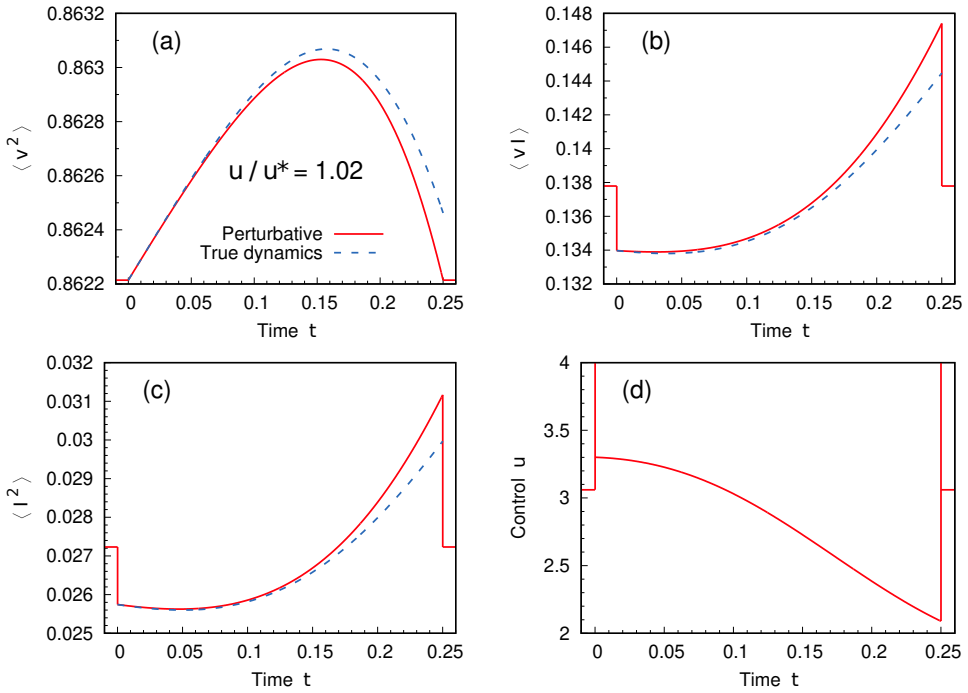
The central claim is that the stationary strategy $u(t)\equiv u_*$, which maximizes harvested power among constant loads, is not the best possible control when the load may vary in time. The paper constructs optimal protocols of the form $u(t)=u_0\delta(t-t_0)+u_b(t)+u_f\delta(t-t_f)$ that return the system to the same stationary covariance state after a finite time $t_f$, and it exhibits parameter values ($\alpha=0$, $\beta=1$, $\zeta=2$, $t_f=0.25$) for which these protocols yield net power gains of a few percent over $P_*=P_s(u_*)$, up to roughly 7% in the plotted range. The calculation yields two physically admissible candidate protocols, and the better one, solution B, stays close to the true nonlinear dynamics in the tested cases. A key statement is that the impulsive components at the endpoints are essential: "Without them, the solutions would not outperform the stationary strategy."
Load-bearing premise
The central assumption is that the instantaneous jumps in resistance are a legitimate idealization of a real fast switch, so that the extra power they contribute survives when the jumps are replaced by physically realizable fast ramps; if that limit is not faithful, the dynamic protocol may not beat the best constant resistance in practice.
Editorial extensions
If this is right
- In the same affine model, the method yields explicit candidate protocols without shooting or iterative numerical search, because the optimality conditions reduce to algebraic equations.
- A full cycle that begins and ends in the same stationary state can be repeated indefinitely, so the gain is not a one-time transient.
- Because the final state under the true dynamics differs slightly from the target, the perturbative protocol can serve as the first step of an iterative refinement toward the exact optimal control.
- The same framework transfers directly to piezoelectric harvesters and other linear stochastic engines, since the control enters the drift matrix linearly in all these cases.
Reading between the lines
- Beyond the paper's claims: one could test this protocol with a programmable electronic load whose switching is fast compared with the mechanical time scale; because the protocol is open-loop, no real-time sensor feedback is required.
- Beyond the paper's claims: the existence of two admissible extremal solutions signals a nonconvex optimization landscape, and a global search over nonlinear protocols might find branches with larger gains than solution B in the same regime.
- Beyond the paper's claims: the delta-function contributions act like instantaneous kicks to the covariance state, so regularizing them will turn each kick into a fast ramp whose width and power cost could themselves be optimized.
- Beyond the paper's claims: applying the same perturbative scheme to colored or non-Markovian noise would reveal whether the gain is tied to white-noise driving or survives in more realistic vibration spectra.
Editorial analysis
A structured set of objections, weighed in public.
Referee Report
Summary. The manuscript studies optimal time-dependent load resistance for a linear electromechanical energy harvester driven by white noise, modeled by an underdamped Langevin equation coupled to a current equation. Working with the covariance matrix representation, the authors formulate the maximization of extracted power as an optimal control problem and apply Pontryagin's Maximum Principle. For affine dynamics of the covariance, they derive the PMP equations, linearize around the stationary optimal resistance, and reduce the boundary-value problem to algebraic equations via the Cayley-Hamilton theorem. In an explicit α=0 example (α=0, β=1, ζ=2, tf=0.25), they find two candidate protocols whose bulk part is supplemented by Dirac-delta impulses at the endpoints, and they report extracted power above the stationary optimum, both in the perturbative calculation and in a direct integration of the original dynamics. The paper frames the study as a proof of principle and leaves the regularization of the impulsive controls to future work.
Significance. If the reported advantage survives physical regularization, the result would be a useful proof that time-varying electrical loads can outperform the optimal constant resistance in a harvester model that has experimental support. The derivation is explicit and reasonably general: the PMP equations for affine covariance dynamics, the elimination of the control through time derivatives of the stationarity condition, and the reduction to algebraic equations are clearly laid out. The authors are also honest about the idealized nature of the construction. The main limitation is that the claimed gain is carried by impulsive controls, no regularized family or lower bound on the regularized gain is provided, and the numerical 'true dynamics' check is under-specified. The significance is therefore conditional: the formal proof of principle is coherent, but the physical claim made in the abstract is not yet established for implementable protocols.
major comments (4)
- [Abstract; §4; §5] The abstract and §1 state unconditionally that it is possible to design protocols that perform better than any possible solution with constant resistance. In the construction, however, the gain is carried by the Dirac-delta terms in Eq. (19): §4 states that without the impulsive changes the solutions would not outperform the stationary strategy, and §5 defers regularization, anticipating 'lower harvesting power.' Since the delta pulses are not physically realizable controls and no finite-width regularization or lower bound on the regularized gain is provided, the central claim is currently established only for an idealized control class. To support the abstract claim, the authors should either construct a regularized family of finite-width, finite-amplitude pulses with a demonstrated positive gain, or explicitly restrict the statement to the impulsive idealization.
- [Fig. 3 caption; Eq. (19)] The numerical check labelled 'true dynamics' in Fig. 3 (and the green circles in Fig. 1) is described as a fourth-order Runge-Kutta integration of the original dynamics (33) under the protocol shown in panel (d), but that protocol contains Dirac deltas at both endpoints. The text does not state how the impulses are implemented numerically, whether through finite-width approximations, exact jump conditions derived from Appendix B, or another procedure. Without this information the verification is not reproducible, and it cannot be taken as evidence that a regularized protocol preserves the gain. The numerical treatment of the pulses should be specified explicitly.
- [Fig. 1 caption; Eq. (13d)] The fixed-endpoint problem requires σ(t0)=σ(tf)=σs, Eq. (13d), but the Fig. 1 caption admits that when the protocol is inserted into the non-perturbative dynamics the final state does not match the prescribed boundary condition exactly, as also visible in Fig. 3. The power comparison for the non-perturbative dynamics therefore uses a protocol that is not admissible in the original fixed-endpoint problem. The text should clearly state that the perturbative protocol satisfies the boundary conditions only within the linearized approximation, and should explain why the boundary mismatch does not undermine the claim of superiority over admissible constant-resistance protocols.
- [Appendix B, Eqs. (52)-(53)] The derivation of the impulsive contribution to the reward uses M1^{-1}, but M1 is singular in both the full model of Eq. (41) and the reduced α=0 example of Eq. (36). The final expressions such as Eq. (32) are meaningful because products like (I-e^{-M1u0})M1^{-1} admit an interpretation as power series in M1, but the text does not state this. As written, the derivation of the central reward formula is not rigorous; the authors should either justify the generalized-inverse/power-series interpretation or rederive the pulse contributions componentwise for the reduced model.
minor comments (3)
- [§1; Appendix B] There are small typos: 'maximixe' in §1 should be 'maximize', and 'Let un now focus' in Appendix B should be 'Let us now focus'. The manuscript would benefit from a final proofreading pass.
- [§3.1-§4] PMP provides necessary conditions for optimality, not a sufficiency certificate. Since the paper identifies multiple candidates (solutions A and B) and does not verify second-order or global optimality conditions, the term 'optimal' in the title and throughout the text is stronger than what is demonstrated. A brief qualification, e.g., 'locally optimal candidate' or 'PMP-optimal', would be more precise.
- [Eq. (32)] In Eq. (32) the integral is written as ∫0^tf dt, whereas the protocol interval is (t0,tf). In the examples t0=0, but the notation should be made consistent with the general formulation.
Circularity Check
No significant circularity: the optimal-control derivation is self-contained and benchmarked against a stationary optimum rederived in the same paper, with no fitted parameters renamed as predictions.
full rationale
The paper's central derivation is self-contained. The PMP equations (6), the affine covariance dynamics (10), and the reward (11) are stated as first principles, and the stationary optimal resistance u* in Eq. (35) is rederived in Appendix A (Eqs. (43)-(44)) rather than imported as a black-box fit. The dynamic protocols are obtained by solving the PMP boundary-value problem (13) with a linearization around u*; the algebraic system (31) determines the control parameters from the model matrices M0, M1, b, and κ, not from a target power gain. The comparison to the constant-resistance optimum P* is an external benchmark, and the authors verify their protocols by inserting them into the true dynamics (Figure 3, green circles), so the gain is not forced by construction. The many self-citations (e.g., [13], [15], [16], [18], [23], [28], [31], [34]) are contextual or methodological; none supplies a uniqueness theorem or an ansatz that carries the result. The paper explicitly flags in Section 4 that the gain over the stationary strategy relies on the impulsive end-point contributions ('Without them, the solutions would not outperform the stationary strategy') and in Section 5 that regularization is left to future studies and is expected to lower the harvested power. This is an honest physical-robustness caveat about Dirac-delta idealization; it does not make the derivation circular. To the extent the idealized pulses are not realizable, the practical strength of the claim is weakened, but the internal derivation chain remains non-circular.
Assumptions & free parameters
free parameters (4)
- spring stiffness α =
0
- viscous damping β =
1
- base dimensionless load ζ =
2
- protocol duration tf =
0.25
assumptions (5)
- domain assumption The stochastic dynamics is linear with additive white noise; the state is Gaussian and fully described by the covariance matrix.
- standard math Pontryagin's Maximum Principle gives necessary conditions for global optimality in this stochastic setting.
- ad hoc to paper The boundary conditions σ(t0)=σ(tf)=σs can be satisfied by allowing impulsive (delta-function) control components u0δ(t-t0) and ufδ(t-tf).
- ad hoc to paper The optimal protocol remains close enough to the stationary optimum u* for the linearized equations (21) to be accurate.
- domain assumption The reward is the average extracted power ∫ u(t)⟨I^2(t)⟩ dt, which depends only on equal-time correlations; higher-order moments are irrelevant.
Cite this review
Pith. "Pith review of Optimal Control of an Electromechanical Energy Harvester." pith.science (2026). https://pith.science/paper/MO6VRWQA
@misc{pith2026250107735,
  author       = {Pith},
  title        = {Pith review of: Optimal Control of an Electromechanical Energy Harvester},
  year         = {2026},
  howpublished = {\url{https://pith.science/paper/MO6VRWQA}},
  note         = {Machine review of arXiv:2501.07735}
}
read the original abstract
Many techniques originally developed in the context of deterministic control theory have been recently applied to the quest for optimal protocols in stochastic processes. Given a system subject to environmental fluctuations, one may ask what is the best way to change in time its controllable parameters in order to maximize, on average, a certain reward function, while steering the system between two pre-assigned states. In this work we study the problem of optimal control for a wide class of stochastic systems, inspired by a model of energy harvester. The stochastic noise in this system is due to the mechanical vibrations, while the reward function is the average power extracted from them. We consider the case in which the electrical resistance of the harvester can be changed in time, and we exploit the tools of control theory to work out optimal solutions in a perturbative regime, close to the stationary state. Our results show that it is possible to design protocols that perform better than any possible solution with constant resistance.
Figures


Forward citations
Cited by 2 Pith papers
-
Harnessing higher-dimensional fluctuations in an information engine
In a d-dimensional feedback-controlled information engine, transverse thermal fluctuations dominate power output via feedback cooling, giving power that saturates to d-1 in the strong-gravity limit.
-
Optimal Control of Engineered Swift Equilibration of Nanomechanical Oscillators
Treating the oscillator potential as a state removes terminal-jump boundary conditions from minimum-work protocols and reduces bulk optimal dynamics to a universal centre-manifold turnpike.
Reference graph
Works this paper leans on
-
[1]
A mathematical theory of adaptive control processes
Richard Bellman and Robert Kalaba. A mathematical theory of adaptive control processes. Proceedings of the National Academy of Sciences, 45(8):1288–1290, 1959
work page 1959
-
[2]
Mathematical theory of optimal processes
Lev Semenovich Pontryagin. Mathematical theory of optimal processes. CRC press, 1987
work page 1987
-
[3]
Optimal control theory: an introduction
Donald E Kirk. Optimal control theory: an introduction. Courier Corporation, 2004
2004
-
[4]
D. Gu´ ery-Odelin, A. Ruschhaupt, A. Kiely, E. Torrontegui, S. Mart ´ ınez-Garaot, and J. G. Muga. Shortcuts to adiabaticity: Concepts, methods, and applications. Rev. Mod. Phys., 91:045001, 2019
work page 2019
-
[5]
David Gu´ ery-Odelin, Christopher Jarzynski, Carlos A Plata, Antonio Prados, and Emmanuel Trizac. Driving rapidly while remaining in control: classical shortcuts from Hamiltonian to stochastic dynamics. Reports on Progress in Physics, 86(3):035902, 2023
work page 2023
-
[6]
Optimal control in stochastic thermodynamics
Steven Blaber and David A Sivak. Optimal control in stochastic thermodynamics. Journal of Physics Commu- nications, 7(3):033001, 2023
work page 2023
-
[7]
Optimal finite-time processes in stochastic thermodynamics
Tim Schmiedl and Udo Seifert. Optimal finite-time processes in stochastic thermodynamics. Phys. Rev. Lett., 98:108301, 2007
work page 2007
-
[8]
Mart ´ ınez, Artyom Petrosyan, David Gu´ ery-Odelin, Emmanuel Trizac, and Sergio Ciliberto
Ignacio A. Mart ´ ınez, Artyom Petrosyan, David Gu´ ery-Odelin, Emmanuel Trizac, and Sergio Ciliberto. Engi- neered swift equilibration of a Brownian particle. Nature Physics, 12:843–846, 2016
work page 2016
Show all 47 references
-
[9]
Thermal brachistochrone for harmonically confined brownian particles
Antonio Patr´ on, Antonio Prados, and Carlos A Plata. Thermal brachistochrone for harmonically confined brownian particles. The European Physical Journal Plus, 137(9):1–20, 2022
2022
-
[10]
Optimal protocols for minimal work processes in under- damped stochastic thermodynamics
Alex Gomez-Marin, Tim Schmiedl, and Udo Seifert. Optimal protocols for minimal work processes in under- damped stochastic thermodynamics. The Journal of chemical physics, 129(2), 2008
2008
-
[11]
On extremals of the entropy production by ‘langevin–kramers’ dynamics
Paolo Muratore-Ginanneschi. On extremals of the entropy production by ‘langevin–kramers’ dynamics. Journal of Statistical Mechanics: Theory and Experiment, 2014(5):P05013, 2014
2014
-
[12]
How nanomechanical systems can minimize dissipation
Paolo Muratore-Ginanneschi and Kay Schwieger. How nanomechanical systems can minimize dissipation. Phys- ical Review E, 90(6):060102, 2014
2014
-
[13]
Optimal control of levitated nanoparticles through finite-stiffness confinement
Marco Baldovin, Ines Ben Yedder, Carlos A Plata, Damien Raynal, Lo ¨ ıc Rondin, Emmanuel Trizac, and An- tonio Prados. Optimal control of levitated nanoparticles through finite-stiffness confinement. arXiv preprint arXiv:2408.00043, 2024. 12
2024 arXiv
-
[14]
Plata, Antonio Prados, Emmanuel Trizac, and David Gu´ ery-Odelin
Carlos A. Plata, Antonio Prados, Emmanuel Trizac, and David Gu´ ery-Odelin. Taming the Time Evolution in Overdamped Systems: Shortcuts Elaborated from Fast-Forward and Time-Reversed Protocols. Physical Review Letters, 127:190605, 2021
2021
-
[15]
Optimal control of underdamped systems: An analytic approach
Julia Sanders, Marco Baldovin, and Paolo Muratore-Ginanneschi. Optimal control of underdamped systems: An analytic approach. Journal of Statistical Physics, 191(9):117, 2024
2024
-
[16]
Minimal-work protocols for inertial particles in non-harmonic traps
Julia Sanders, Marco Baldovin, and Paolo Muratore-Ginanneschi. Minimal-work protocols for inertial particles in non-harmonic traps. arXiv preprint arXiv:2407.15678, 2024
2024 arXiv
-
[17]
Baldassarri, A
A. Baldassarri, A. Puglisi, and L. Sesta. Engineered swift equilibration of a brownian gyrator. Phys. Rev. E, 102:030105, 2020
2020
-
[18]
Shortcuts to adiabaticity for L´ evy processes in harmonic traps
Marco Baldovin, David Gu´ ery-Odelin, and Emmanuel Trizac. Shortcuts to adiabaticity for L´ evy processes in harmonic traps. Physical Review E, 106:054122, 2022
2022
-
[19]
Universal symmetry of optimal control at the microscale
Sarah AM Loos, Samuel Monter, Felix Ginot, and Clemens Bechinger. Universal symmetry of optimal control at the microscale. Physical Review X, 14(2):021032, 2024
2024
-
[20]
Resetting in stochastic optimal control
Benjamin De Bruyne and Francesco Mori. Resetting in stochastic optimal control. Physical Review Research, 5(1):013122, 2023
2023
-
[21]
Resetting as a swift equilibration protocol in an anharmonic potential
R´ emi Goerlich, Tommer D Keidar, and Yael Roichman. Resetting as a swift equilibration protocol in an anharmonic potential. Physical Review Research, 6(3):033162, 2024
2024
-
[22]
Optimal transport and control of active drops
Suraj Shankar, Vidya Raju, and L Mahadevan. Optimal transport and control of active drops. Proceedings of the National Academy of Sciences, 119(35):e2121985119, 2022
2022
-
[23]
Control of active brownian particles: An exact solution
Marco Baldovin, David Gu´ ery-Odelin, and Emmanuel Trizac. Control of active brownian particles: An exact solution. Phys. Rev. Lett., 131:118302, 2023
2023
-
[24]
Davis, Karel Proesmans, and ´Etienne Fodor
Luke K. Davis, Karel Proesmans, and ´Etienne Fodor. Active matter under control: Insights from response theory. Phys. Rev. X, 14:011012, 2024
2024
-
[25]
Optimal closed-loop control of active particles and a minimal information engine
Rosalba Garcia-Millan, Janik Sch¨ uttler, Michael E Cates, and Sarah AM Loos. Optimal closed-loop control of active particles and a minimal information engine. arXiv preprint arXiv:2407.18542, 2024
2024 arXiv
-
[26]
A. Prados. Optimizing the relaxation route with optimal control. Phys. Rev. Research, 3:023128, 2021
2021
-
[27]
Optimal control of uniformly heated granular fluids in linear response
Natalia Ruiz-Pino and Antonio Prados. Optimal control of uniformly heated granular fluids in linear response. Entropy, 24(1):131, 2022
2022
-
[28]
Control of friction: shortcuts and optimization for the rate-and state-variable equation
Andrea Plati, Alberto Petri, and Marco Baldovin. Control of friction: shortcuts and optimization for the rate-and state-variable equation. arXiv preprint arXiv:2407.03696, 2024
2024 arXiv
-
[29]
Energy harvesting in wireless sensor networks: A taxo- nomic survey
Jaspreet Singh, Ranjit Kaur, and Damanpreet Singh. Energy harvesting in wireless sensor networks: A taxo- nomic survey. International Journal of Energy Research, 45(1):118–140, 2021
2021
-
[30]
Energy harvesters driven by broadband random vibrations
Einar Halvorsen. Energy harvesters driven by broadband random vibrations. Journal of Microelectromechanical Systems, 17(5):1061–1071, 2008
2008
-
[31]
Stochastic thermodynamics of a piezoelectric energy harvester model
Luigi Costanzo, Alessandro Lo Schiavo, Alessandro Sarracino, and Massimo Vitelli. Stochastic thermodynamics of a piezoelectric energy harvester model. Entropy, 23(6):677, 2021
2021
-
[32]
In- ference of time-reversal asymmetry from time series in a piezoelectric energy harvester
Luigi Costanzo, Andrea Baldassarri, Alessandro Lo Schiavo, Alessandro Sarracino, and Massimo Vitelli. In- ference of time-reversal asymmetry from time series in a piezoelectric energy harvester. Symmetry, 16(1):39, 2023
2023
-
[33]
Stochastic model for a piezoelectric energy harvester driven by broadband vibrations
Angelo Sanfelice, Luigi Costanzo, Alessandro Lo Schiavo, Alessandro Sarracino, and Massimo Vitelli. Stochastic model for a piezoelectric energy harvester driven by broadband vibrations. Entropy, 26(12):1097, 2024
2024
-
[34]
Stochastic thermodynamics of an electromagnetic energy harvester
Luigi Costanzo, Alessandro Lo Schiavo, Alessandro Sarracino, and Massimo Vitelli. Stochastic thermodynamics of an electromagnetic energy harvester. Entropy, 24(9), 2022
2022
-
[35]
Review on innovative piezoelectric materials for mechanical energy harvesting
Giacomo Clementi, Francesco Cottone, Alessandro Di Michele, Luca Gammaitoni, Maurizio Mattarelli, Gabriele Perna, Miquel L´ opez-Su´ arez, Salvatore Baglio, Carlo Trigona, and Igor Neri. Review on innovative piezoelectric materials for mechanical energy harvesting. Energies, 1...
2022
-
[36]
Unify energy harvesting and vibration control functions in randomly excited structures with electromagnetic devices
Wenai Shen, Songye Zhu, and Hongping Zhu. Unify energy harvesting and vibration control functions in randomly excited structures with electromagnetic devices. Journal of Engineering Mechanics, 145(1):04018115, 2019
2019
-
[37]
Dean Astumian and Martin Bier
R. Dean Astumian and Martin Bier. Fluctuation driven ratchets: Molecular motors. Phys. Rev. Lett., 72:1766– 1769, Mar 1994
1994
-
[38]
Brownian ratchet in a thermal bath driven by coulomb friction
Andrea Gnoli, Alberto Petri, Fergal Dalton, Giorgio Pontuale, Giacomo Gradenigo, Alessandro Sarracino, and Andrea Puglisi. Brownian ratchet in a thermal bath driven by coulomb friction. Phys. Rev. Lett., 110:120601, Mar 2013
2013
-
[39]
Manacorda, A
A. Manacorda, A. Puglisi, and A. Sarracino. Coulomb friction driving brownian motors. Communications in Theoretical Physics, 62(4):505, oct 2014
2014
-
[40]
Tarlie and R
Martin B. Tarlie and R. Dean Astumian. Optimal modulation of a brownian ratchet and enhanced sensitivity to a weak external force. Proceedings of the National Academy of Sciences, 95(5):2039–2043, 1998
1998
-
[41]
Zulkowski and Michael R
Patrick R. Zulkowski and Michael R. DeWeese. Optimal control of overdamped systems.Phys. Rev. E, 92:032117, Sep 2015
2015
-
[42]
Calculus of variations and optimal control theory: a concise introduction
Daniel Liberzon. Calculus of variations and optimal control theory: a concise introduction. Princeton university press, 2011
2011
-
[43]
Stochastic methods, volume 4
Crispin Gardiner. Stochastic methods, volume 4. Springer Berlin Heidelberg, 2009
2009
-
[44]
An application of pontryagin’s principle to brownian particle engineered equilibration
Paolo Muratore-Ginanneschi and Kay Schwieger. An application of pontryagin’s principle to brownian particle engineered equilibration. Entropy, 19(7):379, 2017
2017
-
[45]
Ueber lineare substitutionen und bilineare formen
Ferdinand Frobenius. Ueber lineare substitutionen und bilineare formen. Journal f¨ ur die reine und angewandte Mathematik (Crelles Journal), 1878(84):1–63, 1878
-
[46]
Linear algebra
Serge Lang. Linear algebra. Springer Science & Business Media, 1987
1987
-
[47]
Dynamic programming and stochastic control processes
Richard Bellman. Dynamic programming and stochastic control processes. Information and Control, 1(3):228– 239, 1958. 14
1958
Reviewed August 10, 2026 · model on record in the stance chip above.
Discussion (0). Continue with ORCID to comment.